Introduction
Cognitive impairment in terms of diminished ability to think or concentrate is one of the defining criteria of major depression in ICD-10 (Dilling et al. Reference Dilling, Mombour and Schmidt1991) and DSM-IV (APA, 1994). Empirical evidence supports the existence of moderate but significant cognitive deficits. Performance deficits seen in patients with major depression without psychotic features are reported to vary between 0.5 and 1.5 standard deviations below the performance of control groups (Christensen et al. Reference Christensen, Griffiths, Mackinnon and Jacomb1997; Veiel, Reference Veiel1997; Elliott, Reference Elliott1998; Zakzanis et al. Reference Zakzanis, Leach and Kaplan1998). These values are significantly smaller than those for schizophrenic patients (Goldberg et al. Reference Goldberg, Gold, Greenberg, Griffin, Schulz, Pickar, Kleinman and Weinberger1993; Rund et al. Reference Rund, Sundet, Asbjornsen, Egeland, Landro, Lund, Roness, Stordal and Hugdahl2006) or patients with psychotic depression (Schatzberg et al. Reference Schatzberg, Posener, DeBattista, Kalehzan, Rothschild and Shear2000; Hill et al. Reference Hill, Keshavan, Thase and Sweeney2004; Gomez et al. Reference Gomez, Fleming, Keller, Flores, Kenna, DeBattista, Solvason and Schatzberg2006).
With respect to cognitive domains, impairment has been reported for executive functioning in particular (Fossati et al. Reference Fossati, Ergis and Allilaire2002; Harvey et al. Reference Harvey, Le Bastard, Pochon, Levy, Allilaire, Dubois and Fossati2004), whereas less significant deficits have been found for psychomotor speed (Sobin & Sackeim, Reference Sobin and Sackeim1997), attention (Christensen et al. Reference Christensen, Griffiths, Mackinnon and Jacomb1997; Porter et al. Reference Porter, Gallagher, Thompson and Young2003) and memory (Veiel, Reference Veiel1997; Sweeney et al. Reference Sweeney, Kmiec and Kupfer2000; Landro et al. Reference Landro, Stiles and Sletvold2001). Deficits seem to increase with the number of depressive episodes (Basso & Bornstein, Reference Basso and Bornstein1999; Fossati et al. Reference Fossati, Harvey, Le Bastard, Ergis, Jouvent and Allilaire2004), melancholic symptoms (Austin et al. Reference Austin, Mitchell, Wilhelm, Parker, Hickie, Brodaty, Chan, Eyers, Milic and Hadzi-Pavlovic1999) and age (Christensen et al. Reference Christensen, Griffiths, Mackinnon and Jacomb1997). Substantial improvement in cognitive deficits occurs in the course of treatment and remission of depressive episodes (Savard et al. Reference Savard, Rey and Post1980; Beblo et al. Reference Beblo, Baumann, Bogerts, Wallesch and Herrmann1999).
The assessment of moderate cognitive deficits in patients with depression is complicated by the effects of confounds such as age, severity and duration of the disease, psychotic symptoms and the time of assessment (Christensen et al. Reference Christensen, Griffiths, Mackinnon and Jacomb1997; Elliott, Reference Elliott1998).
The impaired motivation hypothesis relates cognitive deficits of depressed patients to motivational shortcomings and reduced motivation during assessment. However, research on this theory has led to inconsistent results. Supporting evidence has been seen in suboptimal performance in conjunction with abnormal response to perceived failure or negative feedback (Beats et al. Reference Beats, Sahakian and Levy1996; Elliott et al. Reference Elliott, Sahakian, McKay, Herrod, Robbins and Paykel1996, Reference Elliott, Sahakian, Herrod, Robbins and Paykel1997b). The evidence of deficits in difficult tasks requiring effort and executive functioning (e.g. in free recall) relative to preserved performance in easy tasks requiring automated processing (recognition, implicit memory) (Danion et al. Reference Danion, Willard-Schroeder, Zimmermann, Grange, Schlienger and Singer1991; Bazin et al. Reference Bazin, Perruchet, De Bonis and Feline1994) has also been interpreted as supporting the hypothesis. In addition, depressed patients demonstrate better results working with mood-congruent stimuli (e.g. sad, cheerless) than with mood-incongruent stimuli (Murphy et al. Reference Murphy, Sahakian, Rubinsztein, Michael, Rogers, Robbins and Paykel1999). These findings are in agreement with clinical symptoms and diagnostic criteria (i.e. depressed mood, loss of interest, energy and motivation) as well as with theoretical concepts such as learned helplessness (Seligman, Reference Seligman, Friedman and Katz1974; Abramson et al. Reference Abramson, Seligman and Teasdale1978) and negative bias in cognitive processing (Beck, Reference Beck1967, Reference Beck1987). However, results are inconsistent for response to both negative feedback (Shah et al. Reference Shah, O'Carroll, Rogers, Moffoot and Ebmeier1999) and effort (Christensen et al. Reference Christensen, Griffiths, Mackinnon and Jacomb1997; Porter et al. Reference Porter, Gallagher, Thompson and Young2003). Moreover, the fact that depressed patients and control subjects failed to improve memory performance despite financial remuneration (Richards & Ruff, Reference Richards and Ruff1989) has been interpreted as evidence against motivation-induced cognitive differences.
Some of these inconsistencies and negative findings might be explained by Hertel's cognitive-initiative account (Hertel, Reference Hertel and Medin2000). According to this theory, patients are less active in initiating controlled and task-focused attention when circumstances allow or support task-irrelevant thoughts. Hence, rumination may weaken goal-directed attention and cognitive performance (Hertel, Reference Hertel1998). Consequently, aids in focusing attention on task-relevant aspects significantly enhance memory performance (Hertel & Rude, Reference Hertel and Rude1991).
Structural and functional imaging demonstrates abnormal activation in the prefrontal cortex and in the anterior cingulate in depressed patients (Elliott et al. Reference Elliott, Baker, Rogers, O'Leary, Paykel, Frith, Dolan and Sahakian1997a; Drevets, Reference Drevets2000; Brody et al. Reference Brody, Barsom, Bota and Saxena2001; Harvey et al. Reference Harvey, Fossati, Pochon, Levy, Lebastard, Lehericy, Allilaire and Dubois2005). These findings might indicate potential neurocorrelates of a shortage in initiating and monitoring motivated or goal-directed behaviour (Davidson et al. Reference Davidson, Pizzagalli, Nitschke and Putnam2002).
A model describing effective possibilities to improve goal-directed strategies, task-focused attention and better controlled behaviour is the goal-setting theory. This well-validated theory describes the positive effect of goals and goal setting on motivation and performance (Locke & Latham, Reference Locke and Latham1990, Reference Locke and Latham2002). The main finding is that performance increases when specific and difficult goals have been set. This is in contrast to performance under vague or easy goals (e.g. do-your-best goals). Setting specific, difficult goals increased performance in more than 100 different tasks with more than 40 000 healthy subjects in various settings; effect sizes (Cohen's d) ranged from 0.42 to 0.80. Effective goals improve achievement by motivating people to exert greater effort and persistence, to direct attention to relevant task characteristics, and to develop favourable strategies. Furthermore, specific and difficult goals are more effective, because do-your-best goals have no external reference and consequently are set idiosyncratically. If goals are self-set, subjects with higher self-efficacy or confidence in reaching the goal (i.e. task-specific confidence) will set higher goals. This is correlated with a higher performance. If goals are adequately assigned, pre-formulating difficult goals can lead to enhanced performance despite lower self-set goals and will in turn have stimulating effects on self-efficacy (Locke & Latham, Reference Locke and Latham1990). The motivating effect of goal setting has been demonstrated for arithmetic performance of brain-damaged and alcohol-dependent patients (Gauggel & Billino, Reference Gauggel and Billino2002; Scheurich et al. Reference Scheurich, Muller, Szegedi, Anghelescu, Klawe, Lorch, Kappis, Bialonski, Haas and Hautzinger2004). Considering the cognitive and motivational shortcomings, we hypothesized that depressed patients would show significantly reduced cognitive functioning accompanied by reduced self-efficacy. Thus, we hypothesized that patients would take full motivational benefit of pre-formulated specific and difficult goals and consequently would attain significantly higher improvements in task performance than control subjects. We would expect an increase in performance to be correlated to reduced self-efficacy.
Method
The present study explored the effect of goal-setting instructions on neuropsychological performance in 60 psychiatric in-patients suffering from unipolar depression in comparison to the performance of 60 control subjects. Half of both groups completed neuropsychological standard tests receiving the goal-setting instructions to increase test performance, whereas the remaining subjects completed the same tests with a standard instruction, that is ‘to do their best’.
Subjects
Sixty patients with current unipolar and non-psychotic major depression according to the ICD-10 and 60 carefully age- and education-matched healthy control subjects were included. All patients and control subjects gave their written informed consent before participating in the study. The study protocol was approved by the local ethics committee.
All patients had sought treatment at the Department of Psychiatry, University of Mainz, Germany, and were hospitalized. They had received a complete medical, neurological and psychiatric examination at the time of selection. Using the International Diagnostic Checklists (IDCL), a board-certified psychologist (A.S.) was responsible for diagnosing the presence of a current major depressive episode according to ICD-10 criteria (Janca & Hiller, Reference Janca and Hiller1996). The IDCL are semi-structured instruments provided by the World Health Organization (WHO) for the diagnosis of ICD-10 disorders. The Hamilton Depression Rating Scale (HAMD; Hamilton, Reference Hamilton1960) and Beck's Depression Inventory (BDI; Beck et al. Reference Beck, Ward, Mendelson, Mock and Erbaugh1961) were used to rate the vegetative and cognitive symptoms of depression.
Exclusion criteria were age above 65 years, insufficient linguistic proficiency, the presence of another significant mental disorder, a significant neurological or medical illness, and suicidal conditions. In addition to selective serotonin reuptake inhibitors (SSRIs) and monoamine oxidase inhibitors (MAOIs), a maximum lorazepam dose of 1.5 mg/day was allowed. Patients taking tricyclic antidepressant medication were only allowed to participate in the study if they had received the same dosage over the past week prior to neuropsychological assessment. No other co-medication was allowed.
Sixty control subjects were recruited using local advertisements. As compensation for the inconvenience, each participant received €30. To select control subjects, the Stem Item Screening Questionnaire (SSQ) was used in combination with the IDCL. The SSQ consists of all 16 stem questions (stem questions introduce diagnostic sections) from the Diagnostic Interview DIA-X. Negative replies to stem questions (e.g. ‘Did you ever have a panic attack?’) indicate a high probability that the subject does not suffer from the psychiatric disorder in question (Wittchen & Pfister, Reference Wittchen and Pfister1997). Positive responses to stem questions or questionable answers were verified by an ICDL diagnostic examination. We excluded any subject meeting a psychiatric diagnosis or another exclusion criterion described above.
Procedure
Depressed patients and control subjects were matched for age, education and severity of depressive disorder for both experimental conditions separately. Fortunately, we had access to demographic information on the group of depressed patients treated in the Department of Psychiatry in Mainz, Germany over the course of the past few years. Groups of subjects were dichotomized along the median of the variables age, education and (in the group of patients) severity of depressive disorder (HAMD) and/or number of previous depressive episodes. Thus, eight different strata (e.g. young and low level of education and high number of previous depressive episodes) were created. The participants were consecutively appointed to these eight strata and hence we randomly selected patients and control subjects matched for age, education and (in the case of the patients) severity of depressive disorder for the two experimental conditions. One patient was erroneously allocated to the goal-setting condition. Therefore, we assessed 31 depressed patients with goal-setting instructions versus 29 patients with standard instructions. Two hundred and fifty-one psychiatric in-patients suffering from a depressive disorder were checked (October 2003 to April 2005) for eligibility. Of these, 191 patients were excluded: 79 suffered from co-morbid psychiatric or neurological diseases, 47 were too old, 37 had insufficient linguistic proficiency, 22 refused to take part, and six did not meet matching criteria (gender).
Neuropsychological assessment was accomplished as soon as possible after the in-patient treatment had started. At the time of testing, all patients fulfilled the ICD-10 criteria for a major depressive episode.
To assess basic cognitive functioning, we applied a standard vocabulary test (Schmidt & Metzler, Reference Schmidt and Metzler1992) (results are given in terms of verbal IQ scores with a mean of 100 and a standard deviation of 15) and the Block Design Test from the Wechsler Adult Intelligence Scale – Revised (WAIS-R) German version (Tewes, Reference Tewes1991).
Self-efficacy was assessed with the General Self-Efficacy Scale (GSE; Schwarzer, Reference Schwarzer1992). The scale comprises 10 items including ‘I am certain that I can accomplish my goals (Item 3) and ‘I can handle whatever comes my way’ (Item 10). The total score is calculated as the sum of the scores for the 10 items. To quantify the relationship between self-efficacy and improvement in test performance, we calculated Pearson correlation coefficients of GSE total scores with parameters of increased test performance.
Goal-setting instructions
Goal-setting effects were investigated using the German version of the Auditory Verbal Learning Test (AVLT; Heubrock, Reference Heubrock1992), the Number Combination Test [Zahlen-Verbindungs-Test (ZVT); Oswald & Roth, Reference Oswald and Roth1987], the Regensburg Word Fluency Test (RWT; Aschenbrenner et al. Reference Aschenbrenner, Tucha and Lange2000) and the Digit Symbol Test (DST; Tewes, Reference Tewes1991).
Regarding the AVLT, the baseline verbal memory span was assessed by presenting a parallel version of the AVLT wordlist (list D) once. After other baseline tests, the patients and control subjects performed the AVLT either with standard or with goal-setting instructions. Goal-setting instructions were initially based on each individual baseline verbal memory span and subsequently on the result of the previous recall trial. Patients and control subjects with a verbal memory span or recall performance of less than 10 words were asked to recall at least two more words in the next AVLT trial. Those with a verbal memory span or recall performance of at least 10 words were asked to recall at least one more word in the next AVLT trial. The individual baseline verbal memory span assessed with list D was also used to define the goal-setting instructions for the single presentation of the interference list B. The subsequent recall trials of word list A were presented under standard instructions without goal setting.
The ZVT is a trail-making test that consists of four parallel subtests (A–D) in which different trails should be made. In contrast to other trail-making tests, the outcome is represented by the amount of connected numbers within a given time limit of 30 s. Goal-setting instructions were based on the subject's performance in the first subtest. According to the number of correctly combined numbers, the examiner asked the subject to try to reach 20% more in the following trial (e.g. if the result was 40 correctly combined numbers in trial A, the subject was asked to connect 48 numbers in trial B). Goal-setting instructions were given for each subsequent trial.
The RWT measures phonetic and verbal association fluency. The subject is asked to produce as many words as possible beginning with a given letter in a 2-min period of time. Four-word naming trials use the letters P, K, M and B. To establish a baseline, we calculated the average number of words in the trials with P and K. Starting from this baseline, the subjects were asked to produce 20% more words in the M-trial. In the B-trial, the subjects were asked to produce 20% more words than they had in the M-trial.
The DST measures psychomotor performance. The outcome is represented by the number of correctly placed symbols during a 90-s interval. As the DST provides no parallel versions or trials, we decided to divide the testing time into three parts. With goal-setting instructions, each subject was supposed to correctly place as many symbols as would be necessary to achieve the 50th percentile of the individual's age norm. To provide multiple reachable difficult goals, we added marks on each individual testing form, indicating the number of correct symbols that should be surpassed at 30, 60 and 90 s.
Data analysis
To reduce the number of comparisons, we calculated the differences between the experimental trials and the baseline results for each participant. Multivariate analysis of variance (MANOVA) was used with the repeated measures as dependent variables. We decided to use the multivariate test because the univariate test is associated with a higher Type I error rate if the assumption of sphericity is not met (Davidson, Reference Davidson1972). For DST results, the significance of differences between patients and control subjects was tested by ANOVA. All analyses were carried out using SPSS version 12.0 (SPSS Inc., Chicago, IL, USA). Statistical significance was set at α=0.05 for all analyses.
Results
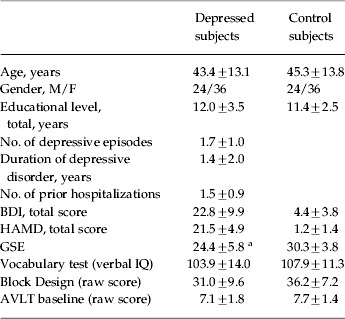
The depressed and control groups did not differ in age, sex distribution, years of education and vocabulary level (see Table 1). For the group of patients, mean depression scores were 21.5 on the HAMD and 22.8 on the BDI. The mean duration of depressive disorder was 1.4 years and the mean number of previous depressive episodes was 1.7. Performance of the patients in visuospatial organization and problem solving (Block Design) and in verbal memory (AVLT-baseline) was significantly lower than that of the control subjects. Patients also reported significantly lower general self-efficacy (GSE). Because of the matching procedure described earlier, neither patients nor control subjects receiving goal-setting instructions or standard instructions differed in age, educational background, gender rate, general self-efficacy, or general cognitive variables (Block Design Test and AVLT). The patients in the experimental groups did not differ in severity of depressive symptoms (HAMD and BDI scores), mean duration of depressive disorder, number of prior depressive episodes, or number of previous hospitalizations.
Demographic and clinical variables and cognitive status of 60 depressed subjects and 60 control subjects

BDI, Beck Depression Inventory [F(1, 118)=179.8, p<0.0005]; HAMD, Hamilton Depression Scale [F(1, 118)=953.484, p<0.0005]; GSE, General Self-Efficacy Scale [F(1, 104)=39.348, p<0.0005]; Block Design [F(1, 118)=11.250, p=0.001]; AVLT, Auditory-Verbal Learning Test [F(1, 118)=3.819, p=0.05].
Data are given as mean±s.d.. The groups were similar for age [F(1, 118)=0.59, p=0.45], education [F(1, 118)=0.85, p=0.36] and gender rate.
a n=46 because of missing values.
Number Combination Test (ZVT)
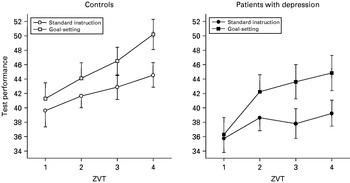
Concerning baseline performance of the goal-setting experiment with the ZVT, the control subjects combined significantly more numbers (40.4±12.2) than the depressed patients [36.0±12.0, F(1, 118)=4.027, p=0.047] within the given time limit of 30 s.
A MANOVA applied to the correctly combined numbers throughout the following three experimental phases showed a significant goal-setting effect for both the depressed patients [Wilk's λ=0.835, F(3, 56)=3.667, p=0.017] and the control subjects [Wilk's λ=0.867, F(3, 56)=2.862, p=0.045] (Fig. 1). Patients with goal-setting instructions improved their performance to 44.8 correctly combined numbers and did not differ significantly from control subjects with standard instructions (44.5 numbers) and with goal-setting instructions (50.2 numbers) in the last experimental phase. By contrast, the outcome of patients with standard instructions (39.2 numbers) was significantly lower than that of control subjects with standard as well as with goal-setting instructions. Despite the greater improvement possible for the patients assigned to the goal-setting group, the interaction of experimental instruction and group factor remained insignificant [Wilk's λ=0.979, F(3, 114)=0.818, p=0.487].
Number Combination Test (Zahlen-Verbindungs-Test; ZVT) in goal-setting experiment with depressed patients. Test performance of 31 depressed patients under goal-setting instructions (to increase performance in the next experimental phase by 20%) versus 29 patients under standard instructions (‘to do their best’). Ordinate shows number of correctly solved tasks during baseline and three experimental phases. Values are means. Total, Group: Wilk's λ=0.921, F(3, 114)=3.272, p=0.024; Goal setting: Wilk's λ=0.865, F(3, 114)=5.923, p=0.001; Interaction: Wilk's λ=0.979, F(3, 114)=0.818, p=0.487; Goal-setting effect: patients, p=0.017; controls, p=0.045.

Auditory Verbal Learning Test (AVLT)
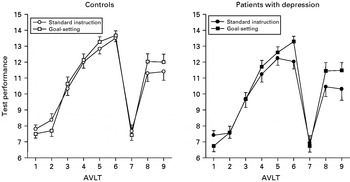
Table 1 shows the significantly better baseline performance of the control subjects (7.7±1.4 words) in comparison to the patients (7.1±1.8 words) in the AVLT. A MANOVA applied to the correctly recalled words throughout the following five experimental recall trials with word list A showed a significant goal-setting effect for the depressed patients [Wilk's λ=0.749, F(5, 54)=3.611, p=0.007] but not for the control subjects [Wilk's λ=0.847, F(5, 54)=1.946, p=0.102] (Fig. 2). Patients increased their performance with goal-setting instructions to 13.3 correctly recalled words and did not significantly differ from control subjects with standard instructions (13.5 words) and with goal-setting instructions (13.7 words) in the fifth learning and recall trial of word list A. By contrast, the outcome of patients with standard instructions (12.0 words) remained significantly lower than that of control subjects with standard or goal-setting instructions. Because of the greater increase in the patients' group, the interaction of the experimental instruction and group factor was statistically significant [Wilk's λ=0.887, F(5, 112)=2.887, p=0.018]. Despite the goal-setting instructions used in the presentation of word list B, no differences between all four experimental groups emerged. However, in contrast to the baseline performance, patients did not differ from control subjects. Likewise, after cessation of goal-setting instructions, no differences between all experimental groups emerged for the recall conditions of word list A after distractor list B and after a 20-min delay.
Auditory Verbal Learning Test (AVLT) in goal-setting experiment with depressed patients. Test performance of 31 depressed patients under goal-setting instructions (to increase performance in the next experimental phase by 20%) versus 29 patients under standard instructions (‘to do their best’). Ordinate shows number of correctly solved tasks during baseline and five experimental phases. Values are means. Total, Group: Wilk's λ=0.968, F(5, 112)=0.739, p=0.595; Goal setting: Wilk's λ=0.892, F(5, 112)=2.715, p=0.024; Interaction: Wilk's λ=0.887, F(5, 112)=2.863, p=0.018; Goal-setting effect: patients, p=0.007; controls, p=0.102.

Regensburg Word Fluency Test (RWT)
The goal-setting experiment with the RWT started from equivalent achievements in the baseline trials. For the depressed subjects, the average amount of words in the trials with P and K was 17.3±5.5, whereas the control subjects had named 18.5±4.6 words on average [F(1, 118)=1.767, p=0.186]. A MANOVA applied to the increase in number of named words throughout the following two experimental trials showed no significant goal-setting effect for the patients [Wilk's λ=0.999, F(2, 57)=0.021, p=0.979] or for the control subjects [Wilk's λ=0.926, F(2, 57)=2.272, p=0.112]. Patients' performance increased to only 18.1 B-words with goal-setting instructions and to 18.9 words with standard test instructions. Similarly, the performance of the control subjects increased to 20.6 words with goal-setting instructions and to 21.1 words with standard test instructions.
Digit Symbol Test (DST)
Goal-setting effects with the DST produced a statistical trend for patients. The patients placed more symbols correctly with the goal-setting instructions (52.2±13.4) than with the standard test instructions [46.1±13.9, F(1, 58)=2.990, p=0.089]. By contrast, the performance of the control subjects did not differ between goal-setting (58.4±14.1) and standard instructions [54.6±10.1, F(1, 58)=1.490, p=0.227]. However, the patients' performance with standard instructions (46.1±13.9) was significantly worse than that of the control subjects with standard instructions [54.6±10.1, F(1, 58)=7.275, p=0.009], whereas the patients with goal-setting instructions were comparable to the control subjects with standard instructions (p=0.433) and showed only a trend towards lower performance than the control subjects with goal-setting instructions (p=0.080).
Relationship between self-efficacy and improvement
We found no significant correlation of GSE total score with increased test performance in the patients group, either for patients with goal-setting instructions (–0.318<r<0.304, p>0.120) or for those with standard instructions (–0.352<r<0.208, p>0.117). Likewise, there was no significant correlation for the control subjects.
Discussion
Patients with depression were able to increase their cognitive performance with goal-setting instructions. In complex visual scanning and psychomotor speed (ZVT), as well as in verbal learning and memory (AVLT), depressed patients with goal-setting instructions started with significant deficits and reached the level of the control subjects even when the control subjects had goal-setting instructions. Regarding the DST, the improvement in the patients with goal-setting instructions was not significant. Nevertheless, the performance level of the patients reached that of the control subjects. However, the results for the depressed patients with standard testing instructions remained inferior.
For the AVLT, a significant interaction of group membership and experimental instruction demonstrated a significantly larger gain in patients' performance compared with the improvement seen in control subjects with goal-setting instructions. However, for the ZVT the interaction was not significant. This difference might be because the control subjects could also increase their test performance on the ZVT significantly, whereas with the AVLT the control subjects did not increase their performance with goal-setting instructions. On the one hand, they probably had performed at the highest level even without additional motivating instructions (ceiling effect). Consequently, the significant interaction could be seen as strong evidence for motivationally caused performance deficits of depressed patients. On the other hand, effects of goal setting for healthy subjects are reliable and the significant increase in ZVT performance in the control subjects corroborates these findings. Therefore, weak goal-setting techniques might have caused the insignificant increment in AVLT performance in the control subjects. In particular, using identical goals for patients and control subjects might have been too easy for the control subjects.
Nevertheless, the present study provides evidence that adding a motivational component (goal-setting instructions) has a differential effect on patients' cognitive performance. Despite significant baseline deficits, the performance of the patients reached the level of the control subjects, irrespective of a significant increase in the control group. Therefore, the present findings support the impaired motivation hypothesis, namely that cognitive deficits of depressed patients are influenced or even caused by motivational shortcomings.
The significant improvement in different cognitive domains demonstrates a general, non-test-specific, goal-setting effect for depressed patients. The fact that goal-setting instructions did not produce a significantly higher outcome with the RWT and the DST should not be taken as evidence that some tests cannot be influenced by goal setting. Goal setting has repeatedly been shown not to be task specific (Locke & Latham, Reference Locke and Latham2002). Furthermore, RWT and DST performance did not increase in either patients or controls. Therefore, we assume that our experimental operationalizations were not working sufficiently. Concerning the RWT, performance level and task difficulty is dominated by the natural frequency of words in different word categories. A raw score of 20 words corresponds to percentile 57 for P-words, percentile 27 for K-words, percentile 39 for M-words, and percentile 29 for B-words. Therefore, it is very difficult to derive effective goals for different word categories. We tried to minimize this problem by creating a baseline out of the two most extreme categories (P- and K-words). Nevertheless, we think there was no increase in performance because the B-trial followed the M-trial. Likewise, poor goal-setting instructions might have led to the moderate success in the DST. The goals that were set to improve performance were derived from the respective age norm and might have been too easy: goal-setting instructions are successful if difficult goals have been set.
However, the experiments described here represent our first attempt to improve performance of depressed patients in standard tests with goal-setting instructions. Consequently, we think that the present findings are all the more impressive and that improving the technique of goal-setting instructions combined with optimized on-line feedback on current results might lead to even higher goal-setting effects in many more cognitive tests.
In contrast to the success we had in demonstrating higher performance with goal-setting instructions, we could not elucidate the reason for the significant increment in patients' test performance. According to goal-setting theory, patients' cognitive underachievement could be due to the lower self-efficacy that accompanies depression. Lower self-efficacy leads to lower self-set goals, resulting in a lower performance level. However, despite the significantly reduced generalized self-efficacy of the patients, we found no significant associations with increased cognitive performance. This might be because we used a scale that measures generalized self-efficacy instead of task-specific self-efficacy. The goal-setting theory only describes effects of task-specific self-efficacy. Therefore, we cannot exclude the possibility that reduced task-specific self-efficacy is the reason for significant improvement in cognitive performance of depressed patients.
We also cannot exclude the possibility that goal-setting instructions worked by helping patients to focus attention on task-relevant aspects and supporting patients to initiate favourable cognitive strategies. Both the goal-setting theory and Hertel's cognitive-initiative account describe enhanced performance as a result of attention focused on relevant task characteristics and initiating favourable strategies. Therefore, future research needs to disentangle the effective components of goal-setting instructions on cognitive performance of patients with depression.
The generalizability of our results to all depressed patients needs to be confirmed in future research. Because our criteria excluded patients older than 65 years, our results are restricted to non-geriatric patients without significant co-morbid conditions. We do not know whether older patients and patients with co-morbid disorders are also able to increase performance with goal-setting instructions.
Our findings are helpful in contributing to an understanding of the inconsistent data concerning the impaired motivation hypothesis. According to Richards & Ruff (Reference Richards and Ruff1989), depressed patients were not able to increase effort and cognitive performance when effort was better rewarded. This finding is congruent with the clinical syndrome of depression in terms of incapability to keep up important business or leisure activities. However, patients can increase their effort if an effective goal is set. The creation and setting of goals gives feedback about personal performance and helps to coordinate and direct effort. Effective goal setting helps to overcome low-set individual goals derived from low self-efficacy and to build up transitional goals and substrategies to reach them. Additionally, patients might interpret the goal set by the instructor as an implicit expression of confidence in their abilities.
The present results might have implications for the description of the cognitive status and for the neuropsychological assessment of depressed patients. Our results challenge the view that depression causes genuine cognitive deficits. Furthermore, our results suggest that the objectivity of test instructions and testing procedures is questionable and should be validated for groups of patients that are different in affective or motivational variables.
In addition to the advantageous effect on performance, goal setting subsequently enhances the self-efficacy of the patients (Locke & Latham, Reference Locke and Latham2002). The mobilizing effect of goal-setting instructions might help patients to overcome the negative triad of depression in terms of negative cognitions about the self, the world and the future (Beck, Reference Beck1987). Goal setting might also be used in cognitive behavioural therapy by supporting activity.
Declaration of Interest
None.