[To understand the meanings with which humans endow things,] we have to follow the things themselves, for their meanings are inscribed in their forms, their uses, their trajectories. It is only through the analysis of these trajectories that we can interpret the human transactions and calculations that enliven things … it is the things-in-motion that illuminate their human and social context.
– Arjun Appadurai, The Social Life of Things Footnote 1
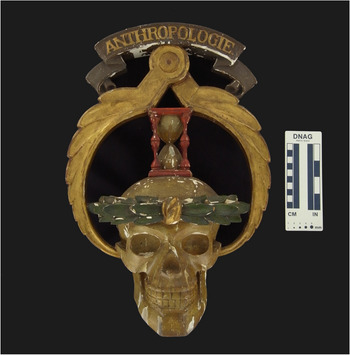
In October 2014, an unusual object labeled as the Symbol of the Science of Anthropology (Anthropologie Symbol) was located in the collections of the Glenn A. Black Laboratory of Archaeology (GBL) at Indiana University. The object, a three-dimensional painted plaster work of craft-art depicting the measurement of a human skull under a banner marked in German “Anthropologie,” seemed out of place in the GBL’s collections, which focus mostly on Midwestern US archaeological artifacts (see Figure 1). Research into the Anthropologie Symbol’s nature as an art object, its origin context, and its later collection and deposition history reveals a complex and illuminating story spanning decades and continents. The object’s story touches on the history and methods of archaeology, physical anthropology, and museums, racial science in Nazi Germany, cultural property protection during times of war, and how networks of actors and institutions influence the meanings of objects throughout their lives.
The Anthropologie Symbol, front view (courtesy of the Glenn A. Black Laboratory of Archaeology, Indiana University).

A number of recent works have explored the value of scholarly efforts to “unpack” museum collections and examine the constitutive networks and histories of objects.Footnote 2 As noted by Sarah Byrne and colleagues, “[t]he act of ‘unpacking’ museum collections seeks to problematise collections as material and social assemblages through an interrogation of how they developed, the impacts they have had over time and the roles they continue to play in the contemporary world.”Footnote 3 These studies draw from a wide range of available primary and secondary sources, including museum records, diaries, letters, images, and material studies. In doing so, efforts to unpack collections draw inspiration from, and contribute to, broader materiality movements in anthropology and social theory generally. For example, scholars conducting object biographies examine the social lives of things through a life history approach, by posing questions such as “where does the thing come from and who made it? What has been its career so far? … How does the thing’s use change with its age, and what happens to it when it reaches the end of its usefulness?”Footnote 4 Object biographies allow for the crafting and analysis of multivocal historical narratives surrounding artifacts, which simultaneously impart greater understanding of how people give meanings to objects and their contexts.
A complementary approach to object biographies is object itineraries, which examine “the strings of places where objects come to rest or are active, the routes through which things circulate, and the means by which they are moved.”Footnote 5 Object itineraries provide evidence for the changing uses, meanings, and significance of objects across time and space without the use of the metaphor of a linear human biography, which Rosemary Joyce argues can result in “the lives of things [being] distorted when forced into the mold of a human life course.”Footnote 6 During their itineraries, objects participate in the creation of material, intellectual, and social networks. These networks are interrelated and inseparable, and evidence what Andrew Jones and Nicole Boivin refer to as the “constant processes of folding together people and things”Footnote 7 (and which others have referred to as “entanglements,”Footnote 8 meshworks,Footnote 9 or assemblagesFootnote 10). Such studies help to examine how objects influence human behavior, including our understanding of others and ourselves.Footnote 11 Interrogations of objects through such methods as object itineraries have the potential to impart important knowledge about the institutions, disciplines, and individuals who have created museum collections. In turn, museum directors, curators, and others can use this knowledge as helpful guidance for future decisions and policies concerning the management of museum collections and other cultural properties.
As a result of its origin context and itinerary, the Anthropologie Symbol can be considered an artifact within the class of cultural properties referred to as “dark,” “difficult,” “dissonant,” or “negative” heritage.Footnote 12 Sharon MacDonald offers a concise description of difficult heritage as “a past that is recognised as meaningful in the present but that is also contested and awkward for public reconciliation with a positive, self-affirming contemporary identity. ‘Difficult heritage’ may also be troublesome because it threatens to break through into the present in disruptive ways.”Footnote 13 Difficult heritage scholarship includes research on dark tourism and why people are attracted to visiting difficult heritage sitesFootnote 14 or fascinated with difficult heritage topics such as the Nazis.Footnote 15 It also includes archaeological excavations at sites of difficult heritage like concentration camps.Footnote 16 With objects of difficult heritage, such as the Anthropologie Symbol, a tendency of museums may be to ignore or overlook their challenging histories and contexts.Footnote 17 But object itineraries of the material culture of difficult heritage can help to avoid one-sided or overly simplified discussions of challenging themes related to such heritage, including death, by demonstrating their complex entanglements – telling their stories in such a way as to guide future decisions on how such objects could be researched, displayed, conserved, repatriated, engaged with by the public, and otherwise managed.
By means of an interesting case study, this article demonstrates what can be learned by an in-depth examination of the itinerary of a single object in a collection. We explore the meanings within and surrounding the Anthropologie Symbol by layering its material, intellectual, and social dimensions from the artistic traditions that inspired its creation, to its in situ provenance in early twentieth-century Berlin, Germany, through its collection during World War II by an American soldier, to its gift to a leading figure at the US Smithsonian Institution, its later accession into an archaeological laboratory at Indiana University, and, finally, to its recent repatriation to the Max Planck Society in Berlin.
The Anthropologie Symbol
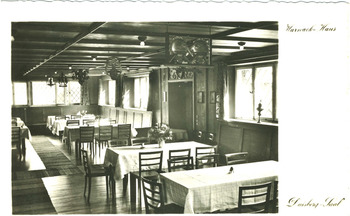
According to the GBL’s accession records, and subsequent research, an unknown artist created the Anthropologie Symbol as a hung ornament in the early twentieth century in Germany. A period postcard (pre-1945) shows the Anthropologie Symbol in its likely original context within the Duisberg Hall room of the Kaiser Wilhelm Institute’s Harnack Haus in West Berlin (Figure 2). The Anthropologie Symbol was one of several hung ornaments in the room, each representing a different scientific institute of the Kaiser Wilhelm Society (more information on these institutions is provided below).
The Anthropologie Symbol shown in its original context, the Duisberg Hall in the Harnack Haus, Berlin, circa 1930s (courtesy of the Glenn A. Black Laboratory of Archaeology, Indiana University).

Materially, the Anthropologie Symbol is a wood substrate covered by a plaster veneer painted with tan, gold, green, and red colors. The object measures approximately 10 inches wide by 20 inches in height and depicts a pair of large winged golden calipers measuring the breadth of a sculpted human skull that is wearing a wreath of laurel. A red hourglass rests on the top of the cranium underneath an “Anthropologie” banner. An examination of the artistic traditions and symbolism associated with the symbol reveals inferred connections between anthropology and core concepts in human societies, such as life, death, and time. The art terms that most appropriately apply to the symbol are “Memento mori” and “Vanitas.” Memento mori is a Latin phrase translated as “remember you must die,” but it can also be interpreted as “remembrance of death.”Footnote 18 Artwork classified as Memento mori, which date from the fifteenth century to the present, frequently includes imagery representative of either death or the ephemeral nature of life, including recurring uses of skulls, hourglasses, candles, fruit, and flowers.Footnote 19 Vanitas is a similar genre that became popular in seventeenth- and eighteenth-century still-life paintings in Europe but originated in earlier “moral engravings” and “emblem” publications from the fifteenth and sixteenth centuries.Footnote 20 Common themes in both genres include death, the fragility of nature, and a concern with the passage of time.
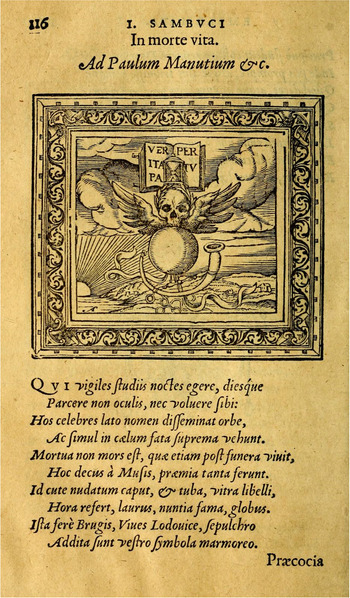
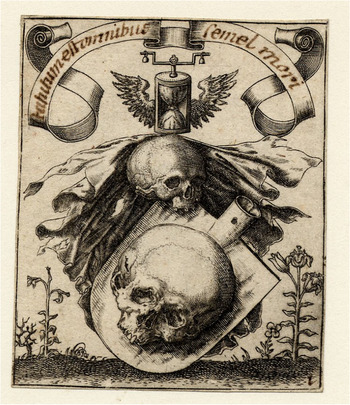
There are many examples of artwork from the fifteenth to nineteenth centuries that feature similar components to the Anthropologie Symbol, including the winged skull, the association of an hourglass with a skull, and the laurel wreath. For example, in Johannes Sambucus’s 1564 Emblemata cum aliquot nummis antique operis, the emblem titled “In Morte vita” (death in life) shows a winged skull resting on a sphere (Figure 3).Footnote 21 The skull wears a laurel wreath, and resting on top of the skull is an hourglass. A similar composition of symbolic elements is found in Theodor De Bry’s 1592 Emblemata Nobilitati (Figure 4).Footnote 22 The Emblemata Nobilitati’s engraving shows two skulls – the first on the end of a shovel (without the handle) at the ground’s surface, which is reminiscent of the burial of the dead. The smaller skull in the background is topped with a winged hourglass and balanced scales. The Latin expression above reads “Statutum est hominibus semel mori” (it was established for men to die once).
Johannes Sambucus, Emblemata cum aliquot nummis antique operis, Reference Joannes1564.

Theodor De Bry, Emblemata Nobilitati, Reference Bry and Theodor1592.

Art historians interpret winged skulls and hourglasses to symbolize either the travel between the worlds of the earth and heaven (as in an angel’s wings) or the idiom still common today: that “time flies.”Footnote 23 The laurel wreath originates in Greek mythology associated with the story of Apollo and Daphne (whose name means laurel). In Ancient Greece, leaders gave laurel wreaths to winners of intellectual or sport competitions, such as the ancient Olympics. The laurel wreath also appears in early coinage from Roman times, such as in Norican silver with an “Apollo-head” wearing a laurel wreath.Footnote 24 Thus, the laurel wreath can be interpreted as a sign of accomplishments, victory, and an honorable life as well as association with deities.
An important component of the Anthropologie Symbol that does not fit with either the Vanitas or Memento mori artistic styles are the golden calipers measuring the breadth of the skull. Here, the artist was undoubtedly making reference to the subfield of anthropology known as anthropometry (the study of measurements from the human body) or, specifically, as craniometry (the study of measurements of the crania). The placement of the calipers suggests the artist was referencing the common craniometric measurement called bizygomatic breadth, which is the distance between the most lateral points of the zygomatic arches.Footnote 25 In early twentieth-century anthropometry studies, anthropologists considered the bizygomatic breadth significant for comparative anatomy research on topics like age, health, and the effects of migration on group physical characteristics. However, the primary use of bizygomatic breadth and similar cranio-facial measurements at this time was in racial and ethnic typology studies. For example, a 1931 study by Melville Herskovits and colleagues included the bizygomatic breadth in an examination of the “physical form of the American Negro” and the “amount and consequence of the racial mixture.”Footnote 26 And Jon Steffensen used the same measurement (among others) to distinguish Norwegian, Danish, Icelandic, and Swedish individuals in a study of the physical anthropology of Vikings.Footnote 27
From its association with the Vanitas and Memento mori artistic styles, and the choice of a de-fleshed skull rather than a complete human head, the Anthropologie Symbol appears to represent not only a reminder of human mortality but also the history (sundial) and accomplishments (laurel) of humans and the study of these topics by anthropologists (calipers). This portion of the analysis of the Anthropologie Symbol’s itinerary is a reminder that object itineraries are “open-ended and multi-directional.”Footnote 28 As noted by Joyce, they can “extend backward to incorporate the sources from which materials came.”Footnote 29 In this case, the artist extended the object’s reach backward hundreds of years to integrate Greek mythology and earlier artistic styles with a “modern” science that recorded the human form and its meanings. The original context of the symbol helps to elucidate its role in signifying a particular historical and cultural view and an understanding of anthropology as an interdisciplinary science of identifying human biological difference in order to contribute to “race knowledge.”
Context of origin
When the Anthropologie Symbol hung from the ceiling of the Duisberg Hall in Berlin, it represented the Kaiser Wilhelm Institute for Anthropology, Human Genetics, and Eugenics (KWI-A). The KWI-A was founded in Berlin in 1927 and was active throughout Germany’s National Socialist (Third Reich) period (1933–45). The KWI-A’s mission was to unify its three title areas of research within one institution – to link studies of genetic traits with evolutionary biology, medicine, demography, and anthropology in order to create a new interdisciplinary science of humans. In a thorough history of the KWI-A, German historian Hans-Walter Schmuhl notes that KWI-A’s objective “was nothing less than the control of human evolution.”Footnote 30
The founding director of the KWI-A was anthropologist Eugen Fischer. Fischer’s most famous research was a study published in 1913 on the “Bastards of Rehoboth and the Problem of Miscegenation in Man.”Footnote 31 Fischer examined the children of “Boers” and female “Hottentots” in German South West Africa (today, Namibia) and argued that human racial characteristics are heritable under Mendelian rules. Fearing the “degeneration” of the colonists, Fischer suggested that mixed marriages be prohibited.Footnote 32 Archaeologist Bettina Arnold refers to Fischer as the “leading physical anthropologist in Germany at the time of Hitler’s accession to power,” who, despite having some opinions counter to National Socialist ideologies, “apparently toed the party line with a truly impressive consistency.”Footnote 33
Under Fischer, the KWI-A’s primary goals of research were to define “normal anatomical” attributes of humans, including the clustering of such attributes into varieties, and to determine to what extent various human traits and behaviors depend on genes or the environment or both.Footnote 34 Numerous KWI-A staff published studies of skulls that included craniometric measurements.Footnote 35 These studies were consistent with anthropological research at the time – for example, German physical anthropologist Rudolph Martin’s 1914 Lehrbuch der Anthropologie,Footnote 36 an attempt at standardization in anthropometric data collection that was likely read by scholars at the KWI-A, detailed 79 different cranial measurements and their significance to anthropological research, including “Jochbogenbreite” (the widest part of the face) in approximately the same position as it appears on the Anthropologie Symbol. Footnote 37
In the social and political context of Germany after World War I, much (though not all) of the research conducted by the KWI-A could be termed Rassenkunde (racial science), which especially emphasized the study of Rassenhygiene (race hygiene). Race hygiene included both positive and negative eugenics efforts to identify the genetic basis of desired and undesired human characteristics (for example, intelligence, criminality, health) and to improve the “stock” of German races.Footnote 38 Race hygiene was taught in nearly all German universities in the 1920s,Footnote 39 including in anthropology programs, which in Germany were primarily focused on physical anthropology (but also included elements of folklore and archaeology). This fact helps to explain why anthropology as the study of humans was represented principally by the taking of physical measurements in the Anthropologie Symbol.
While the origins of the KWI-A were in seemingly objective scientific investigations into the human condition and human evolution, the scientists of the KWI-A, under National Socialism in the Weimar Republic, participated in the crimes of the Nazi state. A memorial plaque placed at the former location of the KWI-A by the Free University of Berlin notes that KWI-A scientists “provided a scientific foundation for the inhumane racial and population policies of the National Socialist state … [thereby making] an active contribution to selection and murder.”Footnote 40 For example, Fischer and other KWI-A staff trained Nazi officials in so-called “race tests” and participated in efforts to judge the “descent” of individuals. Part of such proof sometimes involved expert opinions on race and descent, which included taking anthropometric measurements and reviewing photographs according to anthropometric aspects.Footnote 41 In a 1944 publication, Fischer justified the identification of Jewish people by means of a “general impression” given by their “physiognomic details,” such as “shape of skull.”Footnote 42 While he was the director of the KWI-A, Fischer also co-authored the book Deutsche Köpfe nordischer Rasse (German Heads of the Nordic Race) with race scientist Hans F. K. Günther, which featured front and profile pictures of individuals meant to assist people in identifying those associated with Nordic races. Such publications further connect the Anthropologie Symbol to KWI-A efforts to legitimize Nazi ideologies about innate biological differences and hierarchies between “races.”
The actions of the KWI-A staff to support Nazi crimes are an inexcusable and difficult-to-process part of the history of anthropology. The Anthropologie Symbol should forever be a material reminder of this difficult history. Invoking long-standing artistic traditions, Ancient Greek and Christian imagery, and the objective standards of science, the symbol is a vivid and potent representation of the power of knowledge created about humans by anthropologists, especially when institutionalized as part of a dominant cultural hegemony.
The Anthropologie Symbol is also a reminder of the need to explore and understand the social and political contexts of anthropological research and of related objects in museum collections. With this in mind, it should be noted that craniometrics and ethnic and racial typing efforts were not unique to German anthropology in the 1930s and 1940s. Indeed, former president of the Kaiser Wilhelm Society, Adolf von Harnack (1815–1930), who was also the namesake for the building where the Anthropologie Symbol once hung, materially supported the founding of the KWI-A, noting that Germany had fallen behind similar efforts to study human biology and evolution in Sweden, the United States, France, and England.Footnote 43 In a historical assessment of the concept of race in anthropology, Norman Sauer, Jane Wankmiller, and Joseph Hefner note: “The fact that in the 1920s and 1930s the pages of the American Journal of Physical Anthropology were replete with articles describing the physical and behavioral characteristics of ‘Negroids,’ ‘Caucasoids,’ and ‘Mongoloids’ is testimony to the continuation of physical anthropology’s fascination with the concept of race up to World War II.”Footnote 44 Numerous review essays on race and anthropology have acknowledged the connections between the discipline and various eugenic policies through its promotion of essentialism and determinism in race studies.Footnote 45
At the same time, there were also anthropologists speaking against racist and eugenics-inspired science around the globe, and those calling out race as a cultural construct.Footnote 46 In Germany, there were archaeologists who Betinna Arnold refers to as the “critical opposition,” who acted against National Socialist ideologies and were punished with censure, forced retirements, or banishment, in addition to Mitläufer (passive fellow travelers) who simply continued with their research and “taught what they were told to teach” without questioning or commenting on the situations unfolding around them.Footnote 47
In this way, the Anthropologie Symbol’s itinerary also symbolizes a contentious period in the history of anthropology, where public debates would come to define the discipline in new ways following the end of World War II. Arnold notes: “It is easy to condemn the men and women who were part of the events that transformed the Germany archaeological community between 1933 and 1945. It is much more difficult to understand the choices they made or avoided in the social and political contexts of the time.”Footnote 48 The Anthropologie Symbol as a material reminder of the period ensures continued conversation and debate about the dangers of science done in the service of the state and of the consequences of acting as a Mitläufer scientist.Footnote 49 At the end of the war, the symbol also took on new meanings when it was removed from its initial context by someone who recognized the symbol’s meanings to anthropology due to a family connection.
A wartime collection
Museums, academics, private foundations, and others have undertaken numerous efforts to locate, document, and repatriate works of art and cultural property illegally and/or immorally taken from individuals and institutions by Nazi and other Axis powers during World War II. Journalists, archaeologists, and historians have published multiple monographs on provenance research and repatriation efforts for cultural property looted during World War II.Footnote 50 Popular and film media coverage have also been prevalent (for example, The Rape of Europa, The Monuments Men, Woman in Gold). However, another related class of objects collected during World War II has not received the same scholarly or public attention: items collected by members of the Allied forces and taken away from Germany. Such objects have been less frequently tracked and repatriated, perhaps because governments have not interpreted their collection as illegal because some public individuals consider them “spoils” of war or because the “humanity” of their owners (that is, Germans living under Nazi rule) was called into question during World War II. The Anthropologie Symbol is such an object.
As World War II was ending in 1945, American armed forces entered Berlin, occupying many former government and scientific buildings. One member of these American armed forces was a 36-year-old US Navy lieutenant named Samuel E. Perkins IV, who was assigned as staff to the Economics Division of the US Office of Military Government. Perkins explained how he obtained the Anthropologie Symbol, with the intent of gifting it to his brother-in-law, in a donation letter he wrote in January 1987:
In the spring of 1945, soon after the collapse of Nazi Germany, this symbol of the science of anthropology was still hanging from the ceiling of the dining hall in Harnach Haus, a building in the Kaiser Wilhelm Institute complex located in West Berlin. There were also several other ceiling decorations representing the other sciences taught and studied at this learning center. This one, and some of the others had survived the bombing and other destructive forces of World War II. … When Harnach Haus was being repaired and converted to an officers [sic] mess hall, the ceiling ornaments were being discarded and I was able to obtain the one representing anthropology. I sent it to my brother-in-law, Frank M. Setzler, an anthropologist.Footnote 51
During his life, Perkins served the US government in a number of capacities – as an engineer for the US Coast and Geodetic Survey in the 1930s, as a government attorney in the US Department of Commerce, as a navy lieutenant during World War II, as a cartographer for the US State Department, and, eventually, retiring as a naval commander in 1969.Footnote 52 As a member of the Foreign Service, Perkins and his wife lived in Paris and Brussels for several years. It appears from auction records near the time of his death that the two acquired a substantial estate, with significant object collections from their time spent in Europe. These collections included World War II and Nazi memorabilia.Footnote 53 Thus, the Anthropologie Symbol was part of a larger body of private collecting by Perkins.
Historian Seth Givens has demonstrated from an examination of primary records including memoirs and journals that the “plundering” or “liberating” of German homes and institutions was relatively commonplace during World War II, especially near the end of the conflict.Footnote 54 For the most part, American soldiers did not take cultural treasures but, instead, everyday items. Examining what was taken and why gives some insight into the mindset of American soldiers and to the standing rules of law and their enforcement concerning cultural property. Wartime collections also give insight into ideologies concerning rights and justice related to objects.
During World War II, the United States increased its cultural property protection concerns when, in June 1943, President Franklin D. Roosevelt established the Roberts Commission, a government commission designed to help protect and return European historic artifacts and monuments. Such a commission was necessary because of rampant destruction (on both sides) to churches, monuments, museums, and other significant cultural places during the war. The Roberts Commission worked with the Monuments, Fine Arts, and Archives’s military program that was also designed to protect cultural property and gather data on items appropriated by the Axis powers. In December 1943, General Dwight D. Eisenhower issued an order to his commanders to respect historic monuments in Europe, except in cases of “military necessity.” In a May 1944 second directive, Eisenhower again noted the responsibilities of commanders to protect and respect “symbols” of “that [which] we are fighting to preserve” – in other words, “civilization.”Footnote 55
Despite such protections, Seth Givens argues that American soldiers developed a reputation as “voracious trophy hunters.” He also notes that, while such looting (or the various other names given to it during the war – commandeering, appropriating, confiscating, liberating) was not new or unique to World War II, the practice is “something that has not been seen on the same scale since.”Footnote 56 In their personal accounts,Footnote 57 and in recent news coverage recounting examples of high-value collections made by American soldiers that were returned to Germany,Footnote 58 Allied service members gave many reasons for “liberating” items from Germany and keeping them as personal possessions, including necessity (in the case of food or clothing), profit, keepsakes and mementos (generally as a form of tourism), memories of the battlefield, and/or “revenge for Nazi atrocities,” as part of an ideology that the war was justified by moral obligations and, therefore, collecting was a way to punish Germans.
In this way, the Anthropologie Symbol represents an era of wartime collecting and is symbolic of a difficult heritage context that is under-studied in the literature. The symbol poses interesting questions concerning the legality and ethics of collecting objects during and after times of conflict as well as in regard to the rightful “owners” of cultural properties acquired under such circumstances. In the American efforts to “preserve” civilization and the cultural heritage of humankind, was Perkins justified in collecting the Anthropologie Symbol? Through its association with the continued popularity of World War II memorabilia to modern collectors, the symbol also represents the means by which memories of the war continue and become commercialized.
Perkins’s collection of the Anthropologie Symbol seemed to be not only an act of salvage but also a collection to remember others, specifically his family. Following the end of the war, Perkins gave the Anthropologie Symbol to his brother-in-law, Frank M. Setzler. Setzler was a North American archaeologist who trained at the Ohio State University and the University of Chicago. After working as an archaeological surveyor for the Indiana Historical Society from 1928 to 1930, Setzler was offered a position at the Smithsonian Institution in Washington, DC, where he rose to become head curator of the Smithsonian’s Department of Anthropology, a position he held from 1935 to 1960.Footnote 59 Thus, when Perkins collected the symbol in 1945, Setzler was a leading figure in the US government’s premiere anthropology program.
Though trained mostly as an archaeologist, Setzler had research interests in anthropometry. If Perkins had knowledge of Setzler’s research, he likely would have recognized the craniometry referenced in the Anthropologie Symbol. Through Setzler and the Smithsonian, the symbol is connected with an infamous story of the anthropology-related collection, colonization, and exploitation of Indigenous populations and, eventually, repatriation: the 1948 Arnhem Land Expedition. As Perkins was establishing his military career in postwar Germany, Setzler was deputy leader and archaeologist in an interdisciplinary scientific expedition to Australia. Setzler represented the Smithsonian Institution and, by proxy, US interests and authority in this expedition.Footnote 60
The leader of the expedition was Charles Mountford, an Australian filmmaker and ethnographer who worked for the Commonwealth of Australia. One of the expedition’s primary missions was to create good working relations between the United States and Australia.Footnote 61 During the expedition, over 50,000 archaeological, ethnographic, and natural specimens were collected.Footnote 62 While in Winchelsea Island, Setzler and others excavated several sets of Aboriginal human remains, which Setzler shipped back to the Smithsonian. In his notes from the expedition, Setzler writes that he also took “customary photographs and measurements of the natives” as well as “facial masks” that he envisioned using to create exhibits at the Smithsonian to display the unique features of the Aboriginal people. Setzler commented in 1950 that the human remains he removed from Arnhem Land were “most important to our science of anthropology. … This skull will not only be well preserved in our museum but will contribute much to the study of these primitive aborigines.”Footnote 63
In describing the Arnhem expedition for a recent retrospective edited volume, Martin Thomas notes that the most controversial activity of the expedition was the collection of human remains by Setzler from mortuary caves and burial sites. The removal of the remains, according to Thomas, “has caused sadness, anger and bewilderment in Arnhem Land.”Footnote 64 In two ceremonies in 2008 and 2010, after more than a decade of lobbying, the Smithsonian repatriated all of the human remains to Australia to a delegation of local Aboriginal people, who organized ceremonies for their reburial. The Smithsonian’s Department of Anthropology, like many American universities and museums, has a contentious and complicated history when it comes to the collection, analysis, and curation of human remains and objects of cultural heritage.Footnote 65 The Anthropologie Symbol, especially through its connection to Setzler, is in some ways a reflection and reminder of the complexities of this history. This symbol of German anthropology’s race science in the Nazi era was in the possession of a leading American scientist at the Smithsonian Institution, who himself used his power as an anthropologist and government official to remove and study human remains without the permission of the local communities.
The itinerary of the Anthropologie Symbol therefore poses difficult questions about the similarities and differences in anthropological work from this period, particularly scholarship that involved human bodies, governmentality, colonized or otherwise marginalized communities, and issues of identity. Setzler did not advocate for eugenic policies to be applied to Aboriginal peoples in Australia the way in which KWI-A scientists did for minority populations in Europe. But Setzler’s collection and analysis of human remains contributed to a colonial ideology that saw Aboriginal people as “primitive” and as objects of study rather than as human agents with human rights. As an object, the Anthropologie Symbol helps us to engage this difficult heritage and understand the interconnectedness of anthropology and its practitioners with international politics, foreign relations, human rights discourses, and power dynamics.
The Anthropologie Symbol at Indiana University
While he was head curator for the Smithsonian’s Department of Anthropology, Frank Setzler maintained scholarly and friendly connections within Midwestern US archaeology. When Setzler retired from the Smithsonian in 1960, he moved to Indiana (the place of his wife’s family), and we assume the Anthropologie Symbol travelled with him in his personal collections. When Setzler died in 1975, his wife returned the symbol to her brother, Samuel E. Perkins IV. According to his 1987 donation letter of the symbol, Perkins thought the item “might be of interest” to the GBL because of the association of Setzler with Indiana University. GBL staff accepted the Anthropologie Symbol as a donation and accessioned it into the GBL’s permanent collections. When recently asked, the GBL’s curator of that time, Noel Justice, noted that the GBL accessioned the item primarily because of its association with Frank Setzler, who Justice referred to as a “relative” of the lab.Footnote 66
While Setzler never worked for the GBL or Indiana University, he was connected to these institutions in a number of ways. Setzler was awarded an honorary degree from Indiana University in 1971. The degree was conferred during the dedication ceremony for the opening of the GBL, in part to recognize Setzler’s role in establishing archaeology as a scientific discipline in Indiana during his early archaeology work in the 1920 and 1930s.Footnote 67 Setzler had also known the namesake of the GBL, Glenn Black, since the early 1930s. Black is considered a founding professional archaeologist in Indiana for his decades-long excavations at the pre-Columbian site of Angel Mounds. Black was also a founding member of Indiana University’s Department of Anthropology, which was officially established in 1947.
Setzler and Black corresponded with each other throughout the 1930s and 1940s concerning research, travel, and family, indicating they were friends in addition to colleagues. Their relationship seems to have begun with Setzler advising a young Black on whether and how to pursue training in archaeology.Footnote 68 Later, in a letter from 29 November 1941, Setzler (then at the Smithsonian) wrote to Black in confidence saying that he had “just prepared a letter recommending approval of your WPA [archaeology] application.”Footnote 69 Three years prior (November 1938), Black began a massive Works Progress Administration archaeology project at Angel Mounds. By October 1941, Black was required to prepare a new project proposal. Setzler’s approval letter indicates his support for Black’s research. The Angel Mounds research that Black organized with support from Setzler resulted in the collection of millions of artifacts. The need to analyze and curate these and other research collections from Black’s work and that of other Indiana Historical Society archaeologists (like Setzler) inspired the eventual construction of the GBL. In fact, Setzler is listed as the “Original Collector” of eight collections of skeletal and archaeological materials curated at the GBL, which are from Setzler’s 1928–30 work for the Indiana Historical Society.Footnote 70 Another intriguing letter is from Setzler to Black’s wife, Ida Black, on 27 May 1949. Thanking her for her “wonderful hospitality” during a recent trip to Angel Mounds, Setzler mentions that he is still “in the midst of unpacking our collections from Australia.” As a postscript, Setzler indicates that under “separate cover” he mailed Mrs. Black “a small memento from Groote Eylandt, Arnhem Land, Australia, assembled and strung by the natives there.”Footnote 71
After the GBL accessioned the Anthropologie Symbol in 1987, the curator took photographs and once consulted with another museum for a conservation assessment of the object’s condition. After these steps, GBL staff conducted no further research about the object. They placed the Anthropologie Symbol in a box on the GBL’s curation shelves, and it was not displayed or researched again for over 25 years. This phase of the object’s itinerary addresses an important question when it comes to the routes and paths objects take during their travels – why do some objects come to rest and what actions begin them on their routes again?Footnote 72
In its context within the GBL and Indiana University’s Department of Anthropology, the Anthropologie Symbol represents the act of institutional collecting and the meanings behind the choices that museum directors and curators make when accessioning and caring for objects. Here, the association of the Anthropologie Symbol with Setzler was reason enough to accession the object despite the fact that its provenance and the region of origin do not fit with the traditional collecting or research missions of the lab. The choices made by GBL staff to not display, research, or return the Anthropologie Symbol suggest that, at this time in the object’s itinerary, it was primarily a curiosity and a sign of the networks of men who represented the history of archaeology in Indiana. These choices do not follow current ethical standards and best professional practices for museums.Footnote 73 But it is likely that such curiosities are found in many museums, and pursuing the itineraries of these objects help to demonstrate how collections are material and social assemblages with important stories to tell.Footnote 74 The choices of the GBL staff to accession and then not display or research the Anthropologie Symbol perhaps also reflect the challenging nature of dealing with objects of difficult heritage – materially, the Anthropologie Symbol has distinctive sensuous qualities; it is imposing and somewhat frightening. And, historically, its story would have been challenging to tell in a museum dedicated to North American archaeology.
In the period since the collection and donation of the Anthropologie Symbol, anthropology has changed (both at the GBL and more broadly). Archaeologists and physical anthropologists in the late twentieth century have rejected research associated with eugenics and inaccurate concepts of race and ethnicity.Footnote 75 In the United States, the 1990 Native American Graves Protection and Repatriation Act (NAGPRA) forced institutions to better understand and document their collections, and to consult with stakeholder communities.Footnote 76 Concurrently, anthropology, and, in particular, branches tied to the work of museums, became increasingly concerned with balancing professional ethical obligations of gathering, reporting, and preserving data with ethical concerns for respectful engagements with diverse communities and transparency concerning the sociopolitical history of the discipline. The “unpacking” of collections as well as their repatriation were two defining movements in this transformation of anthropology ethics and praxis.
At the GBL, this transformation has included an acceleration of efforts to meet the requirements of NAGPRA through repatriation and working collaboratively with Native American communities. In 2013, Indiana University created a compliance office for NAGPRA, and the GBL began building better relationships with Native American tribes both to repatriate human remains and funerary objects and to participate in more non-compliance community engaged collaborative scholarship. It was within this environment of openness to critically investigating and discussing the history of the GBL that, in October 2014, the GBL curator of collections rediscovered the Anthropologie Symbol. GBL staff conferred and made the decision to research the origins of the object and its possible significance. After consulting with university attorneys regarding the possibility of deaccessioning the symbol, the GBL contacted the Max Planck Society in an attempt to begin a fact-finding and repatriation process.
The Max Planck Society is the successor organization to the Kaiser Wilhelm Society in Germany. Formed in 1948, the Max Planck Society is now a leading international research organization, including in the field of anthropology. The Max Planck Society admits on its website that it did not “come to grips with National Socialism” and the role of scientists in the Kaiser Wilhelm Society in supporting National Socialist ideologies for many decades following the end of World War II. Concurrent with reflective self-critical studies in anthropology in the 1990s, the Max Planck Society formed a committee of independent historians in 1997 to “address the history of its predecessor organization … in the National Socialist era.”Footnote 77
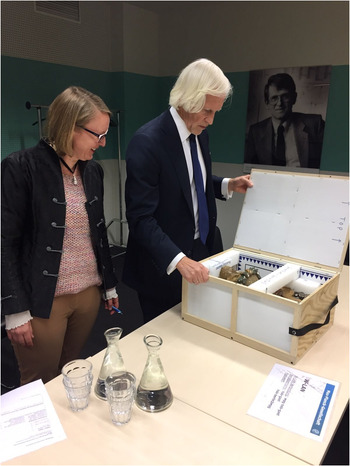
When contacted by the GBL, Susanne Kiewitz, a representative from the Max Planck Society, expressed immediate interest in the return of the Anthropologie Symbol, as it was the only such artifact representing the institutions of the KWI known to have survived World War II. Additionally, a new exhibit was being planned for the Harnack Haus, which is now used as a conference venue for the Max Plank Society. Kiewitz specifically noted that it was “great news to me to hear about the item in your collection and its interesting object history” and expressed how “[i]t would be wonderful to present the object at [its] authentic place.”Footnote 78 To assist with the cost and logistics of shipping the fragile symbol, GBL staff contacted the Monuments Men Foundation in Dallas, Texas, for help. The Monuments Men Foundation’s mission is to honor “the legacy of the men and women who served in the Monuments, Fine Arts, and Archives section, known as the ‘Monuments Men,’ and their unprecedented and heroic work protecting and safeguarding civilization’s most important artistic and cultural treasures from armed conflict during World War II.”Footnote 79 To do this, the foundation works with individuals or institutions to restitute cultural property “to their proper owner[s].” The Monuments Men Foundation, impressed by the symbol’s documented history and associated records, generously agreed to accept responsibility for transferring the Anthropologie Symbol back into the custody of the Max Planck Society in 2017 (Figure 5). After more than 70 years, the symbol has returned to its place of origin where it is available to the Max Planck Society as an artifact that can represent to the public a very different message about anthropology and science than it did when it was viewed by visitors to the Harnack Haus in the early twentieth century.
Return of the Anthropologie Symbol to the Max Planck Society, April 2017 (courtesy of the Monuments Men Foundation Collection).

Conclusion
As noted by Lynn Meskell in her article on the World Trade Center ruins and the Bamiyan Buddhas as sites of negative heritage and past mastering, “the material world is a constant reminder of an ever-present past and yet certain decisions by particular individuals and organizations render particular places as valuable, important, aesthetic and meaningful.”Footnote 80 The Anthropologie Symbol’s itinerary has thus far spanned decades and thousands of miles. Its itinerary documented a network that connected anthropology with art history, racial science, armed conflict, colonialism, private collecting, and recent repatriation movements within museums. The individuals tied to the symbol in many cases never met one another, but their stories are woven together by the symbol’s itinerary – anthropologists, armed forces personnel, Indigenous communities, government agents, and curators. The previous decisions made about the Anthropologie Symbol removed it from its original context, contributed new meanings to the artifact, and concealed the ability of the artifact to help interpret important stories of our collective history by hiding it away on a curation shelf. We decided to pursue an object itinerary of the Anthropologie Symbol in the hope that it will show the values and meanings inherent in difficult objects of history.
In this way, the Anthropologie Symbol’s itinerary also demonstrates how its collection and eventual deposition at the GBL were not natural parts of an objective scientific process but, rather, rather resulted from cultural contexts and practices that implicated broad networks of people and places and revealed the power and interests of anthropologists. Indeed, as Alex Bauer remarked in a recent reflective essay on the scholarship of object biographies and itineraries, “the ways we deal with objects are not inevitable.”Footnote 81 A commitment to “opening up” museum collections begins with an acknowledgment that material culture collections are sometimes contested and controversial. They are political, if for no other reason than the facts shown through a historical analysis of collecting – that the people responsible for collecting cannot be divorced from their social contexts. In this case, the Anthropologie Symbol is a painful reminder of difficult stories of scientific racism, genocide, and war. It is also a reminder of how the movement of cultural properties, global connections amongst researchers in anthropology, cultural encounters, family networks, and political activism act to shape collections. The symbol was made as a political artifact in a contentious context. Its itinerary helps in a general sense to examine the roles of objects in connecting persons, places, and ideas through the creation and transformation of social relations. Such reflections on collections and their origins are rarely available to the general public and museum visitor, but they can be by using objects like the Anthropologie Symbol to engage with materiality and its effects in a tangible way.