Introduction
Galactomannans, in which a (1–4)-β-mannan backbone is substituted at the 6-carbon with single α-galactosyl residues, are a major component of hemicelluloses deposited in the cell walls of a variety of higher plant species (Bewley et al., Reference Bewley, Burton, Morohashi and Fincher1997). For example, cell walls of the tomato and lettuce endosperm, which completely surrounds the embryo, contain large amounts of galactomannans (Halmer and Bewley, Reference Halmer and Bewley1979; Groot et al., Reference Groot, Kieliszewska-Rokicka, Vermeer and Karssen1988; Nonogaki et al., Reference Nonogaki, Nomaguchi and Morohashi1995). The degradation of galactomannans plays an important role in the germination and/or post-germination of these seeds (Bewley, Reference Bewley1997). Weakening of the tomato micropylar endosperm, as a prerequisite for the completion of seed germination, involves hydrolysis of galactomannans in the cell walls of this tissue (Nonogaki et al., Reference Nonogaki, Matsushima and Morohashi1992, Reference Nonogaki, Nomaguchi, Morohashi and Matsushima1998, Reference Nonogaki, Gee and Bradford2000; Bewley, Reference Bewley1997). Then, following germination, hydrolysis and mobilization of galactomannans in the cell walls of the lateral endosperm provide a source of nutrients for early seedling growth (Bewley, Reference Bewley1997; Wang et al., Reference Wang, Li and Bewley2004).
The complete breakdown of galactomannans requires the cooperation of three enzymes, endo-β-mannanase (EC 3.2.1.78), β-mannosidase (EC 3.2.1.25) and α-galactosidase (EC 3.2.1.22). Of these, endo-β-mannanase, which cleaves the β-1,4 linkages between the mannose residues in the mannan backbone, is the enzyme that initiates the hydrolysis of galactomannans.
Endo-β-mannanase has been investigated extensively in relation to seed germination of some dicotyledonous species. Its activity increases in the micropylar endosperm prior to the completion of seed germination of Datura ferox (Sánchez et al., Reference Sánchez, Sunell, Labavitch and Bonner1990; Sánchez and de Miguel, Reference Sánchez and de Miguel1997) and tomato (Nomaguchi et al., Reference Nomaguchi, Nonogaki and Morohashi1995; Toorop et al., Reference Toorop, Bewley and Hilhorst1996). However, endo-β-mannanase activity in seeds of lettuce, celery, date, Chinese senna, pepper and some legume species increases only after the completion of germination, and is regarded as important for the mobilization of galactomannan reserves to support the early growth of seedlings (Bewley, Reference Bewley1997; Gong et al., Reference Gong, Bassel, Wang, Greenwood and Bewley2005).
Different isoforms occur in the micropylar and lateral endosperm of tomato seeds (Nonogaki and Morohashi, Reference Nonogaki and Morohashi1996; Voigt and Bewley, Reference Voigt and Bewley1996). Endo-β-mannanase has been purified or partially purified from seeds of several species (Dulson and Bewley, Reference Dulson and Bewley1989; Halmer, Reference Halmer1989; Nonogaki et al., Reference Nonogaki, Nomaguchi and Morohashi1995; Marraccini et al., Reference Marraccini, Rogers, Allard, Andre, Gaillet, Lacoste, Lausanne and Michaux2001). Gene sequences encoding endo-β-mannanase have been obtained from tomato (Bewley et al., Reference Bewley, Burton, Morohashi and Fincher1997; Nonogaki et al., Reference Nonogaki, Gee and Bradford2000; Gong and Bewley, Reference Gong and Bewley2007), coffee (Marraccini et al., Reference Marraccini, Rogers, Allard, Andre, Gaillet, Lacoste, Lausanne and Michaux2001), carrot (Homrichhausen et al., Reference Homrichhausen, Hewitt and Nonogaki2003) and lettuce (Wang et al., Reference Wang, Li and Bewley2004) seeds.
In contrast to the extensive investigation of endo-β-mannanase in dicotyledonous seeds, only a few papers have been published about this enzyme in monocotyledonous seeds (DeMason et al., Reference DeMason, Sexton, Gorman and Reid1985; Dirk et al., Reference Dirk, Griffen, Downie and Bewley1995; Wang et al., Reference Wang, Wang, Ren, Gong and Bewley2005; Hrmova et al., Reference Hrmova, Burton, Biely, Lahnstein and Fincher2006). Endo-β-mannanase activity has been detected in the endosperm of date palm (Phoenix dactylifera L.) only after the completion of germination (DeMason et al., Reference DeMason, Sexton, Gorman and Reid1985; Gong et al., Reference Gong, Bassel, Wang, Greenwood and Bewley2005). Several to many isoforms of endo-β-mannanase are present in grains of barley, oats, wheat and rice (Dirk et al., Reference Dirk, Griffen, Downie and Bewley1995). Previous studies have demonstrated that there is an increase in endo-β-mannanase activity in rice grains, mostly after the completion of germination (Wang et al., Reference Wang, Wang, Ren, Gong and Bewley2005). Gibberellic acid (GA) increases and abscisic acid (ABA) decreases this endo-β-mannanase activity. The major site for the production of endo-β-mannanase activity is in the aleurone layer, although there is a requirement for the presence of the embryo. However, GA can increase endo-β-mannanase activity of embryoless half-seeds of rice. Recently endo-β-mannanase was purified from germinated barley grains, and a gene encoding this enzyme was cloned (Hrmova et al., Reference Hrmova, Burton, Biely, Lahnstein and Fincher2006).
Changes in activity of endo-β-mannanase have been investigated in rice (Wang et al., Reference Wang, Wang, Ren, Gong and Bewley2005), several isoforms of this enzyme have been reported (Dirk et al., Reference Dirk, Griffen, Downie and Bewley1995), and nine endo-β-mannanase genes have been identified from its genome by in silico sequence analysis (Yuan et al., Reference Yuan, Yang, Lai, Lin, Cheng, Nonogaki and Chen2007). Yet the isoform, protein and gene expression patterns of this enzyme during and following rice grain germination are still unclear. Here, changes in the profile of endo-β-mannanase protein and activity during and following germination are reported. Also, because there are four sequences in the genome of rice in GenBank (http://www.ncbi.nlm.nih.gov) that are labelled as putative (1–4)-β-mannan endohydrolases, these genes were partially cloned and their expression patterns determined.
Materials and methods
Germination
Grains of rice (Oryza sativa L.) cv. Taichung 65, a japonica subspecies, were used. The lemma and palea were removed by hand before imbibition. Triplicate lots of 50 dehulled grains were placed on water-moistened filter paper in Petri dishes and incubated at 25°C in the dark. They were counted every 12 h, and those with protruded radicles were regarded as having germinated.
Enzyme extraction and activity assay
For whole dehulled grains, duplicate lots of five imbibed grains were ground in an ice-cold mortar in 300 μl of 0.1 M Hepes buffer (pH 8.0). For parts of grains, duplicate lots of five imbibed grains were at first dissected into scutellum, starchy endosperm and aleurone layer, then ground separately in 200 μl of 0.1 M Hepes buffer (pH 8.0). The extract was centrifuged at 4°C for 10 min at 13,000 g, and the supernatant collected and used to assay endo-β-mannanase activity. Duplicate 2 μl aliquots of the supernatant were loaded into 2-mm-diameter wells in an agarose gel into which locust bean gum (Sigma, St. Louis, Missouri, USA) was added as substrate, and assayed using a gel-diffusion assay (Bourgault and Bewley, Reference Bourgault and Bewley2002). Degradation of galactomannans in the substrate gel, as shown by staining with Congo Red dye (Sigma), was calculated against a serial dilution of Aspergillus niger endo-β-mannanase (Megazyme, Bray, Eire) as standard.
Isoform detection
One microlitre aliquots of the enzyme extract and 10 μl pI marker (IEF-MIX 3.6-9.3, Sigma) were pipetted into the slots of an application strip (Sigma) on ultrathin-layer polyacrylamide gels (0.12 mm thick). Isoelectric focusing was carried out with a Desaga (Heidelberg, Germany) horizontal electrophoresis unit connected to a cooling apparatus (Van Der Heijden, Germany) at 10°C. Ultrathin-layer polyacrylamide gels were cast as described previously (Zhao et al., Reference Zhao, Yan, Lu, Yang, Huang and Wang2005). The polymerization solution for each gel contained 0.16 g taurine, 5 ml acrylamide (T = 6.8%, C = 2.5%), 0.44 ml of pH 7–9 ampholytes (Servalyt, Heidelberg, Germany), 4 μl N, N, N′, N′-tetramethylethylenediamine and 30 μl of 20% (w/v) ammonium peroxydisulphate. The power supply of the electrophoresis apparatus was set at 1000 V, and the mA adjusted to give an output voltage of approximately 200 V. After the completion of electrophoresis (c. 70 min), the gel was removed from the apparatus; the section of the gel containing the pI marker was cut and stained with 0.015% (w/v) Coomassie Brilliant Blue R 250, 0.045% (w/v) Coomassie Brilliant Blue G250, 11% (v/v) acetic acid, 18% (v/v) ethanol and 71% (v/v) double-distilled water (ddH2O) for 30 min; and then destained with ethanol solution [30% (v/v) ethanol, 5% (v/v) acetic acid and 65% (v/v) ddH2O] for 30 min or longer until the background was clear. The remainder of the IEF gel was laid on top of an activity gel as described by Dirk et al. (Reference Dirk, Griffen, Downie and Bewley1995). The gel sandwich was incubated in a moist chamber at 25°C for about 30 min before washing in McIlvaine buffer (pH 7.0) for 30 min, staining in 0.5% (w/v) Congo Red dye for 30 min, washing in water for 2 min, fixing in 80% (v/v) ethanol for 10 min, washing in three changes of McIlvaine buffer (pH 7.0) for 20 min each and finally developing in 1 M NaCl overnight, all with gentle agitation. The isoform bands were shown as the clearing zones on the activity gel. The pIs of the isoforms were calculated by comparing the positions of the bands on the activity gel with the pI marker bands.
SDS-PAGE and immunoblotting
Protein content of each enzyme extraction was determined using the Bio-Rad protein assay kit (with bovine serum albumin as the standard). Proteins were separated by SDS-PAGE using 10% (w/v) acrylamide separation gels. After electrophoresis, proteins were transferred to nitrocellulose membranes (Amersham Biosciences, Sweden), which were blocked with 5% (w/v) skimmed milk powder in TTBS (Tween–Tris buffered saline), for 2–4 h at room temperature. The membranes were washed twice with TTBS for 10 min before transfer to the first antibody solution in 3% (w/v) powdered skimmed milk in TTBS for 1–2 h. Antibodies developed against endo-β-mannanase from tomato seeds (kindly provided by Dr Hiro Nonogaki, Oregon State University) were used for immunoblotting at 1 : 1000 dilution. Bound antibody was detected using horseradish peroxidase-conjugated goat anti-rabbit immunoglobulin (Sigma). The bands were detected on X-ray film after the reaction with the Detection Reagents 1 and 2 (Amersham Biosciences).
Cloning of cDNA fragments of four putative (1–4)-β-mannan endohydrolases
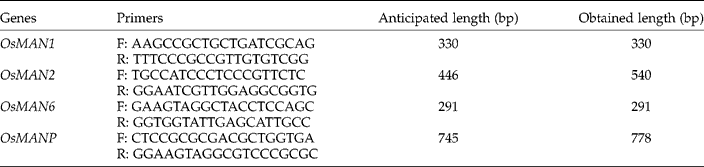
Four sequences in the rice genome in the GenBank database have been designated as being for (1–4)-β-mannan endohydrolase (BAB91747, BAB56016, BAD61770 and BAD17132). Genes encoding those four proteins have been termed OsMAN1, OsMAN2, OsMAN6 and OsMANP by Yuan et al. (Reference Yuan, Yang, Lai, Lin, Cheng, Nonogaki and Chen2007). To clone non-homologous cDNA fragments for each of these four genes for use as probes in Northern blot analysis, specific primers were designed and are listed in Table 1.
Primers used for cloning fragments of four rice endo-β-mannanase genes and the lengths of the PCR products
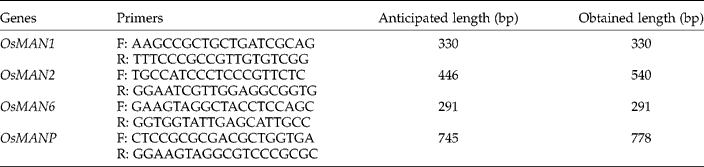
F, forward primer; R, reverse primer.
Total RNA was extracted from the scutellum and aleurone layer of rice grains following the method of Shen et al. (Reference Shen, Wang, Wang, Zheng and Wan2003). First-strand cDNA was synthesized by using oligo (dT) as primer and RevertAid™ M-MuLV reverse transcriptase (Promega, Madison, Wisconsin, USA) according to the manufacturer's instructions. The reverse transcription (RT) product was amplified by primers derived from four rice endo-β-mannanase gene sequences (Table 1) with the following polymerase chain reaction (PCR) conditions: initial denaturation at 94°C (4 min), 25 cycles at 94°C (30 s), at 56°C (30 s), and at 72°C (1 min), followed by extension at 72°C (10 min). The resulting fragments were cloned into the pGEM-T Easy vector (Promega), and sequenced.
Northern hybridization
Total RNA (40 μg) extracted from the scutellum and aleurone layer was subjected to electrophoresis on 1.2% (w/v) agarose gels containing 1.8% (v/v) formaldehyde, transferred to a nitrocellulose membrane (Hybond-N+, Amersham Biosciences) with a solution of 0.1 N NaOH/3 M NaCl. cDNA probes were prepared according to the manufacturer's instructions for a Megaprimer DNA Labelling System (Amersham Biosciences). Membranes were prehybridized for 4 h at 42°C in prehybridization solution [3 × SSC, 5 × Denhardt's reagent, 50% (v/v) formamide, 1% (w/v) SDS, 100 mg/ml denatured salmon sperm DNA). Then membranes were hybridized at 42°C for approximately 30 h in hybridization solution [prehybridization solution, 10% (w/v) dextran sulphate, [32P]dCTP]. After hybridization, membranes were briefly rinsed with formamide wash buffer [50% (v/v) formamide, 5 × SSC, 0.2% (w/v) SDS] at 42°C, then washed for 30 min at 42°C with the same buffer, and finally washed 2–3 times for 15 min with blot wash buffer [0.1 × SSC, 0.1% (w/v) SDS] at room temperature, before exposure to X-ray film at − 80°C.
Results and discussion
Changes in endo-β-mannanase activity during and after germination
Grains of the rice cv. Taichung 65, a japonica subspecies, were used, in contrast to the indica subspecies for our previous studies (Wang et al., Reference Wang, Wang, Ren, Gong and Bewley2005). Thus, the time courses of germination and endo-β-mannanase activity were first determined for this cultivar.
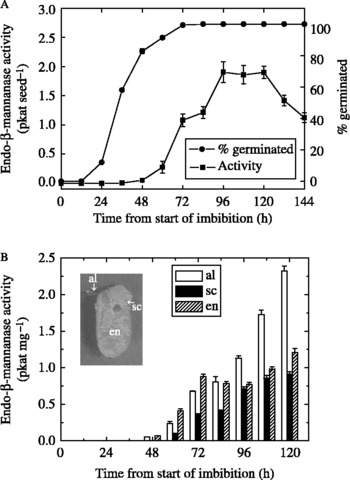
Emergence of the radicle from dehulled rice grains was first observed at about 16 h from the start of imbibition. All grains completed germination after being imbibed in water for 72 h (Fig. 1A). Activity of endo-β-mannanase in dehulled grains was first detected at 48 h from the start of imbibition, increasing up to 96 h, and then decreasing after 120 h (Fig. 1A). Thus, like the indica subspecies cv. Peiza 67, grains of japonica cv. Taichung 65 expressed endo-β-mannanase activity only after the completion of germination. To locate the enzyme activity, grains were dissected into the living aleurone layer, non-living starchy endosperm and living scutellum at various times following germination (Fig. 1B). Activity of endo-β-mannanase was first detected in the aleurone layer and starchy endosperm at 48 h from the start of imbibition, and increased thereafter. Enzyme activity in the scutellum was first detected 12 h later than that in the aleurone layer and starchy endosperm, and while it increased, its activity was well below that of the other seed parts.
(A) Germination percentage and endo-β-mannanase activity in dehulled rice grains during and following germination at 25°C on water in the dark. Error bars indicate the variation in germination percentage between triplicate lots and enzyme activity between duplicate assays of duplicate extracts. (B) Endo-β-mannanase activity (per mg fresh weight) of different grain parts (aleurone layer, scutellum and starchy endosperm) of dehulled rice during and following germination at 25°C on water in the dark. Error bars indicate the variation in enzyme activity between duplicate assays of duplicate extracts. The inserted image illustrates seed parts: aleurone layer (al), scutellum (sc) and starchy endosperm (en).

Isoform patterns of endo-β-mannanase during and after germination
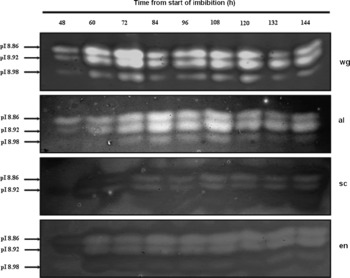
No isoform band of endo-β-mannanase was detected in whole grains or seed parts imbibed for less than 48 h, as anticipated from the activity data (Fig. 2). At 48 h three isoforms with pI of 8.86, 8.92 and 8.98 were detected in the whole grains; the number of isoform bands remained unchanged up to 144 h. The isoform expression patterns of endo-β-mannanase in the aleurone layer were similar to that in whole grains. However, in the scutellum only two isoforms (pI 8.86 and 8.92), were detected after 60 h from the start of imbibition. In the starchy endosperm, only one isoform band (pI 8.86) was detected at 48 h, but from 60 h, the other two isoforms were present in this tissue. Thus, the isoform pattern of endo-β-mannanase in the scutellum is distinct from that of the aleurone layer, and the pattern in the starchy endosperm reflects that of the aleurone layer, indicating this is the sole source of the enzyme, which is secreted in this non-living tissue.
Isoforms of endo-β-mannanase in whole rice grain (wg), aleurone layer (al), scutellum (sc) and starchy endosperm (en).

Western blot analysis of endo-β-mannanase protein during and following germination
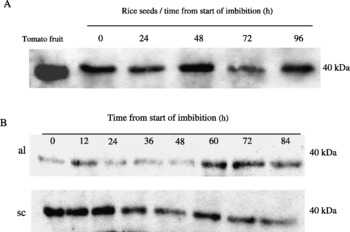
In some tissues, endo-β-mannanase protein can be detected antigenically, even though there is no enzyme activity. No antibody to the rice enzyme has been produced, so tomato seed enzyme antibody was used here. This is known to detect endo-β-mannanase in seeds and fruits of tomato (Bewley et al., Reference Bewley, Banik, Bourgault, Feurtado, Toorop and Hilhorst2000), as well as in seeds of other species, e.g. fenugreek (Malek and Bewley, Reference Malek and Bewley1991; Gong, Reference Gong2007). A clear band of the appropriate kDa was detected in extracts from tomato fruit and those from dry, germinating and germinated rice grains (Fig. 3A). The kDa values of different isozymes of endo-β-mannanases in tomato, as derived from their cDNA sequences, varies from 42 to 44 kDa (Gong and Bewley, Reference Gong and Bewley2007), and that obtained from lettuce is almost 44 kDa (Wang et al., Reference Wang, Li and Bewley2004). However, in the latter species, the kDa of active enzyme proteins in the seed itself, as detected using Western blot analysis, varies from 39 to 43 kDa (Nonogaki and Morohashi, Reference Nonogaki and Morohashi1999). This could be attributed to limited hydrolysis of the protein to make it smaller, without loss of activity, which would also account for the large number of isoforms that are detectable (Nonogaki and Morohashi, Reference Nonogaki and Morohashi1996). The size of the protein detected in rice grains by the antibody to tomato endo-β-mannanase is clearly within the range of those already known. Endo-β-mannanase proteins existed in dry (0 h) and early imbibed whole grains (24 h), in which no endo-β-mannanase activity could be detected (Fig. 1A, B), and the amount of enzyme protein did not change greatly up to 96 h from the start of imbibition, other than weaker detection at 72 h.
Western blot detection of endo-β-mannanase proteins extracted from (A) whole grains and (B) the aleurone layer (al) and scutellum (sc) of rice during and following germination. In (A), the lane on the left was loaded with an extract from tomato fruit. The amount of protein loaded in each lane was 30 μg.

Compared with the whole grains, endo-β-mannanase protein amounts in the scutellum and aleurone layer changed greatly during and following germination (Fig. 3B). In the latter, enzyme protein was low in dry grains and in those imbibed until 60 h from the start of imbibition; then it increased. In marked contrast, endo-β-mannanase proteins in the scutellum of dry (0 h) and early germinating grains (up to 24 h) were at a higher level and decreased after the completion of germination. Thus, the initial amount of enzyme protein in the grain is presumably that which is synthesized during development, and stored in the dry grain, albeit in an inactive form. Later, the enzyme protein that is present is due to its increase in the aleurone layer. There is a poor coincidence between endo-β-mannanase protein and activity of this enzyme during germination and early seedling growth. It is not known if later activity is due to an increase due to de novo synthesis, or to activation of existing protein, or both. In an effort to resolve this, Northern blot analysis of endo-β-mannanase transcripts was carried out.
Northern blot analysis of four rice endo-β-mannanase transcripts during and following germination
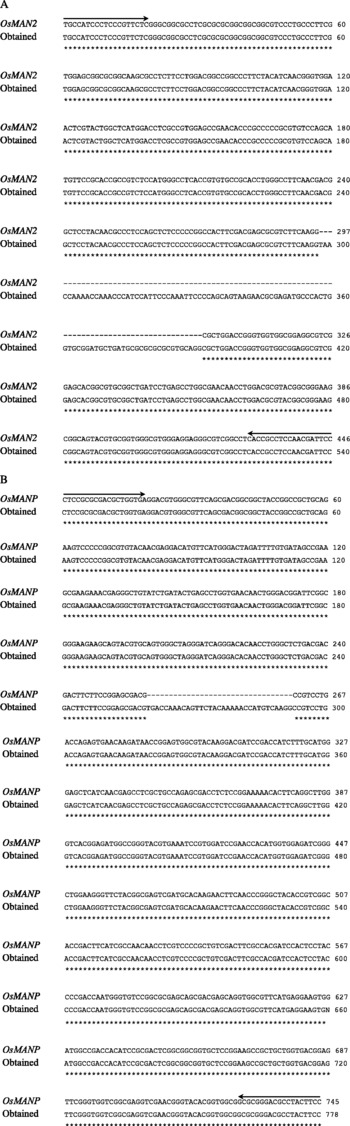
To clone partial cDNA fragments of OsMAN1, OsMAN2, OsMAN6 and OsMANP as probes for Northern blot analysis, four pairs of primers were designed (Table 1) based on the gene sequences recorded in GenBank. After RT-PCR amplification, fragments of 330, 540, 291 and 778 bp were obtained for OsMAN1, OsMAN2, OsMAN6 and OsMANP, respectively (Table 1). The obtained partial cDNA sequences of OsMAN1 and OsMAN6 were identical to the corresponding putative sequences in GenBank, but the obtained partial cDNA sequences of OsMAN2 and OsMANP contained 94 and 33 bp more bases than those recorded in GenBank (Fig. 4, Table 1). This might be because the gene sequences for OsMAN1, OsMAN2, OsMAN6 and OsMANP published in GenBank were the predicted sequences obtained by performing comparative genomic studies, and were not experimental results; therefore, parts of the exon sequences may be those of the intron, and were omitted.
Alignment of sequences obtained by reverse transcriptase-polymerase chain reaction (RT-PCR) using the primers listed in Table 1 (Obtained) and sequences present in GenBank for (A) OsMAN2 and (B) OsMANP. Primer sequences are indicated by horizontal arrows. Asterisks indicate matches.

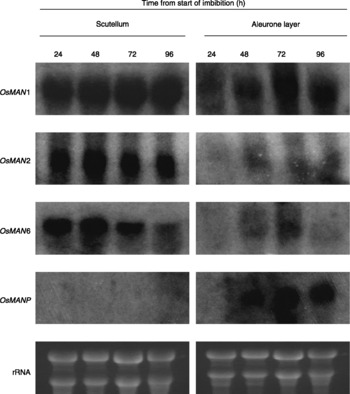
Northern blot analysis showed that the four genes were expressed differently in the scutellum and aleurone layer during and following germination (Fig. 5). OsMAN1, OsMAN2 and OsMAN6 were expressed in both the scutellum and aleurone layer, but OsMANP only in the aleurone layer. High amounts of OsMAN1 and OsMAN2 mRNA were detectable in the scutellum as early as 24 h from the start of imbibition and changed little following germination. Although a high content of OsMAN6 mRNA was also detectable in scutellum at 24 h from the start of imbibition, its abundance decreased after 48 h. In the aleurone layer, only transcripts of OsMAN1 could be detected abundantly as early as 24 h; expression increased up to 72 h and then decreased slightly. Little OsMAN2 and OsMAN6 mRNA was detectable in the aleurone layer throughout the experimental period. Transcripts of OsMANP increased markedly after germination and remained high (Fig. 5).
Northern blot analysis of OsMAN1, OsMAN2, OsMAN6 and OsMANP in germinating and germinated rice grains imbibed on water at 25°C in the dark. Each lane was loaded with 40 μg total RNA extracted from the scutellum or aleurone layer.

Yuan et al. (Reference Yuan, Yang, Lai, Lin, Cheng, Nonogaki and Chen2007) identified nine endo-β-mannanase genes (OsMAN1–8 and OsMANP) from the rice genome by in silico sequence analysis and investigated their expression patterns by RT-PCR in grain, stem, root and leaf of rice. They found that OsMAN1, OsMAN2, OsMAN3, OsMAN4, OsMAN6 and OsMAN8 were expressed in grains, but mRNA for OsMAN5, OsMAN7 and OsMANP were not detectable. However, Yuan et al. (Reference Yuan, Yang, Lai, Lin, Cheng, Nonogaki and Chen2007) only analysed grains imbibed for 18 h, whereas the data presented here show that the transcripts do not appear until some 30 h later.
In conclusion, seeds of the cv. Taichung 65, a japonica rice, exhibit endo-β-mannanase activity from 48 h after the start of imbibition, following germination, similar to the indica cv. Peiza 67 (Wang et al., Reference Wang, Wang, Ren, Gong and Bewley2005). There are three major isoforms of the enzyme, one of which is exclusive to the aleurone layer, and is the major, or sole source of endo-β-mannanase in the non-living starchy endosperm, where it presumably degrades cell walls as a source of sugars for the embryo, and/or to permit faster penetration of the starch degrading enzymes known to be released there for both the scutellum and aleurone layer (Thévenot et al., Reference Thévenot, Simond-Côte and Daussant1991). The tomato anti-endo-β-mannanase antibody detected an antigenic band of approximately 40 kDa in rice grains. This antigen was already present in dry grains, its abundance decreased in the scutellum and increased in the aleurone layer during and after seed germination. A possible interpretation of this finding is that inactive endo-β-mannanase protein is present in dry grains, and the accumulation of endo-β-mannanase activity is due to the activation of extant proteins, de novo synthesis of enzyme proteins or both. Transcripts from three OsMAN genes are present prior to germination, three in the scutellum (OsMAN1, 2 and 6) and two major ones in the aleurone layer (OsMAN1 and OsMANP). Thus, there is no obvious relationship between the presence of active enzyme, its protein or transcripts during germination. As in coffee, lettuce and tomato seeds, the peak of accumulation of mRNA for endo-β-mannanase was prior to the maximum enzyme activity (Nonogaki et al., Reference Nonogaki, Gee and Bradford2000; Marraccini et al., Reference Marraccini, Rogers, Allard, Andre, Gaillet, Lacoste, Lausanne and Michaux2001; Wang et al., Reference Wang, Li and Bewley2004). After germination, paradoxically, there are two distinct isoforms of the enzyme in the scutellum but three transcripts, whereas in the aleurone layer, three isoforms exist, but only two transcripts are abundantly present. However, there are two additional transcripts in lower abundance. It is therefore difficult to correlate activity of the enzyme with either the presence of the protein or its transcripts. To what extent the post-germinative increase in endo-β-mannanase activity is due to de novo synthesis, or to activation of extant protein, is not known.
Acknowledgements
This work was supported by a Natural Science Foundation of China Grant (30370913) and a Guangdong Natural Science Foundation Grant (032264) to X.F.W, and a Natural Sciences and Engineering Research Council of Canada Discovery Grant to J.D.B. Thanks also go to Drs X.D. Liu and J.H. Feng for the supply of rice seeds.