Introduction
In the history of Western Europe, the period from the demise of the Roman Empire in the fifth century to the ‘transformation of the year 1,000’ was long known as the ‘Dark Ages’, in large part because of the limited documentary sources for the period (Smith Reference Smith2005). These limitations have made it difficult to reconstruct how everyday life was organised in the various ‘post-Roman’ societies of Western Europe. Although there have been attempts to review the status of old age in the Middle Ages, these have focused on the high or late-medieval period to the relative neglect of earlier centuries (cf. Rosenthal Reference Rosenthal1996; Shahar Reference Shahar1993, Reference Shahar1997, Reference Shahar and Thane2004; Sheehan Reference Sheehan1990; Youngs Reference Youngs2006). One exception is Georges Minois's (Reference Minois1989) panoramic History of Old Age, in which he devoted two chapters to ‘old age in the early Middle Ages’. Minois concluded his overview by suggesting that old age was something ‘which the early Middle Ages were decidedly not concerned about’ (1989: 155). This lack of concern was not because of the absence of old people, for Minois believed that ‘once they had survived to their 20th year, the men [sic] … could expect to live as long as we do’ (1989: 149). Rather, he suggested, old people ‘played only a negligible social role and were dependent on the care of their families’ – in effect they were marginalised by the society of the time (1989: 149).
The purpose of this paper is to re-examine Minois's view of old age during this period and to propose a different interpretation. Drawing on various material and literary sources, I argue that, for rich and poor alike, the experience of a personal old age was a rare rather than a common event. Reaching adulthood did not result for most people in the experience of ‘old age’. Despite or perhaps because of this, old age acquired a distinct moral status that derived not from accumulating civic or secular power, as had been the case with the ageing patrician elite of Roman society, but from new sources of moral authority that were particularly associated with the growing influence of the Christian Church. Set against the conflicts and institutionalised violence that permeated the secular elites of this period, the new clerical authority achieved a ‘sacralisation’ of old age that formed part of a broader legitimation of ‘the elder’ in early Christian society (Barclay Reference Barclay2007: 225). As a result, old age, at least in its ‘masculine’ form, senectus, emerged as a morally privileged stage in life (Burrow Reference Burrow1986: 109) with those who survived ‘full of days and rich in good works’Footnote 1 being honoured in word if not always in deed.
Expectations of old age in the early Middle Ages: demographic considerations
How common an experience was it to reach old age in early medieval society? Minois suggested that for those surviving into adulthood, life expectancy was not very different in the early Middle Ages from that of modern society. Although there is limited evidence with which to support or refute Minois's claim, that which is available – beyond the sources cited by Minois – suggests that reaching the threshold of adulthood was no guarantee of a long life and that, perhaps as a consequence, people in the early Middle Ages were often attributed with ‘agedness’ at an earlier age than now.Footnote 2 A number of demographers and gerontologists have suggested that until the modern period, from the beginning of the 20th century, there were no ‘aged’ societies. Thus, the age structure and life expectancy of all pre-modern societies are often considered as of one category, i.e. high rates of infant mortality, a preponderance of young over old people, little secular change in the average age of the population, and a continuous struggle to sustain the population, let alone to expand the number. Under those circumstances, it might seem reasonable to assume that the European age structure in the early medieval period was not dissimilar to that throughout the pre-industrial, pre-modern period that preceded the first phase of the modern demographic transition.
Minois cited two contrasting sources concerning (male) longevity for this period, one the age at death of the popes, starting with Silverus (d. 538 CE) and ending with Gregory V (d. 999), the other the life expectancies of the Merovingian rulers, starting with Clovis (d. 511) and ending with Thierry IV (d. 737). The mean age at death of the former was 61 years, and of the latter 34 years (Minois Reference Minois1989: Tables 6.1 and 6.2). This differential between the mean ages at death of secular and sacral rulers is also found in Gregory of Tours's (c. 538–594) account of the History of the Franks (Gregory of Tours, translation 1974). Although he reported the deaths of various bishops, dukes and kings, he rarely noted at which ages they died. For the few stated ages of death of dukes and kings (one in his twenties, two in their forties and one at 70 years), there was a similar contrast with the longevity of abbots, abbesses and bishops (three dying in their seventies and three in their eighties). Childhood mortality amongst the Merovingian princes seems to have been high, and reaching adulthood amongst the elite a chance affair. Even then, during the relentless civil wars of the period many young dukes and counts were slaughtered well before they reached middle age. Thus, while the clerical elite seem to have had longer lives than the secular aristocracy, it is difficult to generalise from the limited information about the deaths of the elite among the elite.
Few documentary sources at the time had information on adult life expectancy about other than elite families. Drawing on records from a surviving ninth-century Carolingian cartulary that purports to enumerate the ages of some 300 serfs of the Abbey of St Victor of Marseille, Minois reported that ‘even among this category of poor peasants, more than 11 per cent of the adults were aged over 60’ (1989: 148). Using the figures that Minois cited, and comparing them with Paul Vincent's (Reference Vincent1947) estimates of the adult age structure of 18th-century France, suggests little change between ninth and 18th-century France.Footnote 3 Other data from the Carolingian period suggest, however, that death struck adults in what we would term early middle age, rather than in older adulthood. From an analysis of the life spans of four generations of Charlemagne's descendants, Wemple (Reference Wemple and Klapisch-Zuber1992: 182) suggested that men who survived childhood died most often between the ages of 40 and 50 years, while women who survived their childhood died at a younger age, typically between 25 and 40. This matches the data cited by Minois from a study of fifth century funerary verse, which indicate an average age of death for men of 44 years and for women of 34 years (Minois Reference Minois1989: 149). Little other documentary evidence on ages at death during the early Middle Ages has been reported. Estimates of life expectancy at this period consequently rely heavily upon records from the later Middle Ages, and assume a remarkable ‘stability of the age and sex structure of the population’ from late antiquity to early modernity (Russell Reference Russell1958: 143).
Data from archaeological analyses of the skeletal remains at early medieval burial grounds point to a rather different conclusion. As with the Carolingian polyptychs and cartularies, the data are limited and notoriously difficult to interpret, because of the problems of identifying accurate age markers for skeletal bones and teeth more than 1,000 years old (Myles 2002; Whittaker Reference Whittaker1992). In addition to the technical problems, there is the question of the representativeness of any group of local burial grounds and the potential confounding of age-at-death with skeletal survival (i.e. skeletons of old people may survive less well than those of younger adults). Still, skeletal remains from this period do provide information about a broader range of the adult population than that based upon the thinly documented lives of the elite (cf. Halsall Reference Halsall1996). The results of these various analyses indicate more consistently than the documentary evidence that few people died after the age of 60 years; or if they did, very few seem to have been laid to rest in these early medieval cemeteries (Riché Reference Riché1966; Telmon et al. Reference Telmon, Rouge, Brugne, Pujol, Larrouy and Arbus1996).
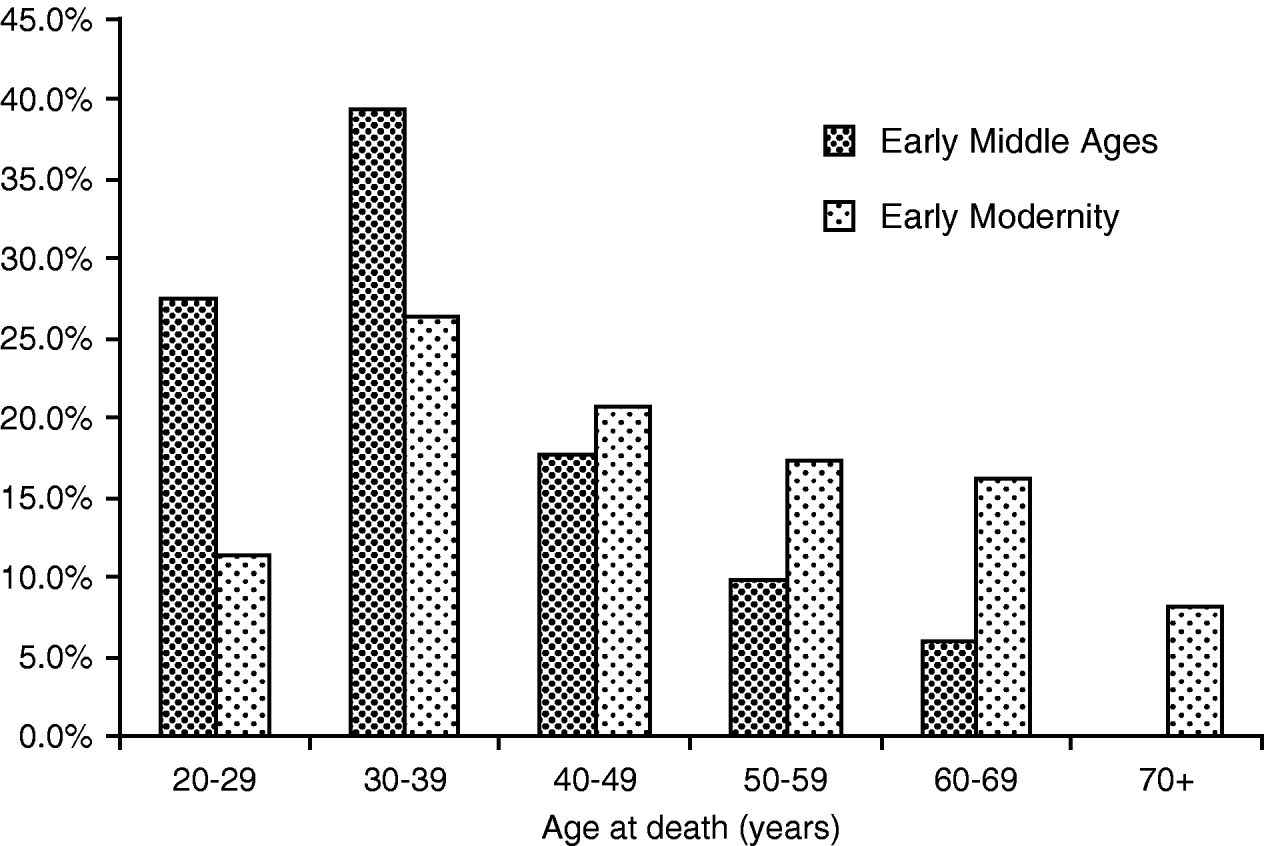
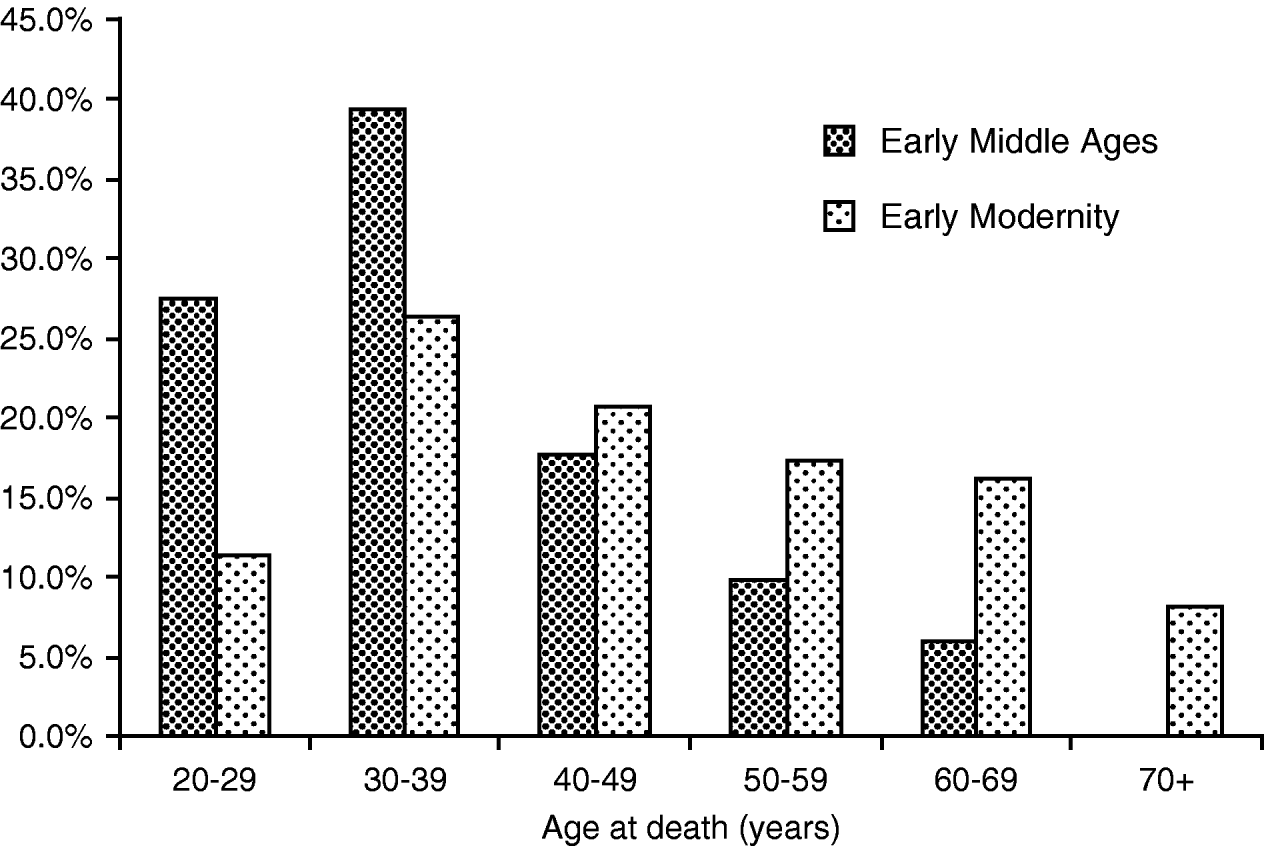
Using dental criteria to estimate the ages at death of 45 adult skeletons unearthed from a seventh-century cemetery at St. Bertrand de Comminges, southern France, Telmon and colleagues (1996: Table 3) reported means of 35 years for men and 34 years for women. Miles (Reference Miles1969) analysed ages at death from two Anglo-Saxon burial grounds (600–800 CE) and subsequently from a 16th-century burial ground – using identical methodology (Miles 1989, cited in Miles Reference Miles2001). Excluding the deaths of infants, children and teenagers (who formed a small minority of the bodies in early medieval cemeteries, but the majority in the 16th century cemetery), the mean age at death of 153 adult skeletons in the early medieval cemeteries was 38 years. In the early modern cemetery, the mean age of death of 236 skeletons was nearer 47 years (Figure 1). Using different techniques to determine age at death, similar findings have been reported from other early medieval Anglo-Saxon burial sites, i.e. a preponderance of adult skeletons aged less than 40 years (cf. Harke Reference Harke and Hines1997; Privat, O'Connell and Richards Reference Privat, O'Connell and Richards2002; Stoodley Reference Stoodley, Mowbray, Purdie and Wei1999). Paleo-demographic studies based upon estimates of age from the bones or teeth of skeletons in Danish, Frankish and German early-medieval burial grounds have also reported very few adult skeletons aged over 60 years at death (Halsall Reference Halsall1990; Helm and Prydso Reference Helm and Prydso1979; Telmon et al. Reference Telmon, Rouge, Brugne, Pujol, Larrouy and Arbus1996; Whittaker et al. Reference Whittaker, Molleson, Daniel, Williams, Rose and Restinghini1985), while the findings from a particularly large series of medieval cemeteries in the former Czechoslovakia indicate a mean age at death in the twenties (Stloukal Reference Stloukal, Austin and Alcock1997: Table 13.2). A recent multi-method analysis estimated the ages at death of more than 100 adult skeletons in an early-medieval cemetery at Lauchheim, Germany, and found that only one of the 12 measurement methods produced a substantial number of ‘over 60s’ (Wittwer-Backofen et al. Reference Wittwer-Backofen, Buckberry, Czarnetzki, Doppler, Grupe, Hotz, Kemkes, Larsen, Prince, Wahl, Fabig and Weise2008: Figure 2).
Adult ages at death in two early-medieval burial grounds and in a 16th century burial ground. Source: Data derived from Miles (1969, 2001).
Evidence of a relative deterioration in adult survival to old age has also been reported during the transition from antiquity to the early medieval period. From a series of studies of ages at death in British cemetery sites covering the Romano-British, early medieval and high-medieval periods, Brothwell (Reference Brothwell1972: Table 26) found that the estimated percentage of ‘over- 50-year-olds’ in the early Middle Ages cemeteries was lower (6.7%) than in either the earlier Romano-British (10.4%) or later medieval cemeteries (10.0%). Other studies that compared ‘late antique’ with ‘early medieval’ skeletal remains in Croatia had evidence of a concomitant deterioration in adult health amongst the latter, with indicators of poorer nutrition and a higher incidence of both acute and chronic infectious diseases, all suggesting ‘a general trend of worsening living conditions during the [early] medieval period’ (Slaus Reference Slaus2008: 464).
Adult ages at death from early-medieval cemeteries unearthed in Britain, Czechoslovakia, Croatia, Denmark, France, Germany and Norway cannot tell us definitively what life expectancy was any more than the documented life expectancies of kings and popes (for a powerful critique of the claims of palaeo-demography, see Johansson Reference Johansson1994). Nevertheless, the consistency of the reported findings from all these early-medieval burial grounds strongly suggests that adult life was considerably shorter for both men and women than in later centuries, and probably shorter than during the Roman period.Footnote 4 Such evidence does not sit easily with Minois's conclusions – his data were much more selective and probably misleading (see note 13). It does however chime with the messages of Anglo Saxon wisdom-poems, such as The Fortunes of Men, that emphasised the fragility and uncertainty of life at the time (Bradley Reference Bradley and Bradley1991b: 341–2). It also suggests that if living beyond 60 years-of-age was so uncommon, the symbolic representation of old age that the Church's writings portrayed would only rarely be challenged by realities.
The status of old age: religious and related literature
Old age was reached more often by the early-medieval clergy than by the laity of any status. Moreover, the higher echelons of the Church were typically restricted to ‘seniors’ – men aged 50 or more years. It was in the Church's early writings that old age first acquired a distinct moral status that was perhaps difficult to challenge given the contemporary age structure. While the ‘stages’ and ‘ages’ of life had not gone unacknowledged in classical writing, the focus of writers such as Plato, Aristotle, Cicero and Plutarch was on the dichotomy between youth and age, rather than ideas of graduated and distinctive steps or stages through life. In the Christian tradition, however, these stages of life became associated with particular moral characteristics, as elaborated in the writings of St Augustine, John Chrystostom, Isidore of Seville, the Venerable Bede, and a host of hagiographers (Burrow Reference Burrow1986; Sears Reference Sears1986). By developing a normative parallel between stages of life and distinct moral virtues, it was also possible for chronological age to be decoupled from its matching spiritual or moral virtue, creating the possibility of transcendent spiritual ages (see Gnilka's Aetas Spiritalis, summarised in Burrow Reference Burrow1986: 95). Thus St Benedict was considered an ‘honorary old man’ even as a youth, as Pope Gregory famously wrote in the Life of St. Benedict:
There was a man of venerable life, blessed by grace, and blessed in name, for he was called Benedictus or Bennet: who, from his younger years, carried always the mind of an old man; for his age was inferior to his virtue: all vain pleasure he contemned, and though he were in the world, and might freely have enjoyed such commodities as it yieldeth, yet did he nothing esteem it, nor the vanities thereof.Footnote 5
At the opposite extreme to the trope of the puer senex (wise child), with which early-medieval Christian hagiographies seemed to characterise the youth of a number of saints, was that of the puer centum annorum (100 year-old child), who despite his (sic) great chronological age persisted with the follies and superficialities of youth (Burrow Reference Burrow1986: 153).Footnote 6 The preoccupation in Church writings with not just describing but also defining what was expected of each stage of life helped form what Sears called ‘the moralised life course’ of the Middle Ages (Sears Reference Sears1986: 134). As is evident from the above, it reflected a symbolic rather than a scientific ordering of the world. From late antiquity through the early Middle Ages, many (mostly ecclesiastical) writers made comparisons between the ages of man (sic) and broader sequences, such as the ages of the world and the seven days of Christian creation. Augustine of Hippo in De Diversis Quaestionibus [Various Questions] was perhaps the first to draw out the analogy between the six days of creation, the six ages of the world and the six ages of man.Footnote 7 Isidore, Archbishop of Seville (died 636), also elaborated on the theme of six ages in his multi-volume Etymologiarum sive Originum [Etymologies or Origins] (Brehault Reference Brehault1912). Similarly, in his eighth-century treatise De Temporum Ratione [The Reckoning of Time], Bede distinguished three stages of childhood: infancy, childhood and adolescence; and three stages of adulthood: youth, maturity and senility (Bede Reference Bede1999: 158). For Bede, ‘youth’ was the beginning of maturity (‘this age in man is normally apt for governing a kingdom’), while maturity was already ‘heavy with age’ and life's final stage – senility – a period whose limits could not be drawn by mortal man.Footnote 8 For Bede, death and the end of the world were ‘unknowable’, and hence the limits of earthly life were equally unclear, but having reached their appointed end, both would usher in a seventh age – of peace in a ‘perennial Sabbath’ (Bede Reference Bede1999: 158.).
This theme – linking life with the ordering of the universe – can be found in other Church writings, such as the Contemptu Mundi [Scorn of the World] of Eucharius of Lyons. He felt that the weaknesses and infirmities of old age were being played out in the post-Roman world as a prelude to the final days. It was no doubt a perspective made particularly acute by those ex-Roman bishops who viewed their own past through the rose-tinted glories of a well-ordered Christianised empire. At the same time, the sixth age was the period in the world's history when ‘God himself became man in Christ’ (Burrow Reference Burrow1986: 81). Old age was seen to be both divinely ordained and of particular value because of what it would usher in. It was a time when eac aelc goes cinnes mann sceal hine sylfne to godnysse awnedan and wisdon lufia and forlaetan idelnyss [every man of good disposition should turn to virtue and love wisdom and forsake vanity] (Homilies of Ælfric, cited by Burrow Reference Burrow1986: 153). By drawing the analogy between the stages of man's life and that of the world itself, it was impossible to dismiss old age as an undesirable or irrelevant state, characterised merely by impotence and impoverishment. Rather, old age offered an important moral lesson to humankind and formed a necessary phase in the journey toward eternal life; the whiteness of the old man's hair symbolising the purity of age so that ‘old age is youthful, is green, and ever will be green’ (St Augustine, Exposition on Psalm 92, translator Schaff Reference Schaff and Knight1888: volume 8).Footnote 9
This ‘sanctification’ of old age as a spiritually-valued stage of life served to reframe age as a symbol of ‘purity’ and ‘virtue’. The bodily signs of age-related infirmity were not reviled but were seen instead as part of the necessary transcendence of the spirit from its earthly chains. The imperial virtue of display and riches that had characterised Roman society was transformed by the Church into symbols of potential vice, and self-denial and poverty acquired spiritual value. This new symbolic exchange reinforced valuing old age not just the aged elite, the ‘elders’ of society, but extending value to the old age of the pauper (Mollat 1996: 24). As Charlemagne is said to have pointed out to his bishops and stewards, ‘it is your duty to minister to the poor, or rather to Jesus Christ in the persons of the poor, and not to waste your substance on stupid objects’ (Einhard and Notker the Stammerer 1971: 109). If old men were criticised by the Church, it was not because they were old or frail or poor, but precisely the opposite, because they failed to respect and uphold the spiritual value of old age. Thus John Chrysostom wrote:
It is a shameful and ridiculous thing to have white hair on one's head and the frivolity of youth in one's heart [since] we honor the gray hair, not because we esteem the white color above the black, but because it is a proof of a virtuous life; and when we see them we conjecture therefrom an inward hoariness.Footnote 10
It was the denial of age, the masking through inappropriate behaviour or dress of agedness, which drew the wrath of the Church fathers. Failure to be old ‘properly’ was in essence a violation of a moral code, a defiance of the true spiritual and symbolic order that is God's world.
The status of old age: contrasting secular traditions
Apart from its spiritual value and its proximity to death and rebirth in the seventh eternal age of peace, old age possessed value to society for more practical reasons. In a world where literacy was limited and knowledge judged more by its provenance than its predictive power, age also acted as a proxy for wisdom. Many of the illustrations in the religious manuscripts of the period portray saints, monks and clerics as white-haired, bearded men sitting alone at a desk, reading from or annotating the Bible (for examples see Nees Reference Nees2002: 153–71). Such attributions of wisdom were also particularly evident in the contemporary secular Anglo-Saxon and Scandinavian literary traditions. In the Anglo-Saxon poem, The Wanderer, the anonymous poet wrote ‘no man can become wise until he has had many winters in the kingdom of earth’. Similar sentiments were expressed in Maxims II when the poet wrote, ‘the old man is wisest, the one who has experienced much, wise with the passing years’ (seeCavill Reference Cavill2001: 92). More vivid is the following from Hovamol [The Ballad of the High One], an Icelandic Edda [Poem and Tale] (Bellows Reference Bellows1936):
This theme of aged wisdom triumphing over youthful inexperience was not new even then, but it is particularly evident in much of the period's surviving literature, in both the overly-Christianised accounts of the Merovingians and Carolingians, as well as in Anglo-Saxon and Norse literature. In another Icelandic Edda, the poet/songwriter tells in Bellow's translation of King Rigsthula:
This theme was echoed in the character of Hrothgar, King of the Scyldings, on whose behalf Beowulf battled the giant Grendel, as also in Beowulf's own personage (Bradley Reference Bradley and Bradley1991a). Hrothgar was variously described as ‘white haired with age and renowned in warfare’ (Bellows Reference Bellows1936; 607), ‘the grey-haired fighting man’ (1936:306), ‘the sagacious man’ (1936: 312), and ‘the old fighting man, the white-haired battle lord’ (1936: 679). Beowulf, in turn, became ‘a wise old king, the aged guardian of his native land’ (2,209), who ‘grown old as the people's guardian lord’ faces and defeats his final monster, the dragon – as both old man and hero (1936: 792). Another aged if less mythical figure was King Alfred (849–901 CE), who matched Charlemagne's status as a powerful ruler. Although probably still in his early fifties when he died, Alfred's stature grew with his years; his strength of character and sagacity as a ruler were lauded ‘despite his own daily infirmities of body’ (Asser, Bishop of Sherborne, translator Giles, 1847).
The post-Roman tradition of valorising old age, rightly lived, in Anglo-Saxon, Frankish and Scandinavian literature can be usefully contrasted with early Celtic accounts of power and prowess. Here, youth triumphed over age – swiftness of action, strength and valour, lustiness and the capacity to bear arms bravely are a refrain in Irish, Scottish and Welsh literature. Typical of the genre is the following lament of the mythical sixth century Welsh king, Llywarch Hen.Footnote 11 He deprecated the weakness of age in contrast to the strength and lustiness of youth:
Many of the surviving poems that described the lives of the kings and heroes of early medieval Ireland, Scotland and Wales have little to say about old age. The idea of paradise was represented in pagan Celtic literature in very different terms from that of the Christian Church. Paradise was a material presence, here on earth but in other worlds, as in the Tìr na mBan [The Land of Women] where Bran, son of Febal, lands with his crew and enjoys uninterrupted pleasure and perpetual youth – or the Tìr na n´Og [The Land of Youth], where the Fenian hero Oisìn stays for some 300 years. These other worlds offer pleasure, good food and agelessness (MacKillop Reference MacKillop2006: 112–24). The heroes of these tales are youths and young sacred kings, such as Angus Óg, the god of youth and beauty, who drinks the ale of immortality and never ages, and Cúchulainn, the hero of the Ulster Cycle Epic, who remains a perpetual if always mortal youth. The little that is said of old age tends to dwell upon the misfortunes associated with its infirmity and impotence, or in its female representation as the old hag, the loss of youth and beauty, as in the verse story Cailleach Bhéirre [The Hag of Beare] (translator Murphy Reference Murphy1999).
Little evidence exists of the equation between age, fortitude and wisdom that is found so often in (Christian influenced) Anglo-Saxon literature (cf. Burrow Reference Burrow1986: 109). Indeed it was not until long after the conversion of Celtic society that there was a deliberate attempt to integrate the pagan and Christian traditions, from which age took on more definite worth. This was evident in the Agallamh na Seanórach [Dialogue of the Ancients], where aged pagan and Christian heroes were brought together during an imaginary journey by St Patrick and an equally ancient Fenian warrior, Caìlte. In this retelling of Celtic myths with a Christian rubric, the virtues of both traditions were exemplified in these two wise and powerful figures (Dooley and Roe Reference Dooley and Roe1999).
An exception to the generalisation might seem to be the role played in early Celtic society by the Druids, who have been commonly portrayed as tall, white-haired and white-bearded elders (see the illustrations in Chadwick Reference Chadwick1966 and Ellis Reference Ellis2002). Druids were clearly important figures, given responsibility for judging the law and administering the various rituals of Celtic society (Chadwick Reference Chadwick1966; Joyce Reference Joyce1903; MacCulloch Reference MacCulloch1948). Given the view of the early Celtic Christians that magic, superstition and pagan practices were forces of Satan to be combated, it is perhaps unsurprising to find in the literature of the Christian period from the fifth century no detailed account of the lives of individual Druids or of their general lifestyle. But evidence from Roman and post-Roman sources suggests that the Druids were a hereditary class or caste in Celtic society, rather than members of a ‘ministry’ that they became after many years of adult life (Ellis Reference Ellis2002). Chadwick (Reference Chadwick1966) suggested that the Druids were like the Brahmins in traditional Indian society, a caste identity that was inherited at birth and that freed its members from the obligation of bearing arms or serving as warriors. If so, it is likely that there were Druid families, Druid children and Druid wives; in short, that it was birth not age that distinguished this element of Celtic society.
Seniority and the sacralisation of the family
Family and kinship provided a ‘ubiquitous matrix’ within which power and authority were expressed and challenged throughout the early Middle Ages (Smith Reference Smith2005: 83). Although peasant households were generally small and predominantly nuclear, with husband, wife, their children and possibly a servant or two living under the same roof, kinship bonds extended well beyond the immediate household. More than the law and the rule of local aristocrats, these bonds provided a necessary measure of security against the hazards of everyday life. The various Germanic law codes written during the sixth and seventh centuries attest to the importance of kin in judging the guilt or innocence of those charged with murder, rape, theft or trespass, and make clear that they were responsible for paying for the consequences of the misdeeds of their kinsfolk (Drew Reference Drew1972, Reference Drew1973, Reference Drew1991; Rivers Reference Rivers1986). Those unable to call upon kin must have been extremely vulnerable and easy prey to all forms of harassment and oppression. Although the decline of urban life must have reduced the number of beggars that previously were drawn to the cities of late antiquity – and who continued to throng the cities of the Eastern (Byzantine) empire (Morris Reference Morris1976) – the precariousness of rural existence for those who grew old alone must have been severe.
Family structure provided a motif for secular and sacred authority alike. The Church was constituted as an alternative ‘family’ whose senior members were the fathers of their flock, whether that flock was the congregation served by the local priest, the monks and other religious orders housed in the abbot's monastery, or the peasants that earned their living on the church's estates. Respect for seniority was illustrated in the ninth-century Decretals [Letters] of Pseudo-Isidore. The First Epistle of Pope Callistus condemned those young clergy who criticised their elders and betters:
Let no one take up an accusation against a doctor [teacher], because it is not right for sons to find fault with fathers, nor for slaves to wound their masters. Now, all those whom they instruct are sons of doctors; and as sons ought to love their fathers after the flesh, so ought they to love their spiritual fathers. For he does not live rightly who does not believe rightly, or who reprehends fathers, or calumniates them.
How far the order of the family was replicated within the monasteries and how far it was used as an ideological weapon to sustain the Church's role and authority in the community is impossible to know. The Benedictine monastic rules certainly paid particular attention to the needs of the elderly brothers in the monastery,Footnote 12 and this model of responsibility was frequently conveyed by the Church to its own members and to the secular elites who were both rulers and brothers in Christ. Raoul, Bishop of Bourges in the ninth century, called on the rich not to oppress the poor, nor deprive them of their belongings, nor ‘pitilessly demand your due [but] know that they are your brothers and that they share the same Father to whom they say, “Our Father who art in Heaven”, and the same Mother, the holy Church, which has given birth to them’ (cited in Mollat Reference Mollat1986: 43, author's italics).
In contrast to the extensiveness of spiritual kinship, as noted above, everyday households were generally small. Partible inheritance was the dominant mode of inter-generational transfer. Primogeniture (i.e. inheritance by the oldest, male child) was rarely practised until the early 11th century (Moore Reference Moore2004: 88). This was the case for both aristocratic and peasant households, with the consequence that small households were perpetuated, as small landholdings spread and then splintered into yet more small freeholds. Property – land – could only accrue by purchase, confiscation or, in the case of the Church, donation. As a result, the landscape of early medieval Europe was dominated by small settlements, the majority of which were ‘single farms, groups of farms and hamlets’ (Rosener Reference Rosener1996: 49) where ‘the norm was probably a two-generation family which included the married couple and their children, possibly enlarged at times with unmarried brothers and sisters, the husband's mother and grandchildren’ (Fichtenau Reference Fichtenau1993: 84).
Households with members of three generations or extended families were rarely recorded. Many peasants – male and female – appear to have remained unmarried, living as adults on the estates of their local bishop, abbot or ‘lord’ (Russell Reference Russell1958: 31–2). Grandparents were rarely mentioned in accounts of the life and times of rulers or religious leaders, and three-generational households seem to have been confined to the rich, their officials and a few better-off peasants (Fichtenau Reference Fichtenau1993: 100). Throughout Gregory of Tours's 10-volume History of the Franks, for example, there is no mention of grandparents, nor were they mentioned in Paul the Deacon's six-volume History of the Lombards written some 200 years later.
In contrast to grandparenthood, gender was clearly an important influence upon the representation of age. For peasants and lords alike – pauperes et potentes – the father retained a status similar to that of the Roman paterfamilias, with overall responsibility for overseeing the work of the familia and ensuring that taxes and rent were paid in kind to the local landowner. Studies of sixth-century Frankish grave goods suggest that while the status of the man was preserved more or less into later life, the status afforded women dropped significantly after the age of 40 years, suggesting that women's value related primarily to their capacity to bear and rear children (Halsall Reference Halsall1996). Although arguably less marked, a similar pattern of age and gender influences on status is evident from studies of early Anglo-Saxon grave goods. Key status items either disappear or become less numerous in the graves of women aged over 40 years, whilst for men of this age there were more valuable grave goods such as long spears and knives (Stoodley Reference Stoodley2000). The age-related decline in women's status relative to men's is also evinced in the laws of the Salian and Ripuarian Franks, where the wergild or financial compensation owed to the family of a murdered woman dropped from 600 solidi so long as she is able to bear children to 200 solidi when she was no longer able to bear children (cf. Drew Reference Drew1991: 127; Rivers Reference Rivers1986: 167).
Given the limited documentary sources concerning the everyday life of the people of the time, there are considerable risks in re-constructing any account of the domestic relations between men and women, whether young or old, particularly for those from non-elite backgrounds. That leaves two options, either to assume that the nature of gendered and generational relationships amongst the elite landowning classes applied to all but the unfree (who in any case were part of other people's familia), or to restrict one's understanding to the very limited evidence drawn from the material records of grave goods and similar proxy indicators of ‘status’. Either way, there seems reason to conclude that old age for women held less of the sacralised virtue that it did for men, and equally that older women acquired few material assets, either through inheritance or through the power they exercised over their adult children or their spouses.Footnote 13
A further consideration concerns the status of unfree men and women in early-medieval society. As Wickham pointed out, the most stable social distinction at this time amongst the peasants of Europe was between the free and the unfree. This distinction differs from that between the free citizen and the slave in Roman society, as the unfree of the Middle Ages were not estate slaves in the sense of the Roman Empire, who were maintained, owned and bound absolutely to their master (Wickham Reference Wickham2005: 560). Most of the unfree in the early Middle Ages were tenants (servi casati or hutted serfs) and had to maintain an independent household, even if they could be moved out any time. They could marry, but only to other ‘unfree’ men or women, own property and pass it to their children, and they could be set free, although often they remained bound as tenants on the estate where they worked (Devroey Reference Devroey2000: 28).
Slavery per se was not abolished after the fall of the Roman Empire, nor was slavery unknown in Celtic, Norse or Germanic societies. Large slave colonies maintained solely to work the lands of a Roman aristocrat seem to have died out alongside the estate system early in this period. Those who remained slaves were increasingly maintained as part of the familia and contributed to its economy. They were certainly no more and probably much less numerous than the free tenants of an estate, and as the distinction between slave and serf dissolved they gradually merged into the mass of tenant householders (Devroey Reference Devroey2000: 23). The period was distinctive, however, in the extent to which the Church took on and in turn transformed the role of ‘slave owner’. As its lands grew – the Church was one of the largest landowners of ninth-century Western Europe (Herlihy Reference Herlihy1961) – so its influence upon the status of the unfree grew. The treatment of the Church's slaves, including their emancipation as a charitable act, provided an alternative model to that which applied in the classical ‘mode of production’. The Church's standards became the standards against which other lay landowners were increasingly judged. New Christian attitudes meant that the welfare of the poor became the responsibility of the powerful, a significant shift from Roman and pre-Roman Germanic custom. ‘Nobility’ became a moral distinction that required those so described to ‘exercise social power in the proper manner’ (Innes Reference Innes2000: 83). While it had been customary in Rome to ‘release’ slaves once they had reached middle age, because their labour was less valuable, their upkeep was more demanding and their experience less useful to their master, the economic inutility of the aged was less important in a society where most of the unfree were not estate slaves but tenants who occupied and worked the land as much for their own survival as for the benefit of the landowner. This, combined with the Church's influence on noblesse oblige, must have meant that unfreedom in old age was less likely to lead to neglect than it evidently did at the time of the Roman Empire.
Conclusions
This reconstruction of old age in the early Middle Ages has had to rely upon limited sources of direct information about the circumstances of older people. Material evidence from unearthed early-medieval burial grounds across Europe suggests consistently that death in old age was uncommon, with most adults dying before they reached what Isidore of Seville called aetas senioris [maturity] (50–70 years old) let alone aetas senectus [old age]. Maturity and old age were typically the province of monks and abbots, bishops and archbishops, the clerical classes of early medieval society. This was evinced in Church documents, in the writings of clerics, and in the religious art of the period.
At the same time, a new sense of value began to be attached to old age. This was distinct from that expressed in earlier Roman writing, which focused upon the dilemmas that faced well-to-do older men and how they might retain their position in civil society.Footnote 14 The institutions that supported literacy and learning during the early-medieval period were primarily those of the Church, not those of the city elites, the senate or the courts. Much of this promotional activity was concerned with establishing a theocracy in which life was regulated according to the life and writings of the early Church fathers. The legitimacy of the new post-Roman kingdoms depended upon the ruling elites successfully blending tribal, Roman and canon law into an institutional system of governance that relied upon a combination of military power, land ownership and widespread allegiance to the familia of the Church. Seniority and authority battled with the impulse to power of young kings and their clansmen as the Church developed its role as arbiter and conscience of the state.
The status of old age was, I suggest, reflected in these circumstances. Old age was part of the struggle for order, particularly moral order. In this sense, wise and powerful figures, as of Charlemagne in continental Europe and Alfred in Britain, represented the iconic coming together of the sacred and the secular. Their ageing reflected the consolidation, not the decline of their powers. Both rulers would become legendary figures who symbolised age, wisdom and integrity as new modes of power and production emerged during the 11th and 12th centuries. This made the early Middle Ages a particularly distinctive period for the history of old age. Whilst old age amongst the rural poor and the unfree gained little obvious benefit from this, the relative rarity of the aged suggests that old people were unlikely to have been perceived as a major economic or social burden for society. To that extent, Minois may have been right when he suggested that old people ‘played only a negligible social role’ in the everyday life of the early Middle Ages. What I have tried to argue, however, is that this did not translate into a lowered status for old age but rather the opposite. Old age acquired a status and an authority that it had not had before and that it would not perhaps achieve again.