Implication
The effect of gonadal status on feed intake behavior in pigs was described and possible consequences for the concentration of skatole and indole were discussed. Immunocastration increased the feed intake mainly because of a higher feed intake rate, whereas the number of meals/day remained at the low level of entire males. An increased feed intake rate may favor the formation of skatole and indole within a gender group, even if the overall level of their formation is depending on the gonadal status. This finding needs further confirmation to develop management systems that reduce the risk of skatole tainted pork.
Introduction
Fattening of entire males for pork production has been discussed controversially for decades. Previously, the discussion has been more focused on the economic advantage of entire male production because of their improved growth performance in contrast to detrimental effects of boar taint due to elevated concentrations of androstenone, indole and skatole in pork meat. Today, animal welfare aspects predominate in the discussion (Fredriksen et al., Reference Fredriksen, Font i Furnols, Lundström, Prunier, Tuyttens and Migdal2009). Surgical castration of male piglets without anesthesia, as carried out, for example, traditionally in Germany, is not accepted by animal welfare organizations and an increasing number of consumers (Prunier et al., Reference Prunier, Bonneau, von Borrell, Cinotti, Gunn, Fredriksen, Giersing, Morton, Tuyttens and Velarde2006; Zamaratskaia et al., Reference Zamaratskaia, Andersson, Chen, Andersson, Madej and Lundström2008a; von Borell et al., Reference Von Borell, Baumgartner, Giersing, Jäggin, Prunier and Tuyttens2009). Thus, alternatives to surgical castration have gained considerable interest during the last years. One alternative is the immunization against Gn-RH by the application of Improvac (Pfizer Ltd, Berlin, Germany; Dunshea et al., Reference Dunshea, Colantoni, Howard, McCauley, Jackson, Long, Lopaticki, Nugent, Simons, Walker and Hennessy2001; Jaros et al., Reference Jaros, Burgi, Stärk, Claus, Hennessy and Thun2005; Zamaratskaia et al., Reference Zamaratskaia, Andersson, Chen, Andersson, Madej and Lundström2008a). Immunological castration is achieved by two injections of that specific vaccine in a 4 week interval leading to androstenone levels in adipose tissue as otherwise observed in castrated males (Dunshea et al., Reference Dunshea, Colantoni, Howard, McCauley, Jackson, Long, Lopaticki, Nugent, Simons, Walker and Hennessy2001; Bauer et al., Reference Bauer, Lacorn, Danowski and Claus2008; Zamaratskaia et al., Reference Zamaratskaia, Andersson, Chen, Andersson, Madej and Lundström2008a). A similar effect on skatole formation has been described (Dunshea et al., Reference Dunshea, Colantoni, Howard, McCauley, Jackson, Long, Lopaticki, Nugent, Simons, Walker and Hennessy2001; Zamaratskaia et al., Reference Zamaratskaia, Andersson, Chen, Andersson, Madej and Lundström2008a; Morales et al., Reference Morales, Gispert, Hortos, Pérez, Suárez and Piñeiro2010), even if the synthesis of this tryptophan metabolite occurs in the intestine due to microbial activity (Claus et al., Reference Claus, Weiler and Herzog1994).
Even if sex differences in skatole formation and accretion in adipose tissue are well established, the physiological mechanisms are not fully understood. Skatole formation has to be recognized as a multifactorial phenomenon and anabolic status, sex, stress and nutrients contribute to the enormous variations observed between animals (Claus et al., Reference Claus, Weiler and Herzog1994; Zamaratskaia et al., Reference Zamaratskaia, Chen and Lundstrom2006). Various factors have been suggested to contribute to the higher skatole concentrations in adipose tissue of boars, in comparison to females and barrows. Such mechanisms include an increased formation rate due to higher amounts of intestinal cell debris stimulated by endocrine or nutritional factors (Claus et al., Reference Claus, Raab and Röckle1996). Moreover, sex differences in hepatic skatole metabolism due to a specific inhibitory effect of androstenone on hepatic skatole degradation (Babol et al., Reference Babol, Squires and Lundström1999; Doran et al., Reference Doran, Whittington, Wood and McGivan2002a and Reference Doran, Whittington, Wood and McGivan2002b; Rasmussen et al., Reference Rasmussen, Zamaratskaia and Ekstrand2011) have been identified.
Fattening trials comparing surgically castrated pigs, entire males and immunologically castrated pigs revealed conflicting results concerning the growth performance of immunocastrates. Some studies described an even higher growth rate for immunocastrates than for entire males or a better feed conversion rate, whereas in other studies no advantage compared with surgical castrates was obtained (Zamaratskaia et al., Reference Zamaratskaia, Andersson, Chen, Andersson, Madej and Lundström2008a; Pauly et al., Reference Pauly, Spring, O'Doherty, Ampuero Kragten and Bee2009; Fàbrega et al., Reference Fàbrega, Velarde, Cros, Gispert, Suarez, Tibau and Soler2010). It was observed that feed intake increases after immunological castration (Cronin et al., Reference Cronin, Dunshea, Butler, McCauley, Barnett and Hemsworth2003; Pauly et al., Reference Pauly, Spring, O'Doherty, Ampuero Kragten and Bee2009). This finding is in good agreement with previous studies about the effect of gonadal steroids and sex differences on feed intake (Bonavera et al., Reference Bonavera, Dube, Kalra and Kalra1994; Claus and Weiler, Reference Claus and Weiler1994) and are consequences of sex specific feed intake pattern (de Haer and de Vries, Reference de Haer and de Vries1993; Cronin et al., Reference Cronin, Dunshea, Butler, McCauley, Barnett and Hemsworth2003). Even if effects of sex and immunocastration on daily feed intake are well known and studies on changes in feed intake behavior after immunocastration have been published (Schmidt et al., Reference Schmidt, Calabrese, Grodzycki, Paulick, Pearce, Rau and von Borell2011), possible consequences of feed intake behavior for skatole and indole formation were not investigated. Therefore, in the present study, the consequences of sex and immunocastration on feed intake pattern were investigated in boars, barrows, immunocastrated boars and gilts and the relationships between feed intake behavior, growth performance and the concentration of skatole and indole in adipose tissue were studied.
Material and methods
From a total of 36 litters (Genotype: Large White × Landrace sows mated by Pietrain boars), one gilt (further on: ‘female’) and three boars per litter were selected for the study. The study comprised three trials with 12 litters each; the trials were conducted simultaneously (12 litters per trial). One boar/litter was castrated surgically during the first week of life (‘barrows’) after the application of an analgesic (0.2 ml Metacam, i.m.), as practiced routinely in Germany. One boar/litter was immunocastrated as described below (‘immunocastrates’) and one boar was raised as an entire male (‘boars’). After 8 weeks of age, corresponding to an average BW of 16.3 kg, 12 animals of the same sex and treatment were group housed in conventional pens (size: 14.4 m2). Daily light period was at least 8 h (in addition to natural photoperiod, artificial light was given from 0600 to 1600 h). The experiment was carried out between December and June and thus mainly under increasing day length. Feed and water were offered ad libitum and feed composition (13.4 MJ ME, 17% CP, 1.1% lysine) was kept constant during the fattening period. Each animal was fitted with an ear transponder system, which allowed identification of the individual and computer controlled entrance to a single space electronic feeder. Animals of each pen had access to one electronic feeder (FIRE®, Feed Intake Recording Equipment; Osborne Industries Inc., Osborne, KS, USA). The feeders recorded the individual entrance time, start weight of feed, exit time and end weight of feed for each visit to the feeder. Thus, data on daily feed intake (g/day), meal size per feeder visit (g/meal), number of feeder visits per day (meals/day), occupation time (time spent feeding, min) per visit and per day and feeding rate/visit (g/min) were available. Feed intake data were further analyzed on the basis of weekly mean values for each individual.
Additionally, the diurnal patterns were analyzed by calculating the average time spent feeding per animal and hour of the day. This analysis was carried out for 10- and 24-week-old animals.
BW was recorded for each individual at an age of 8, 10, 14, 18 and 22 weeks, respectively, as well as at slaughter. Daily gain was calculated over the whole fattening period till slaughter.
The first immunization was carried out on all animals at the same day using Improvac according to manufacturer's recommendations (2 ml, subcutaneous). Their average age was 14 weeks, ranging from 11 to 17 weeks. The second immunization (2 ml, subcutaneous) was carried out at least 4 weeks later, at an average age of 21 weeks, ranging from 19 to 22 weeks. Three boars, three immunocastrates and four barrows were excluded from the study owing to health problems before reaching the slaughter weight. Animals were slaughtered during the 24th week of life at an average slaughter weight of 96 kg. From each carcass a sample of subcutaneous adipose tissue was collected for the determination of androstenone, skatole and indole. Androstenone, skatole and indole were determined in adipose tissue as described earlier (skatole and indole: Dehnhard et al., Reference Dehnhard, Claus, Hillenbrand and Herzog1993; androstenone: Claus et al., Reference Claus, Herbert and Dehnhard1997) with the following modifications: In case of androstenone determination, an additional centrifugation step at 4°C was included during sample preparation, to ensure complete separation of lipids. A new antiserum against 5α-androst-16-en-3-one-3-CMO-RSA was used. The antiserum revealed a cross-reactivity with 5α-androst-16-en-3α-ol of 0.125%, 5α-androst-16-en-3β-ol of 0.125%, androst-5-en-3β-on of 3.2%, androst-5-en-3β-ol of 0.3%, 5α-dihydrotestosterone of 1.8%, testosterone of 0.24% and estradiol of 0.16%. It was used at a final dilution of 1 : 40,000. The coefficient of the interassay variation ranged between 5.46% (0.92 μg/g fat) and 15.74% (0.21 μg/g fat) depending on the concentration. The coefficient of intraassay variation was 1.37% (1.45 μg/g fat). Recovery of androstenone in spiked samples was between 101.7% (1 μg/g fat) and 104.4% (0.2 μg/g fat).
Statistics
All data were analyzed by SPSS using the mixed model procedure. In case of androstenone, skatole and indole, the analysis was based on data after logarithmic transformation. The model included the fixed factor of treatment (gender and castration) and the random factor trial. Least squares (LS)-means and s.e.m. were calculated on the basis of both original data and data after logarithmic transformation. Differences between groups were tested for significance by post-hoc Tukey's HSD (Honestly Significant Difference). Means with a probability level of P < 0.05 were considered to be different. Pearson correlations were calculated within each treatment group to characterize relationships between skatole, indole and the feed intake characteristics in the week before slaughter.
Results
Data from a total of 36 females, 32 immunocastrates, 33 barrows and 33 boars were statistically analyzed. Age and slaughter weight for all groups are summarized in Table 1.
Effects of sex and immunocastration on age at slaughter (days) and carcass weight (kg) of the animals

Superscripts indicate significant differences P < 0.05 by post hoc Tukey test.
Immunocastrates were significantly heavier and older at slaughter than the other groups, whereas barrows and boars were younger than females at similar slaughter weights.
Growth performance and concentrations of androstenone, skatole and indole in adipose tissue are summarized in Table 2.
Effects of sex and immunocastration on concentrations of androstenone (μg/g), skatole and indole (ng/g) in adipose tissue and growth performance over the fattening trail (least squares means)

1Statistical evaluation was carried out with data after logarithmic transformation.
Superscripts indicate significant differences P < 0.05 by post hoc Tukey test.
Entire males were superior to the other groups in feed conversion rate, because of a low feed intake combined with a high growth rate. Immunocastrates had the highest growth rate because of their elevated feed intake. Females revealed the lowest daily gain but feed conversion rate was between that of boars and the two other groups. Androstenone values were high in entire males and low in all other animals. Skatole concentrations were generally low, but tended to be higher in entire males, whereas indole concentrations in adipose tissue were elevated in immunocastrates and low only in females.
Indole and skatole in adipose tissue were highly correlated in all groups except for barrows (females: r = 0.66, n = 36, P < 0.001; immunocastrates: r = 0.91, n = 32, P < 0.001; boars: r = 0.71, n = 33, P < 0.010; barrows: r = 0.04, n = 33, ns). Androstenone concentrations were correlated with concentrations of indole but not of skatole in adipose tissue of entire males (skatole: r = 0.11, n = 33, ns; indole: r = 0.41, n = 33, P < 0.05).
The pattern of feed intake varied considerably along the fattening period and differed between the four groups. Weekly LS-means for each group are given in Figure 1: for daily feed intake (g/day, Figure 1a), meal size (g feed intake/feeder visit, Figure 1b), number of feeder visits per day (meals/day, Figure 1c), occupation time per visit (min, Figure 1d) and per day (min, Figure 1e), respectively, and feeding rate/visit (g/s Figure 1f) from 9 weeks of age until slaughter.
Daily feed intake (g/day; a), meal size (g feed intake/feeder visit; b), number of feeder visits per day (meals/day; c), occupation time (min) per visit (min; d) and per day (min; e), respectively, and feed intake rate (g/s; f) from 9 weeks of age until slaughter in boars, gilts, barrows and immunocastrates.

Daily feed intake, in boars and immunocastrates was similar during weeks 9 and 10 but significantly (P < 0.05) higher in barrows. Feed intake of females was higher than in boars (P < 0.01) only during week 9 and became almost identical to that of boars until the end of the study in 10-week-old animals. The feed intake of barrows was about 10% higher than boars and females and further increased up to 20% more at the end of the study. Significant differences in daily feed intake were obvious between boars and barrows from 12 to 25 weeks of age (weeks 12 and 15: P < 0.05; weeks 13, 14 and 17 to 25: P < 0.001). The difference between gilts and barrows became significant from week 15 until week 25 (weeks 14 and 25: P < 0.05; weeks 15 and 16: P < 0.01; weeks 17 to 24: P < 0.001). Immunocastrates were almost intermediate in their feed intake from weeks 16 to 21 and differed significantly (P < 0.05) from all other groups. Thereafter, the feed intake in this group increased to maximum values, which exceeded that of gilts and boars by 50% and was even significantly higher than in barrows from weeks 23 to 25 (boars and gilts v. immunocastrates: P < 0.001 each; barrows: P < 0.01).
The differences between groups were explained only in immunocastrates by differences in meal size along the investigation period (see Figure 1b). Meal size was between 53 and 62 g at the beginning of the study and increased similarly in all groups until 14 weeks of age. Boars and barrows had increasing but almost identical meal sizes till the end of the study, whereas females tended to consume slightly less per meal than the other groups. This difference became significant between immunocastrates and females, as meal size in immunocastrates increased after week 14 enormously (immunocastrates v. females: weeks 14, 15 and 17: P < 0.05; weeks 21 to 23: P < 0.01). At the end of the fattening period, the meal size in immunocastrates was even more than 50% higher than in the other animals and differed highly significantly from weeks 24 to 26 from all other groups (P < 0.001).
The number of meals per day contributed only to a minor degree to the observed differences in the daily feed intake. Number of feeder visits per day was high at the beginning of the study in all groups and dropped almost linearly during the course of experiment. It was lowest and almost identical in immunocastrates and males during the entire investigation period. In both groups, the number of feeder visits per day was reduced from 14.3 times a day at an age of 9 weeks to 6.0 times in immunocastrates or 6.3 in boars at an age of 25 weeks. Females started with a significantly higher number of feeder visits per day (age 9 weeks: 17.8 visits/day) than boars and immunocastrates (week 9: both P < 0.001; week 10: only boars v. females: P < 0.01), whereas feed visit frequency was intermediate for barrows (15.7 visits/day at 9 weeks of age) and did not differ significantly from any other group. Thereafter, significant differences were only observed between barrows and the other groups: barrows visited the feeder more often than immunocastrates and boars from 13 to 25 weeks of age. The difference was at least significant (P < 0.05) in case of boars and immunocastrates (weeks 13 to 25) or in case of gilts (weeks 19 to 21 and week 24). The difference became even highly significant (P < 0.01) in case of immunocastrates from weeks 13 to 21, and in boars in weeks 16, 23 and from 18 to 21. Gilts were intermediate and did only differ significantly from barrows from weeks 19 to 21 (P < 0.01) and in week 24 (P < 0.05).
Occupation time per meal increased from 2 to 4 min to a similar plateau of about 7 to 8 min between weeks 20 and 22 in all groups. Significant differences were only observed at the beginning of the study between gilts and immunocastrates (week 9: P < 0.01) and entire males (week 9: P < 0.05 and week 10: P < 0.01). From weeks 11 to 23, no significant differences between groups were recorded for the duration of a feeder visit. Thereafter, the time per meal in immunocastrates increased up to 10.8 min, whereas in the other groups no changes occurred (immunocastrates v. all other groups: week 24: P < 0.01; week 25: P < 0.05). Thus, the total time spent feeding per day was nearly identical in immunocastrates, boars and gilts from week 9 until week 22 and dropped in boars and gilts from about 1 h/day by 20% at the end of the study. In immunocastrates, the occupation time per day increased after week 23 because of the higher occupation time/visit and was significantly higher than in boars and gilts at the end of the study (week 24: both P < 0.01; week 25: P < 0.05). Because of the higher number of meals per day along the study, barrows showed a different pattern. Occupation time per day increased in this group to a maximum of 1.2 h/day from weeks 13 to 17 and dropped thereafter to about 1 h/day and was significantly higher than in boars and gilts from week 16 until week 24 (weeks 16 to 23: each P < 0.01, except week 22: boars; P < 0.05). The occupation time of immunocastrated animals was similar to that of boars until week 22, and thus also significantly lower than in barrows (weeks 16 to 22: P < 0.01). Thereafter, the increase in occupation time/day in immunocastrates led to similar values in this group as in barrows and thus a significantly higher occupation time/day than in boars and gilts (week 24: both P < 0.01, week 25: gilts P < 0.01, boars: P < 0.05).
The duration of feeding per day explains only differences between boars, gilts and barrows in feed intake; the pronounced increase in feed intake per day in immunocastrates is mainly explained by an effect of immunocastration on the feed intake rate. These data are summarized in Figure 1f.
Feed intake rate varies between 15.5 g/min (gilts) and 12.9 g/min (males) in the 9-week-old pigs. This difference between both sexes is small but significant during weeks 9 and 10 (P < 0.05); the two other groups are intermediate and not significantly different from any other group. In older animals the differences are not significant except for the feed intake rate in weeks 23 to 25: In immunocastrated animals feed intake increased in consequence of the second Improvac injection and exceeded that of all other groups by about 25%.
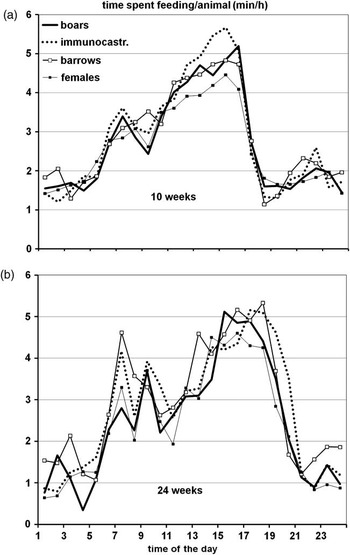
Feeding activity in all groups revealed a clear diurnal pattern. In 10-week-old animals (Figure 2a), occupation time per hour and per animal was below 2 min from 1800 until 0500 h except a transient increase between 2100 and 2200 h up to 2.5 min/h and individual in all groups. Feeding activity started to increase immediately after the light was switched on (0600 h) and reached a maximum of 4.5 to 5.5 min/h and per animal at 1500 h (gilts, immunocastrates, barrows) or 1600 h (boars). In older animals (24 weeks of age, Figure 2b) the pattern revealed a clear bimodal course along the day with a first maximum around 0700 h, a nadir between 1000 and 1100 h and highest feed intake between 1500 and 1800 h. Feeding activity was below 2 min/h and per animal from 2100 to 0500 h
Diurnal pattern of feeding activity (minutes spent feeding/animal and hour) in boars, gilts, barrows and immunocastrates at an age of 10 weeks (a) and 24 weeks (b).

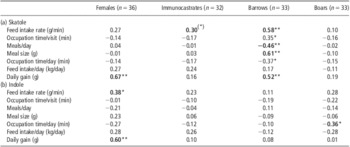
Overall daily gain and feed intake criteria during the last week before slaughter were related to the concentrations of skatole and indole in adipose tissue. The evaluation revealed that in addition to influences of sex and treatment the variation in the concentrations of both indoles in gilts and barrows was correlated to the feed parameter and the growth rate. Data are summarized in Table 3a and b.
(a and b) Pearson correlations between skatole (a) and indole (b) concentrations in adipose tissue, daily gain in the fattening period and feed intake characteristics in the week before slaughter in the four groups

Asterisks indicate levels of significance: *P < 0.05; **P < 0.01; ***P < 0.001; (*)P < 0.10.
Bold values indicate significant corrections (P < 0.10).
Significant relationships were found in gilts and barrows between skatole concentrations in adipose tissue and daily gain during the fattening period. In barrows even a higher correlation was found between skatole and the feed intake rate. In gilts this relationship was not significant but feed intake rate correlated significantly with indole concentrations. In this group also daily gain and indole concentrations were significantly related. In boars only a negative relationship between occupation time and indole concentrations was significant, a similar tendency was obvious for skatole and occupation time also in boars and all other groups. In addition, in barrows the meal size was positively related to skatole concentrations.
In boars, additionally, relationships between feed intake characteristics and androstenone were evaluated but were not significant.
Discussion
In the present study, feed intake behavior in boars, barrows, immunocastrates and gilts was evaluated along the fattening period and related to the concentrations of skatole and indole. It is well known, that the concentration of skatole is influenced by several endogenous and exogenous factors. In contrast to androstenone, which is synthesized in the testes and thus strictly sex specific, skatole formation in the hindgut is influenced by several endocrine parameters, feed composition and environmental influences (Claus et al., Reference Claus, Weiler and Herzog1994 and Reference Claus, Raab and Röckle1996; Zamaratskaia et al., Reference Zamaratskaia, Rydhmer, Andersson, Chen, Andersson and Lundstrom2008b).
The diurnal pattern of feed intake described for older animals in the present study fit the pattern reported by Cronin et al. (Reference Cronin, Dunshea, Butler, McCauley, Barnett and Hemsworth2003), who reported a similar bimodal diurnal pattern for the time spent feeding per hour. In contrast, in a study with growing Yorkshire pigs selected for differences in residual feed intake, a similar bimodal pattern as was only found for the number of visits/2-h block along the day, but not for occupation time, was seen, which was constantly high between 1200 and 2000 h (Young et al., Reference Young, Cai and Dekkers2010). No sex differences or treatment differences were obvious in the diurnal pattern, but pronounced differences in feed intake behavior along the fattening period occurred.
In boars a reduced feed intake and duration of meals have been described (de Haer and de Vries, Reference de Haer and de Vries1993; Cronin et al., Reference Cronin, Dunshea, Butler, McCauley, Barnett and Hemsworth2003) and are explained by suppressive effects of testicular androgens and estrogens on feed intake (Czaja, Reference Czaja1984; Claus and Weiler, Reference Claus and Weiler1987; Weiler et al., Reference Weiler, Claus, Schnoebelen-Combes and Louveau1998; Santollo et al., Reference Santollo, Torregrossa and Eckel2011). Immunocastration led to a pronounced increase in feed intake, which even exceeded that of barrows of the same age by far. In immunocastrates low androstenone concentrations in adipose tissue at slaughter confirmed that the formation of testicular steroids stopped after the second injection of Improvac in the present study. A higher feed intake in immunocastrated animals than in boars and barrows during the late fattening period has been described already by others, but no details on feeding behavior were given (Dunshea et al., Reference Dunshea, Colantoni, Howard, McCauley, Jackson, Long, Lopaticki, Nugent, Simons, Walker and Hennessy2001). The increase in feed intake in immunocastrates did not result from a change in the number of meals per day, as found in barrows. This parameter remained at the same level as in their entire male littermates till the end of the study, as similarly described for boars under different housing conditions (Morrison et al., Reference Morrison, Hemsworth, Cronin and Campbell2003). In contrast, the duration of the meal increased slightly after the immunocastration and an even more pronounced acceleration of the feeding rate was observed. The feeding rate after immunocastration was increased immediately after the second immunization and remained higher than in all other groups. This phenomenon however needs further investigations, as a relationship between feeding behavior and the concentrations of indole and skatole in adipose tissue within groups was found. It is well known that the variation in skatole and indole formation in pigs is mainly influenced by sex and feed composition (Claus et al., Reference Claus, Weiler and Herzog1994; Dunshea et al., Reference Dunshea, Colantoni, Howard, McCauley, Jackson, Long, Lopaticki, Nugent, Simons, Walker and Hennessy2001). Within pigs of the same gonadal status and feeding regimen, the feed intake behavior may contribute to the variability. The relationship between the formation of indoles in the hindgut of pigs and feeding behavior may be explained under these experimental conditions by social interactions within the groups. The feeder allows access of only one animal at the time. The head of the animal is protected to ensure that only that animal has access to the feed. Other animals, even higher ranking animals, may attack lower ranking animals during feeding, such a behavior may result in an accelerated feed intake rate in low ranking animal. In boars it is known that social rank is positively correlated with androstenone concentrations (Giersing et al., Reference Giersing, Lundström and Andersson2000; Fredriksen et al., Reference Fredriksen, Lium, Marka, Heier, Dahl and Choinski2006), whereas skatole may be increased under conditions with elevated cortisol secretion (Claus and Weiler, Reference Claus and Weiler1994; Hansen et al., Reference Hansen, Larsen, Jensen, Hansen-Moller and Barton-Gade1994).
For each group, however, specific consequences of a changed intake rate on skatole and indole concentrations were observed: In animals with an overall reduced feed intake due to gonadal steroid production (boars, gilts), feed intake rate was not as closely associated with skatole concentrations as in both types of castrates. In immunocastrates with an overall high feed intake rate significantly higher indole concentrations were measured than in all other groups. It is known that the levels of enzymes that are involved in the degradation of skatole (CYP2E1 and CYP2A) are increased in barrows and immunocastrates when compared with the levels in boars (Zamaratskaia et al., Reference Zamaratskaia, Zlabek, Chen and Madej2009; Brunius et al., Reference Brunius, Rasmussen, Lacoutiére, Andersson and Zamaratskaia2012). In vitro studies with porcine hepatocytes revealed that the addition of androstenone in physiological amounts reduced the activity of both enzymes (Doran et al., Reference Doran, Whittington, Wood and McGivan2002b; Rasmussen et al., Reference Rasmussen, Zamaratskaia and Ekstrand2011). Such mechanisms may contribute to lower skatole concentrations in adipose tissue of immunocastrated than in boars, as found in this study. The reason for the increase in indole concentrations is not known, it may be assumed, however, that the rapid intake of high amounts of feed by immunocastrates may alter the pH in the digestive tract in direction of a higher pH. Such a change would favor the indole forming microorganisms at the expense of skatole forming ones, as shown in vitro (Jensen et al., Reference Jensen, Cox and Jensen1995; Jensen and Jensen, Reference Jensen and Jensen1998).
Because of a low variability within feed intake, the correlation between indoles and feed intake rate within the group was lower than in barrows and was not significant. In barrows and immunocastrates, the two groups with highest daily feed intake, the feed intake rate was significantly related to skatole concentrations. In gilts, a close relationship was found between growth rate and the concentrations of both indoles, and in barrows growth rate influenced only the skatole concentrations. In boars, the group with lowest feed intake, the time spent feeding per day was negatively correlated with indole concentrations. The data suggest that independent of the sex specific level of feed intake, a slow feed intake and a prolonged feeding duration coincides with reduced concentrations of tryptophan metabolites in adipose tissue. These differences in feed intake behavior seem to contribute to the variability of skatole and indole concentrations within a gender group. Overall, the data fit to results from former studies, where elevated skatole formation was reported in sows during estrous, when feed intake was reduced (Claus et al., Reference Claus, Bernal-Barragan and Dehnhard1991). Similarly elevated formation and accretion of indoles was reported, when the energy content of the ration was increased (Claus and Raab, Reference Claus and Raab1999), a condition where the energy intake rate is also increased and occupation time is reduced. Supplements of inulin lead to a reduced energy intake rate and may reduce skatole formation. For these supplements, other mechanisms may contribute, such as butyrate formation in the colon. In contrast, however, various fiber supplements have an opposite effect on skatole formation (Hansen et al., Reference Hansen, Stolzenbach, Jensen, Henckel, Hansen-Møller and Syriopoulos2008). Whether this effect is related to changes in the intestinal milieu due to feed intake rate or due to social stress and possible changes in cell turnover and thus tryptophane availability due to changed amounts of cell debris need further investigations.