The family Batrachoididae, or toadfish, is the sole family in the order Batrachoidiformes (Haplodoci). They are a group of small to medium-sized bottom fish represented by 25 genera and 78 species (Greenfield et al., Reference Greenfield, Winterbottom and Collette2008) that inhabit warm waters of the coasts of America, Europe, Africa and India. Colletteichthys dussumieri is the only species in the genus Colletteichthys.
Valenciennes, in Cuvier & Valenciennes (Reference Cuvier and Valenciennes1837) described Batrachus dussumieri from Malabar, India, but the genus Batrachus is unavailable (Greenfield, Reference Greenfield2006). Day (Reference Day1876), in his classical work on the ‘Fishes of India’, has given the systematic account of this species as Batrachus grunniens (Bloch.) (Hutchins, Reference Hutchins1981). Bhimachar & Venkataraman (Reference Bhimachar and Venkataraman1952), while studying the inshore fish population of the Malabar coast, reported the species as Batrachus grunniens (Bloch.). Smith (Reference Smith1949) described the genus Austrobatrachus for the South African species Pseudobatrachus foedus Smith, 1947. Menon (Reference Menon1963) utilized Smith's genus for B. dussumieri; with the exception of Nagabhushanam & Rama Rao (Reference Nagabhushanam and Rama Rao1970) who used Halophyrne; the species has been referred to as A. dussumieri (Hutchins, Reference Hutchins1981, Reference Hutchins, Fischer and Bianchi1984; Randall, Reference Randall1995; Carpenter et al., Reference Carpenter, Harrison, Hodgson, Alsaffar and Alhazeem1997). While comparing dussumieri with Austrobatrachus foedus Greenfield (Reference Greenfield2006) observed wide deviation between their morphology and described a new genus Colletteichthys for the species and later placed it in the subfamily Halophyryninae (Greenfield et al., Reference Greenfield, Winterbottom and Collette2008). It is often misidentified as Batrachus grunniens (Linnaeus, Reference Linnaeus1758), now called Allenbatrachus grunniens.
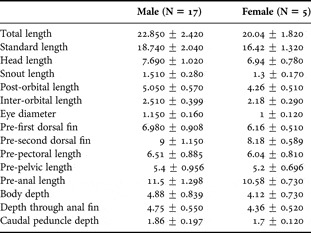
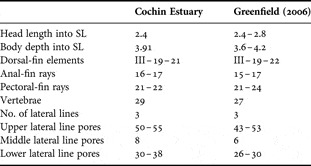
Specimens of C. dussumieri were collected from Cochin Estuary (south-west coast of India) using gill-nets (70-mm). Morphometric and meristic characters are given in Table 1. The specimens agree well with the data from the holotype given by Greenfield (Reference Greenfield2006) (Table 2), except in the vertebral and lateral pore count. Randall (Reference Randall1995) in his book states that the species may occur in coral reefs or in seagrass or weedy bottoms and has been collected in tidepools. This first record of C. dussumieri from the Indian estuary corroborates the statement of Randall (Reference Randall1995) and indicates a marked extension of the distribution from its type locality (Malabar, 30 fathoms) and divergence in meristic and morphological characters.
Morphometric measures of Colletteichthys dussumieri (in mm, mean ± standard deviation) from estuarine waters of India.

Comparison of selected meristics and proportional measurements of Colletteichthys dussumieri from the Cochin Estuary with the holotype (Greenfield, Reference Greenfield2006).

DESCRIPTION
Three solid dorsal-fin spines without venom glands; three solid opercular and one short subopercular spine, often with a small second point below; two subopercular filaments; upper accessory pectoral-fin radial totally ossified; three lateral lines present, the upper with 43–53 pores, the middle with about six, and the lower with 26–30; no photophores; no scales; a funnel-shaped pit at top of pectoral-fin axil, with glandular tissue inside and extending from ventral pit margin onto axil; interorbital areas not crossed by conspicuous skin ridges; head into SL 2.4 to 2.8 times; two rows of pointed teeth in anterior portion of lower jaw; sides of lower jaw with single row of pointed teeth; upper jaw with three rows of pointed teeth anteriorly, two rows on side, grading into single row posteriorly; vomer and palatine with single row of pointed teeth; dorsal-fin elements III, 19–22; anal-fin rays, 15–17; pectoral-fin rays, 21–24; vertebrae, 29. The colour pattern light brown, shading to white ventrally, with four, irregular, branching, dark brown bars on body and dark bands and blotches on head and fin. Maximum length obtained is 30.5 cm.
ACKNOWLEDGEMENT
We thank Dr David W. Greenfield, CAS for his valuable suggestions.