Introduction
The taxonomy of the genus Pungentus Thorne & Swanger, 1936 was recently revised, new features delimitating the genus were proposed, and an identification key for its 16 valid species was given (Álvarez-Ortega and Peña-Santiago, Reference Álvarez-Ortega and Peña-Santiago2014). Besides several taxonomic studies on this interesting genus (a history given by Álvarez-Ortega and Peña-Santiago, Reference Álvarez-Ortega and Peña-Santiago2014), some authors have focused on its plant-association aspects. According to the aforementioned study, all 16 valid species are associated with natural forest plants. In the study of Peña-Santiago et al. (Reference Peña-Santiago, Ciobanu and Abolafia2013), four species were recovered from several locations in the Iberian Peninsula in association with higher plant taxa. The needle-like odontostyle seems to be an adaptation for piercing root cells of higher plants; however, characterization of nematode pharyngeal secretions injected into the plant cell cytoplasm and their function, and the economic aspects of their feeding, are yet to be studied. Yeates (Reference Yeates1982) studied population changes of Pungentus maorium Clark, 1963 (now synonym to P. silvestris (de Man, 1912) Coomans & Geraert, 1962, see Álvarez-Ortega and Peña-Santiago, Reference Álvarez-Ortega and Peña-Santiago2014) during 36 months, and Jairajpuri and Ahmad (Reference Jairajpuri and Ahmad1992) argued that the common stylet form in the three genera Pungentus, Enchodelus Thorne, 1939 and Californidorus Robbins & Weiner, 1978 could be the ancestral state for the well-evolved longidorid-type odontostyle, adopted for plant parasitism.
Pungentus is currently known in Iran with P. silvestris reported as P. thornei (Goodey, 1943) (Solouki et al., Reference Solouki2010). The aforementioned study is in the form of an abstract, with no morphological or molecular data available. There are, however, some reports of species of the genus in the form of university theses, but based on our knowledge, there are none in the form of taxonomic papers.
Following our studies on identification of nordiid taxa occurring in Iran (Pourjam et al., Reference Pourjam2010; Pedram et al., Reference Pedram2009a,Reference Pedramb, Reference Pedram2011a,Reference Pedramb, Reference Pedram2015), several populations of the genus Pungentus, representing one new and a known species, were recovered from natural and agricultural regions of the country. Thus, the present study aims to describe the newly recovered species as P. azarbaijanensis n. sp. and characterize both species based upon their morphological and molecular data.
Materials and methods
Sampling, extracting, mounting and drawing
Several soil samples were collected from cultivated and non-cultivated (grasslands and forests) regions of East and West Azarbaijan, Semnan and Mazandaran provinces. The soil samples were stored at cold temperature until the nematodes were extracted. The tray method (Whitehead and Hemming, Reference Whitehead and Hemming1965) was used to extract the nematodes from soil. Nematodes of interest were handpicked under a Nikon SMZ1000 stereomicroscope, heat-killed by adding boiling 4% formalin solution, transferred to anhydrous glycerin according to De Grisse (Reference De Grisse1969), mounted on permanent slides, and examined using a Nikon Eclipse E600 light microscope. Photographs were taken using an Olympus DP72 digital camera attached to an Olympus BX51 microscope powered with differential interference contrast. Drawings were made using a drawing tube attached to the microscope and were redrawn using CorelDRAW software version 17. The location of pharyngeal gland nuclei was calculated following Andrássy (Reference Andrássy1998).
DNA extraction, PCR and sequencing
Two live nematode specimens of the new species and one live specimen of P. engadinensis from the Noshahr and Damghan populations were used for DNA extraction. Each individual was washed and observed under a temporary slide, transferred to a small drop of TE buffer (10 mm Tris-Cl, 0.5 mm EDTA; pH 9.0; Qiagen) on a clean slide and squashed using a clean cover slip, and the pressure of a plastic pipette tip. The suspension was collected by adding 15 μl TE buffer. The DNA samples were stored at −20°C until used as polymerase chain reaction (PCR) templates. Primers for 28S rDNA D2-D3 amplification/sequencing were forward primer D2A (5´-ACAAGTACCGTGAGGGAAAGT-3´) (Nunn, Reference Nunn1992) and reverse primer KK28S-4 (5´-GCGGTATTTGCTACTACCAYYAMGATCTGC-3´) (Kiontke et al., Reference Kiontke2004) (several attempts to get the expected amplified fragments using the commonly used reverse primer D3B (5´-TGCGAAGGAACCAGCTACTA-3´) (Nunn, Reference Nunn1992) were not successful). PCR products were purified and sequenced directly for both strands using the same primers used in PCR with an ABI 3730XL sequencer (Bioneer Corporation, South Korea). Sequences were deposited in the GenBank database (accession numbers MH346473 for P. engadinensis Damghan population, MH346474 for P. engadinensis Noshahr population, and MH346476 and MH346477 for two isolates of P. azarbaijanensis n. sp.).
Phylogenetic analyses
The newly generated sequences in this study were compared with those of other relevant sequences from other nematodes deposited in the GenBank database using the BLAST homology search program. Almost all available 28S rDNA D2-D3 sequences of nordiid taxa were downloaded. Five dorylaim species were also used as outgroup taxa (for species names and accession numbers see the tree). The sequences were aligned using the Q-INS-i algorithm of the online version of MAFFT version 7 (http://mafft.cbrc.jp/alignment/server/) (Katoh and Standley, Reference Katoh and Standley2013). Poorly aligned positions and divergent regions were eliminated using the online version of Gblocks 0.91b (Castresana, Reference Castresana2000) using all three less stringent options. The model of base substitution was selected using MrModeltest 2 (Nylander, Reference Nylander2004). The Akaike-supported model, a general time-reversible model including among-site rate heterogeneity and estimate of invariant sites (GTR + G + I), was selected for phylogenetic analysis. Bayesian analysis was performed using MrBayes v3.1.2 (Ronquist and Huelsenbeck, Reference Ronquist and Huelsenbeck2003), running the chains for one million generations. Burn-in phase was set at 25% of the converged runs. The Markov chain Monte Carlo (MCMC) method within a Bayesian framework was used to estimate the posterior probabilities of the phylogenetic tree (Larget and Simon, Reference Larget and Simon1999) using the 50% majority rule. To visualize the results of each run in order to check the effective sample size of each parameter, Tracer v1.5 (Rambaut and Drummond, Reference Rambaut and Drummond2009) was used. A maximum likelihood (ML) tree was reconstructed by using RaxmlGUI 1.1 software (Silvestro and Michalak, Reference Silvestro and Michalak2011) based on the same nucleotide substitution model as in the Bayesian analysis in 1000 bootstrap (BS) replicates. The output file of MrBayes was visualized using Dendroscope v3.2.8 (Huson and Scornavacca, Reference Huson and Scornavacca2012) and redrawn in CorelDRAW version 17.
Results
Pungentus azarbaijanensis n. sp.
Order: Dorylaimida; Suborder: Dorylaimina. Figures 1 and 2 show diagrams and micrographs of P. azarbaijanensis n. sp.
Line drawings of Pungentus azarbaijanensis n. sp. (a) Female, entire body. (b) Neck region. (c) Anterior body region. (d) Lip region in surface view. (e) Tail. (f) Anterior genital branch. (g) The canal-like differentiation at tail end.

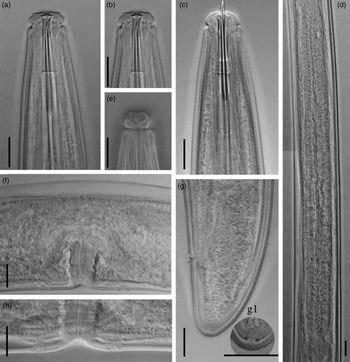
Photomicrographs of female of Pungentus azarbaijanensis n. sp. (a, b) Anterior region in median view, showing odontostyle. (c) Lip region and odontostyle. (d) Pharyngeal expansion. (e) Lip region in surface lateral view. (f) Vulval region and papillae. (g) Tail. (g1) Canal-like differentiation at tail end. (h) Details of vagina. Scale bars = 10 μm.

Measurements
The morphometrics of P. azarbaijanensis n. sp. are presented in table 1.
Morphometrics of Pungentus azarbaijanensis n. sp. and Iranian and some European populations of P. engadinensis. All measurements are in μm and in the form Mean ± SD (range).

* By having a wide range observed for some indices, the mean values were calculated for these two individuals.
Description
Female. Body long and slender, narrowing very gradually towards both extremities, more so towards the anterior end, slightly ventrally curved after heat relaxation. Cuticle three-layered (the three layers distinctly visible on the dorsal side of the caudal region), with fine transverse striation, 1.0–2.5 μm thick at guiding ring level, 2–3 μm thick at mid body, 2–3 μm thick at anus, and 2.5–3.5 μm thick at tail tip, detached from the body in some parts after transferring of the specimens to pure glycerin. Lip region moderately angular, 2.0–2.4 times wider than high, separated from the rest of the body by a constriction, cephalic and labial papillae protruding, large and distinct. Amphidial fovea cup-shaped, large, its slit 7.0–8.5 μm wide, or 55–65% of lip region width wide, at the level of lip region constriction. Cheilostome slender, its walls sclerotized, slightly widened at base (at fixed guiding ring level), guiding ring double, perioral refractive platelets prominent, triangle-shaped. Odontostyle needle-like, well developed and sclerotized, furcate at base, 2.5–2.9 times longer than lip region width, odontophore rod-like, slightly shorter than odontostyle. Pharynx dorylaimoid, the anterior part narrower, enlarging gradually. Pharyngeal gland nuclei located as follows: D = 57, 57, AS1 = 35.5, 39.5, AS2 = 47, 49, PS = 73.0, 78.5 (n = 2). Cardia hemispheroid, 8–12 × 8–9 μm sized. Intestine simple with or without green material, prerectum 2.2–2.5 times, and rectum 1.0–1.8 times anal body diameter long. Reproductive system didelphic-amphidelphic, genital branches equally sized, the anterior branch 244–245 μm long, the posterior branch 215–220 μm long, each branch composed of a small ovary 48–55 and 35–40 μm long (anterior and posterior, respectively), oviduct with developed pars dilatata oviductus 96–110 and 60–99 μm long (anterior and posterior, respectively), a sphincter, a simple tubular uterus 146–160 and 160–169 μm long (anterior and posterior, respectively), vagina 25–31 μm long, perpendicular to body axis, composed of pars proximalis vaginae about twice as long as wide, pars refringens vaginae with two weakly sclerotized pieces each about as wide as high, 3.5 μm (holotype), pars distalis vaginae, and vulva a transverse slit. Papillae were observed anterior and posterior to the vulval slit. Tail rounded-conoid, dorsally convex, ventrally flat, with a narrow canal-like differentiation at tip, originating from the middle cuticle layer, passing through the third layer.
Male. Not found.
Taxonomic summary
Etymology. The specific epithet refers to the type locality of the new species, West Azarbaijan province.
Type habitat and locality. Rhizosphere of grasses, West Azarbaijan province, north-western Iran. GPS coordinates: 38°58.525′N, 44°52.861′E.
Type material. Holotype and one paratype female were deposited in the WaNeCo collection, Wageningen, The Netherlands (www.waneco.eu/), and two paratype females in the USDA Nematode Collection, Beltsville, MD, USA.
Diagnosis and relationships
Pungentus azarbaijanensis n. sp. is characterized by 2082–2365 μm long females with didelphic-amphidelphic reproductive system, lip region separated from the rest of the body by a constriction, 33–35 μm long odontostyle, 175–194 μm long pharyngeal expansion, vulva located at 43.5–51.0%, rounded-conoid tail and absence of males.
By having a long body (longer than 1.5 mm), didelphic-amphidelphic female reproductive system and odontostyle longer than 20 μm, the new species resembles P. angulosus Thorne, 1939, P. crassus Thorne, 1974, P. marietani Altherr, 1950, P. parapungens Gagarin, 1985 and P. pungens Thorne & Swanger, 1936. The differences with these species are as follows:
From P. angulosus by straight (vs slightly curved) and longer odontostyle (2.5–2.9 times lip region width long vs twice), anteriorly located vulva (V = 43.5–51.0 vs 52%), greater c′ (1.0–1.1 vs 0.8), body width at base of pharyngeal bulb 2.1–2.5 times wider than lip region width (vs four), and tail lacking blisters (vs present).
From P. crassus by greater a (47.6–59.1 vs 31), greater b (6.0–6.8 vs 5), rounded-conoid (vs rounded) and shorter female tail (27.0–29.5 vs 40 μm, c′ = 1.0–1.1 vs 0.8, c = 71–87 vs 50) lacking blisters (vs abundant).
From P. marietani by a longer body of female (2082–2365 vs 1150–1660 μm), longer odontostyle and odontophore (33–35 vs 22–28 μm, and 29–34 vs 22–28 μm, respectively) (the length of odontophore of P. marietani after Peña-Santiago et al., Reference Peña-Santiago, Ciobanu and Abolafia2013), and greater a (47.6–59.1 vs 25–44).
From P. parapungens by longer body (2082–2365 vs 1460–1770 μm), greater a (47.6–59.1 vs 18–22) and longer odontostyle (33–35 vs 21–23 μm).
And from P. pungens by longer body (2082–2365 vs 1510–2040 μm), angular lip region separated from the rest of the body by a remarkable constriction vs lip region rounded, offset with less constriction, longer odontostyle (33–35 vs 20–23 μm), saccate bodies (blisters) on tail absent (vs present) and lacking males (vs present).
Iranian populations of Pungentus engadinensis Altherr, 1950
Figures 3–4 show micrographs of Iranian populations of P. engadinensis.
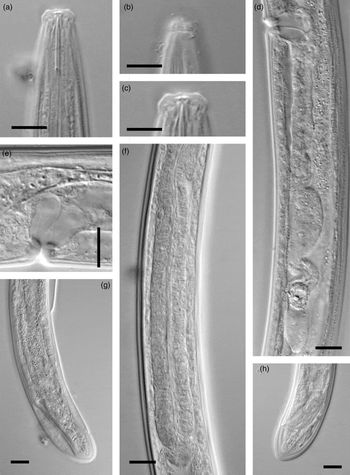
Photomicrographs of female of Iranian population of Pungentus engadinensis Altherr, 1950 (Arasbaran isolate). (a & c) Details of anterior end. (c) Lip region, surface lateral view. (d) Posterior genital branch. (e) Vagina. (f) Pharyngeal expansion (terminal bulb). (g & h) Posterior body region (h: showing a detached cuticle from body during fixation and transferring to pure glycerin). Scale bars = 10 μm.

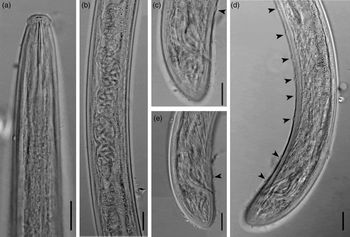
Photomicrographs of male of Iranian population of Pungentus engadinensis Altherr, 1950 (Damghan isolate) (a) Anterior region. (b) Part of reproductive system, showing testes and sperm cells. (c & e) Caudal region showing the last ventromedian supplement (c) and spicules and the cloacal pair of the supplements (e). (d) Posterior body region and copulatory supplements. Scale bars = 10 μm.

Measurements
The morphometrics of Iranian populations of P. engadinensis are presented in table 1. In this study, three populations of P. engadinensis were recovered from three cities: Damghan in Semnan province (from the rhizospheric soil of fruit trees), Kaleibar in East Azarbaijan province (in association with grasses in natural grasslands, close to Babak Fort), and Noshahr in Mazandaran province (from rhizospheric soil of forest trees). The occurrence of the species has already been reported informally from some parts of the country, with no accessible morphological and morphometric data. The morphology and the range of morphometric data of the Iranian populations studied here agree well with the data given for the type population by Altherr (Reference Altherr1950) and the ranges given by Andrássy (Reference Andrássy, Csuzdi and Mahunka2009), Coomans and Geraert (Reference Coomans and Geraert1962) and Peña-Santiago et al. (Reference Peña-Santiago, Ciobanu and Abolafia2013). According to the aforementioned studies, this is the most common species of the genus, having a cosmopolitan distribution, occurring in Canada (Winiszewska-Slipinska, Reference Winiszewska-Slipinska1987), Hungary (Andrássy, Reference Andrássy1962), Iraq (Vinciguerra, Reference Vinciguerra, Eyualem, Andrássy and Traunspurger2006), Italy (Zullini, Reference Zullini1971, Reference Zullini1975), the United Kingdom (Wasilewska, Reference Wasilewska1967) and several other countries (Andrássy, Reference Andrássy, Csuzdi and Mahunka2009; Peña-Santiago et al., Reference Peña-Santiago, Ciobanu and Abolafia2013). According to Coomans and Geraert (Reference Coomans and Geraert1962), the cuticle is detached from some parts of the body in specimens transferred to pure glycerin; this was also observed in the case of the Iranian populations studied here. The tail of females of the Belgian population lacked blisters, and the Iranian populations also lacked blisters on the tail. According to Peña-Santiago et al. (Reference Peña-Santiago, Ciobanu and Abolafia2013), the cuticle of this species is distinctly three-layered, and the tail could have blisters or not. According to Andrássy (Reference Andrássy, Csuzdi and Mahunka2009), the anterior uterine sac is rudimentary, which was also observed for the Iranian populations, or could be slightly larger, as illustrated by Coomans and Geraert (Reference Coomans and Geraert1962) and Peña-Santiago et al. (Reference Peña-Santiago, Ciobanu and Abolafia2013).
Molecular phylogenetic relationships
D2-D3 fragment of 28S rDNA phylogeny
To determine the phylogenetic relationships of the two Pungentus species recovered in this study with other dorylaim nematode species, four newly generated sequences with already assigned accession numbers and isolate codes were used. The two newly generated sequences for two Iranian populations of P. engadinensis were almost identical, and only one different nucleotide was observed between them. The BLAST search using these two sequences revealed they (MH346473 and MH346474) have 99% identity with the homologous sequence of an isolate of the same species (AY593050) (eight mismatches and three gaps, and six mismatches and three gaps, respectively). The identity of these two sequences with two isolates of P. silvestris (de Man, 1912) Coomans & Geraert (1962) (AY593052 and AY593053) was 97% and 96%, respectively, and the identity with a species identified as Enchodelus macrodorus (de Man, 1880) Thorne, 1939 (AY593054) was 96%. The BLAST search using LSU D2-D3 sequences of the new species revealed they have 99% identity with several isolates of P. monohystera Thorne & Swanger, 1936 (MF325340–MF325344), but the coverage of our sequences with aforementioned sequences of P. monohystera was 53% for all isolates.
Almost all available 28S rDNA D2-D3 sequences of members of the family, including four newly generated sequences and several other sequences of dorylaim taxa (considering the non-monophyletic nature of the family Nordiidae Jairajpuri & Siddiqi, 1964), comprising 43 sequences, plus one tylencholaim outgroup taxon (for species names and accession numbers see the tree) were used for reconstructing the 28S phylogeny. The alignment included 648 characters, of which 282 were variable.
In this tree (fig. 5), four species of the genus Pungentus fell into a major clade (see discussion), and their relations were not resolved due to polytomy. The two Iranian isolates of P. engadinensis formed a clade with a European isolate of the species, with high clade support (1.00 BPP, and 98% ML BS). The new species, P. azarbaijanensis n. sp., also occupied a place in this major clade, and its relationship with other species was not resolved due to polytomy. The species Enchodelus macrodorus (AY593054) formed a clade with two isolates of Pungentus silvestris (AY593052 and AY593053).
Consensus 50% majority rule Bayesian phylogenetic tree of Pungentus azarbaijanensis n. sp. and Iranian isolates of P. engadinensis Altherr, 1950 based on 28S rDNA D2-D3 sequences under GTR + G + I model. Bayesian posterior probabilities and maximum likelihood bootstrap values > 50% are given on appropriate clades in the form BPP/ML BS. The new sequences are in bold.

Discussion
In this study, two species of the genus Pungentus were studied and illustrated based upon their morphological and molecular characters. Both species were recovered from rhizospheric soil samples of higher plant taxa.
In the present molecular phylogenetic study, dichotomous cladogenesis events were not observed in the major clade including the sequences of Pungentus spp. However, monophyly of the genus was observed, and further sequences of other representatives of the genus are needed to assess their monophyly. In our tree, a European (?) isolate of P. engadinensis with accession number AY593050 formed a clade with two Iranian isolates. The morphological data of that aforementioned isolate were not available, and its identity may require further confirmation. We also found that the sequence with the accession number AY593054, assigned to Enchodelus macrodorus, belongs to a Pungentus sp., probably P. silvestris. Again, no morphological data for this isolate were available. Our LSU phylogenetic tree, however, shows that the D2-D3 marker of LSU rDNA could help species identification under the genus Pungentus, but cladogenesis events inside the putative Pungentus clade could be influenced by different alignment/post-editing methods. The other fast-evolving markers, such as internal transcribed spacer (ITS) regions of rDNA, and non-genomic markers, such as mitochondrial cytochrome c oxidase subunit I gene (COI mtDNA), could also be tested for unravelling the phylogenetic relations of Pungentus spp.
Author ORCIDs
M. Pedram, 0000-0001-7640-507X
Acknowledgements
The authors appreciate the kind help of Dr Mohammad Reza Atighi, who provided technical assistance. The financial support of Tarbiat Modares University is also appreciated.
Conflict of interest
None.