





Introduction
Spray drones, or unmanned aerial spray systems (UASS), are increasingly employed for the application of pesticides for plant protection (He et al. Reference He, Bonds, Herbst and Langenakens2017; Weicai and Panyang Reference Weicai and Panyang2023). Compared with ground-based equipment, spray drones can access difficult terrain, prevent soil compaction, minimize crop canopy damage, and improve operator safety (Soman et al. Reference Soman, Gnanasekaran, Natarajan, Alsaidi, Balasubramanian, Natarajan and Chelliah2024). Furthermore, drones have the capacity for precision spraying, which reduces chemical inputs and consequently lowers the selection pressure of pest resistance (Nobre et al. Reference Nobre, Santos, Herrera, Araújo, Johann, Gurgacz, Siqueira and Prior2023). As spray drone technology has seen widespread adoption globally, particularly in East Asia, it still remains an emerging but rapidly growing field in the United States (Ozkan Reference Ozkan2024).
Rotary wing drones are commonly used for spraying in the agricultural sector due to lower costs and their ability to apply treatments with high precision (Thompson et al. Reference Thompson, Shi and Ferguson2017). There are two types of rotary wing drones, single-rotor and multi-rotor drones (Borikar et al. Reference Borikar, Gharat and Deshmukh2022; Soman et al. Reference Soman, Gnanasekaran, Natarajan, Alsaidi, Balasubramanian, Natarajan and Chelliah2024). Single-rotor drones are mostly used for longer flight times and heavier payloads, such as crop broadcast spraying. Meanwhile, multi-rotor drones are commonly used for precision agriculture due to their maneuverability and hovering capacities (Guebsi et al. Reference Guebsi, Mami and Chokmani2024; Meesaragandla et al. Reference Meesaragandla, Jagtap, Khatri, Madan and Vadduri2024). Recent developments of these multi-rotor drones led to rotary disk atomizers, which use the speed of disks or centrifugal nozzles to create spray droplets (Ozkan Reference Ozkan2024). This development produces droplets with less pressure, where higher rotational speeds produce smaller droplets and lower rotational speeds produce larger droplets (Chen et al. Reference Chen, Douzals, Lan, Cotteux, Delpuech, Pouxviel and Zhan2022). Rotary disk atomizer drones have advantages and disadvantages. Unlike hydraulic nozzle drones, rotary disk atomizer drones cannot come very close to the target, as injury to the crop can occur (Ozkan Reference Ozkan2024). They also do not have nozzle selection flexibility whereby an optimal orifice size and spray pattern can be chosen for specific uses. However, the disks mounted on the multi-rotor drone provide better uniformity than drones with hydraulic nozzles, while also avoiding nozzle clogging and repair (Chen et al. Reference Chen, Douzals, Lan, Cotteux, Delpuech, Pouxviel and Zhan2022; Qingqing et al. Reference Qingqing, Xinyu, Weicai, Chen and Liangfu2017; Yang et al. Reference Yang, Li, Tang, Hu, Yan and Zhang2025). At the same time, operators can precisely adjust drone settings directly from the remote controller of the rotary disk atomizer drone, which simplifies machine operation. As a result, multi-rotor drones with rotary disk atomizers are increasingly being adopted by drone operators for agricultural applications (Qingqing et al. Reference Qingqing, Xinyu, Weicai, Chen and Liangfu2017; Felipe Oliveira Ribeiro et al. Reference Felipe Oliveira Ribeiro, Leandro da Vitória, Pereira Bastos, Vieira Zanelato, de Assis Martins Júnior, de Vicente Ferraz, Gomes dos Santos, de Assis Ferreira, Victor Oliveira Ribeiro, de Assis Silva and Chen2025).
The rapid commercialization of spray drones is evolving faster than research data can support it. This means that while spray drones are currently being used for pesticide applications, data to ensure proper applications are lacking, raising concerns about efficacy and environmental safety (Houston, Reference Houston2022). To our knowledge, there are only two studies that determined flight parameters for optimal deposition of rotary disk atomizer drones (Caputti et al. Reference Caputti, de Oliveira, Rodrigues, Cremonez, Foshee, Simmons and da Silva2025; Felipe Oliveira Ribeiro et al. Reference Felipe Oliveira Ribeiro, Leandro da Vitória, Pereira Bastos, Vieira Zanelato, de Assis Martins Júnior, de Vicente Ferraz, Gomes dos Santos, de Assis Ferreira, Victor Oliveira Ribeiro, de Assis Silva and Chen2025), despite the increasing adoption of this system. Compounding this issue is that pesticide label language for drone spraying requires drone operators to follow aerial instructions that were written specifically for airplanes and helicopters. Parameters such as height and droplet size are dictated on the label according to aircraft functionality. However, drones differ fundamentally from manned aircraft in their aerodynamics, rotor downwash, flight speeds, payload capacities, and operating altitudes, and therefore likely require platform-specific guidelines. Among the most significant concerns for drone spraying is spray drift (Butts et al. Reference Butts, Fritz, Kouame, Norsworthy, Barber, Ross, Lorenz, Thrash, Bateman and Adamczyk2022). Mitigating this requires establishing optimal operational parameters, yet such research is limited and highly platform dependent (García-Munguía et al. Reference García-Munguía, Guerra-Ávila, Islas-Ojeda, Flores-Sánchez, Vázquez-Martínez, García-Munguía and García-Munguía2024; Ozkan Reference Ozkan2024).
The optimal spraying efficiency and uniform deposition of the drone depends on the flight height, speed, application rate, nozzle type, droplet size, spray pressure, adjuvants, and meteorological factors such as wind speed, wind direction, air temperature, and relative humidity (Meesaragandla et al. Reference Meesaragandla, Jagtap, Khatri, Madan and Vadduri2024). Among these, droplet size is consistently recognized as one of the most influential determinants of both deposition uniformity and drift potential (Qingqing et al. Reference Qingqing, Xinyu, Weicai, Chen and Liangfu2017; Subramanian et al. Reference Subramanian, Pazhanivelan, Srinivasan, Santhi and Sathiah2021; Yang et al. Reference Yang, Li, Tang, Hu, Yan and Zhang2025). Smaller droplets generally improve canopy coverage but are more susceptible to drift and evaporation, whereas larger droplets reduce drift risk at the expense of coverage and penetration (Byers et al. Reference Byers, Virk, Rains and Li2024; Hunter et al. Reference Hunter, Gannon, Richardson, Yelverton and Leon2020a). For rotary disk atomizer drones, Caputti et al. (Reference Caputti, de Oliveira, Rodrigues, Cremonez, Foshee, Simmons and da Silva2025) found that the 350-µm droplet size setting maximized uniformity and penetration when spraying water, aligning with U.S. pesticide label requirements of coarse to very coarse droplet classifications (ASABE 2020). Meanwhile, Felipe Oliveira Ribeiro et al. (Reference Felipe Oliveira Ribeiro, Leandro da Vitória, Pereira Bastos, Vieira Zanelato, de Assis Martins Júnior, de Vicente Ferraz, Gomes dos Santos, de Assis Ferreira, Victor Oliveira Ribeiro, de Assis Silva and Chen2025) tested droplet sizes of 150 µm, 300 µm, and 400 µm and recommended the use of 150-µm and 300-µm droplet sizes for foliar applications of pesticides using rotary disk atomizer drones in eucalyptus sprout (Eucalyptus spp.) fields. However, the 150-µm droplet size setting falls below the minimum droplet spectrum permitted for aerial applications in the United States. These findings reveal that while droplet sizes are influential to the deposition quality of spray drones, droplet sizes tested for drone optimization must align with pesticide label language. Further research is needed to determine optimal droplet sizes and flight parameters for rotary disk atomizer drones within label-compliant droplet classifications.
Effective swath width (ESW) is an important reference for determining spraying operational parameters (Richardson et al. Reference Richardson, Rolando, Somchit, Dunker, Strand and Kimberley2020). ESW refers to the spray distance that provides acceptable and uniform distribution patterns of a product, which affects application coverage, operation efficiency, and drift (Byers et al. Reference Byers, Virk, Rains and Li2024; Chen et al. Reference Chen, Lan, Li, Wang and Peng2017; Koo et al. Reference Koo, Gonҫalves and Askew2024b; YLiu et al. Reference Liu, Gao, Zhao, Wu, Liang, Liang, Liu, Huang, Xie, Lv and Li2024). The American Society of Agricultural and Biological Engineers has set standards to determine the ESW for aerial applications (ASABE 2024). The ESW is determined by the following criteria: (1) the widest pattern at which the coefficient of variation (CV) is no greater than a selected threshold and (2) the widest pattern at which the minimum and maximum points in the pattern do not fall outside the selected range. A lower CV indicates more uniform spraying and improved spray coverage across the target area, while a high CV indicates an uneven spray application (Byers et al. Reference Byers, Virk, Rains and Li2024). Richardson et al. (Reference Richardson, Rolando, Somchit, Dunker, Strand and Kimberley2020) and Fritz and Martin (Reference Fritz, Martin and Elsik2020) used CV calculations to determine ESW, where a 25% to 30% CV threshold is used to establish the minimum thresholds of the ESW. Y Liu et al. (Reference Liu, Gao, Zhao, Wu, Liang, Liang, Liu, Huang, Xie, Lv and Li2024) used a 50% deposition threshold to determine the ESW based on ASABE S341.6 criteria (ASABE 2024), while Li et al. (Reference Li, Hu, Liu, Yi, Han, Zhang and Pan2022) determined ESW by the bilateral 1% method, where ESW is determined by the distance between two points where the coverage reaches at least 1%. Even though there are multiple ways to determine the ESW of a spraying system, no published research to date has tested the swath width setting on a spray drone, often termed as spray width, line spacing, or route spacing, which is the distance in between parallel flight paths on a drone spray flight plan. Spray width drone settings have an influence on ESW measurements (and vice versa), and it is unclear whether increasing spray width settings will affect deposition and increase ESW (Koo et al. Reference Koo, Gonҫalves and Askew2024b). This indicates a knowledge gap regarding whether the spray width setting on the drone influences spray deposition and/or merely represents the ESW achieved on the ground.
Optimal drone spraying parameters vary by crop type, pesticide formulation, drone model, and application purpose. Sinha et al. (Reference Sinha, Johnson, Power, Moodie, Warhurst and Barbosa2022) revealed that two types of drones under the same drone settings showed different spray characteristics, while Wang et al. (Reference Wang, Lan, Qi, Chen, Hewitt and Han2019) and Weicai and Panyang (Reference Weicai and Panyang2023) reported that the type of pesticide, natural environment, and crop canopy characteristics affect spray drone deposition alongside drone operational parameters. Application purposes such as drone spot spraying also affect optimal spray drone parameters. Drone spot spraying refers to the autonomous spraying of the drone through parallel flight paths, where the drone starts or stops spraying based on an imported map (Nobre et al. Reference Nobre, Santos, Herrera, Araújo, Johann, Gurgacz, Siqueira and Prior2023). This type of spraying is a recent development that can be added in the integrated weed management (IWM) toolbox, allowing for site-specific weed management (SSWM) to enable precise control of weed infestations (Esposito et al. Reference Esposito, Crimaldi, Cirillo, Sarghini and Maggio2021). However, studies regarding optimal spray drone settings for drone spot spraying using herbicides are lacking, and in a recent study, spray drones could not precisely spray weed patches as dictated by a weed map or applicator (Hunter et al. Reference Hunter, Gannon, Richardson, Yelverton and Leon2020b). Thus, there is a need to test different spray drone settings and how they affect drone spot spraying deposition on weeds. Current research showed that spot spraying approximately 1-m2 weed plots using a contact herbicide required a 151 L ha−1 application rate, 1 m s−1 speed, 3-m height, 4% fine or smaller (<225 μm in diameter), 4% medium (226 to 325 μm), and 92% coarse or larger (>326 μm) droplets, and 1.5-m spray width as optimal spray drone settings using a DJI Agras MG-1 octocopter (Hunter et al. Reference Hunter, Gannon, Richardson, Yelverton and Leon2020b). Meanwhile, spot spraying wetland weed patches ranging from 0.03 to 4 ha with a systemic herbicide utilized an application rate of 100 L ha−1, travel speed of 1.7 m s−1, 3-m height, medium droplet size (236 to 340 µm), and a 3-m spray width using a Hylio AG-110 multi-rotor spray drone (Lew-Kowal et al. Reference Lew-Kowal, Robinson, Gilbert and Rooney2025). Takekawa et al. (Reference Takekawa, Hagani, Edmunds, Collins, Chappell and Reynolds2023) also spot sprayed a systemic herbicide on wetland weed patches but instead used an application rate of 47 L ha−1, travel speed of 6.7 m s−1, 2- to 3-m height, coarse and very coarse droplet sizes (specific value in micrometers not mentioned), and a 6-m spray width using a PrecisionVision35© drone. Although previous studies have utilized various application settings for herbicide spot spraying, spray width, a key parameter in autonomous spot spraying guided by weed maps, has not been evaluated in combination with droplet size, which directly affects drift potential and spray deposition during spot applications.
In an effort to better understand spray drones and their changing characteristics and purposes, the research presented here investigated spray deposition characteristics of a commercially available rotary disk atomizer drone (DJI Agras T40) for spot-spraying applications. Starting from the hypothesis that increasing spray width and droplet size settings would enhance spray deposition and ESW while reducing drift, the overall objective of this study was to quantify the rotary disk atomizer spray drone deposition to determine optimal spray drone parameters for spot spraying weeds. The specific objectives were to: (1) determine the deposition response to spray width (3.0 m, 4.6 m, and 6.1 m) and droplet size (220 µm, 280 µm, and 340 µm) settings programmed into the rotary atomizer drone, (2) determine the ESW based on deposition response, and (3) quantify drift.
Materials and Methods
Study Area and Meteorological Conditions
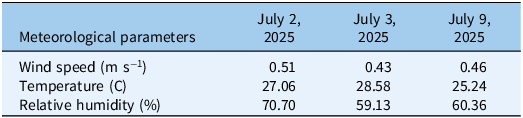
The deposition experiment was set up in a University of Maine live turf field called Lengyel Recreational Field (44.895528°N, −68.671528°W). Spray applications of water occurred on July 2, 3, and 9, 2025, starting at 7:30 AM until 12:00 PM. Water was used as the spray medium due to restrictions associated with the university-owned field. Turfgrass, averaging 10.2 cm in height, was uniformly present in the field and served as the surrogate weeds during spraying. Temperature (C), wind speed (m s−1), and relative humidity (%) were measured with the Kestrel 3000 Weather Meter 830 (Kestrel Instruments, Boothwyn, PA, USA) at every drone spray flight. Data collected for each drone spray flight were averaged by day (Table 1). All drone spray flights were within the acceptable wind speed of 2 m s−1 according to Unmanned Aerial Pesticide Application System Task Force (UAPASTF) protocols (UAPASTF 2024).
Meteorological conditions per time block in the study.

Table 1. Long description
A table comparing meteorological parameters over three days in 2025. The table has three rows and four columns. The columns are labeled as July 2, 2025, July 3, 2025, and July 9, 2025. The row labels are Wind speed (m s-1), Temperature (C), and Relative humidity (%). Row 1: Wind speed (m s-1), 0.51, 0.43, 0.46. Row 2: Temperature (C), 27.06, 28.58, 25.24. Row 3: Relative humidity (%), 70.70, 59.13, 60.36.
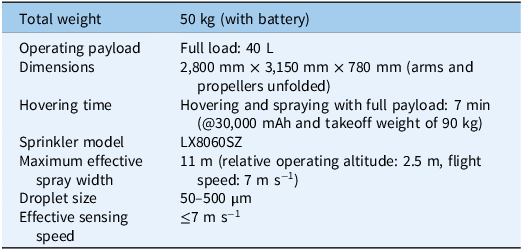
The DJI Agras T40 spray drone (DJI, Shenzhen, Guangdong, China) was utilized in this study to assess drone settings on spray deposition (Table 2). It was controlled by utilizing the DJI Agras T40 Smart Controller Plus pre-installed with the DJI Smart Farm flight application software. The controller is equipped with a real-time kinematic (RTK) receiver and connected to a global navigation satellite system (GNSS) mobile base station (model D-RTK 2, SZ DJI Technology, Shenzhen, China), providing manufacturer-reported horizontal and vertical positioning accuracy of ±1 cm.
DJI T40 spray drone specifications.

Table 2. Long description
A table detailing specifications of a DJI T40 spray drone. The table has 9 rows and 2 columns. Row 1: Total weight, 50 kg (with battery). Row 2: Operating payload, Full load: 40 L. Row 3: Dimensions, 2,800 mm x 3,150 mm x 780 mm (arms and propellers unfolded). Row 4: Hovering time, Hovering and spraying with full payload: 7 min (@30,000 mAh and takeoff weight of 90 kg). Row 5: Sprinkler model, LX8060SZ. Row 6: Maximum effective spray width, 11 m (relative operating altitude: 2.5 m, flight speed: 7 m s^-1). Row 7: Droplet size, 50-500 µm. Row 8: Effective sensing speed, ≤7 m s^-1.
Experimental Design
The spray drone was filled with water for the deposition experiment. The treatments included three levels of spray width: 3.0 m, 4.6 m, and 6.1 m and three levels of droplet size: 220 μm, 280 μm, and 340 μm in a three by three factorial in a randomized complete block design with three replications. The blocks in the experiment were the dates of July 2, 3, and 9. The spray width levels were manually set as determined by the initial spray width or route spacing settings of prescription maps produced from the PIX4Dfields computer software (PIX4D S.A. v. 2.9.5, Prilly, Switzerland), a user-friendly spray drone–compatible prescription mapping software. Droplet sizes were determined based on ASABE S572.3 medium, coarse, and very coarse droplet size classifications (ASABE 2020). The flight height, speed, and application rate remained constant for all treatments, being 3.0 m, 3.5 m s−1, and 65.48 L ha−1, respectively. Spray height was maintained at 3.0 m to comply with aerial pesticide label spray height limits, which presently apply to drone operations. The spray height was also set to 3.0 m as determined by UAPASTF protocols (UAPASTF 2024), which define 3.0 m as the comparative standard across studies. Meanwhile, the speed of 3.5 m s−1 was also determined by UAPASTF protocols, being within the recommended speed range of 3 to 5 m s−1. The application rate of 65.48 L ha−1 was selected as a modified rate based on Takekawa et al. (Reference Takekawa, Hagani, Edmunds, Collins, Chappell and Reynolds2023), adjusted to reflect the higher spray volumes commonly used in spot applications to enhance deposition (Hunter et al. Reference Hunter, Gannon, Richardson, Yelverton and Leon2020b; Lew-Kowal et al. Reference Lew-Kowal, Robinson, Gilbert and Rooney2025) while remaining within herbicide label requirements approved for drone application (Anonymous 2020, n.d.).
Data Collection
Spray droplet deposition was quantified using 76 by 26 mm water-sensitive cards, which are rigid papers with a yellow surface that stains blue when water droplets come in contact. Two 14-cm-high metal stakes held each water-sensitive card to the ground. The papers were set up in 30.50 by 30.50 m plots along three transects. Plot size was determined based on the drone manufacturer label with the goal of capturing the maximum ESW of the drone, which was 11 m. Each 30.50 by 30.50 m plot had transects at 7.62 m (“start”), 15.24 m (“center”), and 22.86 m (“end”). Five cards were placed horizontally at the start and end transects with a 7.32-m distance between each card. The center transect served as the ESW determinant and had 17 cards placed horizontally every 1.83 m (Figure 1). After spraying, the water-sensitive cards were collected using powder-free nitrile gloves after the spray droplets were completely dry. Each card was labeled using an identification code, and all cards from each transect were placed in ziplock plastic bags for storage and further analysis.
(A) Schematic representation of the experimental setup, where 17 water-sensitive cards were placed at 1.83-m intervals at the center transect, while 5 water-sensitive cards were placed at 7.32-m intervals at the start and end transects. (B) DJI Agras T40 spray drone. (C) Water-sensitive card held with metal stakes on turfgrass.

Sprayed water-sensitive cards were fed into a DropScope (SprayX, São Paulo, Brazil), which is a water-sensitive card scanning device that determines deposition parameters. The deposition parameters or response variables captured and analyzed were application volume (μl cm−2) and average diameter (μm). The application volume represents deposition or the volume of the drops that reached the card, which is defined here as the average spray volume deposited (μl) per square centimeter. Average diameter is the mean diameter of all droplets analyzed on the water-sensitive card. Finally, the diameter variation coefficient (DVC) was calculated using the average diameters from cards within each measured ESW to quantify droplet uniformity. Equation 1 presents the DVC formula, where σ represents the standard deviation of the average diameters among cards within the ESW, and μ represents the average diameter mean across those cards.
 ${\rm{DVC}} = {{{{\rm{\sigma }}}\over{{\rm{\mu }}}}{\rm{\;\times\;}}}100$
Syngenta® (Crop Protection, Greensboro, NC, USA) and SpotOn (Innoquest, Woodstock, IL, USA) water-sensitive cards were also used due to availability issues. To ensure comparability of water-sensitive cards, droplet data were normalized using the DropScope spread factor, which estimates original droplet diameter before impact (Ahmad et al. Reference Ahmad, Qiu, Dong, Ma, Huang, Ahmed and Chandio2020; Cunha et al. Reference Cunha, Farnese and Olivet2013). At the same time, a validation experiment ensured that the different water-sensitive brands produced comparable application volume (μl cm−2) and average diameter (μm) responses due to the spread factor. Response variables that resulted in significant differences between water-sensitive brands are presented in Supplementary Material 1 and 2.
ESW was measured based on the standards of ASABE S341.6 (ASABE 2024). To determine ESW based on maximum or minimum deposition response, the 50% deposition method (Y Liu et al. Reference Liu, Gao, Zhao, Wu, Liang, Liang, Liu, Huang, Xie, Lv and Li2024) and a modified version of the bilateral method (Li et al. Reference Li, Hu, Liu, Yi, Han, Zhang and Pan2022) were employed in this paper. Meanwhile, to determine the ESW based on CV thresholds, the ESW30 method based on a 30% CV threshold was adopted (Richardson et al. Reference Richardson, Rolando, Somchit, Dunker, Strand and Kimberley2020). The ESW was measured with the 50% effective deposition method by determining the distance between two points in the center transect where the deposition was half of the maximum deposition. In the modified version of the bilateral method, the ESW was measured by determining the distance of two points in the center transect where the application volume was 0.01 μl cm−2 or greater. For the ESW30 method, the average application volume for each center transect was calculated. The ESW was determined by identifying the largest range of application volumes that were greater than the mean, while having a CV of less than or equal to 30% (Zhang et al. Reference Zhang, Chen, Zhang, Hoffmann, Xu, Lan, Wang and Min2015).
Drift was measured by determining the total swath width of each center transect and subtracting the intended spray width setting. Total swath width was defined as the total discharge of material deposited or the spray footprint of the center transect (Houston Reference Houston2022; Portillo et al. Reference Portillo, Barbosa, Beckwith, Gullen, Haynie, Hovinga, Kesavaraju, Lang, Livingston, Newton, Oostlander, Watson and Sinha2025), while the intended spray width settings were 3.0 m, 4.6 m, and 6.1 m for the rotary disk atomizer drone. The distance between the total swath width and the intended spray setting was called the drift distance. Drift droplets that moved beyond the 30.50 m width of the plot were not recorded in this study due to space constraints. Nevertheless, drift distances within these application areas were compared.
Data Analysis
Data were analyzed using RStudio (v. 2024.12.1, Posit Software, PBC, Boston, MA, USA). To test the effects of spray width, droplet size, and interaction of spray width and droplet size, all data were analyzed using a mixed-model ANOVA using the lme4 package (v. 1.1-37) followed by a Tukey’s honestly significant difference (HSD) all-pairwise mean comparison test (P ≤ 0.05) using the emmeans package (v. 1.11.0). Spray width and droplet size were considered fixed effects, while water-sensitive card brand was treated as an additional fixed effect to account for variability within card brands. Block (date) was modeled as a random effect. A reciprocal transformation was applied to application volume for all analyses and to the diameter CV using the bilateral method. Before analysis, all data were checked for normality using a Shapiro-Wilk test and Q-Q plots. Additionally, all data were checked for homoscedasticity using a Levene’s test and by creating a residual by predicted plot. Interaction terms were not removed from the model if there were significant main effects.
Results and Discussion
ANOVA revealed that the start, center, and end transects did not have significant differences for any response variables tested. There were significant droplet size and spray width effects for the response variables when analyzed within each transect (P ≤ 0.05). Thus, analysis of treatment effects was done within each transect of the plot. All response variables had no interaction, so main effects were analyzed separately.
Deposition Response of Spray Width and Droplet Size
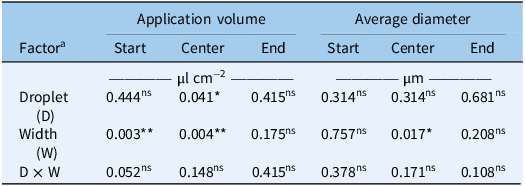
Spray width and droplet size significantly affected application volume when using a rotary disk atomizer drone at the center transect of the plot. Spray width settings also had a significant effect on application volume at the start transect. Spray width settings only had significant effects on average diameter at the center transect and not at the start and end transects (Table 3).
ANOVA for application volume (μl cm−2) and average diameter (μm) at the start, center, and end transects when using a rotary disk atomizer drone.

Table 3. Long description
The table presents data on application volume and average diameter for different factors at start, center, and end transects. It has four rows and seven columns. The columns are labeled as Factor, Application volume Start, Application volume Center, Application volume End, Average diameter Start, Average diameter Center, and Average diameter End. The rows are labeled as Droplet (D), Width (W), and D x W. Row 1: Droplet (D), 0.444ns, 0.041*, 0.415ns, 0.314ns, 0.314ns, 0.681ns. Row 2: Width (W), 0.003**, 0.004**, 0.175ns, 0.757ns, 0.017*, 0.208ns. Row 3: D x W, 0.052ns, 0.148ns, 0.415ns, 0.378ns, 0.171ns, 0.108ns.
a Droplet = droplet size (μm); Width = spray width (m); D × W = interaction between droplet size and spray width.
* Significant at P ≤ 0.05.
** Significant at P ≤ 0.01.
ns Not significant.
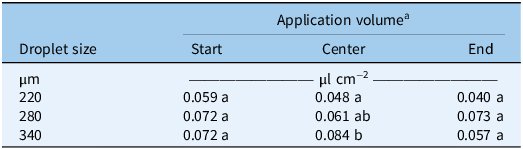
Based on Table 4, the 4.6-m and 6.1-m spray width drone settings resulted in greater application volumes for the start transect, presenting means 0.039 μl cm−2 and 0.071 μl cm−2 greater than the 3.0-m spray width drone setting, respectively. The same trend was observed for the center transect, where the 4.6-m and 6.1-m spray width settings had significantly higher application volumes, 0.025 μl cm−2 and 0.063 μl cm−2 greater than the 3.0-m spray width setting, respectively. For average diameters, the 3.0-m spray width resulted in significantly lower average diameters (63.40 μm) compared with the 6.1-m spray width (79.23 μm), while having average diameters similar to the 4.6-m spray width (72.16 μm) at the center transect. Based on Table 5, droplet size settings significantly affected application volume only at the center transect of the plot, in which the 220-μm setting resulted in lower application volumes (0.048 μl cm−2) than the 340-μm setting (0.084 μl cm−2). The 280-μm droplet size setting had application volumes (0.061 μl cm−2) similar to the 220-μm and 340-μm settings.
Mean application volume and average diameter at the start, center, and end transects of the plot on different spray width settings using a rotary disk atomizer drone a

Table 4. Long description
A table with three columns and four rows comparing application volume and average diameter for different spray widths. The columns are labeled ‘Spray width’, ‘Application volume’, and ‘Average diameter’. The ‘Application volume’ column has sub-columns labeled ‘Start’, ‘Center’, and ‘End’ with units of measurement in microliters per square centimeter. The ‘Average diameter’ column has sub-columns labeled ‘Start’, ‘Center’, and ‘End’ with units of measurement in micrometers. Row 1: Spray width 3.0 meters, Application volume Start 0.031, Center 0.035, End 0.038, Average diameter Start 66.34, Center 63.40, End 76.35. Row 2: Spray width 4.6 meters, Application volume Start 0.070, Center 0.060, End 0.058, Average diameter Start 72.55, Center 72.16, End 59.51. Row 3: Spray width 6.1 meters, Application volume Start 0.102, Center 0.098, End 0.073, Average diameter Start 72.37, Center 79.23, End 75.90.
a Means followed by different lowercase letters in the columns are significantly different from each other using Tukey’s honestly significant difference test (P ≤ 0.05).
Mean application volume at the start, center, and end transects of the plot on different droplet size settings using a rotary disk atomizer drone.

Table 5. Long description
A table with three rows and four columns. The columns are labeled ‘Droplet size’, ‘Start’, ‘Center’, and ‘End’. The row labels are ‘220’, ‘280’, and ‘340’ in micrometers. The values in the table are as follows: Row 1: Droplet size, 220; Start, 0.059 a; Center, 0.048 a; End, 0.040 a. Row 2: Droplet size, 280; Start, 0.072 a; Center, 0.061 ab; End, 0.073 a. Row 3: Droplet size, 340; Start, 0.072 a; Center, 0.084 b; End, 0.057 a.
a Means followed by different lowercase letters in the columns are significantly different from each other using Tukey’s honestly significant difference test (P ≤ 0.05).
The results for the deposition response of spray width and droplet size settings revealed that increasing the spray width to 4.6 m and 6.1 m increased the application volume and average droplet diameters. The increase in droplet sizes may be due to the increase in the flow rate of the drone to cover a wider swath. Koo et al. (Reference Koo, Gonҫalves and Askew2024b) reported that increasing spray width settings in drone spray applications can necessitate greater flow rates delivered to the nozzles, resulting in larger droplets. Similarly, Yang et al. (Reference Yang, Li, Tang, Hu, Yan and Zhang2025) noted that higher flow rates in rotary cage atomizer drones allow more liquid to accumulate within the rotary cage, reducing rotational speed and consequently increasing droplet size. In contrast, at lower flow rates, the liquid is more completely atomized by the faster-spinning disks, producing smaller and more uniform droplets, consistent with observations at the 3.0-m spray width setting. Additionally, the increased application volume observed at wider spray width settings was likely influenced by rotor downwash effects. Larger droplets produced at the 4.6-m and 6.1-m spray widths were less susceptible to turbulence generated by the drone and therefore deposited more rapidly due to their greater mass. This rapid deposition increased the proportion of droplets reaching the target surface, whereas the smaller droplets produced at the 3.0-m setting were more prone to off-target drift (Caputti et al. Reference Caputti, de Oliveira, Rodrigues, Cremonez, Foshee, Simmons and da Silva2025; Lan et al. Reference Lan, Wang, Chen, Liang, Zhang and Ma2024). Consequently, the higher drift potential associated with smaller droplets contributed to the significantly lower application volumes observed with the 220-μm droplet size setting compared with the 340-μm setting. Felipe Oliveira Ribeiro et al. (Reference Felipe Oliveira Ribeiro, Leandro da Vitória, Pereira Bastos, Vieira Zanelato, de Assis Martins Júnior, de Vicente Ferraz, Gomes dos Santos, de Assis Ferreira, Victor Oliveira Ribeiro, de Assis Silva and Chen2025), Wang et al. (Reference Wang, Han, Li, Andaloro, Chen, Hoffman, Han, Chen and Lan2020), and Ozkan (Reference Ozkan2024) reported that finer droplets produced by faster rotational speeds of centrifugal nozzles increased drift potential, supporting the role of rotor downwash and airflow dynamics in influencing droplet movement. In addition, rotary disk atomizer drones inherently present a higher drift risk, because spray discharge occurs in a predominantly horizontal direction. Droplets are formed as liquid is delivered onto a rotating spray plate, where centrifugal force propels the liquid outward along radial grooves at the edge of the disk before release. This mechanism can promote lateral displacement before gravitational settling. Therefore, increasing droplet size settings enhances droplet mass, strengthening gravitational forces relative to aerodynamic forces and promoting downward movement rather than lateral drift (Chen et al. Reference Chen, Douzals, Lan, Cotteux, Delpuech, Pouxviel and Zhan2022; Nuyttens et al. Reference Nuyttens, De Schampheleire, Baetens and Sonck2007).
Determination of the ESW
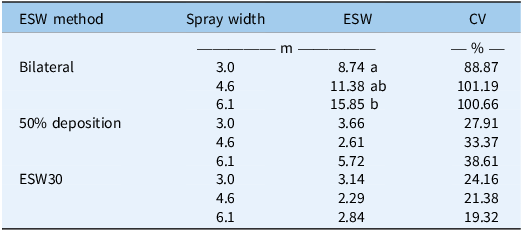
The application volume pattern followed a typical bell-curve shape, in which the majority of the spray deposit was found on the center transects of the plots rather than at the edges (Byers et al. Reference Byers, Virk, Rains and Li2024; Figure 2). This provided an avenue for ESW measurements to occur, such as the bilateral method, the 50% deposition method, and the ESW30 method employed in this paper. Table 6 shows that the bilateral method for measuring ESW had significant ESW differences based on the spray width setting. The 3.0-m spray width resulted in a significantly lower ESW (8.74 m) compared with the 6.1-m spray width (15.85 m). The 4.6-m spray width with an 11.38-m ESW had no significant differences from the 3.0-m and 6.1-m spray width settings. The ESWs of the 3.0-m and 4.6-m spray widths based on the bilateral method were similar to the maximum ESW of the rotary disk atomizer drone used in this study, which was 11 m based on the drone manufacturer’s label. The 6.1-m spray width setting resulted in ESWs beyond the maximum ESW as dictated from the manufacturer’s label. The results revealed that an increase in spray width settings, which consequently produced larger droplets, increased ESW measurements. This trend is consistent with the findings of Y Liu et al. (Reference Liu, Gao, Zhao, Wu, Liang, Liang, Liu, Huang, Xie, Lv and Li2024), who used the bilateral method to measure ESW in flat terrain and reported that larger droplet sizes increased deposition and ESW.
The mean application volume deposition curve and effective swath widths (ESWs) of (A) 3.0-m, (B) 4.6-m, and (C) 6.1-m spray width drone settings using different ESW methods. The 0 position coincides with the flight path of the rotary disk atomizer drone, and each position value has a 1.83-m interval.

Mean effective swath width (ESW) and coefficient of variation (CV) measured at the center transect of the plot on different spray width settings using a rotary disk atomizer drone a

Table 6. Long description
A table with four rows and three columns comparing effective swath width (ESW) and coefficient of variation (CV) for different spray width settings using a rotary disk atomizer drone. The columns are labeled ESW method, Spray width, ESW, and CV. The ESW methods include Bilateral, 50% deposition, and ESW30. The spray widths are 3.0 meters, 4.6 meters, and 6.1 meters. The ESW values and CV percentages vary across the different methods and spray widths. Notable trends include significant differences in ESW based on spray width settings for the bilateral method, with the 6.1-meter spray width resulting in the highest ESW.
a Means followed by different lowercase letters in the columns are significantly different from each other using Tukey’s honestly significant difference test (P ≤ 0.05).
The ESWs measured using the 50% deposition method had no significant spray width and droplet size effects. This method also resulted in a narrower ESW range, which fluctuated from ≥0 m to ≥14.63 m, in contrast with the bilateral method, where ESW ranged from ≥3.66 m to ≥29.26 m. The results agree with the study of Y Liu et al. (Reference Liu, Gao, Zhao, Wu, Liang, Liang, Liu, Huang, Xie, Lv and Li2024), in which the 50% deposition method and the bilateral method showed a large range difference in ESW. However, Y Liu et al. (Reference Liu, Gao, Zhao, Wu, Liang, Liang, Liu, Huang, Xie, Lv and Li2024) did not account for the CV calculations when determining the ESW using the bilateral and 50% deposition methods. Calculating the CV resulted in very high CV for the bilateral method (≥88.87%), while the 50% deposition method resulted in 27.91%, 33.37%, and 38.61% for the 3.0-m, 4.6-m, and 6.1-m spray widths respectively, with the 3.0-m spray width setting having a CV within the 30% or lower threshold for drone aerial spraying. Applying the ESW30 method resulted in ESW CV values within the acceptable 30% or lower thresholds from literature (Fritz and Martin Reference Fritz, Martin and Elsik2020; Richardson et al. Reference Richardson, Rolando, Somchit, Dunker, Strand and Kimberley2020). Similar to the 50% deposition method, it resulted in no significant effects for spray width and droplet size settings, with ESWs having a range of ≥0 m to ≥5.49 m, narrower than the bilateral and 50% deposition method. As expected, there were lower CVs in the 50% deposition and ESW30 methods than the bilateral method, as lower CVs occur at narrower swath widths. Based on these results, examining deposition response based on the bilateral method and the 50% deposition method from the study of Y Liu et al. (Reference Liu, Gao, Zhao, Wu, Liang, Liang, Liu, Huang, Xie, Lv and Li2024) was an appropriate method if specific deposition thresholds are of interest to a pesticide spray applicator. Choosing between the 50% deposition method and the bilateral method also depended on the type of spray drone (Chen et al. Reference Chen, Lan, Li, Wang and Peng2017). Meanwhile, the ESW30 method was a reliable method that meets the industry-accepted uniformity standard of a CV at or below 30% across all settings.
Even though there were no droplet size and spray width effects for the 50% deposition and ESW30 methods, there were still ESW patterns that were observed based on the intended spray width (Table 6). For the 50% deposition method, the 3.0-m and 6.1-m spray width settings achieved ESWs similar to the intended spray widths, while the 4.6-m spray width that had lower ESWs. For the ESW30 method, the ESWs were within the intended spray width for the 3.0-m spray width setting, while the ESWs were lower for the 4.6-m and 6.1-m spray widths. These observations aligned with drone spray observations that had variable or lower ESWs than the intended spray width (Gibbs et al. Reference Gibbs, Peters and Heck2021; Lynch Reference Lynch2025).
Both the 50% deposition method and the ESW30 criterion produced the smallest ESW at the 4.6-m spray width setting. This narrower ESW had a sharper central deposition peak compared with the 3.0-m and 6.1-m spray width settings (Figure 2). This observed pattern was consistent with the influence of multi-rotor downwash on droplet transport. The rotor-induced airflow produces a vertical recirculation zone beneath the drone, often described as a downwash effect or vortex, which governs droplet entrainment, deposition, and lateral spread (Chen et al. Reference Chen, Douzals, Lan, Cotteux, Delpuech, Pouxviel and Zhan2022; Z Liu et al. Reference Liu, Gao, Zhao, Wu, Liang, Liang, Liu, Huang, Xie, Lv and Li2024). Smaller droplets produced by the 3.0-m spray width setting, were more easily captured and recirculated within this vortex, which increased losses and reduced the effective swath footprint (Dengeru et al. Reference Dengeru, Ramasamy, Surendrakumar and Muthusami2022; Guo et al. Reference Guo, Zhu, Tang, Hou, Fang and Chen2025). In contrast, the 6.1-m spray width setting generated larger droplets due to higher flow rates, which produced droplets with greater momentum that were less susceptible to entrainment by the downwash and therefore traveled farther laterally, resulting in a wider deposition pattern (Byers et al. Reference Byers, Virk, Rains and Li2024; Ferguson et al. Reference Ferguson, Chechetto, Hewitt, Chauhan, Adkins, Kruger and Donnell2016). The 4.6-m spray width setting appears to have created an intermediate droplet momentum in which droplets were large enough to resist recirculation losses, yet some were still effectively directed away by the vortex, maximizing on-target deposition beneath the flight path (Guo et al. Reference Guo, Zhu, Tang, Hou, Fang and Chen2025). As a result, the 4.6-m spray width produced a sharp central deposition maximum, which ultimately reduced the ESW estimated by both the 50% deposition and ESW30 methods.
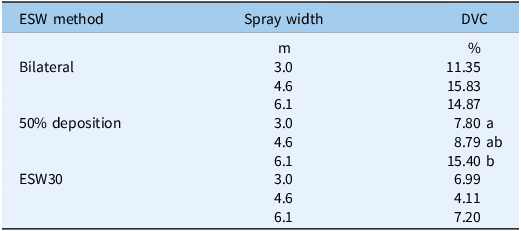
The measured ESWs exhibited DVCs below 20%, well within the recommended CV range for drone spraying applications (≤25% to 30%) (Fritz and Martin Reference Fritz, Martin and Elsik2020; Richardson et al. Reference Richardson, Rolando, Somchit, Dunker, Strand and Kimberley2020). These low DVC values also suggest that the centrifugal nozzles produced a relatively narrow and uniform droplet spectrum, likely attributable to the radial groove design, which minimizes droplet interaction and coalescence during atomization (Chen et al. Reference Chen, Douzals, Lan, Cotteux, Delpuech, Pouxviel and Zhan2022; Qingqing et al. Reference Qingqing, Xinyu, Weicai, Chen and Liangfu2017). There were no significant differences in DVC for the different spray width settings using the bilateral method and the ESW30 method, but significant spray width effects were observed for the 50% deposition method. The 6.1-m spray width setting resulted in significantly higher DVC than the 3.0-m and 4.6-m spray width settings, which showed that the 6.1-m spray width setting resulted in less uniform average diameters than the 3.0-m and 4.6-m spray width settings (Table 7). The results align with previous research by Xing et al. (Reference Xing, Cui, Wang and Shen2024), which revealed that larger droplets produced less uniformly distributed droplets. Larger droplets tend to coalesce or merge with other droplets more readily, forming even larger, less predictable droplets (Jin et al. Reference Jin, Ooi, Dao and Nguyen2017). However, despite the slight deviation of droplet uniformity by the 6.1-m spray width setting through the 50% deposition method, the overall results from all ESW methods supported that rotary disk atomizer drones such as the DJI Agras T40 produced uniform droplets below the industry standard threshold (Caputti et al. Reference Caputti, de Oliveira, Rodrigues, Cremonez, Foshee, Simmons and da Silva2025).
Diameter variation coefficient (DVC) measured at the center transect of the plot on different spray width settings per effective swath width (ESW) method using a rotary disk atomizer drone a

Table 7. Long description
A table comparing diameter variation coefficients (DVC) for different spray widths and effective swath width (ESW) methods. The table has three columns: ESW method, Spray width, and DVC. The ESW methods include Bilateral, 50% deposition, and ESW30. Spray widths are measured in meters (3.0, 4.6, 6.1), and DVC is measured in percent. Row 1: Bilateral, 3.0 m, 11.35 percent. Row 2: Bilateral, 4.6 m, 15.83 percent. Row 3: Bilateral, 6.1 m, 14.87 percent. Row 4: 50% deposition, 3.0 m, 7.80 percent. Row 5: 50% deposition, 4.6 m, 8.79 percent. Row 6: 50% deposition, 6.1 m, 15.40 percent. Row 7: ESW30, 3.0 m, 6.99 percent. Row 8: ESW30, 4.6 m, 4.11 percent. Row 9: ESW30, 6.1 m, 7.20 percent.
a Means followed by different lowercase letters in the columns are significantly different from each other using Tukey’s honestly significant difference test (P < 0.05).
Quantifying Drift
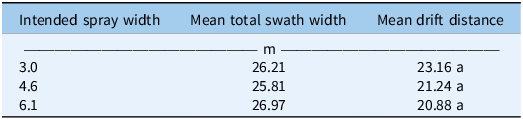
There were no significant droplet size and spray width effects for drift distances beyond the targeted spray width. However, it is observed that the drift distance resulted in more than triple the intended spray width distance for the 4.6-m and 6.1-m spray width and almost eight times farther than the 3.0-m spray width (Table 8). The drift distances observed in this study exceeded those reported by Koo et al. (Reference Koo, Gonҫalves and Askew2024b), who applied herbicide using a DJI Agras MG-1P drone and found that very fine droplets drifted up to 12 m beyond the targeted spray width. In a subsequent study, Koo et al. (Reference Koo, Godara, Cubas and Askew2024a) conducted multiple spray drone passes and reported that drift reached 54% of non-target buffer areas, which was three times or more than the drift percentage observed with a spray gun or ride-on sprayer. These findings indicate that spray drones may deposit spray material beyond intended application settings or target areas, supporting both the present study and Hunter et al. (Reference Hunter, Gannon, Richardson, Yelverton and Leon2020b), who reported off-target deposition beyond mapped weed patches during drone-based spot spraying.
Mean drift distance on different spray width settings using a rotary disk atomizer drone within the 30.50-m by 30.50-m plot a

Table 8. Long description
A table with three rows and three columns. The columns are labeled ‘Intended spray width’, ‘Mean total swath width’, and ‘Mean drift distance’. The row labels are 3.0, 4.6, and 6.1. The values in the table are as follows: Row 1: Intended spray width, 3.0; Mean total swath width, 26.21 m; Mean drift distance, 23.16 a. Row 2: Intended spray width, 4.6; Mean total swath width, 25.81 m; Mean drift distance, 21.24 a. Row 3: Intended spray width, 6.1; Mean total swath width, 26.97 m; Mean drift distance, 20.88 a.
a Means followed by different lowercase letters in the columns are significantly different from each other by Tukey’s honestly significant difference test (P < 0.05).
The inability of the rotary disk atomizer drone in the present study to consistently spray within the intended spray width may be attributed, in part, to the selected spray height (3.0 m), which increased the chance of droplets to move away from the target area. Another reason for high drift distances may be the spray drone’s ground spreading airflow, which is defined as the swirling air that disrupts droplet settlement but enhances spray coverage (Guo et al. Reference Guo, Zhu, Tang, Hou, Fang and Chen2025), or it may be due to the absence of adjuvants that can lessen drift. These results underscore the need for further research focused on optimizing drone operational parameters to improve spray precision of rotary disk atomizer drones.
Practical Implications for Drone Spot Spraying of Weeds
The results revealed that spraying only water using rotary disk atomizer drones resulted in drift distances greater than the intended spray width under 65.48 L ha−1 application volumes, 3.0-m spray heights, and at 3.5 m s−1 speed. This means that an untreated area found on a weed map may be affected by the drone-sprayed area about eight times the distance of the spray width setting under such conditions. Therefore, when developing weed maps for site-specific management, the high drift potential associated with rotary disk atomizer drones should be considered. These systems may be more appropriate for spot applications targeting fields with large, aggregated weed patches, than field with small, uniformly distributed infestations that may be more effectively managed using broadcast applications. At the same time, buffer zones such as those described by Fritz and Martin (Reference Fritz, Martin and Elsik2020) are necessary to mitigate off-target movement beyond target areas. Currently, no universal, single-distance buffer zone exists for drone-based herbicide applications. Instead, operators must consult the specific pesticide label, comply with all conditions outlined in their FAA Part 137 certificate and applicable exemptions, and adhere to relevant state and local regulations to determine the appropriate buffer distance for each application scenario. In addition to regulatory buffer requirements, optimization approaches such as particle swarm optimization (PSO) algorithms can improve spray drone flight path planning to maintain spray applications within target areas under variable environmental conditions, including changes in wind speed and direction (Faiçal et al. Reference Faiçal, Pessin, Filho, Carvalho, Furquim and Ueyama2014). Additional strategies to enhance spray precision include RTK-GPS navigation systems; reduced spray heights that minimize canopy disruption; incorporation of drift-reducing adjuvants; and lower, controlled flight speeds. However, it is important to note that drift is largely displaced spatially and temporally; thus, determining drift risk is dependent on weather, method, product, target, and equipment used (Damalas Reference Damalas, Armon and Hänninen2015).
To improve deposition, increasing the spray width to 4.6 m and 6.1 m and droplet size to 340 μm is recommended. Increasing these settings increases average droplet diameter, thereby reducing the likelihood of droplet entrainment within the drone’s downwash. ESWs increased as spray width increased (bilateral method) or remained within or lower the intended spray width setting (50% deposition and ESW30 method). It depends on the applicator which preferred ESW method to use, but the authors suggest using the 50% deposition method, as it produced similar ESWs with the intended spray width, with the exception of the 4.6-m setting. ESWs determine the spray drone’s spray width setting and thus the number of parallel flight paths with sufficient overlap. Wider ESWs require fewer parallel flight paths to cover a given area, whereas narrower ESWs require more flight paths to achieve the same uniform coverage (Chen et al. Reference Chen, Douzals, Lan, Cotteux, Delpuech, Pouxviel and Zhan2022). This has important implications for spray efficiency, as requiring more flight lines increases application time and chemical inputs to cover the same target area. Therefore, drone operators must conduct field calibrations to decide which ESW method to use to calculate sufficient overlap between parallel flight lines during spot spraying.
Supplementary material
To view supplementary material for this article, please visit https://doi.org/10.1017/wsc.2026.10152.
Acknowledgments
We thank Matthew Blodget of Seed Solutions, Inc., for operating the spray drone in this research. We would also like to thank Active Intelligence, David Handley, and Travis Esau with his graduate student, Chloe Toombs, for providing guidance in this research. Language editing of this manuscript was assisted by ChatGPT 5.2 (OpenAI). The authors reviewed the manuscript and take full responsibility for all content and interpretations.
Funding statement
This research is funded and supported by the University of Maine Cooperative Extension and the Northeast IPM Center (grant no. 2022-70006-38004).
Competing interests
No conflicts of interest have been declared.





 Open access

