This report is necessarily highly idiosyncratic. With at least seven simultaneous sessions going on throughout the International Union of Crystallography (IUCr) XXII Congress, Madrid, August 22–30, 2011, any one person could not hope to cover them all—even for a subset such as materials crystallography.
In microsymposium MS05, “Non-Ambient Powder Diffraction,” Robert Dinnebier (Max Planck Institute for Solid State Research, Stuttgart, Germany) described new tools for the analysis of in situ XRD data, including symmetry mode analysis, parametric Rietveld refinements, and maximum entropy methods. Many of these facilities are incorporated in the Powder3D suite of programs (http://www.fkf.mpg.de/xray/html/powder3D.html).
MS10 concerned determination of ab initio crystal structures from powder diffraction and their applications in the pharmaceutical industry. Chris Gilmore (University of Glasgow, UK) incorporated the maximum entropy software MICE into the Superflip charge flipping program, combining two powerful structure solution algorithms into one package.
In MS18, “Powder Diffraction at the Nanoscale,” a number of leading workers presented new results on total X-ray diffraction analysis, including pair distribution functions and Debye functions. This theme continued in MS26, “Total Scattering and the Nanostructure Problem.”
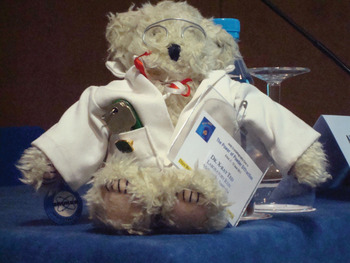
Much powder diffraction is conducted in industry, and the results are proprietary. In MS32, “Crystallography in Industrial Process Control,” five speakers were willing to share industrially relevant results. Nikki Scarlett's colleague X-ray Ted (CSIRO, Australia) made a special guest appearance (see Figure 1). Jürgen Niebauer (University of Erlangen-Nuremberg, Erlangen, Germany) discussed the tricky problem of quantifying the amorphous content of ordinary Portland cement. He obtained an absolute calibration by using an external standard, and determined the linear absorption coefficient of the mixture from the bulk X-ray fluorescence analysis. Dan Riley (University of Newcastle, New South Wales, Australia) applied time-resolved neutron diffraction to study titanium silicon carbides. Neutron diffraction was necessary to determine the bulk compositions, not just the surface compositions derived using X-rays. Riley found that a short-lived (~3 s) face-centered cubic intermediate occurs at ~2600 °C. Ping Liu (Sandvik AB, Sandviken, Sweden) characterized the residual stresses in spring steels. Grazing incidence techniques were used to profile the strong gradients, and electrochemical polishing enabled characterization of the depth profiles. Bob Cernik (University of Manchester, Manchester, U.K.) described the development of rapid tomographic energy-dispersive diffraction imaging using a small incident beam. To obtain results in reasonable times, detector arrays are necessary. Constanza Buioli (Atomic Energy Commission, Argentina) characterized Zr alloy reactor tubes by studying cut sections.
(Color online) X-ray Ted making a special guest appearance at the 2011 Conference of the International Union of Crystallography (IUCr) XXII Congress.

Other sessions containing information useful to readers of Powder Diffraction included (MS04) “Industrial Applications of SAXS and SANS,” (MS14) “Biomineralization and Biomimetic Materials,” (MS19) “Synthesis, Structure, and Properties of Novel Materials at High Pressure,” (MS25) “Crystallography of Materials with Exchange, Sequestration, and Storage Properties,” (MS31) “Structural Implications in Catalytic Processes,” (MS39) “Energy-Related Materials,” (MS40) “Pressure-Induced Phase Transitions,” (MS46) “Powder Diffraction Methods in Archaeometry,” (MS54) “Minerals as Advanced Materials,” (MS60) “Solid State Reactivity,” (MS74) “Powder Diffraction and Complementary Techniques,” and (MS81) “The Crystallography of Functional Inorganic Materials and Their Applications.”
MS95, “Automated Data Processing and Structural Solution for Powder Crystallography,” included a talk by Angela Altomare (University of Bari, Italy) on new features in EXPO2011. These include Rietveld refinement in addition to structure solution capabilities.
In MS83, “Application of Crystal Structure Information in Chemical Education,” the web-based educational materials developed by Dean Johnson (Otterbein University, Westerville, Ohio) were particularly impressive. In MS97, “Web-Based Crystallography Teaching: the Use of Modern Communication Methods to Teach Crystallography,” Anders Markvardsen (ISIS Facility, Rutherford Appleton Laboratory, UK) described Jpowder, a Java program for the display of powder diffraction information.
Among the three Ewald Prize lectures, Carmelo Giacovazzo's (University of Bari, Italy) was particularly interesting, as he discussed the consequences of considering the variances of electron density maps. Gautam Desiraju (new IUCr President) gave a wonderful plenary lecture entitled “Crystal Engineering: From Molecules to Crystals,” and coined the term “molecular sociology” to describe crystal engineering.
The Commission on Powder Diffraction (CPD) decided to make a number of important Acta Crystallographica papers open access. These include the guidelines for Rietveld refinement and the two papers on the CPD Round Robin on Quantitative Phase Analysis.
An exceptionally large amount of behind-the-scenes activity goes on at an IUCr meeting. For the readers of Powder Diffraction, an important development was that Chris Gilmore, Jim Kaduk (Illinois Institute of Technology, Elgin, IL), and Henk Schenk (University of Amsterdam, Netherlands) agreed to serve as editors of a new Volume H of the International Tables for Crystallography devoted to powder diffraction. Selection of chapter authors and development of the outlines are underway. In addition to the usual fundamental material, Volume H will contain a number of special topic chapters on the applications of powder diffraction to specific fields. These chapters are intended to be useful for both the beginner and the expert practitioner. These chapters will include test data with suggestions for data processing. Volume H will be the first International Tables volume for which the electronic version should be considered the primary publication, though there will continue to be a print volume.