


Introduction
Community engagement in research is considered a critical component of strategies to overcome persistent barriers in research translation – supporting topic selection, study design and implementation, and ultimately impact and adoption of evidence in practice [Reference Bertagnolli1–Reference Sanders Thompson, Ackermann, Bauer, Bowen and Goodman3]. However, a recent analysis of NIH-funded implementation science grants found that while 87% of studies reported some form of community or partner engagement, the majority (60%) were limited to outreach or consultation, the lowest rungs on the engagement continuum [Reference Villalobos, Blachman-Demner, Percy-Laurry, Belis and Bhattacharya2]. Moreover, qualitative findings suggest that researchers often lack formal training in community engagement, resulting in superficial engagement strategies and hesitancy to navigate deeper, more collaborative partnerships [Reference Villalobos, Reynolds, Halpin, Jacobs and Peay4]. This gap is further exacerbated in rural settings, where persistent challenges such as geographic isolation and resource limitations can present additional barriers to meaningful engagement [Reference Brockman, Shaw and Wiepert5].
Community Advisory Groups (CAGs) have become a cornerstone in participatory research, serving as structured mechanisms to involve community members in the design, implementation, and dissemination of research, with funder expectations increasingly extending their application to inform intervention research and clinical trials [Reference Yuan, Mayer, Joshweseoma, Clichee and Teufel-Shone6,Reference Fisher, Brewer and Westfall7]. Originally rooted in Community-Based Participatory Research (CBPR), CAG use has expanded to support a wide array of community-engaged research initiatives [Reference Sanders Thompson, Ackermann, Bauer, Bowen and Goodman3]. Well-functioning CAGs are anticipated to foster deeper engagement, enhance trust, and ultimately improve the relevance and effectiveness of research studies, especially in communities historically underrepresented in research [Reference McMaughan, Grieb, Kteily-Hawa and Key8]. Despite the widespread adoption of CAGs, gaps remain in understanding the depth and quality of community engagement achieved or the impacts on project design/outcomes [Reference Newman, Andrews, Magwood, Jenkins, Cox and Williamson9,Reference Nelson, Jenkins and Knox10].
There is a clear desire among researchers to conduct more engaged and impactful research; however, there is limited empirical guidance on how CAGs should be optimally structured, resourced, and sustained across diverse research contexts [Reference Yuan, Mayer, Joshweseoma, Clichee and Teufel-Shone6,Reference Fisher, Brewer and Westfall7]. Specifically, little is known about the typologies of CAGs, the strategies employed for member recruitment and retention, and the operational factors that contribute to their effectiveness and sustainability. Addressing these knowledge gaps is critical for advancing the science of community engagement and for developing best practices that can be adapted to various research settings, including those serving rural and underserved populations [Reference Key, Furr-Holden and Lewis11].
To address these gaps, we conducted a systematic assessment of CAGs affiliated with our institution’s Clinical and Translational Science Award (CTSA) Community Program at Oregon Health & Science University (OHSU). Our objectives were to: (1) catalog existing CAGs within CORE, (2) develop a typology of CAGs based on key structural and operational domains, and (3) evaluate how operational strategy selection, implementation, and effectiveness vary across CAG typologies. Findings inform the relationships between CAG design, implementation, and sustainability, with the ultimate goal of informing decision-making in these three areas.
Methods
Study design and setting
A qualitative descriptive study of CAGs affiliated with the Community Outreach, Research, and Engagement (CORE) Program at OHSU was conducted between September 2024 and October 2025. CORE strategically connects community outreach programs from OHSU’s CTSA, cancer institute, and a Practice-Based Research Network (PBRN). The study was deemed non-human subjects research by the OHSU Institutional Review Board.
While the term Community Advisory Board is commonly used in the literature, we adopted a more inclusive term “Community Advisory Group” (CAG) to better reflect the range of structures represented in the data.
Data collection
CAG identification and document collection
All existing CAGs facilitated by CORE staff in the past five years were identified through informational interviews and conversations with program leads. For each CAG, documents describing procedures, organizational structure, and roles were collected, including charters, meeting minutes, planning documents, and written responses to specific questions about CAG structure provided by CAG facilitators.
Matrix development
Collected data were organized into a comprehensive matrix based on existing literature [Reference Fisher, Brewer and Westfall7,Reference Staniszewska, Brett and Simera12] and preliminary data. Matrix domains included CAG overview, CAG members, CAG operations, charter descriptions, and measures of effectiveness. See the full matrix in Appendix A.
Data analysis
Ideal-type analysis was used to identify recurring patterns and develop empirically grounded CAG typologies [Reference Stapley, O’Keeffe and Midgley13]. We followed Stapley, O’Keeffe, and Midgley’s (2022) seven steps for ideal-type analysis: becoming familiarized with the dataset; writing the case reconstructions; constructing the ideal types; identifying the optimal cases; forming the ideal-type descriptions; checking credibility; and making comparisons [Reference Stapley, O’Keeffe and Midgley13]. We used ideal-type analysis to develop clear, descriptive categories by comparing cases and grouping shared patterns in the data, while ensuring each category was internally consistent and distinct from the others. The process began with familiarization, during which two analysts (NR and CB) reviewed all qualitative materials related to CAG structure, function, and decision-making. Case reconstructions were then developed for each participating CAG facilitator, integrating their contributions into coherent narrative accounts that preserved contextual nuances.
Subsequently, the senior analyst (NR) conducted cross-case comparisons to identify recurring patterns and divergences. These comparisons informed the development of preliminary ideal types, conceptualized as prototypical models representing distinct forms of CAGs. For each type, optimal cases, defined as those most closely approximating the characteristics of the emerging ideal, were identified.
The team next drafted detailed ideal-type descriptions capturing the defining attributes, decision logics, contextual conditions, and intended applications of each CAG type. Credibility checking was undertaken by having a second analyst (CB) compare each ideal type against the full dataset to ensure that the descriptions of the ideal types are appropriately grounded in the data.. Finally, comparative analysis across ideal types was conducted to refine category boundaries, identify hybrid forms, and strengthen the coherence of the overall typology. Case reconstructions and CAG typologies were validated with CAG leads.
Results
Twenty-two CAGs were identified across OHSU CORE. CAGs varied widely in purpose, scope, composition, and operational support (Table 1).
Key characteristics across all core CAGs (n = 22)

Table 1. Long description
A table with four rows and three columns detailing the key characteristics of community advisory groups (CAGs) across different domains. The columns are labeled Domain, Key characteristics observed, and Range or examples. The rows are labeled CAG overview, Membership, Operations, and Effectiveness. Row 1: Domain, Purpose, duration, and level of engagement vary widely across programs; Range or examples, Formed to guide specific projects or ongoing programs, Duration: 1–20 years, Engagement levels ranged from consultation to shared leadership. Row 2: Domain, Composition reflects program goals and target communities; Range or examples, Size: 5–97 members, Mix of academic, clinical, and community representatives, Expertise: research, public health, community leadership, lived experience, Roles: provide feedback, shape priorities, assist with dissemination. Row 3: Domain, Structures and supports vary by institutional affiliation and resources; Range or examples, Staffing: 1–3 facilitators, project managers or coordinators per group, Meeting frequency: monthly to quarterly (virtual or hybrid), Compensation: none–$2000/annually, plus travel or meals, Sustainability strategies: relationship-building, recognition, flexible scheduling. Row 4: Domain, Nearly all CAGs lacked formal measures of effectiveness; Range or examples, Few boards conduct formal evaluations, Accomplishments: sustained member participation, integration of community input, Common challenges: funding, member competing priorities, unclear scope.
CAG effectiveness
Across all CAGs reviewed, formal evaluation of advisory group effectiveness was largely absent; almost none of the groups planned or implemented structured assessment processes with only one group having a participant experience survey. Despite this, many CAGs demonstrated outcomes that could serve as meaningful indicators of success. These included sustained membership and continuity over several years, integration of CAG feedback into institutional strategies such as a cancer center strategic plan, visible engagement of organizational leadership, involvement of members in academic dissemination, support for programmatic activities such as conference planning and evaluation, and the ability of members to mobilize resources or strengthen external partnerships. Together, these observations illustrate both the diverse structures and functions of CAGs across programs and the potential for developing more intentional evaluation strategies grounded in demonstrated accomplishments.
CAG structural and operational domains
Four cross-cutting factors helped explain variation in how CAGs were structured and operated: scope and specificity, primary function, institutional affiliation, and constituency.
-
1. CAGs varied widely in their scope and specificity. Some CAGs were established to guide a single research study, offering focused input on study design or implementation, while others played a broader advisory role to institutional or programmatic initiatives. For example, several groups contributed directly to their organization’s strategic plan, reflecting a wide advisory purview rather than project-specific guidance.
-
2. The primary function of CAGs differed across programs. Some groups operated primarily as research advisors, supporting academic dissemination such as contributing to manuscripts or participating in iterative processes like community-led design and user-centered design for toolkit refinement. Others were oriented toward program implementation and helped plan and evaluate large convenings; one steering committee, for instance, played a central role in defining conference success metrics, including attendance, presentation quality, and participant feedback.
-
3. Institutional affiliation shaped how CAGs functioned and the extent of their influence. In some cases, advisory groups were embedded within institutional structures in ways that elevated community perspectives; a notable example was the regular attendance of organization leadership at CAG meetings, indicating the value leadership placed on community input and enabling direct integration of recommendations. Other CAGs operated with greater autonomy and were more directly driven by community priorities rather than institutional agendas, influencing the types of support they received and the nature of their contributions.
-
4. Board constituency varied and reflected differences in scope, function, and affiliation. Some groups consisted primarily of community members with lived experience relevant to the population served or condition of interest, several of whom remained engaged for many years. Others were composed of representatives from health systems, nonprofit organizations, and community-based agencies whose professional expertise guided program or research decisions. In several cases, these members also leveraged their institutional connections to secure sponsorships or identify new partners. For example, in one CAG, members helped obtain financial support for conferences.
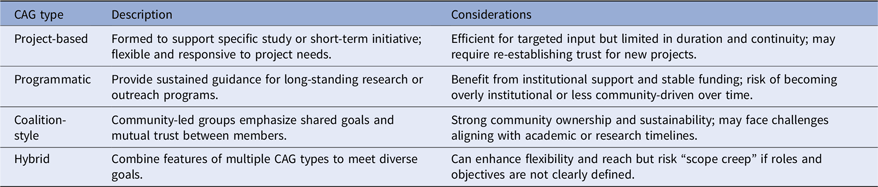
Together, these four factors formed the analytic foundation for deriving the CAG typology. Groups sharing similar combinations consistently clustered, forming the basis for the four types summarized in Table 2.
Emerging CAG typologies

Table 2. Long description
A table categorizing CAG types with descriptions and considerations. The table has three columns: CAG type, Description, and Considerations. It contains four rows detailing different CAG types. Row 1: CAG type, Project-based; Description, Formed to support specific study or short-term initiative; flexible and responsive to project needs; Considerations, Efficient for targeted input but limited in duration and continuity; may require re-establishing trust for new projects. Row 2: CAG type, Programmatic; Description, Provide sustained guidance for long-standing research or outreach programs; Considerations, Benefit from institutional support and stable funding; risk of becoming overly institutional or less community-driven over time. Row 3: CAG type, Coalition-style; Description, Community-led groups emphasize shared goals and mutual trust between members; Considerations, Strong community ownership and sustainability; may face challenges aligning with academic or research timelines. Row 4: CAG type, Hybrid; Description, Combine features of multiple CAG types to meet diverse goals; Considerations, Can enhance flexibility and reach but risk “scope creep” if roles and objectives are not clearly defined.
Project-based CAGs (n = 13) were the most common, characterized by narrow scope, research-focused advisory roles, strong institutional control, and members selected for topic expertise. Programmatic CAGs (n = 3) had a broader but still institutionally anchored scope, providing strategic guidance across initiatives with mixed professional and community representation. Coalition-style CAGs (n = 3) represented the opposite end of the spectrum from project-based groups, with broad scope, community-driven function, loose institutional affiliation, and membership primarily composed of diverse local stakeholders with lived experience. Hybrid Project-programmatic CAGs (n = 3) exhibited intermediate or blended patterns, often addressing both project-specific and regional needs, operating across multiple sites, or shifting between institutional and community leadership depending on context.
Cross-case summary
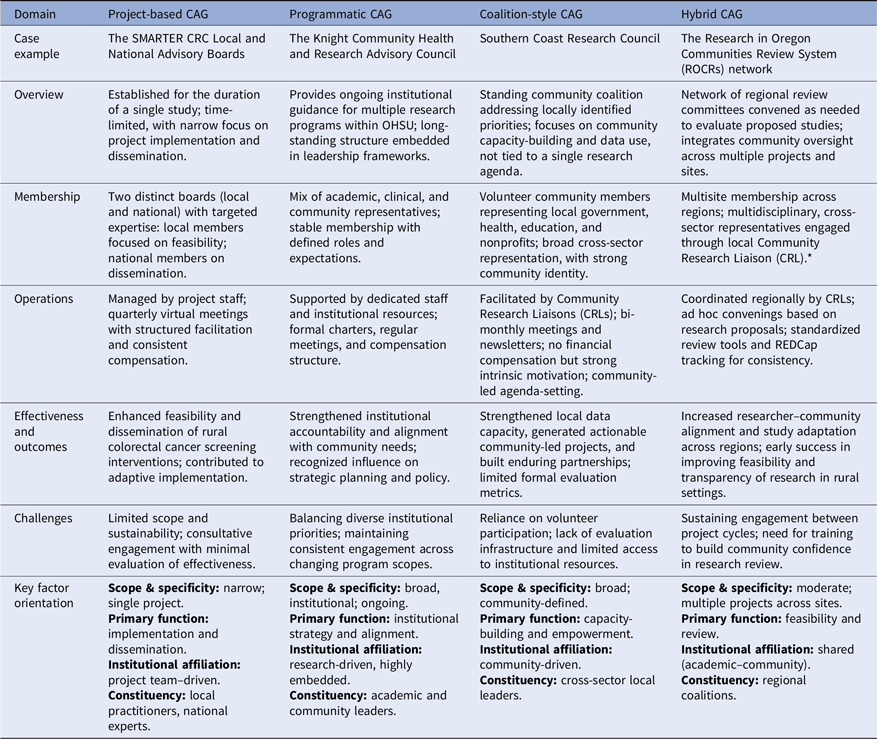
Appendix B provides case examples of the four CAG typologies, with key features summarized in Table 3. These cases highlight how structural features interact with institutional and community contexts and how these differences shape roles, accomplishments and sustainability. Cross-case summaries are provided below.
Cross-case comparison of CAG types across core domains and key factors

Table 3. Long description
A table comparing four types of Community Advisory Groups (CAG) across different domains and key factors. The table has five rows and five columns. The columns are labeled Domain, Project-based CAG, Programmatic CAG, Coalition-style CAG, and Hybrid CAG. The rows are labeled Case example, Overview, Membership, Operations, Effectiveness and outcomes, Challenges, and Key factor orientation. Each cell contains detailed descriptions of the respective CAG type’s features and characteristics. For example, under Project-based CAG, the Case example is The SMARTER CRC Local and National Advisory Boards, and the Overview mentions it is established for the duration of a single study with a focus on project implementation and dissemination. The table provides a comprehensive comparison of the structural features, roles, and accomplishments of different CAG typologies.
* The Community Research Liaison Model is a novel approach to community–academic partnership and community engagement [Reference Jaderholm, Currier and Brown20].
Comparative analysis of the four CAG types revealed a spectrum of community–academic engagement structures within CORE, differentiated primarily by scope, function, and degree of institutional integration. Together, these typologies illustrate the multiple ways that community engagement can be operationalized within translational research infrastructure, each offering distinct advantages and trade-offs.
Project-based CAGs, such as the (Screening More Patients for CRC Through Adapting and Refining Targeted Evidence-Based Interventions in Rural Settings) SMARTER CRC boards, occupy one end of the spectrum. They demonstrate high alignment with specific study goals and timelines, contributing directly to intervention adaptation, feasibility, and dissemination. However, their narrow scope and limited duration can inhibit sustainability, and engagement tends to remain consultative rather than collaborative. While effective for targeted implementation support, these CAGs rarely establish long-term community infrastructure.
Programmatic CAGs represent the most formal and institutionally embedded model, characterized by stable membership, dedicated resources, and an enduring mandate to inform strategy and policy. Their strength lies in continuity and influence. Members often contribute to high-level planning and decision-making but their reach may be constrained by institutional priorities that limit flexibility or grassroots participation.
In contrast, the coalition-style Southern Coast Research Council (SCRC) illustrates a grassroots approach to community engagement, prioritizing local capacity-building and empowerment. As a community-owned coalition, SCRC emphasizes training, data literacy, and cross-sector collaboration rather than project-specific consultation. While this model yields strong relational and educational outcomes, its reliance on volunteer participation and limited formal evaluation infrastructure present challenges for sustainability and measurement of research impact.
The hybrid The Research in Oregon Communities Review System (ROCRs) model blends elements of both approaches. By anchoring regional review committees within existing coalitions, it achieves scalability and standardization while preserving local control. This model demonstrates strong potential for systematizing community review processes across rural regions. Its distributed structure, however, requires ongoing coordination and member development to sustain readiness and ensure equitable participation across sites.
Discussion
Findings from this study of 22 CAGs affiliated with one institution’s CTSA community program display variation in relation to structure, scope, and function – which reflects the diverse goals of community-engaged research. Across the four typologies identified alignment between a CAG’s structure and its intended purpose appears to be the critical determinant of effectiveness. Groups designed to advise a single project or element (i.e., project-based CAGs) excelled in providing targeted, time-sensitive feedback on implementation and dissemination activities. In contrast, programmatic or coalition-style groups played broader roles in shaping institutional strategies or regional research capacity.
Our findings reinforce prior literature emphasizing the need to tailor CAG composition and operational design to the goals and phase of the research [Reference Yuan, Mayer, Joshweseoma, Clichee and Teufel-Shone6,Reference Fisher, Brewer and Westfall7]. For example, narrowly focused projects may benefit from smaller, purpose-built groups with highly relevant expertise, whereas institutions or networks pursuing multiple initiatives may require larger, more stable advisory bodies to maintain continuity across programs. Hybrid models, such as the ROCRs network, demonstrate the potential to bridge these approaches: standardizing community review processes while maintaining local autonomy. Across all types, effective leadership, clear communication of roles, and strong facilitation were consistently associated with sustained engagement and meaningful input, echoing recent calls for attention to process quality and relationship-building in community engagement [Reference McMaughan, Grieb, Kteily-Hawa and Key8,Reference Key, Furr-Holden and Lewis11].
Despite widespread endorsement of CAGs as mechanisms for enhancing research relevance and equity, this study found limited use of formal evaluation metrics to assess their effectiveness. None of the CAGs reviewed employed consistent outcome measures, and few had plans to do so. This mirrors broader national trends that most studies limit community engagement activities to consultation or outreach which are lower levels on the engagement continuum [Reference Villalobos, Blachman-Demner, Percy-Laurry, Belis and Bhattacharya2].
Existing tools such as Guidance for Reporting Involvement of Patients and the Public (GRIPP2) [Reference Staniszewska, Brett and Simera12] and the Continuum of Community Engagement in Research [Reference Key, Furr-Holden and Lewis11] provide valuable frameworks to define CAG structures and operations but are rarely used in practice. This is due in part because these frameworks may not capture outcomes that researchers and community partners most care about such as relationship quality, trust, project sustainability, and long-term impact. These domains often unfold over extended timeframes, beyond the duration of most research grants, and are difficult to quantify using conventional metrics [Reference Sanders Thompson, Ackermann, Bauer, Bowen and Goodman3,Reference Villalobos, Reynolds, Halpin, Jacobs and Peay4]. There may also be issues of awareness and implementation burden. Researchers may be unfamiliar with these frameworks or may know they exist but feel overwhelmed by the effort required to select, adapt, and apply them. In many cases, CAGs are established to inform a specific study or project rather than to serve as objects of evaluation themselves, making formal assessment feel akin to running a parallel study alongside ongoing research. One potential way forward is to overlay an independent evaluative study onto CAGs already in operation thereby reducing burden on project teams, minimizing conflicts of interest, and enabling the use of complementary approaches such as Ripple Effects Mapping to capture downstream and longer-term impacts that extend beyond a single grant or study [14,Reference Washburn, Traywick, Thornton, Vincent and Brown15].
There is a clear need for simpler, more adaptable tools that align evaluation measures with CAG purpose and context, while also acknowledging a key tension: when advisory groups appear to be “working” from an academic or institutional perspective, there may be little perceived urgency to formally evaluate their impact. In such cases, visible or anecdotal benefits can substitute for systematic assessment, reducing pressure to examine whether CAGs are meeting community-defined goals. Condensed surveys and feedback mechanisms embedded within existing processes could help surface misalignments by assessing mutual benefit, satisfaction with communication, and perceived influence on research decisions. Future work should also explore developmental evaluation approaches that allow CAGs to evolve their metrics alongside their functions, ensuring evaluation remains iterative, participatory, and responsive to moments when expectations are not being met [Reference Goodman, Sanders Thompson and Johnson16,Reference Jagosh, Macaulay and Pluye17].
The cross-case analysis also raises questions about efficiency and sustainability in community engagement. Operating multiple project-specific boards can be resource-intensive and may fragment community input. Centralized or hybrid CAG structures like the ROCRs model that build on established groups offer an alternative model that may address community fragmentation, enabling researchers to access standing community expertise while reducing duplication. Centralized models may streamline coordination, reduce the number of meetings members attend, and allow participants to engage selectively with projects most relevant to their expertise or interests.
However, consolidation also introduces trade-offs. While centralization can improve efficiency, it may dilute localized knowledge or weaken relational depth, especially when boards serve multiple communities or diverse study types [Reference Fisher, Brewer and Westfall7]. The key, as others have noted, lies in clarifying the CAG’s specific purpose: whether to generate ideas, refine implementation strategies, or guide institutional priorities [Reference Yuan, Mayer, Joshweseoma, Clichee and Teufel-Shone6]. Getting “the right people in the room” remains essential. The emerging best practice appears to be flexible centralization: maintaining regional or topical advisory structures that share standardized processes but retain local identity. This approach can support scalability while preserving trust and responsiveness, two cornerstones of effective community engagement.
This study provides an empirically grounded typology of CAGs operating within a single translational research ecosystem, illuminating how structural variation shapes engagement, influence, and sustainability. By comparing programmatic, project-based, hybrid, and coalition-style models, we demonstrate that effective community engagement depends less on adopting a particular structure and more on aligning CAG design with specific research goals, resources, and community contexts [Reference Greenhalgh, Hinton and Finlay18]. While institutional CAGs promote continuity and policy influence, localized coalitions foster ownership, trust, and capacity-building. Hybrid and networked models offer promising middle-ground solutions for scalability across diverse settings. These findings contribute to a growing body of evidence emphasizing intentional design and evaluation of engagement structures as a critical component of translational research infrastructure. However, more research is needed to detail CAG operating costs and management which is of particular importance to PBRNs and clinical and translational science programs who commonly use CAGs.
Limitations
This study has several limitations. First, findings are based on CAGs affiliated with one CTSA community program and affiliated community-engaged programs in OHSU CORE. This does not represent all advisory groups at OHSU and may not represent advisory groups in other institutional or geographic contexts. However, the diversity of CAGs analyzed provides a broad and informative range of structures, similar to typologies described in other PBRNs such as the Colorado Ambulatory Partnership for Health Innovation and Research Excellence (CAMPHIRE) [Reference Fisher, Brewer and Westfall7]. Second, although the study incorporated multiple data sources, variability in documentation limited the ability to systematically assess all domains [Reference Staniszewska, Brett and Simera12]. Finally, CAG effectiveness was evaluated qualitatively rather than quantitatively, reflecting the early-stage nature of this typology development effort. Future research should apply mixed-methods or longitudinal designs to assess how different CAG structures influence individual experiences as well as engagement quality, research outcomes, and sustainability over time.
Conclusion
Together, these findings advance understanding of how CAGs can be designed and managed to strengthen community-engaged translational research studies and programs. Aligning CAG structure with purpose, simplifying evaluation tools, and adopting scalable engagement frameworks may collectively enhance both the quality and sustainability of community partnerships. Moving forward, a next generation of research should focus on developing empirically grounded models akin to implementation frameworks in quality improvement [Reference Proctor, Landsverk, Aarons, Chambers, Glisson and Mittman19] that specify which CAG features are most effective for which contexts. Doing so will help ensure that community engagement remains not only a foundational value but a measurable and improvable component of translational science.
Supplementary material
The supplementary material for this article can be found at https://doi.org/10.1017/cts.2026.10827.
Acknowledgements
We are grateful to the CAG leaders for their participation in this project and to the CAG members/partners for their long-standing commitments and engagement in the various program activities. This work would not have been feasible without the rich contributions of the CAG partners during this time. We also acknowledge Jen Coury for her editing assistance. We thank the Community Advisory Group facilitators for generously sharing their time, expertise, and lived experience throughout this work.
Author contributions
NithyaPriya S. Ramalingam: Conceptualization, Data curation, Formal analysis, Funding acquisition, Investigation, Methodology, Project administration, Writing – original draft, Writing – review & editing; Chrystal Barnes: Conceptualization, Data curation, Formal analysis, Writing – original draft, Writing – review & editing; Caitlin Dickinson: Resources, Writing – review & editing; Laura Campbell: Resources, Writing – review & editing; Jackilen Shannon: Resources, Writing – review & editing; Melinda Davis: Conceptualization, Formal analysis, Funding acquisition, Writing – review & editing.
Funding statement
We acknowledge the editorial assistance of the Oregon Clinical & Translational Research Institute, which is supported by the National Center for Advancing Translational Sciences, National Institutes of Health, through Grant Award Number UL1TR002369.
Competing interests
Authors have no competing interests to report.



 Open access

