During the eighteenth and early nineteenth centuries the soloist in a keyboard or violin concerto usually performed double duty: as soloist proper and as part of the orchestra (or even its leader) during all or some orchestral ritornellos. The most compelling evidence for this soloist participation in tuttis is found in the primary sources, such as instructions in autograph scores and manuscript score copies, as well as the notated realization of these instructions in printed and manuscript parts. This article discusses evidence of soloist participation during the tuttis of late eighteenth-century woodwind concertos, specifically those for flute and oboe. Although performances of eighteenth-century keyboard and violin concertos today are beginning to incorporate the soloist participation suggested by the sources, for woodwind concertos the practice has not caught on among performers, nor have its implications been thoroughly considered by the scholarly community.
KEYBOARD AND VIOLIN CONCERTOS
The autograph scores for Mozart's keyboard concertos contain instructions to the copyist that when preparing the performing materials he should enter the orchestral bass line into the left hand of the soloist's part during tutti sections. Mozart indicated this in the score by writing the phrase ‘col basso’ on the staff for the left hand, which he otherwise left blank until a solo section began. In the staff for the right hand, there were rests. In printed and manuscript solo parts prepared from these scores within Mozart's lifetime and shortly thereafter, this bass line was present, sometimes appearing with figures, and occasionally with those figures fully realized. This reveals that the soloist was expected to improvise a basso continuo part during the tuttis unless otherwise instructed.Footnote 1
Mozart's autographs of all five solo violin concertos contain, for most or all orchestral ritornellos, instructions for the copyist to transfer material verbatim from the first violin to the solo part. Mozart indicated this by writing ‘col violino primo unisono’ (or some other phrase with the same meaningFootnote 2) on the solo line of the score, which was left blank thereafter (did not include rests); this instruction was cancelled by the appearance of written notes. Alternatively, Mozart sometimes wrote out the first bar or so of the solo line, doubling the first violins, followed by the instruction just detailed.Footnote 3 In either case, the indications to double the first violin generally appeared immediately at the outset of the orchestral ritornellos and were cancelled at solo sections. When publishing the concertos in parts, Johann Anton André followed the composer's instructions, and the relevant passages taken from the first violin appeared as full-sized notesFootnote 4 in the solo violin part.Footnote 5
Mozart's indications are in line with those of his contemporaries, as is revealed by a wealth of surviving scores and parts. The specifics of the ‘col violino’ or ‘col basso’ instruction might differ from composer to composer, but, in general, the expectation was that the soloist should participate during orchestral sections. Therefore the soloist was seen as part of, rather than apart from, the accompanying orchestra: a keyboard or violin soloist in the eighteenth century emerged out of the orchestral texture for solo sections and was absorbed back into it for ritornellos. This suggests a very different relationship between soloist and orchestra than that promoted by today's performance practice, in which the soloist and orchestra occupy quite discrete musical, physical and conceptual spaces.
TREBLE WOODWIND CONCERTOS
What would the options be with regard to soloist participation during the tuttis of a flute or oboe concerto? The soloist could remain silent during the ritornellos, play an independent part or double his orchestral counterpart (if the instrumentation included one). Another option, and the one that appears most frequently in the primary sources, is for the flute or oboe soloist to double (more or less) the first violin part. Therefore the sonority on this line would be ‘mixed’, comprising both the solo woodwind instrument and the first violins.
The evidence that a treble woodwind soloist (on flute or oboe)Footnote 6 participated in the tuttis is principally the same as for keyboard or violin concertos: indications in composers' scores that specific music during the tuttis should be copied into the soloist's performing materials, and the actual presence of that music in the soloist's part. As I will show, when a treble woodwind soloist doubles the first violins during tutti sections, his part has often been altered in order to make it fit the more limited range of the flute or oboe. To my mind, there would be no reason to go to such trouble if this tutti music was intended simply as a cue and was not to be played. At times the doubling comes and goes in relation to structural divisions within the tuttis, implying that it was not mechanically derived for the purpose of cueing, but instead was responsive to the form and the phrase structure.
In my research I have found that the employment of the soloist in concertos for treble woodwinds was often more flexible than for keyboard or violin concertos. However, the options can be divided into two broad categories: complete and partial (further subdivisions will be described below). General patterns of preference – according to composer, geography or chronology, for example – have not emerged.
COMPLETE SOLOIST PARTICIPATION
For the present, my focus will be on the opening ritornello. If one perceives the events of the classical concerto's ‘double exposition’ as crucial to establishing the relationship between soloist and orchestra, then the soloist's activities during the opening ritornello are paramount. The most straightforward method for indicating tutti participation was, as for the violin concertos, simply to have the first violin part copied verbatim into the soloist's when the soloist was not otherwise engaged. While simplest for both copyist and composer, this might not accurately reflect what (or how much) would have actually been played, for not all violin music is directly transferable to a treble woodwind instrument. An example of this ‘complete’ variety, copied verbatim, appears in the opening ritornello of an oboe concerto by Anton Bachschmidt (1728–1797).
A manuscript score for this concerto is found in the Fürst Thurn und Taxis Hofbibliothek.Footnote 7 It is in an unidentified hand (not that of Bachschmidt) and bears the date 1763. During the opening ritornello the solo oboe line contains neither rests nor written music; instead, the copyist has numbered each bar of the solo line until the solo proper begins at bar 15. (In addition to the appearance of written notes for the solo oboe at bar 15, the structural division is further clarified by the word ‘solo’.)
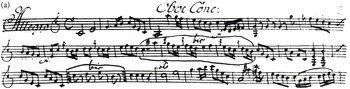
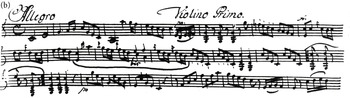
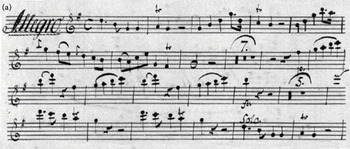
A set of manuscript parts for this concerto is also shelved with the score.Footnote 8 As can be observed in Figure 1, the music of the first violin has been copied verbatim into the solo oboe part for the opening ritornello, including the unplayable double and triple stops and the minim A in the third bar, which is outside the oboe's range. (Note that the copyist has not been entirely consistent in this example, since some of the multiple stops have been eliminated or reduced: see bars 5, 8–9 and 13–14.Footnote 9) A soloist wishing to participate in this opening would have to make octave alterations and decide which notes of the unreduced multiple stops to play.Footnote 10
Anton Bachschmidt, Oboe Concerto in C major, detail of first page, (a) solo oboe and (b) first violin ms. parts. Fürst Thurn und Taxis Hofbibliothek: Bachschmidt 26. Used by permission


Rather than leave the alterations up to the performer, we often find that octave adjustments and elimination of multiple stops have already been made in the soloist's part. This moves one step further on the part of the composer or copyist towards indicating what would actually be played, for it takes on the task left to the performer in Figure 1.
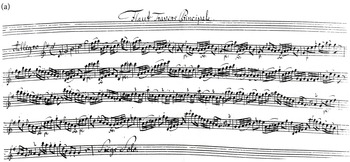
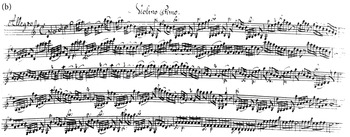
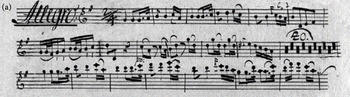
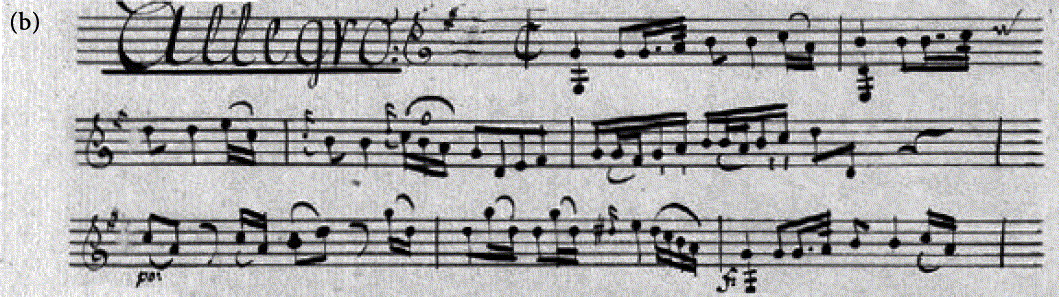
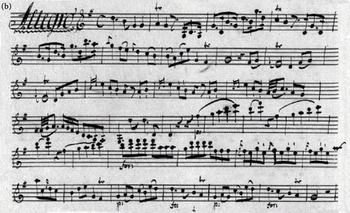
Figure 2 gives an example of ‘complete’ soloist participation altered to suit the solo instrument. In the opening ritornello of this flute concerto by Johann Stamitz (1717–1757)Footnote 11 some of the violin part is doubled at pitch, while the passages that fall below the flute's range have been raised an octave: see especially bars 4–7.Footnote 12 In addition, the g1 on which the flute ends the opening tutti is unique, for it is not present in the violin's triple stop (Figure 2b, sixth bar of the fourth system).
Johann Stamitz, Flute Concerto in G major, opening ritornello, (a) solo flute and (b) first violin ms. parts. Badische Landesbibliothek Karlsruhe Musikabteilung: Mus Hs 913. Used by permission


I am not claiming for either of the examples above that the performer would necessarily have played all of the tutti music appearing in his part; what he played was ultimately up to him. The various strategies for dealing with the unplayable notes will be discussed below, and in the meantime I maintain that the presence of out-of-range pitches and/or multiple stops in a solo flute or oboe part does not indicate that this was a system of cueing.Footnote 13
Anton Fils, Flute Concerto in G major, detail of first page, (a) solo flute and (b) first violin ms. parts. Royal Library of Copenhagen: mu 6306.1950 (Giedde collection VIII.51). Used by permission

PARTIAL SOLOIST PARTICIPATION
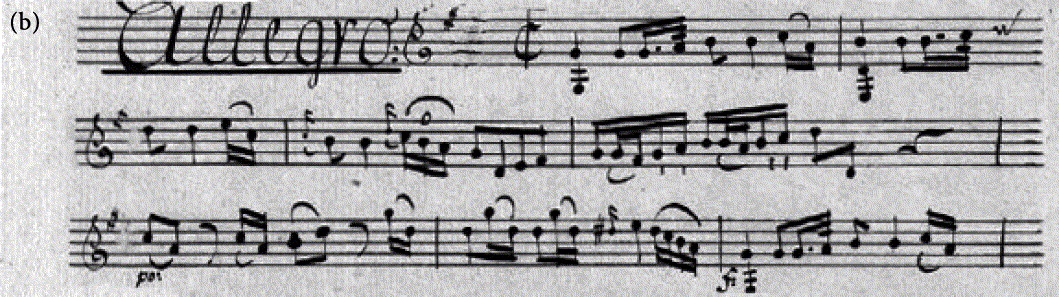
Since rests in the soloist's part during the tutti sections preclude his playing, examples of the second broad category, partial participation, specify not only what the soloist should play, but when. As the name implies, in the ‘partial’ type the soloist does not participate during an entire ritornello; instead, he begins with the orchestra and drops out until the start of the solo section or, alternatively, comes back in shortly beforehand. I call these subtypes ‘incipit’ and ‘split’ respectively. Since the soloist does not perform throughout the entire ritornello, problems of stamina are avoided, and the fact that the soloist is asked neither to remain entirely silent nor to play the entire tutti underscores the importance of the portions that do appear.
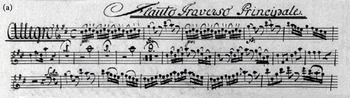
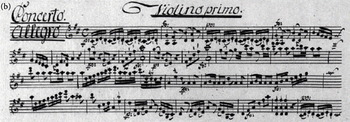
Anton Fils, Flute Concerto in D major, detail of first page, (a) solo flute and (b) first violin ms. parts. Royal Library of Copenhagen: mu 6304.2373 (Giedde collection VIII.25). Used by permission


Figure 3 demonstrates ‘incipit’ participation.Footnote 14 It is from a manuscript set of parts for a flute concerto by Anton Fils (1733–1760)Footnote 15 in the Giedde collection at the Royal Library of Copenhagen.Footnote 16 The soloist is given the first statement of the opening theme (doubling the violins), but rests appear for the remainder of the tutti. The highly decorated repeat of the theme (not shown) is left to the orchestra alone.Footnote 17
According to my research, the most common method of partial participation during the opening ritornello was the ‘split’, in which the soloist begins with the orchestra, drops out and comes back in shortly before the ensuing solo section. This procedure benefits from first having soloist and orchestra display solidarity in the opening, then providing textural contrast in the middle through the soloist's absence, and finally reinforcing the sonority for the closing gesture. This coming and going usually takes place at sensible points within the phrase structure of the ritornello. An example of such a split appears in Figure 4, from another flute concerto by Fils.Footnote 18
In this concerto, the soloist begins with the violins, rests during bars 11–19 and returns for the closing. Idiomatic adjustments have been made for the flute, with multiple stops removed and the entire opening transferred up an octave in order to avoid problems of range. The solo flute is actually given great prominence, since the violins are in their lower register (and could just as well have appeared in the same octave as the flute). A special feature of this example is that in bars 8 and 10 the flute is treated as an ‘orchestral’ wind (in the absence of any other orchestral woodwinds), providing additional emphasis to the minim a2s that are the goal of the violin arpeggios. As with the majority of split-participation examples, the flautist's re-entry just before the solo section corresponds with the final phrase of the opening ritornello, which, as is often the case, is a loud tutti flourish.
While wholly independent parts during the orchestral tuttis were rare in the later eighteenth century,Footnote 19 idiomatic alterations beyond octave displacements and the removal of multiple stops point to an even greater expectation that this music was to be played. Generally these sorts of alterations simplify the violin part, but they none the less reveal the details of participation in the tutti to be meaningful and deliberate. While copyists could have made the more straightforward adjustments without guidance, a quasi-independent line for the soloist during tuttis such as that shown in Figure 5, from a set of parts for a flute concerto by Friedrich Hartmann Graf (1727–1795),Footnote 20 probably originated with the composer.
Friedrich Hartmann Graf, Flute Concerto no. 2 in G major, first movement, detail of (a) solo flute and (b) first violin ms. parts. Royal Library of Copenhagen: mu 6306.1851 (Giedde Collection VIII.50). Used by permission


This Graf example combines many of the procedures we have seen thus far. The flute participates in only some of the opening tutti (beginning, middle and end), the part has been modified to remove out-of-range notes and it contains a simplified, yet unique version of the violin part.Footnote 21 Given Graf's credentials as a successful travelling flute soloist,Footnote 22 and judging from the virtuosic passages found at the end of each solo section, the opening was not simplified because he was incapable of performing the dotted figures in bars 2–5. (The same simplification is present in the parallel passage during the recapitulation.) For the soloist, that dotted figure is reserved for a point in the concerto where he has the spotlight, specifically the second solo section. In the opening tutti (and in the recapitulation), the solo flute is treated as an orchestral wind, and its deployment as such is typical of the increasingly independent role played by wind instruments in symphonic music of this time.
Taken together, these examples demonstrate that there were a number of general options for treble wind soloists' participation in tuttis. These options existed along a continuum: some seem quite precise about the role of the soloist, while others relinquish control to the performer. While the amount of participation and the degree of independence from the first violin part were variable, there was a clear expectation that the soloist would participate at least during the opening bars of the first ritornello.
Once beyond the opening, subsequent ritornellos tended to be treated more flexibly. A concerto that opened with split participation may call for complete participation (or none at all) in later tuttis. Similarly, a concerto featuring idiomatic alterations to the solo part at this juncture may or may not do so later in the movement. Most of the concertos I have examined do include some tutti participation later in the movement, especially in the longer, louder and structurally more important ritornellos. As with violin or keyboard concertos, the interjectory tuttis within solo spans rarely contain doubling.
THE ROLE OF THE COPYIST
The contribution of copyists must be considered when evaluating evidence provided by primary sources, for it was they who were responsible for the physical form of the parts. In all likelihood, some copyists followed composers' instructions literally when preparing parts from a score, while others took on (or were assigned) more responsibility. Indeed, the copyist might have been responsible not only for whether or not the part was idiomatically altered, but also whether participation by the soloist was notated in the first place. Just as what was actually played was ultimately up to the performer, so what a copyist wrote in the parts may or may not have reflected what was in the composer's score.
C. P. E. Bach's oboe concertos serve as a reminder of this distance between autograph score and manuscript parts. In the autograph scores for both h466/wq164 and h468/wq165Footnote 23 Bach indicates the oboe's tutti doubling of the first violin by inserting custodes on the otherwise blank solo line during certain ritornellos, suggesting the ‘complete’ variety of soloist participation. The only surviving manuscript parts were copied by Johann Heinrich Michel,Footnote 24 who for h466/wq164 copied the tutti doubling verbatim into the solo oboe part as Bach had indicated. In the solo part for h468/wq165, however, Michel employs the ‘split’ method. Why Michel interpreted the same score notation in two different ways is not clear, but his decision to do so suggests they were equally viable options. Notably, even though Bach did not specify in his score that it was the first violin part that should be doubled by the oboe soloist, Michel understood this to be the expectation.Footnote 25
EVIDENCE IN PEDAGOGICAL SOURCES
In addition to the primary source evidence, tutti participation by the soloist is specifically mentioned in two flute treatises of the period. Johann Joachim Quantz addressed solo participation in a well-known passage from his Versuch einer Anweisung die Flöte traversiere zu spielen of 1752:
Were the flautist to join in the performance of a well-written ritornello in an arioso that is played muted or piano, and whose melody reappears at the beginning of the solo part on the flute, he would produce the same effect as that of a singer singing along in the ritornello of an aria, or of one player doubling the other's part instead of resting in a trio. If you leave the ritornello to the violins alone, the following solo of the flute will make a much better impression than would otherwise be the case.Footnote 26
One cannot be positive whether Quantz meant this comment specifically in reference to passages of the sort he mentions – arioso, soft and subsequently replayed by the soloist – or to the practice in general. ‘Arioso’ implies that he is referring to slow second movements, and over half of Quantz's flute concertos have slow movements with that marking.Footnote 27 Moreover, an arioso is a specific type of second movement – one drawn from a vocal model – and as such tutti participation might in fact have been inappropriate. Despite his warning against the practice in this specific instance, Quantz's mention of it is surely proof of its existence.Footnote 28
About fifty years later, Johann George Tromlitz echoes Quantz and considers the concerto soloist's ‘doubling’ a part to be a ‘great mistake’, but if such a thing is done,
the discretionary ornaments must of course be held back, and while playing the first time through with the ripieno part, in a good, simple style, furnished of course with the necessary essential ornaments, one can keep those [discretionary] ornaments for later use.Footnote 29
Tromlitz documents the existence of ‘doubling’, or playing along with the ripieno (though he disliked it), and counsels that if it is to be done, it is important for the soloist to fit into the orchestral mass. One way to do this, apparently, was to limit one's ornamentation.
In the discussion of performing materials above, I pointed out that some altered the music found in the first violin part to ensure playability on the flute or oboe, while others did not. Almost no mention is made in flute tutors of the time of how to make the necessary octave adjustments when the violin part went too low. This is not surprising, for most tutors were concerned with more basic matters of performing (breathing, tonguing, fingering and so forth). Specific advice can be found, however, in Jean-Philippe Rameau's Cinq pièces de clavecin en concerts.Footnote 30 Although the work is composed for harpsichord with violin and viol accompaniment, Rameau allows an alternative scoring that substitutes a flute for the violin.Footnote 31 Rather than provide a separate flute part, however, the composer explains in a Foreword to the published parts that when presented with unplayable passages, the flautist may make octave adjustments or note substitutions when necessary. He even devises a system to indicate where entire phrases should be performed up an octave in order to maintain the shape of the melodic line, as opposed to adjusting out-of-range notes individually, which would alter the melodic contour. Rameau displays both an awareness of specific idiomatic concerns when making these substitutions and a generally flexible attitude towards what constitutes the ‘text’ of the work (some parts can be left out, and individual notes or groups of notes can even be transposed by a fourth or a fifth if the player wishes).Footnote 32
A flute tutor by Michel Corrette directly addresses what to do when the flautist wishes to play violin music but finds himself faced with multiple stops and notes that lie out of range. Chapter 15 of his Méthode raisonnée pour apprendre aisément à jouer de la flûtte [sic] traversière avec les principes de musique (Paris, 1773) is specifically devoted to negotiating the problems of playing music originally written for the violin (such as sonatas). It begins by providing specific examples of how to arpeggiate chords, followed by a chart showing which low-register violin notes correspond to which notes in the flute's range.Footnote 33 Corrette then gives excerpts from Corelli's Op. 5 violin sonatas, demonstrating modifications the flautist would make if he wished to perform these works. Again, rather than simply transposing individual notes that are unplayable, Corrette attempts to preserve the overall shape of the musical line; in doing so it is often necessary to bring notes that do not lie out of range up an octave.
Both Corrette and Rameau provide models for what flautists may have done when faced with unplayable passages. These sorts of modifications would not need to have been written down, and could easily have been made by performers on the fly. For today's performers and editors faced with tutti participation copied verbatim from the first violin, Rameau and Corrette's concern for preserving the melodic contour when making octave transpositions should provide some guidance.
One primary pedagogical source clearly demonstrates that to play the tutti music found in a concerto soloist's part was part of his expected contribution. A manuscript entitled Solfeggi pour la Flute Traversière avec l'enseignements: par Monsieur Quantz is part of the Giedde collection at the Royal Library of Copenhagen.Footnote 34 The seventy-six-page Solfeggi is a collection of brief lessons, exercises and short excerpts from works by Quantz and his contemporaries; many are accompanied by commentary explaining how they should be played.
In 1978 Winfried Michel and Hermien Teske published a diplomatic transcription of the Solfeggi.Footnote 35 They date the manuscript rather broadly to 1729–1741, the years in which Quantz was a member of the Dresden orchestra but journeyed twice a year to Berlin to teach then-Prince Frederick, and claim that the notation and commentary are in Quantz's hand.Footnote 36 Horst Augsbach, however, argues that Michel and Teske are incorrect. Based on a comparison of the Solfeggi manuscript and known Quantz autographs, Augsbach finds Quantz's hand nowhere in the Copenhagen source. Furthermore, there are excerpts in the Solfeggi from a Quantz concerto not written until 1750 (and two excerpts from concertos written in the 1760s), so Michel and Teske's dates cannot be correct. The paper, bearing a crowned lily and the letters J KOOL, is from the manufacturer Jan Kool and was produced between 1775 and 1808. Augsbach, therefore, proposes that the Solfeggi manuscript dates from 1775–1782, originated in Berlin and was associated with a student of Augustin Neuff (himself a student of Quantz and flautist in the Berlin Hofkapelle from 1751 to 1792).Footnote 37
Although the Copenhagen manuscript may not be in Quantz's hand, it should not be assumed that the Solfeggi is not somehow associated with him. Indeed, Steven Zohn notes that ‘in compiling the manuscript the unknown copyist seems to have drawn on various older sources connected with Quantz’, and that ‘despite the somewhat indirect transmission of the Solfeggi, no evidence has emerged to undermine the view that most, if not all, of its contents originate with the composer’.Footnote 38 In any case, the Solfeggi document contains valuable information regarding eighteenth-century concepts of tonguing, phrasing and style.Footnote 39
The excerpts of works in this collection were probably selected because they gave the student difficulty or illustrated a particular technical issue. For most of the excerpts, the composer is identified, and the list includes names both familiar (C. P. E. Bach, W. F. Bach, Telemann, Quantz) and relatively unfamiliar (such as Johann Martin Blockwitz and Carl Wilhelm Glösch).Footnote 40
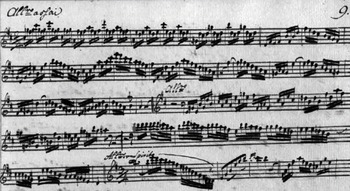
The top five systems of folio 9v (given in Figure 6) contain several excerpts from the Flute Concerto in D major by C. P. E. Bach, h416/wq13.Footnote 41 Many of them are difficult passages from solo sections, ranging from single-instrument polyphony to rapid broken thirds. However, the passage beginning in the third bar of the fourth system and continuing into the first two bars of the fifth system is not from a solo section at all. It corresponds to bars 96–98 of the first movement, and is not found at this pitch level anywhere in the solos. Similar passages are used many times throughout the concerto as closing material, but this specific version happens only once – during an orchestral section.Footnote 42 The point is this: the student is given music to practise that is relevant only if he doubles the violins during the tuttis.
Johann Joachim Quantz, Solfeggi, f.9v, detail. Royal Library of Copenhagen: mu. 6210.2528 (Giedde Collection I.16). Used by permission

It is not at all unusual for a student to practise music originally written for another instrument, or even to perform an arrangement. What is telling here, however, is the context in which this passage appears. It is not part of a series of etude-like exercises, and does not just ‘happen’ to be from the violin repertory. These first five systems of folio 9v contain the difficult sections of a single, specific concerto, and apparently this small portion of a tutti section warranted inclusion. Not only can we infer that the teacher (whether Quantz or Neuff) would have played it, but that he thought his student should, too.
MOZART'S OBOE CONCERTO IN F MAJOR, k293 (416f)
Today, concertos for flute or oboe by C. P. E. Bach, Graf or Fils may be important works to specialist performers, but it is those by Mozart that are perhaps best known.Footnote 43 The source materials for Mozart's completed flute and oboe concertos are very problematic, but do exhibit many of the features already discussed that imply the soloist was to participate during selected tuttis (features such as printed and manuscript parts that contain doubling of the violin, and score copies with soloist participation either written out or indicated by ‘col primo violino’ instructions).Footnote 44 The status of their source materials precludes discussion of these concertos here, but Mozart's unfinished Concerto in F major for Oboe, k293 (416f), is more fruitful for present purposes, and is particularly instructive because it survives in autograph score.
Scholars have disagreed about the dating of this score, but analysis of handwriting and paper type leads Franz Giegling to propose November 1778, just after Mozart left Paris. Giegling connects it to the letter of 12 November 1778 in which Mozart informs his father of his work on the (also unfinished) Concerto for Violin and Piano, k Anh. 56 (315f), and claims it is conceivable that this oboe concerto was also intended for the Academie des amateurs.Footnote 45
When examining such a score, it is helpful to remember that Mozart appears to have composed most of his pre-Vienna concertos in ‘blocks’.Footnote 46 For each formal section (in the case of concertos, these are ritornellos and solos) he writes first the melody, then the bass, then the filler parts, completing the scoring of each section before moving on to the next. Therefore an unfinished Mozart concerto autograph often contains one or more fully scored sections, but the point at which it was abandoned usually contains only the melody and possibly the bass.
The sixty-one-bar autograph score of k293 (416f), housed in the Fitzwilliam Museum in Cambridge,Footnote 47 contains a fully orchestrated opening ritornello. The first solo section begins at bar 47 (though the solo proper begins in bar 51) and is fully orchestrated for only four bars. After that, the remaining eleven bars contain only the solo oboe part. Another source, nine bars in length, also belongs to this concerto.Footnote 48
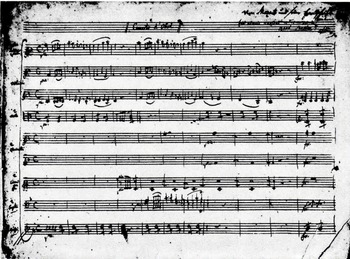
The score contains written-out tutti doubling (as opposed to abbreviated instructions, as in his violin and keyboard concerto scores), clearly demonstrating that Mozart intended the oboist to participate during part of this opening ritornello. As seen in Figure 7, Mozart has written out eight bars for the solo oboe (top line of the score), which doubles the first violin (second line of the score) but does so an octave higher. After the crotchet in bar 8 of the solo oboe line, the remainder of the opening ritornello contains rests for the soloist.
Wolfgang Amadeus Mozart, Oboe Concerto in F major, k293 (416f), autograph score f.1r. Neue Mozart Ausgabe V/14/3, xv, available at <www.dme.mozarteum.at/nma>. Used by permission

In this example Mozart employs the ‘incipit’ type of tutti doubling – the soloist participates only in the first few bars (in this case, the first pair of phrasesFootnote 49). As noted, the oboe is written one octave higher than the violin, but this is not merely an example of idiomatic alteration. The oboe was certainly capable of performing the pair of phrases in unison with the violin, so Mozart wrote the passage in octaves for another reason – perhaps to highlight the oboe's participation in the opening ritornello, seeking to draw attention to the soloist during this otherwise ‘orchestral’ passage. During these first eight bars the violins are scored quite low in their register, as are the violas. Although the oboe tessitura is by no means high, the combination of the higher-register oboe with the lower-register upper strings makes the oboe doubling much more prominent. In addition, Mozart keeps the orchestral winds out of the way for at least the first few bars by staggering their entrances: the horns enter in bar 4, followed by the bassoons (also doubling the melody) in bar 5. The clarinets, completing the wind contingent, are silent until the soloist drops out in bar 8. The texture for the remainder of the ritornello is primarily dominated by the strings (despite a couple of bars featuring the wind alone).
IMPLICATIONS OF THE PRACTICE
What would have been the benefits of the soloist playing along in the tuttis or, at the very least, for a few bars at the beginning of a concerto? From a practical standpoint, it would have been quite helpful for the woodwind player to play a few notes before the first solo section, to allow him to steady his nerves, settle his reed, warm the instrument and fine-tune his pitch. In addition, playing along with the orchestra would have facilitated leadership by the soloist.
Eighteenth-century orchestral music was typically led by a performing member of the ensemble, usually either the first violinist or the keyboard player. As noted at the outset of this article, most violin concerto solo parts also contained the orchestral first violin part during the ritornellos. In addition to invigorating the tuttis with the sound and charisma of the soloist, this also provided him the means for leading the orchestra, since the first violin part was where the rank and file were used to looking and listening for direction. Leadership by the solo violinist was certainly not required, but was nevertheless set up as a possibility by contemporary sources.Footnote 50
From this, it might be inferred that the woodwind concerto soloist also had the option of leading the accompanying orchestra, insofar as ‘leadership’ meant stopping and starting the ensemble, establishing tempos and setting the style. In fact, even if the soloist was not leading, he was probably still responsible for some of these matters: Quantz implores the orchestral leader to pay close attention to the soloist and ‘allow him to set the tempo as he sees best’.Footnote 51 This seems most effectively accomplished by employing the soloist during at least the first few bars of the opening ritornello, and to this end doubling the first violin makes a great deal more sense than doubling an orchestral flute or oboe. Woodwind soloists taking a more active leadership role might have played during most or all tuttis, facilitated by the first-violin doubling included in their parts.
From the perspective of timbre, the addition of the soloist to the tutti strings of a violin concerto is not terribly problematic, since at least two other orchestral violins were probably already playing. In contrast, adding the soloist to the tuttis of a woodwind concerto – in some cases admitting a timbre not already present in the orchestral sonority (and in most cases creating a ‘mixed’ sonority on the first violin line) – is a different story, for it would change the way these concertos sound.
Those objecting to a soloist providing basso continuo in the tuttis of keyboard concertos usually do not deny the presence of the bass line in the keyboard player's physical part (as part of the ‘text’); their problem is with its realization in sound (as part of the performance of that text).Footnote 52 Similar reservations have been raised in connection with woodwind concertos, particularly given the impact of the addition of the soloist's timbre to the orchestral sonority.Footnote 53 Others regard colla parte doubling of this sort as incongruous with typical late eighteenth-century woodwind scoring.Footnote 54
Further objections might be raised that doubling during tutti sections would dilute the individual voice of the solo instrument, thereby upsetting the separation of soloist and orchestra that is so crucial to reading concertos as ‘about’ an individual versus society. Such a reading of contrast (and conflict) between individual and mass is rooted in a later musical aesthetic, however, as is evidenced by the increasingly individualistic treatment of the soloist in nineteenth-century concertos. The sociology of the eighteenth-century concerto is readily revealed by its performance practice, and that practice suggests a soloist who emerges out of the accompanying orchestra – as one among many – and so does not stand apart from it.
In light of the soloist's presence in the tuttis of eighteenth-century concertos, how should the inevitable contrast between soloist and orchestra be regarded? When considering the implications of concerto performance with one player per part, where the soloist participates in tuttis ‘as a matter of course’, Dexter Edge proposes that we will have ‘to abandon the notion of the concerto as an inherently competitive genre’, as well as the idea that the concerto is ‘orchestral in the modern sense of the word’. He maintains that eighteenth-century concertos are indeed based upon contrast, but that contrast is between ‘soloistic texture and ensemble texture, and perhaps between sonata style and symphonic style’ (as opposed to individual versus mass).Footnote 55 It is clear that much remains to be explored with regard to the perception of contrast in the concerto, and, I might add, how it affects the distinctions between the concerto grosso / symphonie concertante, solo concerto and ripieno concerto.
Around the middle of the nineteenth century, tutti participation by a concerto soloist fell gradually from favour.Footnote 56 As a result, new editions of older music replaced the doubling that once appeared during the tuttis with rests, bringing the notation into line with current practice.Footnote 57 While some scholarly editions now print what appeared in the early parts, such soloist participation is often absent from today's performing editions or, if it is printed, is not performed and is misunderstood to be a cueing device. The existence of a variety of means for employing a soloist during the tutti sections, which I have demonstrated through the examples above, suggests that the practice was widespread.
What are performers and editors to do, given this evidence? To be sure, the implications of this practice are best tested in performance. Since a variety of options for soloist participation in tuttis seems to have existed, there is much to be explored.Footnote 58 What may no longer be assumed, however, is that a soloist's only option was to wait in silence when not engaged in a solo section.
New editions of concertos from this period should reflect what is in the sources, even if the results are at odds with the way the concertos are commonly played today. When adopted as an editorial policy, this gives soloists the choice of playing or not playing during tuttis; omitting the soloist participation present in the sources makes that choice for them.