Introduction
Women in the US military have taken on unprecedented responsibilities during Operation Enduring Freedom (OEF) and Operation Iraqi Freedom (OIF) in numbers deployed (Defense Manpower Data Center, 2009) and operations (Street et al. Reference Street, Vogt and Dutra2009). This is likely to continue in the future based on changing US military demographics (Defense Manpower Data Center, 2014) and policies (Department of Defense, 2013), making it increasingly important to understand the effects of deployment on females.
Suicide related to deployment has received considerable recent attention (Kang & Bullman, Reference Kang and Bullman2008). The focus of this work has largely been on males, given that service members are mostly males and, as in the general population, have a much higher suicide rate than females (Bell et al. Reference Bell, Harford, Amoroso, Hollander and Kay2010; Black et al. Reference Black, Gallaway, Bell and Ritchie2011). However, in light of the suggestion that risk factors for military suicides differ by gender (Gradus et al. Reference Gradus, Street, Suvak and Resick2013b), the question of female military suicides is of interest, although investigation has been limited.
A recent analysis of administrative data from the Army Study to Assess Risk and Resilience in Servicemembers (Army STARRS) (Ursano et al. Reference Ursano, Colpe, Heeringa, Kessler, Schoenbaum and Stein2014) provided new and potentially important information about gender difference in Regular Army suicides by documenting that variation in the suicide rate by deployment was more pronounced among women than men, resulting in a significant gender × deployment interaction in predicting suicide (Gilman et al. Reference Gilman, Bromet, Cox, Colpe, Fullerton, Gruber, Heeringa, Lewandowski-Romps, Millikan-Bell, Naifeh, Nock, Petukhova, Sampson, Schoenbaum, Stein, Ursano, Wessely, Zaslavsky and Kessler2014). Specifically, the suicide rate of currently deployed female soldiers was more than three times the rates of never-deployed and previously deployed women, while the suicide rate of male currently deployed soldiers was only slightly higher than the rate of never-deployed men and lower than the rate of previously deployed men. This pattern raises the possibility that the adverse effects of current deployment on suicide might be greater for women than men.
We investigate four hypotheses to account for this pattern in the current report using data from the Army STARRS Historical Administrative Data System (HADS). The first of the four is a hypothesis that we believe unlikely but needing empirical evaluation: that enlisted soldiers in military occupational specialties (MOSs) with the highest proportion of women (e.g. administrative roles, medical technicians) might have the most dramatic increases in suicide during deployment regardless of gender. If this hypothesis is supported, the association between PF/MOS (the proportion of soldiers in a given MOS who are female) and suicide would be stronger among currently deployed than non-deployed soldiers and the interaction between gender and current deployment would attenuate when controlling for the interaction between PF/MOS and current deployment.
A second hypothesis is related to the previously documented findings that female service members experience less social support than their male counterparts during deployment (Street et al. Reference Street, Gradus, Giasson, Vogt and Resick2013), that low unit support is more strongly related to poor post-deployment adjustment among female than male veterans (Vogt et al. Reference Vogt, Smith, Elwy, Martin, Schultz, Drainoni and Eisen2011a), and that women receive more of their social support than do men from same-gender friends (Turner, Reference Turner1994). If the social support hypothesis is correct, we would expect the association between PSG/UNIT (the proportion of members of each soldier's unit who are the same gender as the soldier) and suicide to be stronger among currently deployed than other soldiers, leading the interaction between the soldier's own gender and current deployment in predicting suicide to attenuate after controlling for the interaction between PSG/UNIT and current deployment.
A third hypothesis is that sexual assault victimization might increase either in frequency or psychological impact during deployment. We already know that female soldiers are far more likely than males to be sexual assault victims (Street et al. Reference Street, Gradus, Giasson, Vogt and Resick2013) and that that sexual assault victimization is a significant predictor of subsequent suicide (Belik et al. Reference Belik, Stein, Asmundson and Sareen2009; Devries et al. Reference Devries, Watts, Yoshihama, Kiss, Schraiber, Deyessa, Heise, Durand, Mbwambo, Jansen, Berhane, Ellsberg and Garcia-Moreno2011; Gradus et al. Reference Gradus, Qin, Lincoln, Miller, Lawler, Sorensen and Lash2012, Reference Gradus, Shipherd, Suvak, Giasson and Miller2013a). There is also a suggestion in the literature that sexual assault victimization might increase during deployment (Leardmann et al. Reference Leardmann, Pietrucha, Magruder, Smith, Murdoch, Jacobson, Ryan, Gackstetter and Smith2013a; Street et al. Reference Street, Gradus, Giasson, Vogt and Resick2013), although this evidence is indirect. If true, this increase could lead to the higher suicide rate of currently deployed women observed in the earlier Army STARRS analysis. We are unaware of any previous research on whether the adverse psychological effect of sexual assault on women is magnified during deployment, but such a specification could be another basis for an elevated suicide rate among currently deployed women. If the sexual assault victimization hypothesis is correct, we would expect a meaningful attenuation in the gender × deployment interaction in predicting suicide after controlling for differential exposure and reactivity to sexual assault victimization during deployment.
A fourth hypothesis is that female soldiers are more psychologically vulnerable to deployment stresses than their male counterparts. This possibility is indirectly consistent with the fact that women have elevated rates of the mental/behavioral disorders most strongly associated with suicidality in the general population (Kessler et al. Reference Kessler, Chiu, Demler, Merikangas and Walters2005) and the Army (Kessler et al. Reference Kessler, Heeringa, Stein, Colpe, Fullerton, Hwang, Naifeh, Nock, Petukhova, Sampson, Schoenbaum, Zaslavsky and Ursano2014). Consistent with this possibility, a history of mental/behavioral disorders in medical records is among the most consistent predictors of military suicides (Bachynski et al. Reference Bachynski, Canham-Chervak, Black, Dada, Millikan and Jones2012; Conner et al. Reference Conner, McCarthy, Bajorska, Caine, Tu and Knox2012; LeardMann et al. Reference LeardMann, Powell, Smith, Bell, Smith, Boyko, Hooper, Gackstetter, Ghamsary and Hoge2013b). If the differential vulnerability hypothesis is correct, we would expect a meaningful attenuation of the gender × deployment interaction in predicting suicide after adjusting for prior treatment of mental disorders.
Method
Sample
The HADS includes data from numerous Department of Defense (DoD)/Army administrative data systems for all soldiers on active duty at any time between 1 January 2004 and 31 December 2009. We focused initially on HADS records for all 975 057 Regular Army soldiers who met this definition, 569 of whom died by suicide. There were approximately 37 million person-months for these soldiers over the study period. To create a manageable file, an equal probability sample of 0.25% person-months was selected from the control population, stratified by gender, rank, time-in-service, deployment history (never, currently, previously), and historical time, yielding 92 507 control person-months. These controls were combined with the 569 suicide person-months to create a case–control sample of n = 93 076 person-months (Schlesselman, Reference Schlesselman1982). Each control person-month was assigned a weight of 400 (1/0.0025) to adjust for under-sampling.
Measures
The HADS includes de-identified data from 38 Army/DoD administrative data systems (see eTable 1 at http://www.armystarrs.org/publications). The limited predictors used in the Army STARRS report that initially documented the gender × deployment interaction came from the DoD Defense Manpower Data Center (DMDC) Master Personnel & Transaction Files (MPTF; sociodemographic and Army career characteristics) and Contingency Tracking System (CTS; activations, mobilizations, deployments) as well as from the Armed Forces Medical Examiner Tracking System (AFMETS; suicides). This set of predictors was expanded for the current report to include the four hypothesized explanatory variables considered here: the proportion of female soldiers in each MOS (obtained from the MPTF); the proportion of same-gender soldiers in each unit (also obtained from the MPTF); sexual assault victimizations reported in the prior 12 months [obtained from the Sexual Assault Data Management System (SADMS), Criminal Investigation Division Information Management System/Automated Criminal Investigation/Criminal Intelligence (CIMS/ACI2), Centralized Operations Police Suite/Military Police Reporting System (COPS/MPRS), and Army Central Registry (ACR)]; and healthcare visits (both in-patient and out-patient) with International Classification of Diseases, Ninth Revision, Clinical Modification (ICD-9-CM) 290–319 diagnoses (whether primary or secondary) of mental/behavioral disorders in the prior 2–4 years [obtained from electronic medical records in the Medical Data Repository (MDR) and Theater Medical Data Store (TMDS)]. We limited analysis to sexual assault victimizations in the past 12 months, as we were interested in sexual assaults that occurred contemporaneously with deployment. We excluded information on healthcare visits in the past 12 months because we wanted to focus on healthcare records documenting a history of mental/behavioral disorders prior to current deployments. History of mental/behavioral disorders was considered present if medical records included ICD-9-CM diagnoses of any impulse-control disorder, stress disorder, substance use disorder, depressive disorder, bipolar disorder, anxiety disorder, personality disorder, or evidence of suicidality (for details on coding, see eTable 2 at http://www.armystarrs.org/publications).
Analysis methods
Discrete-time survival analysis with person-month the unit of analysis and a logistic link function (Willett & Singer, Reference Willett and Singer1993) was used to examine associations of the predictors with suicide. The initial Army STARRS report in which the gender × deployment interaction in predicting suicide was documented focused on basic sociodemographics and Army career predictors of suicide in interaction with deployment-status history (i.e. distinguishing never-deployed, currently deployed, and previously deployed soldiers) (Gilman et al. Reference Gilman, Bromet, Cox, Colpe, Fullerton, Gruber, Heeringa, Lewandowski-Romps, Millikan-Bell, Naifeh, Nock, Petukhova, Sampson, Schoenbaum, Stein, Ursano, Wessely, Zaslavsky and Kessler2014). These interactions were examined exclusively among enlisted soldiers (i.e. non-officers), as over 90% of Army suicides over the study period were committed by enlisted soldiers. The models included controls for calendar month based on the fact that the Army suicide rate increased over the study period (Black et al. Reference Black, Gallaway, Bell and Ritchie2011). The implicit assumption that strength of survival coefficients did not vary over time was tested and, consistent with earlier bivariate HADS results (Schoenbaum et al. Reference Schoenbaum, Kessler, Gilman, Colpe, Heeringa, Stein, Ursano and Cox2014), supported. The more in-depth analyses reported here built on the final model developed in the earlier analyses, which included gender, a dummy variable for being currently deployed, an interaction between these two variables, and controls for marital status, age at enlistment, rank, number of prior deployments, and dwell time between two most recent deployments for soldiers with a history of multiple deployments.
In order to evaluate the four hypotheses, we determined the extent to which the elevated gender × deployment interaction became smaller when the hypothesized explanatory variables were included in the model. In the case of PF/MOS, we also evaluated the subsample of soldiers that excluded those with Direct Combat Arms MOSs (i.e. those classified by the Army as having duties ‘to destroy or capture the enemy, or while repelling the enemy's assault by fire, close combat, or counterattack’ (Department of the Army, 1992), as there were virtually no women in those MOSs during the study period.
Importantly, we included in all explanatory models two-way interactions of gender with each hypothesized explanatory variable and of current deployment with each hypothesized explanatory variable. The interactions involving gender adjusted for possible compositional effect of the explanatory variable; that is, that women might have been more adversely affected by the explanatory variable than men regardless of deployment status and the explanatory variable was more prevalent among women than men during deployment than when not deployed. This might have been the case, for example, for sexual assault (i.e. women might have had a higher risk of sexual assault victimization during deployment than when not deployed). The interaction involving deployment, in comparison, adjusted for the potentiation effect of the explanatory variable, that is, for the possibility that the explanatory variable was associated with increased suicide risk during deployment compared with when not deployed regardless of gender but that exposure to the explanatory variable was higher for women than men throughout the Army career. This might have been the case, for example, for an MOS with a higher proportion of women (e.g. administrative roles in which lack of preparation for deployment may have resulted in increased suicide risk during deployment).
Results
Suicide rates by gender and deployment history
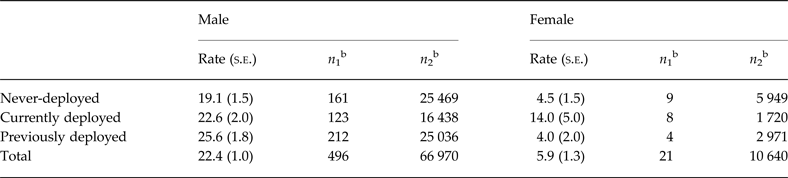
As reported elsewhere (Gilman et al. Reference Gilman, Bromet, Cox, Colpe, Fullerton, Gruber, Heeringa, Lewandowski-Romps, Millikan-Bell, Naifeh, Nock, Petukhova, Sampson, Schoenbaum, Stein, Ursano, Wessely, Zaslavsky and Kessler2014), the mean suicide rate of enlisted Regular Army soldiers over the study period was 20.1/100 000 person-years. As documented in the earlier Army STARRS report (Gilman et al. Reference Gilman, Bromet, Cox, Colpe, Fullerton, Gruber, Heeringa, Lewandowski-Romps, Millikan-Bell, Naifeh, Nock, Petukhova, Sampson, Schoenbaum, Stein, Ursano, Wessely, Zaslavsky and Kessler2014), variation in this rate by deployment status was significantly more pronounced among women than men, with the suicide rate of the currently deployed women three times the rates of the previously deployed and never-deployed (14.0/100 000 person-years compared with 4.0–4.5/100 000 person-years) and the suicide rate of currently deployed men proportionally much closer to the rates of the never-deployed and previously deployed (22.6/100 000 person-years compared with 19.1–25.6/100 000 person-years) (Table 1).
Suicide rate per 100 000 person-years by gender and deployment-status history in the Army STARRS 2004–2009 HADS sample (n = 77 610)a

Army STARRS, Army Study to Assess Risk and Resilience in Servicemembers; HADS, Historical Administrative Data System; s.e., standard error.
a The sample of 77 610 person-months includes all 569 suicides of active duty Regular Army enlisted soldiers in the administrative records during the years 2004–2009 plus a 0.25% (1/400) stratified probability sample of all other person-months in the population exclusive of those associated with other types of death (i.e. combat death, homicide, and death due to other injuries or illnesses). All records in the 0.25% sample were assigned a weight of 400 to adjust for the under-sampling months not associated with suicide.
b n 1 = number of suicides in the population; n 2 = number of person-months in the sample. As noted in footnote a, the person-months represent a 0.25% sample of the person-months of active duty of the 975 057 Regular Army enlisted soldiers (i.e. excluding officers and soldiers in the activated US Army National Guard and Army Reserve) on active duty for one or more consecutive months during the calendar years 2004–2009.
The ratio of the suicide rate among the currently deployed v. others (i.e. either never-deployed or previously deployed) is three times as high among women as men [odds ratio (OR) 3.0, 95% confidence interval (CI) 1.2–7.4]. The goal of our analysis was to determine whether this significantly elevated OR could be explained by introducing the explanatory variables considered here into the prediction equation.
Distributions of control variables
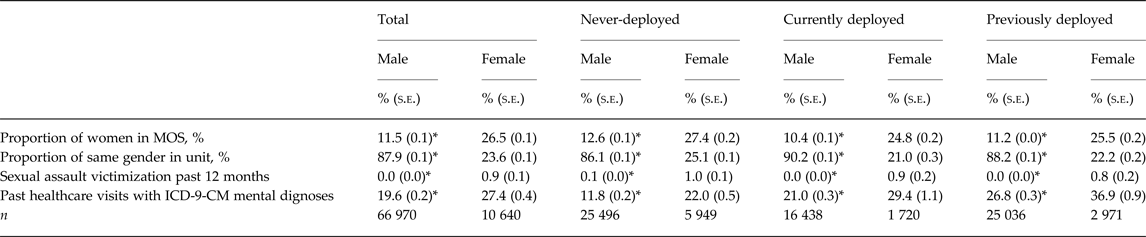
Female soldiers had MOSs in which an average 26.5% other members were women. This is much higher than for male soldiers, who had MOSs where an average of 11.5% of members were women (χ21 = 120.5, p < 0.001) (Table 2). These proportions did not vary substantially by deployment status (24.8–27.4% in the MOSs of female soldiers; 10.4–12.6% in the MOSs of male soldiers). Women also made up a significantly higher proportion of the members of the units of female than male soldiers (23.6% v. 12.1%, χ21 = 590.1, p < 0.001). These proportions again did not differ greatly by deployment status (21.0–25.1% of the members of the units of female soldiers; 9.8–13.9% of the members of units of male soldiers). Officially reported sexual assault victimization in the past 12 months was reported by a substantially higher proportion of female than male soldiers (9.4/1000 females v. 0.3/1000 males; χ21 = 484.1, p < 0.001), but was not significantly more common among currently deployed (8.8/1000) than never-deployed (10.3/1000; χ21 = 0.3, p = 0.57) or previously deployed (8.1/1000; χ21 = 0.1, p = 0.81) women. Finally, a significantly higher proportion of female than male soldiers had a history of healthcare visits with ICD-9-CM diagnoses of mental/ behavioral disorders in the past 2–4 years (27.3% v. 19.6%; χ21 = 333.3, p < 0.001).
Distributions of control variables by gender and deployment history in the Army STARRS 2004–2009 HADS sample (n = 77 610)

Army STARRS, Army Study to Assess Risk and Resilience in Servicemembers; HADS, Historical Administrative Data System; s.e., standard error; MOS, military occupational specialties; ICD-9-CM, International Classification of Diseases, Ninth Revision, Clinical Modification.
* Significant gender difference (p < 0.05; two-sided test).
Effects of control variables on the gender × deployment interaction
The OR of 3.0 describing the gender × deployment interaction in predicting suicide was reduced to 2.8 (95% CI 1.1–6.8) when we adjusted for the sociodemographic and Army career variables found to be significant predictors of suicide in the previous HADS analysis (Gilman et al. Reference Gilman, Bromet, Cox, Colpe, Fullerton, Gruber, Heeringa, Lewandowski-Romps, Millikan-Bell, Naifeh, Nock, Petukhova, Sampson, Schoenbaum, Stein, Ursano, Wessely, Zaslavsky and Kessler2014). The interaction was further reduced to 2.4 (95% CI 0.9–5.9) when we excluded soldiers with Direct Combat Arms MOSs. Although the 95% CI for this OR included 1.0, the OR was marginally significant (p = 0.066) despite the comparatively small number of currently deployed women. We consequently pursued further analysis of the interaction, a decision consistent with guidelines encouraging a focus on effect size indicators rather than tests of significance when interpreting substantively meaningful analytic results (Cumming, Reference Cumming2014).
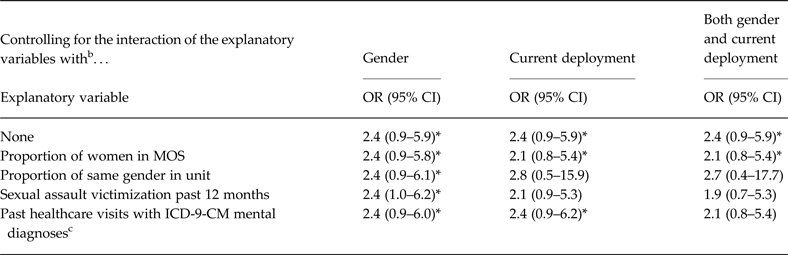
The OR of 2.4 remained unchanged when we adjusted for the compositional effects (i.e. main effects plus interactions with gender) of the hypothesized explanatory variables (Table 3). Also, the OR of 2.4 did not become substantively smaller when we adjusted for the potentiating effects (i.e. main effects plus interactions with deployment) of MOS gender composition, unit gender composition, recent sexual assault victimization, or past healthcare visits for mental/behavioral disorders. However, the OR became unstable when we controlled for the potentiating effect of unit gender composition. This instability is indicated by the CI becoming extremely wide in comparison with other specifications, resulting in the OR not being significant even though it increased from 2.4 to 2.8. The OR decreased to 2.1, in comparison, when we controlled separately for the potentiating effects of MOS gender composition and sexual assault victimization and to 1.9 when we controlled simultaneously for both the compositional and potentiating effects of sexual assault victimization.
Variation in the estimated interaction (OR) of female gender with current deployment (compared with being either never-deployed or previously deployed) in predicting Regular Army enlisted soldier suicide depending on the absence or presence of controls for hypothesized explanatory variables in the 2004–2009 Army STARRS HADS sample (n = 66 273)a

OR, Odds ratio; Army STARRS, Army Study to Assess Risk and Resilience in Servicemembers; HADS, Historical Administrative Data System; CI, confidence interval; MOS, military occupational specialties; ICD-9-CM, International Classification of Diseases, Ninth Revision, Clinical Modification.
a The sample of 66 273 person-months includes all 378 suicides of active duty Regular Army enlisted soldiers exclusive of those with a Direct Combat Arms MOS recorded in the administrative records during the years 2004–2009 plus a 0.25% stratified probability sample of all other person-months in the population of Regular Army enlisted soldiers not in Direct Combat Arms exclusive of those associated with other types of death (i.e. combat death, homicide, and death due to other injuries or illnesses). The 139 suicides among soldiers in Direct Combat Arms were excluded from the analysis along with the additional 11 198 Direct Combat Arms control person-months in the sample, resulting in the reduction of the sample from 77 610 in Tables 1 and 2 to 66 273 in the current table. All records in the control sample were assigned a weight of 400 (1/0.25%) to adjust for the under-sampling months not associated with suicide.
b All ORs reported in the table represent the interactions between gender and deployment in predicting suicide based on multivariate discrete-time survival models with a logistic link function controlling for historical time and the sociodemographic and Army career variables found to be significant predictors of suicide in an earlier analysis of these data (Gilman et al. Reference Gilman, Bromet, Cox, Colpe, Fullerton, Gruber, Heeringa, Lewandowski-Romps, Millikan-Bell, Naifeh, Nock, Petukhova, Sampson, Schoenbaum, Stein, Ursano, Wessely, Zaslavsky and Kessler2014). The value of this interaction in the absence of controls is 2.4 (i.e. the entries in the ‘None’ row). The OR remains elevated regardless of the controls included in the model, but varies in the range 1.9–2.8 across these models and becomes statistically insignificant at the 0.10 level with controls for the interaction of the explanatory variables with current deployment.
c Eight different types of mental disorders (impulse-control disorders, stress disorders, substance use disorders, depressive disorder, bipolar disorder, anxiety disorders, personality disorders, suicidality) were distinguished (i.e. eight main effects and either eight or 16 interactions in each model).
* Significant (p < 0.10; two-sided test).
Discussion
The above results demonstrate that the higher proportional elevation in female than male suicides during deployment could not be explained completely by the hypothesized explanatory variables considered here. It is important to recognize, though, that statistical power was severely restricted by the small proportion of women in the Army, the even smaller proportion of women among the currently deployed, and the rarity of suicide. Results were also limited by being based on administrative data, which limited the precision and completeness of measured constructs. For example, the measure of sexual assault victimization was based on reported cases, while we know that many sexual assaults are not recorded in administrative records because victims either do not report the assaults (Mengeling et al. Reference Mengeling, Booth, Torner and Sadler2014) or choose a restricted reporting option that is recorded without victim-identifying information (Department of Defense, 2012). It is noteworthy in this regard that a self-report survey found suggestive evidence that sexual assault might increase during deployment (Leardmann et al. Reference Leardmann, Pietrucha, Magruder, Smith, Murdoch, Jacobson, Ryan, Gackstetter and Smith2013a) although that study could not definitively distinguish assaults that occurred during deployment from those in the months either before or after being deployed. Based on this result, though, we consider the question still open as to whether increased sexual assaults during deployment account for the higher suicide rate of women during deployment. Our use of administrative data sources also introduced imprecision into the assessment of prior psychopathology, which was based on information about past healthcare visits rather than true prevalence. The proxy measure we used for social support (i.e. percentage of women in the soldier's unit) was also highly indirect.
We were unable to examine other plausible explanations for the significantly greater increase in the female than male suicide rate during deployment because indicators were not present in the administrative data. For example, we were unable to evaluate the effects of gender- and sexually-based harassment (Street et al. Reference Street, Gradus, Stafford and Kelly2007), which are known to be associated with deployment-related adjustment (Vogt et al. Reference Vogt, Pless, King and King2005; Street et al. Reference Street, Gradus, Giasson, Vogt and Resick2013), but are not recorded in administrative records. Also, we were not able to adjust for the likelihood that ready access to firearms almost certainly increased more during deployment for women than men even though previous research has suggested that access to means is instrumental in accounting for elevated suicide risk (Miller & Hemenway, Reference Miller and Hemenway2008; Miller et al. Reference Miller, Barber, White and Azrael2013). The obvious way to evaluate this possibility would have been to carry out the analysis of gender differences separately for firearms suicides and other suicides, but we did not have adequate statistical power to do this. Statistical power due to the small proportion of soldiers who were women and the low base rate of suicides also made it impossible to carry out more refined analyses that we would have liked to implement, such as analyses of three-way interactions among gender, deployment, and the proposed explanatory variables.
One way forward to address the above limitations would be to study gender × deployment differences in onset of untreated mental/behavioral disorders, which are known to be powerful predictors of suicide (Nock et al. Reference Nock, Deming, Fullerton, Gilman, Goldenberg, Kessler, McCarroll, McLaughlin, Peterson, Schoenbaum, Stanley and Ursano2013), rather than suicide itself. Given that mental/behavioral disorders are much more common than suicide, this shift in focus would address the problem of low statistical power to study determinants of gender × deployment difference in suicide. A critical question, though, is whether a similar gender × deployment interaction exists in predicting self-reported mental/behavioral disorders. We plan to examine this in future analyses of the longitudinal Army STARRS Pre-Post Deployment Survey, a survey of over 7000 soldiers assessed just prior to deployment and then again at three time points after returning from deployment (Kessler et al. Reference Kessler, Colpe, Fullerton, Gebler, Naifeh, Nock, Sampson, Schoenbaum, Zaslavsky, Stein, Ursano and Heeringa2013) once this database becomes available for analysis. The shift in focus to gender × deployment differences in mental/behavioral disorders would also be appealing in that it would address the problem of selection bias into deployment, as deployment does not occur at random (Warner et al. Reference Warner, Appenzeller, Parker, Warner and Hoge2011; Ireland et al. Reference Ireland, Kress and Frost2012). This problem cannot be examined by using within-person inter-temporal comparisons of suicide because never-deployed soldiers who commit suicide cannot be followed into deployment and currently deployed soldiers who commit suicide cannot be followed into redeployment.
Our finding that MOS gender composition does not account for the gender × deployment interaction in suicide suggests that vulnerability factors associated with gender differences in selection of MOS cannot explain the seemingly more adverse effect of deployment on women than men. It is important to recognize, though, that gender differences might nonetheless exist in selection into deployment, as unit commanders must make choices about which soldiers to deploy based on mission requirements (e.g. task size, MOS needs) and soldier variables (e.g. training status, medical problems, mental fitness). It might be that the success of this process in excluding psychologically vulnerable soldiers from deployment is higher for men than women, which could account, at least in part, for what appears to be a more adverse effect of deployment on women than men. We know that selection leads to soldiers diagnosed with mental/behavioral disorders early in their Army careers being less likely than others to deploy (Larson et al. Reference Larson, Highfill-McRoy and Booth-Kewley2008; Wilson et al. Reference Wilson, Jones, Fear, Hull, Hotopf, Wessely and Rona2009). Unit leaders might be aware of other vulnerabilities that lead to non-random selection out of deployment in ways that differ by gender and that account for the proportionally higher elevation of the suicide rate during deployment among women than men. As it would be easier to detect such differences in analyses of survey data than administrative data, future analyses of the Army STARRS New Soldier Survey, a survey of over 38 000 new soldiers interviewed just prior to beginning basic combat training (Kessler et al. Reference Kessler, Colpe, Fullerton, Gebler, Naifeh, Nock, Sampson, Schoenbaum, Zaslavsky, Stein, Ursano and Heeringa2013), will be carried out once these data become available to evaluate the possibility that the associations of pre-enlistment mental/behavioral disorders and other suicide risk factors (e.g. personality characteristics, coping styles) with subsequent within-MOS variation in probability of deployment differ by soldier gender.
Although Army STARRS data collection was completed before the January 2013 Women in the Service Implementation Plan (Department of Defense, 2013), which rescinded the direct combat exclusion rule for women, female soldiers already had expanded roles during OEF/OIF compared with historical patterns (Street et al. Reference Street, Vogt and Dutra2009), exposing women to many deployment-related stressors known to be risk factors for suicidal behavior (Pietrzak et al. Reference Pietrzak, Goldstein, Malley, Rivers, Johnson and Southwick2010; Maguen et al. Reference Maguen, Luxton, Skopp, Gahm, Reger, Metzler and Marmar2011). Most, although not all (Luxton et al. Reference Luxton, Skopp and Maguen2010; Skopp et al. Reference Skopp, Reger, Reger, Mishkind, Raskind and Gahm2011), of the limited evidence examining associations between deployment-related stressors and later mental health by gender shows that these associations were not stronger for women than men (Department of the Army Office of the Surgeon General, 2006; Hoge et al. Reference Hoge, Clark and Castro2007; Vogt et al. Reference Vogt, Vaughn, Glickman, Schultz, Drainoni, Elwy and Eisen2011b; Gradus et al. Reference Gradus, Street, Suvak and Resick2013b; Street et al. Reference Street, Gradus, Giasson, Vogt and Resick2013). However, the Army STARRS finding of a significant gender × deployment interaction in predicting suicide suggests that a more thorough investigation of these patterns is needed. In particular, it is noteworthy that previous studies focused on the mental health of previously deployed, rather than currently deployed, soldiers, whereas the results presented in the current report show that the focus with regard to suicide risk should be on the currently deployed, as it is only among the currently deployed that the suicide rate of women is elevated. We hope to address this limitation in future analyses of the Army STARRS All-Army Survey (a cross-section survey of over 35 000 respondents sampled to be representative of all never-deployed, currently deployed, and previously deployed active duty soldiers other than those in training) (Kessler et al. Reference Kessler, Colpe, Fullerton, Gebler, Naifeh, Nock, Sampson, Schoenbaum, Zaslavsky, Stein, Ursano and Heeringa2013) as soon as those data are available for analysis.
Conclusions
We found that none of the explanatory variables considered here could fully account for the disproportionately elevated female suicide rate during deployment among Regular Army enlisted soldiers over the years 2004–2009. Future analyses need to investigate the extent to which this gender × deployment interaction in suicide is due to gender differences in individual-level processes of selection into deployment, deployment-related experiences, or differences in vulnerability to deployment-related experiences. Such analyses could have important implications for Army suicide prevention efforts as women play increasingly important roles in future combat deployments.
Acknowledgements
Army STARRS was sponsored by the Department of the Army and funded under cooperative agreement number U01MH087981 with the US Department of Health and Human Services, National Institutes of Health, National Institute of Mental Health (NIH/NIMH). The contents are solely the responsibility of the authors and do not necessarily represent the views of the Department of Health and Human Services, NIMH, the Department of the Army, or the DoD. Co-principal investigators are: Robert J. Ursano, MD (Uniformed Services University of the Health Sciences) and Murray B. Stein, MD, MPH (University of California San Diego and VA San Diego Healthcare System). Site principal investigators are: Steven Heeringa, PhD (University of Michigan) and Ronald C. Kessler, PhD (Harvard Medical School). NIMH collaborating scientists are: Lisa J. Colpe, PhD, MPH and Michael Schoenbaum, PhD. Army liaisons/consultants are: Col. Steven Cersovsky, MD, MPH (US Army Public Health Command; USAPHC); Kenneth Cox, MD, MPH (USAPHC). Other team members: Pablo A. Aliaga, MA (Uniformed Services University of the Health Sciences); Col. David M. Benedek, MD (Uniformed Services University of the Health Sciences); Susan Borja, PhD (NIMH); Gregory G. Brown, PhD (University of California San Diego); Laura Campbell-Sills, PhD (University of California San Diego); Catherine L. Dempsey, PhD, MPH (Uniformed Services University of the Health Sciences); Richard Frank, PhD (Harvard Medical School); Carol S. Fullerton, PhD (Uniformed Services University of the Health Sciences); Nancy Gebler, MA (University of Michigan); Robert K. Gifford, PhD (Uniformed Services University of the Health Sciences); Stephen E. Gilman, ScD (Harvard School of Public Health); Marjan G. Holloway, PhD (Uniformed Services University of the Health Sciences); Paul E. Hurwitz, MPH (Uniformed Services University of the Health Sciences); Sonia Jain, PhD (University of California San Diego); Tzu-Cheg Kao, PhD (Uniformed Services University of the Health Sciences); Karestan C. Koenen, PhD (Columbia University); Lisa Lewandowski-Romps, PhD (University of Michigan); Holly Herberman Mash, PhD (Uniformed Services University of the Health Sciences); James E. McCarroll, PhD, MPH (Uniformed Services University of the Health Sciences); Katie A. McLaughlin, PhD (Harvard Medical School); James A. Naifeh, PhD (Uniformed Services University of the Health Sciences); Matthew K. Nock, PhD (Harvard University); Rema Raman, PhD (University of California San Diego); Sherri Rose, PhD (Harvard Medical School); Anthony Joseph Rosellini, PhD (Harvard Medical School); Nancy A. Sampson, BA (Harvard Medical School); LCDR Patcho Santiago, MD, MPH (Uniformed Services University of the Health Sciences); Michaelle Scanlon, MBA (NIMH); Jordan Smoller, MD, ScD (Harvard Medical School); Michael L. Thomas, PhD (University of California San Diego); Patti L. Vegella, MS, MA (Uniformed Services University of the Health Sciences); Christina Wassel, PhD (University of Pittsburgh); and Alan M. Zaslavsky, PhD (Harvard Medical School). A complete list of Army STARRS publications can be found at http://www.ARMYSTARRS.org. As a cooperative agreement, scientists employed by NIMH (L. J. Colpe and M. Schoenbaum) and Army liaisons/consultants (Col. Steven Cersovsky, MD, MPH USAPHC and Kenneth Cox, MD, MPH USAPHC) collaborated to develop the study protocol and data collection instruments, supervise data collection, plan and supervise data analyses, interpret results, and prepare reports. Although a draft of this manuscript was submitted to the Army and NIMH for review and comment prior to submission, this was with the understanding that comments would be no more than advisory.
Declaration of Interest
In the past 12 months, R.C.K. has served as a consultant for Hoffmann-La Roche, Inc. and Johnson & Johnson Wellness and Prevention. R.C.K. has served on advisory boards for Mensante Corporation, Johnson & Johnson Services Inc., Lake Nona Life Project, and U.S. Preventive Medicine. R.C.K. owns a 25% share in DataStat, Inc. The remaining authors report no conflicts of interest.