The invasion of Belgium and France in August 1914 highlighted the civilian dimensions of the First World War and its characteristic ‘totalising logic’.Footnote 1 The subsequent ‘German atrocities’ have attracted attention from historians who distinguish the nature and actuality of war violence from its cultural constructions.Footnote 2 However, the experiences of the four million people who fled their homes before the invasion have been surprisingly neglected, as if historiography and collective memory alike concurred in marginalising the Western Front refugees. Yet the very displacement of this population testified to the age of ‘total war’.Footnote 3 Although military operations on the Western Front directly affected a minority of civilians, the refugee experience in 1914–18 illustrates through ‘the growing, deliberate implication of civilians’ and ‘the erosion of the distinction between the military and civilian society’ a defining moment in the history of warfare, which thenceforth implied the submission of the enemy population.Footnote 4 Moreover, the reception of refugees across Europe highlights another critical change in the character of war that emerged during this conflict: the extensive mobilisation of the home front, whose commitment to the war effort provided the material and ideological support essential to an industrial conflict waged on a global scale.
Such a considerable movement of population led to an unprecedented encounter between civilians in exile and host communities in the allied states, mainly in France and Britain. This encounter sheds light on the logic and configurations of the social responses to the war. An analysis of the humanitarian response elicited by the refugees’ plight indeed reveals the strengths as well as the tensions inherent in the process of social mobilisation that is inseparable from ‘total war’. In the wake of the German invasion, the refugees embodied the tragic necessity of the conflict into which the societies of France and Britain had been plunged.Footnote 5 While their ordeal was deemed to illustrate German ‘frightfulness’ and ‘barbarity’, their reception was to symbolise Britain's commitment to upholding the rights of the ‘Gallant Little Belgium’ and the French determination to drive the enemy off the national territory. However, as the war took its material and human toll, tensions gradually arose between the exiles and their hosts. In some cases, this transfer of population led to confrontations that appeared to belie the cultural mobilisation of belligerent societies.
While the dimensions of a journal article can hardly do justice to the scope and complexities of the topic, this paper is intended to fill some of the gaps left by a relatively sparse body of scholarship dedicated to First World War refugees.Footnote 6 Ultimately, this work would not only contribute to a better appreciation of the changing character of war but also attempts to rescue those people who, on the road to ‘total war’ ‘have fallen into the cracks of history’.Footnote 7
An unprecedented transfer of population
Since the devastation of that heroic little land [Belgium] began, its inhabitants have turned to England, their only available shelter, and a stream of fugitives, largely destitute, has set in to our shores. At first, it trickled, it now flows strongly, and it may yet become a cataract. Whatever the magnitude, it must not only be received, but also welcome and instantly provided for, until this tempest be overpast.Footnote 8
Unaware as yet of the tempest unleashed in Belgium and France by the German troops, the reporter on The Times betrayed the uncertainty that hampered the initial preparations of the British and French governments alike. The incremental organisation of the public services and charities that assisted the refugees and the refugee movements within the host countries explain why it is difficult to give an accurate figure for the men, women and children who sought asylum. Nonetheless, it is possible to provide an estimate based on reports written by the state agencies and voluntary organisations that presided over the reception of refugees in Britain and France.
The word ‘refugee’ encompassed different situations. The relevant legal category prescribed refugees’ freedom of movement, and in some instances the type of assistance they received, and thus their daily life. This was especially true in France, where, beside Belgians, the inhabitants of the combat zones of northern and eastern France as well as Alsatians and Lorrainers all strove to escape the military conflict and subsequent devastation. Although essential to the organisation of relief, these administrative categories are not of much help to the historian, for such distinctions tended to blur both in practice and in terms of representation. As we shall see, some French refugees deeply resented the confusion that arose. Constantly updated throughout the war, the definition of the réfugié was eventually consolidated in the ‘Instruction portant fixation du régime des réfugiés’.Footnote 9 Article 3 distinguished between those who lived in the invaded regions at the time of the mobilisation, the evacuees, inhabitants of the towns under enemy fire, foreign refugees and refugees’ children.
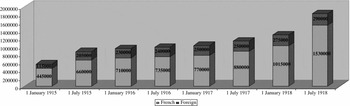
The estimate of the number of refugees who resettled in France was based on the monthly reports that local authorities had forwarded to the interior ministry. However, these reports recorded only assisted refugees, who perhaps accounted for only 70 per cent of the total refugee population.Footnote 10 On 12 January 1917, the interior minister told the Chambre des Députés that by the end of August 1914 there were already 150,000 refugees in the country. At the end of the war, an official report counted 1,812,000 assisted refugees, including Belgians and Serbs. Since the number of non-assisted refugees exceeded half a million, the number of displaced persons who sought refuge in the country may have reached nearly three million over the course of the war.Footnote 11 At no point during the conflict did the number of foreign refugees rise beyond 290,000 (see figure 1).
French and foreign refugees in France
Source: Michel Huber, La population de la France pendant la guerre (Paris and New Haven: Publications de la Dotation Carnegie pour la paix internationale, 1931), 172.

The French sources indicate the geographical distribution of refugees. Many of the 1,447,000 French refugees stayed in their department and moved just behind the front line. The records show that the distribution of refugees was a function of their proximity to the front, the proportion being higher in departments near the front or in those chosen as a centre of refuge, such as Calvados.Footnote 12
Moreover, the movement of the front line logically affected the number of French refugees forced into exile by the advance of the German armies. After the initial exodus of August 1914, and although the Allies’ victory on the Marne allowed some refugees to return to their homes, their number kept rising steadily until September 1915. The increase then proceeded at a slower pace until 1918, when repatriations via Switzerland were approved. The impossibility of counting the number of refugees who settled in Paris underlines the difficulties involved in undertaking such enumeration. Indeed, while the 1918 military operations account for another sizable increase, leading to a maximum of 1,850,000 in September, one cannot tell whether the number of Parisians who fled the German bombardment offset those who sought refuge in Paris.Footnote 13 Official agencies, discouraged by the incessant movement of refugees in Paris and in the department of the Seine, eventually gave up attempting to count the number of refugees.Footnote 14
However sketchy and unsatisfactory the French statistics may be, the British estimates are more fragmentary and limited, even though the categorisation of the refugee was nowhere near as problematic as it was in France. While twenty-nine countries were represented among the refugee population, the British authorities did indeed choose to lump them together under a single category, as Belgians accounted for 95 per cent of the refugee population.Footnote 15 Besides, the relatively modest scale of the wartime exodus to Britain, as well as the less significant part played by the state in their reception before 1915, accounts for the scant information at our disposal.
Over 200,000 ‘Belgian’ refugees thus arrived in Britain in the wake of the German invasion, and they were subsequently registered in the Central Register of Belgian Refugees. The maximum number of Belgian refugees present at any one time in the United Kingdom was about 210,000, and as of 1 June 1919 the card index produced for the Central Register listed 225,572 names.Footnote 16 The unequal representation of the different Belgian provinces ought to be stressed, since it determined the linguistic and social fabric of the wartime Belgian community in Britain. The Flemish-speaking element appears to have been over-represented; indeed, two-thirds of the Belgian refugee population hailed from the Flemish provinces (Antwerp, East and West Flanders, Limburg) while 15 per cent had fled the predominantly Walloon regions (Hainaut, Liège, Luxembourg, Namur). The remainder originated from ‘mixed’ provinces such as Brabant.Footnote 17 Directly related to the advance and retreat of the armies in the field, the influx of refugees to Britain virtually ceased following the occupation of Belgium.Footnote 18 Between the evacuation of Antwerp in September 1914 and the first repatriations at the end of 1918, one defining feature of the refugee population in Britain was therefore its relative stability.
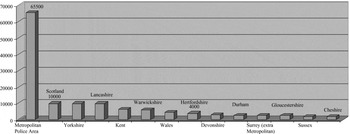
The London Metropolitan Police Area was far and away the biggest concentration of Belgian refugees in the country, accounting for 38 per cent of the refugee population. A report sent to the Belgian interior ministry in August 1917 mentioned that 50,468 Belgian refugees had set up temporary home in London (see figure 2).Footnote 19
Geographical distribution of Belgian refugees in Britain. The other counties counted fewer than 2,000 refugees apiece.
Source: Ministry of Health, Report on the Work Undertaken by the British Government in the Reception and Care of the Belgian Refugees (London: H.M. Stationery Office, 1920).

Folkestone was the first destination for most Belgian refugees (35,000 of whom arrived in the space of five days in late September 1914), while London was supposed to act as a clearing house from which to despatch them to the provinces. However, the capital was an attractive destination as a potential centre of employment and a place where assistance might rally to the cause of the Belgian exiles. Many refugees therefore stayed put, while a few Belgian entrepreneurs established factories that came to be predominantly staffed by their fellow countrymen.Footnote 20
Refugees and the culture of conflict
The recent historiography of the First World War emphasises ‘dominant representations’ in which hatred of the enemy loomed large.Footnote 21 This system of representation sustained the cultural, moral and ideological commitment of each nation to fight an ‘uncivilised’ and even dehumanised enemy until it capitulated. This narrative, however critical to the cultural mobilisation of the British and French populations, was nonetheless constantly reconfigured throughout the conflict. What may be conceived as a process of acculturation to the war reveals above all the critical resilience of class, religion, gender and local identities in the face of industrialised warfare.Footnote 22 The experience of Western Front refugees provides another illustration of the importance of such plural modes of figuration and organisation that determined their reception in home front communities.
Refugees were in many ways the paradigmatic embodiment of the culture of warfare in 1914–18. Through their pre-eminent position in the war narratives they supported a vision of the conflagration as a war for civilisation against barbarism, waged in confident expectation of lawful reparations. The singularity of their experience obviously contrasted with that of the home front communities that had been spared from military operations. Rallied under the common flag of a sacred cause, the victims of the invasion found refuge with their outraged ‘brothers-in-arms’, indignant over the treatment they had received. Refugees thus came across as the beleaguered victims of a cruel conflict, whose sufferings and distress could not be imagined by the population in the rear.Footnote 23 As it happened, French and British civilians were fully aware of the disproportionate ordeal the refugees were going through and of the unequal distribution of the burden of war.Footnote 24
Albeit victims of the German aggression, refugees were nonetheless considered as heroes whose very presence at the rear was a testimony to the courageous resistance shown towards a fearsome enemy. In wartime Paris, tributes to Belgium and the invaded countries prominently figured in the work of patriotic songwriters, thus attesting to the significance of the refugee in popular culture:Footnote 25
Accordingly, the assistance provided to the Belgian refugees became ‘a striking tribute to the country which commanded the world's admiration’.Footnote 27
In leaving the combat zones, refugees shaped a system of representation which in the early stages of the conflict had unfurled without the population having had any direct contact with the enemy. Subsequently, the sufferings and distress brought about by the invasion were gradually embodied in the refugee as these ‘homeless victims of the barbarian’ reached their haven.Footnote 28 The impression made on volunteers who went to London railway stations to look out for Belgians found its echo in Paris, where inhabitants from the war zones initially sought refuge:
At the Gare de l'Est . . . The exodus from the invaded départements is still going on. It is a terrible procession [défilé] of poor wretches carrying along all that is left of their belongings. One could hardly witness a sadder scene.Footnote 29
The exiles’ experience bred a hatred of the enemy that lay at the heart of war cultures that increasingly focused on the person of the enemy. The systematic moral condemnation of the foe was moreover strengthened by a recourse to sacred images and words to invoke the ‘martyrdom’ of the invaded and devastated areas.Footnote 30 Accordingly, the refugees must have found through the welcome at the home front the assistance that their eminent position in the contemporary Weltanschauung (worldview) conferred upon them. The positive reception of refugees constituted, according to The Times, the ‘country's obligation of honour’.Footnote 31 Relief was thus conceived as a duty that the authorities in both countries invoked to underline the demands of wartime solidarity.Footnote 32
Furthermore, translating the cardinal values of the war cultures, the reception of refugees established a link between the ethics of wartime mobilisation and the institution of a specific legal regime. In France in particular, national solidarity was not just to provide the basis for material assistance to civilian victims of the invasion; the moral demand of reparation for the harm done to ‘heroic’ refugees also culminated in the recognition of a right to state relief.Footnote 33 Parliamentary debates as well as prefectorial archives disclosed the extent to which the legal protection of the refugee as well as public policies were suffused with this moral dimension:
In all circumstances, in Parliament or through [the interior ministry] administration's circulars, it has been proclaimed that the assistance to refugees corresponds to a true debt incurred by the nation towards a category of citizens that bore the brunt of the miseries brought about by the war or of the sacrifices entailed by the national defence. It therefore so results that such assistance does not constitute a favour that one is at liberty to grant or to deny the claimants in an arbitrary fashion, but a real entitlement [droit].Footnote 34
Refugees themselves made this point vigorously via their organisations and publications. As the Bulletin des réfugiés du Nord put it,
[Refugees] do not have to implore pity; they must assert their right to existence . . . Victims of the war undertaken for the triumph of Justice and Right, they must be treated, on account of their sacrifices, in accordance with the principles of Justice, Right, and Solidarity.Footnote 35
Undeniably, the reception of refugees also derived great importance from its patriotic character conjured up throughout the conflict by the highest authorities of the state.Footnote 36 However, the authorities were above all concerned with bolstering the countries’ confidence and propping up civilian morale that was likely to be undermined by the refugees’ fate.
A legitimate object of the cultural history of the war, the experience of ‘Belgium in exile’ must not be reduced to discourses and symbolic artefacts that instituted but did not exhaust the reality with which we are concerned. A critical issue, underlined by the reception of French and Belgian refugees, lies in the articulation of representations and practices, of the individual and the collective, that the historian attempts to reconstruct.Footnote 37 In this case, the treatment of the victims of the invasion took on such a symbolic and emotional charge that this undertaking is made all the more difficult. It is therefore necessary to assert and maintain a critical distinction between the experiences of exile in 1914–18 and the functions performed by the image of the ‘refugee’ in belligerent societies.
The courage, patience, and good humour of the Belgian refugees was astonishing. Many of them told terrible stories which made it quite impossible to retain any doubt as to the German atrocities.Footnote 38
The history of the ‘refugee’ is inseparable from the 1914 atrocities which provide the backdrop against which we must approach their representation.Footnote 39 On their arrival as well as in the course of their settlement, refugees functioned as vehicles for the dissemination of images of brutality and suffering. Just arrived at the Gare du Nord in Paris, Belgian refugees and their French counterparts, were telling ‘dreadful things’.Footnote 40 According to The Times,
as they sit there they are talking about one thing – of what the ‘Bosches’ [sic] have done to the villages they have passed through already. ‘they cut the hands off the little boys, so that there shall be no more soldiers for France. They kill the women, and the things they do to the young girls, Monsieur, are too terrible to be told. They burn everything and steal and destroy. Back there is nothing but wilderness.’Footnote 41
Likewise, refugees’ tales prominently figured in the Parisian press, which frequently dispatched its journalists to the city's railway stations in the first weeks of the conflict. While it is difficult to ascertain that newspapers adopted a specific reporting strategy, it is important to note the recurrence of those types of refugee deemed defenceless by virtue of their gender, age or condition. Victims of German might – women, children and even priests – regularly featured in those narratives.Footnote 42
Settled in communities spared by the invasion, the refugees’ tales were reinforced by the authority that their direct experience conferred upon them. Thus, in the French primary schools, as a deputy prefect put it,
The little refugees quickly become important. They tell what they saw. We gather around them. The teacher shows a bit more tenderness towards them. They are back from the front. Sometimes one even calls them les poilus.Footnote 43
The influx of Belgian refugees brought the settled population face to face with the realities and disasters of modern warfare. Parisian newspapers gave an account of the arrival of the invasion's victims, who, as soon as they set foot on the railway station platform, were transformed into ‘refugees’ in the eyes of others who were deeply affected by the ‘painful sight’ they offered.Footnote 44 Similar scenes took place in Folkestone, the refugees’ gateway to Britain, where ‘each boat was carrying a contingent always worthier of help and pity’.Footnote 45 In Northampton, where about two hundred refugees reached their final destination, they served to provide tangible evidence of the distress of war:
The arrival of the first batches of Belgians here, and train loads on their way north brought home to us the tragedy of their martyred country . . . Kind hearted ladies were ready at the station with steaming coffee, buns, sweets, which they eagerly devoured, smiling wondrously the while at the contrast between their reception here and the horrors from which they had fled.Footnote 46
During the first weeks of the conflict, when the restriction of information prevented people knowing what was going on at the front, Belgian refugees supplied news about the conduct of war and its impact. The misfortune of war found its expression in the tragedy of separation of family members:
One evening another and myself were sent to Charing Cross to meet a late train, after waiting an hour in the very dimly lighted station we went to the trains, at the last moment, were all being sent into Victoria & we were hurrying out when a young man came up to us seeing our sashes and asked if we spoke French & then told us his pathetic story – he was trying to meet all the refugee trains to find his mother & sisters – refugees from Brussels – & apparently had been doing this for nights . . .Footnote 47
The role played by ‘refugees’ in mobilising opinion in host countries is suggested by their ‘performance’ among the population that provided them with shelter. As a mobilisation device, the refugees’ distress contributed to consolidating the national community at war. In France in particular, where most refugees were fellow countrymen and -women, the idea was to ‘create around the war victims a brotherly and affectionate atmosphere’,Footnote 48 which would testify to that ‘magnificent national unity, which, out of all French souls makes one single enthusiastic and vibrating soul: the very soul of France’.Footnote 49 Despite its singularity, the refugee ‘experience’ contributed to a process of national integration. The solidarity that the reception of refugees purported to demonstrate also revealed the negative dimensions of the integration and engagement of a nation at war that braced itself for the onslaught of an enemy that was mythologised as much as it was hated. The Belgian refugees were not only war victims but had also fallen prey to a ‘barbaric’ enemy. As a matter of fact, when a French local newspaper had set out to compare ‘their practices and ours’, to castigate ‘the breaches of the rule of war’, it just had to describe ‘how they [were] treating the Belgians’.Footnote 50
In fact, the plight of the refugees reinforced a system of representations according to which the war must lead to the foe's complete capitulation. ‘Innocent’ targets of a military operation that refused to comply with the traditional laws of war, the refugees were victims of a conflagration understood in social-Darwinist and ethnic terms, as a life-and-death struggle.Footnote 51 In a nutshell, the ‘refugees’ offered a metonymy of the war, of its stakes, around which a coherent system of representation hinged as well as the social practices that ultimately made up the social mobilisation of the belligerent nation.
A litmus test of social mobilisation
Surprised British, Belgian and French commentators were at a loss before the flood of refugees, and constantly resorted to a maritime trope, conjuring up the ‘Teutonic tide’ and its ‘formidable waves’.Footnote 52 The waves of refugees indeed broke against the mobilisation of the Allied countries, which struggled to organise a humanitarian response and to determine some organising principles in the emergency and confusion that characterised the first weeks of the war. National organisations such as the War Refugees Committee (WRC) and the Secours National, supported by the British and French governments respectively, laid the institutional and legal foundations of the reception, while local refugee committees provided the personnel and showed a ‘compassionate’ side.
The number of local relief committees in England stabilised at around 1,500 in 1915. In most cases these committees had been created spontaneously on the initiative of local notables and pre-existent institutions or communities.Footnote 53 The example of the Newport committee illustrates the methods and principles usually adopted. On 16 September 1914 the mayor convened a meeting where volunteers concerned with the welfare of Belgian refugees agreed to form a committee. Offers of hospitality were forwarded to the WRC. In the meantime, various personalities and representative bodies joined the committee. Anxious to keep its official endorsement, the committee asked the mayor to retain the chairmanship of an agency which now benefited from the free and regular collaboration of the local newspapers – the South Wales Argus and the Monmouthshire Evening Post.Footnote 54
Many localities and all levels of society contributed to alleviating the catastrophe. In Paris, the Gare du Nord and the Gare de l'Est witnessed the largest arrivals of refugees, while their premises and surroundings were the setting for numerous local charitable initiatives.Footnote 55
The private or official organisations that came to the refugees’ assistance inferred from the Catholic heritage of Belgium the denominational characteristics of the refugee population. They were therefore anxious to involve local Catholics and their charitable associations, even though local and national organisations soon realised that they needed to call on other denominational or social groups.Footnote 56 Likewise, at the instance of the WRC, the Catholic Women's League (CWL) took charge of welcoming refugees at railway stations. Refugees were expected to recognise the white sashes worn by the League's volunteers with ‘Ligue des Femmes Catholiques’ written in black.Footnote 57
Yet Belgium presented a diversified religious landscape, as illustrated by the charitable work carried out along denominational lines by the Jewish War Refugees Committee.Footnote 58 Originally from Russia and Galicia, most ‘Belgian’ Jewish refugees had fled Antwerp in the wake of the invasion. During the war, 8,000 of them sought refuge in Britain and were cared for by Jewish relief organisations.Footnote 59 In London, the Jews’ Temporary Shelter in Whitechapel initiated a humanitarian response that developed into the Jewish War Refugees Committee at the end of August 1914.Footnote 60 Despite the persistence of social and political tensions within the community, the mobilisation of British Jews and their collaboration with local and state authorities enabled them to provide their coreligionists in exile with dedicated refuges across London. Their employment, however, proved rather more problematic than their accommodation. Indeed, according to the WRC the strict observance of the Sabbath among these predominantly orthodox Jews raised a serious difficulty that compounded the situation of a largely unskilled population.Footnote 61
The reception of refugees highlights the mechanisms of wartime collective action. Its rhetorical emphasis on unity must, however, be re-evaluated in the light of the discrimination that occurred, notably in liminal zones of the societies at war, such as railway stations.Footnote 62 There, upon arrival the exiles were ascribed their identity. Then defined as ‘refugees’, they fell into a specific category and legal regime signified by agents of the state as well as the mobilisation of civil society. In the stations, social mobilisation took on various forms and expressed specific solidarities directly related in some cases to the primary function of the site. The concomitant presence of refugees and commuters, for instance, encouraged spontaneous and individual acts of solidarity whereby Parisians supported those refugees they had come across on their daily journey.Footnote 63
On entering and leaving the cities to be despatched to their wartime shelter in the country, refugees carried their misfortunes around, prompting episodes of compassion:
Belgian and French refugees are still passing through Paris . . . With a nice gesture of brotherly solidarity soldiers whipped round to give some money to these poor wretches, for many of them are completely destitute. In return, the Belgians bought a large three-colour bunch of flowers they offered to the soldiers.Footnote 64
The support provided to refugees shows how important specific group solidarities were for the general war effort. The Friendly Association of Primary Teachers exemplified professional solidarity. Among its various initiatives the association set up a special relief fund, the Franc des Camarades Belges, thanks to which the French primary teachers supported their Belgian counterparts.Footnote 65 Likewise, the Railway Executive Committee, on behalf of the British railways, decided to offer hospitality to Belgian railwaymen, while the National Fire Union held its hand out to Belgian firefighters.Footnote 66 Civil society thus contributed a formidable effort in favour of the Belgian refugees. However, this massive involvement appeared somewhat paradoxical, since the war simultaneously strengthened state control while the mobilisation of civil society enabled the state to cope with the ordeals of war.Footnote 67
Soon, the state had not only to sustain but also to substitute for private philanthropy in cases where charitable energy flagged.Footnote 68 Two chronologies must be considered. One is that of the material support for the refugees, the other is that of the attitudes towards refugees. As early as 1915, local and national organisations in both countries noticed a worrying drying up of financial resources.Footnote 69 In Britain, the WRC and the Local Government Board responded by launching a remobilisation campaign. Herbert Samuel, chairman of the Local Government Board, forwarded a letter to the British press on 7 January 1915, reminding them of the principles that governed refugee relief and contrasting the British effort to that of the neutral Netherlands:
The sympathy of the British people for the Belgians had shown itself, among other ways, by the widespread offer of hospitality to the refugees . . . But the small country of Holland is generously giving refuge to twice as many Belgians as the United Kingdom . . . In view of all that these refugees have suffered and of all that Belgium has done for the cause of the Allies, I trust that it is only necessary for the present urgent need to be made known to the country in order to evoke a response adequate to meet the situation.Footnote 70
Admittedly, shortages and economic disturbances weighed heavily on private initiative, of which the middle and upper classes were the backbone. But the discrepancy between this chronology and that of the national mobilisations, whose crisis is traditionally deemed to have begun in 1916, leads us to pursue the analysis, and to highlight the circumstances that turned the refugees’ reception into a paradoxical confrontation.
Solidarity, confrontation, oblivion
Up to the beginning of 1915, refugees symbolised the consequences of barbaric German warfare. Thronging to the rear, they were regarded as the heroic victims of German militarism. Thereafter tensions surfaced and incidents broke out between refugees and their hosts. ‘Boches du Nord’, ‘Dirty Belgians’, ‘German’ and other abuses were hurled at the exiles, prompting their spokesmen to demand greater respect and, where appropriate, to appeal to the courts.Footnote 71 In this context, the policing of railway stations, especially of the Gare du Nord in Paris, occasionally led to a fierce denunciation of the police. Its indiscriminate round-up of refugees led to their being lumped together by the press alongside ex-convicts and vagrants. It notably prompted a stern protest addressed to the interior ministry by M. Deguise, deputy for the Aisne, in September 1915.Footnote 72
Sources of tension between the refugees and the host communities varied in both nature and importance. Refugees were party to the ‘social relations of sacrifice’ on which the historiography of the First World War has recently insisted. The strains generated by the situation on the housing market for example constituted a major bone of contention between refugees and landlords ‘of the vulture tribe’.Footnote 73
Even though physical confrontations and clashes remained scarce, an anti-Belgian riot broke out in May 1916 in London when the crowd subjected Belgian citizens and property to the same kind of treatment inflicted on suspected Germans at the outbreak of the war.Footnote 74 That local residents identified refugees with the ‘enemy’ is exemplified in a letter written by a Fulham inhabitant:
The Belgians here are causing a lot of trouble. On Sunday, they nearly murdered a policeman and a soldier and yesterday the English people and kids collected in hundreds in Liller [illegible] Rd where a lot of Belgians have opened shops & last night the scene was beyond description. They have served them like they served Landsowne and the other Germans. Windows & shops smashed up everywhere. With the Irish Germans etc. now the Belgians we have our share of the troubles.Footnote 75
Close examination of private sources and official and charity reports suggests something of the prejudices, frustrations and sufferings that soured relations between the Belgian refugees and their hosts. The diary of Miss Coules, written in London between June 1914 and November 1915, describes the successive changes of perspective:
Everyone was Belgian mad for a time. Mother helped furnish a home for Belgians & gave a monthly subscription & Mercedes got up a choir of 20 girls – we called ourselves the Black Dominoes, as we wore long black cloaks and masks – to sing the national anthems of the allies in the streets, in aid of the Belgians. We made quite a considerable sum, & it was great fun. But the Belgians are not grateful. They won't do a stroke of work & grumble at everything & their morals . . .! It may be true enough that Belgium saved Europe, but . . . save us from the Belgians! As far as I am concerned, Belgianitis has quite abated.Footnote 76
An interesting testimony of the versatility of some sections of the British upper class, this text also indicates the main grievances against the Belgian refugees: a lack of enthusiasm for work as well as an ‘alien’ lifestyle. Belgians, Britons and French concurred in admitting to a small proportion of problematic characters, and agreed that this ought not to have led to systematic generalisations and condemnations. Instead, citizens were asked to accept that refugees possessed the same mundane qualities and flaws as anyone else.Footnote 77
The attitudes towards the Belgian exiles stemmed to an extent from the home-front ambivalence towards participation in the war effort. Barred from the ‘myth of the war experience’, civilians were fully aware of being ancillaries to the conduct of a war, embodied in the figure of the Tommy and the poilu. Social practices as well as language and symbolic products were moulded by a wartime morality – an ‘ethic of mobilisation’ – that undeniably relied on traditional social codes and visions of social order.Footnote 78 Accordingly, the front-line soldier stood out as the main character in a narrative that also sought to characterise the ideal civilian comportment. As duty, sacrifice and solidarity governed the soldier's attitude under fire, the combatant provided the benchmark against which the home front would be deemed worthy of his patriotic sacrifice.Footnote 79 However, as the war dragged on, the home front formulated a different part in the national script. While the soldier retained his prominence, the civilian population entered a process of victimisation caused by restrictions and hardships and, above all, by soaring casualties and the subsequent grief.
Reinforced by deep and reciprocal ignorance as well as by linguistic or legal marks of otherness, the refugees were therefore no longer granted any special distinction in the system of representation.Footnote 80 Now that every family confronted loss and encountered grief, refugees found themselves accused of excessive comfort, idleness and grim opportunism:
How fast do the deaths mount up; and how many of our Belgian friends seem to have confused and vague memories of what they suffered. Let's not blame these friends. Moreover, they suffer as well, in their bodies, in their heart, in their interests; today, everyone attends to their own pain.Footnote 81
The disappointment of the host communities matched the initial investment in the figure of the ‘refugee’. The mobilisation device was eventually turned against the exiles themselves, who became victims of their hosts’ self-delusion, as a French deputy prefect conceded in 1915:
We tended to make ascetics and martyrs of the refugees. They are men like others, but they suffered more than the others: this should make us admire their qualities more than we do, and make us more lenient towards their flaws.Footnote 82
Local populations no longer ascribed to them any dignifying quality, and increasingly demanded from them a total participation in the war effort. Belgian elites were consequently called on to defend the reputation of their fellow countrymen for fear of seeing a few ‘black sheep’ compromising refugee relief and undermining Britain's support for Belgium. In 1917 Madame Vandervelde, a prominent Belgian notable and wife of the socialist minister Emile Vandervelde, thus set out to tour the country to denounce misunderstandings and abuses.Footnote 83 In the speeches she gave throughout the country she strove to rebut anti-Belgian accusations and rumours of shirking.Footnote 84
Attitudes towards refugees did not change with the dip in morale during 1917 or the military success of 1918. In fact, the reception of refugees and the subsequent tensions reflected the inner strains of the belligerent societies. Again, the prominent position bestowed on the French and Belgian victims of the military operations by the war cultures did not prove sufficiently resilient to overcome regional tensions and linguistic otherness within the imagined national community. While commentators initially commented favourably on the unfamiliar traits and voices of the exiles, the strains imposed by the war on the host communities soon led to tensions with refugees whose otherness and idiosyncrasies abetted confusions with enemy aliens.Footnote 85 In Alton, Hampshire, a refugee recalled how a Scottish officer had mistaken Flemish for German and therefore proceeded to arrest a group of such suspicious Belgians.Footnote 86 In France, the refugees from Alsace-Lorraine and the northern regions actually suffered slanders from their meridional fellow citizens who mistook them for German-speaking persons and hurled at them the infamous abusive term ‘Boche’ (Hun). Evidence garnered from perlustration bore out the recurrence of these feuds, suggesting that the ‘gap between the North and the South [Midi] seemed to grow wider’.Footnote 87
Wartime social mobilisation rested on discriminatory processes that turned out to be successively inclusive and exclusive, at the benefit or at the expense of refugees and other war victims. Whilst the evidence presented above is consistent with a gradual shift from solidarity to confrontation, one ought nonetheless to be wary of concluding that bitterness and tensions obliterated the refugees’ gratitude. Undeniably, the British and French communities that welcomed them derived a legitimate and well-founded pride from the help they provided. This national or inter-allied solidarity was celebrated on several occasions even before the refugees’ homecoming, as in 1916 in Cardiff, where the refugees planted a tree in tribute to the city's hospitality.Footnote 88
Yet collective memory enshrouded the singular experience of the refugees soon to be counted among ‘les oubliés de la Grande Guerre’. As the exiles returned to the now devastated or formerly occupied areas of France and Belgium, the charitable energies that had sustained refugee relief were channelled into the reconstruction of localities laid waste by military operations. The networks of solidarities first tested by the reception of refugees were called on to help with the reconstitution of combat zones. The French Catholic Oeuvre de secours aux églises dévastées invited British Catholic organisations such as the Catholic Women's League to become or find ‘godparents’ willing to ‘mother the ruined churches’ of France.Footnote 89 In Britain as well as in France, the fate of the ‘martyr towns’ that many Allied soldiers died defending soon eclipsed the ordeal of refugees. As Annette Becker has pointed out with regard to the occupied populations, civil deportees and prisoners of war, the historiography sanctioned this oblivion through a long-lasting lack of regard for the complex processes of victimisation that operated within the belligerent societies.Footnote 90 The experience of refugees is here symptomatic of the travails of memory, with which historians must come to terms:
Soldiers had a chance to become heroes; but no refugee was lionized. Even in death, military and civilian casualties were accorded different treatment. There are no war graves for the thousands of refugees who died en route to a ‘place of safety’. The literature of war scarcely paid them any attention. No Owen or Remarque dwelt on their plight; no ‘passing-bells’ tolled for the refugees who moved – and sometimes died – like cattle. The contrast deserves to be included in the ironies of the First World War.Footnote 91
In this remark, Peter Gatrell underlines a common feature of the predicament of the exiles of the First World War. Indeed, in Belgium itself, where the occupation further entangled the commemoration and memorialisation of the war, refugees are conspicuous by their absence.Footnote 92 While the transitional nature of refugeedom certainly accounts for the fading memory of the refugees’ experience, its relative neglect in academic circles has for too long belied the significance of exile in shaping the impact of war in twentieth-century Europe.