


Introduction
Irritable bowel syndrome (IBS) is a chronic, functional gastrointestinal disorder with a population prevalence of between 10 and 20%, depending on the diagnostic criteria employed (Canavan et al., Reference Canavan, West and Card2014; Drossman et al., Reference Drossman, Camilleri, Mayer and Whitehead2002; Lovell and Ford, Reference Lovell and Ford2012; Talley and Spiller, Reference Talley and Spiller2002). Often a lifelong condition, it is associated with reduced quality of life and increased healthcare use (Halder et al., Reference Halder, Fett, Locke, Melton, Talley and Zinsmeister2004). IBS is diagnosed on the basis of symptoms and behaviours rather than physiological abnormalities (Drossman et al., Reference Drossman, Chang, Bellamy, Gallo-Torres, Lembo, Mearin, Norton and Whorwell2011), and patients often present in primary care with a wide range of distressing symptoms, some of which they can be reluctant to disclose to others (NICE, 2008).
Garakani et al. (Reference Garakani, Win, Virk, Gupta, Kaplan and Masand2003) reported that 17–46% of IBS sufferers had a co-morbid anxiety disorder, whilst studies of anxiety disorders have found particularly high co-morbidity with IBS in panic disorders and generalized anxiety disorder (Gros et al., Reference Gros, Antony, McCabe and Swinson2009). Indeed, researchers have proposed that the physiological symptoms related to anxiety, worry and anxiety sensitivity may play a causal role in the onset and maintenance of IBS (Keefer et al., Reference Keefer, Sanders, Sykes, Blanchard, Lackner and Krasner2005). To this end, a biopsychosocial model of IBS has been developed, which centres on the role of anxiety-related cognitions and behaviours (Darnley and Miller, Reference Darnley and Miller2003; Kennedy et al., Reference Kennedy, Chalder, McCrone, Darnley, Knapp, Jones and Wessely2006; Moss-Morris et al., Reference Moss-Morris, McAlpine, Didsbury and Spence2010; Reme et al., Reference Reme, Stahl, Kennedy, Jones, Darnley and Chalder2011).
The National Institute for Health and Clinical Excellence (2008, 2011) recommend cognitive behavioural therapy (CBT) for the treatment of anxiety disorders, and also for the treatment of refractory IBS (amongst other psychological therapies). The Department of Health has also expanded the national ‘Improving Access to Psychological Therapies’ (IAPT) programme to ensure that patients with co-morbid anxiety/depression and chronic physical health conditions receive timely access to psychological therapies such as CBT (Department of Health, 2012; Department of Health, 2014). This strategy is based on the rationale that by integrating the treatment of mental health and long-term conditions, improvements may be made in the symptoms and self-management of chronic physical health conditions, which could also reduce National Health Service (NHS) expenditure and improve quality of life.
The training of IAPT therapists and practitioners has therefore been expanded to include working with medically unexplained symptoms, and the specific competencies required to deliver disorder-specific CBT interventions for conditions such as IBS have now been outlined (Rimes et al., Reference Rimes, Wingrove, Moss-Morris and Chalder2014). Yet although several controlled studies have demonstrated the effectiveness of CBT for the direct treatment of IBS as a primary problem (Kennedy et al., Reference Kennedy, Chalder, McCrone, Darnley, Knapp, Jones and Wessely2006; Li et al., Reference Li, Lishou, Shenghong, Qiao and Minhu2014; Ljótsson et al., Reference Ljótsson, Hesser, Andersson, Lackner, Alaoui, El and Falk2014; Moss-Morris et al., Reference Moss-Morris, McAlpine, Didsbury and Spence2010), there is a lack of evidence on how co-morbid IBS symptoms are affected if anxiety disorders are treated as the primary problem with CBT in routine primary care psychological therapy services. If anxiety plays a causal role in IBS, is it possible that effectively treating anxiety disorders with CBT may also reduce IBS symptoms in patients with both conditions, without specifically treating the IBS?
The NICE (2008) guidance on the management of IBS in primary care states that several different forms of psychological therapy have demonstrated effectiveness for IBS alongside CBT: hypnotherapy, counselling and dynamic psychotherapy. This prompts the question of whether IBS symptoms are particularly amenable to improvement from general therapeutic effects, rather than specific competencies/interventions. Further evidence supporting this possibility was reported in a study by Kaptchuk et al. (Reference Kaptchuk, Kelley, Conboy, Davis, Kerr, Jacobson, Kirsch, Schnyer, Nam, Nguyen, Park, Rivers, McManus, Kokkotou, Drossman, Goldman and Lembo2008), in which 28% of IBS patients reported adequate relief from symptoms if they were simply observed by a practitioner (no intervention), rising to 44% if they received a placebo therapeutic ritual (acupuncture), and rising further to 62% if this was administered with a patient–practitioner relationship augmented by warmth, attention and confidence.
A commonly reported anxiety problem related to IBS that might require specific therapeutic competencies/interventions in order to improve, is bowel control anxiety (BCA), in which sufferers fear losing control of their bowels, and being incontinent in public (Kamboj et al., Reference Kamboj, Langhoff, Pajak, Zhu, Chevalier and Watson2015). This problem has been associated with panic due to the intense focus on physical symptoms (e.g. abdominal cramps), which can be exacerbated by anxiety, leading to a vicious cycle of worsening symptoms (Clark and Salkovskis, Reference Clark, Salkovskis, Hawton, Salkovskis, Kirk and Clark2017). The cognitive model of panic applied to BCA includes the role of various toilet-related safety behaviours, checking and avoidance, which serve to maintain the problem. CBT for these patients will therefore require these behaviours to be addressed directly in behavioural experiments designed to modify specific beliefs about bowel control/incontinence, and the role of toilet-related behaviours (Clark and Salkovskis, Reference Clark, Salkovskis, Hawton, Salkovskis, Kirk and Clark2017).
If these aspects of IBS-related problems need to be addressed with specific CBT interventions to achieve improvement in bowel control anxiety, then any examination of improvements in IBS symptoms due to psychological therapies for anxiety will need to differentiate between patients with or without BCA. Yet evidence on the frequency of BCA in IBS sufferers accessing routine primary care psychological therapy services is lacking.
Aim
This naturalistic study aims to examine whether patients with anxiety disorders and co-morbid IBS report significant IBS symptom reduction when they are routinely treated with CBT for anxiety in a primary care psychological therapy service. The study also aims to examine the proportion of these patients that have BCA, and whether this affects treatment and outcomes.
Method
Design
This was a naturalistic, observational cohort study.
The service
The study was carried out in a medium-sized primary care psychological therapy (IAPT) service in the North Midlands, covering a population of 213,000 people and 33 GP practices. The service covers a large geographical area, ranging from densely populated urban localities to isolated rural communities, and serves a population with both high levels of social deprivation and chronic physical health problems.
The service accepts self or professional referrals, and treatment was delivered by 13 cognitive behavioural therapists, and nine psychological wellbeing practitioners (PWPs) across a range of primary care sites, GP practices and patients’ homes.
Participants
One hundred and thirty-eight self- or professional-referred patients with anxiety disorders and co-morbid IBS referred between 1 April 2012 and 31 March 2013, and completed treatment by May 2014.
Procedure
On receipt of a self-referral telephone call, or professional referral (written, telephone or electronic), patients had a brief initial telephone screening with a therapist (if insufficient information was included at referral) to determine their main problem and level of risk. If suitable for the service, all patients were offered an assessment appointment (either face-to-face or by telephone) with either a PWP or a therapist depending on complexity and risk. All workers carried out the same structured, problem-centred, ICD-10 diagnostic assessment interview, focused on eliciting a preliminary diagnosis, followed by problem-specific information giving and discussion of treatment options. During this interview all patients were routinely asked if they suffered from the symptoms of IBS (amongst a list of other physical conditions). If patients answered ‘yes’, the assessors carried out a standardized, structured assessment of IBS symptoms, based on the ROME III IBS diagnostic module (Drossman et al., Reference Drossman, Corazziari, Delvaux, Spiller, Talley, Thompson and Whitehead2006), with four further questions on ‘red flag indicators’ (NICE, 2008).
The service delivered a stratified stepped-care treatment model, in which all patients with anxiety disorders were offered treatment in accordance with NICE guidelines (2011). Patients with panic disorder (with or without agoraphobia), generalized anxiety disorder and obsessive compulsive disorder (OCD) of mild severity or recent onset were routinely offered treatment with a PWP (Step 2), which most commonly consisted of a workbook-based guided self-help package, with up to 10 telephone treatment sessions (a maximum of two of these sessions could be delivered face-to-face if required). Patients were stepped up to a more intensively resourced treatment (Step 3) if: (1) no improvement was recorded by session four, (2) severe risks were identified, (3) barriers to guided self-help were identified, or (4) at the patient's request. Patients with severe OCD, social phobia, specific phobias, health anxiety, post-traumatic stress disorder (PTSD) and body dysmorphic disorder were routinely offered individual treatment with a CBT therapist across a varying number of sessions, in accordance with disorder-specific NICE guidelines. All patients in the study were offered follow-up appointments at 3 and 6 months after discharge.
Measures
IAPT minimum data set
All clinical workers collected and entered data directly onto a secure electronic clinical data system, designed for IAPT services. Demographic data entered by both administrators at referral, and by clinicians at assessment, included contact details, date of birth, gender, ethnicity, source of referral and problem stated in the referral. Data entered by clinicians at each contact (including follow-ups), included attendance, appointment format (face-to-face/telephone) stage/step and purpose of appointment, interventions provided, duration of appointment and the clinical IAPT minimum data set consisting of:
-
• The Patient Health Questionnaire (PHQ-9) (Kroenke et al., Reference Kroenke, Spitzer and Williams2001): a nine-item self-report questionnaire evaluating depressive symptomatology with scores ranging from 0 (no symptoms) to 27 (severe depressive symptoms).
-
• The Generalized Anxiety Disorder Questionnaire (GAD-7) (Spitzer et al., Reference Spitzer, Kroenke, Williams and Lowe2006): a seven-item self-report questionnaire focusing on symptoms of anxiety with scores ranging from 0 (no anxiety symptoms) to 21 (severe anxiety symptoms).
-
• Three single-item Likert scales (range 0–8) taken from The Fear Questionnaire (Marks and Mathews, Reference Marks and Mathews1979) measuring avoidance due to panic disorder, social phobia and specific phobia.
-
• The Work and Social Adjustment Scale (Mundt et al., Reference Mundt, Marks, Shear and Greist2002), a self-report questionnaire measuring the social and functional impact of a patient's main problem.
In addition, CBT therapists routinely used disorder-specific measures in treating the following anxiety disorders: social phobia, PTSD, OCD and health anxiety, but due to the smaller sample sizes of these sub-groups, and poor completions rates, only the generic minimum data set measures completed by all patients at every session were included in this analysis.
IBS-specific measures
All patients completed the following assessments of their IBS symptoms at assessment, discharge and 6-month follow-up:
-
• The ROME III IBS Module diagnostic questions (Drossman et al., Reference Drossman, Corazziari, Delvaux, Spiller, Talley, Thompson and Whitehead2006), a 10-item questionnaire used to elicit the diagnostic criteria for IBS.
-
• The Symptom Severity Scale specific for irritable bowel syndrome (Francis et al., Reference Francis, Morris and Whorwell1997). The SSS is an IBS-specific instrument with satisfactory reliability that is sensitive to change over time, and includes an assessment of the impact of IBS on general well-being. The maximum score is 500 and patients may be considered to have mild IBS (75–174), moderate IBS (175–299) or severe IBS (300–500). Scores below 75 indicate normal bowel function.
Presence of bowel control anxiety
A systematic post-treatment review of the electronic clinical notes was completed for all patients in order to identify those with BCA. Patients were identified as having BCA if the ‘Why? – main fears/beliefs’ section of the assessment report contained a fear of faecal incontinence in public, or specific situations. Two reviewers were required to agree on the presence of BCA.
Data analysis
Anonymized data for the patient cohort was extracted into .csv files containing demographic and outcome data for each patient treated, as well as session-by-session data files. These were converted into Microsoft Excel, and then SPSS files for analysis. Problems with data quality were identified in 42 treatment cases, as anomalies existed, such as no recorded discharge code despite having no clinical contacts for several months. The data were cleaned by emailing each worker whose clients had outstanding/anomalous data, and requesting clarification/correction. For 13 cases where the clinical worker was unavailable as they had left the service, the electronic clinical notes were reviewed for each client, and where they lacked explanation they were recorded as treatment drop-outs. Patients for whom the service had received a referral, but had no clinical appointments, were recorded as either ‘failure to engage’ or ‘declined treatment’, depending on whether they had answered/responded to the administrator's phone call/letter.
In 2012 the IAPT programme amended the definition of having ‘entered psychological therapies’ to recognize patients that attended one single appointment (if the purpose of the appointment was recorded as ‘treatment’). However, for the purposes of clarity, patients in the cohort were separated into those who had ‘one session of assessment and treatment only’, and those who received ‘more than one treatment session’. At discharge following one or more appointments, clinical workers could record one of the following discharge reasons: planned discharge, drop-out, agreed early ending, declined treatment, not suitable, or deceased.
The demographic data of the cohort were analysed to report the appropriate means and standard deviations (see Table 1). The following types of outcome data were analysed and reported:
-
• The pre- and post-treatment means and standard deviations on the IAPT minimum data set measures for patients with each anxiety disorder presented separately.
-
• The pre- and post-treatment means and standard deviations on the IBS symptom scale for patients with each anxiety disorder and co-morbid IBS.
-
• The numbers and percentage of patients who meet the criteria for IBS on the ROME III IBS Module diagnostic questions at 1-month follow-up (for each anxiety disorder).
-
• The numbers and percentages of patients who meet the IAPT programme criteria for ‘moving towards recovery’ presented for each anxiety disorder: GAD-7 score of 8 or more at assessment, and 7 or less at discharge; score on relevant Disorder-Specific Measure at caseness at assessment, and below caseness at discharge; PHQ-9 score of 10 or more at assessment, and at 9 or less at discharge (IAPT, 2011).
-
• The number and percentage of patients who made clinically reliable change on the PHQ-9, GAD-7 or relevant disorder-specific measures. Reliable change is defined as a change in scores greater than the standard margin of error that can be expected from the measure.
-
• The pre- and post-treatment effect sizes. These were calculated as: the mean pre-treatment score minus the mean post-treatment score, divided by the mean post-treatment standard deviation.
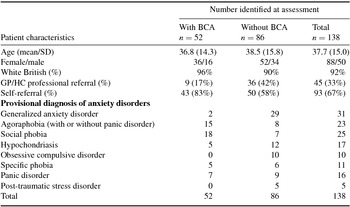
Characteristics of 138 patients with co-morbid anxiety disorders and irritable bowel syndrome – with and without bowel control anxiety

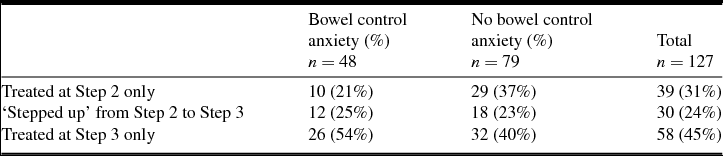
Numbers treated at each step of the stepped-care model

As this was a naturalistic, observational cohort study with no control group, it was not possible to test any hypotheses, or make specific inferences about the wider patient population from this cohort. Therefore, the above outcomes are presented and described without the use of inferential statistics.
Results
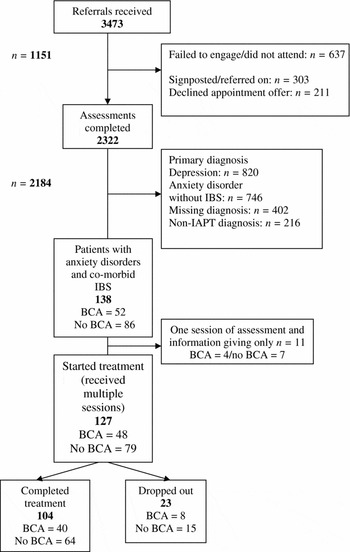
3473 patients were referred to the service during the 12-month sample period. Of these patients, 637 failed to engage or did not attend an assessment appointment, 303 were signposted or referred on to other services, and 211 declined an appointment offer. Of the 2322 (76%) patients who received an assessment, 1365 were excluded from the analysis because they did not have a provisional diagnosis of an anxiety disorder (see Fig. 1): 597 had a diagnosis of depressive episode, 196 recurrent depression, 191 had a ‘non-IAPT’ diagnosis (such as an eating disorder, adjustment disorder, somatoform disorder, etc.) and 379 had a missing diagnosis. Of the 957 patients with a provisional diagnosis of an anxiety disorder, 138 met the diagnostic criteria for irritable bowel syndrome, and were included in the analysis (see Table 1).
Fifty-two patients were identified as having BCA, and 86 did not report significant BCA at assessment. Of these, 48 with BCA, and 79 without BCA started treatment, and were included in the analysis. Seventy-nine per cent of patients with BCA received treatment with a CBT therapist at Step 3 (a more intensively resourced treatment than the guided CBT self-help programme delivered at Step 2) vs 63% of those without BCA. However, the difference did not reach statistical significance: χ2 (1, n = 127) = 3.53, p = 0.06), and the mean overall clinical contact time was similar for each group: BCA 7.2 hours (SD 5.8), no BCA 6.9 hours (SD 5.5).
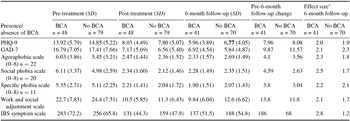
Mean pre- to 6-month follow-up change scores on measures for anxiety and depression were clinically significant for all patients with co-morbid IBS pooled: PHQ-9: 14.38 (5.6) – 6.36 (3.97), effect size = 2.0; GAD7, 17.11 (7.35) – 6.38 (3.97), effect size = 2.2 (59% ‘moved towards recovery’), and was similar to 613 patients who received CBT for anxiety disorders without co-morbid IBS during the same period: PHQ-9, 14.87 (6.32) – 7.15 (4.15), effect size = 1.8; GAD-7, 16.96 (7.91) – 6.78 (4.24), effect size = 2.4 (56% ‘moved towards recovery’; see Tables 3 and 4).
Flow diagram of patients through the service over 12 months

Mean pre- and post-treatment scores for patients with co-morbid anxiety disorders and irritable bowel syndrome on the IAPT minimum data set measures and IBS symptom scale (n = 127)

*Formula: (pre-treatment mean – post-treatment mean)/pre-treatment SD; 0.8 upwards is usually regarded as clinically significant.
The number and percentage of patients with co-morbid anxiety disorders and irritable bowel syndrome who met the criteria for recovery at post-treatment

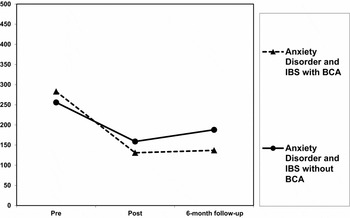
Patients with and without BCA made similar improvement on the PHQ-9 and GAD-7, but BCA patients made more improvement than non-BCA patients on both the social phobia and agoraphobia symptom scales (see Fig. 2 and Table 3).
Graph showing improvement on the IBS symptom severity scale for patients with and without bowel control anxiety

Mean pre- to 6-month follow-up change on the IBS symptom severity scale was clinically significant for all patient pooled: 270 (69.0) – 163 (53.2), effect size = 2.0, but patients with BCA showed greater improvement at 6-month follow-up than those without BCA (see Table 3 and Fig. 2).
Discussion
Patients with co-morbid anxiety disorders and IBS who routinely accessed CBT for anxiety in a routine primary care psychological therapy service over 12 months made clinically significant improvement on anxiety measures. Improvement was similar to patients without co-morbid IBS who were treated during the same period. The findings suggest that co-morbidity with IBS may not be detrimental to outcomes with CBT for anxiety disorders in routine primary care IAPT services. This is important because much evidence exists to support the strategy of treating long-term conditions (LTCs) and medically unexplained symptoms, such as IBS, with psychological therapies in IAPT services (Creed et al., Reference Creed, Fernandes, Guthrie, Palmer, Ratcliffe, Read, Rigby, Thompson and Tomenson2003; Department of Health, 2009; Naylor et al., Reference Naylor, Parsonage, McDaid, Knapp, Fossey and Galea2012), yet little evidence exists on the effect of co-morbid LTCs on CBT outcomes for anxiety disorders and depression.
Patients who received CBT for an anxiety disorder also reported a clinically significant reduction in IBS symptoms. On average, patients remained symptomatic for IBS at 6-month follow-up, which may reflect the chronic nature of the condition, but those with BCA that was addressed with CBT moved to an average IBS score in the ‘mild’ range, compared with those without BCA, whose average score remained ‘moderately’ symptomatic. This IBS symptom reduction was despite the fact that therapists and practitioners in the service were neither trained to deliver CBT for IBS, nor was this the focus of treatment. The evidence for a causal role of anxiety in IBS (Keefer et al., Reference Keefer, Sanders, Sykes, Blanchard, Lackner and Krasner2005) makes it possible to infer that IBS symptoms may have lessened as a result of general anxiety reduction achieved through CBT for specific anxiety disorders. Yet we must acknowledge that this effect may also have been due to a range of other non-specific factors, such as the general therapeutic effects from attending treatment, as these have also been shown to significantly improve IBS symptoms (Kaptchuk et al., Reference Kaptchuk, Kelley, Conboy, Davis, Kerr, Jacobson, Kirsch, Schnyer, Nam, Nguyen, Park, Rivers, McManus, Kokkotou, Drossman, Goldman and Lembo2008).
This study provides an interesting observation of the phenomenology of co-morbid IBS when anxiety disorders are routinely treated in an IAPT service. Eighteen per cent of patients with anxiety disorders also had IBS, and of these 37% had BCA. Seventy-three per cent of patients with BCA were diagnosed with a phobic disorder vs 24% of patients without BCA. This group of patients with IBS, who sought treatment for BCA, had a much higher prevalence of social phobia (34.6%) than in a previous study of IBS sufferers (Gros et al., Reference Gros, Antony, McCabe and Swinson2009), which only reported 11.4%. However, this previous study included patients with primary diagnoses of both depression and anxiety disorders, which may have resulted in a lower overall proportion of anxiety disorders reported. Yet the diagnostic picture of patients without BCA was similar across both studies, with generalized anxiety disorder and panic disorder as the most common diagnoses for patients with co-morbid IBS.
More BCA patients (79%) were treated at Step 3 compared with those without BCA (63%), yet Table 1 shows that a greater proportion of those without BCA appear to have what could be considered to be more complex or harder to treat psychological problems, not routinely treated at Step 2 (e.g. hypochondriasis, OCD, PTSD). An examination of treatment allocation revealed that the majority of these more complex non-BCA patients were in fact treated at Step 3, yet this was offset by 29 non-BCA patients with GAD, of which 21 were routinely allocated to Step 2 in line with NICE guidance. The BCA group had slightly more clinical contact time than those without BCA (although not statistically significant), but this is a poor method of comparison between treatments, as the differences in content between Step 2 and 3 treatments can be marked, regardless of contact time.
Therefore, it does not seem plausible that patients with BCA made greater improvement because they had easier-to-treat anxiety problems and/or received more treatment. Instead, these results seem to indicate that a greater proportion of this more phobic BCA group of patients received more appropriate/targeted interventions (e.g. specific cognitions and behaviours associated with IBS may have been better addressed).
In the assessment/treatment notes the phobic anxiety of BCA patients was described as beliefs about the likelihood of being incontinent in public, triggered by an over-focus on gastro-intestinal symptoms, and these beliefs appeared to be the central focus of treatment. When applying the cognitive models of either panic disorder, or social phobia (Clark and Salkovskis, Reference Clark, Salkovskis, Hawton, Salkovskis, Kirk and Clark2017) to fears/beliefs about incontinence, CBT therapists are likely to directly address IBS-related safety behaviours (e.g. toilet behaviours, avoidance, gastro-intestinal symptom focusing) that maintain the problem/symptoms. These are usually addressed through behavioural experiments designed to gather evidence to modify specific beliefs about bowel control/incontinence.
These observations lend support to the proposal of BCA as a discrete, viscerally centred phobic syndrome (Kamboj et al., Reference Kamboj, Langhoff, Pajak, Zhu, Chevalier and Watson2015). Patients with BCA, whose beliefs and maintaining behaviours were identified and addressed in treatment, had greater reductions in IBS symptoms, as well as greater reductions in both social and agoraphobic avoidance at 6-month follow-up, compared with patients without BCA. This finding is also consistent with the evidence across several studies that modifying such behaviours demonstrates improvement in IBS symptoms (Li et al., Reference Li, Lishou, Shenghong, Qiao and Minhu2014).
Patients without BCA had a wide range of catastrophic fears/beliefs recorded at assessment, with generalized anxiety disorder the most commonly recorded diagnosis, which suggested that CBT for these patients was less likely to directly focus on IBS-related fears and behaviours. Both BCA and non-BCA patients had similar proportions of health anxiety diagnoses, and fears about bowel cancer were noted in a high proportion of these patients (84% of all health anxiety patients pooled). This is an IBS-related belief that is not directly concerned with BCA, but for which IBS-specific cognitions and behaviours may also need to be addressed in CBT. Whilst the sample size of the health anxiety and IBS group was too small for a meaningful analysis, this warrants further investigation.
Limitations
There are several limitations to this naturalistic, observational study. Obvious caution should be taken in interpreting outcomes from such an uncontrolled, non-randomized observational cohort study, due to the risks of bias. Such caution is especially important in examining the apparent differences in outcomes between IBS patients with and without BCA. We also acknowledge that the use of assessment notes to identify the presence/absence of BCA is a less preferable and reliable methodology than the use of a standardized, validated assessment tool for BCA. Therapists in the service delivered a standardized assessment, which required the recording of the catastrophic fear/belief for all anxiety disorders in a consistent structured format, and researchers examined this section of the assessment reports, upon which the consensus of two examiners was required to confirm the presence/absence of BCA. This relies on both the skills of the therapist conducting the assessment, and the judgement of the examiners in reviewing the notes, and is therefore also open to bias. However, the fact that these beliefs/fears about IBS symptoms were formally recorded in assessment reports may have increased the likelihood of therapists addressing them directly in treatment. Since completion of this study, a ‘Fear of incontinence survey’ has been developed and published (Kamboj et al., Reference Kamboj, Langhoff, Pajak, Zhu, Chevalier and Watson2015), which could be used in future investigations.
Summary and recommendations
This study provides a useful indication that co-morbid IBS symptoms may improve alongside anxiety when patients are routinely treated for anxiety disorders in IAPT services. The findings also suggest that co-morbid IBS symptoms may improve further if IBS-related behaviours and cognitions are directly addressed in treatment, when patients have phobic anxiety about loss of bowel control.
These preliminary findings in a routine IAPT service build upon the findings of an internet study of non-treatment-seeking IBS sufferers (Kamboj et al., Reference Kamboj, Langhoff, Pajak, Zhu, Chevalier and Watson2015) that proposed the conceptualization of bowel control anxiety as a discrete, viscerally centred phobic syndrome. This study found a similar phenomenology of BCA phobic cognitions and behaviours in a clinical population of IBS sufferers who sought treatment for anxiety disorders in a primary care IAPT service.
Future studies should seek to validate specific measures for BCA, such as the ‘Fear of incontinence survey’, and further examine the characteristics of this treatment-seeking patient group, using a range of validated anxiety disorder-specific questionnaires within routine psychological therapy services. These should be compared with patients suffering from other phobic disorders, along with their treatment outcomes. This will help to further identify and characterize the cognitive and behavioural processes of this syndrome, leading to a more specific empirical model and treatment protocol.
The identification of IBS-related phobic anxiety that improved further when IBS cognitions and beliefs were directly addressed in CBT, suggests that IAPT workers may need to routinely screen for IBS at assessment, and be trained to deliver cognitive behavioural interventions for IBS, using specific competency frameworks (Rimes et al., Reference Rimes, Wingrove, Moss-Morris and Chalder2014). This training may need to address BCA, and the resulting treatment protocols could also be supported by evidence-based self-help guides for IBS (e.g. Moss-Morris et al., Reference Moss-Morris, McAlpine, Didsbury and Spence2010).
Acknowledgements
None.
Financial support: None.
Ethical statements: No ethical approval was required for this naturalistic study, which reports the standard treatment and outcomes of a cohort of patients in a routine NHS clinical service in line with all standard NHS policies, with no experimental manipulation of conditions.
Conflicts of interest: The authors have no conflicts of interest with respect to this publication.




Comments
No Comments have been published for this article.