


Introduction
Chronic fatigue syndrome
Chronic fatigue syndrome (CFS) is a condition characterized by severe and disabling fatigue, affecting physical and mental functioning, lasting at least 6 months (Fukuda et al., Reference Fukuda, Straus, Hickie, Sharpe, Dobbins and Komaroff1994).
Various different theories have been proposed to explain the aetiology and treatment of CFS, including biopsychosocial (Harvey and Wessely, Reference Harvey and Wessely2009) and psychodynamic (Taerk and Gnam, Reference Taerk and Gnam1994) models, and models highlighting the importance of pre-morbid psychological processes such as attachment and mentalization (Luyten and van Houdenhove, Reference Luyten and van Houdenhove2013). CFS has frequently been associated with personality traits such as neuroticism and perfectionism (van Geelen et al., Reference van Geelen, Sinnema, Hermans and Kuis2007). The present study considers CFS in the context of a cognitive-behavioural model suggesting that individuals who develop CFS tend to have a pre-morbid personality characterized by perfectionism, high standards for performance and personal conduct, and beliefs that negative emotions are unacceptable signs of weakness (Surawy et al., Reference Surawy, Hackmann, Hawton and Sharpe1995). It is suggested that psychosocial stress or illness may cause acute fatigue (Hatcher and House, Reference Hatcher and House2003), and that pre-morbid psychological characteristics may contribute to this fatigue becoming chronic. Surawy et al. (Reference Surawy, Hackmann, Hawton and Sharpe1995) suggest that the fatigue experienced after stress or illness may result in the individual perceiving that they are no longer meeting their goals for performance, behaviour, or independent coping, thus activating underlying unhelpful beliefs (e.g. ‘If I make mistakes or show negative emotions, others will think badly of me’). The activation of such beliefs may cause distress and greater fatigue. Typically, the individual then tries harder to meet their standards, despite increasing exhaustion. Surawy et al. (Reference Surawy, Hackmann, Hawton and Sharpe1995) suggest that when this fails, the individual falls into a state of chronic exhaustion and demoralization. More recent theories have expanded on the idea of stress vulnerability, for example suggesting that CFS involves a ‘crash’ in the neurobiological stress system (van Houdenhove et al., Reference van Houdenhove, van Den Eeede and Luyten2009), a persistent elevated stress response (Wyller et al., Reference Wyller, Malterud and Eriksen2009), or dysregulated stress signal sensitivity (Strahler et al., Reference Strahler, Skoluda, Rohleder and Nater2016). Chronic stress may be associated with pathophysiological changes in CFS such as disturbances in inflammation, oxidative stress, mitochondria or energy metabolism (Tanaka et al., Reference Tanaka, Tajima, Mizuno, Ishii, Konishi, Miike and Watanabe2015; Strahler et al., Reference Strahler, Skoluda, Rohleder and Nater2016).
Perfectionism and goal pursuit
Luyten et al. (Reference Luyten, van Houdenhove, Cosyns and van den Broeck2006) investigated the relationship between pre-morbid and post-morbid perfectionism, fatigue and depression in individuals with CFS. Contrasting retrospective and current ratings by CFS patients with responses from healthy controls (HC), they showed that CFS patients reported higher pre- and post-morbid levels of both adaptive and maladaptive perfectionism, although CFS attenuated certain aspects of perfectionism. Personal standards appeared to be lower after illness onset and participants showed less concern for mistakes. A prospective study investigating predictors of CFS following an acute episode of glandular fever (Moss-Morris et al., Reference Moss-Morris, Spence and Hou2011) found that perfectionism predicted CFS onset. Dittner et al. (Reference Dittner, Rimes and Thorpe2011) used a prospective design to explore whether students with negative perfectionism (i.e. believing that failure to meet high standards was unacceptable) were more at risk for fatigue after academic stress than those without perfectionistic beliefs. Negative perfectionism was positively associated with fatigue and predicted subsequent levels of both fatigue and depression; a case-control study (Deary and Chalder, Reference Deary and Chalder2010) has also shown an association between unhealthy perfectionism and fatigue. Related to the concept of perfectionism, action proneness – that is, the tendency toward direct action to meet goals – has been related to CFS: a retrospective study by van Houdenhove et al. (Reference van Houdenhove, Neerinckx, Onghena, Lysens and Vertommen2001) suggested that a high level of action proneness may play a perpetuating role in CFS.
Failing to meet perfectionist expectations may worsen psychological wellbeing and striving to pursue unattainable goals may contribute to fatigue. Furthermore, it has been suggested that a tendency to invest self-esteem in one goal while neglecting other goals puts one at risk of distress if something happened making it difficult to maintain progress towards the primary goal (Lam and Power, Reference Lam and Power1991). There is evidence to support this hypothesis in depression (Arieti and Bemporad, Reference Arieti and Bemporad1980; Champion and Power, Reference Champion and Power1995; Lam et al., Reference Lam, Green, Power and Checkley1996), with research also linking this to perfectionism (Powers et al., Reference Powers, Koestner and Topciu2005) and self-criticism (Shahar et al., Reference Shahar, Henrich, Blatt, Ryan and Little2003). The present study aimed to explore if this tendency to invest self-esteem in one goal may also be true for CFS.
Self-sacrifice
Ware's (Reference Ware1993) interviews with CFS patients suggested they often tended to put others’ needs before their own. This is consistent with Surawy et al.’s (Reference Surawy, Hackmann, Hawton and Sharpe1995) observations of high moral standards for behaviour pre-onset in CFS patients. The cognitive behavioural model suggests that believing that putting one's own needs before those of others is selfish or wrong may lead to people failing to prioritize looking after their own health despite increasing fatigue. Conversely, they may feel guilty if unable to keep up with their standards for helping others, which could also contribute to distress and fatigue. However, the concept of self-sacrifice has not been systematically investigated in this population.
Beliefs about emotions
In a cross-sectional study, White and Schweitzer (Reference White and Schweitzer2000) found no differences between CFS patients and controls with regard to the extent to which they tried to control their reactions when they were feeling anxiety, sadness or anger. In contrast, Rimes and Chalder (Reference Rimes and Chalder2010) found that CFS patients were more likely to report beliefs about the unacceptability of experiencing or expressing negative emotions than HC. An experimental study by Rimes et al. (Reference Rimes, Ashcroft, Bryan and Chalder2016) found that CFS participants had lower observer-rated emotional expression than HC, despite greater distress and higher autonomic arousal. Hiding distress takes effort which could add to fatigue, and could reduce the likelihood of receiving social support.
Design of CFS studies
Many of the studies we have described thus far have been cross-sectional or prospective, with a small number of retrospective studies (e.g. van Houdenhove et al., Reference van Houdenhove, Neerinckx, Onghena, Lysens and Vertommen2001; Luyten et al., Reference Luyten, van Houdenhove, Cosyns and van den Broeck2006) and a lack of longitudinal studies. This is reflective of CFS literature as a whole, with very few longitudinal studies and only a small number of retrospective studies, most relating to childhood trauma and experiences (e.g. Fisher and Chalder, Reference Fisher and Chalder2003; Heim et al., Reference Heim, Nater, Maloney, Boneva, Jones and Reeves2009). The current study aimed to address this gap in the literature by using a combination of retrospective and current ratings of psychological variables.
Aims and hypotheses
This study investigated psychological characteristics of people with CFS compared with healthy individuals.
The majority of previous studies exploring psychological characteristics of CFS patients have asked about current, rather than pre-morbid, tendencies. It is important to explore pre-morbid beliefs and other psychological characteristics as, once CFS has developed, individuals may be forced to modify such tendencies due to the impact of their illness. It is also possible that some individuals may believe that previous psychological characteristics may have contributed to their difficulties and made the deliberate decision to modify them. We therefore aimed to examine both current and pre-morbid perfectionist tendencies to better understand perfectionism in CFS patients, by asking them to rate their characteristics in the 6 months pre-CFS onset as well as currently. As these retrospective ratings may be affected by memory or other biases, relatives of CFS patients were also asked to rate the pre-morbid psychological characteristics of the affected individual. The current study enables replication of the pre-morbid and post-morbid perfectionism comparison used by Luyten et al. (Reference Luyten, van Houdenhove, Cosyns and van den Broeck2006), and extends it by exploring other variables such as self-sacrifice, beliefs about emotions and goal investment.
We hypothesized that CFS patients would show greater perfectionism, greater self-sacrificial beliefs and more negative beliefs about emotions than the control group. In line with previous evidence that individuals over-invested in one area to the exclusion of others are more prone to depression, it was hypotheszed that CFS patients would report more over-investment in one goal (pre-onset) than HC. We also predicted that CFS patients would report more disruption in the area of their main goal in the 6 months prior to onset than HC report over past 6 months.
Method
The study was cross-sectional and retrospective, comparing psychological factors in CFS patients versus healthy controls. CFS patients were asked to rate beliefs both currently and 6 months pre-onset. The control group were only asked to rate beliefs in the last 6 months.
Sixty-seven patients meeting the Oxford (Sharpe et al., Reference Sharpe, Archard, Banatvala, Borysiewicz, Clare and David1991) or Center for Disease Control (Fukuda et al., Reference Fukuda, Straus, Hickie, Sharpe, Dobbins and Komaroff1994) criteria for CFS who had been assessed at the specialist CFS clinic at King's College London/South London and Maudsley NHS Foundation Trust completed questionnaires after assessment but before receiving cognitive behavioural therapy. Additionally, one relative, partner or close friend of each patient were asked to complete questionnaires. A total of 44 family/friends completed questionnaires about the CFS patient – the discrepancy between numbers is due to some participants not wanting to ask a family member to take part, or not having anyone they felt was appropriate to ask. The control group consisted of 73 individuals from the general population who self-reported that they had never received treatment for a psychological illness, matched with the CFS sample for age, gender and education level. Controls were recruited via university and social media adverts and through assistance from colleagues.
Measures
Fatigue
The Chalder Fatigue Questionnaire (Chalder et al., Reference Chalder, Berelowitz, Hirsch, Pawlikowska, Wallace and Wessely1993) was used to measure fatigue. Research has reported this scale to be reliable and valid (Cella and Chalder, Reference Cella and Chalder2010) and the original study reported Cronbach's α of .8903 (Chalder et al., Reference Chalder, Berelowitz, Hirsch, Pawlikowska, Wallace and Wessely1993).
Perfectionism
Perfectionism was assessed using Campbell and DiPaula's (Reference Campbell, DiPaula, Flett and Hewitt2002) Perfectionistic Self-Belief Scales, including two measures of self-oriented perfectionism (Importance of Being Perfect) and two measures of socially prescribed perfectionism (Others’ High Standards and Conditional Acceptance). Support for the four subscales of perfectionism used in this measure came from Stoeber and Childs (Reference Stoeber and Childs2010) who found satisfactory reliability (Cronbach's α ≥ .70) for all scores and replicated the original findings that Perfectionist Striving appears to be the most positive form of perfectionism, and Conditional Acceptance is the most negative. Relatives also completed the perfectionism measure.
Self-sacrifice
The 16-item self-sacrifice subscale of the Young Schema Questionnaire (Young and Brown, Reference Young, Brown and Young1994), containing items such as ‘I put others’ needs before my own, or else I feel guilty’ was used to assess self-sacrificial beliefs. There is some evidence to support the reliability and validity of this scale (Schmidt et al., Reference Schmidt, Joiner, Young and Telch1994), with Cronbach's α between .83 and .96 for all scores. Relatives also completed the self-sacrifice measure.
Beliefs about emotions
The 12-item Beliefs About Emotions Scale (Rimes and Chalder, Reference Rimes and Chalder2010) was used to assess beliefs about experiencing negative thoughts and feelings, showing negative thoughts and feelings to others and beliefs about the anticipated reactions of other people, if the person were to reveal their emotions. Good reliability and validity of this scale has been shown, with Cronbach's α of .91 (Rimes and Chalder, Reference Rimes and Chalder2010). Relatives also completed the Beliefs About Emotions measure.
Goals
The Roles and Goals questionnaire (Lam and Power, Reference Lam and Power1991) asks a number of questions about an individual's main roles or goals, in different life domains: employment, hobbies and interests, most important relationship, health, and any other significant role/relationships. Investment in each role or goal was assessed by asking questions including how much this made them feel good as a person; how much energy and effort they put in; to what extent success in other areas of their life depended on them doing well in this role or goal; and to what extent they thought that life would feel meaningless or unhappy without it. Participants reported whether there had been any events causing problems in any of the five domains, and rated the extent of the problem on a scale from 0 (‘no problem’) to 5 (‘totally disrupted this area of my life’) to give a measure of goal disruption. An extra item, ‘How stressful did you find your work?’, rated on a 4-point scale, gave a measure of work stress. Investment in each goal was calculated using the mean of the ratings on the five questions in each domain; the goal with the highest investment score was the ‘primary’ goal. Over-investment was calculated using investment in primary goal minus investment in remaining goals. Relatives also completed the Roles and Goals measure.
This measure has good reliability with Cronbach's α of .85 (Lam and Power, Reference Lam and Power1991). This questionnaire was only used in the pre-morbid version of the questionnaire for the CFS patients, due to the severe disturbance to the roles/goals for most patients’ current life as a result of their condition.
Anxiety, depression, stress
The Hospital Anxiety and Depression Scale (Zigmond and Snaith, Reference Zigmond and Snaith1983) used to assess anxiety and depression has been shown to be reliable and valid, with Cronbach's α of .83 for the anxiety scale and .82 for the depression scale (Bjelland et al., Reference Bjelland, Dahl, Haug and Necklemann2002). The Perceived Stress Scale (Cohen et al., Reference Cohen, Kamarck and Mermelstein1983) measured the degree to which situations in one's life were appraised as stressful. This scale has shown good reliability (Cronbach's α ≥ .84) (Cohen et al., Reference Cohen, Kamarck and Mermelstein1983).
Relatives completed questionnaires regarding the 6 months before the patient developed CFS, while the non-clinical group completed similar questionnaires concerning their feelings over the previous 6 months. The CFS group completed both questionnaires.
Ethics
The study was approved by the Institute of Psychiatry Ethics Committee (reference 308/02). Full informed consent was obtained from all participants. Data was anonymized. The CFS participants were given two versions of the questionnaires to complete, one for themselves and one to pass on to a relative who returned it directly to the researchers in a stamped addressed envelope provided. Both had the same study number attached so they could be matched afterwards. There was no record of which patient was given which number questionnaire.
Analysis
Data was entered into SPSS version 21.0 (IBM Corporation, 2012) for analysis. Missing items on scales were replaced with that patient's mean response in cases where less than 25% of items were missing; if more than 25% of responses had been left blank, questionnaires were excluded.
Independent sample t-tests were used to examine group differences on questionnaire scores. CFS patients’ ratings of their feelings over the previous 6 months, and the 6 months pre-onset, were compared using paired-sample t-tests. Matched-pairs analysis compared CFS patients’ ratings to those of their relatives. The Chi-square test was used to calculate whether there was a significant difference in the percentage of CFS patients and controls reporting disruption to the primary goal. Pearson's correlation was used to examine the relationship between fatigue and over-investment in primary goal. Effect sizes (Cohen's d) are reported for significant results.
Results
Sociodemographics and clinical characteristics
CFS patients and healthy controls were of similar age, with a mean age of 41.2 years for CFS patients and 37.5 years for controls (t (100) = –1.301, p = .196). Approximately 79.1% of CFS patients and 69.9% of controls were female (χ2(1, N = 122) = 0.49, p = .36). There was no significant difference in the proportion of each group who were of Caucasian ethnicity (96.7% of CFS, 89.2% of HC; χ 2(1, N = 99) = 2.34, p = .14). The HC were more likely to be living with a partner (85.0%, compared with 55.2% of CFS patients; χ 2(1, N = 106) = 9.43, p = .002, d = 0.68), and were more likely to be in paid employment (86.3% compared with 32.8% of CFS patients; χ 2(1, N = 106) = 28.22, p = .000, d = 1.28). CFS patients were more likely to report having had previous psychological problems than HC (53.7% vs 26.0%, respectively; χ 2(1, N = 106) = 5.35, p = .017, d = 0.59) as well as current psychological problems (52.2% of patients vs 5.5% of controls; χ 2(1, N = 106) = 24.03, p = .000, d = 1.20). Mean duration of CFS was 74.6 months. As expected, CFS participants had significantly higher scores on the Chalder Fatigue Scale (mean 18.4, SD 8.74) than the HC (mean 12.4, SD 3.73; t (103) = –4.067, p = .000, d = 0.89); the HADS-depression scale (mean 7.97, SD 4.82 vs 2.53, 3.05; t (103) = –6.382, p = .000, d = 1.35) and the HADS-anxiety scale (mean 10.4, SD 5.52 vs 5.30, 3.38; t (103) = –5.247, p = .000, d = 1.11).
Psychological characteristics: current and pre-morbid
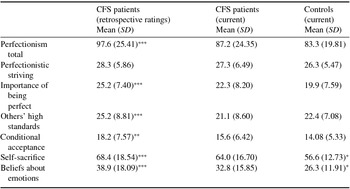
The scores on the self-report measures for psychological characteristics are shown in Table 1; for the CFS participants there are ‘current’ ratings (ratings for the previous 6 months) and also ‘retrospective’ ratings (the 6 months prior to CFS onset) while the healthy controls rated the previous 6 months only.
Mean (SD) of psychological characteristics for CFS patients and healthy controls

Significantly different from the current ratings of CFS patients: *p < .05; **p < .01; ***p < .001. Higher scores indicate more problematic beliefs.
For ratings of the previous 6 months, independent t-tests indicated that CFS patients reported significantly higher levels of self-sacrifice (t (62) = –2.370, p = .020, d = .74) and more negative beliefs about emotions (t (94) = –2.190, p = .031, d = 0.82) than healthy controls, but did not report significantly higher levels of perfectionism (t (94) = –.864, p = .390).
Paired t-tests were used to compare ratings for CFS participants for the previous 6 months with the 6 months prior to onset. These indicated that CFS patients reported significantly higher total perfectionism (t (56) = –3.234, p = .002, d = 0.42), as well as scoring higher on the subscales Conditional Acceptance (t (64) = –3.233, p = .002, d = 0.38), Others’ High Standards (t (58) = –4.015, p = .000, d = 0.47) and Importance of Being Perfect (t (65) = –3.591, p = .001, d = 0.37). Patients also reported higher self-sacrifice (t (55) = –4.367, p = .000, d = 0.25) and more negative beliefs about emotions (t (57) = –3.857, p = .000, d = 0.36) in the 6 months pre-CFS onset than at the current time.
Role and goal investment
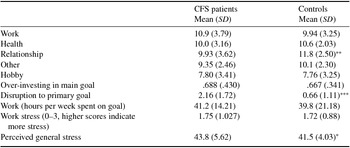
Ratings of goal involvement and stress are shown in Table 2.
Mean (SD) of roles and goals, over-investment in one goal, disruption to primary goal, hours worked, work stress and perceived general stress

Significantly different from the ratings of CFS patients: *p < .05; **p < .01; ***p < .001. Higher scores indicate greater investment in goals, greater disruption to primary goal, and greater stress.
There were no significant differences in the scores for investment in work, health, hobby or ‘other’ roles and goals for the two groups; however, the control group reported significantly more investment in relationship goals than CFS patients (t (101) = 2.882, p = .005, d = 0.60). The two groups did not differ significantly in terms of over-investing in one goal. However, as predicted, CFS patients reported significantly greater disruption to their primary goal than healthy controls (t (101) = –4.157, p = .000, d = 1.04), indicating that they found it more difficult to modify goals after a disrupting event than controls. There were no significant differences between the two groups in hours spent on work or work stress, but CFS patients reported significantly higher perceived general stress (t (99) = –2.340, p = .021, d = 0.47).
As expected, there was a significant correlation between fatigue and the extent to which the primary goal was overvalued relative to other goals, for the sample as a whole: r (99) = .220, p = .029. However, this relationship did not remain significant after controlling for depression: r (95) = .193, p = .058.
Relatives’ ratings about the CFS patient
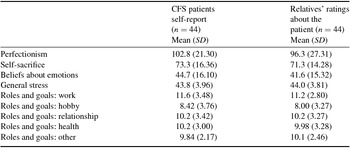
Consistency was found between CFS participants’ scores and their relatives’ ratings. Results for the 44 CFS patients whose relatives completed questionnaires are presented in Table 3 alongside the results of the relatives’ questionnaires.
Relatives’ ratings of psychological characteristics of the individual with CFS

Significantly different from the ratings of CFS patients: *p < .05; **p < .01; ***p < .001 (no significant differences found).
There were no significant differences found between patients’ pre-morbid scores and relatives’ ratings about the patients for pre-morbid perfectionism (t = –.988, p = .330), self-sacrifice (t = 1.115, p = .272), beliefs about emotions (t = –.656, p = .516), general stress (t = –.150, p = .881), or investment in any of the goals: work (t = .887, p = .380), hobby (t = .964, p = .342), relationship (t = .723, p = .474), health (t = .636, p = .528), or other role/goal (t = –.656, p = .521).
Discussion
This study provides evidence for several different psychological vulnerability factors for CFS – perfectionist standards; self-sacrificial beliefs/behaviours; negative beliefs about experiencing/expressing negative emotions; perceived stress and primary goal disruption.
After CFS onset, perfectionism (with the exception of Perfectionist Striving, a positive form of perfectionism), self-sacrifice and beliefs about emotions were all less negative than pre-onset, although self-sacrifice and beliefs about emotions were still more negative in CFS patients than controls. It should be noted that these findings reflect mean-level differences; it should not be assumed that all patients will have shown pre-morbid psychological factors. Additionally, the design of the study cannot prove that these are vulnerability factors or whether they interact with virus to influence onset; however, we can explore the differences between groups to support our hypothesis that psychological vulnerability factors contribute at least in part to the onset of CFS.
As predicted, CFS patients were more likely to report disruption to their primary goal in the 6 months pre-CFS onset compared with healthy individuals rating the previous 6 months. There was no evidence of over-investment in their main goal or time spent pursuing goals, but they reported more stress than healthy individuals in the 6 months pre-onset.
These findings are consistent with a cognitive behavioural model which suggests that CFS onset is triggered by a virus or other stressor making it difficult for the individual to maintain their usual high standards in their valued activities (e.g. Surawy et al., Reference Surawy, Hackmann, Hawton and Sharpe1995). This model suggests that due to pre-morbid psychological characteristics of perfectionism and unhelpful beliefs about the unacceptability of negative emotions and putting others’ needs before their own, the CFS-prone individual becomes distressed by this disruption to their valued goal and finds it difficult to access help. However, a recent paper in a general population found that the association between unhelpful beliefs about emotions and fatigue was not mediated by lower social support-seeking, but by greater emotional avoidance and lower self-compassion (Sydenham et al., Reference Sydenham, Beardwood and Rimes2017). These possible processes require further investigation in people with CFS.
Beliefs that one should hide negative emotions and put others’ needs before one's own could be regarded as forms of emotional and moral perfectionism. However, it should be noted that these may also relate to other psychological constructs. For example, people may put others’ needs before their own because of low self-esteem or fear of rejection.
Developing CFS appears to be associated with a modification of some unhelpful beliefs: this needs to be considered in research investigating the psychological characteristics of people with CFS. It is unlikely that psychological intervention explains this change as participants were recruited at the beginning of treatment. It may be that getting ill helps individuals identify and re-evaluate unhelpful beliefs and behaviours, or it may be that they are simply too tired to maintain previous high standards. Some individuals may find that being forced to seek help or reduce their high standards helps to challenge their previous beliefs about the negative consequences of these actions. Future community-based studies could investigate further how psychological characteristics may change after fatigue onset even without treatment, and how this might impact on the course of the condition. Cognitive behavioural treatment of CFS typically addresses perfectionist attitudes which may be important for preventing relapse after recovery even if the patient does not feel currently able to pursue their desired high standards.
Of course it should be noted that these findings may also apply to individuals with other chronic conditions such as multiple sclerosis. Future research should consider the role of the psychological factors investigated here.
Limitations
As this study was retrospective and based on self-report data, the findings are open to bias. Memory and other biases can affect results. The inclusion of relatives’ ratings was helpful in that they closely matched the participants’ own ratings and therefore suggest that bias was minimal. However, a prospective study is needed to confirm that these are pre-morbid vulnerability factors.
A further limitation is that the CFS participants completed the same questionnaires twice in one sitting (i.e. once to rate pre-morbid characteristics and once to rate current characteristics), which could have affected responses.
Additionally, it is important to note that although relatives’ ratings were shown to confirm patient reports and therefore gave us some insight into pre-morbid traits and behaviour, it is possible that a gradual (rather than sudden) onset of CFS could account for pre-morbid characteristics. For example, it may be that having to cope with increasing fatigue, pain and anxiety during the onset of CFS leads to perfectionism as a means of coping – therefore relatives may have perceived the patients to be perfectionistic pre-CFS but this may be associated with the gradual onset of the illness rather than an innate personality trait. It would be useful for similar future studies to collect information on whether CFS onset was gradual or sudden so that this can be taken into account.
Unfortunately we did not keep information about participants’ refusal rate and so cannot make demographic comparisons between participants and non-responders, which may have been useful.
Our results apply to a group of participants attending a tertiary CFS service and may not be generalizable to other CFS populations; for example, in primary care the patients are likely to be more divergent.
The current paper considered only psychological vulnerability factors for CFS, and we acknowledge that despite our significant results there are likely to be other influences in illness development – for example, biological factors such as cortisol. Future research could explore both the vulnerability factors discussed here and other, non-personality-related variables.
Implications
Our results suggest that CFS patients have a tendency to be perfectionist and self-sacrificial prior to illness onset; hold negative beliefs about emotions; and are more likely to have experience disruption in their primary goal prior to onset. These findings, if replicated, could have important implications for understanding the aetiology and treatment of CFS. For example, it may be necessary within CBT to address perfectionism, beliefs about emotions, self-sacrifice, and addressing disrupted goals. Even if perfectionist standards about performance, emotions or self-sacrificial behaviour have been attenuated since onset because the individual is not able to maintain their desired standards, addressing these attitudes may be important for preventing relapse after recovery. It may be necessary to ask the patient about those factors directly or use questionnaires to assess them, because patients do not typically come to treatment presenting these as the problem and may not realize that they have, for example, more negative beliefs about emotions than other people. As well as addressing people's unhelpful beliefs about emotions it may also be the case that emotional processing needs to be encouraged in treatment for CFS. Indeed, Godfrey et al. (Reference Godfrey, Chalder, Ridsdale, Seed and Ogden2007) found that the extent of emotional processing that occurred during therapy for chronic fatigue (either CBT or counselling) was a significant predictor of outcome. One way of addressing unhelpful beliefs about emotions might be mindfulness-based cognitive therapy (MBCT), a pilot study of which has suggested that such therapy may be useful for improving fatigue, depression and unhelpful beliefs in people with CFS (Rimes and Wingrove, Reference Rimes and Wingrove2013). For any treatment approach, it may be particularly challenging to improve outcomes for patients with very strong negative beliefs about emotions or consider perfectionism as adaptive and ego-syntonic; indeed, research has suggested that strong unhelpful beliefs about emotions are associated with poorer recovery rates in CBT for CFS (Flo and Chalder, Reference Flo and Chalder2014). It may be beneficial to draw on CBT for perfectionism (cf. Shafran et al., Reference Shafran, Egan and Wade2010) to enhance the treatment of CFS, as this treatment was developed for individuals who usually have positive beliefs about perfectionism. Interventions should also consider focusing on roles and goals and strategies for modifying these if they are disrupted or problematic.
Acknowledgements
We express thanks to the individuals who participated in the study, and to all therapists involved in collecting the data: Suzanne Roche, Sue Wilkins, Bella Stensnas, Mary Burgess and Brendan Thomas. We would like to thank Helen Roy for her help with recruiting healthy control participants.
Ethical standards: The authors assert that all procedures contributing to this work comply with the ethical standards of the relevant national and institutional committees on human experimentation and with the Helsinki Declaration of 1975, and its most recent revision.
Conflicts of interest: T. Chalder is the author of the following books: Chalder, T. (1995), Coping with Chronic Fatigue, Sheldon Press, London; Burgess, M. and Chalder, T. (2005), Overcoming Chronic Fatigue, Constable and Robinson, London. K. Rimes and T. Chalder (2015) are co-authors of the book Overcoming Chronic Fatigue in Young People, Routledge. S. Brooks has no conflicts of interest with respect to this publication.
Financial support: This research received no specific grant from any funding agency, commercial or not-for-profit sectors. Professor Chalder receives research support from the Biomedical Research Centre for the South London and Maudsley NHS Foundation Trust and the Institute of Psychiatry. This organization had no role and no involvement in study design, collection of data, analysis, writing up, or decision to submit.



Comments
No Comments have been published for this article.