According to Fritzsche (Reference Fritzsche1976), Fistularia L. comprises four species, distributed in tropical and subtropical seas: F. corneta Gilbert & Starks, 1904, F. petimba Lacépède, 1803, F. tabacaria L., 1758 and F. commersonii Rüppell, 1835.
Of minor fisheries commercial importance, the bluespotted cornetfish Fistularia commersonii Rüppell, 1835 is widely distributed in the eastern Pacific, from Mexico to Panama, in southern Japanese, Australian and New Zealand waters, in East African waters and in the Red Sea (Froese & Pauly, Reference Froese and Pauly2003). In the Mediterranean Sea, it was first recorded along the coast of Israel in January 2000 (Golani, Reference Golani2000) and was classified as a new lessepsian migrant (Golani et al., Reference Golani, Orsi-Relini, Massuti, Quignard and Briand2002), then at Rhodes Island in the south-eastern Aegean Sea in Greece (Corsini et al., Reference Corsini, Kondilatos and Economidis2002; Peristeraki et al., Reference Peristeraki, Lazarakis, Skarvelis, Georgiadis and Tserpes2006), along the Mediterranean coast of Turkey (Bilecenoğlu et al., Reference Bilecenoğlu, Taskavak and Kunt2002), in the north-western Aegean Sea (Karachlé et al., Reference Karachlé, Triantaphyllidis and Stergiou2004), in the central Mediterranean Sea (Azzurro et al., Reference Azzurro, Pizzicori and Andaloro2004), from the coast of Syria (Saad, Reference Saad2005), in the northern (Micarelli et al., Reference Micarelli, Barlettani and Ceccarelli2006) and central Tyrrhenian Sea (Psomadakis et al., Reference Psomadakis, Scacco, Consalvo, Bottaro, Leone and Vacchi2008), in Sardinia (Pais et al., Reference Pais, Merella, Follesa and Garippa2007), in the Iberian Peninsula (Sanchez-Tocino et al., Reference Sanchez-Tocino, Hidalgo Puertas and Pontes2007) and in the south-western Adriatic Sea (Dulčić et al., Reference Dulčić, Scordella and Guidetti2008; Joksimović et al., Reference Joksimović, Dragicević and Dulčić2008). In North Africa, specimens were caught in the south (Ben Souissi et al., Reference Ben Souissi, Zaouali, Bradai and Quignard2004) and the north of Tunisia (Charfi-Cheikhrouha, Reference Charfi-Cheikhrouha2004) and along the coast of Libya (Shakman & Kinzelbach, Reference Shakman and Kinzelbach2007).
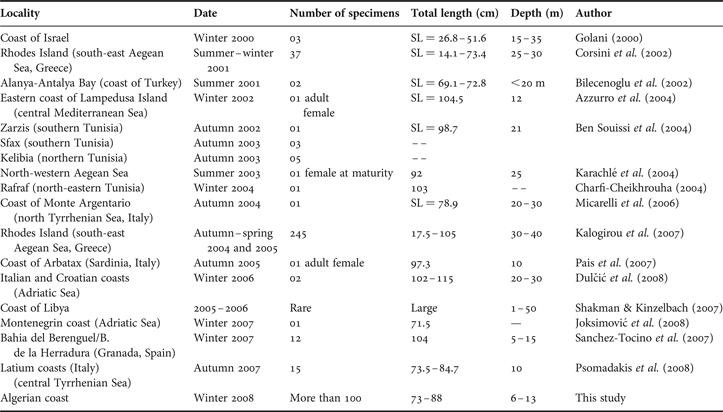
Actually, F. commersonii is well established around the island of Rhodes (Corsini et al., Reference Corsini, Margies, Kondilatos and Economidis2005). During 2004–2005, it was regularly present in autumn–winter trawl catches, ranging from 1 to 7.4% of the total catch weight (Corsini, in Kalogirou et al., Reference Kalogirou, Corsini, Kondilatos and Wennhage2007). Stomach contents of 245 specimens were examined (Kalogirou et al., Reference Kalogirou, Corsini, Kondilatos and Wennhage2007) indicating that it is a higher order carnivore. Table 1 shows the chronological records of this species in the Mediterranean.
Chronological records of Fistularia commersonii in the Mediterranean.

In its original geographical area, F. commersonii inhabits shallow waters of coral and rocky reefs in tropical and sub-tropical Indo-Pacific regions (Fritzsche, Reference Fritzsche1976). Rather common in the Red Sea, it frequents coral reefs, but also shallow sandy shores (Golani, Reference Golani1993, Reference Golani2000; Field & Field, Reference Field and Field1998). In the eastern Mediterranean, it lives on sandy–muddy bottoms and Posidonia oceanica meadows (Bilecenoğlou et al., 2002; Kalogirou et al., Reference Kalogirou, Corsini, Kondilatos and Wennhage2007). Juveniles and adults are also observed in shallow waters (beach, harbour) and juvenile specimens have been observed in shallow waters on sandy bottoms rich in Cymodocea nodosa meadows (Kalogirou et al., Reference Kalogirou, Corsini, Kondilatos and Wennhage2007).
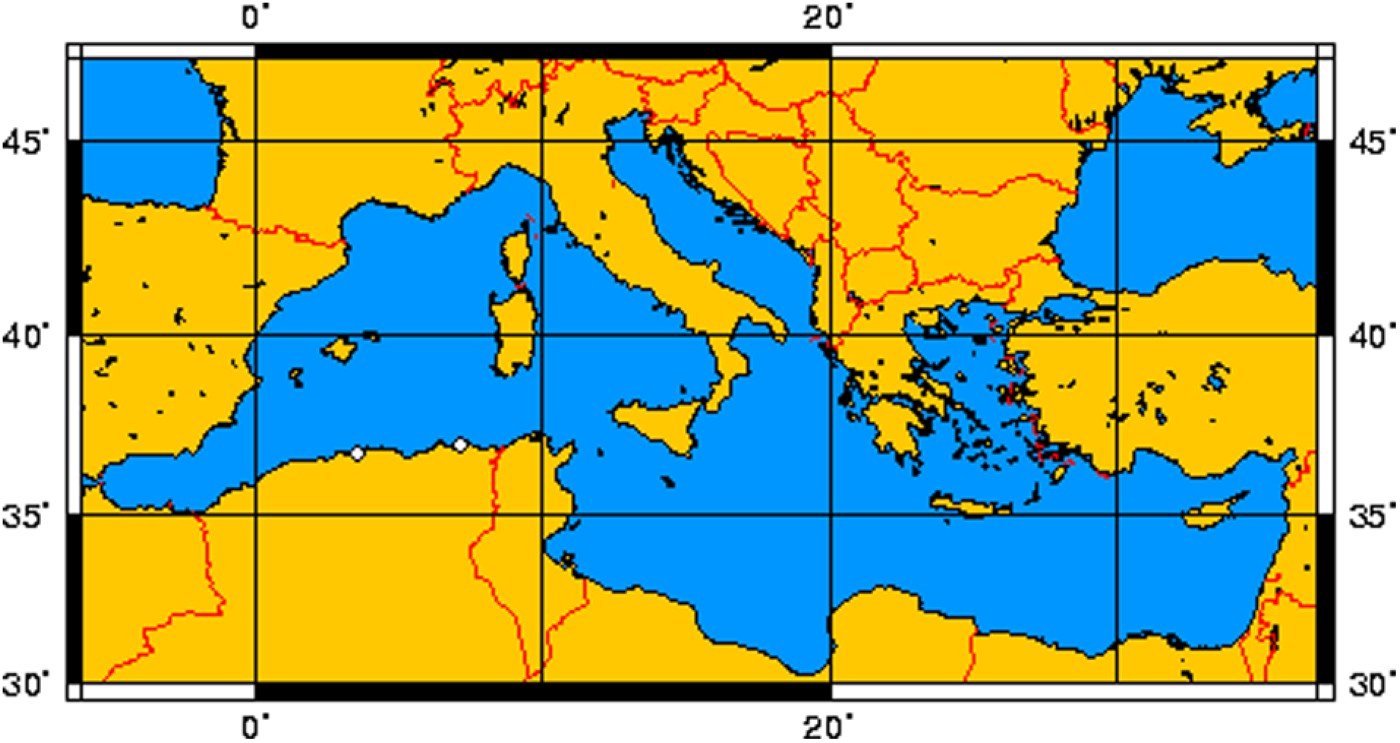
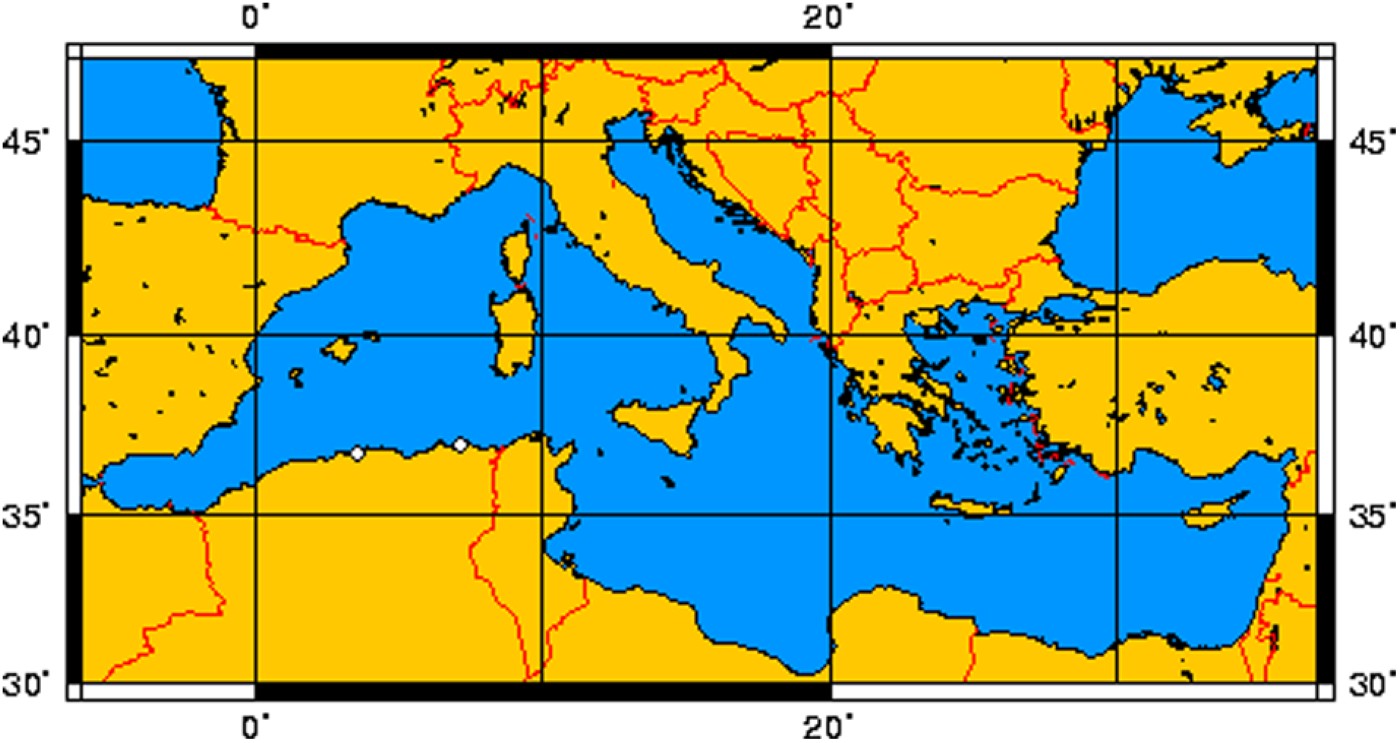
On 25 January and 3 February 2008, two and one individuals of F. commersonii were captured by ring-net and by harpoon fishing on the eastern coast of Algeria, respectively around ‘Seridjina’ Island and near ‘Molo’ beach, at a depth of between 6 and 13 metres. Since then, several samples and records regarding its occurrence have been provided by fishermen in Skikda Bay (eastern Algeria) and offshore Bou Ismaïl Bay (west of Algiers) (Figure 1), reaching a total number of about 100 specimens. They were collected from rocky, sandy bottoms and Posidonia oceanica meadows.
Map pointing out the capture areas (○) of Fistularia commersonii on Algerian coasts.
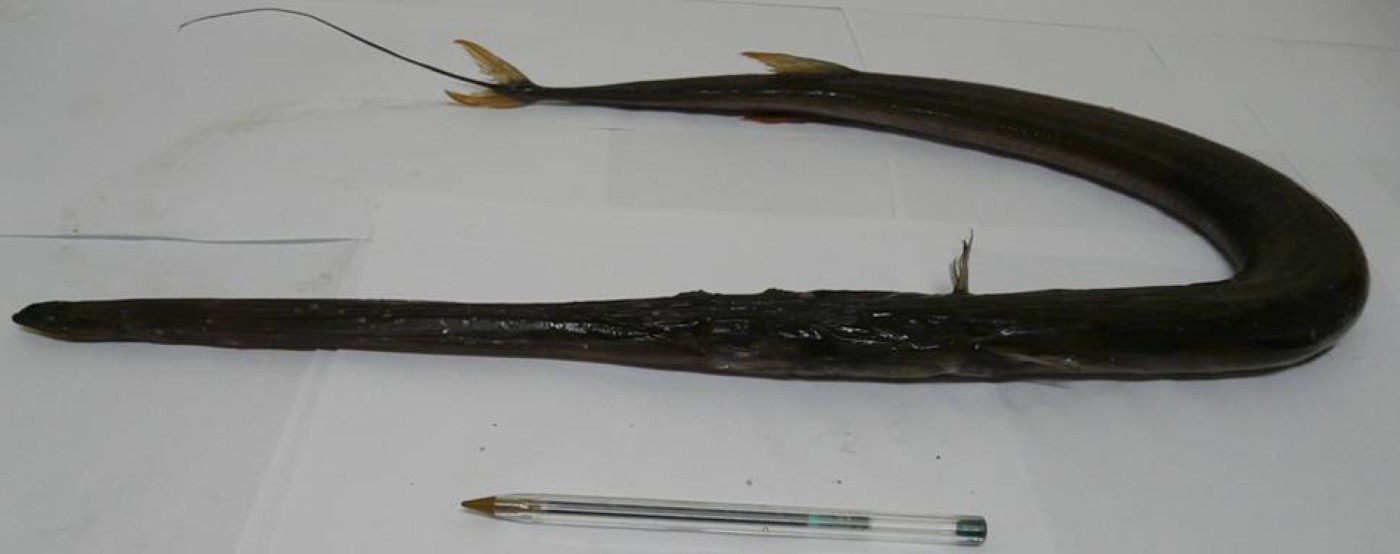
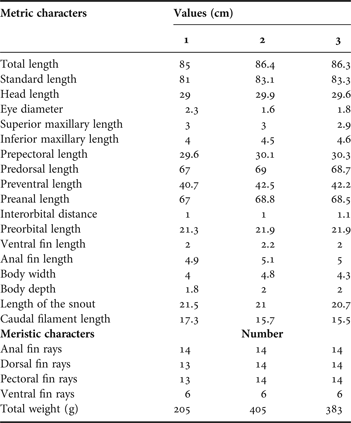
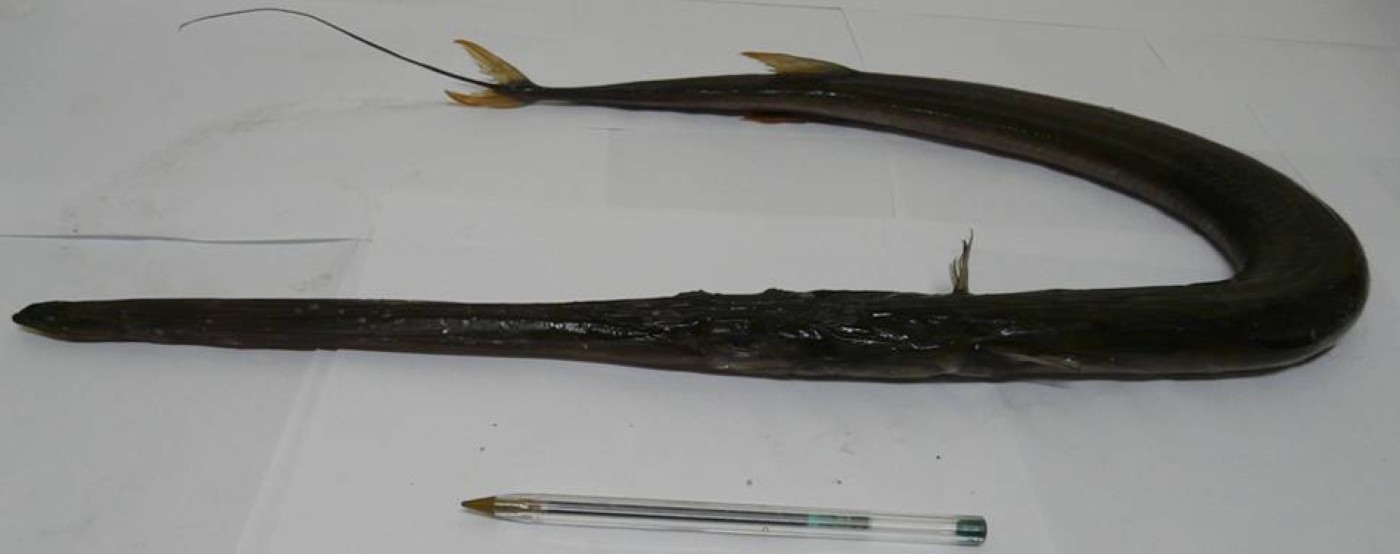
The three specimens were identified to species following Fischer & Bianchi (Reference Fischer and Bianchi1984). Identification was based on the absence of both bony plates along the mid-line of the back and of spines in ossifications of the posterior lateral line (typical of F. petimba), and on the presence of strongly serrated ridges on the snout (in contrast with smooth ridges typical of F. tabacaria). All the fish were weighed and morphometric and meristic characters were recorded (Table 2). One specimen (Figure 2) was deposited at the ichthyologic collection of the National Museum of Natural History in Paris with the number code 2008-0969.
Fistularia commersonii (total length = 85 cm) captured in the Bay of Skikda in January 2008.
Main metric and meristic characteristics of the three captured specimens of Fistularia commersonii.

Fistularia commersonii is the first lessepsian immigrant fish recorded in Algeria. The species is now well established with the presence of some adult individuals. The underlying mechanisms that promoted the dispersal and the successful establishment of this tropical fish remain to be determined. The latter indicate a good ability to adapt to different environmental conditions, which results in important effects on the local communities and unpredictable consequences for ecosystem functioning and evolutionary pathways (Sax et al., Reference Sax, Stachowicz and Gaines2005). It can also be speculated that such a successful adaptation to the prevailing environmental conditions has been facilitated by general climatic changes, as suggested by Vitousek et al. (Reference Vitousek, D'antonio, Loope and Westbrooks1996). Thus, a combination of abiotic and ecological factors, such as high niche opportunities and/or a particular pre-adaptation, allowed the bluespotted cornetfish to succeed in its new environment (Golani et al., Reference Golani, Azzurro, Corsini-Foka, Falautano, Andaloro and Bernardi2007). Indeed, this species seems to feed mostly on native Mediterranean fish regardless of the habitat type in which it lives, and to prefer schooling species living in the water column (Bariche et al., Reference Bariche, Alwan, El-Assi and Zurayk2009). Its most abundant prey by weight are Spicara smaris, Boops boops, Mullidae spp. (Kalogirou et al., Reference Kalogirou, Corsini, Kondilatos and Wennhage2007), Coris julis, Boops boops, gobiid species (Psomadakis et al., Reference Psomadakis, Scacco, Consalvo, Bottaro, Leone and Vacchi2008), Atherinidae spp., Blenniidae spp., Engraulidae, Sparidae, Centracanthidae and Labridae (Bariche et al., Reference Bariche, Alwan, El-Assi and Zurayk2009), where Centracanthidae (i.e. S. smaris) and Sparidae (mainly B. boops) constituted the most important selected prey, comprising 81.6% of the total %IRI. Since these species are very important to the ecological balance and to local fisheries, the potential negative effect of F. commersonii on the local fish communities deserves particular attention.
Fistularia commersonii was recorded in Bou Ismaïl Bay, which is approximately situated 1000 km from the nearest occurrence site for this species in the central Mediterranean. This demonstrates the particular and uncontested tendency of the species to extend its distribution to the western Mediterranean basin. This fast establishment in new areas and the potential to become an important species in the Mediterranean deserves in depth investigation into its life history and different aspects of its ecology.