Introduction
The red-gum lerp psyllid Glycaspis brimblecombei Moore (Hemiptera: Psyllidae) is an exotic eucalypt pest introduced recently in Brazil (Wilcken et al., Reference Wilcken, Couto, Orlato, Ferreira-Filho and Firmino2003). It has rapidly dispersed and causes serious damage in Eucalyptus spp. (Myrtaceae) plantations around the world (Brennan et al., Reference Brennan, Gill and Weinbaum1999; Wilcken et al., Reference Wilcken, Couto, Orlato, Ferreira-Filho and Firmino2003; Rosales et al., Reference Rosales, Lobosque, Carvalho, Bermúdez and Acosta2008; Valente and Hodkinson, Reference Valente and Hodkinson2009; Laudonia and Garonna, Reference Laudonia and Garonna2010). In high infestation scenarios, this pest can cause leaf drop, growth reduction and plant death. Eucalypt mortality rates can reach 15% in the first year of attack and up to 40% in the second year if efforts are not made to control the pest (Gill, Reference Gill1998). Both adults and nymphs cause plant damage by sucking sap from the leaves, resulting in defoliation. The main indication of insect presence is the occurrence of small white cones on the leaf surface formed by the nymphs' excretion, which also serve as shelter until they reach adulthood (Halbert et al., Reference Halbert, Gill and Nisson2001).
The most prominent method of control to date has been biological control through the rearing and releasing of the parasitoid Psyllaephagus bliteus Riek (Hymenoptera: Encyrtidae), whose presence in Brazil was detected shortly after the detection of the red-gum lerp psyllid (Berti Filho et al., Reference Berti Filho, Costa, Zuparko and Lasalle2003). However, satisfactory levels of pest control have not been reached in Brazil, most likely due to the inability of P. bliteus to adapt to some regions of the country. A few studies that address the chemical control of this pest report only the use of systemic insecticides, which have been effective only in short-term control and only in controlling a small range of the psyllid populations (Dreistadt and Dahlsten, Reference Dreistadt and Dahlsten2001). Moreover, there is a growing demand for limited applications of synthetic insecticides in certified Eucalyptus spp. forests, particularly since some products approved by the Forest Stewardship Council (FSC) qualify for tax-exempt status (Forest Stewardship Council, 2006–2008). Therefore, researchers are considering the use of entomopathogenic agents as alternative methods of control, primarily the fungi Beauveria bassiana (Balsamo) Vuillemin and Lecanicillium longisporum (Petch) Zare & W. Gams, which have shown high pathogenicity to insects in laboratory studies (Favaro, Reference Favaro2006; Wilcken et al., Reference Wilcken, Dal Pogetto, Lima, Ferreira Filho, Wenzel and Tigano2007). These and other fungi species such as Metarhizium anisopliae (Metsch.) Sorokin and Paecilomyces fumosoroseus (Wize) Brown & Smith are commercially available in Brazil for the control of sucking insects in other crops and have provided satisfactory results (Almeida et al., Reference Almeida, Pratissoli, Polanczyk, Holtz and Vicentini2007; Padulla and Alves, Reference Padulla and Alves2009). Mycoinsecticide formulation technologies are well understood and have great potential for improving the efficiency of microbial agents (Burges, Reference Burges and Burges1998). Most mycoinsecticides are produced in formulations of technical concentrate and oil dispersion. Such formulations provide a clear advantage because propagules can be applied using the same equipment and technology used to apply synthetic insecticides (Lacey and Kaya, Reference Lacey and Kaya2000). However, the careful selection of pathogen species and strains is necessary for the successful development of mycoinsecticides. Pathogens are selected through laboratory bioassays that also serve to evaluate the quality and effectiveness of the fungal preparations during and after production (Landa et al., Reference Landa, Osborne, Lopez and Eyal1994; Lacey, Reference Lacey1997). Damage to Eucalyptus spp. from this pest is increasing significantly, yet information on the use of entomopathogenic fungi for the control of the red-gum lerp psyllid is scarce. Therefore, this study investigates the potential use of mycoinsecticides through the spray application of entomopathogenic fungi formulations on G. brimblecombei-infested eucalypt seedlings under semi-field conditions.
Materials and methods
Plant material
The eucalypt seedlings used in the experiment were derived from commercial seed of Eucalyptus camaldulensis Dehnh. (Institute for Studies and Research Forest, Piracicaba, São Paulo state, Brazil). Seeds were sown in 50-ml Plantmax Florestal® (Eucatex, Salto, São Paulo state, Brazil) plastic tubes and stored in a greenhouse. After 4 months, the seedlings were transplanted in 540-ml tubes and transferred to the G. brimblecombei rearing cages.
Insects
Adult psyllids were collected from E. camaldulensis trees in the College of Agronomic Sciences, UNESP, Campus of Botucatu, São Paulo state, Brazil. Psyllids rearing was conducted on E. camaldulensis trees, previously stored in ten cages (80 × 40 × 44 cm; 12 plants/cage), as described by Wilcken et al. (Reference Wilcken, Sá, Dal Pogetto, Couto, Ferreira Filho and Firmino-Winckler2010). The cages were stored in a room with 26 ± 2°C temperature, 60 ± 10% relative humidity and 13-h photoperiod (light). Forty couples of G. brimblecombei were released in each cage for oviposition. After 14 days, seedlings heavily infested by 3rd instar psyllid nymphs were selected.
Mycoinsecticides
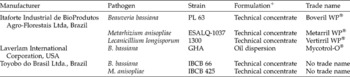
The bioassay was conducted with six commercial entomopathogenic fungi formulations, derived from three fungus species: B. bassiana, M. anisopliae and L. longisporum. The products covered two formulation types, technical concentrate and oil dispersion, as described by Faria and Wraight (Reference Faria and Wraight2007) (Table 1). Both B. bassiana and M. anisopliae are widely used as biocontrol agents against Hemiptera, Coleoptera and Lepidoptera (Zimmerman, Reference Zimmerman2007). L. longisporum is widely used against Hemiptera (Feng et al., Reference Feng, Johnson and Kish1990). These formulations have not been tested on G. brimblecombei.
Description of formulated mycoinsecticides used against red-gum lerp psyllid

+ Formulations defined as per Faria and Wraight (Reference Faria and Wraight2007).
Bioassay
The number of conidia/gram of the tested mycoinsecticides was determined by counting the conidia using a Neubauer chamber. The viability was assured by applying the 0.1 ml aliquot of a conidial suspension (1 × 10⁸ conidia/ml) in 90 mm diameter Petri dishes (containing potato dextrose agar) and spread with a Drigalsky handle. The plates were incubated at 25 ± 1°C for 24 h. The viability was estimated by counting the conidia germinated, under a light microscope. Only spores with germ tubes longer than their width were considered germinated.
Before the mycoinsecticides spraying, the number of psyllid nymphs/leaf (preview) was counted. The seedlings were sprayed with a boom sprayer simulator fitted with hollow cone nozzles using spray volume of 200 l/ha. Two mycoinsecticide concentrations (5 × 10⁷ and 1 × 10⁸ viable conidia/ml)+0.02% Tween 20 were used (Table 1). The conidial suspension was prepared in 2 litres of distilled water and manually agitated for 60 s. For each spraying, five replicates of eucalypt seedlings, supported by 540-ml plastic tube, were used. The control treatment was sprayed with distilled water+0.02% Tween 20 only. After spraying, seedlings were stored in a greenhouse, where they remained for 7 days. After this period, the number of live nymphs/leaf, selecting ten leaves/seedling, was counted. Environmental conditions were monitored by an automatic thermohygrometer set at an interval of 2 h.
Conidial deposits
To determine the conidial deposits derived from each spraying, four replicates of glass slides (25 × 75 mm) were randomly distributed among the seedlings. A plastic tube supported each glass slide, placed carefully so that the leaves did not intercept the spraying. After spraying, each slide was exposed to dry air and stored in individual Petri dishes (90 mm diameter). An optical microscope with 400 × magnification was used for the conidia counting of five random fields of view (0.3318 mm2) per slide.
Data analysis
As the number of nymphs was not homogeneous before the spraying (preview), the number of nymphs observed after spraying was submitted to ANCOVA using the preview as covariate. The means of treatments were compared by Scott–Knott test. The efficiency of mycoinsecticides was calculated using Sun-Shepard's method (Püntener, Reference Püntener1981). For statistical analysis, the number of psyllids/leaf was transformed (x+0.5)1/2.
Results
Environmental conditions in greenhouse
The experiment was conducted in September 2009, i.e. at end of the dry season, which is the period of greatest occurrence of red-gum lerp psyllid. During this time, the temperature favours the development of most kinds of entomopathogenic fungi; but on the other hand, the humidity is relatively low, which may be detrimental. The daily temperature recorded during the experiment ranged, on average, between 26 and 31 °C, which is considered generally favourable for the development of entomopathogenic fungi used in this study (Goettel et al., Reference Goettel, Inglis, Wraight, Lacey and Kaya2000). The average daily relative humidity ranged from 36 to 58%, which is conducive for both B. bassiana and M. anisopliae (Doberski, Reference Doberski1981; Ramoska, Reference Ramoska1984) and critical for the development of Lecanicillium spp. (Hall, Reference Hall1981; Fransen, Reference Fransen and Gerling1990; Hsiao et al., Reference Hsiao, Bidochka and Khachatourians1992). The high temperature and high relative humidity that occurred on the first day after spray (DAS) may have been sufficient for a good performance of some of the tested mycoinsecticides.
Mycoinsecticide efficacy
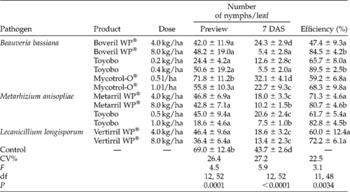
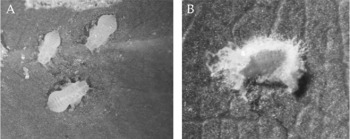
All treatments reduced the number of nymphs/leaf at 7 DAS compared with days before the application. The number of psyllid nymphs counted before spraying ranged between 18.6 and 69.0 nymphs/leaf, while at 7 DAS between 5.4 and 43.7. At a concentration of 1 × 10⁸ conidia/ml, the efficiency of the products Boveril WP®, B. bassiana (Toyobo), Metarril WP® and M. anisopliae (Toyobo) was significantly higher for insect control (>80%) (Table 2). The lowest efficiency was obtained by Boveril WP® with 47.4% at a concentration of 1 × 10⁷ conidia/ml. Figure 1 shows G. brimblecombei nymphs, healthy and colonized by B. bassiana.
Mean (±SEM) number of red-gum lerp psyllid nymphs/leaf and efficiency of mycoinsecticides

Means followed by the same letter in the same column do not differ by Scott–Knott test (P < 0.05).
Nymphs of Glycaspis brimblecombei healthy (A) and colonized by Beauveria bassiana (B)

Conidial deposits
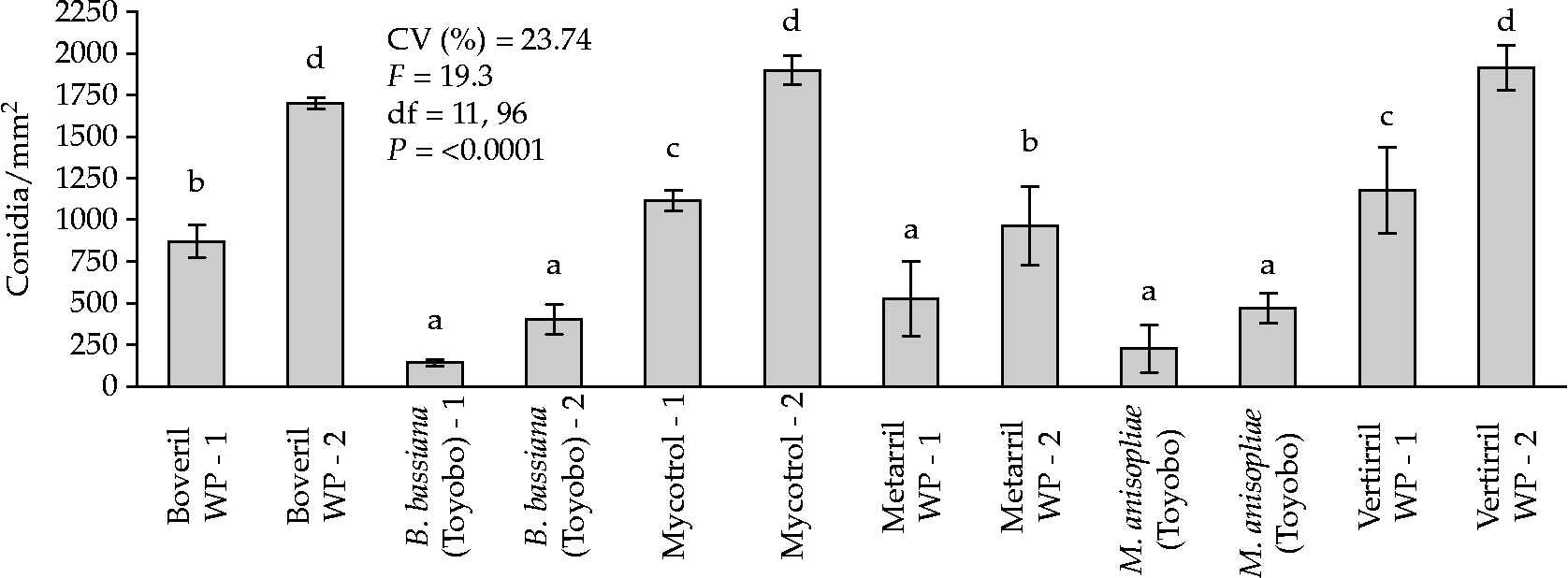
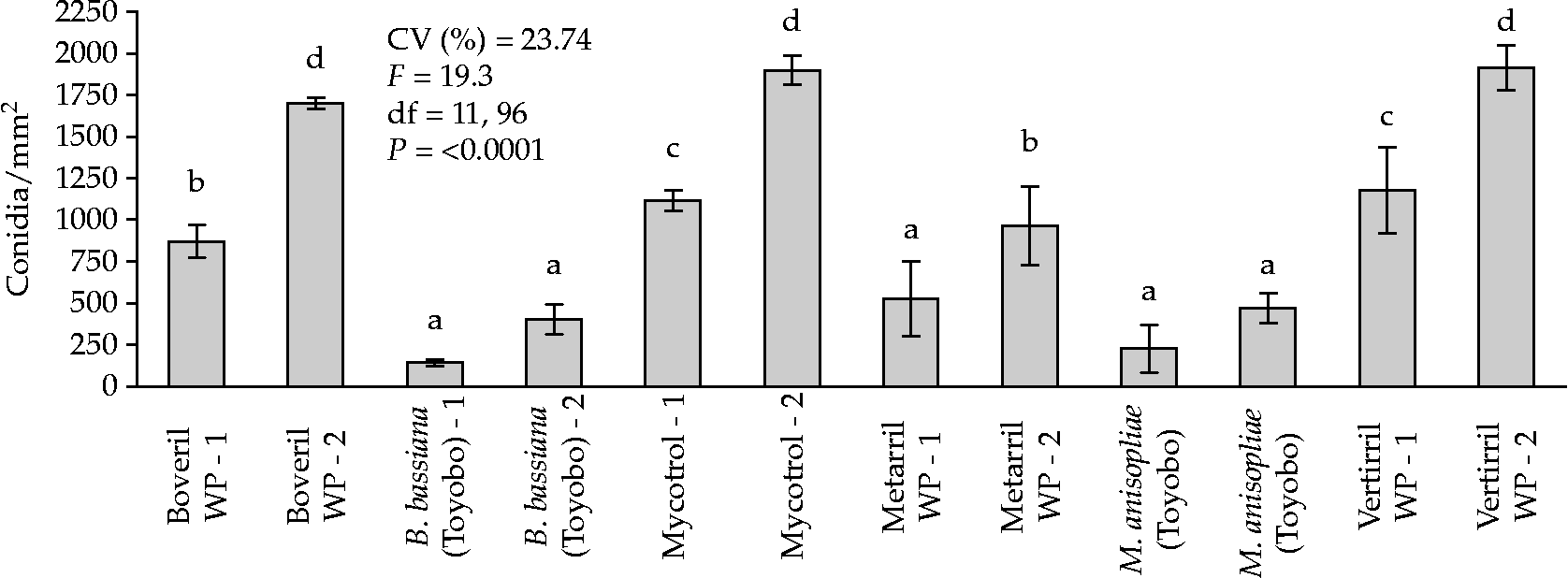
The number of conidia deposited on the glass slides after spraying of the mycoinsecticides differed significantly between products and concentrations tested (Fig. 2). In the lower concentrations (1 × 10⁷ conidia/ml), the deposition ranged from 142.0 to 1175.7 conidia/mm2. At high concentrations (1 × 10⁸ conidia/ml), the number of conidia/mm2 ranged from 400.5 to 1913.8. Probably, the great variation of conidial deposits can be attributed to formulation types and different granulometry observed between the products formulated in technical concentrate. The difference in granulometry may be due to the production method of each company. The mycoinsecticides manufactured by Itaforte Industrial of BioProdutos Agro-Florestais Ltda. had lower grain size resembling talc, while the mycoinsecticides manufactured by Toyobo do Brasil Ltda. had a larger particle size. The highest depositions were obtained by the products formulated in technical concentrate (thinner) (Boveril WP® and Vertirril WP®) and oil dispersion (Mycotrol-O®). According to the concentrations used in this study, the deposits achieved by these products were within the expected range (1000 and 2000 conidia/mm2 for the highest and lowest concentration, respectively). The lowest deposits were obtained by Metarril WP®, B. bassiana (Toyobo) and M. anisopliae (Toyobo) products. In this case, the lowest number of conidia deposited was associated with the fungus M. anisopliae and with products formulated in technical concentrate with higher granulometry.
Mean number of conidia/mm2 ( ± SE) deposited onto the glass slides after spraying of mycoinsecticides (axis label: ‘1’ denotes 5 × 10⁷ conidia/ml, and ‘2’ denotes 1 × 10⁸ conidia/ml). Bars followed by same letters do not differ by Scott-Knott test (P < 0.05).
Discussion
Bioassays of entomopathogenic fungi that only look at their efficiency do not provide enough evidence for a sound recommendation of a specific fungus or commercial product. Other important parameters include the lifetime and efficiency of the entomopathogenic fungi, which are directly influenced by the number of infective propagules deposited on the target insect (Navon and Ascher, Reference Navon and Ascher2000), since many entomopathogenic fungi can colonize the host by penetrating their cuticle (Goettel et al., Reference Goettel, St Leger, Rizzo, Staples and Roberts1989; St Leger et al., Reference St Leger, Butt, Staples and Roberts1989). Thus a spore deposition analysis is important not only to standardize the fungus concentration applied to enable a proper comparison of results obtained in different laboratories but also to be more effective in pathogen evaluation, because it reflects the number of conidia virtually deposited onto the target pests (Ye et al., Reference Ye, Dun and Feng2005; Shi et al., Reference Shi, Zhang and Feng2008). In this study, the conidia deposition varied significantly among the formulations and species tested, which can be attributed to differences in conidia size of the different pathogen species and the formulations themselves (Milner, Reference Milner1997; Ibrahim et al., Reference Ibrahim, Butt, Beckett and Clark1999, Chapple et al., Reference Chapple, Downer, Bateman, Lacey and Kaya2000; Wraight and Ramos, Reference Wraight and Ramos2002). So, the products that show highest efficiency with conidial deposition less than 1000 conidia/mm2 against nymphs of red-gum lerp psyllid are considered more pathogenic to the insect, and pathogens that do not cause desired pest mortality with 1000 conidia/mm2 can be rejected without hesitation (Shi et al., Reference Shi, Zhang and Feng2008). Mycotrol-O®, a mycoinsecticide formulated in oil dispersion, showed high conidia deposition and low efficiency. Some authors report that pathogens formulated in oil do not promote good conidia adhesion on the leaf or insect surface, since the conidia are encapsulated in the oil droplets, which can affect their ability to penetrate the host (Inglis et al., Reference Inglis, Goettel and Johnson1995; Ugine et al., Reference Ugine, Wraight and Sanderson2005).
In conclusion, the prospects of G. brimblecombei control with entomopathogenic fungi are promising. All tested mycoinsecticides reduced the nymph density/leaf, indicating that strains of B. bassiana, M. anisopliae and L. longisporum are pathogenic against this pest. The M. anisopliae (Metarril WP® and Toyobo) and B. bassiana-based products (Boveril WP® and Toyobo) can be recommended as viable alternatives to the conventional red-gum lerp psyllid control. The low control efficacy of some products may have been due to unfavourable environmental conditions during the bioassay, and/or the inability of the pathogens to overcome the psyllid shell. Additional field studies including different mycoinsecticides are needed to verify their control effectiveness under different environmental conditions. Also, due to the limited selectivity of many entomopathogenic fungi, more studies are necessary to ascertain the effect of the pathogens on natural enemies of the red-gum lerp psyllid, mainly its specific parasitoid P. bliteus.
Acknowledgements
The authors gratefully acknowledge Inajá M. Wenzel (Toyobo do Brasil Ltda.) and Gabriel M. Mascarin (Itaforte Industrial de BioProdutos Agro-Florestais Ltda) for providing the mycoinsecticides to aid in the execution of this study.