

From the end of 2019, coronavirus disease 2019 (COVID-19) has become widespread in China. COVID-19 is a respiratory infectious disease that can be spread through direct or indirect contact with droplets or aerosols, and there is no specific drug or vaccine to treat it.Reference Zhu, Zhang and Wang1
As of May 1, more than 84,000 confirmed cases and 4500 death cases have been documented in China. As of May 1, approximately 3,229,640 people were diagnosed with COVID-19 worldwide, and 229,888 people died.2 At present, the epidemic situation in Europe and America is very serious, especially in the United States, Italy, and Spain, and the number of new cases per day is still high. Due to the limited medical resources, a large number of suspected or confirmed patients cannot be admitted to the hospital.Reference Tian, Liu and Li3
In the early stage of the outbreak, patients failed to receive timely medical treatment. The purpose of home isolation is to prevent the transmission of infection by diagnosed or potentially latent patients through physical isolation.Reference Wang, Liao and Wang4 In the early stages of the outbreak, there have been many close contacts with confirmed or suspected cases or cases that have been infected, and in latent period, home isolation is, therefore, an effective way to stop the transmission of the virus.Reference Chiew, Li and Lee5 Indeed, we found that, although many severe patients in the early stage were unable to receive timely treatment due to the limitation of medical resources, leading to deterioration of their conditions or even death, there were still many patient with mild symptoms gradually improved or even recovered through effective measures to limit transmission. Therefore, the study hypothesized that, in the early stages of the epidemic, under special circumstances in which hospital and social resources are insufficient, isolating patients with mild COVID-19 at home under the guidance of doctors may become an effective response measure.
METHODS
Ethical Approval
This study was conducted in accordance with the edicts of the 1975 Declaration of Helsinki and was approved by the Medical Ethics Committee, Zhongnan Hospital of Wuhan University (approval number: 2020040K). Participants were informed in writing and verbally about the study the voluntary nature of their participation, and their right to withdraw at any time without consequences. Moreover, anonymity and confidentiality were assured and observed. Participants were assigned identification codes, which were used to present data.
Study Participants
This study included mild COVID-19 patients who have undergone home isolation under the guidance of doctors in the early stage of the epidemic (January 1 to February 8, 2020). The diagnosis and treatment standards of patients included in this study refer to the “Diagnosis and treatment plan of new coronavirus infection pneumonia (The Fifth Edition)” issued by the National Health Commission of the People’s Republic of China on February 4.6 The study included both adult individuals who obtained positive results for nucleic acids of severe acute respiratory syndrome coronavirus 2 (SARS-CoV-2) test and people who were confirmed by clinical symptoms and CT scans. All participants experienced mild symptoms (fever, cough, or lack of strength), and hospitalization was not required by doctors. Those with severe symptoms, previously diagnosed with serious cardiovascular (heart failure, myocardial infarction, cardiomyopathy, etc.) and cerebrovascular diseases and women during pregnancy or lactation were excluded from this study. All participants have been informed of the treatment measures by doctors from Zhongnan Hospital of Wuhan University on telephone or online from the beginning of isolation and continued interacting during the period of isolation.
Study Design
A cross-sectional study design was used, including the demographic and sociological data for each participant and disease-related information. In this study, a questionnaire was designed and combined with the corresponding outpatient data of participants to evaluate the compliance with epidemic prevention measures during isolation and return visits for isolation.
Measures to Limit Transmission in Home Isolation
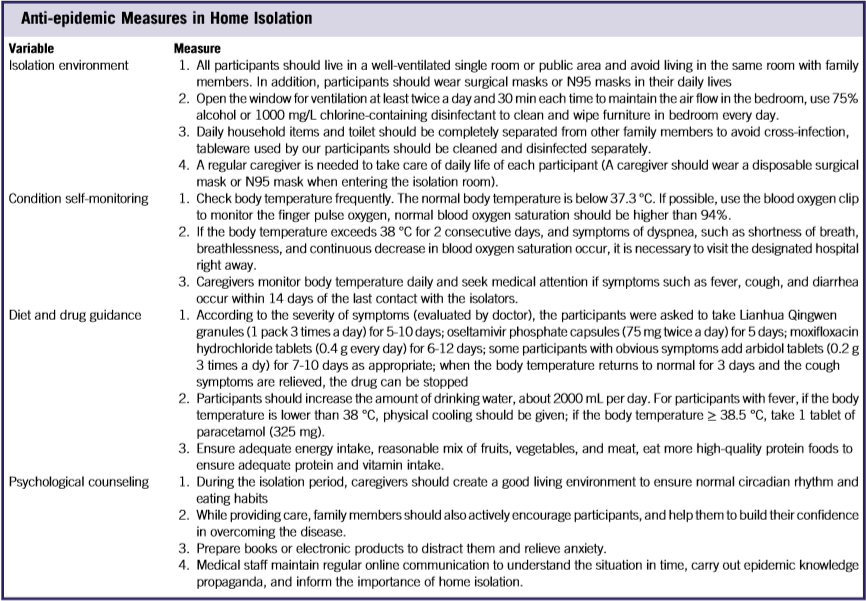
During home isolation, all participants have been asked to comply with the following measures to limit transmission (Table 1).
Anti-epidemic Measures in Home Isolation
Implementation of Home Isolation
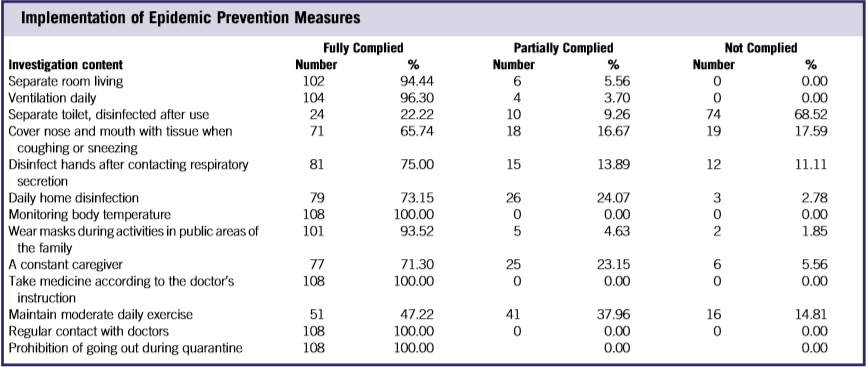
The study questionnaire was designed to evaluate the implementation of the participant’s home isolation. The questionnaire includes the following questions: (Fully complied = F; Partially complied = P; Not complied = N) (the results are summarized in Table 2)
-
5.1 Did you keep living in a separate room during home isolation? (F/P/N).
-
5.2 Did you maintain daily ventilation during the isolation? (F/P/N).
-
5.3 Did you use separate toilets during isolation and disinfect them after each use? (F/P/N).
-
5.4 Did you keep your nose covered with tissue when coughing or sneezing during isolation? (F/P/N).
-
5.5 Did you wash your hands and disinfect them after contact with respiratory secretions (saliva, mucus)? (F/P/N).
-
5.6 Did you clean and disinfect your home daily as required? (F/P/N).
-
5.7 Did you maintain temperature monitoring every day? (F/P/N).
-
5.8 Did you wear a mask when you were in the public areas at home? (F/P/N).
-
5.9 Did you take medication according to the doctor’s advice during your isolation? (F/P/N).
-
5.10 Did you maintain a certain amount of daily activity/exercise? (F/P/N).
-
5.11 Did you keep regular contact with your doctor? (F/P/N).
-
5.12 Did you ever go out during isolation (F/P/N).
-
5.13 Is there any infection in your family members? (Yes/No).
-
5.14 Did your symptoms get worse during isolation? (Yes/No).
-
5.15 What is your status on the 14th day after isolation begins? (Recovery/isolation at home/In the mobile cabin hospitals/In the designated hospital).
Implementation of Epidemic Prevention Measures
Statistical Analysis
Data were presented as the median or the percentage (%). All data were analyzed by SPSS 22.0 software.
RESULTS
Study Participants
A total of 108 cases of home isolation participants were return visited, with the return of 108 valid questionnaires and the success rate of revisit was 100%. Among them, 58 participants were male and 50 were female, with a range of 20-82 years old and a median age of 49 years.
Implementation of Home Isolation
Among the participants, more than 90% of them could fully comply with the rules, such as living in separate rooms, daily ventilation, temperature monitoring, wearing masks in the public areas of the family, taking medicine according to the doctor’s advice, and not going out, etc. However, they showed poor performance in using separate toilet and maintaining moderate daily exercise (Table 2).
Participant’s Follow-up After Isolation
After 14 d of isolation, a total of 49 participants (45.37%) had negative results for nucleic acid tests. Among them, 36 were asymptomatic (fever, cough, dyspnea), 9 had mild cough, and 4 had mild cough combined with fatigue.
Forty-nine participants (45.37%) still had positive results for nucleic acid tests, but their symptoms improved. Among them, 14 participants had no obvious symptoms, but only showed fatigue and mild muscle aches, and continued to carry out home isolation; the remaining 35 participants (32.41%) with obvious symptoms were transferred to mobile cabin hospitals for subsequent isolation treatment.
Three participants (2.78%) were admitted to a designated hospital for treatment due to worsening symptoms (persistent fever, dyspnea) during isolation. No participant died, but 7 family members were infected.
Study Limitations
The study methodology had limitations. For instance, the number of participants in our study is relatively small, and most of them are the young and the middle-aged. There are research reports that elderly COVID-19 patients face higher mortality and severe disease rate.Reference Chen, Liang and Jiang7 In addition, underlying diseases of our participants may also have some impact on the outcome of COVID-19, which was not fully considered in this study, and, therefore, there might be some systematic errors.
DISCUSSION
In the prevention and control of infectious diseases, the isolation of confirmed and suspected cases is an important step to stop the spread of the epidemic.Reference Bedford, Enria and Giesecke8 The main purpose of this study was to investigate and analyze the compliance and the effects of measures to limit transmission of SARS-CoV-2 from mild COVID-19 patients during the period of relatively insufficient hospital resources in the early stage of the outbreak of the epidemic in Wuhan. The results showed that more than three-quarters of participants were able to observe and implement basic measures to limit transmission. Strict bans on going out, disinfection, and ventilation effectively prevent the transmission of the virus among people. However, some of the participants failed to cover their noses and mouths with tissues when coughing and sneezing, and a considerable number of participants failed to use separate toilets. According to the information obtained on the return visit, most participants have 2 separate toilets in their homes. We suspect that the inadequate implementation of the measures for patients using separate toilets may be related to their living habits (such as washing hands in public toilets, etc.). A significant number of participants failed to maintain adequate daily physical activity during isolation, which may be related to low moods and limited home space.
All participants in this study took oseltamivir phosphate capsules during home isolation; however, current study suggests that oseltamivir may not have the desired effect on COVID-19.Reference Sanders, Monogue and Jodlowski9 Even so, after 14-d home quarantine, most of the participants’ viral nucleic acids turned negative, and their clinical symptoms were relieved (including participants whose nucleic acids had not yet turned negative), the remaining participants received appropriate treatment after a period of home isolation.
To date, many countries in the world have also seen a pandemic of COVID-2019. Some countries are still in the early stage, which is very similar to the early stage of Wuhan, facing a situation of short medical resources and public-health crisis.Reference Jakovljevic, Bjedov and Jaksic10 Our results showed that, for patients with mild symptoms, the measures to limit transmission under the guidance of professional doctors can play a role in comforting and isolating patients to a certain extent, which can be regarded as a good transitional way to deal with the shortage of hospital resources. Orderly home isolation under the management of doctors can greatly relieve the pressure of insufficient medical resources and social resources, and strive for valuable resources and time for the government to further control the epidemic.
Acknowledgments
Thanks to Dr. Lu Jinping and Dr. Peng Yuanyuan for the medical consultation given to the participants. Thanks also to Ms. Zhu Hong for proofreading part of the manuscript.
Conflicts of interest Statement
The authors have no conflicts of interest to declare.


 Open access

