Referring expressions are used in narratives to serve such discourse-pragmatic functions as introducing characters into discourse and maintaining reference to those characters. The appropriate use of referring expressions is essential for effective and successful communication, especially in speech situations in which the only access of an addressee to a particular universe of discourse is through the language provided by the speaker (Küntay, Reference Küntay2002). The development of this aspect of form-function mapping thus constitutes an integral part of the development of communicative competence. In this paper, we explore the developmental trends that characterize the way in which different types of referring expressions in English are used to introduce and maintain reference to characters in picture-based oral narrative discourse by American-born Chinese-speaking children and adults.
The development and use of referring expressions in discourse in English as a first language
In English, there are a range of referring expressions to mark the distinction between entities newly introduced into discourse and entities that have already been mentioned (i.e., those that are given in the discourse). These referring expressions can be ordered along a continuum that increasingly presupposes the existence and identity of their referents, as illustrated in (1) (Hickmann, Reference Hickmann2003).
(1)


In general, indefinite nominal expressions introduce referents into discourse, thereby marking new information. By contrast, definite nominal expressions and pronominals (explicit or null elements) maintain reference to a previously mentioned referent, thereby marking given information. The choice between a definite nominal expression and a pronominal for maintenance function is largely determined by local coreference: pronominals are preferred when there is immediate coreference across clauses, but nominals are preferred when there is no such coreferential tie (Hickmann and Hendriks, Reference Hickmann and Hendriks1999). The example in (2) may help to illustrate this point.
(2) An owl comes and Ø drops him. Meanwhile, the bees were running after the dog.
The null pronoun Ø co-refers with the noun phrase an owl in the preceding clause. While the use of the definite noun phrase the owl would allow the listener to identify the entity introduced in previous discourse, its use in this context could be interpreted as overspecification or redundancy (Grice, Reference Grice, Cole and Morgan1975). By contrast, the noun phrases the bees and the dog are not coreferential with any noun phrase in the preceding clause. There is a shift of reference, and some entities which have been interrupted by previous discourse are re-introduced into discourse. The need to disambiguate the references for the listener demands the use of the definite noun phrases, as the listener would be unable to assign reference to a pronoun such as they or them given this context.
Much research has examined how monolingual English-speaking children develop the ability to use appropriate referring expressions to introduce and maintain reference to characters as the story proceeds (Karmiloff-Smith, Reference Karmiloff-Smith1985; Wigglesworth, Reference Wigglesworth1990, Reference Wigglesworth1997; Hickmann, Hendriks, Roland and Liang, Reference Hickmann, Hendriks, Roland and Liang1996; Hickmann and Hendriks, Reference Hickmann and Hendriks1999; Hickmann, Reference Hickmann2003). These studies first demonstrate that this development, like other aspects of discourse development, is a protracted process. Children do not reliably use indefinite expressions for referent introduction until around the age of ten, even in the absence of mutual knowledge (Warden, Reference Warden1981; Hickmann, Reference Hickmann2003). Hickmann et al. (Reference Hickmann, Hendriks, Roland and Liang1996) examined the development of referent introduction in children learning English, French, German, and Chinese. They elicited oral narratives from adults and from children at the ages of 4, 7, and 10 using two picture-sequences that included stories involving different animal characters. They found that appropriate marking of referent introduction increased with age in all four languages. In English, proportions of introductions with appropriate referring expressions increased significantly between four and seven years (29% vs. 57%) as well as between seven and ten years (57% vs. 92%). Hickmann et al. observed that younger children make frequent uses of both definite nominals and pronouns, rather than indefinite nominal expressions, for referent introduction (see also Wigglesworth, Reference Wigglesworth1990).
The development and use of referring expressions is also influenced by discourse function. In particular, the late mastery of the forms of referent introductions has been found to contrast with the relatively early mastery of appropriate forms for referent maintenance. Hickmann and Hendriks (Reference Hickmann and Hendriks1999) examined how children and adults speaking English, German, French and Chinese maintained reference to animate characters in the same picture-based narratives that were analyzed for referent introduction in Hickmann et al. (Reference Hickmann, Hendriks, Roland and Liang1996). They reported that children at all ages used definite nominals and prononimals to maintain reference to animate characters. From preschool on, children also used these two general types of referring expressions contrastively according to a number of local coreference strategies. In particular, most prononimals occurred in coreferential contexts, but most nominals occurred in non-coreferential contexts.
Finally, previous studies have shown that the referent type (main vs. secondary) also has an effect on the choice of referring expressions for different discourse functions. In comparison to secondary animate referents, main animate referents are less likely to be introduced with indefinite nominal expressions, but are much more frequently maintained with pronouns (Karmiloff-Smith, Reference Karmiloff-Smith and Deutsch1981). Karmiloff-Smith (Reference Karmiloff-Smith1985) carried out a large-scale developmental study of the use of referring expressions in discourse production with four-to-nine-year-old English- and French-speaking children. She reported that the youngest group used pronouns deictically; in addition, they produced pronouns much more often than older children, even when it would be more appropriate to use other referring expressions. From the age of six, children seemed to follow a “thematic subject strategy” in that they built their discourse around the main character(s) and largely restricted their use of pronouns to the thematic subject or discourse topic, avoiding pronouns for other characters. It was not until after nine years of age that they started to exhibit an adult-like flexibility and use pronouns to maintain reference to both the main and secondary characters.
In recent years, researchers have begun to investigate the development and use of referring expressions in the discourse of children whose exposure to English and another language starts from birth and whose contact with the two languages has been regular until the time of study. These children are considered to acquire two first languages simultaneously, and fall within the category of bilingual first language acquisition (cf. Meisel, Reference Meisel1990). Researchers are interested in whether these children are able to acquire English and the other language as two independent systems at the discourse level. Álvarez (Reference Álvarez2003) examined the development of referring expressions for character introduction in a Spanish–English school-age simultaneous bilingual child. The child was living in Barcelona, and his mother had always spoken to him in Spanish whereas his father always spoke to him in American English. Partly due to relatively limited opportunities for interaction in English, the language that the child felt most comfortable speaking was Spanish. Álvarez collected oral narratives in both English and Spanish from the child at school at the ages of 6;11, 7;11, 8;11, 9;11, and 10;11, using the wordless picture storybook Frog, where are you? (Meyer, Reference Mayer1969). Results showed that proportions of adequate introductions to animate characters increased with age in both English (56% at age 6; 78% at ages 7, 8, and 9; and 89% at age 10), and in Spanish (78% at age 6; 89% at ages 7 and 8; 100% at age 9; 67% at age 10). These results led Álvarez to suggest that the degree of appropriateness of the forms for introducing animate characters was developing at the same rate in this bilingual child. Álvarez also noted that similar to monolingual children, the bilingual child tended to introduce characters with the use of referring expressions in postverbal positions in both languages. However, the percentage of postverbal introductions by the bilingual child was higher in English but lower in Spanish than has been attested in monolingual data. Álvarez concluded that character introductions in the child's stories in either of the languages were largely similar to those produced by monolingual children, and the difference was in the frequency of use.
More recently, Serratrice (Reference Serratrice2007) presented a detailed study of the use of referring expressions to introduce, re-introduce, and maintain reference to animate characters in the oral narratives of bilingual English–Italian children and their monolingual peers. She used Frog, where are you? (Meyer, Reference Mayer1969) to elicit oral narratives in English and/or Italian from twelve eight-year-old children from each of three groups: simultaneous English–Italian bilinguals, English-speaking monolingual children, and Italian-speaking monolingual children. The bilingual children had regular exposure to both English and Italian from birth, as well as regular use of both languages on a daily basis. Serratrice reported that there were no significant differences in either language between the monolingual children and the English–Italian bilingual children in the use of referring expressions for referent introduction, re-introduction, and maintenance. Serratrice suggested that children who had consistent and regular input in two languages from birth were able to acquire the language-specific ways of form–function mapping in the use of referring expressions for such discourse functions as character introduction and maintenance.
The development and use of referring expressions in discourse in English as a second language
Despite the increasing interest in the comparison of child first language (L1) acquisition, child second language (L2) acquisition and adult second language acquisition (Unsworth, Reference Unsworth2007), little study has been carried out to document the developmental trends in the use of referential devices in narratives by children learning English as an L2. Given that children learning English as L2 by definition have some knowledge of another language, there is potential for L1 transfer or more general cross-linguistic influence. However, it would be erroneous to assume that children have mastered their L1 at the time of first exposure to the L2. Though these children may possess knowledge of phonology, morphosyntax and vocabulary in the L1, they may not yet have acquired the skills needed to use these structural options appropriately in discourse in accordance with universal and first-language-specific principles. Thus, in spite of growing evidence for L1 transfer at the morphosyntactic level (see e.g., Haznedar, Reference Haznedar, Hughes, Hughes and Greenhill1997; Whong-Barr and Schwartz, Reference Whong-Barr and Schwartz2002) it can not be assumed that discourse will be affected by L1 transfer. In fact, there seems to be mixed evidence for L1 transfer or cross-linguistic influence in the development of referring expressions in discourse. On the one hand, studies involving languages other than English as an L2 seem to suggest that the strategies used in children's development of referring expressions to fulfill various discourse functions are universal, and do not depend on their linguistic background or on whether they are acquiring a particular language as an L1 or L2 (Severing and Verhoeven, Reference Severing and Verhoeven2001; Verhoeven, Reference Verhoeven, Strömqvist and Verhoeven2004). On the other hand, the two studies on bilingual first language acquisition which we reviewed in the last section provide evidence for crosslinguistic influence. Álvarez (Reference Álvarez2003), for example, observed quantitative differences between monolingual children and the bilingual child in her study in their use of referring expressions to introduce story characters. Serratrice (Reference Serratrice2007) also observed that for referent maintenance in Italian her bilingual children used a larger proportion of object noun phrases than monolingual children, but for referent introduction in Italian her monolingual children used twice as many postverbal subjects as the bilingual children. Such quantitative differences, although not statistically significant, can reasonably be attributed to cross-linguistic influence (Yip and Matthews, Reference Yip and Matthews2007).
By contrast, the evidence for L1 transfer is much clearer in adult second language acquisition. Adult learners have been found to have difficulty in using referential choices and strategies in L2, especially if the native language and the target language differ in their referential systems. Kang (Reference Kang2004), for example, compared the use of referring expressions to introduce and maintain reference to animate characters in oral narratives produced by L2 Korean adult learners of English as an L2 and adult American native English speakers. Kang observed that her Korean learners of English frequently used nominal expressions in their English narratives where native speakers of English would have used pronouns. She suggested that this resulted from the influence of the Korean referential system, which relies heavily on nominals even when characters have been previously mentioned and remain in the central plot.
There are several structural differences between English and Chinese that have been found to influence the use of referring expressions for referent introduction and maintenance in these two languages, which may in turn influence the process of English language acquisition by Chinese-speaking children. First, English noun phrases can be syntactically marked with definite/indefinite articles, whereas Chinese is considered to be a language without definite/indefinite articles. English speakers make extensive use of the indefinite/definite opposition between nominal determiners to mark the distinction between referent introduction and maintenance. Chinese speakers, however, mainly use nominals with numeral/quantifying determiners followed by general or specific classifiers (yī-gè nánhái “one-classifier boy”) or bare nominals (i.e., nominals with no determiners) for referent introduction. They are more likely than English speakers to reserve postverbal positions for new information.Footnote 1 In the study of Hickmann et al. (Reference Hickmann, Hendriks, Roland and Liang1996), for example, postverbal referring expressions accounted for about 80% of all the referring expressions for introducing characters that were produced by adult Chinese speakers, but only 63% of all such expressions by adult English speakers. In addition, nominals used for reference maintenance tend to be nouns with definite determiners in English, but mostly bare and demonstrative nouns in Chinese (Hickmann et al., Reference Hickmann, Hendriks, Roland and Liang1996).
Secondly, Chinese is a pro-drop language that permits subject and object pronouns to be omitted, but English is not. Null elements (or zero anaphora as they are sometimes called) are much more commonly used in Chinese than in English to maintain reference to a previously mentioned referent (Tao and Healy, Reference Tao and Healy2005). Also, Chinese speakers prefer to use pronominals (overt and null) over nominals for reference maintenance, while no such preference exists for English (Hickmann and Hendriks, Reference Hickmann and Hendriks1999). These differences have been found to produce language transfer effects in adult second language acquisition. Jin (Reference Jin1994), for example, explored the question of whether English learners of Chinese would transfer L1 English features when using L2 Chinese. She collected production data in the form of oral interviews, story retelling, and free compositions from ten native speakers of Chinese and forty-six English native speakers learning Chinese as an L2. She focused on three structures that differentiate Chinese as a topic-prominent (TP) language from English as a subject-prominent (SP) language: null elements versus overt noun phrases, bare nouns versus noun phrases with a definite determiner referring to previously identified information, and double nominative construction (i.e., a sequence of two noun phrases with the first as a topic and the second as a subject). It was found that before their proficiency reached a level at which the concept of topic emerged, the L2 learners made excessive use of SP structures such as demonstratives and overt noun phrases in their production of Chinese in situations where TP structures would be more appropriate.
It remains to be seen whether knowledge of these structural and discourse properties of Chinese will exert their influence on Chinese-speaking children's development and use of referring expressions in L2 English. For example, will the referential devices used by young Chinese speakers of L2 English be different from those of young monolingual English speakers? Will Chinese-speaking children and adults use more bare nominals, pronouns, and null elements to maintain reference to story characters, even when they start learning English as an L2 from childhood? To help answer these questions, the present study examined the use of referring expressions in the English narrative discourse of children and young adults (ages 5, 8, 10, and 20) whose first language was Chinese. The development of referring expressions in narrative was assessed using two types of measures: (a) a type and token analysis of referring expressions, and (b) assessment of referential appropriateness as determined by the percentage of appropriate use of referring expressions in both referent introduction and maintenance contexts.
The specific goals set out for the present study were (i) to establish the inventory of referring expressions in English narratives used for the two discourse functions (introducing and maintaining characters), (ii) to show how the use of these expressions changes with development, (iii) to identify the possible influence of the first language on the use of referring expressions in the second language, and (iv) to gain insight into discourse development in child second language acquisition.
Method
Participants
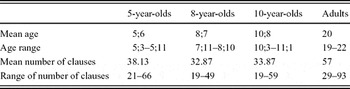
Sixty Chinese–English bilingual speakers who came from Chinese-speaking families residing in the United States participated in this study. There were 16 males and 44 females. They included fifteen speakers from each of the following four age groups: five-year-olds (range: 5;3–5;11, mean age: 5;6), eight-year-olds (range: 7;11–8;10, mean age: 8;7), ten-year-olds (range: 10;3–11;1, mean age: 10;8), and young adults (college students at an American university). Table 1 provides the mean ages, the age range, and the mean clause length and range of the narrative text produced. All participants had been exposed to Mandarin Chinese from birth. The maintenance of the Chinese language and culture is highly valued and promoted at the homes of these participants. Their parents, who are from mainland China, communicate with their children in Mandarin Chinese, and have enrolled them in community-based Chinese schools to learn to read and write in Chinese. The adult participants were enrolled in advanced Chinese classes for heritage language learners at an American university. From around the age of three to the time when thy entered kindergarten, all participants were exposed to English primarily through television programs and library story times. After that, they had increased opportunity for English input and output, both in school and in the neighborhood. Based on parental or self ratings of oral proficiency in Chinese and English using a five-point scale (0 = no proficiency, 4 = native-like proficiency), all participants were reported to have native-like proficiency in Chinese, and all but the five-year-olds were reported to have native-like proficiency in English.
Ages of subjects and mean length of texts in clauses.

The participants were recruited from kindergartens, elementary or middle schools, and universities. They had neither received speech or language services in the past nor were they receiving such services at the time of the data collection. All children were given parental permission to participate. Consent forms were obtained from the young adults.
Materials
Spoken narratives were elicited from children and adults using the picture book Frog, where are you? (Mayer, Reference Mayer1969). This book has been used by researchers around the world to study first and/or second language acquisition in both typically and atypically developing populations (Bamberg, Reference Bamberg1987; Kail and Hickmann, Reference Kail and Hickmann1992; Berman and Slobin, Reference Berman and Slobin1994; Hickmann, Kail and Roland, Reference Hickmann, Kail and Roland1995; Chen, Reference Chen2007; Chen and Oller, Reference Chen, Oller, de Knop and de Rycker2008). The book consists of 24 pictures (with no accompanying text) portraying a series of complicated events involving several animate referents. There are three main characters: a boy, his dog, and his pet frog. The frog escapes one night, and on their way to search for him, the boy and the dog have several adventurous encounters with four secondary characters: a ground squirrel, an owl, some bees, and a deer. Introducing and maintaining reference to these characters as they interact with one another provides a rich context for the study of referring expressions in narratives. The present study focused on analyzing the initial and subsequent mentions of all of the animate characters by the Chinese-speaking children and adults in the production of narratives in English.
Procedure
The participants were seen individually, either at home or at school, by a Chinese–English bilingual researcher who informed them that they would tell a story in both English and Chinese based on some pictures. The participants were seated opposite the researcher so that the researcher could not see the pictures. The researcher then asked the participants to go over the picture book page by page from the beginning to the end to familiarize themselves with the story. The participants were instructed to examine the pictures as long as they wanted before beginning. When the participants were ready, they were asked to return to the first page and tell the story from beginning to end. Roughly half of the participants in each age group told the story first in English and then in Chinese, and the other half told the story first in Chinese and then in English. This study focused on the analysis of the English narratives only. In an attempt to minimize interviewer control over participant narrations, only minimal instructions, such as “This is a story about a boy and a dog” or verbal prompts such as “What's next?” or “What about the boy?” were given (Berman and Slobin, Reference Berman and Slobin1994, p. 22–25).
Transcription
Each oral narrative was audiorecorded using a portable Marantz PMD660 solid-state recorder. The stories were then transcribed according to the conventions of the Child Language Data Exchange System, or CHILDES (MacWhinney, Reference MacWhinney2000). The CHILDES system consists of a transcription protocol (CHAT) and a series of language analysis programs (CLAN). The recorded narrative texts were transcribed verbatim in clauses (i.e., units consisting of one predicate and its argument) following the guidelines given by Berman and Slobin (Reference Berman and Slobin1994, p. 655–664). A research assistant who is a native speaker of English first transcribed the recording, and to assess inter-rater agreement, the first author reviewed all the audiotaped samples for correspondence to the transcript. Those clauses where there was any disagreement were reviewed and then transcribed and segmented jointly until consensus was reached.
Coding and analysis
All references to the main or secondary characters except those in quotations and reported speech in each of the sixty narratives were identified. The codes for each reference consisted of three parts: (a) the identification of the referent types in the clause (main or secondary characters); (b) the identification of the discourse function (reference introduction or reference maintenance); and (c) the form of the referring expressions used (indefinite nominal, definite nominal, pronoun, zero anaphora, possessive construction, etc.). To assess intercoder reliability, the two authors each initially coded all the transcripts independently. Then the two sets of coded transcripts were compared for intercoder agreement. Differences in coding were noted and resolved via consensus. Initial intercoder agreement was 95.6%; final intercoder agreement was 100%.
From the coded data, we first calculated the percentage of each type of referring expression used (a) to introduce the main characters, (b) to introduce the secondary characters, (c) to maintain reference to the main characters, and (d) to maintain reference to the secondary characters for each age group. This first set of measures was intended to assess the development, if any, in the use of different types of referential strategies to introduce or maintain reference to characters.
Then, for each age group, we calculated the percentages of appropriate introductions for the main and secondary characters and the percentage of appropriate maintenance. This second set of measures was used to assess the development of appropriateness in the use of referential expressions in narratives. A referring expression for character introduction was considered appropriate if it took the form of an indefinite NP (e.g., a dog), a possessive NP (e.g., his dog), or the first person pronoun I (when the narrator identified himself or herself as one of the main characters, namely, the boy). We then calculated the mean percentage of adequate referent introductions for each story by dividing the appropriate introductions by the total number of referring expressions used in each story to introduce the characters. For reference maintenance, we followed Schneider and Dubé (Reference Schneider and Dubé1997) in considering the use of an expression for referent maintenance appropriate if it clearly referred to a previously introduced character, regardless of whether the introductory referring expression was appropriate. We followed Hickmann et al. (Reference Hickmann, Kail and Roland1995) in treating possessive NPs as definite NPs in the maintenance context. In addition, if the referent of a possessive NP could be clearly identified, its usage was deemed appropriate. Expressions of referent maintenance were considered inappropriate when they did not allow the listener to clearly identify a specific referent. In principle, inappropriate uses include (a) use of a different and inappropriate lexical item such as the horse for a referent introduced as a deer, (b) use of an indefinite expression for a previously introduced referent, and (c) ambiguous use of a pronoun or null element as illustrated in (3).
(3) The deer took the boy. Meanwhile, the dog was running behind the deer. He pushed them both off the cliff.
The uses of the pronouns he and them are ambiguous in the context of (3). Without information about the pictures, the listener may, among other possibilities, take the use of he to refer back to the boy, and the use of them to the dog and the deer. However, in the context of the pictures, it is the deer that causes the boy and the dog to fall off the cliff. In the present study, inappropriate cases of referent maintenance involved exclusively the use of pronouns. We thus calculated the mean percentage of adequate referent maintenance for each story by dividing the appropriate and non-ambiguous uses of pronouns by the total number of pronouns used in each story to maintain reference to the characters. Two graduate students who are native speakers of English independently checked each story to determine the appropriateness of all expressions for referent maintenance. Intercoder agreement ranged from 95.6% to 100% with an average of 97.8%. All disagreements were resolved by discussion between the two students and the first author.
ANOVAs were used to evaluate the effects of the following factors on the type of referring expressions: Age, Referent Type (main vs. secondary characters), and Discourse Function (introduction vs. maintenance). All statistical analyses were run at an alpha level of .05 unless specified otherwise. Post-hoc comparisons were conducted using the Tukey HSD procedure.
Results
The stories varied greatly in length (as measured by the total number of clauses). Unsurprisingly, the stories produced by the adult group were generally significantly longer than those produced by the children (F(3,56) = 12.19, p < .0001). No significant differences were found in the length of stories produced by the three groups of children, however. Because of the differences in story length, data analyses were based on proportions rather than absolute numbers. In the following analyses, the different types of referring expressions for character introduction are reported first, followed by those for character maintenance. Two aspects of referential constructions are reported: (a) the percentage of each type of referring expressions, and (b) the assessed degree of referential appropriateness.
Referring expressions to introduce animate referents in discourse
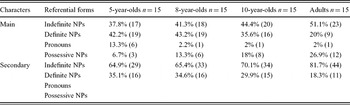
Table 2 shows the mean percentages of the different types of referring expressions used by the subjects to introduce the main or secondary characters. Four major types of referring expressions were used by children and adults to introduce the story characters: indefinite NPs, possessive NPs, pronouns, and definite NPs. Indefinite nominal expressions occurred in presentational structures (4), passive structures (5), intransitive motion constructions (6), and active transitive sentences (7).
(4) There once was a little boy who had a frog.
(5) The dog is distracted by some bees.
(6) Out of the hole came a hamster.
(7) One evening a little boy and his dog were watching a frog that was kept in a jar.
In addition, we found infrequent use of definite NPs and pronouns to introduce the story characters, as illustrated in examples (8)–(11).
(8)
(9)
(10)
(11)
Mean of referring expressions used for character introduction in percentages (occurrences in parenthesis).

Nominals with indefinite or definite determiners were used for both main and secondary characters, while possessive constructions were restricted to the main characters. Pronoun use was further restricted to one of the main characters, the boy. Six five-year-olds used the pronoun he to introduce the boy, while only one participant in each of the other age groups made use of a pronoun for character introduction. The adult speaker who used a pronoun told a first-person story, identifying himself as the boy, and so was within the bounds of appropriate introductions. It is also worth noting that, while all the main characters were mentioned by all the participants across the age groups, some of the secondary characters were not mentioned in some of the stories. This was particularly true for the stories produced by the five-year-old children: only two five-year-olds introduced all the secondary characters into their constructed discourse, whereas only two adults failed to introduce all the secondary characters in their stories. Thus, although both children and adults were less likely to introduce the secondary characters than the main characters, adults were less likely than children to fail to introduce any of the secondary characters.
Referential appropriateness in introducing animate referents in discourse
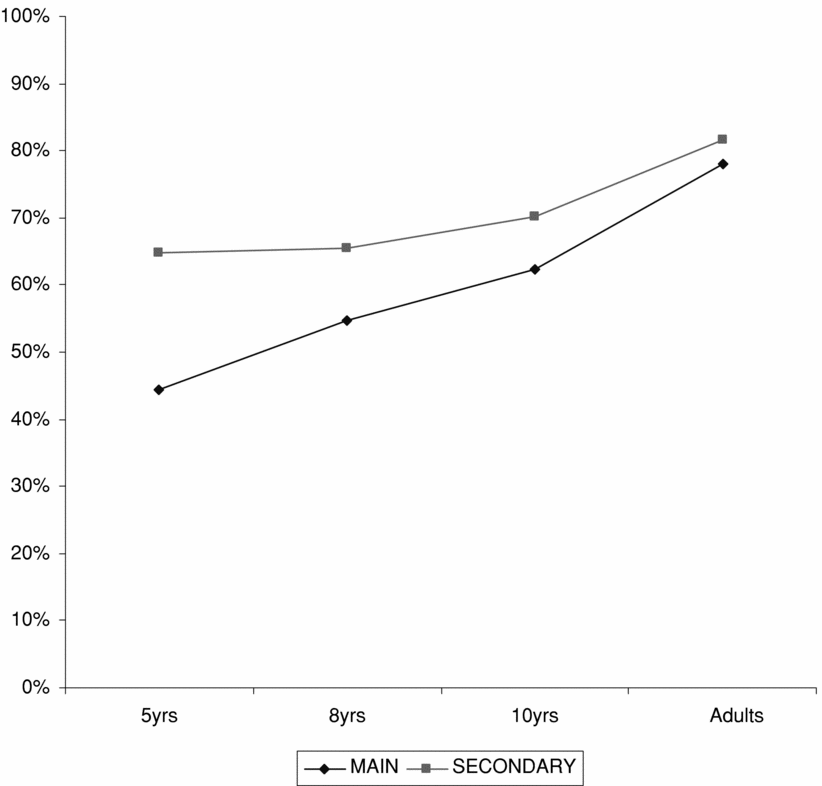
Table 3 shows the mean percentages of appropriate introductions as a function of characters and age. As can be seen from this table, as children grow older, they produce more appropriate introductions, and this is especially true for the introduction of main characters. In addition, there is a progressively reduced difference in the proportion of appropriate introductions of main characters to the proportion of appropriate introductions of secondary characters: 20.40% at five years, 10.80% at 8 years, 7.70% at 10 years, and 3.70% in the adult group. The developmental pattern is further illustrated in Figure 1.
Mean percentages of appropriate introductions as a function of age and character.

Proportions of appropriate introductions as a function of age and character.
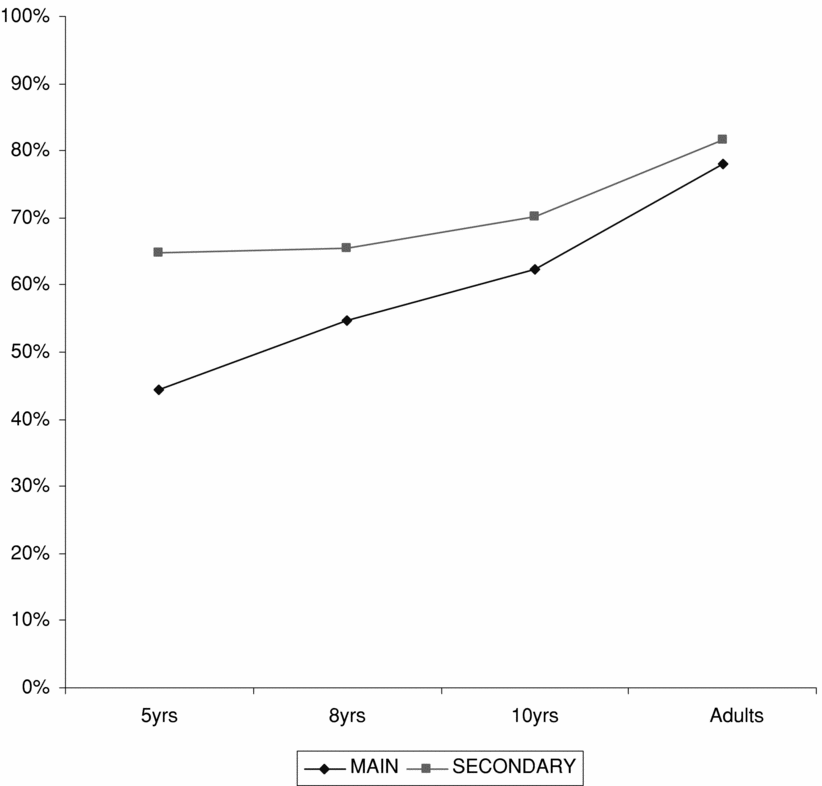
An Age (4) × Character (main vs. secondary) ANOVA was used to test differences between mean proportions of appropriate introductions for significance. The analysis revealed a significant effect of Age (F(3,56) = 2.81, p < .05). As children grew older, they produced more appropriate introductions. The analysis also revealed an effect of Character (F(1,56) = 5.11, p < .003), with higher proportions of appropriate introductions for secondary characters than main characters. A significant interaction between Age and Character (F(3,112) = 3.21, p <.03) was also found. When the significant interaction was further investigated by testing the simple main effects of age for main characters and secondary characters, the effect of age was significant when referring to the main characters (F(3,56) = 2.81, p < .05), but not when referring to the secondary characters. A post-hoc comparison showed that the five-year-olds produced less frequent appropriate introductions of the main characters than and the three older groups (p < .005), and the eight-year-olds produced less frequent appropriate introductions of the main characters than the adult group (p < .05). When the significant interaction was further investigated by testing the simple main effects of character for each age level, the effect of character was only significant for the five-year-olds (F(1,56) = 5.34, p < .03). Specifically, the five-year-olds appropriately introduced the secondary characters significantly more frequently than they did the main characters. It seemed that the five-year-olds were apt to take for granted that the listener already knew the main characters in the story.
The children and adults in the present study were asked to tell the story twice, once in English and once in Chinese, in the same session and to the same listener. It is thus possible that in the second retelling of the story they may have not considered as “new information” the first appearance of a character, as the same character was already familiar to both the participant and her interlocutor through the previous retelling. As a result, there might have been an order effect on the referential appropriateness in referent introduction. Specifically, the children and adults who told the story first in English might have produced more appropriate introductions than those who told the story in English after they told the story first in Chinese. To ascertain whether this was the case, a one-way ANOVA was performed to test for significant differences in referential appropriateness between the English-before-Chinese order and the English-after-Chinese order. Table 4 compares the mean percentages of appropriate introductions to animate characters (main and secondary characters collapsed) between the two orders (the English-before-Chinese order and the English-after-Chinese order) for each age group.
Mean percentages of appropriate introductions as a function of age and order-of-retelling (standard deviations in parenthesis).

The overall effect of order was not significant (F(1,56) = 1.5, p > .05), which suggests that the order of retelling did not significantly affect the choice of referring expressions for character introduction. It should be noted, however, that the English-before-Chinese order did produce relatively more appropriate introductions as well as fewer variations among each age group (as shown by the relatively lower standard deviations) as compared to the English-after-Chinese order. The interpretation of the results needs to take this observation into consideration.
Referring expressions used to maintain reference to animate referents
Several referring expressions were used by children and adults to maintain reference to story characters. These included the use of a subject relative pronoun, repetition of the noun with a definite determiner (e.g., the definite article the or the demonstratives this/that), the use of a possessive construction, the use of a proper name, the use of a pronoun, and the use of subject ellipsis. The following excerpt from an adult story provides a good example of the different types of referring expressions used for referent maintenance.
(12)
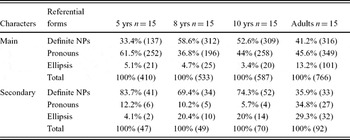
The referring expressions for referent maintenance were collapsed into three categories: definite NPs, pronouns, and ellipsis. Only two adult speakers made use of proper names to maintain reference to the main characters, and so these references were included in the category of definite NPs for analysis. Since possessive NPs were only used for main characters, they were included in the category of definite NPs for ease of statistic analysis. Similarly, because of the low frequency of use, relative pronouns were combined with personal pronouns for analysis. Table 5 summarizes the mean percentages of the different types of referring expressions used for maintaining reference to the main or secondary characters in discourse for the different groups of subjects.
Mean percentage of referring expressions used for maintaining reference to characters (number of occurrences are given in the parentheses).

Table 5 shows that main characters were mentioned much more often than secondary characters across all age groups. This observation, together with the earlier observation that main characters are more likely to be introduced than secondary characters, seems to suggest that continuity in narratives is dependent on the continuity of the underlying existence of the story characters that form the basis for the story line (cf. Chen and Oller, Reference Chen and Oller2005; Oller and Chen, Reference Oller and Chen2007).
In the rest of this section, we will focus on two questions: (i) Which forms are most frequently used when speakers maintain reference to story characters? and (ii) What is the role of the character type in speakers’ selection of linguistic forms? Two analyses of variance – one for the main characters, and one for the secondary characters – were performed with Age as a between-subjects variable and Types of Referring Expressions as a within-subjects variable: 4 (age groups) × 3 (types of referring expressions, i.e., definite NPs, pronouns, and ellipsis).
A main effect of age was found for both the main characters (F(3,56) = 10.96, p < .0001), and secondary characters (F(3,56) = 9.37, p < .0001). The two findings show a general developmental increase in the frequency of subsequent mentions of story characters, regardless of whether they are main or secondary ones. For main characters, post-hoc Tukey HSD tests revealed that this age effect was due particularly to differences between the five-year-olds and the ten-year-olds (p < .0005), and to the differences between the adults and the three groups of children (5-year-olds, p < .0001; 8-year-olds, p < .0001; 10-year-olds, p < .0002). For secondary characters, the age effect was due to the difference between the adults and the two youngest groups of children (5-year-olds, p < .0001; 8-year-olds, p < .0001).
A main effect of linguistic form was found for both main characters (F(2,56) = 7.88, p < .001) and secondary characters (F(2,56) = 7.27, p < .002). Definite NPs and pronouns were used equally frequently to maintain reference to the main characters, and these two types of referring expressions were used significantly more frequently than elliptical forms (definite NPs, p < .002; pronouns, p < .002). For secondary characters, definite NPs were the most frequently used forms (p < .0005).
A statistically significant interaction between age and linguistic form was also found for both main characters (F(6,112) = 3.41, p < .004) and secondary characters (F(6,112) = 3.84, p < .002). For the main characters, there was a significant effect of age on pronouns (F(3,56) = 4.05, p< .02), definite NPs (F(3,56) = 3.42, p< .03), and ellipsis (F(3,56) = 4.29, p < .009). As shown in Table 5, the eight-year-olds used more definite NPs than the other three groups, the five-year-olds were more likely to use pronouns than the older children, and the adults used more ellipsis in comparison to the younger groups. For secondary characters, a similar effect of age was found: pronouns (F(3,56) = 4.88, p < .005), definite NPs (F(3,56) = 4.62, p < .006), and ellipsis (F(3,56) = 3.77, p < .02). As Table 5 shows, the adult group showed a significantly lower mean use of definite NPs, but a significantly higher mean use of pronouns in comparison to the child groups. In addition, the five-year-olds used ellipsis significantly less often than the older groups.
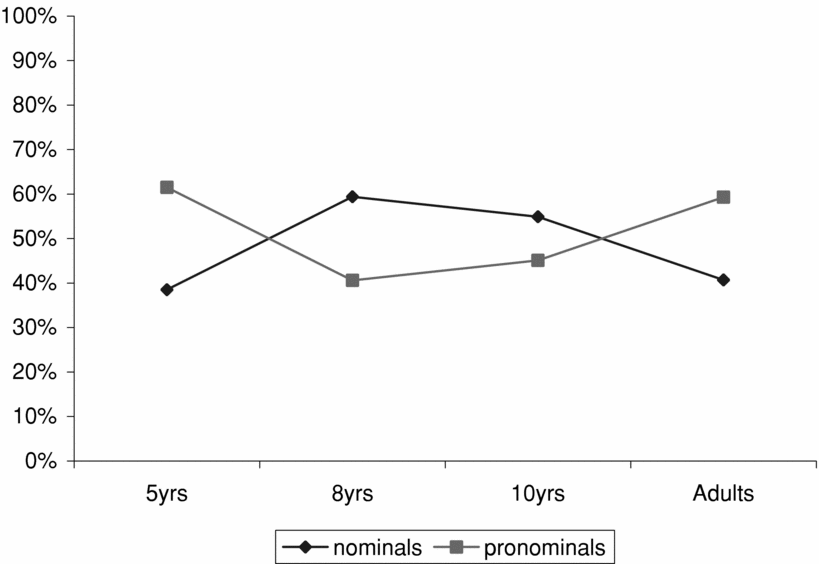
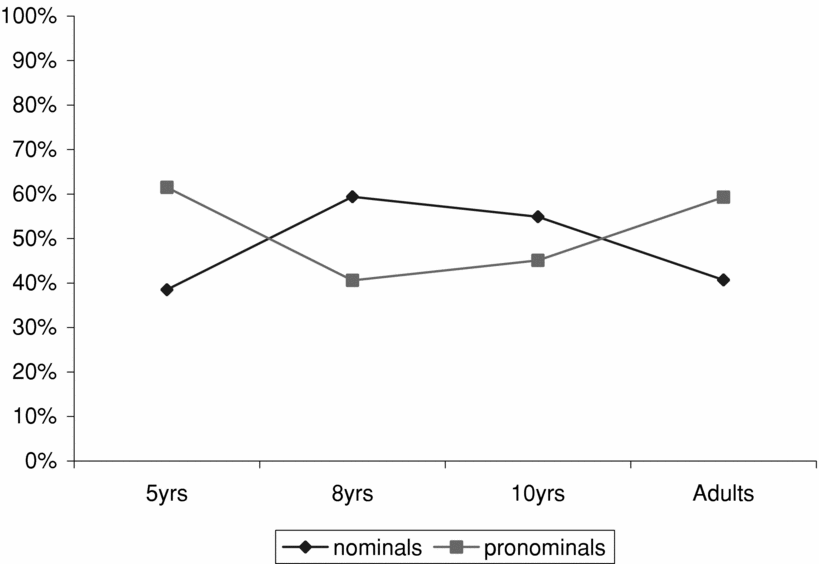
We noted earlier that definite NPs, pronouns and ellipsis are all referential devices for maintaining reference to animate characters. As Jisa (Reference Jisa2000, p. 597) points out, however, the use of definite noun phrases is expected to decrease with age “from a discursively economic point of view”. This is exactly what we found in our data when we grouped the referring expressions for maintaining reference to animate characters under two general types: nominals (definite NPs and possessive NPs) and pronominals (null and overt pronouns). Figure 2 shows the proportion of nominal versus pronominal expressions for maintaining reference to (both main and secondary) characters as a function of age. A steady growth is visible between age eight and adulthood in the preference for pronominal references.Footnote 2
Proportions of nominal versus pronominal expressions for maintaining reference to animate characters as a function of age.
Referential appropriateness for maintaining reference to the animate characters
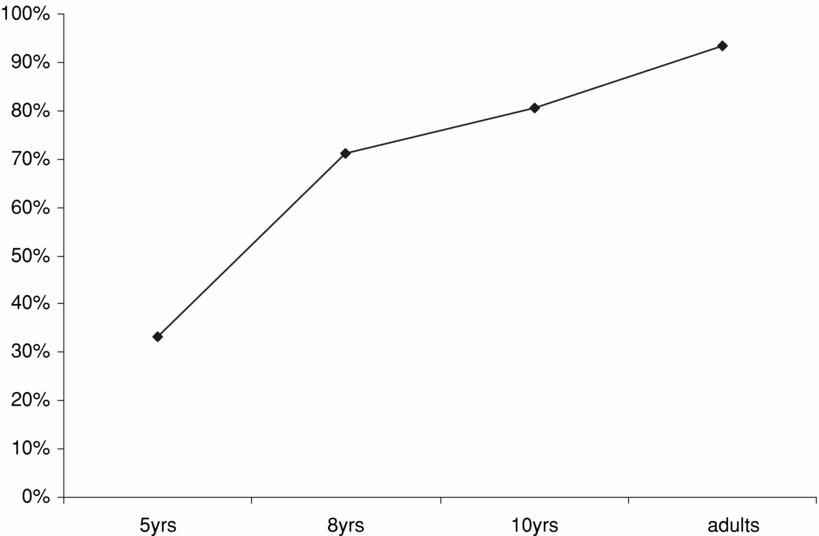
In assessing referential appropriateness for maintaining reference to the animate characters, we focused on those referring expressions that referred to the main characters. The decision was based on the observation that there were very few inappropriate uses of referring expressions for maintaining reference to the second characters, and they were limited to the deer, as seen in excerpt (3) mentioned earlier. Figure 3 presents the mean percentages of appropriate referent maintenance as a function of age.
Mean percentages of appropriate uses of pronouns to maintain reference to the main characters by age.
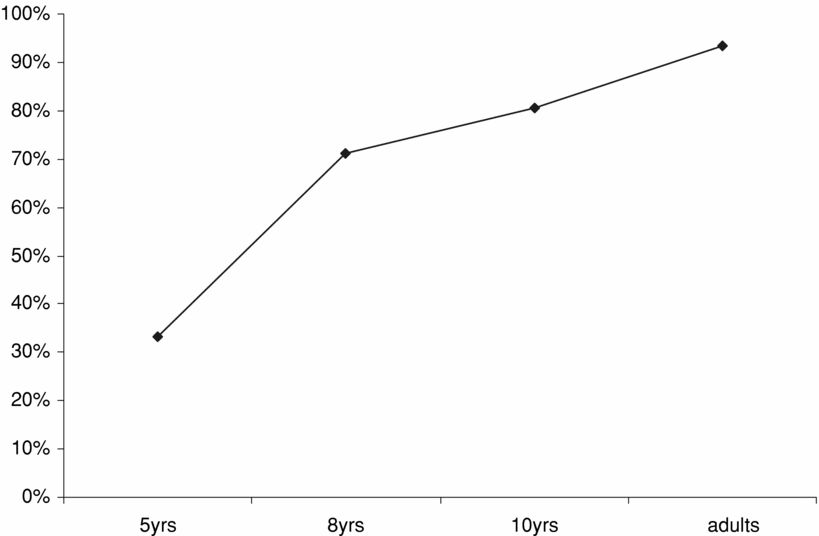
A one-way ANOVA was conducted to compare appropriate use of referring expressions for referent maintenance across age groups. As might be expected from the figure above, the overall effect of age was significant (F(3,56) = 22.64, p < .0001), and was attributed to differences between the five-year-olds and all of the other groups (8-year-olds, p < .0001; 10-year-olds, p < .0001; adults, p < .0001) and to the difference between the eight-year-old children and the adult group (p < .006). There was no significant difference in the mean percentage of appropriate referring expressions for referent maintenance between the eight-year-olds and the ten-year-olds, nor was there any significant difference between the ten-year-olds and the adult group. Nevertheless, the trend analysis revealed a significant linear relationship between age and the appropriate use of pronouns for character maintenance (p < .001). The omnibus test for deviation from linearity was not significant and there were no significant quadratic or cubic components. Thus, there appeared to be an overall upward trend, as expected: as age increased, so did appropriate use of pronouns for character maintenance.
Thus, the analysis of the use of pronouns revealed two patterns. On the one hand, our results confirmed earlier findings that pronouns are the form preferred by younger children for maintaining reference to animate characters across successive clauses (Karmiloff-Smith, Reference Karmiloff-Smith1985; Hickmann, Reference Hickmann2003). On the other hand, our results showed that early use of pronouns in narrative discourse differs considerably from adult use. The thematic subject strategy seems to be the preferred option for even some of the eight-year-olds. The following excerpt from a story told by an eight-year-old is particularly revealing.
(13) Once there was a little boy named Tom. He had a frog named Robert. He went to sleep one night, and the frog escaped.
Note that although the eight-year-old named the main characters, the child refrained from using the names when they were more appropriate than pronouns. Rather, the child resorted to the thematic subject strategy, using the pronoun exclusively to maintain reference to the main character, the boy, throughout the story. While more flexibility was observed with subsequent development, difficulty with appropriate use of pronouns for referent maintenance was observed in the majority of the ten-year-olds and even two of the adult speakers in the present study. Qualitative discourse analysis revealed that this difficulty manifested itself in the tendency to use the same pronoun to refer to more than one character. For example, participants would use the pronoun he or him first to refer to the boy, then to refer either to the dog or a secondary character such as the deer while continuing to use the same pronoun to refer to the boy. Such usages resulted in ambiguity, breaking the surface cohesion of the narrative discourse and forcing the listener to disambiguate pronominal references in order to maintain coherence in the story line.
Discussion
This study was undertaken to show how children whose L1 is Chinese learn to use referring expressions to introduce and maintain reference to story characters in English. In this section, we summarize our findings and discuss them in relation to other, similar studies in an attempt to identify similarities and differences in the development and use of referring expressions in discourse between children acquiring English as an L2 and those acquiring English as an L1.
Similarities in development and use of referring expressions in discourse in L1 and L2
The results of this study are in accord with a number of previous studies which have indicated that the development of referring expressions in narrative discourse is a gradual process that continues into adulthood. This developing ability is influenced by character type (main vs. secondary) and by discourse function (character introduction vs. character maintenance) for both monolingual English-speaking children and our Chinese-speaking children acquiring L2 English. The gradual process is prominent in the increase of appropriate introductions and in the increase of adequate use of pronouns and ellipsis for character maintenance. These results provide evidence for the developmental increase in children's capacity to package information through differentiated use of referring expressions in both L1 and L2 discourse. With respect to the effect of discourse function, our results also revealed a relative lag in the mastery of appropriate forms for character introduction versus character maintenance. With respect to the effect of referent types, the three groups of children in the present study used more appropriate referring expressions for introducing and maintaining reference to the secondary characters than they did for the main characters. In particular, they less frequently produced indefinite expressions to introduce, but more frequently produced ambiguous pronouns to maintain, reference to main characters as compared to secondary ones. This tendency has been observed in the narrative productions of monolingual children acquiring different languages and under varying experimental contexts, e.g., whether the narrator and the listener have mutual knowledge either prior or during the story telling (Bamberg, Reference Bamberg1987; Karmiloff-Smith, Reference Karmiloff-Smith and Deutsch1981; Kail and Hickmann, Reference Kail and Hickmann1992; Hickmann et al., Reference Hickmann, Kail and Roland1995; Hickmann and Hendricks, Reference Hickmann and Hendriks1999). These similarities suggest that both L1 and L2 children are guided by universal strategies in their development of referring expressions to fulfill various discourse functions. They provide further support for the view that “[C]hildren with various native languages, from immigrant to established families, of bilingual and monolingual backgrounds, rely on largely similar strategies for global discourse production in the conceptualization, planning, and organization of their narrations” (Berman, Reference Berman2001, p. 421). These language-universal strategies may form part of a discourse grammar that provides all language users with “mental processing instructions” (Givón, Reference Givón1990, p. 914) for the construction of narrative discourse.
Differences in development and use of referring expressions in discourse between L1 and L2
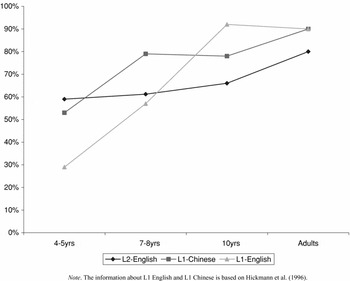
This study suggests some important differences between the development and use of referring expressions in monolingual L1 English narratives and Chinese-speaking L2 English narratives. The first difference involves the development of referential appropriateness in referent introduction, and is based on a comparison with the results from the crosslinguistic developmental study of referent introduction in Hickmann et al. (Reference Hickmann, Hendriks, Roland and Liang1996). For ease of reference and comparison, we present in Figure 4 the mean percentages of appropriate introductions in L1 English (based on Hickmann et al., Reference Hickmann, Hendriks, Roland and Liang1996) and L2 English (collapsing main and secondary characters from the present study). We also include information on L1 Chinese (again based on Hickmann et al., Reference Hickmann, Hendriks, Roland and Liang1996) to trace if there is any effect of the first language on the development of referential appropriateness.
Proportions of appropriate introductions as a function of age in L1 English, L2 English, and L1 Chinese.

Figure 4 shows that monolingual four-to-five-year-old English-speaking children were only able to produce appropriate introductions 29% of the time, monolingual Chinese-speaking four-to-five-year-old children produced appropriate referring expressions 53% of the time, and the Chinese-speaking five-year-old L2 children in the present study produced appropriate introductions 59% of the time. The difference is interesting because the L2 children were exposed to English two or three years later than the L1 children. We suggest this may be an instance of bilingual bootstrapping in the sense that “something that has been acquired in language A fulfills a booster function for language B” (Gawlitzek-Maiwald and Tracy, Reference Gawlitzek-Maiwald and Tracy1996, p. 903). Chinese, the more developed language, is performing a facilitative role in boosting the development and use of referring expressions in the less developed language, English. Figure 4 also shows significant growth among the three groups of monolingual English-speaking children, but almost no growth among the three groups of Chinese-speaking L2 children. The effect of bilingual bootstrapping seems to be temporary, since the advantage of L2 children disappears by age eight. The performance of monolingual English-speaking seven-year-old children in Hickmann et al. (Reference Hickmann, Hendriks, Roland and Liang1996) was close to that of the eight-year-old Chinese-speaking children in the present study (57% vs. 61%), whereas the performance of monolingual English-speaking ten-year-old children was much better than the ten-year-old Chinese-speaking children in the present study (92% vs. 66%). Figure 4 shows that growth pattern in the development of the degree of appropriate introduction in Chinese-speaking learning English as an L2 is similar to that of monolingual Chinese-speaking children, but is different from that of monolingual English-speaking children. This may suggest that except for its initial facilitative role, knowledge of Chinese may have hindered further development and use of referring expressions for introducing story characters in English as an L2.
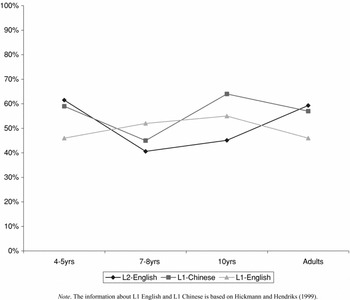
The second difference between L1 and L2 acquisition relates to the use of pronominal expressions for referent maintenance. Hickmann and Hendricks (Reference Hickmann and Hendriks1999), in their crosslinguistic developmental study of referring expressions, found no significant age effect in English on the choice of pronominal expressions for referent maintenance. They found that the proportion of pronominals in the adult L1 English narratives (46%) and in the narratives of the four-to-five-year-olds (46%) was slightly lower than in the narratives of their seven-year-olds (52%) and ten-year-olds (55%). Results from the present study show an opposite pattern. Specifically, the proportion of pronominals in the narratives of our Chinese-speaking adults (59.3%) and the five-year-olds (61.5%) was higher than that in the narratives of the seven-year-olds (40.6%) and the ten-year-olds (45.1%). Again, we present the comparisons in Figure 5 on the mean percentages of pronominals for referent maintenance in L1 English, L1 Chinese, and L2 English.
Proportions of pronominals for character maintenance as a function of age in L1 English, L2 English, and L1 Chinese.

Figure 5 demonstrates that the choice of pronominals for referent maintenance in English as an L2 by our Chinese-speaking children (except for the ten-year-olds) and adults is very similar to that in Chinese by monolingual Chinese-speaking children. Currently, we can only speculate why the ten-year-old Chinese–English bilingual children used fewer pronominals than the monolingual English-speaking children or why they, in turn, used many fewer pronominals than monolingual Chinese-speaking children. The ten-year-old bilingual children may have become more aware of how the use of pronouns may lead to potential ambiguities and/or conscious of the need to make messages unambiguous. This higher level of awareness may have resulted in their greater use of nominal expressions than the two groups of monolingual children. The heightened awareness may in turn reflect the ten-year-old bilingual children's greater maturity in pragmatic development than their monolingual peers.
A third difference relates to the timeline in the mastery of appropriate forms for referent introductions versus referent maintenance. Hickmann and her colleagues observed late mastery of the forms of referent introductions (Hickmann et al., Reference Hickmann, Hendriks, Roland and Liang1996) but early mastery of the forms for referent maintenance (Hickmann & Hendriks, Reference Hickmann and Hendriks1999). Specifically, their monolingual English-speaking children underwent a clear developmental increase in their use of appropriate expressions for referent introductions, but no change in their use of referring expressions for referent maintenance. By contrast, developmental trends were observed in the present study in both appropriate introductions of distinct referents and appropriate maintenance of referential continuity across time. In fact, our results suggest that 8 years was the critical age at which our participants began to use more appropriate referring expressions for character introduction, whereas 10 years was the critical age at which our participants began to make more appropriate and unambiguous uses of pronominal expressions for maintaining the referential continuity of particular characters. One may consider the absence of developmental changes in Hickmann and Hendriks (Reference Hickmann and Hendriks1999) as an artifact of the stimuli used: Hickmann and Hendricks made use of two stories consisting of a sequence of six pictures, while the frog story used in our study included 24 pictures. The stories in the Hickmann and Hendricks (Reference Hickmann and Hendriks1999) study might not have afforded their adult participants sufficient opportunities to distinguish themselves from the young children. This explanation, however, turned out to be unlikely. After all, children can benefit from stories consisting of more pictures as much as adults do. Bavin and Shopen (Reference Bavin and Shopen1985), in their study of a group of 30 Warlpiri children ranging in age from 4:10 to 12;0, found that a longer story (i.e., 12 pictures rather than six) allowed the children to become more involved in the story and produce more cohesive narratives. We suggest that the persistent difficulty with appropriately manipulating the use of pronouns experienced by our participants, in comparison to monolingual English-speaking children, may be related to the fact that Chinese prefers to use pronominals (overt and null) over nominals for reference maintenance, but no such preference exists for English. The Chinese background of our L2 children may have led them to pay less attention to the contextual constraints on the appropriate use of pronominals in English, which in turn resulted in the protracted process of developing referential appropriateness in reference maintenance in the second language. Further study comparing the use of pronominals to refer to the same story characters by learners of English as an L2 with different L1 backgrounds may help better understand the nature of this difference.
Implications for narrative development in bilingual speakers
During the process of language acquisition, children learn to use different types of referring expressions to construct relevant and coherent messages that are essential for effective communication. Since the acquisition of nominal and pronominal reference involves both morphosyntax and pragmatics, children must go beyond analyzing the formal properties at the sentence level to internalize the intricate system of form–function relations at the discourse level. The development of referential appropriateness in bilingual children who are experiencing the interaction of two developing systems is more complex and intricate than in monolingual children. Research on narrative development in monolingual children has pointed to the need to distinguish between the general cognitive underpinnings of narrative production (e.g., the ability to differentiate something new from something that is given) and the ability to make appropriate use of linguistic devices under various pragmatic discourse conditions. Results from the present study suggest that such a distinction is even more necessary for bilingual narrative development. While the mechanisms underlying the developmental changes found in this study are still unclear, the similarities and differences that we observed between Chinese-speaking children learning English as an L2 and children learning English as an L1 demonstrate both universal and L2-specific patterns in the development and use of referring expressions in discourse in bilingual children who learn two languages in a successive manner. The universal patterns may partly result from the determining role of general cognitive processes that guide monolingual and bilingual children's gradual development of referential appropriateness in narrative production. In other words, developmental differences in such cognitive abilities are not to be expected between children acquiring different languages (Rozendaal and Baker, Reference Rozendaal and Baker2008), nor should they be expected between monolingual children and bilingual children.
While the Chinese–English bilingual children in the present study and their English monolingual peers share similar cognitive, conceptual, and developmental abilities underlying narrative competence, their abilities to make discourse-appropriate use of linguistic devices to fulfill various narrative functions may differ and this difference is partly reflected in the L2-specific patterns observed in the present study. These L2-specific patterns are more complex to interpret, because various factors may have contributed to their occurrence. For one, the comparisons between our bilingual data and existing monolingual data may not be straightforward as far as methodology is concerned. For example, the narratives in the crosslinguistic studies by Hickmann and her colleagues were elicited in the context of non-mutual knowledge. But while the present study has attempted to use the sitting arrangement to minimize the effect of mutual knowledge on the use of referring expressions, results may have been affected by the presentation of the storybook. Specifically, the fact that the researcher in the current study presented the book to the participants may have encouraged them, particularly the children, to assume that the listener was familiar with the story and consequently affected their choice of referring expressions. It is recommended that future studies follow the procedure in Serratrice (Reference Serratrice2007, p. 1064) where the researcher presented each participant with three envelopes, each containing a copy of the same picture book. The participants were told that the books were slightly different from each other, and their task was to tell the story in such a way that the researcher would be able to identify which of the books they had chosen. Secondly, there is crosslinguistic variability in the properties of linguistic devices for reference introduction and maintenance (Hickmann, Reference Hickmann2003). Whereas English relies more on determiners (local marking) to mark reference introduction, Chinese seems to rely more on clause structure (global marking) for the same discourse function. Similarly, Chinese relies on zero elements for reference maintenance more than English does. A third factor may be crosslinguistic differences in the timing of acquisition of the form–function associations of referring expressions. For example, ten-year-old English-speaking children achieve adult-like performance with respect to the use of appropriate referring expressions for reference introduction and differ significantly from their seven-year-old peers. However, Chinese-speaking seven-year-olds and ten-year-olds do not differ from each other, but they still have a long way to go to achieve adult-like performance (Hickmann et al., Reference Hickmann, Hendriks, Roland and Liang1996). These and other factors (e.g., the observation that each language trains its speakers to pay different kinds of attention to events and experience when talking about them) affect not only the development of referring expressions in narrative discourse but other aspects of narrative development as well (see e.g., Berman and Slobin, Reference Berman and Slobin1994; Berman, Reference Berman2001). As a result, narratives produced by bilingual speakers may be unique, and fall in between those produced by their monolingual peers in each of the languages.