



Introduction
Understanding the regional water consumption and distribution plays an essential role in indicating crop water consumption and determining irrigation strategies (Ma et al., Reference Ma, Wu, Yan, Zhu and Xu2021; Disasa et al., Reference Disasa, Yan, Wang, Zhang, Zhang and Zhu2024). Evapotranspiration (ET), equivalent form of the latent heat flux (λET), contributes significantly to the energy balance of farmed surfaces (Gao et al., Reference Gao, Mei, Gu, Hao, Gong and Li2018; Yan et al., Reference Yan, Zhang, Coenders Gerrits, Acquah, Zhang, Wu, Zhao, Huang and Fu2018; Wang et al., Reference Wang, Yan, Zheng, Wu, Tian, Zhang, Zhu, Wang, Lakhiar and Liu2024b), and is a key consideration for addressing a number of scientific and engineering issues, such as the hydrological cycles, climate change and carbon cycle (Ma et al., Reference Ma, Yan, Wu, Stein, Zhu and Zeng2019; Xu et al., Reference Xu, Li, Wang, He, Tian, Tian and Yang2020; Liu et al., Reference Liu, Jiang, Wang, Jin, Yue, Yu, Zheng, Jiang and Yao2022; Lakhiar et al., Reference Lakhiar, Yan, Zhang, Wang, Deng, Bao, Zhang, Syed, Wang and Zhou2024).
Farmland ET is estimated by several methods such as water balance (Choudhury et al., Reference Choudhury, Singh and Pradhan2013; Jiang et al., Reference Jiang, Kang, Tong, Li, Li, Ding and Qiu2014), lysimeters (Evett et al., Reference Evett, Schwartz, Howell, Louis Baumhardt and Copeland2012) and micrometeorological methods such as eddy covariance (Hossen et al., Reference Hossen, Mano, Miyata, Baten and Hiyama2011; Yang et al., Reference Yang, Hu, Tian, Zhang and Dai2016) and Bowen ratio energy balance (Zhang et al., Reference Zhang, Kang, Zhang, Du, Li and Yang2010; Pozníková et al., Reference Pozníková, Fischer, van Kesteren, Orság, Hlavinka, Žalud and Trnka2018; Yan et al., Reference Yan, Deng, Zhang, Wang, Zhao, Li, Liang, Jiang and Zhou2023; Li et al., Reference Li, Yan, Zhang, Zhang, Wang and Acquah2024). However, the limitations of typical observation approaches include poor spatial representation, expensive installations, and only providing point measurements (Liu et al., Reference Liu, Liu, Hafeez, Xu and Vote2012b).
In recent decades, remote sensing ET retrieval based on the combination of satellite remote sensing data and the land surface energy model has become an increasingly important area of research, as it can provide spatial distributions of surface information, solve the problem of bad spatial representativeness of the methods for point scale, and provide an effective way of calculating ET (Jung et al., Reference Jung, Reichstein, Ciais, Seneviratne, Sheffield, Goulden, Bonan, Cescatti, Chen, de Jeu, Dolman, Eugster, Gerten, Gianelle, Gobron, Heinke, Kimball, Law, Montagnani, Mu, Mueller, Oleson, Papale, Richardson, Roupsard, Running, Tomelleri, Viovy, Weber, Williams, Wood, Zaehle and Zhang2010; Miralles et al., Reference Miralles, De Jeu, Gash, Holmes and Dolman2011; Mu et al., Reference Mu, Zhao and Running2011; Zhang et al., Reference Zhang, Kong, Gan, Chiew, McVicar, Zhang and Yang2019). Nevertheless, remotely sensed data-based ET estimate algorithms can only compute an instantaneous energy budget at the time of the satellite overpass, which is not able to meet the requirements of ET on daily as well as longer time scale in practical applications (Delogu et al., Reference Delogu, Boulet, Olioso, Coudert, Chirouze, Ceschia, Le Dantec, Marloie, Chehbouni and Lagouarde2012; Liu et al., Reference Liu, Yang, Xu, Zhang and Liu2017). Accurate daily ET can provide important guidance for water resources management, hydrological cycle studies and establishment of rational irrigation schedules (Tang et al., Reference Tang, Li and Sun2013). It is, therefore, necessary to develop temporal upscaling methods in order to upgrade ET from an instantaneous to a daily scale (Jiang et al., Reference Jiang, Zhang, Han, Chen and Wei2021), which may be an effective way to address the problem that remote sensing only provides a basic instantaneous estimate of ET, and this scaling-up relationship should be investigated and demonstrated through studies that primarily use localized (in situ) observations. In addition, the applicability of the upscaling approach to different ecosystems should be assessed, especially in water resources studies (Van Niel et al., Reference Van Niel, McVicar, Roderick, van Dijk, Beringer, Hutley and van Gorsel2012).
Most of the existing upscaling methods in practice are developed based on daily stability or regularity properties in instantaneous ET estimation models (Chávez et al., Reference Chávez, Neale, Prueger and Kustas2008; Cammalleri et al., Reference Cammalleri, Anderson and Kustas2014). Relating daily ET (λETd) to a component that can be almost constant during the day or throughout a diurnal cycle is crucial to the development of different upscaling methods (Farah et al., Reference Farah, Bastiaanssen and Feddes2004; Liu et al., Reference Liu, Hafeez, Liu, Xu and Vote2012a). The factor can be stated as the ratio of an hourly computable reference variable to instantaneous ET (λETi) at a given time of day (Van Niel et al., Reference Van Niel, McVicar, Roderick, van Dijk, Beringer, Hutley and van Gorsel2012; Tang et al., Reference Tang, Li and Sun2013; Cammalleri et al., Reference Cammalleri, Anderson and Kustas2014). Several methods, including the evapotranspiration fraction method, the crop coefficient method, the canopy resistance method, the Katerji Perrier method, the advective drought method, and the daily sinusoidal function, can be used to estimate λETd based on the assumption that the diurnal course of ET is similar to that of the solar irradiance.
The evaporative fraction (Ef), defined as the ratio between latent heat flux and available energy at the surface, is an important parameter that reflects the distribution of available energy at the surface and explains the components of the energy budget (Shuttleworth et al., Reference Shuttleworth, Gurney, Hsu and Ormsby1989). Many studies have been conducted to test the validity of the evaporative fraction method (Eva-f method) utilizing local available energy observations and the self-preservation assumption that Ef remains roughly constant throughout the day. Tang et al. (Reference Tang, Li and Sun2013) and Zhang et al. (Reference Zhang, Chen, Xu and Li2017) found that the Eva-f method accurately estimates λETd for winter wheat and summer maize in Northern China and semiarid northwest China, respectively. However, previous studies have revealed that a range of environmental factors has an impact on the assumption of self-preservation (Farah et al., Reference Farah, Bastiaanssen and Feddes2004; Gentine et al., Reference Gentine, Entekhabi, Chehbouni, Boulet and Duchemin2007; Xu et al., Reference Xu, Liu, Xu, Chen, Jia, Xu and Nielson2015; Wandera et al., Reference Wandera, Mallick, Kiely, Roupsard, Peichl and Magliulo2017). The Ef during the daytime is largely time related and depends strongly on soil moisture effectiveness, canopy cover, developmental stage, relative humidity, and the biological characteristics of vegetation in an area (Gentine et al., Reference Gentine, Entekhabi, Chehbouni, Boulet and Duchemin2007; Hoedjes et al., Reference Hoedjes, Chehbouni, Jacob, Ezzahar and Boulet2008), while the surface energy budget affects the microclimate of the vegetation canopy (Hossen et al., Reference Hossen, Mano, Miyata, Baten and Hiyama2011). These variable environmental factors may lead to inaccuracies in λETd estimates when using the Eva-f method. As a result, there is no consensus on the overall trend of daytime Ef fluctuations, which may vary from site to site (Van Niel et al., Reference Van Niel, McVicar, Roderick, van Dijk, Renzullo and van Gorsel2011). Tang et al. (Reference Tang, Li and Sun2013) and Van Niel et al. (Reference Van Niel, McVicar, Roderick, van Dijk, Beringer, Hutley and van Gorsel2012) implied that the Ef is more variable under cloudy conditions compared to clear sky conditions. The daily shape of Ef depends on atmospheric forcing and surface conditions (Gentine et al., Reference Gentine, Entekhabi, Chehbouni, Boulet and Duchemin2007); the Ef typically remains constant in the morning and increases sharply in the afternoon (Gentine et al., Reference Gentine, Entekhabi, Chehbouni, Boulet and Duchemin2007; Delogu et al., Reference Delogu, Boulet, Olioso, Coudert, Chirouze, Ceschia, Le Dantec, Marloie, Chehbouni and Lagouarde2012). Gentine et al. (Reference Gentine, Entekhabi, Chehbouni, Boulet and Duchemin2007) and Hoedjes et al. (Reference Hoedjes, Chehbouni, Jacob, Ezzahar and Boulet2008) found that the Ef fluctuates more in humid areas, whereas the Eva-f method performs best in arid areas. In addition, the Ef was also affected by effective energy, which varied little in areas with high effective energy during the day (Li et al., Reference Li, Kang, Li, Zhang and Zhang2008). When the leaf area index is large, the Ef is less stable for the same amount of soil moisture (Gentine et al., Reference Gentine, Entekhabi, Chehbouni, Boulet and Duchemin2007). Allen et al. (Reference Allen, Tasumi, Morse, Trezza, Wright, Bastiaanssen, Kramber, Lorite and Robison2007) noted a consistent decrease in hourly Ef for mowed grass, whereas sugarbeet had a significant increase in Ef in the afternoon. Chemin and Alexandridis (Reference Chemin and Alexandridis2001) suggested that assuming soil heat flux (G) equal to 0 may significantly improve the accuracy of the Eva-f method for calculating λETd because the G is a low percentage of the surface energy balance and always varies with soil thermal properties and soil moisture. Therefore, a revised evaporative fraction method (R-Eva-f method) was developed to calculate the λETd using a modified evaporative fraction (REf), which is the proportion of λET to net radiation (Rn). Suleiman and Crago (Reference Suleiman and Crago2004) found that the R-Eva-f method is more effective for extrapolating λETd from time-by-time measurements in grasslands. Chávez et al. (Reference Chávez, Neale, Prueger and Kustas2008) showed that the R-Eva-f method overestimates λETd in maize and soybean fields.
Allen et al. (Reference Allen, Tasumi, Morse, Trezza, Wright, Bastiaanssen, Kramber, Lorite and Robison2007) found that the crop coefficient (Kc), which is the ratio of ET to reference evapotranspiration (ET 0), is almost constant at low daylight frequencies, which applied to ET magnification and was named the crop coefficient method (Kc-ET 0 method). Several experiments have successfully estimated the λETd from instantaneous values using the Kc-ET 0 method, which considers the influence of atmospheric characteristics (Delogu et al., Reference Delogu, Boulet, Olioso, Coudert, Chirouze, Ceschia, Le Dantec, Marloie, Chehbouni and Lagouarde2012; Xu et al., Reference Xu, Liu, Xu, Chen, Jia, Xu and Nielson2015; Zhang et al., Reference Zhang, Chen, Xu and Li2017). The Kc-ET 0 method performed well over agricultural irrigated areas (Allen et al., Reference Allen, Tasumi, Morse, Trezza, Wright, Bastiaanssen, Kramber, Lorite and Robison2007), but poorly over bare soil where ET decreased rapidly (Colaizzi et al., Reference Colaizzi, Evett, Howell and Tolk2006).
Furthermore, the direct canopy resistance method (Direct-rc method) was developed by Farah et al. (Reference Farah, Bastiaanssen and Feddes2004) to estimate the λETd from the λETi based on a diurnal fluctuation of canopy resistance (rc).The effectiveness of the Direct-rc method has been validated by numerous studies (Tang et al., Reference Tang, Li, Sun and Bi2017; Zhang et al., Reference Zhang, Chen, Xu and Li2017; Yan et al., Reference Yan, Li, Zhang, Zhang, Wang, Yu, Ma and Zhao2022b). Tang et al. (Reference Tang, Li, Sun and Bi2017) and Yan et al. (Reference Yan, Li, Zhang, Zhang, Wang, Yu, Ma and Zhao2022b) reported that the Direct-rc method did not yield a much closer scaled λETd when utilizing varied rc as opposed to fixed rc. They also noted that the assumption that the rc would be virtually constant during the day was dubious and that more research was necessary.
A number of comparative analyses have also been carried out to evaluate the precision and suitability of various upscaling methods. As for the comparison of the ET scaling up methods based on Ef, Kc and rc, Colaizzi et al. (Reference Colaizzi, Evett, Howell and Tolk2006) and Xu et al. (Reference Xu, Liu, Xu, Chen, Jia, Xu and Nielson2015) showed that the estimated λETd based on the Eva-f method fitted measured values better for non-vegetated land cover, while the Kc-ET 0 method and Direct-rc method had the best performance during the season of vegetation growth. Chávez et al. (Reference Chávez, Neale, Prueger and Kustas2008) found that the Kc-ET 0 method performed better under uniform vegetation cover, whereas the R-Eva-f method overestimates λETd for both corn and soybean fields. Yan et al. (Reference Yan, Li, Zhang, Zhang, Wang, Yu, Ma and Zhao2022b) noted that in circumstances where there is a significant departure from reference grass, the Kc-ET 0 method may not perform well. Tang et al. (Reference Tang, Li and Sun2013) used eddy-correlation data from northern China to assess the efficacy of four upscaling methods, and showed that the Kc-ET 0 method was the most accurate in the clear and partly cloudy skies. Another comparative study based on four upscaled methods was also conducted in Australia, and the Direct-rc method was used to calculate λETd for maize and canola crops, with a high degree of consistency with eddy-correlation systems (Liu et al., Reference Liu, Hafeez, Liu, Xu and Vote2012a). Zhang et al. (Reference Zhang, Chen, Xu and Li2017) found that the Eva-f and Kc-ET 0 methods gave the best performance when using instantaneous values from 11:00 to 15:00. Yan et al. (Reference Yan, Li, Zhang, Zhang, Wang, Yu, Ma and Zhao2022b) reported that the Eva-f and R-Eva-f methods gave the best performance when using instantaneous values for the time period 11:00–14:00.
Previous studies have shown that the accuracy and applicability of different upscaling methods are affected by factors such as ecosystem, location, instantaneous time of upscaling and meteorological data. The performance of the above upscaling methods at instantaneous time may be different under different satellite traversal times, climatic conditions and vegetation growth conditions. Thus, the objectives of this study were (1) to evaluate the performances of the four scaling methods (Eva-f, R-Eva-f, Kc-ET 0 and Direct-rc method) in estimation of the λETd from λETi for maize grown in two climatic regions (semi-arid and semi-humid continental climate); (2) to comprehensively evaluate the optimal scale-up times of the four models by adopting global performance indicators (GPI); (3) to analyse the differences of these methods under two climatic regions and (4) to recommend proper approaches for estimating λETd and the optimal upscaling time for two climatic regions.
Materials and methods
Field observations
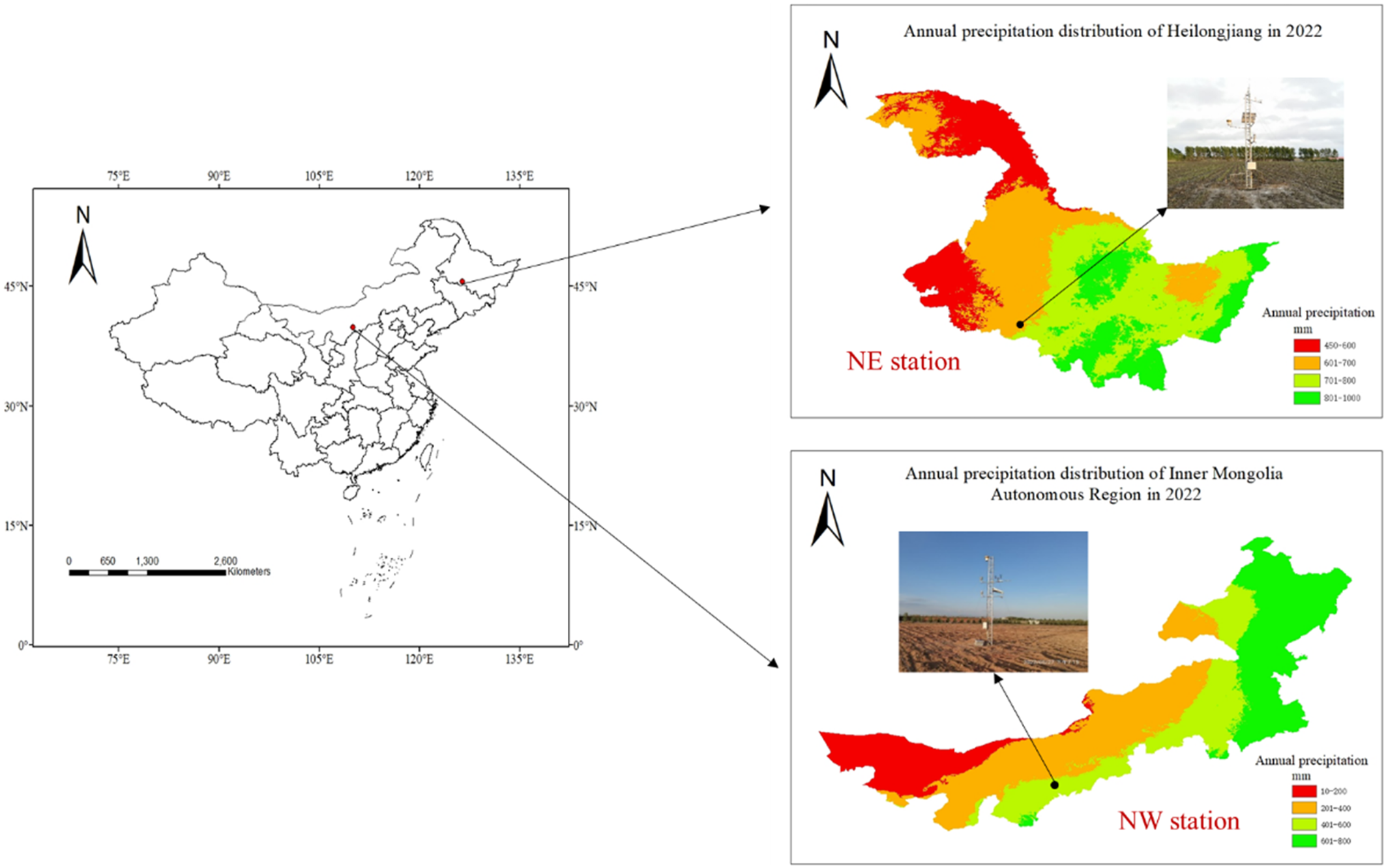
The experimental data used in this study were obtained from two long-term automatic meteorological stations in northwestern and northeastern China. The experiment in northwestern China (NW) was conducted in a maize field located at Ordos city (39°53′ N, 109°60′ E, 1456 m a.s.l.) from May 2022 to September 2023. It is a semi-arid temperate continental monsoon area with abundant sunshine resources, average hours of sunshine are more than 3000 h per year, the average annual temperature is 12.9 ℃, the average annual precipitation ranges from 190 to 300 mm, the evaporation of free water surface is 1500 mm and the frost-free period is 150 days. The soil texture is primarily sandy soil, with an average soil bulk density and field water-holding capacity of 1.60 g/cm3 and 24.7%, respectively. The experiment in northeastern China (NE) was conducted in a maize field located at Harbin city (45°38′ N, 126°22′ E, 140 m a.s.l.) from May 2021 to October 2022. It has a temperate semi-moist continental monsoon climate, with rainfall mainly occurring from June to September, and the average annual precipitation ranges from 500 to 600 mm. The average annual temperature is about 6.9°C, with the highest and lowest average monthly temperatures occurring in July (23.7°C) and January (−13.5°C), respectively. The soil texture is primarily loamy, with an average bulk density and field water-holding capacity of 1.35 g/cm3 and 32.0%, respectively. The location and precipitation information for both sites are shown in Fig. 1. The precipitation data were obtained from the Geographic Data Sharing Infrastructure (GDSI), Global Resource Data Cloud (www.gis5g.com).
Locations of the two climatic regions of northern China.
Two sets of Bowen ratio energy balance (BREB) observation systems were installed in the centre of the maize fields at the NW and NE China experimental stations (Yan et al., Reference Yan, Li, Zhang, Zhang, Wang, Yu, Ma and Zhao2022b). The study fields were surrounded by other similar crops and the installation heights of the probes used to observe the temperature and humidity were low (50–100 cm above the canopy), so adequate fetch length (> 100–200 m) can be provided (Yan et al., Reference Yan, Yu, Zhang, Wang, Huang and Ma2021). Net radiation (Rn) of maize fields at two sites was measured by CNR-4 sensors (Kipp and Zonen, Netherlands) at 4 m for NW and 3 m for NE above the ground; wind speed (u) was measured by three-cup anemometers, A100L2 (MetOne, USA, with an accuracy of ±0.12 m/s), at 6 m for NW and 4 m for NE above the ground; and the air temperature (Ta) and relative humidity (RH) were measured with HMP155A sensors (Vaisala, Finland, accuracy ±0.1°C for Ta and ±2% for RH) at 3 and 4 m above the ground for NW station, and at 3.5 and 4.5 m above the ground for NE station for the Bowen ratio energy balance (BREB) method; the volumetric soil water content (VWC) was measured by five TDR-315H sensors (Acclima, USA) at depths of 20, 40, 60, 80 and 100 cm at the centre of the field at NW station; four TDR-315H sensors (Acclima, USA) were used in NE station to measure the VWC at 5, 10, 20 and 100 cm; the soil heat flux (G) measurements in both stations were carried out using soil heat flux panels HFP01-L10 (Campbell Scientific, USA) and rainfall (P) was measured using TE525MM (Campbell Scientific, USA). All sensors were connected to a CR1000 data logger (Campbell Scientific, USA), with an average sampling frequency of every 10 min (Jiang et al., Reference Jiang, Yan, Zhang, Wang, Zhang, Liang and Deng2024). The accuracy of all sensors was verified prior to installation. Data are missing from 12 May 2022 to 29 May 2022 at the NW station and from 21 August 2022 to 14 September 2022 at the NE station due to instrument failure. The date format used was ISO 8601 time format (https://en.wikipedia.org/wiki/ISO_8601).
Scaling up methods
Eva-f method
The evaporative fraction (Eva-f) method can be expressed as (Sugita and Brutsaert, Reference Sugita and Brutsaert1991):


where Ef is the evaporative fraction at a certain hourly time, λETi and λETd are the latent heat flux at time i and total daytime, respectively (W/m2). Rn and G are the net radiation and soil heat flux (W/m2) and λ is the latent heat of vaporization (J/kg). The subscripts i and d express the instantaneous time of day and total daytime values, respectively.
R-Eva-f method
The revised evaporative fraction (R-Eva-f) method estimating λETd from λETi was proposed on the assumption that the daily mean value of the soil heat flux (G) in Eva-f method is zero (Chemin and Alexandridis, Reference Chemin and Alexandridis2001) and expressed as follows:


where REf is the ratio of λETi and Rni at a certain hourly time, other symbols have the same meanings as in (Eqns (1) and (2)).
Kc-ET0 method
The crop coefficient (Kc-ET 0) method to estimate λETd from λETi based on the crop coefficient (Kc) can be expressed as follows (Colaizzi et al., Reference Colaizzi, Evett, Howell and Tolk2006):


where Kc is the crop coefficient at a certain hourly time, λET 0 is the latent heat flux from the reference crops (W/m2), Δ is the slope of the saturation vapour pressure curve (kPa/℃), ρa is the air density (kg/m3), Cp is the specific heat of dry air at constant pressure (J/kg/K), VPD is the vapour pressure deficit (kPa), γ is the psychrometric constant (kPa/℃), and u 2 is the wind speed at 2 m height (m/s), the subscripts i and d express the instantaneous time of day and total daytime values, respectively.
Direct-rc method
The direct canopy resistance (Direct-rc) method to estimate λETd from λETi based on rc can be expressed as follows (Malek et al., Reference Malek, Bingham and Mccurdy1992):


where ra is the aerodynamic resistance (s/m), rc is the canopy resistance (s/m), the subscripts i and d express the instantaneous time of day and total daytime values, respectively.
The value of ra was calculated by (Thom, Reference Thom1972):

where z is the height of wind measurements (m), d is the zero plane displacement height (m) estimated as d = 0.67hc, hc is the mean height of the crop (m), z 0 is the roughness length governing momentum transfer (m) calculated as z 0 = 0.123hc, z 0h is the roughness length governing transfer of heat and vapour (m) computed as z0h = 0.1z0, uz is the wind speed at height z (m/s), and κ is the von Karman constant ( = 0.41).
Evapotranspiration measurements
One of the standard techniques for measuring λET indirectly is the Bowen ratio energy balance (BREB) method (Pozníková et al., Reference Pozníková, Fischer, van Kesteren, Orság, Hlavinka, Žalud and Trnka2018; Yan et al., Reference Yan, Huang, Zhang, Zhang, Wang, Li, Zhao, Li and Zhao2022a). The BREB determines the latent heat and sensible heat fluxes based on the rearrangement of the simplified surface energy balance equation given by (Heilman and Brittin, Reference Heilman and Brittin1989):


where β is the Bowen ratio, ΔT is the air temperature gradient and Δe is the actual vapour pressure gradient. The measured λETd were computed by the sum of λETi which was obtained using the BREB method based on the hourly meteorological data from 8:00 to 16:00 for both areas. To control the measurement quality, the λET results were ignored when β was close to −0.75 (Ohmura, Reference Ohmura1982).
Performance evaluation
The relative performance of the four upscaling methods was evaluated using the statistical indices, including coefficient of determination (R 2), mean absolute error (MAE), relative root mean absolute error (RRMSE) and coefficient of efficiency (ɛ).


where Ei and Oi represent the estimated and observed values, respectively, n is the total sample number and $\overline O$ is the mean of observed values. R 2 represents the degree of replication of the model to the observed value. The higher the value of R 2 is, the better the performance is. Both RRMSE and MAE values are range from 0 (perfect fit) to ∞ (worst fit). ɛ is dimensionless, which ranges from 0 (worst fit) to 1 (perfect fit) (Yan et al., Reference Yan, Acquah, Zhang, Wang, Huang, Zhang, Zhao and Wu2019; Zhao et al., Reference Zhao, Yan, Zhang, Li, Deng, Liang and Jiang2023; Wang et al., Reference Wang, Bao, Yan, Zheng, Wu, Zhang and Wang2024a).
The optimal upscaling methods based on the four accuracy evaluation indexes differed at different fertility stages, but also the optimal upscaling moments were not exactly the same, and thus the global performance indicators (GPI) was introduced to comprehensively evaluate the optimal upscaling times of the four models (Despotovic et al., Reference Despotovic, Nedic, Despotovic and Cvetanovic2015). The calculation formula is as follows:

As for indicators of R 2 and ɛ, aj is equal to −1, while as for other indicators, aj is equal to 1, yj is the median scale value of the index j and yij is the scale value of the index j in the model i. The higher the GPI value is, the higher the accuracy of the model is.
Results
Meteorological conditions
The observed meteorological data during the growing periods of maize in two climatic regions are shown in Fig. 2. For the NW station, the net radiation (Rn) in 2022 (from 12 May to 26 Sep) ranged from −22.8 to 241.6 W/m2, with average value of 132.0 W/m2, and the corresponding values ranged from 6.96 to 213.0 W/m2, with average value of 139.0 W/m2 in 2023 (from 6 May to 22 Sep). The soil heat flux (G) in 2022 ranged from −16.2 to 39.1 W/m2, with average value of 4.33 W/m2, and the corresponding value ranged from −13.5 to 22.2 W/m2, with average value of 6.23 W/m2 in 2023.
Variations of meteorological data during maize growing periods in two climatic regions. Rn is the net radiation, G is the soil heat flux, Ta is the air temperature, VPD is the vapour pressure deficit and u is the wind speed. (a), (c), (e) and (g) for northwestern China, (b), (d), (f) and (h) for northeastern China.

The air temperature (Ta) in 2022 ranged from 8.71 to 27.5 ℃, with average value equalled 19.8 ℃, while Ta in 2023 ranged from 8.75 to 25.5 ℃, with average value equalled 19.2 ℃. The vapour pressure deficit (VPD) in 2022 ranged from 0.09 to 3.04 kPa, with average value equalled 1.06 kPa, while VPD in 2023 ranged from 0.12 to 2.38 kPa, with average value equalled 1.15 kPa. The wind speed (u) had mean values of 2.45 m/s for 2022 and 2.38 m/s for 2023, with maximum values of 5.65 and 4.68 m/s.
For the NE station, the Rn in 2021 (from 1 May to 26 Oct) ranged from 3.27 to 209.7 W/m2, with average value of 116.3 W/m2 and the corresponding values ranged from −11.7 to 223.7 W/m2, with average value of 126.5 W/m2 in 2022 (from 1 May to 22 Oct). The G in 2021 ranged from −6.07 to 4.94 W/m2, with average value of 0.35 W/m2, and the corresponding values ranged from −3.17 to 8.71 W/m2, with average value of 1.94 W/m2 in 2022. The Ta in 2021 ranged from −1.34 to 27.4 ℃, with average value equalled 17.7 ℃, while Ta in 2022 ranged from 2.12 to 28.0 ℃, with average value equalled 17.7 ℃. The VPD in 2021 ranged from 0.03 to 2.41 kPa, with average value equalled 0.59 kPa, while VPD in 2022 ranged from 0.03 to 1.88 kPa, with average value equalled 0.63 kPa. The u had mean values of 1.55 m/s for 2021 and 1.62 m/s for 2022, with maximum values of 5.18 and 6.03 m/s.
Validity of the constancy of the upscaling factors
Figure 3 is the diurnal variations of the evaporative fraction (Ef), revised evaporative fraction (REf), crop coefficient (Kc), and canopy resistance (rc) obtained by averaging the parameters during 2022–2023 and 2021–2022 maize growing seasons in NW and NE, respectively. The amplitude of variations in the Ef, REf, Kc and rc were similar over NW and NE. Specifically, the Ef showed a slightly increasing trend and ranged from 0.6 to 0.8 over both areas, which attributed the reason to the dry weather conditions (Hoedjes et al., Reference Hoedjes, Chehbouni, Jacob, Ezzahar and Boulet2008; Yang et al., Reference Yang, Chen and Lei2013). The diurnal pattern of REf remained constant for most of the time except for the period close to sunrise and sunset, which may be due to lower available energy flux to drive ET in the early morning and the late afternoon (Yan et al., Reference Yan, Li, Zhang, Zhang, Wang, Yu, Ma and Zhao2022b).
Hourly variations in calculated evaporative fraction (Ef), revised evaporative fraction (REf), crop coefficient (Kc) and canopy resistance (rc) for maize. (a), (b) for northwestern China and (c), (d) for northeastern China.
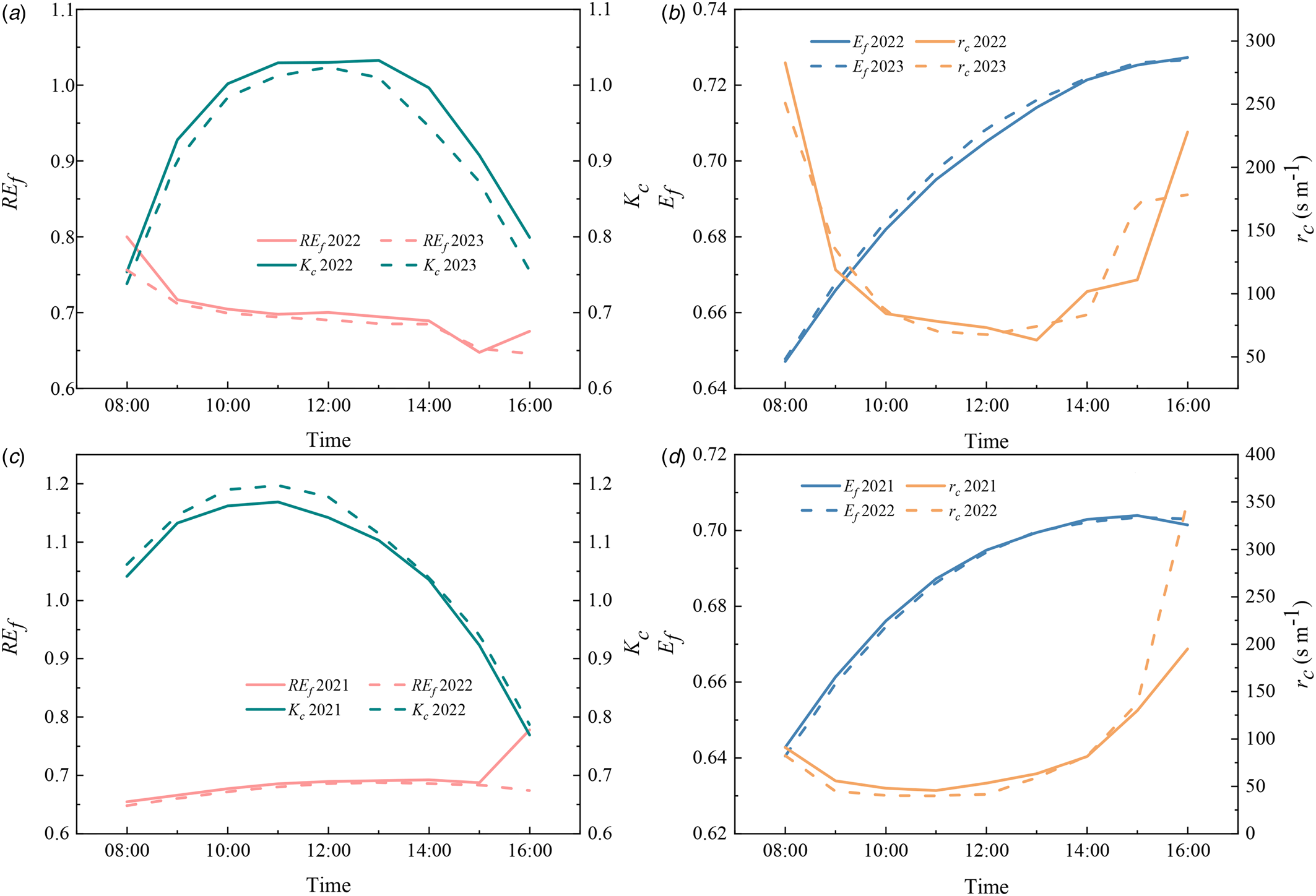
The parameter Kc exhibited a typical down-concave shape throughout the day, with relatively sharp variations in the early morning and late afternoon, and reached a maximum near midday. The turbulent exchange was intense, especially after sunrise and before sunset. The latent heat flux varied greatly, and the susceptibility of wind speed was obvious. The ET capacity and ET intensity of the subsurface were affected, so that Kc fluctuated greatly. However, the calculation of the Ef ignored these effects and assumed that the impedance was constant, and thus the fluctuation was small. The trend of Kc in this study was consistent with previous studies (Liu et al., Reference Liu, Hafeez, Liu, Xu and Vote2012a; Yan et al., Reference Yan, Li, Zhang, Zhang, Wang, Yu, Ma and Zhao2022b). However, the magnitude of Kc was usually higher than Ef, which was related to soil moisture stress and vegetation cover (Zhang et al., Reference Zhang, Chen, Xu and Li2017).
The trend of rc exhibited a dramatically declining tendency in the early morning and late afternoon, while maintaining steady for the majority of the day, with a mean of 125 s/m in the NW, and 91 s/m in the NE. The rapid increase in rc was partly due to the high atmospheric stability in the late afternoon, which reduced the soil water content and the overall resistance to evapotranspiration in the maize field. On the other hand, because the Rn decreased rapidly in the afternoon, but the decrease of G lagged behind that of Rn, so the calculated effective energy was smaller than that of the actual effective energy, and the inverse calculation of rc using the P-M formula was on the large side, and the estimated λETd was on the small side. The daily variations of Ef and Kc were mainly affected by stomatal regulation and the diurnal pattern of Ta, VPD and relative humidity, which has strong effects on stomatal resistance (Yang et al., Reference Yang, Chen and Lei2013; Liu et al., Reference Liu, Xu, Zhou, Wang and Yang2020).
Performance of the four upscaling methods
Based on λETd estimated by the BREB method, the efficacy of four upscaling methods (Eva-f, R-Eva-f, Kc-ET 0 and Direct-r c methods) for estimating λETd of NW and NE maize based on λETi for the time period 08:00–16:00 was verified. The λETi between 08:00 and 16:00 was chosen because it coincided with the time when the majority of satellites emerge over the study area and the upscaling factors are relatively stable.
The correlations between the estimated and measured λETd at different hourly periods (08:00–16:00) for the four methods are shown in Figs 4 and 5. The slopes (α) of the fits of the four scaling methods at the two stations showed different degrees of intraday decreasing or increasing, which indicated that the four scaling methods had great variability in the calculation results for estimating λETd using λETi at different moments. The slopes of the measured and estimated λETd by Eva-f and R-Eva-f methods for both climatic zones were the closest to 1 during the 10:00–14:00 time period, were the smallest during the 08:00–10:00 time period, were the largest during the 14:00–16:00 time period, and then increased, but the slopes did not vary much from one time period to the next. The slopes of the Kc-ET 0 and Direct-r c methods varied drastically, with different trends in magnitude. In 2022, the slopes in NW region increased and then decreased from 08:00 to 16:00, and were the closest to 1 for the time period 09:00–11:00 and 13:00–15:00, respectively. In 2023, the slopes in NW region increased from 08:00 to 16:00, and were the closest to 1 for the time period 09:00–11:00 and 13:00–15:00, respectively. The slopes in NW region showed an increase and then a gradual stabilization and then a decrease from 08:00 to 16:00, and was the closest to 1 in the 09:00–15:00 time period with similar variations in 2021 and 2022, and both showed gradual decrease, and a rapid decrease after 13:00 which upscales the estimated λETd larger than the measured value. The coefficients of determination (R 2) of the estimation results of the four methods were mostly located near 1, indicating a strong correlation between the measured and estimated λETd. The simulation results of the four methods were the closest to each other during the 10:00–14:00 time period. In terms of the fitted R 2, all four methods showed high in midday and low in morning and afternoon. Previous studies found a minor divergence between measured λETd and the estimations based on midday λETi (Hoedjes et al., Reference Hoedjes, Chehbouni, Jacob, Ezzahar and Boulet2008; Zhang et al., Reference Zhang, Chen, Xu and Li2017; Jiang et al., Reference Jiang, Zhang, Han, Chen and Wei2021).
Slopes (α) obtained by comparing the simulated daily evapotranspiration (λETd) of the four upscaling methods with the measured λETd based on the Bowen ratio energy balance system (BREB) method. (a), (b) For northwestern China and (c), (d) for northeastern China.

Coefficients of determination (R 2) obtained by comparing the simulated daily evapotranspiration (λETd) of the four upscaling methods with the measured λETd based on the Bowen ratio energy balance system (BREB) method. (a), (b) For northwestern China and (c), (d) for northeastern China.

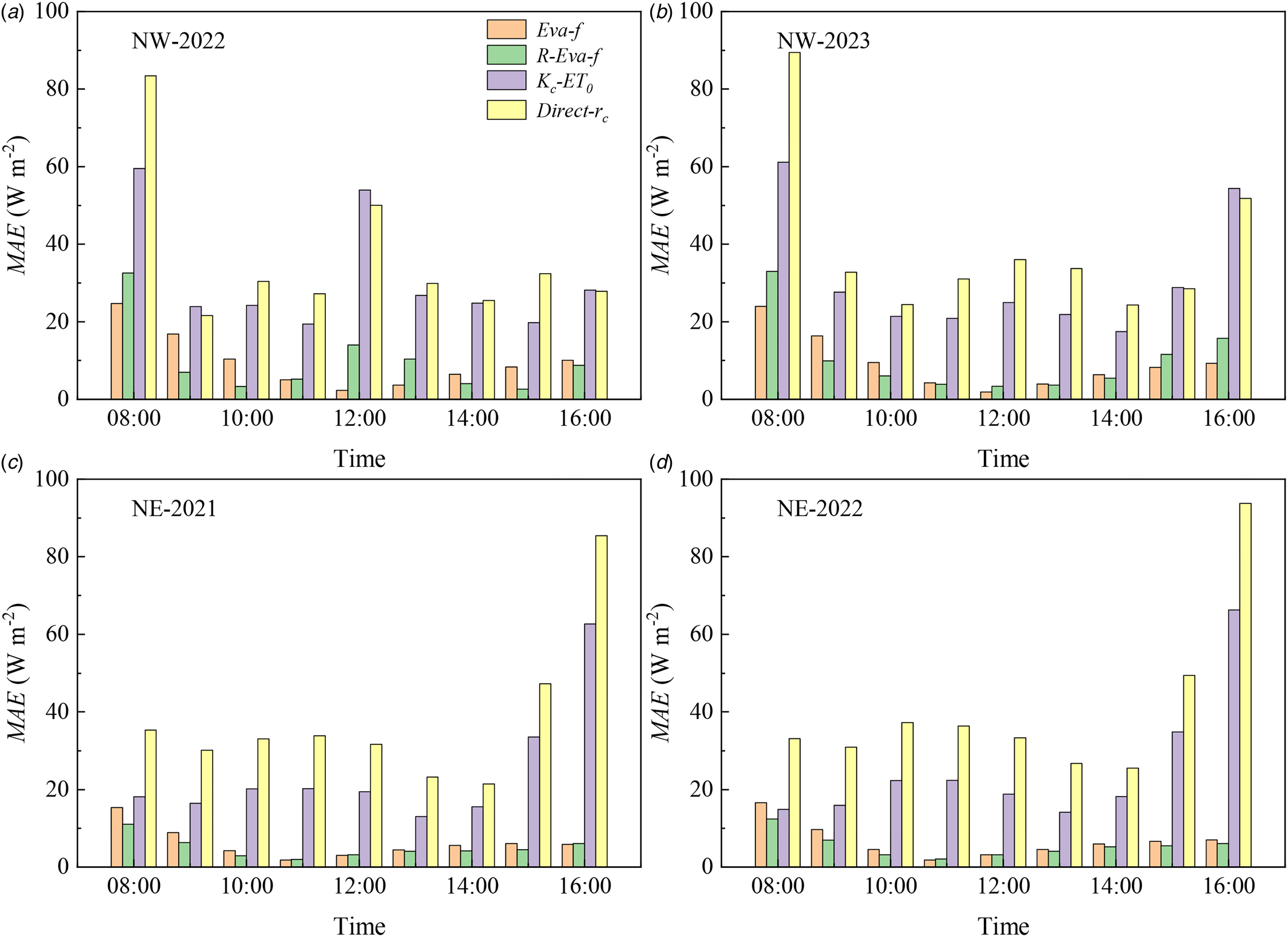
The mean absolute error (MAE) and relative root mean squared error (RRMSE) of the estimated λETd calculated by four methods varied greatly as shown in Figs 6 and 7. The results of the MAE and RRMSE exhibited similar performance, with the Eva-f and R-Eva-f methods having the smallest MAE and RRMSE during the study periods. The Kc-ET 0 and Direct-r c methods performed unstable, with a slightly higher MAE and RRMSE than the Eva-f and R-Eva-f methods. For the Kc-ET 0 method, the MAE and RRMSE showed different performance for NW and NE, which the minimum values appeared when the λETi was used at 14:00 and 13:00 for NW and NE, respectively. The results of MAE and RRMSE illustrated that the Direct-rc method exhibited similar performance in NW and NE. The trend of MAE and RRMSE showed upward concave shape, which confirmed the underperformance for most time in NW and NE. During the day, the MAE and RRMSE of the Eva-f and R-Eva-f methods were generally consistent, with average values of less than 10.1 W/m2 and 0.03. When using the λETi from 9:00 to 15:00, the Kc-ET 0 and Direct-rc methods had an average MAE of 27.3 W/m2, which was considered satisfactory accuracy.
Mean absolute error (MAE) obtained by comparing the simulated daily evapotranspiration (λETd) of the four upscaling methods with the measured λETd based on the Bowen ratio energy balance system (BREB) method. (a), (b) For northwestern China and (c), (d) for northeastern China.
Relative root mean absolute error (RRMSE) obtained by comparing the simulated daily evapotranspiration (λETd) of the four upscaling methods with the measured λETd based on the Bowen ratio energy balance system (BREB) method. (a), (b) For northwestern China and (c), (d) for northeastern China.

Moreover, diurnal variation of the efficiency coefficient (ɛ) of four methods was displayed in Fig. 8. The hourly variations of ɛ for the Eva-f and R-Eva-f methods changed slightly and the values were more stable for NE than for NW. For the Kc-ET 0 and Direct-rc methods, the trend of ɛ curves showed clear similarities. For the NW station, the ɛ values of the Kc-ET 0 and Direct-rc methods were lower when the λETi in the morning was used, and remain around 0.6 for the rest of the day, but decreased obviously for the time period 10:00–14:00. For the NE station, the trend of ɛ curves sharply concaved down and attached the peak when the λETi at 14:00 was used. Overall, the Eva-f method performed best and followed by the R-Eva-f method, with mean ɛ values less than 0.85 at all times; while the Kc-ET 0 and Direct-rc methods performed worst in most cases. The mean ɛ values of the Kc-ET 0 and Direct-rc method were only 0.55 and 0.46 for NW and 0.73 and 0.57 for NE, respectively.
Coefficient of efficiency (ɛ) obtained by comparing the simulated daily evapotranspiration (λETd) of the four upscaling methods with the measured λETd based on the Bowen ratio energy balance system (BREB) method. (a), (b) For northwestern China and (c), (d) for northeastern China.

From the above evaluation, it can be seen that not only the optimal upscaling methods based on the four accuracy evaluation indexes differed at different fertility stages, but also the optimal upscaling moments were not exactly the same, and thus the global performance indicators (GPI) was introduced to comprehensively evaluate the optimal upscaling times of the four models. Based on the four upscaling methods, the GPI of the calculated λETd and measured values for different time intervals at the NW and NE stations were shown in Fig. 9. The larger the GPI value, the better the simulation performance. The four upscaling methods showed the ability to accurately simulate daily λETd from 10:00 to 14:00, and the Eva-f and Kc-ET 0 methods were superior to the Kc-ET 0 and Direct-rc methods. However, the GPI of the four methods decreased obviously when the λETi in the morning and afternoon was used. Overall, the Eva-f method performed best at 12:00 for the NW station, with the mean GPI of 0.55 for two years. At the NE station, the R-Eva-f method performed best at 14:00, with the mean GPI of 1.04 for two years.
Global performance indicators (GPI) of four upscaling methods at different times. (a), (b) For northwestern China and (c), (d) for northeastern China.

Discussion
The key parameters for upscaling methods (Eva-f, R-Eva-f, Kc-ET 0 and Direct-rc method) showed different characteristics of variation and temporal representativeness. The results of this study showed that the Ef and REf in the process of estimating λETi to λETd changed slightly through the day, which is similar to the results of Zhang et al. (Reference Zhang, Chen, Xu and Li2017) on maize in north China. However, Yan et al. (Reference Yan, Li, Zhang, Zhang, Wang, Yu, Ma and Zhao2022b) showed that the Ef and REf showed an arch shape for a tea and wheat field during the day in southeast China. This difference may be due to the difference in meteorological factors, leaf area index and crop physiological mechanisms. It may also be due to the fact that solar radiation was lower in the morning and afternoon, resulting in less available energy flux to drive ET. Thus, the results in the calculated Ef and REf were unstable in these time periods. The Kc displayed a somewhat concave-down shape through the day, with comparatively sharp variations in the early morning and late afternoon. The Kc was not only related to the crop type, but also closely related to the climatic conditions, volumetric soil water content, crop cultivation conditions, irrigation and drainage management in the study areas. It is difficult to use the same set of Kc variation rules to reflect the λETd, so it is necessary to determine the Kc based on the actual conditions of the study areas to accurately estimate the λETd (Bezerra et al., Reference Bezerra, da Silva, Bezerra, Sofiatti and dos Santos2012). The trend of rc showed a typical concave-up shape through the day. Due to the problem of condensate re-evaporation after sunrise, the rc values back-calculated with the P-M formula were too small or even less than 0,which was similar to the results of the previous study (Perez et al., Reference Perez, Lecina, Castellvi, Martínez-Cob and Villalobos2005). The rc values appeared to be constant with a slight increase in shape for the time period 12:00–14:00, which was attributed to an increase in rc due to partial stomatal closure at midday when the light was stronger (Allen et al., Reference Allen, Pruitt, Wright, Howell, Ventura, Snyder, Itenfisu, Steduto, Berengena, Yrisarry, Smith, Pereira, Raes, Perrier, Alves, Walter and Elliott2006). The change of rc were influenced by field climate, such as Rn, VPD, etc. (Liu et al., Reference Liu, Xu, Zhou, Wang and Yang2020). The trend of rc showed to sharply increase in the late afternoon. Specifically, on the one hand, crop stomatal conductance decreased with decrease in radiation intensity, so rc increased rapidly near noon. In most cases, all four upscaling methods showed some degree of underestimation, with better performance during the middle of the day than in the morning and afternoon, which agreed with other research results (Tang and Li, Reference Tang and Li2017; Zhang et al., Reference Zhang, Chen, Xu and Li2017). The presence of clouds and energy conditions may be a potential reason for the underestimation of λETd, (Delogu et al., Reference Delogu, Boulet, Olioso, Coudert, Chirouze, Ceschia, Le Dantec, Marloie, Chehbouni and Lagouarde2012; Tang et al., Reference Tang, Li, Sun and Bi2017; Jiang et al., Reference Jiang, Tang, Jiang and Li2018).
In this study, we found that the Eva-f method performed best for the time period 11:00–2:00 in both NW and NE stations. The R-Eva-f method performed best for the time period 10:00–11:00 for the NW station and for the time period 10:00–12:00 for the NE station. Yan et al. (Reference Yan, Li, Zhang, Zhang, Wang, Yu, Ma and Zhao2022b) and Liu (Reference Liu2021) concluded that the optimal upscaling time period of the Eva-f and R-Eva-f methods was from 09:00 to 15:00, particularly for instantaneous values between 11:00 and 14:00. In addition, Zhang et al. (Reference Zhang, Chen, Xu and Li2017) showed that the optimal upscaling moment of the Eva-f method was 14:00–15:00 on maize. The reason for this difference was mainly due to the difference in the geographical location of the study regions. The difference in sunrise and sunset times in different geographical locations led to the slight difference in optimal upscaling moment of the study regions. Liu et al. (Reference Liu, Liu and Xu2011) found that the Kc remained mostly constant during the reproductive period of wheat. The values in the morning (10:00–11:00) and afternoon (14:00–15:00) were the most similar to the daily average values, which were less than 1. Chávez et al. (Reference Chávez, Neale, Prueger and Kustas2008) and Katimbo et al. (Reference Katimbo, Rudnick, Liang, DeJonge, Lo, Franz, Ge, Qiao, Kabenge and Nakabuye2022) found that the accuracy of estimating λETd using the Kc-ET 0 method was not as good as the Eva-f method, but the accuracy of the estimation could be improved by using the Kc values during the midday. There was a clear intraday variation characteristic of Kc in this study. At the NW station, the fluctuation of Kc was smaller from 10:00 to 14:00. The fluctuation of Kc was smaller from 10:00 to 12:00 for the NE station. Thus, it was seen that the study of the optimal upscaling timing in different regions was an important prerequisite for the improvement of the estimation accuracy of λETd by the Kc-ET 0 method. From the analysis of rc, it was concluded that the rc values for the time period 10:00–11:00 instead of daily average value were more effective in estimating λETd for the NW station. At the NE station, the rc for the time period 13:00–14:00 instead of daily value were more effective in estimating λETd. This period coincided with the time of remote sensing satellite transit, and the time period (9:00–11:00) is the process of atmospheric stability changing from stable to unstable, which is in line with the condition of atmospheric neutral stability assumed by aerodynamic drag.
Taken together, both the Eva-f and R-Eva-f methods achieved good results in modelling λETd from λETi at most of the time. However, the R-Eva-f method was slightly inferior to the Eva-f method for two different climatic regions, and similar conclusions were obtained by Yan et al. (Reference Yan, Li, Zhang, Zhang, Wang, Yu, Ma and Zhao2022b) for tea and wheat in southeast China. Liu (Reference Liu2021) reported the Eva-f method, which uses potential evapotranspiration and incoming shortwave radiation, outperformed the other methods for simulating daily series. Chen et al. (Reference Chen, Yang and Lü2013) and Jiang et al. (Reference Jiang, Zhang, Han, Chen and Wei2021) concluded that the R-Eva-f method performed best for most ecosystems. This discrepancy was mainly due to errors in the observation of G, where the soil heat flux sensors were buried in the soil surface and were affected by changes in wind speed, soil properties and soil moisture. However, Cammalleri et al. (Reference Cammalleri, Anderson and Kustas2014) pointed out that if the daily fluxes were for 24 h instead of just the daytime, the influence of G might not be as significant. Yang et al. (Reference Yang, Chen and Lei2013) showed that the diurnal pattern of Kc was strongly dependent on the leaf area index (LAI) and the Kc-ET 0 method may perform poorly at higher LAI, whereas Zhang et al. (Reference Zhang, Chen, Xu and Li2017) reported the performance of the Kc-ET 0 methods was good under various LAI. The Direct-rc method showed poor estimation results in most intervals, which suggested the Direct-rc method in extrapolating λETi into λETd may not be valid in this study and is no longer robust and universally applicable.
Conclusion
In this study, we evaluated four upscaling methods (Eva-f, R-Eva-f, Kc-ET 0 and Direct-rc methods) performance in estimating λETd from λETi, using the measurements of λETd by Bowen ratio energy balance system in two different climatic regions of Northwest and Northeast China based on the measured data from 2021 to 2023, and the following conclusions were drawn:
-
(1) The key parameters Ef, REf, Kc and rc of λETi to λETd upscaling had obvious daily variation characteristics, and the overall trends were consistent in the two regions, with Ef and REf behaving more closely than Kc and rc.
-
(2) The Eva-f and R-Eva-f methods were better than the other two methods (Kc-ET 0 and Direct-r c methods) in all evaluation indexes, but the R-Eva-f method was slightly inferior to the Eva-f method due to the neglect of soil heat flux (G). Both the Eva-f and R-Eva-f methods were more suitable for the Northwest and Northeast regions.
-
(3) The time for λETi had a significant effect on estimating λETd by upscaling methods. Specifically, at the NW station, the Eva-f method gave the best scaling when λETi at 12:00 was used, while at the NE station, the λETd simulation had the highest accuracy using the R-Eva-f method when the λETi at 11:00 was used.
-
(4) Therefore, it is recommended that the Eva-f method is the preferred method for upscaling evapotranspiration in the Northwest region, with the moment of 12:00 being the optimal upscaling time. The R-Eva-f method is the best upscaling method for the Northeast region, with 11:00 being the optimal upscaling time.
Author contributions
Xuanxuan Wang, Biyu Wang, Haofang Yan, Chuan Zhang, Hexiang Zheng, Guoqing Wang, Jianyun Zhang and Bin He conceived and designed the study. Rongxuan Bao, Run Xue, Yudong Zhou, Jun Li, Rui Zhou, Beibei Hao and Yujing Han conducted data gathering. Xuanxuan Wang, Biyu Wang performed statistical analyses. Xuanxuan Wang, Biyu Wang and Haofang Yan wrote the article.
Funding statement
This study was financially supported by the National Key R&D Program (2021YFC3201103, 2023YFC3205701), the Natural Science Foundation of China (52121006, U2243228, 1509107, 42177065).
Competing interests
The authors declare that there is no conflict of interest, nor is there any commercial or competing interest, which is defined as a conflict of interest in connection with the work submitted.
Ethical standards
Not applicable.



