Introduction
Several authors illustrate the relationship between the human resources (HRs) policies adopted by firms and the impact on the different results obtained with these policies, attempting to evaluate how human resource management (HRM) adds value for the company (Arthur, Reference Arthur1994; Huselid, Reference Huselid1995; Delaney & Huselid, Reference Delaney and Huselid1996; Koch & McGrath, Reference Koch and McGrath1996; Ichinowski, Shaw, & Prennushi, Reference Ichinowski, Shaw and Prennushi1997; Wood & De Menezes, Reference Wood and De Menezes1998; Hoque, Reference Hoque1999; Ichinowski & Shaw, Reference Ichinowski and Shaw1999; Bae & Lawler, Reference Bae and Lawler2000; Birdi et al., Reference Birdi, Clegg, Patterson, Robinson, Stride, Wall and Wood2008; Takeuchi, Chen, & Lepak, Reference Takeuchi, Chen and Lepak2009).
In this context, a recent, growing but still limited body of literature has been focussed on effective HRM implementation (Rasmussen, Andersen, & Haworth, Reference Rasmussen, Andersen and Haworth2010; Guest, Reference Guest2011; Bos-Nehles, Van Riemsdijk, & Looise, Reference Bos-Nehles, Van Riemsdijk and Looise2013; Sikora & Ferris, Reference Sikora and Ferris2014; Lo, Macky, & Pio, Reference Lo, Macky and Pio2015), especially considering that implementation is a process that is not limited to HR departments and it is not only executed by HR managers, as other internal agents, such as line managers (LMs), are also involved (Valverde, Ryan, & Soler, Reference Valverde, Ryan and Soler2006; Ozcelik & Uyargil, Reference Ozcelik and Uyargil2015). LMs, who traditionally have held only operational responsibility of managing people, have emerged as an important participant in managing HR, and their role in HRM has continued to increase over time (Storey, Reference Storey1992; Papalexandris & Panayotopoulou, Reference Papalexandris and Panayotopoulou2003; Alfes, Truss, Soane, Rees, & Gatenby, Reference Alfes, Truss, Soane, Rees and Gatenby2013; Azmi & Mushtaq, Reference Azmi and Mushtaq2015; Brewster, Brookes, & Gollan, Reference Brewster, Brookes and Gollan2015). Therefore, LM commitment can be considered to be a crucial factor in understanding the relationship between HRM and performance, as they bring HR practices to life (Gilbert, DeWinne, & Sels, Reference Gilbert, DeWinne and Sels2015). In doing so, LMs influence employees’ perceptions of the HRM system in place, as well as their attitudes, behaviour and performance (Purcell & Kinnie, 2006). Not in vain, Becker, Huselid, Pickus, and Spratt (Reference Becker, Huselid, Pickus and Spratt1997), Becker and Huselid (Reference Becker and Huselid1998), Ferris, Arthur, Berkson, Kaplan, Harrell-Cook, and Frink (Reference Ferris, Arthur, Berkson, Kaplan, Harrell-Cook and Frink1998) and Ostroff and Bowen (Reference Ostroff and Bowen2000) noted that employee attitudes, behaviours and skills are variables that help explain the influence exerted by the HRM system on the firm’s performance.
Despite the relevant role in those practices that is ultimately played by the firm’s LMs, LM vary in the extent to which they consistently implement the practices (Van Iddekinge, Ferris, Perrewé, Perryman, Blass, & Heetderks, Reference Van Iddekinge, Ferris, Perrewé, Perryman, Blass and Heetderks2009; Sikora & Ferris, Reference Sikora and Ferris2014). From this point of view, the effectiveness of LMs’ HRM implementation is of crucial importance to employees and organizations (Gilbert, DeWinne, & Sels, Reference Gilbert, DeWinne and Sels2015), and additional research is required to test the actual relationships between their perceptions and company performance.
Considering this situation, this paper delves into the role of LMs in the HRM by understanding the perceptions they have about the strategic function of HR as a requirement to be truly and effectively involved in the strategic implementation of HR practices. If the LMs do not perceive the relevance and strategic importance of HR and its key role in company strategy and performance, it is difficult to guarantee their commitment and effectiveness in HRM implementation. Following Currie and Procter (Reference Currie and Procter2001), the LMs we want to concentrate in this article are middle managers: those between the highest and lowest levels who, in the words of Floyd and Wooldridge, ‘mediate, negotiate and interpret connections between the organisation’ s institutional (strategic) and technical (operational) levels’ (Reference Floyd and Wooldridge1997: 446).
This study answers the following research question: what is the LMs’ perception of the strategic importance of HR for the business performance? Our contribution is primarily twofold: first, we further contribute to the strategic human resource management (SHRM) literature on devolvement to the line by examining LM perceptions and comparing it with HR manager perceptions; second, this paper has implications for practice, specifically on the role of front-LMs in implementing HR policies, studying their appreciation on the importance of these tasks. With our study, we build knowledge on both issues, strategy and implementation, which is essential for academics to understand the performance link and for practitioners to create the necessary conditions under which LMs can succeed as HR partners.
The present study is comprised of four main sections. After the introduction, the theoretical background and hypotheses briefly reviews the strategic role of HR in the companies’ management and studies the role of LMs in HRM and the factors influencing their perception on HR’s strategic role. The data sample and analysis section presents the empirical analysis of LM and HR managers’ perceptions. Finally, the discussion contains the conclusions of the paper and the managerial implications for HRM and the company’s strategy, as well as its limitations and future avenues of research.
Theoretical background and hypotheses
Strategic role of HR
HR executives increasingly have become concerned with being able to demonstrate the HR function’s value to the firm (Ulrich, Reference Ulrich1997; Ulrich & Brockbank, Reference Ulrich and Brockbank2005, Ulrich & Dulebohn, Reference Ulrich and Dulebohn2015; Kim, Ryu, Kim, & Lepak, Reference Kim, Ryu, Kim and Lepak2017), including a role as strategic partner of the other company actors (Ulrich, Younger, Brockbank, & Ulrich, Reference Ulrich, Younger, Brockbank and Ulrich2012), supporting top managers in formulating and implementing corporate and business strategies (Martell & Carroll, Reference Martell and Carroll1995; Ulrich, Reference Ulrich1997), as key in change-oriented roles (Ulrich and Brockbank, Reference Ulrich and Brockbank2005), generating business impact (recently Boselie & Paauwe, Reference Boselie and Paauwe2004; Nikandrou & Papalexandris, Reference Nikandrou and Papalexandris2007; Kim et al., Reference Kim, Ryu, Kim and Lepak2017, among others), and providing the firm with an idiosyncratic source of competitive advantage (Barney, Reference Barney1991; Heneman, Ledford, & Gresham, Reference Heneman, Ledford and Gresham2000).
The resource-based view of the firm provided a core theoretical rationale for HR’s potential role as a strategic asset in the firm (Wright & McMahan, Reference Wright and McMahan2011). The SHRM literature has placed special focus on the link between HRM and organizational performance (e.g., Huselid, Reference Huselid1995; Becker & Gerhart, Reference Becker and Gerhart1996; Sun, Aryee, & Law, Reference Sun, Aryee and Law2007; Gollan, Kalfa, & Xu, Reference Gollan, Kalfa and Xu2015). Wright, McMahan, McCormick, and Sherman (Reference Wright, McMahan, McCormick and Sherman1998) suggest that the involvement of HR functions in strategy formulation positively influences firm performance, particularly when a firm’s core business requires human capital as a strategic asset (Kim & Sung-Choon, Reference Kim and Sung-Choon2013). Most of the existing research has utilized large-scale surveys with senior HR managers to examine their perceptions of how HR contributes to organizational performance (Nishii, Lepak, & Schneider, Reference Nishii, Lepak and Schneider2008). Gilbert, DeWinne, and Sels (Reference Gilbert, DeWinne and Sels2015) suggest that SHRM emerges from this larger process in which strategy formulation involves top managers making decisions that affect HR-related goals, practices and policies.
Naznin and Hussain (Reference Naznin and Hussain2016) considers that HR needs to reinvent its strategic function. This reorientation means a transition’ from a strategic server of the business to a proactive and trusted adviser inherently related to the workforce planning of the organization. The challenge of this task is to convince line executives that HR is providing a value-added contribution to the firm in order to gain equal footing with other functional areas in the decision-making process (Wright, McMahan, Snell, & Gerhart, Reference Wright, McMahan, Snell and Gerhart2001). As such, prior researchers, such as Gollan, Kalfa, and Xu (Reference Gollan, Kalfa and Xu2015), indicate that devolving some of the HR responsibilities to LMs would enable faster decision-making that is in line with business reality (Perry & Kulik, Reference Perry and Kulik2008). MacNeil (Reference MacNeil2001) argues that LM could influence both strategic and operational priorities because they occupy a unique position between and the operating core of organizations and their strategic apex. The LM perception on the strategic role of HR is therefore key.
Finally, LMs’ involvement in HRM helps the HR managers take on strategic roles in their organizations (Finegold & Frenkel, Reference Finegold and Frenkel2006; Azmi & Mushtaq, Reference Azmi and Mushtaq2015). When LM assume most of the routine activities associated with people management (e.g., training, recruitment and selection, performance appraisal), HR specialists are free to spend more time orchestrating large-scale organizational change efforts, gaining visibility within the organization and being viewed as making a clear value-added contribution for the organization as a whole (Kulik & Perry, Reference Kulik and Perry2008). The transference of HR responsibilities to the LM therefore has relevant implications for SHRM.
LMs’ involvement and perception
Different previous theoretical studies have developed models of HR implementation effectiveness and a set of propositions for testing in the field. The social context theory (Ferris et al., Reference Ferris, Arthur, Berkson, Kaplan, Harrell-Cook and Frink1998) considers the attitudes, beliefs, values and political issues that shape organizational culture and climate also drive the development of HR policies and practices. The Ability–Motivation–Opportunity framework (Appelbaum, Bailey, Berg, & Kallenberg, Reference Appelbaum, Bailey, Berg and Kallenberg2000) is assembled from basic concepts of psychology: motivation has been perceived as the incentive towards a behaviour; ability as skills and capabilities essential to the performance of a behaviour; and opportunity as contextual and situational constraints relevant to the performance of the behaviour. Both models are widely spread and applied in recent studies (Bos-Nehles, Van Riemsdijk, & Looise, Reference Bos-Nehles, Van Riemsdijk and Looise2013; Sikora & Ferris, Reference Sikora and Ferris2014) seeking to explain LMs’ involvement in HRM implementation for analysing LMs’ HRM effectiveness and in performance studies (Paauwe, Reference Paauwe2009).
As already indicated, a large amount of research studies in the area suggest that the involvement of these LMs in HRM is critical to the effectiveness of HR (Purcell & Hutchinson, Reference Purcell and Hutchinson2007). In increasing numbers of organizations today, LMs develop activities which were traditionally performed by HR specialists (Storey, Reference Storey1992) and partnerships between HRM and LM are gaining acceptance in business organizations (Green, Wu, Whitten, & Medlin, Reference Green, Wu, Whitten and Medlin2006). Brewster, Brookes, and Gollan (Reference Brewster, Brookes and Gollan2015) estimate that half of the organizations assign HRM responsibilities to the line and that organizations appear to have considerable latitude in making choices in this area.
Several researchers highlight the LMs’ willingness to collaborate: Renwick (2003) notes that significant numbers of LMs want to get involved in sharing HR responsibilities with HR specialists and that they take these responsibilities in a quality manner, showing service-oriented attitudes (Beatson, Lings, & Gudergan, Reference Beatson, Lings and Gudergan2008). Conversely, a number of scholars stress the difficulties and the complexity of the relationship between HR department and the LMs. Many LMs lack people management skills (Naznin & Hussain, Reference Naznin and Hussain2016) and often complain of the burden of workloads, and many of them are unwilling to consider these devolved people management tasks as a part of their job role (Reilly & Williams, Reference Reilly and Williams2006). LMs could be neither capable nor motivated to develop these activities (Hailey, Farndale, & Truss, Reference Hailey, Farndale and Truss2005) or simply reluctant (Hall & Torrington, Reference Hall and Torrington1998), as organizational commitment is variable that has a strong affective or emotional component (Morrison, Reference Morrison2008).
Sikora and Ferris (Reference Sikora and Ferris2014) argue that LMs may resist, fail to cooperate or simply ignore their HR responsibilities for various reasons, such as lack of trust between the parties and/or high work load levels. This lack of compliance can lead to lower employee involvement and undesirable employee attitudes and behaviours. In fact, Alfes et al. (Reference Alfes, Truss, Soane, Rees and Gatenby2013) demonstrate that perceived LM behaviour and perceived HRM practices are linked with employee engagement, and Ozcelik and Uyargil (Reference Ozcelik and Uyargil2015) argued that the weaker the LM involvement is, the lower the organizational performance levels will be.
Accordingly, Wright et al. (Reference Wright, McMahan, Snell and Gerhart2001) contend that no matter how effective the HR practices are in theory, if LMs are not proactively involved in implementing them, top performance levels cannot be attained by the firm. In other words, implementation of effective HR practices is fundamental to employee management success and improved firm performance (Huselid, Reference Huselid1995; Becker & Gerhart, Reference Becker and Gerhart1996; Wright, Gardner, Moynihan, & Allen, Reference Wright, Gardner, Moynihan and Allen2005).
Purcell and Hutchinson (Reference Purcell and Hutchinson2007) insist on the fact that success of HR activities’ implementation relies mostly on motivation and commitment of the LMs. In any case, their perceptions pertain to their being willing to accept the HR roles and being rewarded for their effective behaviours.
Despite there being some studies analysing managers and employees’ perceptions of HR practices (Jiang, Hu, Liu, & Lepak, Reference Jiang, Hu, Liu and Lepak2017), there are no studies devoted to the evaluation and influence of the LM perception of the strategic role of HR and its link with LM involvement in HRM implementation, which is why a specific study such as this one is of special interest.
Given the theoretical rationale and the limited empirical evidence, we formulate the following hypothesis:
Hypothesis 1: LMs’ perceptions of the HR strategic role will be positively related to HR managers’ perceptions of the HR strategic role.
Kim et al. (Reference Kim, Ryu, Kim and Lepak2017) note that firm size and human capital of HR departments appear to have a positive impact on the strategic involvement of HR departments. The results of firm size can be interpreted such that top management teams in smaller firms are likely to be aware of their employee’s traits, whereas those in larger firms are less likely to have this awareness. Thus, in accordance with these authors, it may be plausible that larger firms need their HR department to be more involved in strategic decisions.
Additionally, as emphasized in the strategic management and industrial organization literatures (e.g., Porter, Reference Porter1980; Dess, Ireland, & Hitt, Reference Dess, Ireland and Hitt1990), a firm’s industry is an important part of the milieu within which organizational policies and practices are framed and executed. We believe this should also be the case for HRM policies and practices, following Wright and Snell (1998) who highlight the importance of industry as a critical contextual variable for HRM. Datta, Guthrie, and Wright (Reference Datta, Guthrie and Wright2003) observe that that industry conditions’ role in defining the value-adding potential of HR practices has remained practically unexplored, and support the argument that industry conditions influence the impact of HR systems and human capital. Additionally, as DiMaggio and Powell (1983) noted, institutional isomorphism may promote similar strategic choices among organizations in the same industry. Based on the above arguments, we test also the following hypothesis:
Hypothesis 2: LM and HR managers’ perceptions of the HR strategic role will be related to company characteristics (size, industry).
Marler and Parry (Reference Marler and Parry2016) note that less attention is paid to another strand of the SHRM research, which describes and analyses the involvement of the HR function in the strategic management process. This conception of SHRM draws on Ulrich’s early model of strategic HRM, which posits that the way for the HR function to become more involved in the strategic process is to become a truly strategic business partner (Wood & Albanese, Reference Wood and Albanese1995; Ulrich, Reference Ulrich1997; Roche, Reference Roche1999; Marler, Reference Marler2009). Scullion and Starkey (Reference Scullion and Starkey2000), and Barney and Wrigth (Reference Barney and Wrigth1998) go further by stating that the way that employees are handled may be critical not only in terms of business success but also as a strategic source of sustainable competitive advantages. Despite research by MacKay and Torrington (1986) and Hall and Torrington (Reference Hall and Torrington1998) noted a rise in the presence of HR directors on boards of directors, there is a view in the literature that as the HR function has a still low presence on the boards, it has little influence in the formulation of the organization’s strategy (Kelly & Gennard, Reference Kelly and Gennard2007). These authors consider that a presence on the main board of directors is not necessary for an individual and/or management function to exercise influence on the formulation of business strategy. Caldwell (Reference Caldwell2011) argues that HR boardroom representation matters in terms of HR director’s perceptions of their role and strategic influence: as such it appears to carry enormous ‘symbolic capital’ in affirming the perceived status and legitimacy of the profession and its contribution to business performance; but no literature has been found about the perceptions that this causes in employees, and in particular LM and HR managers.
Given the theoretical rationale and the indicated empirical evidence, we formulate the following hypothesis:
Hypothesis 3: LM and HR managers’ perceptions of HR strategic role will be related to the presence of an HR representative in the company’s board of directors.
Data sample and analysis
To perform our analysis, we have selected a subset of a generic survey of strategy and management developed by our University to 100 Spanish companies of different sizes and sectors.
The research team agreed a stratified sampling frame, which provided a reasonable representation of organizations by size, sector and annual turnover. Using local databases, contact was made by the research team with the HRD manager or equivalent. We followed this procedure until we reached our proposed target of 100 organizations with matched pair data (separate interviews with the HRD manager and one LM. The interview schedule was based on that used in earlier studies of management development (Thomson, Mabey, Storey, Gray, & Lies, Reference Thomson, Mabey, Storey, Gray and Lies2001; Mabey and Ramirez, Reference Mabey and Ramirez2005). The interviews were arranged in advance and respondents were requested to prepare factual data like number of staff, annual turnover, and training budgets. Interviews were conducted by phone (20–30 min for HRD managers and somewhat less for LMs). The sector across the total sample is distributed among manufacturing, transport and distribution, and the services sector (including financial and insurance companies as well as legal, business and management consultancy firms).
We have selected the questions related to the HR strategic implications for this study. The questions that have been used are the following: Q1.: My organization has a clear business strategy; Q2.: HR managers play an active role in the formulation of business strategy; Q3.: The management strategy of the HR of my organization is clearly linked to the business strategy; Q4.: The HR management strategy in my organization sets the priorities for personnel management policies and practices; and Q5.: My organization has identified the set of skills required for its staff in the future.
In the elaboration of the questions, we have started to make sure that the company has a business strategy and recognizes it. From that starting point, we have considered what is the role and involvement that HR has in the strategy definition, and asked about the alignment of HR and its management practices with this business strategy. For each of the questions the answers obtained are on a scale of 1–5, where 1 represents ‘Totally disagree’ and 5 represents the ‘Very much agree’ option (Likert Scale).
Despite the risk of potential subjectivity in the responses, the use of a self-report measure of outcomes should not be discounted. Some authors (Mayo, Reference Mayo2000; Guest, Reference Guest2001) argued that it is the perceived view of corporate outcomes rather than more remote, financial measures, that actually influences the way managers act and the way decisions are made, especially when more objective measures of performance, such as those created by accountants for annual reports, are often socially constructed and therefore distorted (Machin & Stewart, Reference Machin and Stewart1996). In an extensive review by Wall et al. (Reference Wall, Michie, Patterson, Wood, Sheehan, Clegg and West2004) comparing the validity between objective and self-report measures of company performance found, in all the cases they examined, convergent, discriminant and construct validity between the two measures. They conclude that: ‘the degree of equivalence between the findings for subjective and objective measures means we can have some confidence in findings from studies so far that have been based on subjective company performance’ (Wall et al., Reference Wall, Michie, Patterson, Wood, Sheehan, Clegg and West2004: 111).
The statistical analysis, using Gretl y SPSS, for the empirical analysis, will be carried out in three phases: in the first phase, the responses given by LMs will be studied; in the second phase, the answers given by the HR managers will be analysed; and in the third phase, the answers given by both groups will be compared.
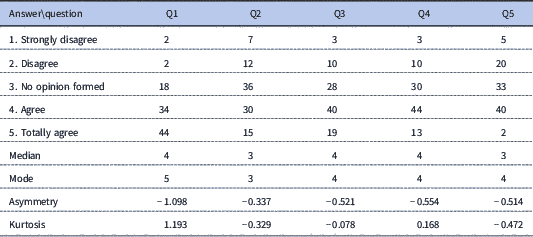
Thus, we first proceed to perform a descriptive analysis of the responses obtained from the LMs. When asking the LMs the first question (Q1), the results obtained are that 44% indicated the value 5, which is to say, very much in agreement with that affirmation, 34% answers indicated the value 4, 18% indicated the value 3, and only 2% indicated the value 2 and another 2% indicated the value 1, showing that most managers (78%) agree with such a statement.
The statistics of this first question are the median that takes the value of 4 and the mode that takes a value of 5, the coefficient of asymmetry is −1.098, which tells us that the representation is asymmetric towards the right and the coefficient of kurtosis takes the value 1.193. The frequencies and statistics for each of the questions are summarized in Table 1. As the primary result, we can observe that LM perceive the HR to be in alignment with the strategy of the organization and agree, although to a lesser extent, with the active role HR plays in the formulation of the business strategy.
Frequency of answers and statistics: line managers

Next, we perform a series of nonparametric tests. Thus, we analyse the answers offered by LMs, distinguishing whether the HRs manager occupies a position on the Board of Directors. We used the U Mann–Whitney nonparametric test, where in all cases, the results were not significant, then the null hypothesis cannot be rejected, and no differences therefore are observed in the responses obtained depending on whether the HR manager belongs to the Board of Directors. The results of the various tests are shown in Table 2.
Nonparametric test: line managers

Note. ***, **, *Indicates that the corresponding null hypothesis is rejected at the 1, 5, 10% level of significance, respectively.
Next, we analyse the answers offered by the LMs, distinguishing by the level that occupies in the direction, where we use in this case H Kruskal–Wallis nonparametric test (Kruskal & Wallis, Reference Kruskal and Wallis1952) as a nonparametric method to test whether a group of data comes from the same population. The null hypothesis assumes that the data come from the same distribution. In all questions except for Q2, the results are not significant, and the null hypothesis cannot be rejected. Therefore, no differences are observed in the responses obtained depending on the level of direction occupied.
Finally, we analyse the answers offered by LMs, distinguishing between the activity sector of the company, Manufacturing or Process, Distribution or Transport and Services. We use the H Kruskal–Wallis nonparametric test again, and in all questions except for Q3, the results are not significant, the null hypothesis cannot be rejected, and no differences are therefore observed in the responses obtained depending on the sector of activity of the company.
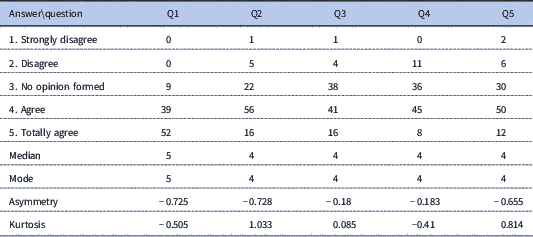
In the second phase, the analysis is replicated for the answers offered by the HRs managers. The answers offered by HR managers are shown in Table 3, which shows that in general, the scores obtained are higher than those offered by LMs, meaning that HR has a higher consideration (than the LM) of their own role in the strategy of the company. The most positive self-assessment of HR Managers versus the evaluation of LMs is sustained by psychological theories, long researched about the self-evaluation and self-evaluation maintenance. The self-evaluation maintenance theory assumes two things: that a person will try to maintain or increase their own self-evaluation, and self-evaluation is influenced by relationships with others (Tesser, Reference Tesser1988).
Frequency of answers and statistics: HR managers

Regarding the nonparametric tests performed, when analysing the answers offered by the HRs managers, distinguishing whether the HRs manager holds a position on the Board of Directors through the Mann–Whitney nonparametric test, the results obtained are all significant, except for Q5, the null hypothesis is rejected, and there are therefore differences in the answers obtained depending on whether the HR manager belongs to the Board of Directors. In this case, HR seem to consider their strategic function relevant for the participation of an HR representative in the company board. The results of the various tests are shown in Table 4.
Nonparametric tests: HR managers

Note. ***, **, *Indicates that the corresponding null hypothesis is rejected at the 1, 5, 10% level of significance, respectively.
Finally, we analyse the answers offered by the HR managers, distinguishing the Kruskal–Wallis nonparametric test for the business sector, Manufacturing or Process, Distribution or Transportation and Services, and in all questions except for Q4, the results are significant, the null hypothesis is rejected, and there are therefore differences in the responses obtained depending on the sector of activity of the company. It seems that the sector has influence in the perception of the HR managers, although this relationship is not significant in the case of the LM.
In the third phase, the perceptions of LMs and HRs managers are compared, and contingency tables are created for each pair of similar questions. By means of the χ 2 test, it can be established if the variables in study are related to each other or if they are independent.
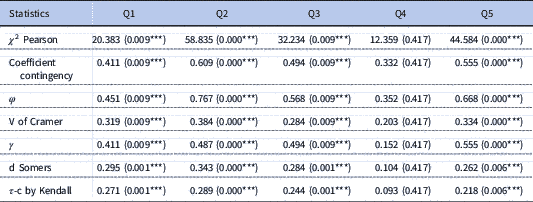
Thus, from for the contingency table created from the answers received for the first question by the LMs and the HRs, a χ 2 of 20,383 is obtained with a significance of 0.009 to 95%, implying that there is a relation between both variables.
Once we have established that there is an association, we want to calculate the association measures to evaluate the intensity of the association. For this purpose, we calculate different statistics: The contingency coefficient reaches a value of 0.411 (p-value ≤.009), which is considered as a moderately strong association between the variables; the coefficient φ reaches a value of 0.451 (p-value ≤.009); and finally, Cramer’s V coefficient, which is the most conservative of the three, reaches the value of 0.319 (p-value ≤.009).
Finally, we use other statistics to see if the relationship is positive (the values of the variables increase simultaneously) or negative (an increase in the values of one variable corresponds to a decrease of the other): Goodman’s γ Coefficient and Kruskal takes the value 0.457 (p-value ≤.001), which is reason why there is positive association; statistic ‘d’ of Somer takes the value 0.295 (p-value ≤.001), which also implies positive association, and Kendall τ-c concordance coefficient takes the value 0.271 (p-value ≤.001), which also implies a positive association.
Therefore, in the light of the results, we can conclude that for the results obtained when asking question Q1 to LMs and HRs managers, there is a relationship between the two variables with a moderately strong intensity and positive association. We then replicate the analysis for the rest of the questions under study, generating the contingency tables and the different statistics. The results obtained are shown in Table 5.
χ 2 test and intensity and association statistics

Note. ***, **, *Indicates that the corresponding null hypothesis is rejected at the 1, 5, 10% level of significance, respectively.
In view of the results obtained in Table 5, there is a relationship between the two variables with a moderately strong intensity and positive association with the exception of question number 4, which is more HR-specific.
Discussion
Increasingly, the responsibilities of HRM are being passed on to LMs, who have become more involved in HR (Storey, Reference Storey1992; Papalexandris & Panayotopoulou, Reference Papalexandris and Panayotopoulou2003; Alfes et al., Reference Alfes, Truss, Soane, Rees and Gatenby2013; Azmi & Mushtaq, Reference Azmi and Mushtaq2015; Brewster, Brookes, & Gollan, Reference Brewster, Brookes and Gollan2015). Studying the perceptions of the LM and HR, this paper provides a clearer view on the working environment in which these managers must collaborate. The results of this research seem to provide support for the notion that HR executives and line executives slightly divert in their perceptions of the strategic value of the HR function.
In summary, the scores are higher in the case of LM than HR, but there is a statistically positive relationship between the obtained values, confirming Hypothesis 1. The company sector has influence in the case of HR perceptions (Hypothesis 2), but this influence cannot be affirmed for LM perceptions. Similarly, the influence of the HR presence in the board of directors (Hypothesis 3) is significant in HR perceptions (but it cannot be affirmed for LM).
Bowen, Galang, and Pillai (Reference Bowen, Galang and Pillai2002: 104) reported that ‘In Spain, a variety of factors have contributed to HRM low status over the years, but HRM departments now seem to be increasing in status in company hierarchies’; this progressive improvement, which is always slower in the strategic plane, can be observed from the results of this analysis.
Implications for the management
From this analysis, we can highlight as main findings that the LM has a positive opinion of the HR role in the company’s strategy, independently of the inclusion of an HR representative in the board of directors, and consider more clearly that the management strategy of the HR of their organization is clearly linked to the business strategy than that HR managers play an active role in the formulation of the business strategy. Therefore, the LM perceive the alignment more than the active role of HR in the strategy definition. No significant differences have been found related to company size, sector or LM category. Perceiving linked HR strategy to the business strategy prepares the way for an effective implementation of HR strategy by LM, as high-commitment HRM is more effective when employees can make sense of HRM (Sanders & Yang, Reference Sanders and Yang2016). Unfortunately, these researchers obtain less definitive results regarding whether HR managers play an active role in the formulation of this business strategy. Therefore, there is work to be done in the company to strengthen the HR role in the strategy definition.
The scores are higher in the HR answers, and these managers have a better perception of themselves, their role and their strategic importance. Their own appreciation is higher when an HR representative is included in the board of directors, showing that they perceived themselves more valuable when they have a voice in the highest company management levels. These conclusion are not meaningful in the case of LM, which can indicate a more reflective and personal valuation on HR, probably related with their own experience, independent of board positions or political company games. In the case of HR, we have also found differences between sectors (not significant in LM) that represent an interesting finding that will require further analysis due to its managerial implications.
HR managers, as we have seen, have a higher concept of themselves, in terms of their strategic value, their role and their value in the strategic definition. This finding slightly mismatches with LM perceptions. This evidence, already outlined in studies related to HRM and its effectiveness (Wright et al., Reference Wright, McMahan, Snell and Gerhart2001; Op de Beeck, Wynen, & Hondeghem, Reference Op de Beeck, Wynen and Hondeghem2016), is found here related to the strategic field beyond the mere implementation of HR practices. We highlight the positive evaluations of the LMs who consider that their organization has a clear business strategy and that the HR strategy of the organization is clearly linked to the business strategy.
Beyond the slightly misaligned perceptions in the disparate valuation, the nonattribution to HR of an active role in the formulation of the business strategy and the expected best score from HR, perhaps the most relevant result is the common good perception on the linkage of HR with the company strategy. Fortunately, we determine a clear correlation in the answers of both types of manager showing a common positive perception of the HR relevance in the strategic management of the company: the ratings allow for a positive approximation of LMs towards the strategic value of performing HR tasks.
Strategic integration means more than simply matching HR policies with business strategy. The extent to which HRs are perceived to be of central importance for the business will determine the perceived added value of the function within the organization. We believe that the consideration of the workforce as a resource of great value for the company, can facilitate the alignment between LM and HR. As the human capital is critical to organizational success, there is a need of exploring human capital: putting ‘human’ back into SHRM (Wright & McMahan, Reference Wright and McMahan2011).
Limitations and future directions
Clearly, our study has several limitations: in particular, the limited informative capacity of the data available, which does not allow for more daring deductions or more ambitious conclusions. However, interweaving HR’s strategic component with the lines managers’ perceptions, beyond the mere implementation of HR’s actions, is a novelty in this field of research. Additionally, we should continue attempting to assess in more detail the potential relationship between HR implementation levels and firm performance outcomes (Sikora & Ferris, Reference Sikora and Ferris2014), as we could not obtain any conclusive results in this area, especially as there is still a dearth of empirical evidence concerning how LM HR implementation level directly impacts firm performance outcomes (such as sales growth, profit growth and/or employee productivity) and what are the perceptions of the strategic importance of the HR tasks.
Therefore, as a future line of research, we must continue to explore the reasons for proper involvement and successful performance of HR functions by LMs (and also other types of managers) to achieve success and to obtain a positive impact on the company’s results. In this area, it is advisable to investigate the link between strategy, implementation and impact in company performance of HR activities. Finally, it is also interesting to continue researching the impact in the organization of the presence of HR directors in the board.
Acknowledgements
No acknowledgements, financial support, or competing interest statements.