Introduction
The rates of obesity are rising worldwide, with 16% of the Australian adult population classified as obese [i.e. a body mass index (BMI) of >30 kg/m2], and 49% of women in either the obese or overweight range (BMI > 25).Reference Schrauwers and Dekker1 Furthermore, over 50% of American women enter pregnancy either overweight or obese.Reference Ogden, Carroll and Curtin2 Maternal obesity during gestation has been associated with a number of pregnancy complications which include an increased risk of stillbirth and neonatal death attributable to fetal and placental dysfunction.Reference Kristensen, Vestergaard, Wisborg, Kesmodel and Secher3
During the first and third trimesters, maternal dietary fat and total energy intake is elevated in overweight and obese pregnant women.Reference Ehrenberg, Mercer and Catalano4 Obese pregnant women typically have increased rates of fetal macrosomia,Reference Jaipaul, Newburn-Cook, O'Brien and Demianczuk5–Reference Mathew, Machado, Al-Ghabshi and Al-Haddabi7 but a small subset of women give birth to growth-restricted babies.Reference Perlow, Morgan, Montgomery, Towers and Porto6, Reference Gardosi and Francis8 Recent experimental studies in the rat have shown that mothers consuming a moderate high-fat (HF) diet also give birth to growth restricted offspring.Reference Akyol, Langley-Evans and McMullen9, Reference Howie, Sloboda, Kamal and Vickers10 This perinatal outcome seems counter-intuitive given that these mothers consumed more calories, and suggests that placental function may be compromised in this setting.
The impact of intrauterine growth restriction (IUGR) extends well beyond the neonatal period, since offspring born small are predisposed to a variety of adult onset diseases that include obesity, hypertension, type 2 diabetes and cardiovascular disease.Reference Barker11–Reference de Rooij, Painter and Roseboom14 Animal models have been particularly useful in the identification of mechanisms that link fetal growth restriction to adverse outcomes, and aberrant placental function has been strongly implicated in this regard.Reference Gagnon15–Reference Wyrwoll, Mark, Mori, Puddey and Waddell20 Thus, prenatal exposure to glucocorticoids reduced fetal growth and programmed offspring hypertension; effects associated with compromised placental vascularization and transplacental passage of leptinReference Smith and Waddell21 and most likely nutrients and substrates. Indeed, transplacental passage of glucose was impaired following similar changes in placental vasculature development induced by glucocorticoid excess in the 11β-HSD2 knockout mouse.Reference Wyrwoll, Seckl and Holmes18
The mammalian target of rapamycin (mTOR) is a well-conserved serine/threonine protein kinase that functions as an intracellular nutrient sensor and has been implicated in the pathogenesis of obesity and other related metabolic disorders.Reference Le Bacquer, Petroulakis and Paglialunga22, Reference Um, Frigerio and Watanabe23 Placental mTOR has been suggested to regulate amino transport in the placenta and downregulation of mTOR activity has been associated with IUGR.Reference Roos, Jansson and Palmberg24, Reference Roos, Powell and Jansson25 Thus, mTOR may serve to integrate nutrient and growth factor signaling to control nutrient transport from mother to fetus,Reference Roos, Powell and Jansson25 and so its activity in the placenta is of interest.
Using a previously validated rat model that exhibited reduced birth weight following maternal consumption of an HF diet,Reference Howie, Sloboda, Kamal and Vickers10, Reference Sloboda, Howie, Pleasants, Gluckman and Vickers26 this study was designed to characterize the maternal, fetal and placental changes induced by this altered nutritional status. It was hypothesized that the reduced fetal growth in this model would be associated with smaller placentas and a decreased expression of peroxisome proliferator activated receptor gamma (PPARγ) and vascular endothelial growth factor (VEGF). Both PPARγ and VEGF promote placental vascularization and their expression in the placenta is compromised in other models of IUGR.Reference Hewitt, Mark and Waddell19, Reference Barak, Nelson and Ong27, Reference Hewitt, Mark and Waddell28 We also anticipated a decrease in protein levels of phosphorylated mTOR (p-mTOR) and investigated one of the downstream signaling factors, eukaryotic initiation factor binding protein 1 (4EBP1).
Methods
Animals and diets
All animal work was approved by the Animal Ethics Committee of the University of Auckland. This study used an established model of fetal growth restriction via consumption of a moderate high-fat diet throughout gestation.Reference Howie, Sloboda, Kamal and Vickers10, Reference Sloboda, Howie, Pleasants, Gluckman and Vickers26 Briefly, male and female Wistar rats were housed under standard conditions with a 12:12 h light–dark cycle and free access to water. Virgin females (day 100) were time-mated using an estrus cycle monitor (Fine Science Tools, Foster City, CA, USA). The presence of spermatozoa in a vaginal smear was designated day 1 of pregnancy. Upon confirmation of pregnancy, females were randomly assigned to receive either standard control rat chow (Con; n = 6, 24% kcals as protein, 18% as fat and 58% as carbohydrate, diet 2018, Harlan Teklad, Blackthorn, Bicester, UK) or a high-fat diet (HF; n = 4, 20% kcals as protein, 45% as fat and 35% as carbohydrate, D12451, Research Diets, New Brunswick, NJ, USA) ad libitum from day 1 of pregnancy and for the duration of pregnancy. All pregnant dams were weighed and had food intakes measured daily throughout pregnancy.
Sample collection
On the morning of day 21 of gestation (E21) and following an overnight fast, rats were decapitated and trunk blood collected into heparinized tubes and centrifuged to separate plasma for analysis. All fetuses and placentas were removed by cesarean section and weighed. Placentas were separated into junctional and labyrinth zones by blunt dissection, weighed and snap frozen in liquid nitrogen for later analysis. Trunk blood was collected following decapitation of fetuses, whole blood glucose measured using a glucose meter (Roche AccuChek) and fetal plasma collected for measurement of insulin, leptin and corticosterone concentrations. Maternal body composition of carcasses was quantified using dual energy X-ray absorptiometry (DEXA, Lunar Prodigy, GE Medical Systems, Madison, WI, USA) as previously described.Reference Howie, Sloboda, Kamal and Vickers10
Plasma analyses
Maternal and fetal leptin and insulin concentrations were analyzed using commercial rat-specific ELISAs (CrystalChem 90040 and 90060, respectively, Uppsala, Sweden). Plasma corticosterone concentrations were measured using HPLC mass spectrometry as previously described.Reference Pathipati, Surus, Williams and Scheepens29 The intra- and inter-assay coefficients of variation were 4.2% and 9.0%, respectively.
RNA sample preparation
Total RNA was isolated from placental zones using Tri-Reagent (Molecular Resources Center, Cincinnati, OH, USA) according to the manufacturer's instructions. RNA was quantitated using the Nanodrop ND-1000 spectrophotometer (Thermo Scientific, Wilmington, DE, USA) at 260 nm. Total RNA (5 μg) was used as a template for the synthesis of cDNA using M-MLV Reverse Transcriptase RNase H Point Mutant and random hexamer primers (Promega, Madison, WI, USA) according to the manufacturer's instructions and containing 2.5 mg/ml Ficoll 400 and 7.5 mg/ml Ficoll 70.Reference Lareu, Harve and Raghunath30 The resultant cDNAs were purified using the Ultraclean PCR Cleanup kit (MoBio Industries, Solana Beach, CA, USA).
Quantitative RT-PCR
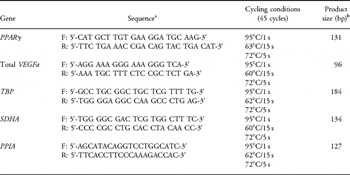
Analyses of mRNA levels for total VEGFa and PPARγ transcripts were performed by quantitative RT-PCR on the Rotorgene 6000 (Corbett Industries, Sydney, Australia) using Immolase DNA polymerase (Bioline, Alexandria, Australia). Primers for total VEGFa, PPARγReference Hewitt, Mark and Waddell28 and the reference genes TATA-box binding protein (TBP), succinate dehydrogenase subunit A (SDHA) and cyclophilin A (PPIA; Table 1) were designed using Primer 3 software (MIT/Whitehead Institute, http://www-genome.wi.mit.edu).Reference Rozen and Skaletsky31 Each of the selected primer pairs was positioned to span an intron to ensure no product was amplified from genomic DNA. Primers were used at a concentration of 0.2 μM, SYBR Green (Molecular Probes, Eugene, OR, USA) at 1/40,000 of stock, MgCl2 at 3 mM (2 mM for SDHA) and 0.5 U of Immolase enzyme per reaction. Ficoll supplementation (2.5 mg/ml Ficoll 400 and 7.5 mg/ml Ficoll 70) was used to improve PCR amplification efficiency.Reference Lareu, Harve and Raghunath30 Cycling conditions included an initial denaturation of 95°C for 10 min to activate the Immolase enzyme, followed by amplification for 45 cycles of the specific profiles indicated (Table 1). The resulting amplicons were sequenced to confirm specificity (data not shown). All samples were standardized against TBP, SDHA and PPIA using the GeNorm algorithm.Reference Vandesompele, De Preter and Pattyn32 Standard curves for each product were generated from gel-extracted (QIAEX II; Qiagen, Melbourne, Australia) PCR products using 10-fold serial dilutions and the Rotorgene 6000 software.
Primer sequences and conditions for quantitative PCR

aF, forward; R, reverse.
bbp, base pair.
Western blot analyses
Total placental protein was extracted in 500 μl of PhosphoSafe™ Extraction Reagent (Novogen Inc., New Canaan, CT, USA) and Mini EDTA-free Protease Inhibitors (Roche Pharmaceuticals, Basel, Switzerland). Protein (60 μg) was electrophoresed on 3–8% NuPAGE Tris-acetate gels (Invitrogen) and transferred onto polyvinylidene fluoride membrane (Sequi-blot; Bio Rad Laboratories, Hercules, CA, USA). The blots were blocked for 2 h at room temperature (7.5% skim milk powder w/v in PBS + Tween-20) and incubated with primary polyclonal antibodies (p-mTOR (Ser2448); p-4EBP1 (Thr70); Cell Signaling; Danvers, MA, USA) diluted in 5% BSA prepared with TBST buffer (p-mTOR 1 : 1000; p-4EBP1; 1 : 1000) overnight at 4°C. Blots were rinsed in TBST and then incubated with monoclonal anti-β-actin antibody in 5% non-fat milk (1 : 50,000) for 1 h at room temperature. Secondary antibody incubations for phosphorylated proteins (Anti-rabbit IgG: 1 : 20,000; Sigma-Aldrich, Castle Hill, Australia) and β-actin (Anti-mouse IgG; 1 : 3000; Sigma-Aldrich, Castle Hill, Australia) were done in 5% milk at room temperature for 1 h. Detection was accomplished using SuperSignal West Dura Extended Duration Substrate (Pierce Biotechnology, Rockford, IL, USA). Quantitation of the protein of interest is represented as a ratio to β-actin and presented as arbitrary optical density (AOD).
Statistical analysis
For each analysis, the ‘n’ represents the numbers of litters analyzed, with a single, representative male and female placenta analyzed from each litter. Differences between groups were assessed by two- or three-way factorial ANOVAs using Genstat 9.0 software (Hemel Hempstead, UK) with maternal diet, fetal sex and placental zone as factors. Prior to ANOVA, data were assessed for normality; where the distribution of residuals was considered non-normal, data were log transformed to equalize variance across groups. This log transformation was necessary for fetal, total placental and placental zone weights. Where the F-test reached statistical significance (P < 0.05), specific group differences were assessed by least significant difference (LSD) tests.Reference Snedecor and Cochrane33
Results
Maternal characteristics
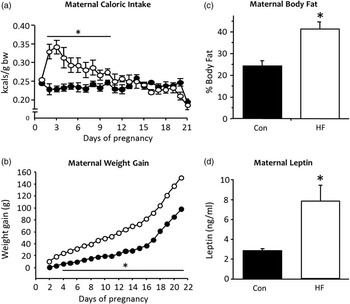
Consumption of an HF diet from day 1 of gestation increased maternal caloric intake, compared to the control diet, for the first 10 days of gestation (Fig. 1a) and resulted in greater maternal weight gain from day 4 of gestation (Fig. 1b). From day 11 onwards, caloric intake was similar between groups although HF mothers continued to gain weight more quickly than controls until day 16 of gestation. Maternal growth trajectories were then parallel for the remainder of gestation. Maternal HF diet increased maternal body fat percentage by 71% (P = 0.005; Fig. 1c) and plasma leptin levels by 2.5-fold (P < 0.001; Fig. 1d) by E21. Interestingly, although the HF animals had more body fat, lean body mass was slightly lower (8%, P < 0.05; Con: 215 ± 3 g, HF: 198 ± 7 g). Maternal blood glucose, plasma insulin and corticosterone concentrations, litter size and number of resorptions did not differ between groups (results not shown).
Maternal characteristics during pregnancy for mothers that consumed either control (Con; black) or high-fat (HF; white) diets. (a) caloric intake (b) weight gain (c) percentage body fat at E21 and (d) plasma leptin at E21. Values are mean ± s.e.m. (n = 4–6). *P < 0.01 compared to Con diet (one-way ANOVA).

Fetal and placental weights
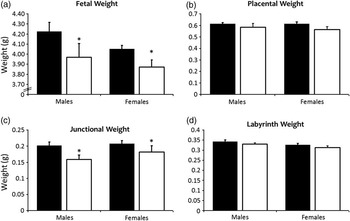
Fetal weight at E21 was reduced in the HF group (P < 0.05, two-way ANOVA) to the same degree in both males (6%) and females (8%; Fig. 2a). Maternal HF nutrition tended to reduce total placental weight at E21, but this difference did not reach statistical significance (P = 0.066, two-way ANOVA; Fig. 2b). This moderate reduction appeared to be attributable to a significant reduction in junctional zone weight (P = 0.013, two-way ANOVA) in HF placentas (21% and 12% lower in males and females, respectively; Fig. 2c). In contrast, maternal HF diet had no effect on labyrinth zone weight (Fig. 2d). Accordingly, both male and female junctional : labyrinth zone weight ratios were reduced (P = 0.032, two-way ANOVA) by 19% and 9%, respectively, following an HF diet. Fetal : placental weight ratios were not affected by either diet or gender (results not shown).
Fetal and placental weights at E21 for pregnancies from mothers that consumed either control (Con; black) or high-fat (HF; white) diets. (a) fetal (b) placental (c) junctional zone and (d) labyrinth zone. Values are mean ± s.e.m. (n = 4–6). *P < 0.05 overall diet effect (two-way ANOVA).

Fetal leptin, insulin, corticosterone and glucose
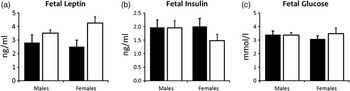
Maternal HF resulted in higher fetal leptin levels (P = 0.036, two-way ANOVA; Fig. 3a), an effect that appeared greater in female (69% increase) compared to male fetuses (25% higher). The maternal:fetal leptin ratio tended to be higher in HF pregnancies but this did not reach statistical significance (Con: 1.2 ± 0.2, HF: 2.1 ± 0.4; P = 0.065, two-way ANOVA). Fetal insulin, glucose (Fig. 3b and 3c) and corticosterone (results not shown) levels were unaffected by maternal diet or fetal sex.
Fetal levels of (a) leptin (b) insulin and (c) glucose at E21 in pregnancies from mothers that consumed either control (Con; black) or high-fat (HF; white) diets. Values are mean ± s.e.m. (n = 4–6). *P < 0.05 compared to Con diet (two-way ANOVA, LSD test).

Placental gene expression
Maternal HF nutrition did not change the expression of PPARγ mRNA in males or females in either zone (results not shown). Similarly levels of total VEGFa mRNA were unaffected by the HF diet in either placental zone in both sexes (results not shown).
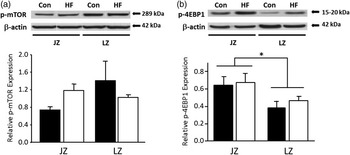
p-mTOR and p-4EPB1 protein were present in both the placental zones. Overall p-mTOR levels were similar between zones but p-4EBP1 levels were significantly higher in junctional compared to the labyrinth zone (P = 0.011). Maternal HF nutrition did not alter p-mTOR or p-4EBP1 protein levels in either zone (Fig. 4a and 4b).
Placental expression of (a) phosphorylated mammalian target of rapamycin (mTOR; Ser2448) and (b) phosphorylated 4EBP1 (Thr70) in pregnancies from mothers that consumed either control (Con; black) or high-fat (HF; white) diets. Values are mean ± s.e.m. (n = 4).

Discussion
This study extends that of Howie et al.Reference Howie, Sloboda, Kamal and Vickers10 which showed that offspring of mothers that consumed an HF diet during pregnancy were smaller at birth than those from control pregnancies, consistent with the subset of obese human mothers that give birth to growth-restricted newborns.Reference Perlow, Morgan, Montgomery, Towers and Porto6, Reference Gardosi and Francis8 The major findings of this study were that maternal consumption of an HF diet during pregnancy reduced fetal weight at E21, and resulted in placental growth restriction that was localized to the junctional zone of the placenta. The HF diet also increased maternal and fetal plasma leptin levels. Although we observed zone-dependent differences in protein levels of p-4EBP1, we did not observe any MHF-induced changes in protein levels of either p-mTOR or p-4EBP1 and no change in placental mRNA expression of markers of vascular development, PPARγ and VEGF.
Fetal growth restriction following maternal HF seems counter-intuitive since maternal caloric intake was considerably higher in these pregnancies for much of gestation. Consistent with this, HF mothers gained an extra 50% of weight throughout their pregnancies. Interestingly, the increased caloric intake occurred only in the first half of gestation, with HF mothers appearing to autoregulate their calorie intake to match that of control mothers from midgestation (i.e. during the time of maximal fetal growth).
Labyrinth zone weights were not affected by the HF diet, even though fetal and junctional zone growth was reduced. The labyrinth zone is the site of maternal and fetal exchange and it is possible that maintenance of labyrinth zone growth reflects a compensatory mechanism initiated by signals from the under-developed fetus. Indeed, recent studies in mice suggest that such signals may operate to drive increased fetal growth in the face of inefficient placental function.Reference Wyrwoll, Seckl and Holmes18, Reference Coan, Vaughan and Sekita34 This labyrinthine growth compensation does not appear to occur through upregulation of mTOR-mediated protein synthesis, since there are no dietary-induced changes in either mTOR or 4EBP1 phosphorylation. The role of mTOR in placental function is unclear, although studies have shown that without mTOR, embryos are unable to survive,Reference Gangloff, Mueller and Dann35 presumably due to its suggested role in syncytialization.Reference Mparmpakas, Zachariades and Foster36 Its importance in placental amino acid transfer has been shownReference Roos, Jansson and Palmberg24, Reference Jansson, Pettersson and Haafiz37 and placental mTOR activity is reduced in certain circumstances of intrauterine growth restriction.Reference Roos, Jansson and Palmberg24 Notably mTOR also regulates angiogenesis through its action on hypoxia inducible factors and VEGF expression.Reference Xue, Nagy and Manseau38 Previous studies have shown that mTOR regulates placental trophoblast cell growth in response to nutrients and growth factors.Reference Wen, Abbasi, Kellems and Xia39 Whether other potential regulatory phosphorylation sites in mTOR (Ser 1261) and 4EBP1 (Thr 37 and Thr 46) play roles in placental function is unclear.
Consistent with a lack of HF-induced changes in mTOR, mRNA levels for markers of placental vascular development, PPARγ and total VEGFa, were unchanged in either zone following consumption of the maternal HF diet. It was anticipated that expression of these genes might be decreased, thus contributing to the fetal growth restriction, similar to other studies.Reference Hewitt, Mark and Waddell19 Further studies are required to determine whether the morphological development of the placental vasculature is affected by consumption of the HF diet.
As PPARγ is also a regulator of placental lipid transferReference Xu, Wang, Cook and Knipp40 and de novo lipogenesis,Reference Capobianco, White, Higa, Martinez and Jawerbaum41 future studies will determine whether placental transport of lipids are altered following a maternal HF diet. Both excess and insufficient lipid placental transfer have been shown to be detrimental to fetal growth and well-being.Reference Jarvie, Hauguel-de-Mouzon and Nelson42, Reference Robillard and Christon43 Although placental levels of PPARγ did not change following consumption of the HF diet, dietary fatty acids could act as PPARγ agonists to alter transfer of extra dietary lipids to the fetus. Further studies are required to determine whether these processes are affected.
Leptin levels were consistently higher in both maternal and fetal circulations following maternal HF nutrition, although there was a strong trend toward a higher maternal:fetal leptin ratio in the HF group. This suggests that placental transport of leptin may be compromised by the HF diet, since the mother is the principal source of fetal and placental leptin in rodents, at least until term.Reference Amico, Thomas, Crowley and Burmeister44, Reference Dessolin, Schalling and Champigny45 Compromised placental leptin transport has been previously reported in rat models of growth restrictionReference Smith and Waddell21 and would likely occur by either decreased placental vasculature as occurs in models of elevated glucocorticoid exposureReference Hewitt, Mark and Waddell19 or decreased active transport mechanisms. Interestingly, we have previously shown that shortly after birth, offspring from a similar HF pregnancy cohort had markedly reduced plasma leptin levels,Reference Howie, Sloboda, Kamal and Vickers10 which may have arisen due to decreased adipose tissue associated with the fetal growth restriction.
Although fetal growth restriction can originate by various mechanisms which include placental insufficiency,Reference Gagnon15, Reference Wlodek, Westcott and O'Dowd46 maternal undernutritionReference Coan, Vaughan and Sekita34, Reference Vickers, Breier, Cutfield, Hofman and Gluckman47 and elevated glucocorticoid exposure,Reference Hewitt, Mark and Waddell28, Reference Burton and Waddell48–Reference Sloboda, Newnham and Challis51 the latter can be ruled out in our current model as neither maternal nor fetal corticosterone levels at E21 were affected by HF. Furthermore, models of elevated glucocorticoid exposure cause a decrease in the placental expression of both PPARγReference Hewitt, Mark and Waddell28 and VEGFa,Reference Hewitt, Mark and Waddell19 alterations that were not observed in this study.
Maternal HF did not alter maternal or fetal glucose levels at E21, suggestive of normal placental glucose transport in these pregnancies, or that labyrinthine compensatory mechanisms were sufficient for normal nutrient transport by E21. Other models of fetal growth restriction have shown effects on expression and activity of placental glucose transporters.Reference Jansson, Pettersson and Haafiz37, Reference Fowden, Ward, Wooding, Forhead and Constancia52–Reference Jones, Woollett and Barbour54 In contrast to this study, consumption of an HF diet for 8 weeks before conception and throughout pregnancy increased placental glucose transport by five-fold in mice.Reference Jones, Woollett and Barbour54 Whether this difference is due to the timing of nutritional intervention, differences in diet composition or species differences is yet to be determined.
In addition to nutrient transporters, placental-derived endocrine signals, many of which originate from the junctional zone, are also capable of influencing fetal growth.Reference Fowden, Sferruzzi-Perri, Coan, Constancia and Burton55, Reference Fowden and Forhead56 HF-induced placental growth restriction occurred predominantly within this endocrine zone and disturbances in the hormonal milieu may contribute to the fetal growth restriction. It would be of interest to measure circulating progesterone concentrations as a reduction in progesterone concentration decreased fetal and placental weights, and impacted on junctional zone weight more than that of the labyrinth zone.Reference Mark, Smith and Waddell57
In summary, we have demonstrated that maternal consumption of an HF diet during pregnancy reduced fetal weight and had differential effects on placental growth, with only the junctional zone showing growth retardation. It may be that maternal HF diet resulted in a compensatory response of the labyrinth zone of the placenta to increase the supply of substrate to the growth-restricted fetus.
Acknowledgments
The authors would like to thank Dr Thea Shavlakadze for discussions during the preparation of this manuscript. This study was supported by a grant from the National Health & Medical Research Council of Australia.
Statement of Interest
None.