Introduction
The rocky intertidal zone is an iconic ecosystem in which the impacts and consequences of parasitism are understudied. Whether this is the absence of evidence or evidence of absence remains to be determined. This is striking because ecologists have long used this ecosystem to develop a foundational theory (e.g. Connell, Reference Connell1961a, Reference Connellb; Paine, Reference Paine1966; Dayton, Reference Dayton1971; Gaines and Roughgarden, Reference Gaines and Roughgarden1985). Barnacles, in particular, have a long history of ecological study and have been a model organism for evaluation of key processes such as competition (Connell, Reference Connell1961a; Menge, Reference Menge1976), predation (Connell, Reference Connell1961b), disturbance (Sousa, Reference Sousa1979) and recruitment dynamics (Gaines and Roughgarden, Reference Gaines and Roughgarden1985; Menge, Reference Menge2000). However, the role of parasitism in barnacle population performance has been generally ignored (with some interesting exceptions, see Blower and Roughgarden, Reference Blower and Roughgarden1987; Harley and Lopez, Reference Harley and Lopez2003). In fact, in his classic 1961 Ecology paper on competition, Connell remarked that Semibalanus balanoides had an isopod parasite that could impact growth rate. He chose to ignore that interaction, yet noted the parasite may be able to regulate the outcome of competition by diminishing the ability of S. balanoides to outcompete Chthamalus stellatus, which had not been reported as infected. Currently, when searched as a topic, Web of Science recovers 369 items for the genus Chthamalus, but only 13 for its parasite, Hemioniscus. Concealed within the host, parasites are often excluded from ecological consideration. However, the importance of the rocky intertidal zone to ecology, particularly its barnacles, calls for an evaluation of the effects of parasitism on these model organisms in this model ecosystem.
Hemioniscus balani is a globally distributed isopod parasite that castrates its barnacle host (Caullery and Mesnil, Reference Caullery and Mesnil1901; Crisp, Reference Crisp1960; Goudeau, Reference Goudeau1970). Parasitic castrators use a consumer strategy in which a single infecting parasite eliminates host reproduction (Kuris, Reference Kuris1974; Lafferty and Kuris, Reference Lafferty and Kuris2009; Lafferty et al., Reference Lafferty, Harvell, Conrad, Friedman, Kent, Kuris, Powell, Rondeau and Saksida2015). Hemioniscus balani enters the barnacle test and attaches to the ovaries, draining ovarian fluid and rendering the barnacle unable to reproduce as a female. After the isopod matures, it releases its offspring and dies. Following infection, barnacles recover female reproductive function. Hence, H. balani is an ephemeral, semelparous parasite that temporarily blocks female reproduction (most castrators are long-lived and iteroparous). Consequently, H. balani has the potential to substantially impact the ecology of its barnacle hosts.
Ecologists use standing-stock biomass and reproductive output to estimate the importance and contribution of different populations to communities, ecosystems and ecological processes. Examples include competition (Wilson and Tilman, Reference Wilson and Tilman1991; Fong and Fong, Reference Fong and Fong2018), trophic dynamics (Lindeman, Reference Lindeman1942; Power, Reference Power1992; Wilmers et al., Reference Wilmers, Estes, Edwards, Laidre and Konar2012), stability (Tilman, Reference Tilman1996; Borer et al., Reference Borer, Seabloom and Tilman2012), carbon fixation (Wilson and Tilman, Reference Wilson and Tilman1991; Wilmers et al., Reference Wilmers, Estes, Edwards, Laidre and Konar2012) and nutrient cycling (Odum and Odum, Reference Odum and Odum1955; Odum, Reference Odum1971; Metcalfe et al., Reference Metcalfe, Asner, Martin, Silva Espejo, Huasco, Farfán Amézquita, Carranza-Jimenez, Galiano Cabrera, Baca, Sinca and Quispe2014). Infectious agents have generally been ignored in these studies, likely because they were assumed to have negligible biomass and productivity (e.g., Loreau et al., Reference Loreau, Roy and Tilman2005). However, parasite biomass can be substantial, exceeding the biomass of top predators and major groups of free-living organisms in estuarine and pond ecosystems (Kuris et al., Reference Kuris, Hechinger, Shaw, Whitney, Aguirre-Macedo, Boch, Dobson, Dunham, Fredensborg, Huspeni and Lorda2008; Preston et al., Reference Preston, Orlofske, Lambden and Johnson2013). However, because of the challenging logistics of studying the effects of parasitism, the generality that parasites are important to population, community and ecosystem processes is still in question.
Here, we provide an initial insight into the role of parasites in rocky intertidal communities by examining how H. balani impacts Chthamalus fissus hosts and populations using the currencies of biomass and reproduction. Chthamalus fissus is a simultaneously hermaphroditic acorn barnacle susceptible to parasitism by H. balani that inhabits the high rocky intertidal zone. We first documented the relationship between body size and reproductive output for both individual hosts and parasites. We then applied these relationships to natural barnacle populations from 12 localities throughout Southern California, allowing us to express the impacts of parasitism at the population-level in terms of host and parasite standing-stock biomasses and reproductive outputs.
Methods
Individual estimates
We collected naturally infected and uninfected barnacles from the field to quantify individual barnacle and parasite tissue weight and reproductive output. Barnacles were collected from Miramar Beach in Santa Barbara, CA, USA between September 2013 and September 2015 (see Fong et al., Reference Fong, Kuris and Hechingerin revision for methods). Barnacles were processed in the laboratory to quantify the relationships between size and reproductive rates for both barnacle hosts and isopod parasites. We ensured each dissected barnacle belonged to the genus Chthamalus based on plate arrangement. While we cannot exclude the possibility that other similar Chthamalus species (e.g., the rarer Chthamalus dalli) were included in our samples, C. fissus is the most common Chthamalus species in southern California (Newman and Abbott, Reference Newman, Abbott, Morris, Abbott and Haderlie1980; Ricketts et al., Reference Ricketts, Calvin, Hedgpeth and Phillips1985, Newman, personal communication). Both species are similar in size, biology and ecology (Newman and Abbott, Reference Newman, Abbott, Morris, Abbott and Haderlie1980) and H. balani infects both species (Blower and Roughgarden, Reference Blower and Roughgarden1988), making accidental inclusion relatively unimportant. Hence, we refer to the host as C. fissus in this study.
For each barnacle, we measured maximum basal diameter to the nearest ¼ mm and determined whether it was infected or uninfected. For infected barnacle weight, we only used hosts with mature infections (when the parasite had eggs) to minimize variation in weight due to parasite developmental stage. For uninfected barnacles, we classified individuals as brooding or non-brooding where non-brooding barnacles had fully deflated ovaries while brooding barnacles had oviposited eggs (embryos). We only included brooding barnacles because as the ovary inflates, it goes from a negligible weight to a fully developed ovary that can comprise 70% of barnacle total weight (Hines, Reference Hines1976). We separated and weighed the barnacle body, parasite body and barnacle egg mass using an analytical balance.
To relate barnacle size to barnacle egg production, we used GetData (www.getdata.com) to digitize graphs from the unpublished thesis of Hines (Reference Hines1976) that provided egg counts vs barnacle basal diameter. This data come from the same species of host, just north of the geographic range covered in our study.
To relate host barnacle size to parasite egg production, we measured maximum host base diameter to the nearest ¼ mm and counted the number of eggs (embryos) in the marsupium of the parasite within the host. We only used gravid parasites because eggs could be easily counted and to minimize variability due to development. We excluded barnacles with more than one parasite (<5% of infections across all sites) to minimize variation due to competition among parasites for host resources (Fong et al., Reference Fong, Moron and Kuris2017).
To estimate the total volume of parasite and barnacle eggs, we used published measurements of parasite and barnacle egg length and width (Goudeau, Reference Goudeau1976, Hines, Reference Hines1978). We calculated egg volume as a prolate spheroid and calculated the total biovolume of eggs produced by individual parasites and barnacles by multiplying the number of eggs by individual egg volume.
For these individual data, we collected a total of 142 barnacles ranging from 1.75 to 5.50 mm long. All of the barnacles were collected from Miramar Beach in Santa Barbara, CA, USA. We processed 60 infected, 28 uninfected/brooding and 54 uninfected/non-brooding barnacles. From the 60 infected barnacles, we counted the eggs produced by the parasite for 25 individuals ranging in size from 2.00 to 5.25 mm.
Population estimates
We applied the weight relationships described at the individual level to these field samples to estimate population standing-stock biomass and standing-stock reproductive output for barnacle and parasite. We surveyed 12 barnacle populations along the Southern California Bight to quantify population standing-stock biomass for uninfected barnacles, infected barnacles and parasites (see Fong et al., Reference Fong, Kuris and Hechingerin revision for descriptions of field sampling, collection, dissection and SOM). Briefly, we surveyed 6 sites with 2 habitats per site – natural rock and pier pilings. Sites ranged from Gaviota to San Diego (SOM Fig. 1). To characterize each population, we used 10 replicate cores to quantify barnacle population density, size-frequency distribution, brooding frequency and infection prevalence (percentage of hosts infected). We dissected every C. fissus individual ⩾1 mm collected to characterize the barnacle population. Population estimates of biomass and reproduction included uncertainty from individual measurements and population samples, so we estimated the combined uncertainty using standard rules of error propagation (Taylor, Reference Taylor1982; Lehrter and Cebrian, Reference Lehrter and Cebrian2010). We estimated the total error originating from the regressions by propagating the standard error of the regression [root of (SSE/(N-2))], first among individuals within each core, then among cores before dividing by sample size. We then added in quadrature standard error from the individual regressions to the standard error from the population density estimates. Hence, standard errors for estimates of population biomass and reproduction include both sources of uncertainty.
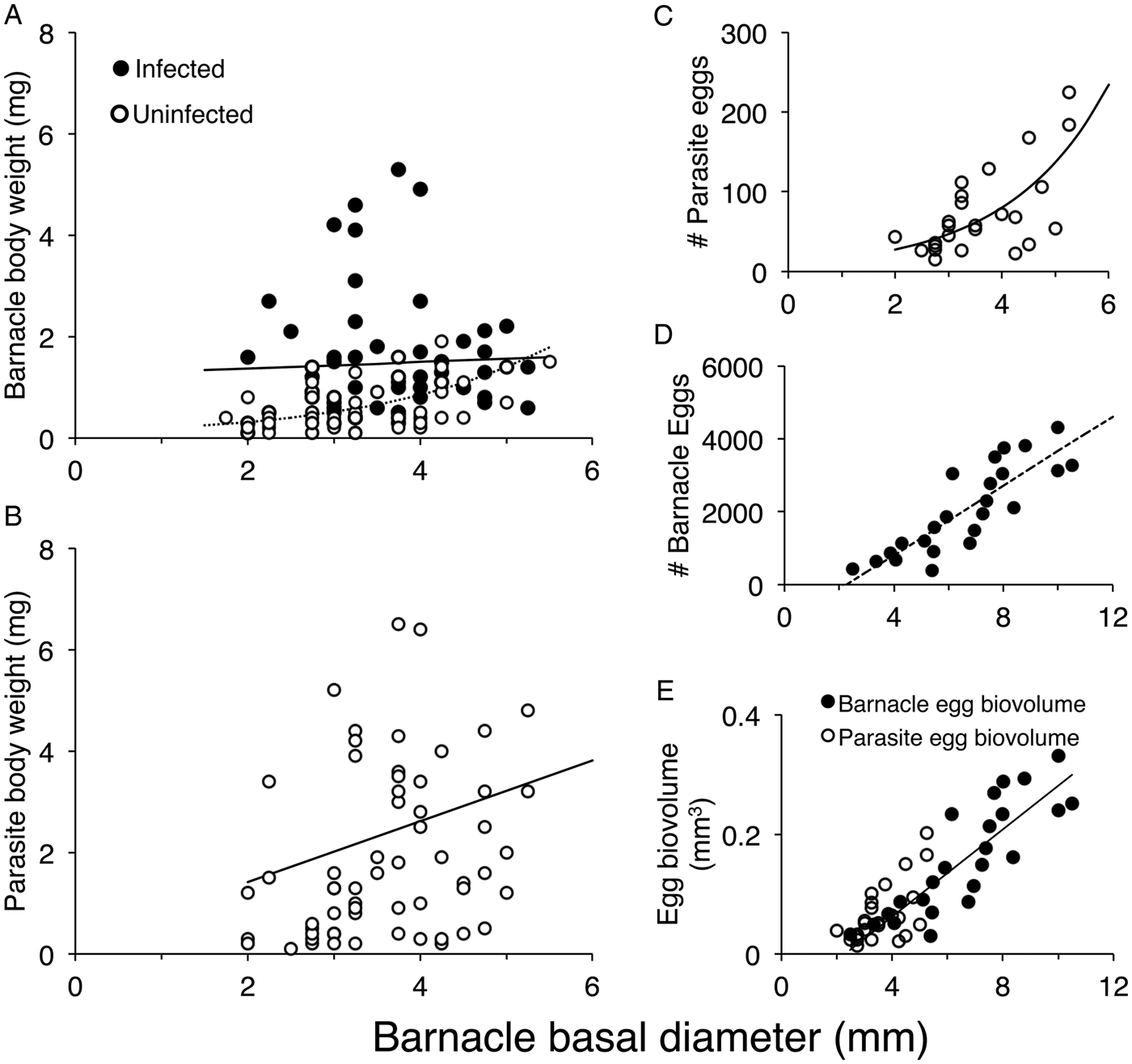
(A) Relationship between barnacle body weight and barnacle test basal diameter. The dashed line represents the positive exponential relationship between uninfected barnacle weight and basal diameter, while the solid line represents the non-significant linear relationship between infected barnacle weight and basal diameter. (B) The relationship between isopod parasite body weight and barnacle host basal diameter. (C) Dependence of the number of isopod parasite eggs on barnacle basal diameter, (D) the number of barnacle eggs in relation to barnacle basal diameter, and (E) the biovolumes of parasite and barnacle eggs produced in relation to barnacle basal diameter.

We then determined the relationship between parasite prevalence and number of barnacle and parasite eggs per cm2 across the 12 localities surveyed. To do this, we used the relationships between barnacle body size and egg production, barnacle body size and parasite egg production and applied these relationships to the population estimates from our survey data.
Statistical analysis
We used a combination of linear and non-linear models to analyse the data using the statistical package JMP v. 12.0. We ensured data met assumptions of homogeneous variance and normality. When appropriate, we used a model selection approach where we compared AICc scores to choose the most appropriate model using the model selection platform in JMP.
Results
Individual estimates
The best-fit model for predicting individual barnacle body weight included infection status and barnacle length, but not barnacle brooding status (Table S1). We used a follow-up model selection approach to determine what type of regression (i.e. linear, exponential, log, etc.) best explained the relationship between length and weight for infected and uninfected barnacles. For infected barnacles, although a linear relationship between basal diameter and weight had the lowest AICc, the fit was not substantially better than the exponential fit and the relationship was not significant (P = 0.42). Overall, the mean weight of infected barnacles was 1.47 ± s.e. 0.15 µg. An exponential relationship best described the positive relationship between tissue weight and test diameter for uninfected barnacles (uninfected weight = 0.10.5*length), P = , Fig. 1A). Thus, the tissue weight of uninfected barnacles increased exponentially with test diameter. Hence, uninfected barnacles weighed less than infected barnacles for all but the largest size classes (Fig. 1A).
Parasite body weight was best explained by a linear relationship with a basal diameter (Table S1, Fig. 1B). As basal diameter increased, parasite weight increased (y = 0.22 + 0.60*length). Thus, while infected barnacle body weight did not vary with basal diameter, parasites grew larger in larger barnacles.
Barnacle eggs are 65 × 47.5 × 47.5 µm and 7.68 × 10⁻¹⁴ m3 while H. balani eggs are 190 × 95 × 95 µm and 8.97 × 10⁻¹³ m3. Hence, a parasite egg is ~11.7 × the size of barnacle eggs.
Egg number increased with barnacle basal diameter exponentially for parasites and linearly for barnacles (Fig. 1C and D). Thus, parasites in larger barnacles produced eggs exponentially (Table S1, Fig. 1C, y = 9.40.54x) while the barnacle itself produced linearly more eggs with increased size (Table S1, Fig. 1D, y = 475.3x-1090.3). However, the relationship between barnacle length and egg biovolume did not differ in either slope or intercept between parasite eggs and barnacle eggs (Table S1, Fig. 1E). Thus, a barnacle produced an equivalent biovolume of eggs, whether parasite or barnacle.
Population estimates
To estimate standing-stock biomass and egg production at the population level, we processed 6381 barnacles collected from 12 sites along the Southern California Bight. Barnacles at the 12 sampled sites ranged in size from 1 to 13.5 mm and the overall prevalence of Hemioniscus balani was 5.7%. Of the uninfected barnacles, 28% were actively reproducing as females.
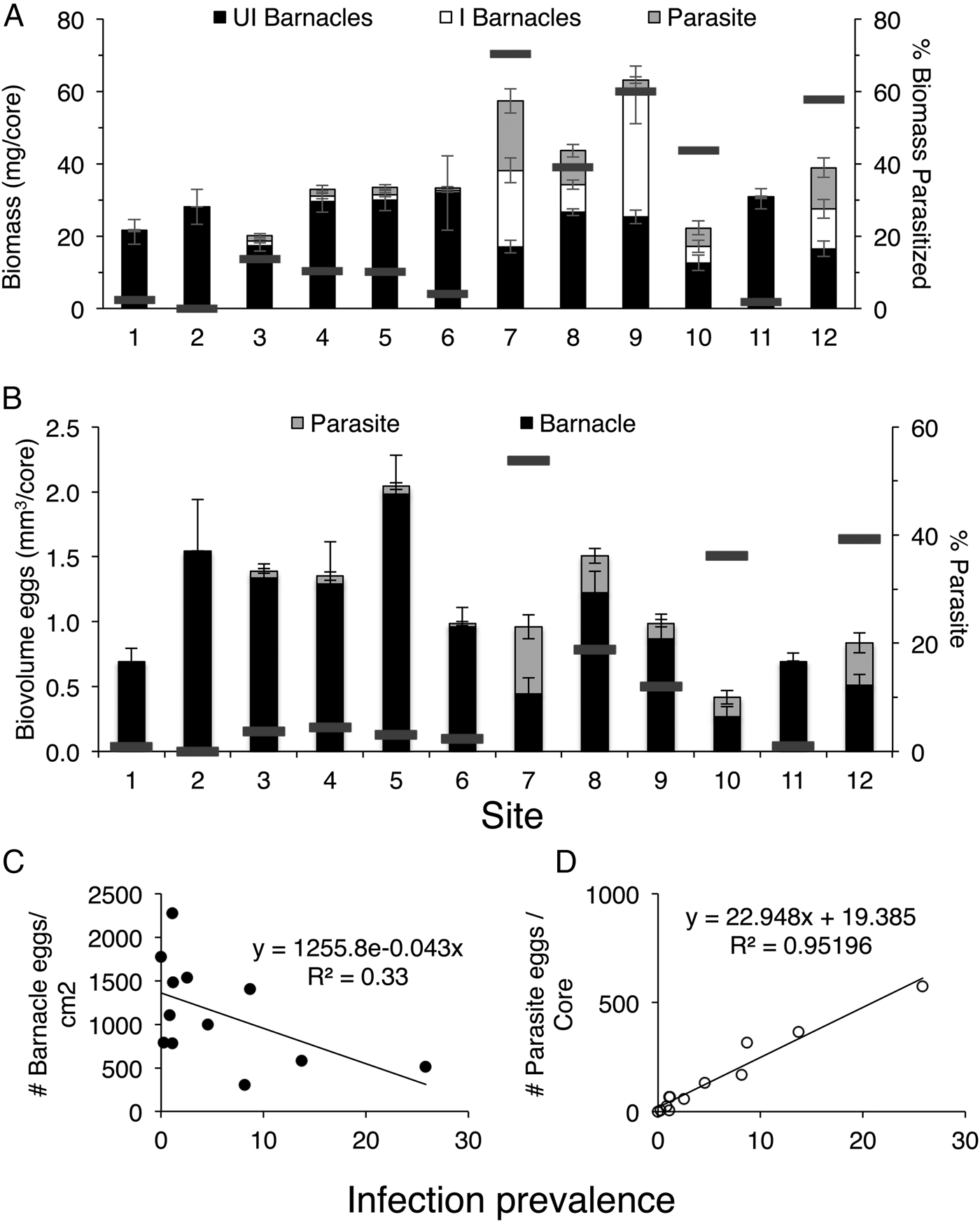
Across all sites, estimated average standing-stock biomass of uninfected barnacles (2.10 ± s.e. 0.28 mg per cm2) was significantly greater than that of infected barnacles (0.61 ± s.e. 0.14 mg per cm2), which in turn was greater than that of the parasites (0.41 ± s.e. 0.10 mg per cm2) (Fig. 2A).
(A) Average standing-stock biomass of barnacle hosts and isopod parasites in ten 11.34 cm2 cores taken at each of 12 sites spread throughout southern California. Error bars represent ± 1 s.e., and include error propagated from both the replicate cores and the application of length-weight regressions. Horizontal bars indicate the percent of biomass at each site that is parasitized (parasite + infected barnacle biomass). (B) Average biovolume of barnacle host and isopod parasite eggs produced in 11.34 cm2 for each of 12 sites. Ten cores were taken per site and estimated biovolume of egg production was averaged across cores. s.e. on means include error generated by both the core and the individual level count data. Horizontal bars indicate the percent of egg biovolume at each site that is parasite. (C) An average number of barnacle eggs produced and (D) average number isopod parasite eggs produced per 11.34 cm2 core at each site as a function of infection prevalence at that site.

Mean standing-stock biomass of uninfected barnacles ranged from 1.11 ± s.e. 0.19 to 2.81 ± s.e. 0.91 mg per cm2, infected barnacles from 0.00 to 2.97 ± s.e. 0.71 mg per cm2, and parasites from 0.00 to 1.69 ± s.e. 0.30 mg per cm2. Site 7 had the highest parasite prevalence (Fig. 2A), and infected barnacle standing-stock biomass was ~1.3 × the standing-stock biomass of uninfected barnacles while standing-stock biomass of parasite equaled that of uninfected barnacles.
Across sites, biovolume of barnacle eggs was ~7 × greater than parasite egg biovolume. Brooding barnacles produced an average of 0.09 ± s.e. 0.02 mm3 biovolume of eggs per cm2 while parasites produced an average 0.01 ± s.e. 0.00 mm3 biovolume of eggs per cm2. Egg production varied substantially among sites, and at one site (7), parasite egg biovolume production exceeded barnacle egg biovolume production (Fig. 2B).
Mean parasite egg production ranged from 0 to 0.05 ± s.e. 0.01 mm3 per cm2 between sites while barnacle egg production per core ranged from 0.02 ± s.e. 0.01 to 0.18 ± s.e. 0.03 mm3 per cm2. At site 7, parasites and barnacles produced an equivalent biovolume of eggs, with parasites producing 0.05 ± s.e. 0.01 mm3 and barnacles producing 0.04 ± s.e. 0.01 mm3 per cm2.
There was a marginally significant negative linear relationship across sites between parasite prevalence and the estimated egg production density of the barnacle population (Fig. 2C, P = 0.073). This pattern reflected ~50% reduction in barnacle population reproductive output as prevalence increased from 0 to 26% prevalence. Similarly, we found a strong, positive, linear relationship between prevalence and parasite egg productivity (Fig. 2D, P < 0.0001).
Discussion
Within apparent barnacle populations, Hemioniscus balani comprised a substantial component of its biomass, a common proxy for relative importance. Parasite standing-stock biomass, including the extended phenotype of the infected host (O'Brien and Van Wyk, Reference O'Brien and Van Wyk1985; Kuris et al., Reference Kuris, Hechinger, Shaw, Whitney, Aguirre-Macedo, Boch, Dobson, Dunham, Fredensborg, Huspeni and Lorda2008; Dawkins, Reference Dawkins1982), was greater than or equal to uninfected barnacle standing-stock biomass at 25% of our sites. Although the relationship between host size and parasite size had much unexplained variation, the error in our population estimates far exceeded the error in our individual estimates, so this effect was predominantly driven by variation in parasite prevalence among sites.
Researchers have found parasites can comprise substantial biomass in Californian estuaries (Kuris et al., Reference Kuris, Hechinger, Shaw, Whitney, Aguirre-Macedo, Boch, Dobson, Dunham, Fredensborg, Huspeni and Lorda2008) and ponds (Preston et al., Reference Preston, Orlofske, Lambden and Johnson2013) and New Zealand lake (Lagrue and Poulin, Reference Lagrue and Poulin2016) communities. We extend that finding to barnacle populations in the rocky intertidal zone, necessitating consideration of parasites in this iconic community.
We found parasite reproductive output could match that of barnacles. This needs to be assessed over time to consider the extent to which a barnacle population contributes more barnacle or parasite progeny to ecosystem energetics. This productivity has important implications for connectivity between populations and ecosystems. Predators often consume free-living parasites (e.g., Kaplan et al., Reference Kaplan, Rebhal, Lafferty and Kuris2009; Orlofske et al., Reference Orlofske, Jadin, Preston and Johnson2012); in the rocky intertidal zone, in particular, intertidal anemones readily consume H. balani cryptonisci (Fong and Kuris, Reference Fong and Kuris2017). Parasite larvae are substantially larger than barnacle larvae and may be consumed by different species of predators, which may influence food web dynamics. Further, both barnacle and parasite offspring are resource subsidies (Yang et al., Reference Yang, Bastow, Spence and Wright2008) from intertidal to near-shore subtidal/pelagic marine communities. However, the nature of these subsidies is likely quite different – barnacle larvae disperse far and spend considerable time in the water column; in contrast, H. balani larvae attach to copepod intermediate hosts and likely stay near shore. By diverting and repackaging a substantial fraction of host productivity, H. balani may alter energy flows, and the perception of relative sources and sinks for barnacle recruitment to adult populations, within and between near-shore marine communities.
Hemioniscus balani may have the potential to control C. fissus barnacle populations by suppressing barnacle reproduction. The number of barnacle eggs produced per area decreased with increasing parasite prevalence. Models indicate that the high prevalence of H. balani can regulate host populations (Blower and Roughgarden, Reference Blower and Roughgarden1987). Some anecdotal evidence supports population regulation as well – Perez (Reference Perez1923) reported an outbreak of H. balani in Balanus improvisus populations lasting several years, after which the barnacle population was almost completely eradicated. Hence, there is evidence that this parasitic castrator can regulate barnacle host populations by suppressing barnacle reproduction and ultimately recruitment. Here we show a significant and substantial diversion of productivity from barnacle to parasite that varies among sites (Blower and Roughgarden, Reference Blower and Roughgarden1988; Fong et al., Reference Fong, Kuris and Hechingerin revision). This study suggests H. balani may strongly influence the metapopulation dynamics of C. fissus. In particular, the parasite-host dynamics may control relative sources and sinks for barnacle reproductive productivity and recruitment to adult populations. Further analyses of barnacle population biology should assess the impacts of these parasites.
We documented substantial variation in parasite prevalence among our sites. While we cannot currently provide a definitive driver for this spatial variation, we provide two hypotheses. One possible mechanism is the differences in food availability. Increased food availability increases barnacle female reproductive productivity (Hines, Reference Hines1978). For example, the fraction of barnacles brooding eggs can be 5 times higher at sites with higher near-shore primary productivity (Leslie et al., Reference Leslie, Breck, Chan, Lubchenco and Menge2005). Thus, if food availability varies amongst sites and sets barnacle reproduction, this might in turn control resource availability for the parasite. Another possibility has to do with predators on parasite infective stages. For example, anemones consume H. balani infective stages and reduce fine-scale parasite prevalence (Fong and Kuris, Reference Fong and Kuris2017). Thus, spatial differences among sites in levels of predation on parasites may also explain the strong variability in levels of parasitism among sites.
Barnacles in the rocky intertidal zone have been used as a model system for understanding basic ecological processes. However, the foundational studies did not evaluate parasitism (e.g. Connell, Reference Connell1961a, Reference Connellb; Paine, Reference Paine1966; Dayton, Reference Dayton1971; Menge, Reference Menge1976, Reference Menge2000; Sousa, Reference Sousa1979; Gaines and Roughgarden, Reference Gaines and Roughgarden1985). How could parasitism be included in rocky intertidal zone ecosystem research? For example, consideration of parasitism may alter the interpretation of the classic study of competition and zonation in the rocky intertidal zone (Connell, Reference Connell1961a). Only one species, the competitively dominant Semibalanus balanoides, was a documented host of H. balani. Hemioniscus balani likely reduces the growth rate in barnacles (Crisp, Reference Crisp1960). Hence, the extent of parasitism could alter competitive outcomes as barnacles compete by overgrowing or dislodging inferior space competitors. Parasitism could also influence predation rates on barnacles and thus zonation. Barnacle ovaries are predominantly lipid, a rich resource for predators and can comprise 70% of barnacle body weight (Hines, Reference Hines1976). By consuming ovarian fluid and rapidly leaving, parasites may make recently infected barnacles a less desirable food source, reducing predation rates. Larval recruitment is a strong structuring force in the rocky intertidal zone (Gaines and Roughgarden, Reference Gaines and Roughgarden1985; Menge, Reference Menge2000). By depressing local reproduction, parasites may drive variability in barnacle recruitment rates in both space and time. This could further drive population and community responses to disturbances. Following disturbance, rocky intertidal communities undergo succession driven by recruitment (Sousa, Reference Sousa1979). If parasitism suppresses reproduction in source populations, then parasitism by H. balani may affect barnacle population recovery following disturbance. Our findings in this iconic system show a widespread distribution of this sometimes-abundant parasite and a substantial reduction in host reproductive productivity where it is prevalent. Its impacts on barnacle populations and rocky intertidal community structure may be substantial and are worthy of further study.
Supplementary material
The supplementary material for this article can be found at https://doi.org/10.1017/S0031182018001634.
Acknowledgments
Thank you to the Ecological Parasitology Group at the University of California, Santa Barbara for discussion and insights.
Financial support
Karla Bernardo, Nancy Moron, and Eugena Grigsby who were funded by the Summer Institute for Math and Science (SIMS) and the Research Internships in Science and Engineering (RISE) Programs at UCSB.
Conflicts of interest
None.
Ethical standards
Not applicable.