The main aim of this article is to offer a reasoned definition of cabinet for comparative purposes. First, we point out why the triadic legal conception of cabinet is a better starting point for a definition of cabinet than a functional definition can be. Subsequently, we provide some criteria that will allow us to define what a minister is, to single out the ministers who are cabinet members from the ministers outside the cabinet, and to classify the ministers on the basis of their roles. A comparative picture of 38 parliamentary and semi-presidential governments in terms of their actual structure will be offered to show the definition's appropriateness to the real world. We will highlight some features that are common to all governments, or, at least, to most, as well as the peculiar traits of a small number of executives.
Let us start with the more general task of finding a definition of cabinet. Two main definitions of cabinet stand out in the literature: a functional decision-making definition and a legal definition. The first defines the cabinet according to what it actually does or should do. The second defines it as the set of organs of which it consists, as well as their balance, or what the cabinet should be. We will use the latter in a descriptive and non-normative way, by defining the cabinet in terms of the actors that make it up. First we will look at why the first definition is not useful for our purposes.
The Functional Decision-Making Definition
The first definition describes the cabinet on the basis of its functions and activities. This approach boils down to defining what the cabinet actually does. The cabinet is viewed in its basic capacity as the source of coordination of the governmental policy-making process. This path is followed with great conviction by Dunleavy and Rhodes (Reference Dunleavy and Rhodes1990; Rhodes Reference Rhodes1995). Rudi Andeweg has their work in mind when he says:
in the functional approach to a definition, cabinet government is defined in terms of what it is supposed to accomplish. The function that is most often mentioned in this respect is that of coordination . . . It is not self-evident, however, why coordination should be the defining function of cabinet government, rather than functions such as the provision of democratic legitimation to government, or the creation of a channel for political accountability, or simply decision making: the ‘authoritative allocation of values’. And even if we accept the subjective choice of ‘coordination’, it is not clear what is and what is not to be included in that term. (Andeweg Reference Andeweg1997: 59, emphasis added; see also Andeweg Reference Andeweg2003: 40)
Defining the cabinet on the basis of its functions can lead to some discussion about the singling out of the functions. However, there is another point we would like to make. Dunleavy and Rhodes (Reference Dunleavy and Rhodes1990), by putting functions in the forefront, de facto reject the cabinet as an institution and as a proper research object. Only empirical research is in a position to ascertain the persons who exercise the function of coordination in policy-making: consequently, the cabinet turns out to be somewhat unwieldy as a proper research object. The two authors shy away from terms such as ‘cabinet’ and ‘ministers’, to avoid being trapped into prejudices as to who performs a certain government function. In order to do this, they resort to an expression such as ‘core executive’, which refers to ‘all those organizations and structures which primarily serve to pull together and integrate central government policies, or act as final arbiters within the executive of conflicts between different elements of the government machine’ (Dunleavy and Rhodes Reference Dunleavy and Rhodes1990: 4).
A question is selected, and an empirical research problem is submitted. Consequently, the object of the research remains necessarily unknown until the inquiry has completed. Leaving aside the interesting methodological questions that a similar definition raises, it is worth noting that it does not offer a defining stipulative answer,Footnote 1 but a research problem.
We have in mind a different aim. We are looking for a stipulative definition, namely, an approach that enables the researcher to somehow circumscribe the area of research and thus tackle the research object (the so-called cabinet) in a viably empirical way.
The Legal Definition
According to the legal definition, the cabinet is a complex body made up of a number of distinct organs: the prime minister, individual ministers and the council of ministers as a whole (Morbidelli et al. Reference Morbidelli, Pegoraro, Reposo and Volpi2007: 412–14). Different constitutions bestow on the three organs relatively different influences by assigning them different functions in ways that are not always clear. However, in all the countries with the governmental makeup described above, the three parties share the functions of government, administrative duties and coordination of the processes required for both. There might be differences from one country to the next, but on the whole the three organs should aim at some kind of balance. In particular, there are three principles at work: (1) the monocratic principle (which underpins governability through the reductio ad unum ability); (2) the ministerial principle (which assigns value and power to the minister uti singulus); and (3) the collegial and collective principle (which asserts the necessity of a common action in order to have a proper cabinet).
Thus, the legal definition stresses what the cabinet must be, in a twofold sense: it prescribes the way the cabinet is composed and the way its three components ought to act; and it presumes an equilibrium is reached among the three organs, anointed with the teleological duty of making the three principles work harmoniously and in unison.
Most analyses of cabinets owe much to the legal tradition. They have embraced – more or less consciously – the idea that the government is a complex tripartite body. This is true even though the shift from the strictly legal perspective to political science brings changes to the terminology and the line of reasoning in terms of models – that is, the collegial model, the prime ministerial model and the departmental model (Andeweg Reference Andeweg1993; Aucoin Reference Aucoin1999; Blondel Reference Blondel1989; Elgie Reference Elgie1997; Laver and Shepsle Reference Laver and Shepsle1994; Mackie and Hogwood Reference Mackie and Hogwood1985a; O'Leary Reference O'Leary1991; Rhodes Reference Rhodes1995).
Rudi Andeweg (Reference Andeweg1993) was well aware of the issue, and others followed in his steps (Barbieri Reference Barbieri2003). Broadly speaking, all models dealing with cabinet decision-making are nothing but ways of going beyond the legal principles triangle. They provide empirical research and models of power distribution with a view to getting as close as possible to what decision-making is actually like. No viable alternative to the legal definition of cabinet has been put forward, but the normative tendency is cast aside.
As a result, a number of questions are implicitly raised: (1) to what extent is a cabinet actually collegial? (Baylis Reference Baylis1989); (2) to what extent is the prime minister predominant? (Hefferman Reference Hefferman2003); (3) to what extent are the departments and cabinet committees important for policy-making? (Laver and Shepsle 1996; Mackie and Hogwood Reference Mackie and Hogwood1985b).
The legal definition is a starting point to highlight some very important issues, including sophisticated theoretical and normative speculations, but comparative politics needs a more explicit, autonomous and comprehensive definition of cabinet.
What a Cabinet Is
Most government ministers are cabinet members; the cabinet is made up of ministers who are supposed to be major political actors and in a position to make (together) government decisions. In this respect, Jean Blondel (Reference Blondel1999: 200) gives us an image of the cabinet when he talks about it as a ‘club of ministers’. This notion implies the following: a positional definition of power (Mills Reference Mills1956) – ministers are cabinet members because of their position at the apex of government; a decisional definition of power (Dahl Reference Dahl1961) – ministers are cabinet members because of their power to make government decisions; an idea about the power distribution among them, which is not hierarchical and basically diffused; and a certain idea of the decision-making process, which is, in any case, also somehow collective and collegial.
The existence of the cabinet does not rule out the possibility that other actors might intervene (even substantially) in decision-making. It focuses only on actors belonging to a top political institution of a parliamentary system. All government decisions, no matter where they are actually taken, must eventually pass through the cabinet. Following this, we might choose to define the cabinet on the basis of which government political actors compose it. By focusing on the notion of club of ministers, we are undoubtedly on the path to defining the cabinet as a whole, complex though the investigation might turn out to be. How can we recognize club members? What is a minister? What are the indicators that best cover the concept of ‘cabinet member’, given that it means all the things we have said?
The question is harder than it might at first seem. There are senior and junior ministers, ministers with or without a department, some ministers with considerable power, others who have little power, some who regularly sit on the full cabinet, and some who do not. The term ‘minister’ itself is not universally used. Sometimes, for example, they are called secretaries of state and under-secretaries of state. The exact meaning of these titles may be different from one country to the other. We cannot sidestep the issue if we are truly interested in defining the concept of cabinet. We have to identify criteria by which to identify which government members are members of the club.
What is a Minister?
Appointment and Accountability. There are two traditional criteria that draw the line between politicians and mere executive administrators: only the former must be politically appointed and politically responsible to the parliament. Sometimes top civil servants might be politically appointed via the spoils system and accountable to some politician, but they still have no representative role. Besides, duties and activities (political versus administrative, political decision versus its implementation) are diversified, although, as is well known, this is only approximately and tendentially true.
From a strictly operational viewpoint, dealing with the two criteria (type of appointment and type of delegation) is far from easy, but the distinction is an inescapable starting point when it comes to government in its political sense. Powerful administrators may be very important from the viewpoint of the decision-making process, but they are not government members because they are not politically responsible to parliament. The government is a political body. Its members are politically accountable.
All ministers are political individuals. The field of investigation must be more conveniently restricted in order to define the cabinet. The concept of a ‘club of ministers’ summons the image of actors gathered in a room. The notion of governmental political actors ranging from the chief executive to ministerial under-secretary seems too broad: not all governmental political actors are cabinet members, whereas all cabinet members are governmental political actors.
Full Ministers and Dependent Ministers. A minister's responsibility can be direct or indirect. When a minister depends on another minister, his or her political responsibility is indirect. These are dependent ministers. They are usually called junior ministers. Full ministers are ministers who do not depend on another minister. Dependent ministers are not normally part of the cabinet, but they are ministers in every respect. Their exclusion is justified by the fact that the cabinet is a top body in which the relationships are not hierarchical: not all ministers are cabinet members, whereas all cabinet members are ministers.
Marking the Borders of Cabinet by Identifying its Members
(a) To be Formally in the Council of Ministers with the Right to Vote. Many researchers are inclined to consider members of the ‘club of ministers’ to be those with voting rights in the full cabinet (for example, Müller and Strøm Reference Müller and Strøm2000; Strøm et al. Reference Strøm, Müller and Bergman2006, Reference Strøm, Müller and Bergman2008). The reason for this seems to be that the council of ministers is the most formal cabinet arena.
The council of ministers can be a decision-making arena, but its members can also meet there in spite of the fact that the actual decision-making has taken place somewhere else. Consequently, we are not always confronted with an assembly of deciding actors. Nevertheless, it is very unlikely that the main government ministers do not have a seat with full voting rightsFootnote 2 in the council. Council ministers have a formal acknowledgement of their role, and this highly ritualized acknowledgement is there for all to see. Sometimes this acknowledgement is assigned to someone whose decision-making power is not great. Minor figures can sit in the council, being there to ratify decisions taken by others.
There are, then, junior ministers who regularly or occasionally attend the meetings.Footnote 3 Other governmental and institutional (see, for example, Arian et al. Reference Arian, Nachmias and Amir2002: 63; Arter Reference Arter1987: 127–8, 133; Australian Department of the Prime Minister and Cabinet 2004: 10–12; Blondel and Müller-Rommel Reference Blondel and Müller-Rommel1997, 2001; Jain Reference Jain2003: 155; Mulgan Reference Mulgan2004: 80–1; Thiébault Reference Thiébault1993: 80) or party (for example, Eriksen Reference Eriksen1997: 216–17; Larsson Reference Larsson1997: 234) actors can also be regularly invited. The phenomenon of ‘external’ participants that enter into the core of governmental institutions is very interesting, and it is a topic deserving further research. However, these ‘external’ participants have no voting rights. Consequently, they must be viewed as actors with substantial power to exert political pressure at meetings, but not as proper cabinet members.
However, sometimes among the ministers in council with the right to vote are weak ratifying actors, and some powerful political heads of departments are excluded in those systems – from the British tradition – in which the two roles do not always coincide (see below). Although the first mistake is not so important (to include councillors, as we will label them: they are generally an exception), the second one is serious (to exclude some powerful ministers) and this forces us to make a correction.
(b) To be Head of a Department with Portfolio. Whether you can rely on a department or not does make a difference if you want to enter the decision-making process and develop your own policy-making. As a result, all else being equal, ministers without portfolio have far less power than colleagues who can rely on a department.Footnote 4 On the other hand, in some political systems, ministers can head a department without actually sitting in the council of ministers. In other words, the two conditions could occur separately, although they are generally combined.
The departmental resources that prime ministers hold are of a different type. The main difference lies in the degree of effectiveness of their support for two things: the development of centralized policy-making and the control of other executive members. Sometimes we find a full-blown departmental support (such as the German Kanzleramt) and sometimes a more political staff (the British case is the best-known example). Furthermore, there are cases in which there is a division between structures which directly serve the prime minister and those which serve the cabinet as a whole (as is the case in Australia, Canada and the United Kingdom), and cases in which the administrative apparatus for the support of the summit departs from the two aforementioned models (Peters et al. Reference Peters, Rhodes and Wright2000; see also Müller-Rommel Reference Müller-Rommel1993). To make it simpler, let us suppose that our prime ministers should, by definition, be provided with a department (barring the cases in which this is manifestly falseFootnote 5). However, it goes without saying that the prime minister is always in the full cabinet and has the right to vote.
According to the importance of the relevant department (and the issues at stake), the minister's influence varies. One department that gives its head a more prominent status within the cabinet is the ministry of finance. Indeed, as Larsson (Reference Larsson1993: 207–8) points out, ‘to an extent, the minister of finance can even be regarded as a second prime minister, since no other minister is involved in all the aspects of the life of the cabinet in the way the minister of finance is’. However, we argue that the two indicators (a) and (b) are necessary and sufficient to circumscribe the cabinet – that is, to single out its members without the danger of serious mistakes for the comparative research.
On the other hand, the understanding of what a cabinet is implies ideas that concern both the distribution of power within the ‘club of ministers’ and the way the decisions are made. These two aspects are dimensions from which the literature has analysed cabinets (Andeweg Reference Andeweg1993; Aucoin Reference Aucoin1999; Blondel Reference Blondel1989; Elgie Reference Elgie1997; Laver and Shepsle Reference Laver and Shepsle1994; Mackie and Hogwood Reference Mackie and Hogwood1985a; O'Leary Reference O'Leary1991; Rhodes Reference Rhodes1995; Vercesi Reference Vercesi2012a). Our work is merely a preliminary step towards this kind of analysis, which is only mentioned below; an inquiry into these issues is not the purpose of this article.
Distribution of Power and Decision-making Processes and the Party Leadership
Several indicators for the analysis of the two dimensions may be drawn from existing studies. For example, a monocratic model implies a strong prime minister. Among the indicators of his or her strength we find the power to select and dismiss his or her ministers and to reshuffle the cabinet. Inner cabinets are usually considered as indicators of oligarchical cabinets (Andeweg Reference Andeweg1993: 28). With regard to the form of the cabinet decision-making, a high tendency to use cabinet committees (Mackie and Hogwood Reference Mackie and Hogwood1985b) is a sign of a segmented process. Frequent and long full cabinet meetings are indicators of a more collective process.
In the study of power within the cabinet, we cannot ignore the party resources of ministers. The amount of party resources a minister has is a rough but nonetheless efficient indicator of a more powerful position inside the group of ministers (Jones Reference Jones1991; Vercesi Reference Vercesi2012b: 273–4). The status of being a party leader is a specific party resource. This indicator (being party leader) may be a good and simple way to distinguish those cases in which the parties ‘strongly’ enter the cabinets from the (exceptional) cases in which they do not enter at all (technical cabinets) or ‘weakly’ enter (cabinets without party leaders).
To make a distinction between ministers on the basis of party role is an operation as complicated as it is important. Ministers wield different degrees of party power. An indepth scrutiny is beyond the scope of this article; instead we suggest that focusing only on ministers who are party leaders is enough to investigate some structural features about the relationship between parties and cabinets, and the governmental role of ministers.
A notable case is that of deputy prime ministers. They are prominent figures in the cabinet because they usually represent the main coalition party that did not manage to win the presidency. Vice-premiers (there is often more than one within the same government) may or may not head a department. However, their political role is substantial. Vice-premiers, even those without portfolio, can be crucial just because of their party role.Footnote 6
The Cabinet and the Way it is Made Up
Now we can give a definition of a minister; set up a list of types of ministers according to their roles; and give a definition of cabinet according to its ministerial composition.
(1) A minister is a governmental political actor. He or she is politically appointed and individually or collectively responsible to the parliament. His or her office is linked to the government's life.
(2) Ministers can be full ministers or dependent ministers. The latter are responsible to another minister.
Ministers can enjoy one or more of the following roles:
(a) member of the council of ministers with the full right to vote;
(b) head of a department;
(c) party leader.
(3) The cabinet is made up of the following types of ministers:
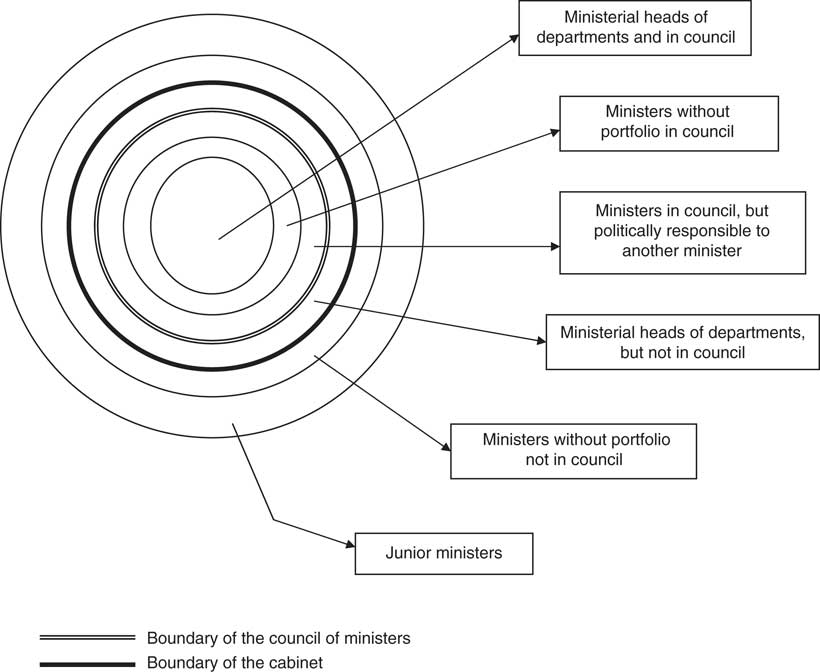
super-ministers, who hold the three main roles: council member, department head, and party leader;
ordinary ministers, who hold both the council membership and the departmental head roles;
Some other types exist:
party ministers, who are full council members and party leaders;
councillors, who are ministers without portfolio, with the right to vote in the full cabinet;
second ministers, who are ministers who hold the right to vote, but are dependent ministers (accountable to another minister);
departmental ministers, who head a department but are not members (with the right to vote) of the council. They are quite isolated, but in the decision-making process they carry considerable weight in their field.
On the other hand, outside cabinet there are other types of ministers (see Figure 1): ministers without portfolio who are not members of the council of ministers, and junior ministers (ministers who depend on another minister and are not council members).
Government Layers: From Centre to Periphery

Composition of Cabinets: A Comparative View
Up to now we have provided a conceptual critical analysis of the notion of cabinet and proposed an analytical definition of it by focusing on its members and the roles they occupy. We have seen that the borders of cabinets can be more or less broad, depending on the types of ministers the government includes. Now we will look at the reality in order to demonstrate that the definition is appropriate. A deeper analysis of cabinets both across and within countries in order to answer questions about power distribution and decision-making modes is beyond the scope of our work. We are going to provide here just a general picture of the structure of cabinets in 38 parliamentary and semi-presidential democracies (17 in Western Europe, 15 in Central and Eastern Europe and six in non-European countriesFootnote 7) to gain an idea of the cabinet composition across the world. More exactly, we will examine the overall ministerial composition of the various executives, down to the junior ministerial layer. As far as possible we will try to focus on the regularities and traits specific to certain countries.
In choosing the countries, we have tried to cover almost all notable European parliamentary, and some semi-presidential, systems,Footnote 8 since Europe is the birthplace of cabinet government as well as the area of the world in which it is most widespread. We have also selected some countries from among the most important parliamentary systems outside Europe – those with a long tradition of cabinet government. The aim is to provide a general picture of reality that is as comprehensive as possible.
Council Members
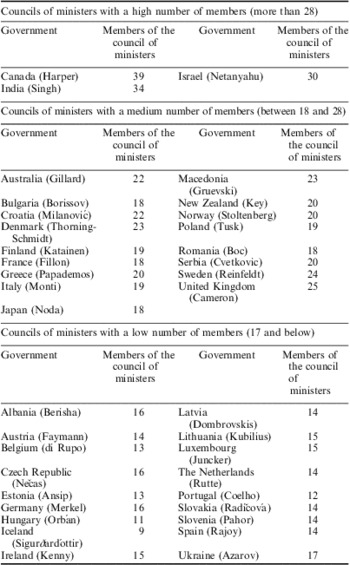
All countries that have adopted a cabinet government show a formally collegial organ made up of a prime minister as well as a number of other ministers. The number of people involved can be large or small; it varies from one country to the other (see Table 1) and has varied diachronically within countries, sometimes according to specific regulations.
Number of Members of the Council of Ministers (Prime Minister Included) in the Relevant Countries (1 February 2012)

Regular council members with the right to vote are, by our definition, endowed with an important role. For some regular council members, such as the councillors, the right to vote is all they have. There are substantial differences from one country to the other regarding the importance of this kind of actor. In Italy, ministers without portfolio whose status is only as members of the council of ministers have generally been given a relatively high status, and there have been many such actors (see Verzichelli and Cotta Reference Verzichelli and Cotta2000: 469–70). In Portugal, where their number has risen over time, they have turned out to be a ‘reflection of [prime ministerial] power to influence others and control government’ (Costa Lobo Reference Costa Lobo2007: 276). In other countries, though, councillors are rare. In Belgium no such ministers have been appointed since 1968. In Finland none has been appointed since the 1950s. In Ireland only one was appointed, for the period 1939 to 1945, for the purpose of coordinating defensive measures. In Bulgaria only two councillors were appointed in the 10 years after the fall of the Communist regime, one in 1990 and one in 1995 (Blondel and Andreev Reference Blondel and Andreev2001: 135). In Romania in 2001 there was only one councillor, in the last months of the Roman government (Blondel and Penescu Reference Blondel and Penescu2001: 113). Historically, the United Kingdom shows a peculiar case: in December 1916 Lloyd George formed a war cabinet (Jennings Reference Jennings1959: 294–301; Mackintosh Reference Mackintosh1977: 371–9) made up of five members, all non-departmental ministers, except for Chancellor of the Exchequer Bonar Law.
Usually, council ministers are in charge of a department (in the strict sense of the word; see note 4), and they are ordinary ministers.
Super-ministers, however, are a common reality in all countries, even those where, in the past, party leaders seldom entered governments (such as Italy and the Netherlands). Deputy prime ministers, who are normally super-ministers in coalition governments, can be found in most countries (France is one exception). Sometimes they are representatives – together with prime ministers who are also leaders of their own party – of a cabinet oligarchy. This is the situation with the Belgian Kerncabinet, a true inner cabinet, and the ‘dual leadership’ of the Austrian chancellor and vice-chancellor (see also Andeweg Reference Andeweg1993).Footnote 9
Sometimes there are ministers who are not in charge of a specific department or who act in support of the prime ministers or the government as a whole,Footnote 10 but are in charge of agencies (as in Canada and Japan) or some other entity. Some examples of the latter are the president of the Canadian Treasury Board, or president of some committee under the Polish government headed by Buzek (1997–2001). In other cases, the guidance of one department can actually be shared among a number of ministers. In Finland, for instance, it is an established practice to place more than one minister at the head of the most important departments, establishing a division of responsibility but not a hierarchical structure among the heads (Nousiainen Reference Nousiainen1997: 249). In Estonia, during the Ansip government, which took office in 2007, there were two ministers at the head of the Ministry of the Interior (the minister of the interior and minister for regional affairs).
Some ministers can be given honorific titles that confer on the holder a special, higher symbolic status. These symbols reflect reality, as is the case with the title of minister of state (ministre d’état) in France. This title is reserved for prominent or long-serving politicians (Kam and Indridason Reference Kam and Indridason2009: 49). In Portugal the same title (ministro de estado) is conferred on people who occupy a pivotal position within the cabinet, as is the case with the minister of finance (Costa Pinto and Tavares de Almeida Reference Costa Pinto and Tavares de Almeida2009: 149). The British prime minister may name one secretary of state as first secretary. This determines precedence in the cabinet, and the first secretary can deputize for the prime minister in his or her absence (Bradley and Ewing Reference Bradley and Ewing2007: 268).
Greece and Canada have unique ministerial groups in their full cabinet. In the Greek government there are so-called ‘alternate ministers’. Despite the voting right and the specific responsibilities they have, they are still politically responsible to another minister (Trantas et al. Reference Trantas, Zagoriti, Bergman, Müller and Strøm2008: 391–2). These ministers form a very peculiar ministerial category with several overlapping statuses. They are dependent ministers in the council, considered to be cabinet members, although of a particular and residual type, that of second ministers. Canadian ministers of state are quite similar. Appointed in the 1970s in order to help other ministers perform the duties of their portfolios, they are also quite active in a number of cabinet committees (Aucoin Reference Aucoin1999: 116).
Full Ministers Outside the Council
It is only in a very few countries with a common tradition (Weller Reference Weller1985) that some full ministers are not actually council members (Weller Reference Weller1980).Footnote 11 These countries are the United Kingdom and a few others in which the British tradition was widespread (Australia, New Zealand and India), which are all in a class of their own when it comes to the creation of their governmental institutions.
In the United Kingdom ministers with a department can sometimes be somewhat isolated within the ‘club of ministers’. Their jobs range from secretaries of state, who are senior ministers at the head of major departments, to lower rank departmental ministers, who are confined to the cabinet committees in which they participate (Biagi Guerini Reference Biagi Guerini1982: 147; Fabbrini and Vassallo Reference Fabbrini and Vassallo1999: 129). However, the departmental resources they have enable them to play a substantial role in the decision-making and the policy-making of the government (James Reference James1999: 12). We believe they should be perceived as part of the cabinet.
The position of the full minister without traditional membership status appeared in New Zealand only in 1987. She or he is authorized to take part in the proceedings of the cabinet only by the prime minister's invitation, should this be required in the discussion of some specific issue. She or he is definitely a full-fledged minister in his or her own right, and may attend cabinet committee meetings regarding matters within his or her responsibilities.
Full ministers outside the council are also to be found in the Australian (Weller Reference Weller1980) and Indian governments. In India, they are called ministers of state with independent charge. Unlike ministers of state, who are junior ministers, they are not accountable to any other minister for their specific duties.
Junior Ministers Outside the Cabinet
The junior minister is a minister, but not technically a cabinet member. She or he is a governmental political actor working in a department or in a structure in support of the prime minister,Footnote 12 that is, a dependent minister outside the council. Not all junior ministers have equal status. We can separate out two main types: that of junior ministers operating on the basis of some special power of proxy covering the specific field they are involved in, which gives them a very special status, and the type of traditional junior ministers without this special status.
The former type is only found in a few countries: France, India, Italy, New Zealand and the United Kingdom, all countries with specific traits of their own. In Italy in the 1990s a new figure was established: the deputy minister. She or he may sit on the full cabinet, but only by invitation, and without the right to vote. She or he belongs to an ‘intermediate layer of junior ministers . . . in between . . . ministers proper . . . and other ministerial Under-Secretaries, who are not appointed deputy-ministers’ (Barbieri Reference Barbieri2003: 146).Footnote 13 In major departments in the British government we can find ministers of state, who – unlike other junior ministers (under-secretaries and parliamentary secretaries) – are appointed by the monarch and not by the prime minister. In India this type of junior minister is called minister of state. In New Zealand the figure in question is called associate minister; in most cases, she or he has a ministerial portfolio in his or her own right (New Zealand Cabinet Office 2008: 22). In addition, in France you can find the term ‘delegate minister’ (ministre délégué), a minister who does not take part in the proceedings of the council of ministers, save for specific cases where his or her act of appointment provides otherwise.
There are junior ministers of the ‘classic’ type in all the countries dealt with so far,Footnote 14 with the exception of Denmark and Iceland. In Finland they have been introduced only recently.
In addition to the common junior ministers, it is possible to find so-called parliamentary secretariesFootnote 15 in four countries: Canada, Japan, IndiaFootnote 16 and Latvia. Parliamentary secretaries maintain the links between their respective ministers and parliament. Unlike Canadian and Latvian secretaries, the Japanese ones are even closer to their minister and take part in planning policy in compliance with the instructions of the minister.Footnote 17
Conclusions
In order to give a definition of cabinet that is useful for empirical comparative research, we must lay aside the functional perspective and start from the triadic legal definition of cabinet to highlight an analytical definition based on the composition of the cabinet. From this perspective, the cabinet is viewed as a club of ministers, and we define what criteria should be applied to classify them: political appointment, political delegation, degree of responsibility (direct and indirect) and three kinds of ministerial roles (voting right in the council, guidance of a department and party leadership). The criteria define who the ministers are, and enable us to mark the boundaries of the cabinet.
In most countries the cabinet tends to concentrate the three mentioned ministerial roles. In some countries, the ministerial roles are differentiated. The governments with a British tradition are the most important exceptions. These often separate the roles of head of a department and member of the council with voting rights, creating two very different figures in the cabinet system. Other rare categories are councillors, ministers in the council without a department, and ministers in the council who are politically responsible to another minister.
A complementary exercise may be to group the countries on the basis of the internal distribution of power, according to the lines indicated by the literature. What was lacking here was an empirical definition of the ‘ministerial club’. We have tried to provide one that will be useful in the future, to research further questions: (1) how can we classify the cabinets according to their decision-making processes? (2) how can we analyse the power distribution? and (3) how can we distinguish the cabinets according to their power patterns? Through this article we have tried to answer the question of what a cabinet is, as an empirical object for comparative studies, keeping in mind the most important questions raised by the literature.
In summary, our conceptual framework does not discard what has been done in the political studies of cabinet government, but it is an attempt to make a clearer starting point from which to trace research paths to help us understand the very widespread and intriguing system of cabinet government.
Acknowledgements
This article is fully co-authored. We would like to thank Rudy Andeweg, Jean Blondel, the editors and the reviewers of Government and Opposition for their valuable comments.