Introduction
Sudden hearing loss is defined as any loss greater than 30 dB, over at least three continuous frequencies, that develops over a period of 3 days or less.Reference Sara, Teh and Friedland1 Possible causes include viral infections, trauma, neurological diseases and neoplasia.Reference Sara, Teh and Friedland1
Spinal anaesthesia is one of the most widely used regional anaesthesia techniques. Sudden bilateral hearing loss occurring after spinal anaesthesia has only been reported in a few cases in the literature.Reference Schaffartzik, Hirsch, Frickmann, Kuhly and Ernst2 Several factors are claimed to be influential in the development of hearing loss, but the exact mechanisms are unclear.
In this paper, we present the case of a 50-year-old woman who developed sudden bilateral hearing loss following spinal anaesthesia for hallux valgus surgery.
Case report
A 50-year-old woman presented to our ENT clinic with hearing impairment, vertigo and tinnitus after hallux valgus orthopaedic surgery. The symptoms were reported to have begun 6 hours after surgery.
The patient's medical history did not include hearing loss, vertigo or any other ear disease. Moreover, physical examination of the patient revealed natural and normal bilateral ear canals, auricles, and tympanum. The ENT examination findings proved to be normal. In addition, the neurological examination showed no pathological findings.
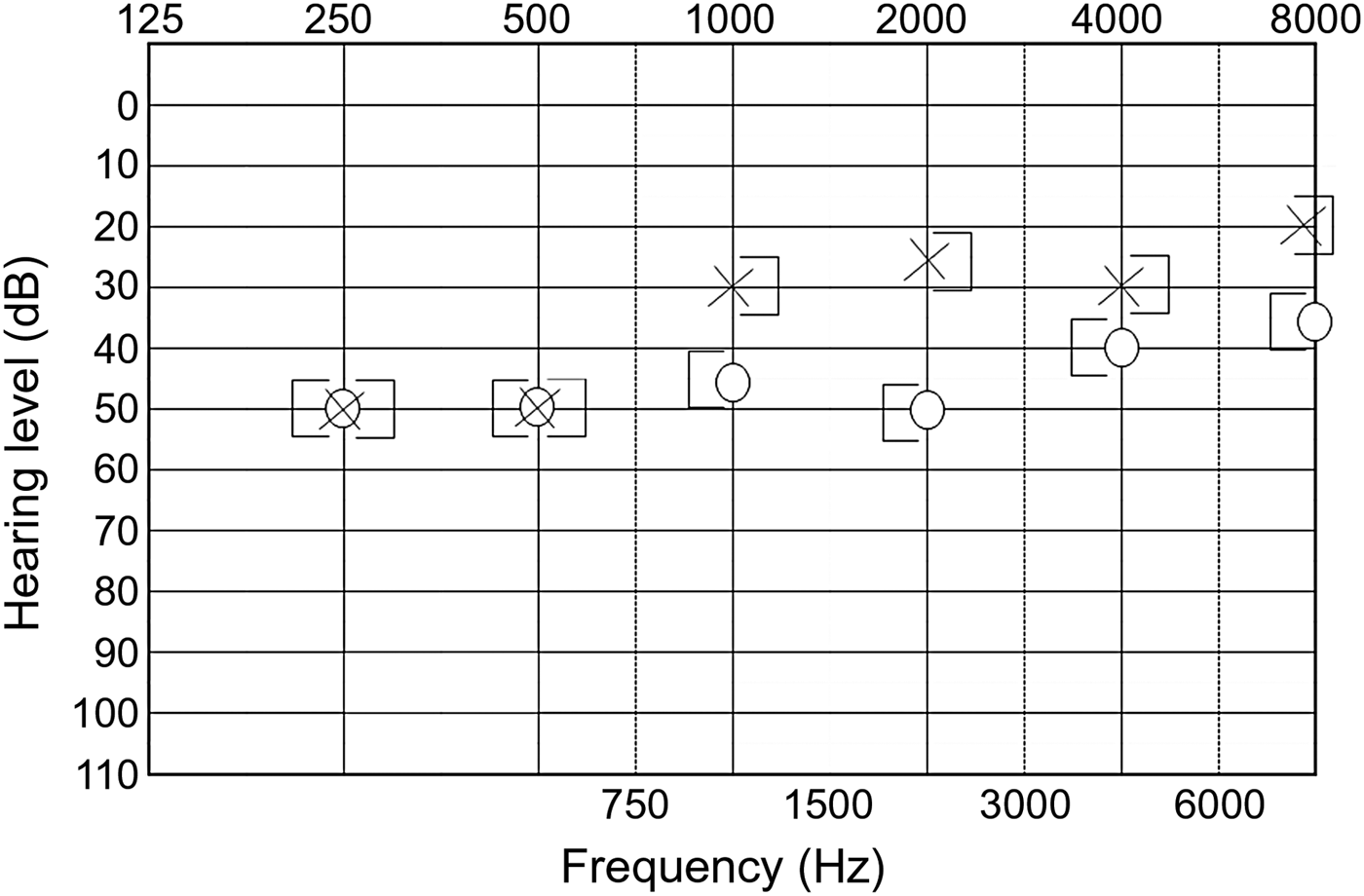
Audiometric analysis of the patient revealed bilateral sensorineural hearing loss over 30 dB (Figure 1). Speech perception was normal bilaterally. Tympanometry showed the type A curve of a normal tympanogram. Pre-operative audiometry was also normal.
Audiometric analysis of the patient after spinal anaesthesia. [=right bone conduction with masking;] = left bone conduction with masking; × = left air conduction; ○ = right air conduction

At systemic examination (conducted pre-operatively), the patient's temperature was 37°C, with a pulse rate of 80 bpm and blood pressure of 120/80 mmHg. Neither hepatosplenomegaly nor petechiae or purpura were noted. Laboratory tests, blood biochemistry tests, chest X-ray, and toxoplasmosis, rubella, cytomegalovirus and herpes simplex (‘TORCH’) screening tests were normal. Cranial and temporal magnetic resonance imaging findings were evaluated as normal. The findings of a pre-operative physical examination conducted under anaesthesia (before hallux valgus orthopaedic surgery) were also normal.
The spinal anaesthesia was performed by inserting a 25-gauge needle (Spinocan®; B. Braun, Melsungen, Germany) into the subarachnoid space at the L3/L4 vertebral interspace. The first attempt to insert the needle into the subarachnoid space was successful. A 15 mg dose of 0.5 per cent heavy bupivacaine was injected after cerebrospinal fluid (CSF) leakage was observed.
Post-operatively, the patient was started on 2 mg/kg prednisolone administered intravenously (IV), 2 × 24 mg betahistine dihydrochloride orally, 3 × 4 g piracetam IV, and 1 × 1 vitamin B complex IV (25 mg vitamin B1, 2 mg vitamin B2, 15 µg vitamin B12, 50 mg nicotinamide and 10 mg calcium pantothenate). Hyperbaric oxygen therapy was initiated on the 2nd day after hearing loss and continued for five sessions.
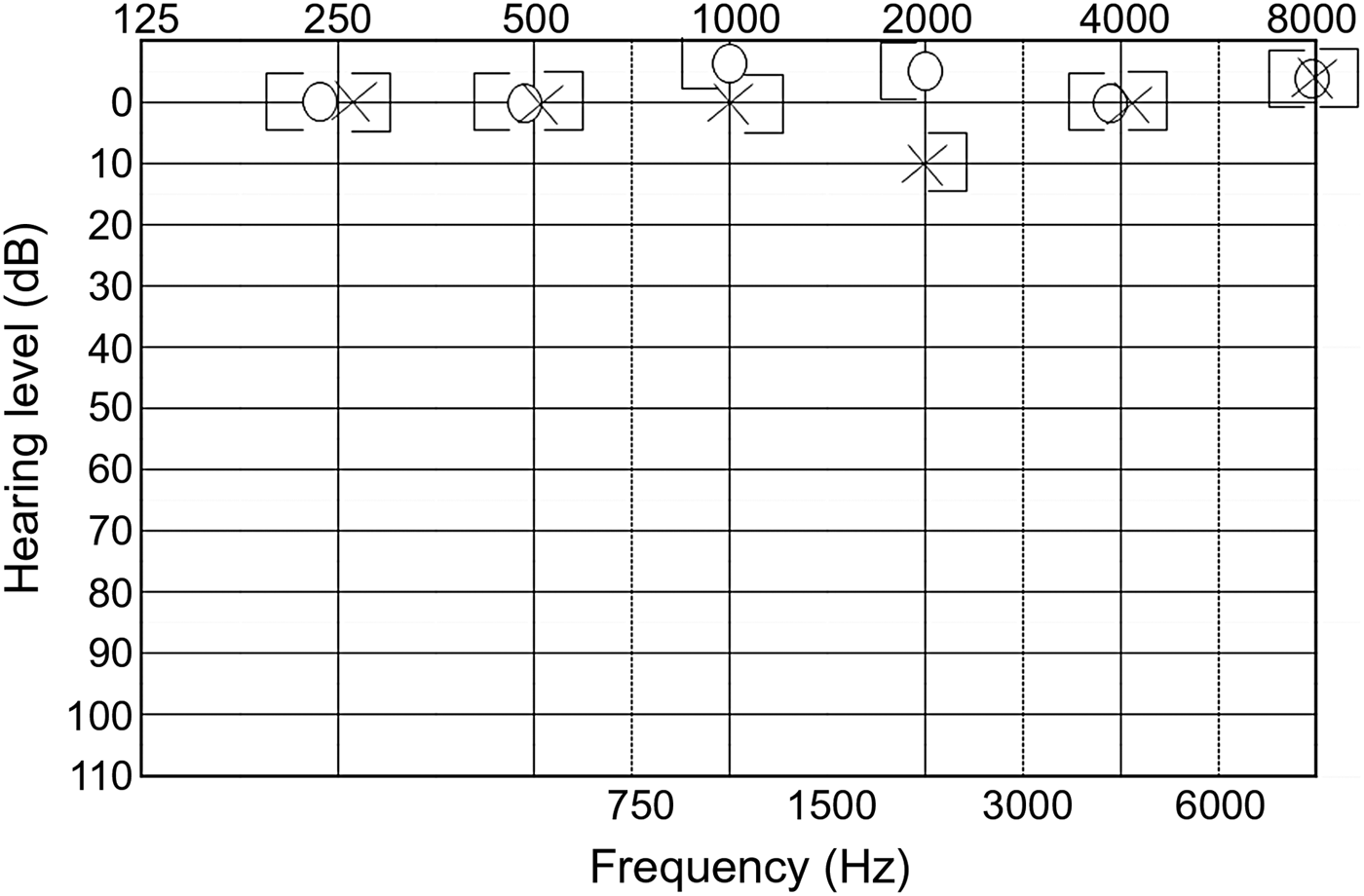
The patient's hearing had almost completely returned to normal on the morning of the 3rd day following surgery (Figure 2). Complaints about vertigo had virtually disappeared by the 4th day. Steroid treatment was tapered off and finally stopped on the 14th day. No recurrences of hearing loss, tinnitus or vertigo were reported during the six-month follow-up period.
Audiometric analysis of the patient after treatment. [= right bone conduction with masking; ○ = right air conduction; × = left air conduction;] = left bone conduction with masking
Discussion
Spinal anaesthesia is one of the most widely used forms of regional anaesthesia. The rate of post-operative hearing impairment after spinal anaesthesia is reported to be 0.2–8 per cent.Reference Kiliçkan, Gürkan and Ozkarakas3 Hearing problems may emerge in the first 24 hours or present up to the 1st week post-operatively. Hearing loss following spinal anaesthesia is predominantly unilateral, occurring at the low frequencies of 125, 250 and 500 Hz.Reference Kiliçkan, Gürkan and Ozkarakas3 Sudden bilateral hearing loss at high frequencies has been reported in very few cases. In our case, hearing impairment was evident 6 hours after surgery, and bilateral hearing loss was observed at all frequencies (125, 250, 500, 1000, 2000, 4000 and 8000 Hz).
Vascular factors (thrombosis, spasm, emboli and ischaemia), autoimmunity and viral disease of the cochlea are thought to be the main causes of sudden hearing loss.Reference Sara, Teh and Friedland1 However, the aetiology of hearing loss following spinal anaesthesia is not yet fully understood. It is suggested that CSF leakage after dural puncture causes a decrease in intracochlear pressure and a relative increase in endolymphatic pressure.Reference Sprung, Bourke, Contreras, Warner and Findlay4 Relative endolymphatic hydrops affects all basilar membranes, especially the apex of the cochlea. It is thought that the hearing organ is affected by ischaemia caused by increased endolymphatic pressure and decreased interior pressure of the cochlea, inevitably causing hearing loss. Increased endolymphatic pressure might also cause tinnitus and vertigo complaints. In fact, our case had tinnitus and vertigo in addition to hearing loss.
Patients who receive spinal anaesthesia with needles of a large diameter are at greater risk of hearing loss than those treated with needles of a smaller diameter.Reference Malhotra, Joshi, Grover, Sharma and Dutta5 Moreover, sharp needles are more likely to cause hearing loss than pencil point needles.Reference Erol, Topal, Arbag, Kilicaslan, Reisli and Otelcioglu6 Additional CSF leakage during the process would generate this effect. More than one entry into the dura with the needle has greater potential for hearing loss than a single entry.Reference Tyagi, Gupta, Kumar, Sethi and Mohta7
The age of the patient is an important factor associated with hearing loss after spinal anaesthesia.Reference Gültekin and Ozcan8 Gültekin and Ozcan found that 52 per cent of hearing losses occurred in young patients, compared with 16 per cent in older patients.Reference Gültekin and Ozcan8 Young people have more CSF and this may be related to the reported difference between age groups. Our patient was 50 years old.
Acute changes in blood volume and osmolarity during anaesthesia might contribute to ischaemia. This may have a role in the aetiology of hearing loss.Reference Yildiz, Solak, Iseri, Karaca and Toker9 Our patient received sufficient liquid replacement; furthermore, blood pressure and pulse rate were normal during the operation, and no hypotension was detected.
As the definite cause of sudden hearing loss in these cases is unclear, treatment of the condition is controversial. Some patients may heal spontaneously, without treatment after surgery.Reference Gültekin and Ozcan8 Systemic steroids, cochlear vasodilators and betahistine are used for treatment. Hyperbaric oxygen therapy speeds up the tissue healing process, contributes to the diminution of tissue oedema by inducing vasoconstriction, decreases platelet aggregation, helps detoxification of the oxidative toxins and increases axonal regeneration.Reference Kang, Gorti, Quan, Ho and Koch10 In our case, as we had diagnosed hearing loss, 2 mg/kg prednisolone, piracetam, betahistine and vitamin B complex treatment were commenced. On the 2nd day after hearing loss, hyperbaric oxygen therapy was initiated and continued for five sessions. The patient's hearing had returned to normal on the morning of the 3rd day following surgery. Even though an epidural blood patch has been described in the literature, it was not attempted in our case as hearing had improved.Reference Lee and Peachman11
• Spinal anaesthesia is one of the most widely used regional anaesthesia techniques
• Sudden bilateral hearing loss occurring after spinal anaesthesia is rare
• Early diagnosis is crucial for successful treatment
• Post spinal anaesthesia complaints such as hearing loss, tinnitus or vertigo should be taken seriously
In conclusion, hearing complications may emerge in some patients after spinal anaesthesia. Cases of sudden bilateral hearing loss following spinal anaesthesia have been presented in a limited number of studies. Our study has shown that the possibility of hearing loss following spinal anaesthesia is a serious repercussion that one should be aware of.