Accounts of Buddhism in Thailand, Burma and Cambodia offer detailed descriptions of ‘the power attributed to inscribed amulets, tattoos, and related forms of writing’ (p. 8). But earlier scholarship on Southeast Asia ‘often looked down on non-literary uses of script’, treating it as either a ‘non-Buddhist “cultural” accretion or the ignoble trappings of popular superstition’ (p. 8). Such judgements were based on an idealised conception of Buddhism that focused on canonical scripture, and congealed under colonial rule.Footnote 1 Where Richard Fox finds a fruitful ‘indeterminacy’ in the aksara of Bali, colonial scholarship tended towards overdetermination, creating a rigid hierarchy of Buddhist scriptural forms. Pali, the language in which generations of monks had chanted, thought and wrote, was deemed ‘less than’ Sanskrit, but ‘more than’ the plethora of indigenous languages of the region.
In seeking to dislodge the primacy of written text as the medium for the transmission of belief and the exercise of authority in Bali, Fox finds good company in recent scholarship on mainland Southeast Asia.
In his historical ethnography of monastic communities in Northeastern Thailand, Daniel Veidlinger emphasises the primacy of oratory as the medium of the Dhamma.Footnote 2 Seers transcend words, and scribes are minor pen-pushers (or stele wielders). The glaring absence of writing instruments in the hands or near the vicinity of Buddha in the visual culture of Theravada Southeast Asia, supports Veidlinger's thesis. Buddha didn't write. He spoke. Wordsmithing was the work of lesser beings. To listen is to learn, to learn is to listen, and to scriven is to clerk. But it is also to gain merit.
The potency of Buddha's utterances requires training in more than words. It requires virtue, insight and spiritual discipline. Justin McDaniel demonstrates how Nang Nak shrines in contemporary Thailand are at once ‘repertoires of abundance’ and part of a broader spiritual landscape animated by paritta (protective verses) and jhana (meditative practices).Footnote 3 The ‘public and participatory’ nature of powerful prophylactic texts such as the Jinapanjara gatha (Verses on the victor's armour) creates community while underscoring individual incandescence.Footnote 4 Activating such powerful texts requires deep reserves of far-sightedness (panna) and spiritual potency (barami). Only when chanted by Venerable Somdet To, does the Jinapanjara subdue Nang Nak's restless soul, quell her desire and sunder her attachment.
Against these repertoires of abundance and performance, Fox's nuanced study of the intrinsic power of words reveals letters as vehicles of concealment. Only the most spiritually powerful and skilled can inscribe and interpret them. This very illegibility telegraphs their hidden potency. The archaic Khmer script, known in Thai as khom—a term also used by conservative intellectuals to refer to a powerful race believed to have vanished after it built Angkor—is a preferred medium of inscription for yantras (talismanic inscriptions) in Thailand.
Balinese letters have transmitted traditional knowledge through palm leaf manuscripts, inscriptions and printed books. But letters, as Fox tells us, are also more than the words they build. They enact a ‘more fundamental, and inclusive, transfer of efficacy’.Footnote 5 This efficacy inheres in an economy of scale. Small is often better: concealed, more so. In the ‘sacred geometry’ of a protective tattoo needled by a war veteran turned practitioner on a Phnom Penh client ‘Na symbolizes the father's merits, Mo those of the mother, Bu those of the older brother or the family, Dha those of royalty and Ya those of the guru (here signifying the practitioner himself), the whole forming a protective skein against ill health, accident and injury’.Footnote 6 In Fox's Bali as in Cambodia, letters function not as lone stars, but as symbols of fuller constellations and instruments of a higher power.
That higher power can also be the state, whose manipulation of letters and repression of literati points to a more secular use of word craft as warcraft. In his brilliant essay ‘I hate the word and the letter ត’ Cambodian writer Khun Srun (1945–78) resists aksara as instruments and symbols of repression. ‘My hatred for the word ត caused my hatred for the letter ត. It's true! I detest this sly, sinuous letter, which coils, returns and closes back on itself without ever allowing for the possibility of being undone.’Footnote 7 Khun Srun's assault on aksara takes oblique aim at the regime of Norodom Sihanouk for stifling voices and repressing writers. Twice imprisoned by the right-wing Lon Nol regime, Khun Srun was later executed by the Khmer Rouge, whose war on words sought to eviscerate the language of nuance.
Translation
A key goal of Fox's More than words is to decipher the relationship between writing, agency and collective life.Footnote 8 In doing so, Fox draws on the Greek and Latin schema of ‘carrying across’ that still frames translation studies,Footnote 9 while looking beyond this ‘woefully misleading trope’Footnote 10 to Sanskrit,Footnote 11 a script that tells only one side of the story. The Khmer compound to translate (bakprae,  ) combines the word bak បក for to peel, to strip, to return, with to turn, to turn around, to turn over (prae,
 ) and has less in common with Sanskrit than with Chinese. In Chinese, 翻 (fan), the root verb in the compound for translate 翻譯 (fan yi), most commonly means overturn, to flip upside down, to render bottom top; and only less commonly to climb over 爬(pa)or pass across 越 (yue). The Thai compound plae plien, one of many Thai terms for translation, derives from the above noted Khmer (prae
 ) and the Chinese bian (變), to change, which in turn inform and reflect Thai concepts of translation—concepts themselves in change—as a process of contingency, not porterage.Footnote 12 In this topsy turvy world of multilingual meanings, one thing is clear. Whether carried in a yantra of cloth, paper or body ink words, translating the power and meaning of words involves much more than an act of passage; it requires an act of passing through. Lauren Elkin's elegant definition is helpful here:
translation is more than grammar, it is a listening. When we translate, we are not rendering a block of text in its immediate equivalent, we keep an ear out for what is unspoken, carried through language; smuggled inside of it.Footnote 13
Desire
Embodied in palm leaf manuscripts, amulets and other inscribed objects, the incision and creation of such words is the preserve of an elite educated in knowledge forms that are at once arcane and widely sought. In Cambodia, whether ‘traced on a scarf, on a shirt, on a metal or paper amulet, or a fortiori tattooed on the flesh’, the practitioner knows precisely ‘which formula has the power to obstruct arrows, which can render one invisible on losing one's weapons, which of the 108 configurations of the letter NA should be used to never be trampled on by an elephant’, as well as their more prosaic properties: which yantra can bring wealth, success in business, luck in gambling, and lure womanly love.Footnote 14 This is a highly gendered art.
While women are a large market for yantras on paper and cloth, men are still believed to be the most attached to such amulets, especially in their use as a means of augmenting personal power. Male yantra inscribers practice on mostly male bodies. This tradition might be seen as an attempt to control female power. These sacred graffito act like a form of magnetic field, repelling such negative energies as attacks and bad luck, and inviting such positive forces as prosperity, promotion, and protection. Specific tattoos and yantra are also designed to channel and control carnal desire.
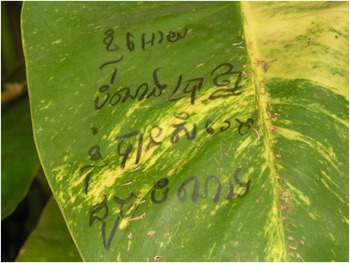
More than signs, Fox shows us, words are symptoms of human desires—for contact, for connection, for protection. These desires intersect with another: the desire to be seen, to be heard, to be read by spirits and higher beings. We see this in contemporary Cambodia in the incision of personal wishes in Khmer on foliage known as slik caa (leaves for inscribing) at spiritually potent sites. This practice contravenes Buddhist environmental ethics, and secular and monastic laws. A sign in the grounds of Phnom Penh's Royal Palace warns: ‘All who harm leaves by inscribing on them will be reborn cross-eyed and hare-lipped’ (see fig. 1). But leaf writers from all walks of life resist this injunction.
Sign at the Royal Palace, Phnom Penh. Photo: Penny Edwards, 2005.

‘I hope I get the decision I want,’ reads one inscription among many I observed at this site in 2005 (see fig. 2). Some wishes revealed the hand of aspiring provincial governors, stressed students, and pensive monks. Unlike the love, protest and tourist graffiti etched in tree bark, on construction sites and in monuments elsewhere in the city at the former royal capital of Oudong, these leaves from modern life are unsigned and undated.Footnote 15 Leaf writing is life writing. Connecting spiritual, earthly, human and plant life, this practice is in rhythm with three keys of Fox's book: writing, agency and collective life.
Leaf Inscription at the Royal Palace, Phnom Penh. Photo: Penny Edwards, 2005.