Introduction
In the recent years more attention has been given in selection strategies to obtaining robust animals that have good reproduction and survival characteristics. A high level of reproductive longevity reduces the replacement cost of the animals and, together with some rearing and housing practices that could improve the freedom to express natural behavioral patterns (Trocino and Xiccato, Reference Trocino and Xiccato2006), is also considered a component of welfare friendly production.
In producing animals, longevity reflects the animals ability to not succumb to disease or reproductive failure and thus maintain productive performance (Vollema, Reference Vollema1998). On commercial rabbit farms, the culling policies are also related to evident pathological problems and reproductive failure (low fertility and prolificacy). Therefore, the ability of animals to confront with success possible environmental challenges (e.g. infections, heat stress conditions, under-nutrition, etc.) and demanding production situations (lactation–pregnancy concurrency, high milk yield, etc.) is an important factor in long-lived productive animals.
In rabbit females, the main productive challenges are linked to the reproductive rhythm, i.e. the intensity of reproduction timing (Xiccato et al., Reference Xiccato, Trocino, Boiti and Brecchia2005) and the litter size during lactation (Fortun-Lamothe et al., Reference Fortun-Lamothe, De Rochambeau, Lebas and Tudela2002). Several works indicate that modern primiparous rabbit does show a clear energy deficit during lactation (Xiccato et al., Reference Xiccato, Parigi-Bini, Dalle Zotte, Carazzolo and Cossu1995; Bolet and Fortun-Lamothe, Reference Bolet and Fortun-Lamothe2002; Pascual et al., Reference Pascual, Motta, Cervera, Quevedo, Blas and Fernández-Carmona2002), and benefit from lengthening the interval between kindlings to allow complete body recovery (Parigi-Bini et al., Reference Parigi-Bini, Xiccato, Dalle Zotte, Carazzolo, Castellini and Stradaioli1996), thereby reducing the risk of culling during the second cycle. At the same time, selection for litter size has increased the milk demand of the kits (Quevedo et al., Reference Quevedo, Cervera, Blas, Baselga and Pascual2006), potentially exacerbating this situation. This apparent dilemma between production and reproduction is found in the other livestock species [in cattle: Pryce et al. (Reference Pryce, Nielsen, Veerkamp and Simm1999), in pigs: Grandinson et al. (Reference Grandinson, Rydhmer, Strandberg and Solanes2005) and other livestock species: see the review of Rauw et al. (Reference Rauw, Kanis, Noordhuizen-Stassen and Grommers1998)].
Sánchez et al. (Reference Sánchez, Theilgaard, Mínguez and Baselga2008) compared two rabbit selection lines, selected for breeding female longevity (line LP) or for litter size at weaning (line V); they observed that V females were 1.3 times more likely to leave the herd than LP females (demonstrating the longer productive life of the LP line), and that litter size in parity 1 to 3 was on average higher in the V line (between +0.5 and +0.92 kits born alive). Theilgaard et al. (Reference Theilgaard, Sánchez, Pascual, Berg, Friggens and Baselga2007) found that adult LP females were on average 250 g (i.e. 5%) heavier than adult V females. Theilgaard et al. (Reference Theilgaard, Sánchez, Pascual, Berg, Friggens and Baselga2007) observed that an environmental challenge (high temperature or strong feed restriction out of lactation) led to a subsequent decrease of reproductive performance in V females, which maintained body weight. By contrast, LP females maintained their reproductive performance but reduced body weight. This suggests that selection for litter size and selection for longevity have different consequences for reproductive robustness, i.e. for the ability to sustain production under environmental challenge. Increased body reserves (analogous to the increased adult soma of the LP line) have been reported to favorably influence reproductive longevity in pigs (Yazdi et al., Reference Yazdi, Lundeheim, Lydhmer, Ringmar-Cederberg and Johansson2000).
The hypothesis of this study is that the better longevity of the LP line is due to its ability to exploit its greater soma to sustain production under environmental challenge. We study the LP and V lines’ ability to cope with productive challenges during a critical culling period. Females of both lines were submitted to different parturition to mating intervals after first parturition, and to different litter sizes during second lactation (the critical culling period in commercial rabbit production, where about 20% of females commonly die or are culled; Sánchez et al., Reference Sánchez, Theilgaard, Mínguez and Baselga2008). Traits recorded include reproductive performance, body condition and lipolytic potential.
Material and methods
The experiment was carried out following the recommendation on care and protection of animals used for experimental purpose of the European Union (2003) and the recommendations for applied nutrition research in rabbits described by the European Group of Rabbit Nutrition (Fernández-Carmona et al., Reference Fernández-Carmona, Blas, Pascual, Maertens, Gidenne, Xiccato and García2005).
Experimental design
Rabbit does from two selection lines (LP and V; see the next section for the genetic histories) developed at the Polytechnic University of Valencia were used. After first parity, does were randomly allocated to experimental groups. Litter size in first parity had been standardized to nine kits at birth to minimize bias due to first-parity differences. Within each line, three experimental groups with different levels of productive effort were planned: a group inseminated at day 4 post first partum and standardized to a litter size of nine kits at the second partum (PP9), and two groups inseminated after first weaning (day 30 post first partum) and standardized to either nine (PW9) or five kits (PW5) at second partum. Kits from nursing does outside the experiment were used to ensure a sufficient number of kits until weaning (day 30, end of the trial). The experiment was carried out in two batches, both of equal size, to reduce seasonal effects: first from May to June 2005, second from December 2005 to January 2006.
Animals
A total of 132 female rabbits were used in the experiment: 60 from the V line and 72 from the LP line. The V line has been selected for litter size at weaning for 31 generations, using as selection criterion the best linear unbiased prediction (BLUP) under a single-trait repeatability animal model (Estany et al., Reference Estany, Baselga, Blasco and Camacho1989; García and Baselga, Reference García and Baselga2002). The LP line was newly founded from commercial farms by the selection of females with at least 25 litters and with a minimum average litter size of 7.5 kits born alive (the typical population means in Spain are six litters per female and nine liveborn kits per litter; Ramón and Rafel, Reference Ramón and Rafel2002a and Reference Ramón and Rafel2002b). This involved three screenings of commercial rabbit farms in Spain and Portugal, with realized selected proportions between 0.002 and 0.005 of all animals screened; in effect, a system analogous to the ‘hyperprolific’ selection schemes for litter size reported by Herment et al. (Reference Herment, Runavot and Bidanel1994) and Noguera et al. (Reference Noguera, Alfonso, Babot, Pérez-Enciso and Estany1997) for pigs and by Cifre et al. (Reference Cifre, Baselga, García-Ximénez and Vicente1998) for rabbits. The first screening was done in April 2002, selecting 15 does from eight farms, which were transferred to the Institute test station. These does were inseminated with semen of males from the current generation of the V line at that time, resulting in 12 litters. The second screening was done in September and November 2002, selecting 15 does from 10 farms. These does were inseminated with semen of males produced in the first round, resulting in 17 male offsprings from 11 of the 15 females. The last screening was done in June and November 2003, selecting 32 does that were mated to males from the second round. This produced 30 litters, which formed generation 0 of the LP line. This generation 0 consisted of 42 females and 32 males, and it was multiplied by random mating.
Management of rabbit does
Animals were brought to the experimental farm unit (with light alternating on a cycle of 16 light hours and 8 dark hours, and under controlled environmental conditions) at 2 months of age and fed the same standard commercial diet for reproductive rabbit does (218 g acid detergent fiber and 174 g crude protein per kg of dry matter; Cunilactal, Nutreco) provided ad libitum throughout the experimental period. At 4.5 months of age all females were artificially inseminated (AI). During their first lactation the litters were standardized to nine kits. The does having a successful first parturition were randomly assigned to one of the two reproductive rhythms described above to obtain 43 and 89 females mated at post partum (PP) and post weaning (PW), respectively.
Litter sizes were standardized at the second partum to five or nine kits to obtain the three experimental groups, namely PP9, PW9 and PW5. During lactation females were prevented from having access to the nest when not nursing the kits. Within the first 14 days post partum, kits were replaced if dead. At day 17 of lactation the females were moved to individual cages and their litters had free access to water and feed, being re-united once a day for nursing until weaning (30 days). Females were not mated during the second lactation to avoid heterogeneity.
Performance traits
All measurements were made at the same time each day to minimize the influence of environmental factors, e.g. feeding and day rhythm. The perirenal fat thickness (PFT) was measured at days 1, 10 and 30 of lactation by ultrasound (Pascual et al., Reference Pascual, Castella, Cervera, Blas and Fernández-Carmona2000). Animals were placed in an immobilizing box (15 × 15 × 37 cm3) during ultrasound measurement and ultrasound gel was applied to the scanning area. The probe was always placed in the same position to obtain a repeatable transversal section of perirenal fat at 3 cm in front of the space between the second and third lumbar vertebrae. Images were obtained with an ultrasound unit (JustVision 200 ‘SSA-320A’ real-time machine; Toshiba; Medical Systems Co., Ltd, Tokyo, Japan) equipped with image analyser software to determine distances. The average of the left- and right-side PFT was used for further calculations. The evolution of the estimated body energy (EBE) content of does was determined from live weight (LW) and PFT of does, using the equations proposed by Pascual et al. (Reference Pascual, Blanco, Piquer, Quevedo and Cervera2004) for body energy estimation at different physiological states.
The daily milk yield was measured by the weigh-suckle-weigh technique: the difference in LW of does before and after taking them to the offspring. The LW measurement taken after suckling was used as the daily LW of the doe. Weekly means of milk yield and LW were used for further analysis. Feed intake of the rabbit does was recorded at days 7, 14, 21 and 30 of lactation.
Adrenergic stimulation
The energy from the adipocytes is released into the plasma as non-esterified fatty acids (NEFA). The amount of NEFA released and thus the change in the concentration of NEFA is a function of the size of the lipolytic signal and the sensitivity of the fat reserves to the signal, here called the lipolytic potential. This can be measured as the response to a standardized adrenergic stimulus (Chilliard et al., Reference Chilliard, Ferlay, Desprès and Bocquier1998).
The plasma NEFA response to an adrenergic agent was measured at days 1, 10 and 30 of the second lactation, using the protocol described in detail by Theilgaard et al. (Reference Theilgaard, Facila, Blas, Baselga and Pascual2005), to evaluate the lipolytic potential of both lines in the different experimental groups. Briefly, animals were fixed in hammocks to minimize movements and stress. Thereafter ears were shaved and a catheter was arranged in the central ear artery. Blood was sampled just before and 7.5 min after isoproterenol injection in the marginal ear vein (50 μg/kg LW, Sigma I5627; Sigma-Aldrich Co., St. Louis, USA). This time interval and concentration of isoproterenol were found appropriate for assessing the lipolytic potential in rabbits (Theilgaard et al., Reference Theilgaard, Facila, Blas, Baselga and Pascual2005). Blood samples were centrifuged immediately after sampling (2000 × g, 4°C and 15 min) and plasma was stored at −20°C until further analysis.
Plasma NEFA concentrations were determined using the in vitro enzymatic colorimetric methodology prepared by the NEFA Test Wako C (Wako Pure Chemical Industries, Ltd, Osaka, Japan). Samples were analyzed in an auto-chemical analyzer Wako Diagnostics 20R (Toshiba Medical Systems Co., Ltd, Tokyo, Japan). The within-run precision of this technique was 2.7%, 1.1% and 1.1% coefficient of variability for mean concentrations of 0.33, 0.66 and 0.99 mmol/l, respectively.
Statistical analysis
The model used to analyze the data of the rabbit does and their litters at partum was a fixed effects model (PROC GLM of SAS, Statistical Analysis System, 1996) that included the genetic line (LP and V), the reproductive rhythm during the first reproductive cycle (PP and PW) and their interaction:

For analyzing the performance of the rabbit does throughout second lactation, a mixed model (PROC MIXED of SAS, 1996) was used, according to a repeated measures design that takes into account the variation between animals and covariation within them. Covariance structures were objectively compared using the most severe criteria (Schwarz Bayesian criterion), as suggested by Littell et al. (Reference Littell, Henry and Ammerman1998). The model included the genetic line (LP and V), the experimental group (PP9, PW9 and PW5), the experimental period (spring and winter), the time point of measurement (7 or 10 days depending on the trait, and 30 days), and their interactions as fixed effects. Random terms in the model included a permanent effect of each animal (p) and the error term (e), both assumed to have an average of zero, and variance σ 2p and σ 2e. Only significant interactions were maintained in the model:
Different contrasts were computed to test the significance of the differences between genetic lines [LP = (PP9LP + PW9LP + PW5LP)/3 v. V = (PP9V + PW9V + PW5V)/3], previous reproductive rhythm [PW = (PW9LP + PW9V)/2 v. PP = (PP9LP + PP9V)/2] and litter size [LS9 = (PW9LP + PW9V)/2 v. LS5 = (PW5LP + PW5V)]. A statistical significance was declared at α = 0.05.
Results
Eight reproductive females decreased LW considerably just after they were moved at day 17 of lactation to individual cages, apparently due to difficulties learning how the water dispenser worked in the new cages but they regained LW afterwards. These unexpected observations of LW differing from the usual pattern were discarded as they were considered to be experimental artifacts. Two animals (one from each genetic line) died during the trial.
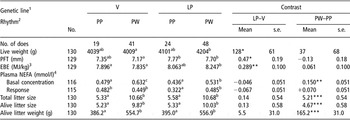
The effect of genetic line and reproductive rhythm used during the first reproductive cycle on the main performance traits of rabbit does at the second partum is presented in Table 1.
Effect of genetic line (V and LP) and reproductive rhythm of previous cycle (PP and PW) on the main performance traits of does at partum

PFT = perirenal fat thickness.
*P < 0.05; **P < 0.01; ***P < 0.001.
a,b,cWithin a row, means not sharing any common superscript are significantly different (P < 0.05).
1V: line selected for litter size at weaning for 31 generations; LP: line constituted by selection for hyper longevity and reproductive criteria.
2Reproductive rhythm at the previous cycle: PP, post partum (artificial insemination at 4 days after parturition); PW, post-weaning (artificial insemination at 2 days after weaning).
3Estimated body energy using the equations provided by Pascual et al. (Reference Pascual, Blanco, Piquer, Quevedo and Cervera2004).
4Basal, blood non-esterified fatty acids (NEFA) concentration before adrenergic challenge; response, increase of blood NEFA concentration after adrenergic challenge.
On average, LP does showed greater LW (+128 g; P < 0.05), PFT (+0.47 mm; P < 0.05) and EBE (+0.29 MJ/kg; P < 0.01) than V does at the second partum, mainly due to the differences between both lines when on the PW rhythm. With respect to the effect of genetic line on the litter size and weight at birth, both lines showed similar values. However, a huge effect of the previous rhythm of does on the litter traits at second partum was observed. PW females had a larger litter size (+5.21 kits; P < 0.001) than those mated at PP. The reproduction rhythm used during the previous reproductive cycle did not significantly affect LW, PFT or EBE of rabbit does. Basal NEFA concentration in plasma was just affected by the previous rhythm, being higher for PW does (+0.15 mmol/l; P < 0.01) than for PP does. After the adrenergic challenge, the increase of plasma NEFA concentration was not affected by the genetic line or the previous rhythm, but in LP does mated at PP was significantly lower (0.32 mmol/l) than for the other groups (averaging of 0.47 mmol/l).
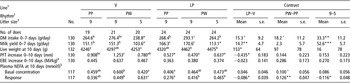
Table 2 shows the effect of the genetic line and the level of productive effort on the main performance traits of rabbit does in early stages of second lactation. With the exception of lipolytic response, there was no effect of reproduction rhythm (PW v. PP) on lactational performance. Although the feed intake of LP does was slightly higher (+15 g/day) than that observed for V does during the first week of lactation, it was mainly due to the greater LW of LP does, since the consumption per kg of metabolic weight (LW0.75) was similar for both lines (94 and 95 g of dry matter (DM)/kg LW0.75 day for V and LP does, respectively). As expected, the main factor affecting the feed intake of does was the litter size, with the daily feed intake of females with nine kits being 14% greater than for those with five kits (P < 0.01).
Effect of genetic line (V and LP) and level of productive effort (a group inseminated at day 4 post first partum and standardized to a litter size of nine kits at the second partum (PP9), inseminated after first weaning (day 30 post first partum) and standardized to either nine (PW9) or five kits (PW5) at second partum) on the main performance traits of does in early second lactation

DM = dry matter; PFT = perirrenal fat thickness.
+P < 0.10; *P < 0.05; **P < 0.01; ***P < 0.001.
a,b,cWithin a row means not sharing any common superscript are significantly different (P < 0.05).
1V: line selected for litter size at weaning for 31 generations; LP: line constituted by selection for hyper longevity and reproductive criteria.
2Reproductive rhythm at the previous cycle: PP, post partum (artificial insemination at 4 days after parturition); PW, post-weaning (artificial insemination at 2 days after weaning).
3Litter size standardized at second partum: five or nine kits per doe.
4Estimated body energy using the equations provided by Pascual et al. (Reference Pascual, Blanco, Piquer, Quevedo and Cervera2004).
5Basal, blood non-esterified fatty acids (NEFA) concentration before adrenergic challenge; response, increase of blood NEFA concentration after adrenergic challenge.
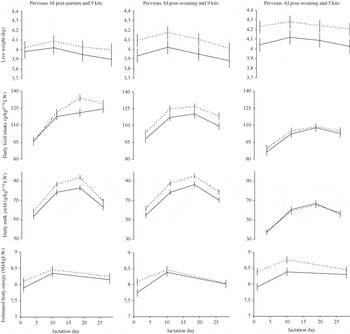
Litter size was again the main factor affecting milk yield, being 49% greater for those does with nine kits (P < 0.001). LP does had a higher milk yield (+10%; P < 0.01) than V does during the first week of lactation. However, as can be seen in Table 2 and Figure 1, the difference in milk yield between the lines during the first week of lactation was significant only when the litter size was nine (60 v. 54 g of milk/kg LW0.75 day for LP and V does, respectively; P < 0.01), milk yield was almost the same for the two lines when litter size was five (37.5 and 37.3 g of milk/kg LW0.75 day, respectively).
Effect of genetic line [V (——) or LP (- - -)] and level of productive effort on the evolution of live weight, daily feed intake, daily milk yield and estimated body energy of rabbit does during the second lactation.

LP does still presented a higher LW than V does at day 10 of lactation when litter size was five (+222 g; P < 0.05), whereas live weights were not significantly different when litter size was nine. Concurrently, during this period, LP does showed a lower recovery of PFT than V does when litter size was nine (−0.582 mm; P < 0.05), whereas a similar recovery of PFT was observed for both lines when litter size was five. Likewise, LP does showed a lower lipolytic response when litter size was five (−26%; P < 0.05), whereas differences between lines were not significant when litter size was nine. Females mated at PW in the previous cycle showed a higher lipolytic response (+41%; P < 0.01) than those mated at PP.
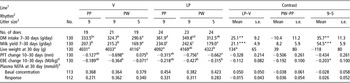
Finally, Table 3 shows the effect of the genetic line and the level of productive effort on the main traits of rabbit does during the last 3 weeks of the second lactation. Again, reproductive rhythm used during the previous cycle had no effect on the lactational performance of the females. Females with nine kits showed a higher feed intake (+13%; P < 0.01), milk yield (+33%; P < 0.001) and EBE mobilization (+0.20 MJ/kg; P < 0.05) than those with five kits.
Effect of genetic line (V and LP) and level of productive effort (a group inseminated at day 4 post first partum and standardized to a litter size of nine kits at the second partum (PP9), inseminated after first weaning (day 30 post first partum) and standardized to either nine (PW9) or five kits (PW5) at second partum) on the main performance traits of does at the middle and end of second lactation

DM = dry matter; EBE = estimated body energy.
*P < 0.05; **P < 0.01; ***P < 0.001.
a,b,c,dWithin a row means not sharing any common superscript are significantly different (P < 0.05).
1V: line selected for litter size at weaning for 31 generations; LP: line constituted by selection for hyper longevity and reproductive criteria.
2Reproductive rhythm at the previous cycle: PP, post partum (artificial insemination at 4 days after parturition); PW, post-weaning (artificial insemination at 2 days after weaning).
3Litter size standardised at second partum: five or nine kits per doe.
4Estimated body energy using the equations provided by Pascual et al. (Reference Pascual, Blanco, Piquer, Quevedo and Cervera2004).
5Basal, blood non-esterified fatty acids (NEFA) concentration before adrenergic challenge; Response, increase of blood NEFA concentration after adrenergic challenge.
As can be seen in Table 3 and Figure 1, when litter size was nine, LP does showed higher feed intake (+6 g DM/kg LW0.75 day; P < 0.05) and milk yield (+27 g/day; P < 0.001) than V does, resulting in no significant difference in LW between the lines at 30 days of lactation. However, when litter size was five, LP and V does showed similar feed intake and milk yield, and maintained a significant difference in LW at 30 days of lactation (+206 g in favor of LP does; P < 0.05).
All the females, independent of the genetic line, previous reproductive rhythm and litter size, showed a similar basal NEFA concentration on plasma (0.395 mmol/l) and lipolytic response (0.316 mmol/l) at weaning.
Discussion
The main effects of the two experimental treatments imposed to affect gestational and lactational performance are in accordance with the existing literature. Thus, an intensive reproductive rhythm (PP) had a negative effect on litter size and litter mass (see the review of Fortun-Lamothe and Bolet, Reference Fortun-Lamothe and Bolet1995). Likewise, an increased litter size resulted in greater intake, milk production and body reserve usage (Fortun-Lamothe and Gidenne, Reference Fortun-Lamothe and Gidenne2000; Castellini et al., Reference Castellini, Dal Bosco and Mugna2003; Maertens et al., Reference Maertens, Lebas and Szendro2006). Those effects were expected and were not the main focus of the present study, rather they were used to investigate the way in which the two lines responded to a performance challenge. We wished to assess whether selection for reproductive longevity (LP) results in changed priorities relative to selection for reproductive intensity (V).
There is evidence from a wide range of species of relationships between reproductive performance, longevity and body size (Clutton-Brock, Reference Clutton-Brock1984; Stearns et al., Reference Stearns, Ackermann and Doebeli1998; Reznick et al., Reference Reznick, Nunney and Tessier2000). In multiparous mammalian species [mouse: Falconer (Reference Falconer1960), Nelson and Robinson (Reference Nelson and Robinson1976); rabbits: Poigner et al. (Reference Poigner, Szendro, Levai, Radnai and Biro-Nemeth2000), Rommers et al. (Reference Rommers, Meijerhof, Noordhuizen and Kemp2001), pigs: Van der Steem (Reference Van der Steem1985)], there also seems to be evidence that females born in smaller litters showed better reproductive performance than those from larger litters. In addition, some studies in mice (Ozanne and Hales, Reference Ozanne and Hales2004) and rats (Langley-Evans and Sculley, Reference Langley-Evans and Sculley2006) have suggested that impaired fetal growth and consequently low LW in early life could reduce lifespan. In a previous study, the LP line was found to have longer reproductive lifespan than the V line (Sánchez et al., Reference Sánchez, Korsgaard, Damgaard and Baselga2006), with the most evident advantage of LP females being their greater LW from weaning (+46 g) to seventh parity (+150 g) (Theilgaard et al., Reference Theilgaard, Sánchez, Pascual, Friggens and Baselga2006). This result agrees with other selection experiments finding greater LW for mice selected on reproductive longevity compared to a control group (Nagai et al., Reference Nagai, Lin and Sabour1995).
In the present study, LP rabbit does also reached second parturition with a greater body size and body reserves (LW, PFT and EBE) than V does when mated after weaning (PW). However, LP rabbit does subjected to a more intensive reproductive rhythm (PP) seem to use part of their greater soma to successfully overcome this challenge, and consequently presented no significant differences in LW and EBE when compared to V does on PP (Table 1 and Figure 1). Further, and possibly related to this previous mobilization effort, LP does mated at PP showed the lowest lipolytic response at second parturition. This agrees with the findings of Theilgaard et al. (Reference Theilgaard, Sánchez, Pascual, Berg, Friggens and Baselga2007), who observed that when these same lines were subjected to an environmental challenge (summer temperatures and feed restriction after weaning), rabbit does of LP line reduced their body weight advantage with respect to the V line to maintain their reproductive performance, while V line females instead showed a reduction in the number of kits born alive.
With respect to the effect of genetic line on the performance and body condition of reproductive rabbit does during early second lactation, the results in Table 2 and Figure 1 show that, independent of the level of productive demand (experimental group), females of both lines presented a similar daily feed intake, especially per kilogram of metabolic weight (94 and 95 g DM for V and LP lines, respectively). In fact, it could be considered that the energy input by the females during these first days was the same, because the slightly greater value obtained for LP does is compensated for by the better efficiency in the use of apparent digestibility of dietary energy of V does with respect to LP (59.0% and 56.8%, respectively; P < 0.05), reported by Pascual et al. (Reference Pascual, Baselga, Blas, Ródenas and Catalá2008).
When the lactation effort was clearly lower (PW5 group), LP and V does showed similar milk yield and PFT recovery during this period, resulting in the differences in EBE in favor of LP does being maintained at 10 days of lactation (Figure 1). In contrast, and in spite of the similar energy intake, when the females had nine kits, LP does always showed significant higher milk yield (+17 g/day; P < 0.001, and +4.8 g of milk/kg LW0.75 day; P < 0.01) and lower body reserves recovery (−0.17 MJ of EBE per kg LW) than V does during the first days of lactation, leading to both lines having similar EBE at 10 days of lactation (Figure 1). This effect was independent of the previous reproductive rhythm. In spite of the LP line having not been selected directly for litter size, and thus not being expected to have increased milk production relative to V line does (Casado et al., Reference Casado, Piquer, Cervera and Pascual2006; Quevedo et al., Reference Quevedo, Cervera, Blas, Baselga and Pascual2006), they had a greater response relative to the V line. As such, the LP line showed evidence of a different energy partitioning with increased priority for milk production over body condition recovery, if required in a demanding productive situation. Thus, in the same manner to that observed at parturition when a lactation–gestation concurrency (more intensive reproductive rhythm) was imposed, when the milk demand is increased (larger litter size) LP does seem to use their somal advantage at second partum to maintain with success their litter during the first days of lactation, a key period for kit survival (Pascual et al., Reference Pascual, Cervera, Blas and Fernández-Carmona1999), while when the demand is clearly lower LP does show a similar performance to the V does, not using their soma advantage.
The effects of genetic line and experimental group on performance of rabbit does were slightly different after the first week of lactation (Table 3 and Figure 1). Unlike that observed during the first week, LP does with nine kits showed a significantly higher feed intake (+27 g DM/day and +6 g DM/kg LW0.75 day; P < 0.05) and milk yield (+27 g/day and +7.8 g of milk/kg LW0.75 day; P < 0.001) relative to V does. When the litter size was maintained at five kits, LP and V does showed a similar feed intake and milk yield (Figure 1). For this reason no differences in the evolution of body condition between lines were observed during this period, independent of the experimental group, both LP and V does showed in general a decrease in the PFT and EBE content, although the losses in the LP does were slightly higher (perhaps related to their greater milk yield). This evolution of the EBE content was similar to that described for lactating multiparous does by different studies where the body condition has been evaluated in vivo (Bolet and Fortun-Lamothe, Reference Bolet and Fortun-Lamothe2002; Quevedo et al., Reference Quevedo, Cervera, Blas, Baselga and Pascual2006; Theilgaard et al., Reference Theilgaard, Sánchez, Pascual, Friggens and Baselga2006). In these studies, the animals showed a recovery of body reserves during the first days after parturition and usually a decrease of body condition from this time until weaning.
Finally, no differences in EBE content, NEFA basal concentration and lipolytic response were observed between lines in the different experimental groups at weaning. Independent of the differences in body condition at the beginning of the experiment, animals of both lines seem to reach at weaning a similar target level of body fatness. Similar results have been observed by Garnsworthy and Topps (Reference Garnsworthy and Topps1982) in dairy cows, where females with different levels of body fatness at calving, receiving the same feed and yielding similar amounts of milk arrived at the end of the milking period with similar body condition scores. Friggens (Reference Friggens2003) proposed as an explanation that animals were re-adjusting the size of their body reserves to optimize the cost benefit trade-off of having this safety factor (an excess of reserves is costly and a deficit of reserves is dangerous).
In general, lipolytic responses decreased as lactation progressed, suggesting that the does are progressively less ready to mobilize the further they are from parturition. However, at 10 days after kindling – the time when multiparous rabbit does achieve their maximum body condition (Quevedo et al., Reference Quevedo, Cervera, Blas, Baselga and Pascual2006), females subjected to the lower productive demand (those mated after weaning with five kits; PW5 group) showed a greater lipolytic response relative to those females subjected to a greater productive effort, suggesting that lipolytic response values could be useful for analysing the effect of productive demand on the body condition of reproductive rabbit does.
In summary, the present work confirms that the rabbit line selected for reproductive longevity has a greater soma (LW and PFT) than a line selected for reproduction intensity, as was previously observed by Theilgaard et al. (Reference Theilgaard, Sánchez, Pascual, Berg, Friggens and Baselga2007). This feature appears to allow these animals to better cope with the possible productive challenges that they could meet along their productive life. They seem to present a greater plasticity to use their greater soma to overcome these demanding situations. This is reflected in the fact that the greater the productive effort (PP9 > PW9 > PW5), the lower the differences in LW between lines (see Figure 1). Therefore, rabbit does selected for reproductive longevity are more robust in these situations (more milk for the offspring), and consequently reduce their risk of early culling for low production.
Acknowledgements
This study has been supported by the Danish Research Council and the Spanish CICYT project AGL 2004-02710/GAN. Luis Ródenas Martínez and the farm staff are gratefully acknowledged for careful maintaining of the animals and collection of data.