Introduction
Technologies such as smartphone and the internet are advancing daily. Smartphone is one of the greatest inventions of the modern world that is used by the majority of people throughout developed and developing countries due to reasons such as ease of use and offered facilities. Smartphones offer a diverse range of new functions, such as cameras, Global Position Systems (GPS), and music players. Despite the attraction of cell phones as a means of interpersonal communication and interaction and the remarkable advances in smartphone technology since its debut in 1983 and its potential benefits, the use of Smartphones is not a solely beneficial act, and there is always an increased risk associated with its misuse (Takao, Takahashi, & Kitamura, Reference Takao, Takahashi and Kitamura2009).
Cell-phone dependent-like behaviour is a serious problem for people's work and social life. Without their smartphones, people feel depressed, failed, and lonely; occasionally, their work and life are disrupted by frequent calls, text messages, web surfing, and online chats (Rutland, Sheets, & Young, Reference Rutland, Sheets and Young2007). Recent studies reveal the high prevalence of using smartphones and the variety of applications they have to offer in society. For example, the results of one study showed that the majority of students use social networks for 140 min on average per day (Khalili, Reference Khalili2015). The majorities of virtual social networks are currently accessible by smartphones and are also very popular (Amiri & Habibzade, Reference Amiri and Habibzade2016; Mojaye, Reference Mojaye2015). According to the statistics, the social network Instagram and the video-sharing service Aparat are among the top 20 most-visited websites in Iran (www.alexa.com/topsites/countries/IR).
Mental health has a major role in psychosocial development in different periods of life, particularly in adolescence, and mental health problems in this period can be the root of new diseases (Najafi & Foladjang, Reference Najafi and Foladjang2007; Zareipour, Eftekhar Ardabili, & Azam, Reference Zareipour, Eftekharardabili and Azam2012). Due to their age and particular social circumstances, adolescents are at an increased risk of problems such as violence, living tensions, depression, anxiety, suicide, and various mischiefs such as delinquency, drug abuse, school dropout, and academic failure (Alizadeh-Navaei & Hosseini, Reference Alizadeh-Navaei and Hosseini2014; Mazloomy Mahmoudabad, Zolghadr, Mirzaei, & Baigi, Reference Mazloomy Mahmoudabad, Zolghadr, Mirzaei and Baigi2011; Okada, Suzue, & Jitsunari, Reference Okada, Suzue and Jitsunari2010). As for media usage, adolescents are regarded as special and unique audiences and users whose behaviour is different from other age groups despite their lack of a similar pattern of media use (Jordan, Trentacoste, Henderson, Manganello, & Fishbein, Reference Jordan, Trentacoste, Henderson, Manganello and Fishbein2007). While taking advantage of the educational benefits of smartphones, adolescents also use this device in inappropriate ways that cause certain disciplinary and educational problems (Diamantes, Reference Diamantes2010; Nicol & Fleming, Reference Nicol and Fleming2010; Raskauskas, Reference Raskauskas2009). Previous studies have investigated and confirmed the high prevalence of smartphone dependence and its related factors, such as poor emotional intelligence, self-esteem, and self-efficacy in the age group less than 20 years (Chiu, Reference Chiu2014; Wu, Cheung, Ku, & Hung, Reference Wu, Cheung, Ku and Hung2013), especially the 15–16-year-old age group (Haug et al., Reference Haug, Castro, Kwon, Filler, Kowatsch and Schaub2015).
Although the term addiction is used in medical science and behavioural psychology in cases of substance abuse, the term has been used in various studies to describe the dependence and habit of excessive use of smartphones (Chiu, Reference Chiu2014; Haug et al., Reference Haug, Castro, Kwon, Filler, Kowatsch and Schaub2015; Wu et al., Reference Wu, Cheung, Ku and Hung2013). A tool for measuring smartphone dependency was also developed and published by Koo in Reference Koo2009.
Some studies conducted on smartphones have mostly addressed the reasons for the interest in this device and its consequences and its use in business (Haug et al., Reference Haug, Castro, Kwon, Filler, Kowatsch and Schaub2015; Koo & Kwon, Reference Koo and Kwon2014; Park & Lee, Reference Park and Lee2011; Park, Kim, Shon, & Shim, Reference Park, Kim, Shon and Shim2013) or its use to correct health and disease-related behaviours. Meanwhile, smartphone dependence is an increasing phenomenon.
There are methods to control dependence and heavy dependence in the field of psychology. For example, in the field of behavioural therapy, for the controlling of internet and smartphone dependency, the focus is on the improvement of personal attributes, such as controlling aggression, improving self-esteem, and decreasing depression symptoms (Choi & Han, Reference Choi and Han2006). Also, in the cognitive-behavioural approach, the focus is on understanding emotions and thoughts that lead to the internet and smartphone use (Orzack, Voluse, Wolf, & Hennen, Reference Orzack, Voluse, Wolf and Hennen2006). But in the field of health, educational interventions, especially those using educational models, are major methods for behaviour correction and prevention. Self-management training is a common term in health education that refers to the process in which the participants participate in the promotion of their health and play an active role in their well-being (Lorig & Holman, Reference Lorig and Holman2003).
This method involves the skills, attitudes, and capabilities needed by the patients to cope with a chronic disease (Lenoci, Telfair, Cecil, & Edwards, Reference Lenoci, Telfair, Cecil and Edwards2002). Self-management interventions provide patients with the necessary knowledge and encourage them to learn or improve the coping skills needed to reduce their symptoms and achieve a better quality of life (Anie et al., Reference Anie, Green, Tata, Fotopoulos, Oni and Davies2002). Having a problem-oriented approach, teaching the process of problem resolution and decision-making (Jonkman et al., Reference Jonkman, Schuurmans, Jaarsma, Shortridge-Baggett, Hoes and Trappenburg2016), skills training, structural attitude modification, self-regulation, and self-awareness and attracting social support are also among the interventions used in this method (Lorig & Holman, Reference Lorig and Holman2003; Osborne, Elsworth, & Whitfield, Reference Osborne, Elsworth and Whitfield2007). Providing training and counselling to parents for controlling and improving their children's behaviours, including their use of computer games, is an effective measure (Krossbakken et al., Reference Krossbakken, Torsheim, Mentzoni, King, Bjorvatn, Lorvik and Pallesen2018). Nevertheless, although parents have a role in their adolescents’ self-regulation, the parents’ strict, and direct control of the adolescent (Tang & Davis-Kean, Reference Tang and Davis-Kean2015) does not often produce positive results and the children should instead be merely assisted in achieving self-regulation (Meldrum, Young, & Weerman, Reference Meldrum, Young and Weerman2012). It should be noted that modern technologies cause the widespread use of smartphones in society at large. Furthermore, because of the negative relationship between age and smartphone dependence (Dekovic, Reference Dekovic1999) and the importance of the means of using smartphones in the sensitive period of adolescence, the present study was designed and conducted to determine the effect of self-management training on smartphone dependence in male high school students.
Methods
Participants
The study population consisted of tenth-year male high school students. The Inclusion criterion was adolescents aged 15–16 years, who have owned smartphones and had used them for at least six consecutive months. Based on the results of the pilot study, the sample size per group was determined as 21 participants but raised to 25 to take account of potential attrition.
In this study, tenth-grade students from two high schools located in the fifth education district of Mashhad based on inclusion criteria that have relatively similar economic, social, cultural conditions, and access to welfare facilities and the two schools are similar in terms of rules and regulations. They were selected by the available method and then each of the schools was randomly assigned to one of the two experimental and intervention groups. Participant characteristics are shown in Table 1.
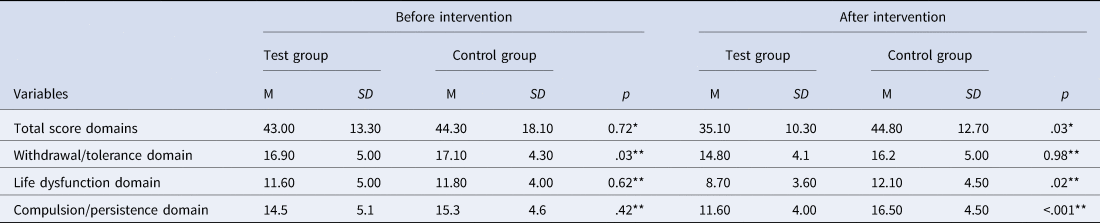
The Mean Score of Cell-phone Dependence and its Domains in the Intervention (n = 25) and Control (n = 25) Groups Before and After the Intervention

M = Mean; SD = Standard Deviation.
* Independent t-test, **Mann–Whitney U-test.
Before conducting the study, necessary arrangements were made with the education authorities, and after explaining the study objectives to the parents and adolescents, their written consent was obtained for participation in the study. The study subjects were allowed to withdraw from the study at any time, and all their data and questionnaire results remained confidential and were published only as general findings. Moreover, for ethical considerations, a summary of the educational programme was given to the students in the control group after the completion of the research.
Measures
Smartphone dependence is an inappropriate behavioural habit and considered the inability to control smartphone use despite negative effects and harmful consequences in all aspects of life on users (van Deursen, Bolle, Hegner, & Kommers, Reference Van Deursen, Bolle, Hegner, Hegner and Kommers2015). The study Scale was Koo's Cell Phone Addiction Scale for adolescents (Reference Koo2009). This questionnaire consists of two parts, including demographic details and the method of using the smartphone. The demographic variables included the duration of smartphone use, the frequency of talking on the phone and sending text messages, the use of GPS on the phone, the use of Bluetooth features, the use of the smartphone camera, the number of calls received, the number of calls made, the duration of the calls, the number of messages received, the number of messages sent, the messages received over the weekend, the calls received over the weekend, the monthly smartphone plan costs, playing games on the smartphone, watching videos on the smartphone, surfing the web on the smartphone, and the frequency of playing music. The second part consists of 20 items about smartphone addiction in three domains, including withdrawal/tolerance (seven items), life dysfunction (six items), and compulsion/persistence (seven items), which are scored based on a 4-point Likert scale (from ‘very little’ = 1 to ‘very high’ = 4 points). The range of scores is between 20 and 80 in this questionnaire. Scores <63 indicate a moderate use of the smartphone, 63< scores <69 show heavy use and scores ≥70 mean dependence. The item analysis, factor analysis, validity, and internal consistency were carried out in Koo's study and the Cronbach's alpha coefficient was 0.92 for the 20 items (Koo, Reference Koo2009).
The validity of the translated version of this scale was determined using factor analysis and confirmed by university professors. Moreover, the reliability of the scale was confirmed with a Cronbach's alpha coefficient of 92% in previous studies (Khazaee, Saadatjoo, Shabani, Senobari, & Baziyan, Reference Khazaee, Saadatjoo, Shabani, Senobari and Baziyan2013; Khazaei, Sharifzadeh, Jahed Sarawani, Khazaei, & Hedayati, Reference Khazaei, Gh, Sarawani M, Khazaei and Hedayati2014). This Scale was completed by both groups before and a month after the educational intervention was over.
Treatment
Self-management training provides persons with the necessary knowledge and encourages them to learn or improve the coping skills needed to reduce their symptoms and achieve a better quality of life (Anie et al., Reference Anie, Green, Tata, Fotopoulos, Oni and Davies2002). In this study, the educational programme was then implemented for the intervention group in five 90 min weekly sessions. Attempts were made in this training to raise the adolescents’ awareness about their characteristics and also the advantages and disadvantages of smartphones and virtual systems and their social and communication consequences to generate motivation for self-management and self-control. Besides, the students received the skills needed for the proper use of this device, including time management and self-regulation. The educational content thus consisted of the following headings: The significance of adolescence, the significance of concentrating on education, technology and its effects on communications, communication tools and virtual systems, smartphones (opportunities and threats), personal and social communication with an emphasis on communications within the family (the parent–child relationship), self-management, and successful time management. The students received training on these subjects by the researcher and an expert psychologist.
Department using lectures, Question & Answer and brainstorming. Finally, at the end of the study, the control group was given the pamphlets of the training content.
Statistical Analysis
The data collected were analysed in SPSS-16. The results were presented in two parts. First, the groups’ demographic details were compared and the homogeneity of the two groups in terms of each variable was assessed. The normal distribution of the quantitative variables was assessed using the Kolmogorov–Smirnov and Shapiro–Wilk tests. To compare the two groups, the independent t-test was used for the normal quantitative variables and Mann–Whitney's test and the Wilcoxon test were used for the non-normal and ordinal quantitative variables. The two groups were assessed and compared in terms of the nominal variables using Chi-square and Fisher's exact tests. In the second part, the two groups were assessed and compared in terms of the main study variables before and after the intervention using the Chi-square test for the qualitative variables, the independent t-test for the normal quantitative variables and Mann–Whitney's test for the non-normal variables.
Results
This study was conducted with the participation of 50 tenth-year high school students aged 15–16 years, divided into an intervention and a control group (n = 25 per group). The duration of owning a cell-phone was 3.1 ± 0.9 years in the intervention group and 2.7 ± 0.9 years in the control group, which reveals the lack of significant differences between the two groups according to Mann–Whitney's U-test (U = .239, p = .134).
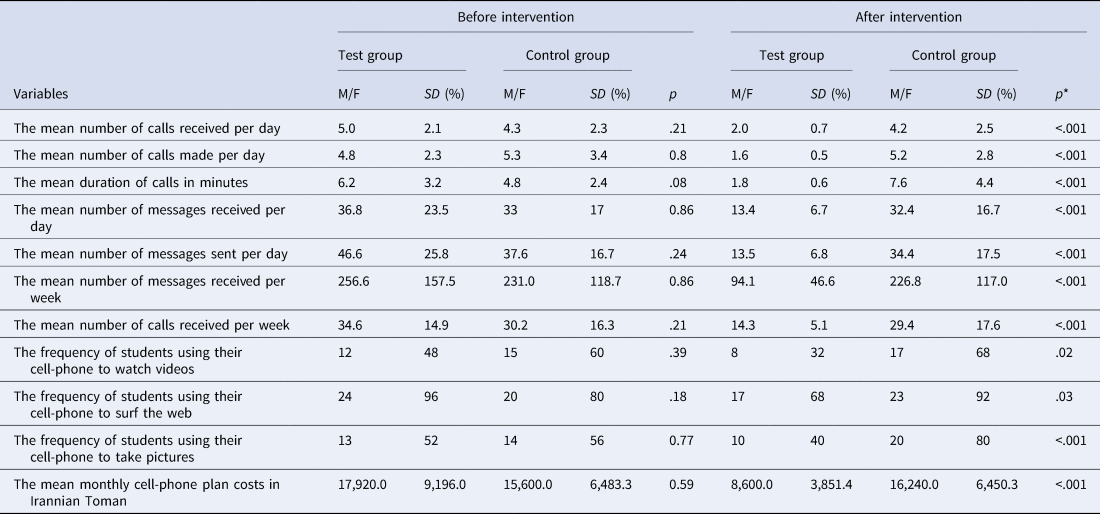
Table 1 shows no significant differences between the two groups in the mean score of smartphone dependence and its domains (p > .05) before the intervention, and since this mean score was less than 63, the students’ smartphone dependence can be said to fall in the moderate range. The data obtained after the intervention showed a significantly lower mean smartphone dependence score in the intervention group compared to the controls (p = .03). Moreover, the mean post-intervention scores of cell-phone dependence were significantly lower in the intervention group compared to the controls in withdrawal/tolerance (p = .004), life dysfunction (p = .022), and compulsion/persistence (p = .036). Table 2 presents the items related to the comparison of cell-phone use in the intervention and control groups before and after the intervention. The other items did not change significantly (p > .05).
A Comparison of Cell-phone Uses in the Students in the Intervention and Control Groups Before and After the Intervention

M = Mean; F = Frequency; SD = Standard deviation.
* Mann–Whitney U-test.
Discussion
The present study was conducted to determine the effect of self-management training for the use of smartphones on cell-phone dependence in male high school students. According to the results, the students had a moderate cell-phone dependence, and there were no cases of heavy dependence, which has been observed in some studies (Haug et al., Reference Haug, Castro, Kwon, Filler, Kowatsch and Schaub2015; Inyang et al., Reference Inyang, Benke, Dimitriadis, Simpson, McKenzie and Abramson2010; Khazaee et al., Reference Khazaee, Saadatjoo, Shabani, Senobari and Baziyan2013; Sharifzadeh et al., 2014). Nonetheless, the results regarding the various smartphone applications and the significant amount of time spent using them were consistent with the results of other studies (Haug et al., Reference Haug, Castro, Kwon, Filler, Kowatsch and Schaub2015; Sharifzadeh et al., 2014).
The main finding of this study was that self-management training in the use of smartphones led to a better understanding of its beneficial and harmful applications and improved time management and decision-making skills in the intervention group.
Although the researchers found no other studies that had used self-management training for controlling smartphone dependence, the relationship between negative self-control and dependence to smartphone use has previously been demonstrated (van Deursen et al., 2015).
In another study, training time self-management was able to increase the overall level of self-directed learning and each of its components (self-management, self-control, and desire to learn) in the students (Delavar & Karimi, Reference Delavar and Karimi2016). This method has also produced positive results concerning behavioural control in chronic diseases. Several studies have shown the positive effects of self-management training on the promotion of health. Using this method is consistent with the traditional theory of health education, which considers behaviour alterable, but its exact means of effectiveness is not entirely clear. One of the theories that has produced positive experimental results are the theory of the promotion of self-efficacy (Lorig & Holman, Reference Lorig and Holman2003).
Although this study did not measure self-efficacy, the recommended methods that affect this variable was used. According to the theory of Locus of Control, people with a high internal locus of control can control their addictive behaviours, including smartphone use (Park et al., Reference Park, Kim, Shon and Shim2013).
The high-risk applications of smartphones in relation to sending and receiving messages and calls and using them to play videos surf the web and take pictures and also the costs of using smartphones decreased in the intervention group. This reduction may be due to the students’ knowledge of the potential harms of these types of applications. A study (Moeini, Rezapur-Shahkolai, Faradmal, & Soheylizad, Reference Moeini, Rezapur-Shahkolai, Faradmal and Soheylizad2014) showed a reduction in the frequency of smartphone use while driving in the intervention group following an educational programme implemented based on the Health Belief Model. The mechanism of the effect of this model is through creating a sense of being at serious risk and highlighting the benefits of behaviour change and the possibility of removing the barriers to behaviour change. According to many resources, reducing the frequency of behaviours associated with smartphone use can reduce the incidence of behaviours such as aggression, cigarette addiction, and high-risk sexual behaviours (Haug et al., Reference Haug, Castro, Kwon, Filler, Kowatsch and Schaub2015; Khazaee et al., Reference Khazaee, Saadatjoo, Shabani, Senobari and Baziyan2013).
The limitations of this study include the convenience sampling initially used to select the subjects and the lack of control over the students’ other means of accessing data and also not including any female samples in the project.
Conclusion
Despite the limitations, the results showed that the training programme led to a reduction in smartphone dependence. Since the use of smartphones is increasing as an important communication tool and students spend hours on them, reducing their threats is essential.
Although further studies are required on this subject, especially with the participation of female students, the programme developed in this study is recommended to be used as an acceptable programme in terms of content and duration of time required (given the students’ school conditions).
Acknowledgements
This article is an extract from the author's MSc thesis at Gonabad University of Medical Sciences in Iran. Hereby, the authors wish to express their gratitude to the authorities of the university and the study setting and also all the participating students.
Declaration of Interest
The authors declared none.
Ethical Standards
The authors assert that all procedures contributing to this work comply with the ethical standards of the relevant national and institutional committees on human experimentation and with the Helsinki Declaration of 1975, as revised in 2000.