INTRODUCTION
Habitat fragmentation is a recognized threat to biodiversity in marine ecosystems, and its consequences have been recently considered (Bell et al., Reference Bell, Brooks, Robbins, Fonseca and Hall2001). Patchy habitats are not necessarily poor quality habitats, rather the combination of patchy and contiguous habitats in a given area may be required to maximize diversity, particularly if certain taxa demonstrate an affinity for isolated habitat patches (Healey & Hovel, Reference Healey and Hovel2004). In nearshore marine ecosystems, complex benthic habitats such as sea grass and algal beds, oyster reefs and mussel beds, possess a suite of spatial and ecological characteristics that make them amenable to assess the effects of habitat patchiness on animal abundance (Eggleston et al., Reference Eggleston, Elis, Etherington, Dahlgren and Posey1999; Ragnarsson & Raffaelli, Reference Ragnarsson and Raffaelli1999; Bell et al., Reference Bell, Brooks, Robbins, Fonseca and Hall2001; Roberts & Poore, Reference Roberts and Poore2005). Mussel beds, for example, range in size from small intertidal patches of less than 1 m2, to continuous subtidal structures over hundreds of hectares. For soft-sediment, aquatic invertebrates, the spacing of mussel shell among unstructured flat bottoms is large (up to hundreds of metres) compared to their body size (0.5–10 mm). Moreover, mussels themselves create a secondary space or habitat within which different (from the surrounding bare sediment matrix) animal assemblages can develop (Ragnarsson & Raffaelli, Reference Ragnarsson and Raffaelli1999). In such mosaics, it is of great importance how an organism perceives the habitat. Smaller organisms might have a different perception of a mosaic of habitat patches in respect to larger organisms (Kotliar & Wiens, Reference Kotliar and Wiens1990), thus, abundance of small invertebrates might change significantly to varying patch size more often than abundance of large invertebrates.
Musculista senhousia Benson in Cantor 1842, is a mytilid bivalve native from Asia which has recently spread throughout Mediterranean lagoons and estuaries (Hoenselaar & Hoenselaar, Reference Hoenselaar and Hoenselaar1989; Mastrototaro et al., Reference Mastrototaro, Matarrese and D'Onghia2003; Mistri, Reference Mistri2003). The species is defined as ‘an ecosystem engineer’ (Crooks, Reference Crooks2001), since individuals aggregate with byssal filaments in dense patches (over 10,000 ind m−2) in the upper layer of estuarine and lagoonal soft sediments. Mussels create novel three-dimensional episurface structures that can provide increased habitat heterogeneity on an otherwise soft bottom, including hard-surface areas and crevices, holes or cracks for the colonization of sessile and mobile species (Mistri et al., Reference Mistri, Rossi and Fano2004). Moreover, by removing a huge volume of suspended organic material from the water column, M. senhousia deposits that filtered material on the bottom as faeces and pseudofaeces and modifies the nutritional quality of sediments (Mistri et al., Reference Mistri, Modugno and Rossi2003). Natural patches of M. senhousia vary in size, ranging from less than 0.50 m2 to over 100 m2 (Creese et al., Reference Creese, Hooker, Deluca and Wharton1997).
In this study, the main effects of M. senhousia patch size and habitat diversity on benthic invertebrates were examined, considering taxa and body size. Specifically, two main questions were addressed: (1) does the abundance of fauna vary with the size of naturally occurring patches of the mussel M. senhousia?; and (2) do small and large invertebrates perceive habitat patchiness in the same way?
MATERIALS AND METHODS
Study sites
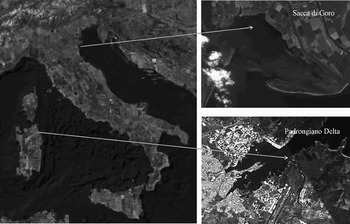
Sampling was conducted on the sub-tidal flats of two Mediterranean, microtidal waterbodies, the Goro Lagoon and the Padrongiano Delta (Figure 1), where Musculista senhousia has been present in high abundance for several years (Mistri et al., Reference Mistri, Rossi and Fano2004). The Goro Lagoon (44°50′10 N 12°17′40 E, Adriatic Sea) is located in the southernmost Po Delta area, and receives nutrient rich fresh water primarily from two deltaic branches of the Po river. Average depth is about 1.5 m, and the sediment is muddy sand. The Padrongiano Delta (40°55′09 N 09°32′31 E, Tyrrhenian Sea) is located in north-eastern Sardinia, and receives polluted waters from the Olbia harbour, the most important industrial and tourist port of Sardinia. Average depth is about 1.0 m, and the sediment is coarse sand.
Study sites: Goro Lagoon (northern Adriatic Sea) and Padrongiano Delta (north-eastern Tyrrhenian Sea).

Sampling of the matrix and natural patches of varying size
The effect of changes to the configuration of habitats is commonly examined by classifying the landscape as areas that support the organisms of interest (habitat patches) and the remaining areas (the matrix) (Wiens, Reference Wiens, Hannson, Fahrig and Merriam1995). The relationship between the size of naturally occurring patches of M. senhousia and the abundance of fauna was examined by sampling mussel beds from each of two different patch size-classes. Patches were classified as small (SM, greatest patch dimension smaller than about 1.0 m2) and large (LG, greatest patch dimension larger than about 10.0 m2). Four small and four large patches were sampled in March, July and October 2003. Each patch was separated by at least 100 m from neighbouring habitat patches. Invertebrates from the matrix habitat (MX, bare sediments) among the patches of M. senhousia were also sampled (four randomly-chosen plots at each sampling date). Fauna was collected with a Van Veen grab. The contents of the grab were washed on a 0.5 mm sieve. The material retained on the sieve was preserved in 8% buffered formalin, and stained with Rose Bengal to facilitate sorting and identification. Invertebrates were identified at the species level, then measured by length and divided into 2 classes of body size: small (0.5–2.0 mm) and large (>2.0 mm).
Statistical analysis
The interactive effect of habitat type (SM, LG and MX) on large and small invertebrates (after the exclusion of M. senhousia) was analysed using six response variables: (1) total number of large species; (2) total number of small species; (3) total number of large crustaceans; (4) total number of small crustaceans; (5) abundance of large individuals; and (6) abundance of small individuals. Small invertebrates were mostly polychaetes, nemertea, amphipods and isopods. Large invertebrates were mostly large polychaetes, bivalves, gastropods and crabs. Each response variable was analysed with a separate two-way ANOVA with habitat type (SM, LG and MX) and time (March, July and October) as factors. Heteroscedastic variances were corrected with log-transformation. Differences between means were revealed with a lower-level ANOVA, or a Tukey's comparison test.
RESULTS
A total of 33 invertebrate taxa were found in the Goro Lagoon, and 115 in the Padrongiano Delta. Analysis of similarities (Clarke & Warwick, Reference Clarke and Warwick1994; R = 1.0) confirmed sharp differences in invertebrate assemblages between the two study sites, reflecting biogeographical differences. In Appendix A, the taxonomic list of the fauna collected at the two study sites is reported.
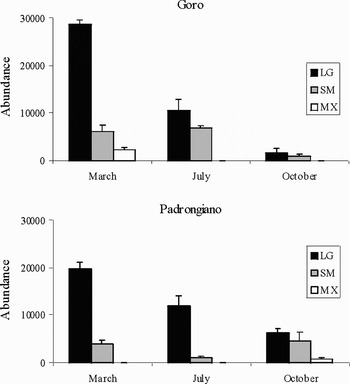
Abundance of Musculista senhousia within beds greatly varied with time (Figure 2). Single specimens or small clumps (abundance <20 ind clump−1) of the mussel were also found in the matrix, far from the beds, at Goro (March) and Padrongiano (October). At both sites, mussel abundance was significantly higher at LG (one-way ANOVA, all P < 0.001) in March and July, while in October it was similar at LG and SM (one-way ANOVA, P = NS), suggesting a differential mussel mortality within large patches.
Abundance (individuals m−2) of Musculista senhousia at the study sites (bars are SE).

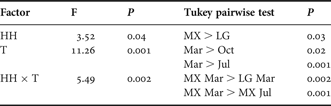
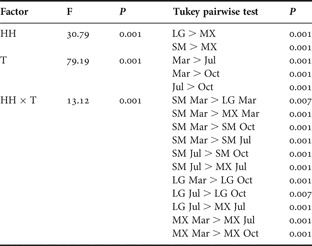
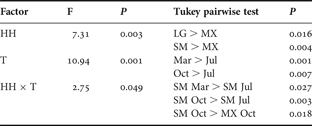
In the Goro Lagoon, a two-way ANOVA (factors: habitat heterogeneity and time; Table 1) revealed differences in the number of large species in response to both habitat type (P < 0.05) and time (P < 0.001). No differences were found on the number of small species due to habitat heterogeneity, while significant seasonal variations (one-way ANOVA; P < 0.001; all pairwise comparisons: P < 0.01) were detected. Large crustaceans (Table 2) responded to both habitat heterogeneity (P < 0.001) and time (P < 0.001). The interaction term was significant (P < 0.001), revealing complex dynamics. Post-hoc tests showed significant higher numbers of large crustaceans at MX. Small crustaceans responded only to time (one-way ANOVA; P < 0.001; all pairwise comparisons: P < 0.01). Habitat heterogeneity had an effect upon the abundance of large invertebrates (P < 0.001), as well as time (P < 0.001); there were also significant interactions among the main effects (Table 3). Upon the abundance of small invertebrates, only the main factor time had an effect (P < 0.001). Independently from the organism size, opportunistic species (sensu Borja et al., Reference Borja, Franco and Pérez2000) represented 52.6% and 53.2% of the total density at LG and SM, respectively, while they accounted for only 21.5% of the total number of organisms at MX. Sensitive species were abundant at MX, representing 42.3%, 12.5% and 17.6% of total abundance of organisms at MX, LG and SM, respectively.
Goro: two-way ANOVA on the number of large species. Factors: habitat heterogeneity (HH) and time (T). Significant Tukey pairwise tests are also shown.
Goro: two-way ANOVA on the number of large crustaceans. Factors: habitat heterogeneity (HH) and time (T). Significant Tukey pairwise tests are also shown.
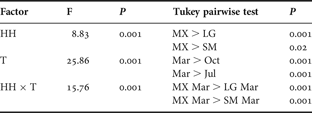
Goro: two-way ANOVA on the abundance of large organisms. Factors: habitat heterogeneity (HH) and time (T). Significant Tukey pairwise tests are also shown.

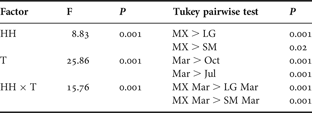
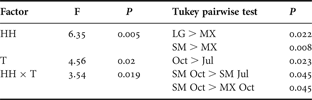
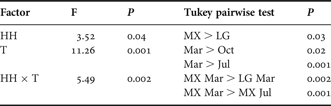
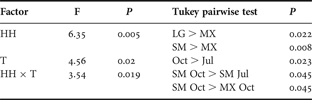
In the Padrongiano Delta, both factors habitat type and time had an effect on the number of large species (Table 4) and large crustaceans (Table 5), with significant interactions among the main effects. The number of large species and crustaceans were always significantly higher at SM and LG with respect to MX. Time had an effect on the number of small species (one-way ANOVA; P < 0.001; all pairwise comparisons: P < 0.001), and the number of small crustaceans (one-way ANOVA; P < 0.001; all pairwise comparisons: P < 0.01). A higher abundance of large invertebrates occurred in SM samples (one-way ANOVA; P < 0.001), while a higher abundance of small invertebrates occurred in MX samples (one-way ANOVA; P < 0.01), in March. Opportunistic species at LG accounted for 40.6% of all collected organisms; at SM and XM they represented 51.9% and 53.5% of total density, respectively. Differences among the types of habitat were more evident for sensitive species, which represented 32.6%, 34.3% and 52.2% at MX, SM and LG, respectively.
Padrongiano: two-way ANOVA on the number of large species. Factors: habitat heterogeneity (HH) and time (T). Significant Tukey pairwise tests are also shown.
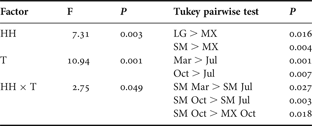
Padrongiano: two-way ANOVA on the number of large crustaceans. Factors: habitat heterogeneity (HH) and time (T). Significant Tukey pairwise tests are also shown.
DISCUSSION
This study provides evidence that the response of an organism to the spatial arrangement of habitats is dependent upon the joint effects of habitat type and body size. At the two study sites, benthic invertebrates responded to habitat heterogeneity in a complex manner that varied according to species, animal body size, and type of environment. Moreover, Musculista senhousia was likely playing a double role: (1) as secondary substratum, enhancing the environmental structural complexity; and (2) as densely aggregated, living organisms, thus giving rise to a number of possible interactions with other invertebrates. Mussel patches had a likely gross structurant effect, but at extremely high mussel density (e.g. Goro, LG and March), the effect seemed to be opposite. The architectural complexity of mussel beds results from the number, shape, and size–frequency of mussels (Eggleston et al., 1998; Ragnarsson & Raffaelli, Reference Ragnarsson and Raffaelli1999; Commito & Rusignuolo, Reference Commito and Rusignuolo2000). Final conclusions on the role of scale-dependent biotic processes underlying interactions between animal body size, patch size, and habitat type on invertebrate abundance remains to be determined experimentally.
Although the mechanisms underlying invertebrate abundance patterns described in this study remain unknown, the results suggest that certain groups of invertebrates may be more sensitive to habitat fragmentation. In general, large invertebrates were more sensitive to habitat patchiness. At both sites, small species did not show any response to a supposed edge effect, notwithstanding small patches should give a higher surface area to intercept for small species, due to the high perimeter–area ratio. Conversely, large organisms responded to habitat fragmentation and patch size, showing higher abundance alternatively at LG and SM, depending on time. It should be noticed that large species were mostly predators (crabs and snails: Brachynotus sexdentatus, Nassarius corniculus, Haminoea navicula and Hexaplex trunculus) that at LG probably found higher numbers of prey. Small prey organisms, as well as small predators (e.g. Schistomeringos rudolphii) probably avoided frequent encounters with large predators refuging at SM and MX. It is noteworthy that in March, in the Goro Lagoon, large crustaceans responded to habitat heterogeneity preferring MX. It must be stressed, however, that the majority of such large crustaceans were not predators, but tube-builder Ampelisca, which probably suffered hard competition for space within mussel beds. Ampelisca is a brooder, able to rapidly build-up large populations in spring. The tubes increase the spatial heterogeneity of the habitat at MX, and other species are able to coexist with the amphipod, subsequently explaining the elevated number of invertebrate species found in the matrix at March. Conversely, large predatory crabs, such as Rhithropanopeus harrisii and Carcinus aestuarii, preferred, as at Padrongiano, the LG habitat. Differences in predation pressure between fragmented and contiguous habitats may shape the responses of communities to habitat configuration (Hovel & Lipcius, Reference Hovel and Lipcius2002; Laurel et al., Reference Laurel, Gregory and Brown2003). If predation pressure is enhanced at patch edges, small patches with a greater proportion of patch edge to interior habitat offer lower protection from predation than do large patches (Hovel & Lipcius, Reference Hovel and Lipcius2002). Alternatively, predators may aggregate within and concentrate foraging efforts upon larger patches (Laurel et al., Reference Laurel, Gregory and Brown2003). In this study, the effects of predation on the entire community can only be speculated, but the finding that large predators respond preferentially to large mussel patches seems evident. It should also be noted that crabs and snails are voracious consumers of Asian date mussels (Mistri, Reference Mistri2004a, Reference Mistrib).
It is often assumed that reductions in habitat patch size will result in reductions in the species richness and abundance associated with those habitats (Hill & Curran, Reference Hill and Curran2003). This study showed that reductions of mussel patch size were associated with minor effects on the invertebrates inhabiting mussel beds. These results are consistent with other marine studies which have found few predictable impacts of variation in patch size on the abundance of invertebrates (Bell et al., Reference Bell, Brooks, Robbins, Fonseca and Hall2001). The prediction of decreased abundance in small patches versus large patches has been shown for species of infaunal bivalves (Irlandi, Reference Irlandi1997) and for crustaceans (Eggleston et al., Reference Eggleston, Etherington and Elis1998), while other studies showed greater abundance of invertebrates in smaller patches (Eggleston et al., Reference Eggleston, Elis, Etherington, Dahlgren and Posey1999). Thus, results from the present study add to the gathering evidence that simple patterns have not yet been identified as to the effect of patch size on organism abundance in aquatic ecosystems. Moreover, individual mobility and habitat/organism interactions are known to play a fundamental role in determining communities and maintaining populations on habitat patches in heterogeneous landscapes (Thrush et al., Reference Thrush, Whitlach, Pridmore, Hewitt, Cummings and Wilkinson1996). As this study shows, there are many variables that may influence the community pattern in small and large patches, and prevent to individualize a univocal pattern for small species and another for large species. Information on body size, feeding mode, and mobility can be used to predict small-scale spatial arrangement of aquatic benthic invertebrates (Hewitt et al., Reference Hewitt, Thrush, Cummings and Pridmore1996), but evidences from this and other studies (e.g. Fahrig, Reference Fahrig2003) suggest that varying patch size has inconsistent impacts upon fauna. This study also shows that basic life history information is essential in predicting how organisms respond to habitat heterogeneity in lagoons and estuaries; where sediment transport is common, passive faunal advection may be substantially elevated and may even remove the patch size dependence of immigration.
Invertebrate population size and biodiversity, yet, may be maximized in landscapes that include both small and large patches of mussel beds ‘embedded’ in a continuous matrix. Musculista senhousia beds serve as a critical refuge and foraging habitat for many species, and patchy and continuous areas may promote the persistence of organisms with different life histories. Information on the interdependence of shallow aquatic habitats such as sea grass and mussel bed habitats, as well as their relative importance as refuge or settlement sites, is critical for understanding population dynamics of ecologically important species. This information can be particularly important in areas, like Goro Lagoon and Padrongiano Delta, lacking sea grass, where mussel beds may represent the only structural refuge available.
Ecosystem engineers add habitat heterogeneity to the otherwise homogeneous, bare sediments and provide space and refuge for many organisms (Bianchi & Morri, Reference Bianchi and Morri1996; Schwindt et al., Reference Schwindt, Bortolus and Iribarne2001). Increasing of macrobenthic species richness or abundance of predators is also observed in structurally complex habitats, such as oyster and polychaete reefs, when compared with the surrounding areas (Bianchi & Morri, Reference Bianchi and Morri1996; Rodney & Paynter, 2006; Dubois et al., Reference Dubois, Commito, Olivier and Retière2006; Rabaut et al., Reference Rabaut, Guilini, Van Hoey, Vincx and Degraer2007). Rodney & Paynter (Reference Rodney and Paynter2006) observed increased density and species richness of benthic macrofauna in Crassostrea virginica reefs. Their results indicated also a more complex trophic structure within the reefs, with high densities of omnivores and suspension feeders. Since macrofauna included many important crab and fish prey species, oyster reefs resulted in increased grazing rates (water filtration) and subsequent transfer of energy from the plankton community to the benthos, and increased transfer of energy to the higher trophic levels of the reef community. Another ecosystem-engineer established in many Mediterranean and Atlantic lagoons is the Australian polychaete Ficomatus enigmaticus (Bianchi & Morri, Reference Bianchi and Morri1996, Fornós et al., Reference Fornós, Forteza and Martínez Taberner1997; Bianchi & Morri, Reference Bianchi and Morri2001; Occhipinti Ambrogi, Reference Occhipinti Ambrogi2000; Schwindt et al., Reference Schwindt, Bortolus and Iribarne2001). Schwindt et al. (Reference Schwindt, Bortolus and Iribarne2001) studying the effect of the reef-building F. enigmaticus on the benthic community of the Mar Chiquita lagoon (southern Atlantic coast) found that reefs strongly affected the infaunal community structure by offering refuge to omnivorous crabs, altering the interactions between preexistent species and also by changing the characteristics of the sediment. Although other studies have shown that species richness and diversity of the associated fauna increased with age and size of mussel patches (Tsuchiya & Nishihira, Reference Tsuchiya and Nishihira1985, Reference Tsuchiya and Nishihira1986), Borthagaray & Carranza (Reference Borthagaray and Carranza2007) found no correlations between bed traits (i.e. shell length and shell biomass) and species richness. Collins & Glenn (Reference Collins and Glenn1991) suggested that the patterns in abundance and occurrence of different functional groups did not respond in the same way to the engineering effect and that dispersal capabilities and body size might affect the way in which the organisms interact with their environments. These observations raise concerns regarding the effect of invasive bio-engineers on existing native communities, by providing refuge to crabs and also by changing the physical factors of the invaded environments. Also influences on the habitat itself, either directly or indirectly, could in a longer perspective drastically decrease the biodiversity (Wallentinus & Nyberg, Reference Wallentinus and Nyberg2007).
The European Water Framework Directive (WFD) 2000/60/EC (EC, 2000) requires Member States to assess the ecological quality status (EcoQS) of coastal and transitional waters. The biological quality elements to be used are phytoplankton, aquatic flora (sea grass and seaweeds), benthic invertebrates and fish. Introduced ecosystem engineers may produce contrasting effects. The large filtering capacity of introduced mussels have resulted in positive environmental effects by clearing water masses (Wallentinus & Nyberg, Reference Wallentinus and Nyberg2007). Moreover, the creation of dense mussel mats has negative effects on native eelgrass (Reusch & Williams, Reference Reusch and Williams1998). In the present investigation, a large amount of opportunistic organisms (sensu Borja et al., Reference Borja, Franco and Pérez2000) has been found within mussel patches, in the Sacca di Goro. Opportunistic species were more dependent upon the response of secondary structure to patch size (such as amount of organic matter, hydrodynamic reduction and low oxygen content), rather than to patch size itself. This finding suggests a deterioration of the ecological quality caused by mussel invasion and dependent on the scale of habitat patchiness. It remains unclear, how biodiversity and habitat changes due to non-indigenous ecosystem engineers should be interpreted in a context of WFD. Therefore, preparation of a framework for assessment of the role of such non-indigenous species ecosystem engineers in a local biodiversity should attain more efforts in the near future when implementing WFD.
ACKNOWLEDGEMENTS
This study is part of my PhD thesis and was supported by the Italian Ministry of University and Research (MIUR, PRIN2003). Professor M. Mistri (University of Ferrara) is acknowledged for continuous encouragement and constructive criticism.
APPENDIX A