Implications
To maintain sustainability of farm incomes, farmers need to optimise the balance between maximum production while minimising costs of production. Reduced profitability is associated with health and fertility costs of the dairy herd, which are also leading causes of involuntary culling. Reducing disease incidence in dairy cattle is not only of economic importance to dairy industries worldwide but essential in accounting for the societal and environmental considerations, such as concerns over animal welfare and carbon emissions. Although, health traits tend to have low heritability implying slow genetic gain, the gain achieved year on year would be positive and cumulative.
Introduction
For many years, selection indices for dairy cows worldwide have focused on increasing milk production because of consumer demands and the impact of production on farm profit margin. This was extremely successful through genetic selection together with improvements in nutrition and management. However, inefficiencies exist because increased production has led to negative effects on health, reproduction and longevity (e.g. Oltenacu and Broom, Reference Oltenacu and Broom2010), which directly influence costs of production. Thus, selection indices have evolved more recently focusing on a broader and more balanced breeding goal to include functional traits (Miglior et al., Reference Miglior, Muir and Van Doormaal2005), such as fertility, health and longevity, with the realisation that these traits have both economic and socioeconomic impact through improving animal welfare and the sustainability of dairy production. Particularly in countries where food supply is secured, demand has shifted towards societal expectations and guarantees (Duhem and Bendali, Reference Duhem and Bendali2006). Although not directly associated with milk production, food scares and animal disease outbreaks (e.g. bovine spongiform encephalopathy, foot and mouth disease) that have received recent media attention impact greatly on public opinion and consumers are reminded of the link between their food and the farm animal. Hence, public perception of milk production is becoming increasingly important and concerns over disease incidence, longevity, antibiotic usage and residues in milk, environmental issues and energy expenditure are issues becoming more frequently raised. Standards expected by consumers are thus reflected by retailers who are taking a more active role in animal welfare through their contracts with farmers. The overall economic index (Profitable Lifetime Index – £PLI) used in the United Kingdom, revised in 2007, further increased the emphasis on health, welfare and fitness traits so that the emphasis on production was reduced from 75% in 2003 to 45% in 2007. Despite, fluctuating economic conditions and short-term breeding goals that change with time; functional traits are expected to be valuable under all future markets (Goddard, Reference Goddard2009).
Increasing the productive life of cows improves the efficiency of dairy production by lowering replacement costs, allowing more restrictive selection and capturing greater potential milk yields from mature cows (Brickell and Wathes, Reference Brickell and Wathes2011). In the United Kingdom, lifespan proofs for bulls were first published in 1998 (Visscher et al., Reference Visscher, Thompson, Yazdi, Hill and Brotherstone1999). Lifespan evaluations currently are calculated from a lifespan score (LS), a ‘phenotypic’ score calculated from actual completed lactations plus predictions of a future survival score based on three traits (mammary composite, legs and feet and fore udder attachment) and somatic cell count (SCS).
Average culling rates of 22% to 25% were reported in UK dairy herds (Esslemont and Kossaibati, Reference Esslemont and Kossaibati1997; Whitaker et al., Reference Whitaker, Macrae and Burrough2004) and half of all culls were attributed to ‘involuntary’ reasons such as infertility, mastitis and lameness (Whitaker et al., Reference Whitaker, Macrae and Burrough2004). In addition, mastitis and lameness are commonly reported as the most costliest diseases of dairy herds (Kossaibati and Esslemont, Reference Kossaibati and Esslemont1997; Bennett, Reference Bennett2003) because of milk losses, treatment costs, high incidence rates and their knock-on effects. Essl (Reference Essl1998) advised including determinants of involuntary culling, such as disease incidence, dystocia and reproductive performance, as part of selection as these traits should increase the genetic potential for longevity. In the early 2000s, producer-recorded data related to fertility were assessed for their suitability for use in genetic evaluations (Wall et al., Reference Wall, Brotherstone, Woolliams, Banos and Coffey2003), which led to the inclusion of the Fertility Index in UK genetic evaluations in August 2006. However, in the construction of selection indices, some functional traits have been excluded because of insufficient or complete lack of records.
Mastitis and lameness have been selected against by the use of indirect traits in the selection index. These are test-day records for SCS and overall udder composite for mastitis, and overall feet and legs and locomotion for lameness. Efforts to reduce disease incidence by genetic improvement are thought to be more effective when the disease trait is selected for directly (Banos et al., Reference Banos, Coffey, Wall and Brotherstone2006). However, the lack of a national recording system for mastitis and lameness (and other diseases/health events) has impeded their use in genetic improvement. As with fertility traits, the recording of disease events is done voluntarily by farmers as part of their herd management, and recording has increased in recent years. This is likely due to the uptake of on-farm software for herd management purposes, the increase in farm assurance schemes, contracts with retailers requiring detailed recording, the mandatory recording of veterinary treatments/medicines use on food producing animals and campaigning by agricultural levy bodies and suchlike raising awareness of disease problems and encouraging recording. The higher level of recording in more recent years has brought about interest in the feasibility of utilising health event data, such as mastitis and lameness, for use in genetic evaluations.
Kadarmideen et al. (Reference Kadarmideen, Thompson and Simm2000 and Reference Kadarmideen, Rekaya and Gianola2001) estimated genetic parameters for mastitis and lameness in Holstein–Friesians in the United Kingdom; however, until recent years sufficient data were lacking. The objectives of this study were to obtain genetic parameters for mastitis and lameness together with genetic correlations with other goal traits currently in the national UK breeding goal (i.e. production, fertility and longevity traits). Although other UK studies have examined production, fertility, longevity and health traits independently, a single study examining all these traits together is lacking and farmer-recorded data on health data were limited in earlier studies.
Material and methods
Data
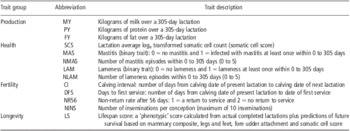
The recording of health events used in this study was undertaken by farmers on a voluntary basis as part of routine milk recording and the data were made available by milk recording organisations in the United Kingdom. Herds with no mastitis events over all years were considered to be not recording and were not used. However, the number of herds recording lameness was fewer, thus the above herds without lameness records were included to maintain an adequately sized dataset for genetic parameter estimation. Health data consisted of the health event code (e.g. mastitis) and the health event/treatment date for the affected animal. A health event (either mastitis or lameness in this study) was taken as an event or treatment taking place 0 to 305 days from calving. Mastitis and lameness were each defined as two separate traits for analysis. For the first trait, mastitis (MAS) and lameness (LAM) were treated as a binary trait; thus, affected animals were classed as 1 and non-affected animals were classed as 0. Repeated events within the same lactation were not considered, that is, one record per cow per lactation. Incidence of MAS or LAM was defined as the number of lactation records with a health event divided by the total number of lactation records. The second trait examined the number of unique episodes of mastitis (NMAS) or lameness (NLAM) during each lactation period. On the basis of recommendations of Kelton et al. (Reference Kelton, Lissemore and Martin1998), a mastitis case was considered to be a new mastitis episode when there had been no other mastitis events recorded during the preceding 8 days, whereas a lameness case was considered to be a new lameness episode when there had been no other lameness events recorded during the preceding 30 days. Incidence of NMAS or NLAM was defined as the number of episodes divided by the total number of lactation records. Data on the first three lactations were used from Holstein–Friesian dairy cattle in the United Kingdom. In the last 30 years in the United Kingdom, what was predominantly a Friesian dairy cattle population has now become predominantly Holstein. Data were used from cows that had at least 87.5% Holstein–Friesian genes, were born from 1996 to 2006 and calved from 1998 to 2008. A dataset was created that contained animals with 305-day production, SCS, fertility, mastitis, longevity and lameness records, which are defined in Table 1. All animals required records on all traits with the exception of lameness, which had relatively fewer records and was recorded on 35.6% of lactations in the final dataset.
Description of traits and their abbreviations

Dataset edits included: (1) Calving ages for first, second and third lactation were within the ranges of 18 to 42 months, 30 to 62 months and 42 to 70 months, respectively; (2) minimum 200 days in milk were required; (3) calving interval (CI) was between 300 and 600 days; (4) day of first insemination was not less than 20 days and not later than 200 days in milk; (5) 10 or more inseminations until conception were grouped as 10; (6) sires were born from 1990 onwards; (7) sires had at least 25 eligible daughters, and of all eligible daughters, up to the first 300 born were selected; (8) there were at least five animals per herd-year-season; (9) there was at least one animal with a mastitis record per herd-year-season; (10) at least 1% of animals affected with mastitis per herd-year-season; and (11) all cows required records in their first parity. The first 300 daughters born of a bull were selected to ensure that the first crop daughters of proven bulls were used in the analysis. This implies that the data are not dominated by daughters of a few widely used proven bulls, which will tend to reduce the genetic variance. The alternative is to include widely used sires as a fixed effect but the approach of selecting the first 300 daughters was thought to be appropriate. For the analysis of lameness, a subset of the data was used that required at least one lameness record per herd-year-season with at least five animals per herd-year-season.
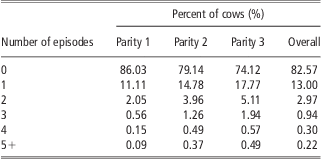
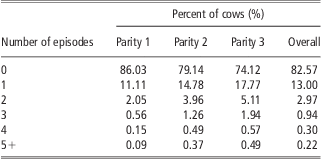
After editing, the dataset consisted of 75 137 cows with 124 793 lactations, which calved between the years 1998 and 2008, from 2434 herds and sired by 1586 bulls. There were 75 137, 31 704 and 17 952 animals in lactations 1, 2 and 3 and the frequency of mastitis was 14.0%, 20.9% and 25.9%, respectively (Table 2). There were 23 966, 12 898 and 7585 animals in lactations 1, 2, and 3 with lameness records, and the frequency of lameness was 15.0%, 15.7% and 18.9%, respectively (Table 2). Overall 24.3% cows had at least one mastitis event during the first three parities. Overall 20.4% cows had at least one lameness event during the first three parities. The frequency of mastitis episodes are shown in Table 3.
Summary of data in terms of observations of health traits in different parities

aIncidence measured as a binary trait (0/1).
Distribution of cows by the number of mastitis episodes
Model
The data were analysed in ASReml to estimate variance components (Gilmour et al., Reference Gilmour, Gogel, Cullis and Thompson2006). A linear model was chosen although the threshold model, which accounts for the categorical nature and non-normal distribution of traits, might be regarded as theoretically superior (Gianola, Reference Gianola1982). However, existing traits in UK genetic evaluations, such as non-return at 56 days (NR56, a binary trait) and number of inseminations (NINS, a categorical trait) currently employ the linear model. In addition, several studies that have compared both linear and threshold models have reported there to be very little advantage of the non-linear model (Kadarmideen et al., Reference Kadarmideen, Thompson and Simm2000; Negussie et al., Reference Negussie, Strandén and Mäntysaari2008). To begin with, univariate linear models were run to compare animal and sire models. A linear model was fitted that included either animal or sire as a random effect, together with permanent environmental effect for the analysis of all three lactations as a repeatability model. Genetic parameter estimates were similar when comparing animal and sire models. Slight differences were observed for yield traits, which had slightly higher heritability estimates with the use of a sire model due to larger variances attributed to additive genetic effect and lower permanent environmental variances. As estimates were closely similar between animal and sire models, a sire model was used for all bivariate analyses as it was less computationally demanding.
The model used for analysis of single parity for production, health and fertility traits is shown in equation (1). The repeatability model also included age in months at calving nested within parity number and a permanent environmental effect of the animal as a random effect. LS is defined as a functional longevity trait, and thus corrects for milk yield, shown by equation (2). An animal had a single measure for LS and data for fixed effects were taken from time of first calving:
 $$\[<$$>no{{{Y}_{ijk}}\, = \,\mu \, + \,{\rm{hy}}{{{\rm{s}}}_i}\, + \,{\rm{mont}}{{{\rm{h}}}_j}\, + \,{{\beta }_1}{{X}_{{\rm{het}}}}\, + \,{{\beta }_2}{{X}_{{\rm{rec}}}}\cr\quad + \,{{\beta }_3}{{X}_{{\rm{age}}}}\, + \,{{\beta }_4}{{({{X}_{{\rm{age}}}})}^2} \, + \,{\rm{sir}}{{{\rm{e}}}_k}\, + \,{{e}_{ijk}}<$$>\]$$
 $$\[<$$>no{{\rm{L}}{{{\rm{S}}}_{ijk}}\, = \,\mu \, + \,{\rm{hy}}{{{\rm{s}}}_i}\, + \,{\rm{mont}}{{{\rm{h}}}_j}\, + \,{{\beta }_1}{{X}_{{\rm{het}}}}\, + \,{{\beta }_2}{{X}_{{\rm{rec}}}} + \,{{\beta }_3}{{X}_{{\rm{age}}}} \cr\quad + \,{{\beta }_4}{{({{X}_{{\rm{age}}}})}^2} \, + \,{{\beta }_5}{{X}_{{\rm{MilkDev}}}}\, + \,{\rm{sir}}{{{\rm{e}}}_k}\, + \,{{e}_{ijk}}<$$>\]$$
where Yijk is an observation for production, health or fertility; LSijk is an observation for LS; μ the overall mean of trait (Y/LS); hysi the fixed effect of ith herd-by-year-by-season (two seasons per year) of calving; monthj the fixed effect of the jth month of calving (12 months); β 1 to β 5 the linear and quadratic regression coefficients of dependent variable (Y/LS) on age at calving (X age), heterosis (X het), recombination (X rec) and first lactation milk yield deviated from the mean of contemporaries (X MilkDev); sirek the random effect of sire k and eijk the residual random error term. Bivariate analyses were carried out for all pair-wise combinations between health, production, fertility and longevity traits for the first lactation and repeated across the first three lactations. All bivariate analyses included the additive genetic, permanent environmental (for repeatability model) and residual variances together with corresponding covariances between both traits. In addition, for MAS and NMAS a multivariate analysis was carried out, treating separate lactations as separate traits using the same model as in equation (1).
With use of the sire model heritability estimates of all traits were calculated as four times the sire variance component divided by the phenotypic variance. Ratio of permanent environmental variance to total phenotypic variance (pe2) was calculated as permanent environmental variance minus three times the sire variance (i.e. pe2 = 3/4 animal genetic variance).
Results
Descriptive statistics
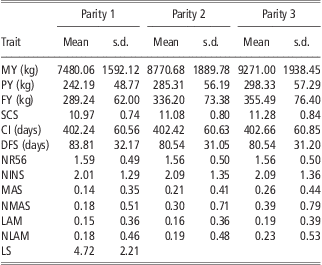
Means with standard deviations of milk 305-day yield (MY), protein 305-day yield (PY), fat 305-day yield (FY), lactation average loge transformed lactation average somatic cell count (SCS), calving interval (CI), days to first service (DFS), non-return at 56 days (NR56), number of inseminations (NINS), mastitis (MAS), number of mastitis episodes (NMAS), lameness (LAM), number of lameness episodes (NLAM) and lifespan score (LS) within parities (1, 2 and 3) are given in Table 4. Mean production, SCS and disease incidence increased with parity. As a binary trait, mean mastitis and lameness incidence increased with parity from 14% to 26% and 15% to 19%, respectively. The proportion of animals with repeated episodes of mastitis and lameness also increased with parity for mastitis episodes (Table 3). Of the fertility traits, CI increased slightly with parity, whereas DFS and NINS increased slightly from parity 1 to 2, and there were fewer returns to service in parity 1 than parity 2.
Mean and s.d. of production, fertility and health traits for parities 1, 2 and 3
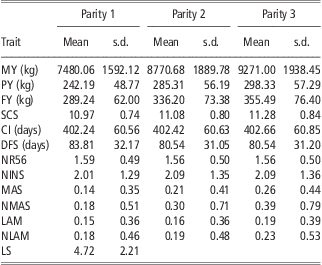
s.d. = standard deviation; MY = milk 305-day yield; PY = protein 305-day yield; FY = fat 305-day yield; SCS = somatic cell score; CI = calving interval; DFS = days to first service; NR56 = non-return at 56 days; NINS = number of inseminations; MAS = mastitis; NMAS = number of mastitis episodes; LAM = lameness; NLAM = number of lameness episodes; LS = lifespan score.
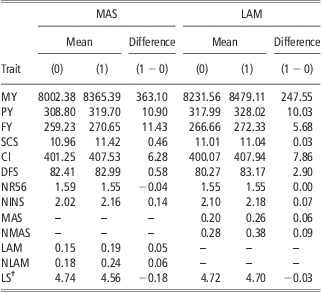
Table 5 shows that higher yielders tend to be more affected by mastitis and accompanied by higher SCS, higher lameness incidence, increased CI and DFS, increased NINS and increased returns to service. On average (across the first three parities), milk yield was 363.1 kg greater, CI and DFS increased by 6.3 and 0.6 days, respectively, NINS increased by 0.14 inseminations, non-return rate decreased by 4% of cows, lameness incidence was 5% greater and SCS was 4.2% higher in mastitic cows. A similar trend was given between means of unaffected and affected lameness animals. On average (across the first three parities), milk yield was 247.6 kg greater, CI and DFS increased by 7.9 and 2.9 days, respectively, NINS increased by 0.07 inseminations and mastitis incidence was 5% greater in lame cows.
Comparison of overall means for production, fertility and health traits of unaffected (0) and affected (1) animals for mastitis and lameness
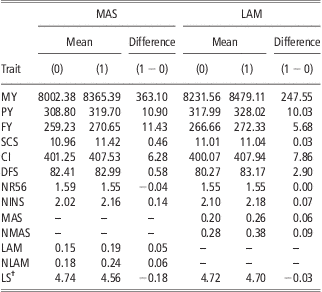
MAS = mastitis; LAM = lameness; MY = milk 305-day yield; PY = protein 305-day yield; FY = fat 305-day yield; SCS = somatic cell score; CI = calving interval; DFS = days to first service; NR56 = non-return at 56 days; NINS = number of inseminations; NMAS = number of mastitis episodes; NLAM = number of lameness episodes; LS = lifespan score.
†LS based on one measure.
Incidence of health events
For disease traits, mastitis and lameness incidence increased with parity and first cases tended to be in the winter months. The largest numbers of first mastitis cases occurred in the first 30 days of lactation. However, the peak was much higher in the first than later lactations. The first incidence of mastitis peaked in the first couple of days after calving and by day 30 about 40% of first mastitis cases had occurred in animals in their first parity. Highest incidence of first mastitis cases were in January, followed by February, March and November (during winter months) and lowest in the summer months with the least number of cases in June. Similar to mastitis, incidences of the first lameness cases were highest in the 1st month of lactation, after which cases were evenly distributed, and were highest during the first 4 months of the year, January to April. Unlike mastitis, the peak of lameness cases in the 1st month of lactation was higher for animals in later parities.
Heritabilities and correlations
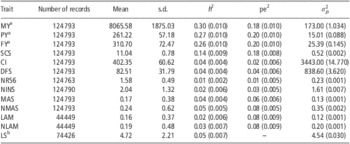
Estimates of heritabilities (h 2) and ratio of permanent environmental variance to total phenotypic variance (pe2), together with number of observations, means and standard deviations (s.d.) for production, health and fertility traits from analysis using a repeatability model are given in Table 6. All the h 2 estimates were significant and estimates obtained from bivariate analyses were similar to univariate analyses. Heritability estimates obtained from repeatability models ranged from 0.29 to 0.34 for production traits, 0.14 for SCS, whereas fertility and remaining health traits ranged from 0.01 to 0.05. Mastitis and lameness count traits had slightly higher heritability than the corresponding binary traits (Table 6). Heritability estimates from a repeatability model were very similar to estimates obtained from parity 1 (Tables 7 and 8).
Number of observations, mean and s.d., heritability (h 2), ratio of permanent environmental to total phenotypic variance (pe2), phenotypic variance (  $$)(-->$<>\sigma _{p}^{2} <$>
<!--$$ ) together with their standard errors (in parenthesis) for production, fertility and health traits obtained using a univariate repeatability model (animal model)

s.d. = standard deviation; MY = milk 305-day yield; PY = protein 305-day yield; FY = fat 305-day yield; SCS = somatic cell score; CI = calving interval; DFS = days to first service; NR56 = non-return at 56 days; NINS = number of inseminations; MAS = mastitis; NMAS = number of mastitis episodes; LAM = lameness; NLAM = number of lameness episodes; LS = lifespan score.
aMY, FY and PY were scaled by 100, 10 and 10, respectively, in analysis.
bLS not analysed as a repeated trait.
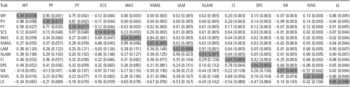
Estimates with standard errors (in parenthesis) from bivariate analyses with heritability (on diagonal), genetic correlations (below the diagonal) and phenotypic correlations (above the diagonal) using a repeatability sire model across the first three lactations

MY = milk 305-day yield; PY = protein 305-day yield; FY = fat 305-day yield; SCS = somatic cell score; MAS = mastitis; NMAS = number of mastitis episodes; LAM = lameness; NLAM = number of lameness episodes; CI = calving interval; DFS = days to first service; NR = non-return; NINS = number of inseminations; LS = lifespan score.
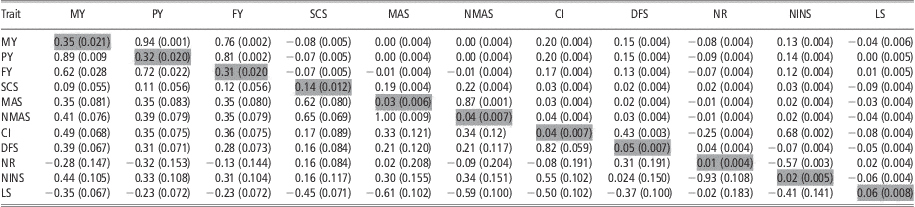
Estimates with standard errors (in parenthesis) from bivariate analyses using a sire model with heritability (on diagonal), genetic correlations (below the diagonal) and phenotypic correlations (above the diagonal) for lactation one
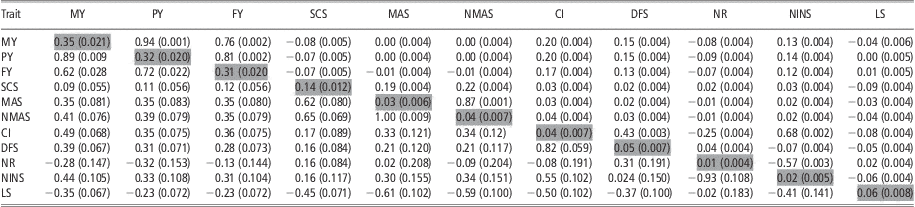
MY = milk 305-day yield; PY = protein 305-day yield; FY = fat 305-day yield; SCS = somatic cell score; MAS = mastitis; NMAS = number of mastitis episodes; CI = calving interval; DFS = days to first service; NR = non-return; NINS = number of inseminations; LS = lifespan score.
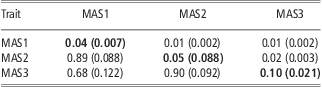
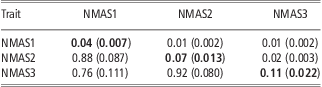
The heritability of MAS increased with parity and estimates were 0.04, 0.05 and 0.10 in parities 1, 2 and 3, respectively, obtained from multivariate analysis across parities (Table 9). Genetic correlations between MAS in adjacent parities were high (∼0.90) and more strongly correlated than non-adjacent parities 1 and 3 (0.68). Estimates of NMAS were similar with heritabilities of 0.04, 0.07 and 0.11 (Table 10). Genetic correlations between NMAS parities 1 v. 2, 1 v. 3 and 2 v. 3 were 0.88, 0.76 and 0.93, respectively. Univariate analyses for separate parities gave slightly lower heritability estimates (in particular parities 2 and 3) for MAS and NMAS compared with multivariate analyses (results not shown). There were convergence problems for the multivariate analysis of LAM and NLAM across lactations; thus, genetic correlations between parities were not estimated. Genetic correlations between MAS v. NMAS and LAM v. NLAM were high (0.99 and 0.96, respectively) using a repeatability model, indicating that binary and count traits are virtually the same trait, likely due to a very low proportion of animals with more than one episode of mastitis or lameness.
Genetic correlations (below diagonal), heritabilities (on diagonal in bold), phenotypic correlations (above diagonal) between mastitis in the first three parities with standard errors (in parenthesis) using a sire model
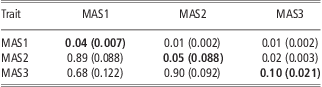
MAS1, MAS2 and MAS3 = mastitis in parities 1, 2 and 3, respectively.
Genetic correlations (below diagonal), heritabilities (on diagonal in bold), phenotypic correlations (above diagonal) between number of mastitis episodes in the first three parities with standard errors (in parenthesis) using a sire model
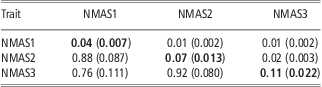
NMAS1, NMAS2 and NMAS3 = number of mastitis episodes in parities 1, 2 and 3, respectively.
Genetic correlations are presented in Table 7 for bivariate analyses using a repeatability model. The majority of genetic correlations were significant, with the exception of pair-wise combinations mainly with NR56 and NINS, and lameness with some fertility traits. Standard errors obtained from pair-wise combinations with both lameness traits were higher in relation to other combinations because of the smaller proportion of lameness records in the dataset. Highest genetic correlations were between production traits (0.58 to 0.88), SCS and mastitis (0.69), CI and DFS (0.78) and NR56 and NINS (−0.91). Genetic correlations analysed using data from first parity are presented in Table 8 not including analyses with both lameness traits as there was insufficient data. Compared with the results from the repeatability model, standard errors were larger because of the smaller subset of data; thus, a greater proportion of pair-wise combinations were not significant, particularly between fertility and health traits. Comparisons between bivariate analyses of the repeatability model and first parity showed that genetic correlations were quite similar. However, there was a tendency for higher genetic correlations with production traits in first parity, whereas genetic correlations with SCS tended to be lower in the first parity. Similar to the repeatability analyses, highest genetic correlations were between production traits (0.62 to 0.89), SCS and mastitis (0.62 to 0.65), CI and DFS (0.82) and NR and NINS (−0.93).
Discussion
Incidence of mastitis and lameness
Overall incidences of mastitis and lameness (as binary traits) were 17.4% and 15.8%, respectively, across three lactations. This reflects the greater effort in farmer recording since the study of Kadarmideen et al. (Reference Kadarmideen, Thompson and Simm2000), which was also based on UK farmer-recorded data, with mastitis and lameness incidences of 6% and 4%, respectively, across five lactations. Higher incidence rates have been reported in UK literature on mastitis (38.2%) and lameness incidence (23.3%) (Whitaker et al., Reference Whitaker, Macrae and Burrough2004) and it is commonly reported that incidences based on farmer-recorded health events are lower than veterinary recorded events (Whay et al., Reference Whay, Main, Webster and Green2003). Lameness is less recorded than mastitis, which is reflected by the current dataset. The records on treatments are likely to be on animals that have had the most severe lameness and require extra treatments (i.e. antibiotics) on top of routine herd treatments such as the use of foot baths or regular hoof trimming. These records may be a good indicator of the most costly cases of lameness. Leach et al. (Reference Leach, Whay, Maggs, Barker, Paul, Bell and Main2010) explained that the lack of recording was due to farmers not being fully aware of the costs of lameness on productivity and profitability. It is thought that because of limited time and resources, farmers are likely to prioritise, and thus mastitis and high SCS that have an immediate and visible cost are expected to be higher on the agenda than lameness, with regard to recording.
Mastitis
The trend of increased mastitis incidence with increasing parity and the proportions of animals affected in the first three parities are similar to other studies, although incidence level is at the higher end of the range. In first lactation cows, the proportion of animals affected by mastitis at least once ranged from 5.4% (Pösö and Mäntysaari, Reference Pösö and Mäntysaari1996) to 23.1% (Chang et al., Reference Chang, Gianola, Heringstad and Klemetsdal2004) in literature. However, when comparing studies it is important to be aware that different observation periods during lactation are used, in addition to different breeds and different countries. Carlén et al. (Reference Carlén, Schneider and Strandberg2005) obtained incidence levels of 10%, 12% and 15% in Swedish Holstein for numbers of cows affected in parities 1, 2 and 3, respectively. These were lower incidences than UK data, which would be understandable as udder health including mastitis has been a breeding goal in Sweden since 1984 (Heringstad et al., Reference Heringstad, Klemetsdal and Ruane2000), but also the observation period was shorter (for the period of 10 days before calving to 150 days from calving). Mastitis incidence of a herd is influenced by age structure, which has also been shown by many studies that have included later parities, and found mastitis incidence to increase with parity (Pösö and Mäntysaari, Reference Pösö and Mäntysaari1996; Carlén et al., Reference Carlén, Schneider and Strandberg2005; Appuhamy et al., Reference Appuhamy, Cassell and Cole2009). The number of episodes per lactation also tended to increase with parity, indicating that cows of later parities are more prone to re-infection or less able to fight off infection allowing persistence of the organism within the mammary gland. A similar pattern was observed from SCS measurements; with increasing parity, SCS tended to increase. The increasing disease incidence with parity could be explained by the higher yields produced by older cows, thus at risk to negative energy balance and therefore at greater risk to disease. In addition, with maturity and increased stage of lactation physiological damage to the teats and udder are likely to contribute to increased risk to mastitis infection (Lund et al., Reference Lund, Jensen and Petersen1999). Udders are prone to become more pendulous as the cow matures, caused by increased udder depths due to high yields and loosening of the main tendon holding the udder, and this can cause hindrance to movement and making the cow prone to injury. The time to first mastitis incident corresponds with reports in the literature that most new infections take place during the periparturient period when mammary glands undergo transition to a state of active milk synthesis (Mulligan and Doherty, Reference Mulligan and Doherty2008). The highest frequency of mastitis was around calving and early lactation, after which the frequency remains fairly low and constant. Carlén et al., (Reference Carlén, Schneider and Strandberg2005) reported that 20% to 30% of all mastitis cases occurred before day 10 of lactation, and the values were highest for first-parity cows.
Lameness
Similar to mastitis and as described in literature, lameness incidence was found to increase with parity (Barkema et al., Reference Barkema, Westrik, van Keulen, Schukken and Brand1994; Espejo et al., Reference Espejo, Endres and Salfer2006). Incidences of the first lameness events were highest in the 1st month of lactation and during the first 4 months of the year, January to April. Generally, lameness tends to be more common in the winter months when the cattle are housed (Whitaker et al., Reference Whitaker, Macrae and Burrough2004). Barker et al. (Reference Barker, Leach, Whay, Bell and Main2010) found that cattle that were locomotion scored at 61 days or later, from start of housing, had a significantly higher prevalence of lameness, which is in agreement with the data used in this study where lameness incidence was greatest towards the end of the housing period. Barkema et al. (Reference Barkema, Westrik, van Keulen, Schukken and Brand1994) found that most lameness cases were during the 1st month of lactation, which is the time the dairy cow is greatly immuno-suppressed because of the physiological stresses of calving and the rapid increase in milk yield (Mulligan and Doherty, Reference Mulligan and Doherty2008). Research into hoof composition has shown that events associated with calving weaken the connective tissue of the hoof suspensory apparatus, which leads to increased susceptibility to clinical lameness at early lactation (Knott et al., Reference Knott, Tarlton, Craft and Webster2007). Incidences of first lameness events after the 1st month of lactation appeared evenly distributed throughout the lactation, similarly observed by Appuhamy et al. (Reference Appuhamy, Cassell and Cole2009).
Heritability estimates of functional traits
Health traits – mastitis and lameness
The heritability estimates for mastitis were in the range reported in literature using a linear model (Heringstad et al., Reference Heringstad, Klemetsdal and Ruane2000). By treating different parities as separate traits, heritability estimates were slightly higher using a multivariate model compared with a univariate model. Relatively, high genetic correlations between parities are likely to raise heritability estimates in multivariate analyses. In similar studies, the heritability estimates for lameness, using linear models, have been reported as low (1% to 2%; Kadarmideen et al., Reference Kadarmideen, Thompson and Simm2000; Laursen et al., Reference Laursen, Boelling and Mark2009; Haile-Mariam and Goddard, Reference Haile-Mariam and Goddard2010). In general, low heritability is common for functional traits, such as health and fertility. Heritability estimates of mastitis increased with parity, which could be due to the higher proportion treated, as heritability estimates from linear models fitted to binary/categorical traits depend upon frequency (Heringstad et al., Reference Heringstad, Klemetsdal and Ruane2000). The low heritability estimates for both health traits can be explained by large environmental influences and as their classification as a binary/categorical trait, which results in a low observed variation among cows. The large environmental influences suggest that some improvements could be made by changes in herd management. Analysis of multiple episodes as a binary trait implies that animals with one case are equally at risk to those animals with multiple cases; thus, it is perceived that there is a loss of information when the trait is treated as binary (Vazquez et al., Reference Vazquez, Gianola, Bates, Weigel and Heringstad2009). Estimates were generally higher when repeated cases of mastitis or lameness within parities were accounted for, as more variability is observed among cows. Definition, as either a binary or count trait, has been found to have differing impacts on sire rankings (Pérez-Cabal et al., Reference Pérez-Cabal, de los Campos, Vazquez, Gianola, Rosa, Weigel and Alenda2009; Vazquez et al., Reference Vazquez, Gianola, Bates, Weigel and Heringstad2009), and it has been suggested that the definition should depend upon the selection goal. Pérez-Cabal et al. (Reference Pérez-Cabal, de los Campos, Vazquez, Gianola, Rosa, Weigel and Alenda2009) explained that if the objective was to discard animals with mastitis problems, then the binary trait would be suitable. However, with regard to overall profitability, because of the known antagonistic relationship between milk production and mastitis resistance the number of mastitis events leads to a greater ability to predict future costs associated with mastitis.
The inclusion or exclusion of animals with partial lactation records could introduce a bias and/or result in a loss of information. For instance, an animal could have had mastitis in the early stages of lactation but culled before 200 days, and hence not included in this study dataset, but could add valuable information to the analysis. Furthermore, an animal with no mastitis reported as healthy but culled before 200 days, if included in the dataset could introduce potential bias as it could have succumbed to mastitis if allowed the whole observation period of 305 days. For the study of mastitis or lameness, this is the reason to use survival analysis; however, it was necessary to restrict the dataset as the aim was partly to estimate genetic correlations of health traits with production, fertility and longevity traits.
Fertility, SCS and longevity
Heritability estimates of the fertility traits were low (0.01 to 0.04) and were similar to those obtained by Wall et al. (Reference Wall, Brotherstone, Woolliams, Banos and Coffey2003) for first lactation only. The heritability estimate of NR56 reported by Wall et al. (Reference Wall, Brotherstone, Woolliams, Banos and Coffey2003) was twice that of this study (0.018). The former study involved a six-trait multivariate analysis, which included condition score and daily milk yield nearest to 110 days. It has been observed that a higher heritability of NR56 was obtained when a multivariate analysis is performed accompanied by these two traits, which have relatively higher heritability. Similar heritability estimates have also been reported in Norwegian Red first lactation cows for DFS (0.03) and NR56 (0.01; Andersen-Ranberg and Heringstad, Reference Andersen-Ranberg and Heringstad2006). Lui et al. (Reference Lui, Jaitner, Reinhardt, Pasman, Rensing and Reents2008) treated later lactations as repeated measurements and reported heritability estimates similar to this study of 0.039 and 0.015 for DFS and NR56, respectively. The heritability estimates for SCS were within the reported range (0.08 to 0.19) of literature using a linear model (Heringstad et al., Reference Heringstad, Klemetsdal and Ruane2000). As well, the heritability of LS was consistent with work from which it was derived, generally ranging from 0.05 to 0.06 (Brotherstone et al., Reference Brotherstone, Veerkamp and Hill1998).
Genetic correlations
Mastitis correlations across parities
The genetic correlations between parities were different from one, and therefore indicate that separate parities should be treated as separate traits, rather than using a repeatability model. The estimates obtained here were similar to those obtained in a combined analysis of mastitis with test-day SCS by Mrode et al. (Reference Mrode, Pritchard, Coffey and Wall2012). All animals in the dataset had data from their first parity, but some cows may not have completed all three lactations. The lower genetic correlation between parities one and three could be due to some animals being affected by mastitis in their first parity and removed from the herd and thus not seen in later parities.
Relationships between traits
Mastitis and lameness
Genetic correlations between mastitis and lameness traits were positive, which suggest that animals that are genetically prone to mastitis are also more prone to lameness. This indicates that an improvement in one trait may also lead to an improvement in the other. Buch et al. (Reference Buch, Sørensen, Lassen, Berg, Eriksson, Jakobsen and Sørensen2011) reported moderate genetic correlations between mastitis with hoof diseases, sole ulcer and sole haemorrhage, in first-parity Swedish Red cows, which were 0.32 and 0.35, respectively, which were similar to estimates in this study (0.36 to 0.38). Other studies have found a relationship between locomotion with udder conformation traits, which are both type traits used as predictors of udder health and lameness (Boelling and Pollott Reference Boelling and Pollott1998; Van Dorp et al., Reference Van Dorp, Boettcher and Schaeffer2004; Onyiro and Brotherstone Reference Onyiro and Brotherstone2008). Results of Onyiro and Brotherstone (Reference Onyiro and Brotherstone2008) implied that a well-fitted mammary system was associated with better locomotion, whereas cows with sagging or pendulous udders were more likely to suffer from lameness. In addition, with increasing age the udder depth increases caused by higher milk yields of maturer cows and by loosening of the main tendon (Fascia trunci) that holds the udder, thus likely to impede locomotion. However, SCS, a predictor of mastitis, was not significantly genetically correlated with lameness, which was similarly observed by Buch et al. (Reference Buch, Sørensen, Lassen, Berg, Eriksson, Jakobsen and Sørensen2011) when examining four hoof diseases.
Health and fertility
Genetic correlations between health and fertility traits were favourable, which indicates that selection against mastitis or lameness is expected to result in a shorter calving interval, a shorter interval from calving to first service, fewer inseminations to conception and a higher non-return rate. Poor health, such as mastitis and lameness, has been shown to have negative effects on reproductive performance (Huszenicza et al., Reference Huszenicza, Jánosi, Kulcsár, Kóródi, Reiczigel, Kátai, Peters and De Rensis2005; Morris et al., Reference Morris, Kaneko, Walker, Jones, Routly, Smith and Dobson2011). It is thought that disease early in lactation may impair the cow's ability to show oestrus (thus, reducing detection) and to conceive after insemination. Huszenicza et al. (Reference Huszenicza, Jánosi, Kulcsár, Kóródi, Reiczigel, Kátai, Peters and De Rensis2005) found that mastitis can affect the resumption of ovarian activity in post-partum cows, for instance, mastitic cows at 15 to 28 days in milk had delayed luteal activity and reduced oestrous behaviour. Similarly, several studies have found that lame cows expressed absence of ovarian activity or reduced oestrous behaviour (Morris et al., Reference Morris, Kaneko, Walker, Jones, Routly, Smith and Dobson2011), linked to lower maximum progesterone levels, and also explained by the fact that lame cows spend more time lying down, leading to reduced time to display sexual behaviour (Walker et al., Reference Walker, Smith, Routly, Jones, Morris and Dobson2008). Dobson et al. (Reference Dobson, Walker, Morris, Routly and Smith2008) reported that it took more than an extra 40 and 18 days, respectively, to get a lame or mastitic cow in-calf compared with healthy herd mates. Wilson et al. (Reference Wilson, Grohn, Bennett, González, Schukken and Spatz2008) reported that cows were significantly less likely to become pregnant if infected by Escherichia coli (42% pregnant) or Streptococcus spp. (38% pregnant) compared with cows with no mastitis (78% pregnant). Risco et al. (Reference Risco, Donovan and Hernandez1999) found that cows with mastitis during the first 45 days of gestation were 2.7 times at greater risk of abortion within the next 90 days than cows without mastitis.
Kadarmideen et al. (Reference Kadarmideen, Thompson and Simm2000) estimated genetic correlations between mastitis and lameness with CI, DFS, NR56 and NINS using UK data. Genetic correlations between MAS with CI, DFS, NR56 and NINS were 0.28, 0.32, −0.21 and 0.41, respectively, from the study of Kadarmideen et al. (Reference Kadarmideen, Thompson and Simm2000) and 0.31, 0.28, −0.27 and 0.28, respectively, in this study. Thus, estimates between CI and DFS appear close to this study. Genetic correlations between LAM with CI, DFS, NR56 and NINS were 0.22, 0.18, −0.22 and 0.06, respectively, from the former study, compared with 0.35, 0.24, −0.36 and 0.38, respectively, in this study. Hence, there were some differences between the estimates of the two studies, and estimates between LAM and fertility traits tended to be stronger in the present study. In this study, standard errors were higher for genetic correlations with lameness and some estimates were not significantly correlated because of relatively fewer lameness records in the dataset. This is also likely to be a problem with the former study where many genetic correlations were not significantly different from zero, which is also likely because of relatively lower numbers of health records. Outside of the United Kingdom, Andersen-Ranberg and Heringstad (Reference Andersen-Ranberg and Heringstad2006) obtained a genetic correlation of 0.23 between NMAS and DFS in first lactation Norwegian Red, which was similar to this study (0.21), although it was not significant. The study of Sogstad et al. (Reference Sogstad, Østerås and Fjeldaas2006) emphasises the increased risk of poor fertility because of different causes of lameness. Buch et al. (Reference Buch, Sørensen, Lassen, Berg, Eriksson, Jakobsen and Sørensen2011) obtained significant genetic correlations between dermatitis and heel horn erosion with NINS, with estimates of 0.32 and 0.22, respectively, as well as a significant genetic correlation of 0.33 between sole ulcer and DFS.
Genetic correlations between fertility traits with SCS tended to be lower than with mastitis, with the exception of SCS and DFS. In the current study, SCS was not significantly correlated with NR56 or NINS. Lower genetic correlations of 0.13 in Swiss Holsteins (Kadarmideen Reference Kadarmideen2004) and 0.16 in UK dairy cattle (Pryce et al., Reference Pryce, Esslemont, Thompson, Veerkamp, Kossaibati and Simm1998) were obtained for the correlation between SCS and DFS. In contrast, a higher genetic correlation of 0.28 between SCS and CI was obtained in the same study of Pryce et al. (Reference Pryce, Esslemont, Thompson, Veerkamp, Kossaibati and Simm1998). In addition to clinical mastitis, subclinical mastitis also has a negative effect on fertility. Separate studies have found that higher SCS lead to greater risk of embryo loss (Moore et al., Reference Moore, Overton, Chebel, Truscott and Bondurant2005; Pinedo et al., Reference Pinedo, Melendez, Villagomez-Cortes and Risco2009), thus would cause longer CIs as cows would require further inseminations. Genetic improvement of animal health should lead to simultaneous improvement of reproductive performance.
Production and functional traits
An antagonistic relationship exists between milk production traits with fertility, health and longevity. These relationships can be partly explained because of negative energy balance of high yielding cows and the accompaniment of reduced feed intake at calving time, generally when metabolic diseases are at their peak. For cows starting their first lactation, there are demands from the growing calf up until parturition, the production of mammary tissue and milk synthesis, in addition to the animal's requirements for its own growth as it is not yet physically mature. Negative energy balance contributes to reduced immune response. For instance, in the case of mastitis infection, defence mechanisms of the mammary gland during the periparturient period have been found to have decreased or impaired function (Sordillo and Streicher, Reference Sordillo and Streicher2002). Hence, the reason mastitis and lameness are often termed as production diseases although they are caused by infectious agents. Fertility can be affected directly due to negative energy balance or indirectly due to disease, such as mastitis or lameness. Dobson et al. (Reference Dobson, Walker, Morris, Routly and Smith2008) explained that establishing a pregnancy is risky for an animal in poor health, so through survival instinct animals will not show obvious signs of oestrus to avoid conception. Mastitis, fertility and lameness are the three main causes of involuntary culling, thus resulting in reduced longevity (Whitaker et al., Reference Whitaker, Macrae and Burrough2004).
The association between health and milk yield is well documented in the literature for both mastitis (Gröhn et al., Reference Gröhn, Wilson, González, Hertl, Schulte, Bennett and Schukken2004; Windig et al., Reference Windig, Calus and Veerkamp2005; Hagnestam et al., Reference Hagnestam, Emanuelson and Berglund2007) and lameness (Barkema et al., Reference Barkema, Westrik, van Keulen, Schukken and Brand1994). Genetic correlations between both health traits with milk production yield traits were all positive, indicating that animals genetically above average for yield traits were more liable to mastitis and lameness. Genetic correlations were in line with estimates from the study of Carlén et al. (Reference Carlén, Strandberg and Roth2004) for milk with SCS and mastitis, which, depending on parity, ranged from 0.13 to 0.22 and 0.26 to 0.45, respectively. In addition, Kadarmideen (Reference Kadarmideen2004) obtained an estimate of 0.13 for the genetic correlation between milk and SCS, which is close to this study (0.12). Genetic correlations between milk and lameness were also within the range reported by other studies (0.13 to 0.48; Pryce et al., Reference Pryce, Veerkamp, Thompson, Hill and Simm1997 and Reference Pryce, Esslemont, Thompson, Veerkamp, Kossaibati and Simm1998; Van Dorp et al., Reference Van Dorp, Dekkers, Martin and Noordhuizen1998). A high milk yield is predisposing to mastitis or lameness, although a case of either of these will decrease the yields for the remainder of the lactation (Hagnestam et al., Reference Hagnestam, Emanuelson and Berglund2007) and particularly mastitis will affect milk yields of subsequent lactations because of impaired or destroyed secretory tissues of the udder (Lucey and Rowlands, Reference Lucey and Rowlands1984). Thus, the advantage of cows with higher yields is lost, or to benefit from much higher yields better management is required. The greatest economic loss due to subclinical and clinical mastitis is reduced milk yield. The magnitude of losses depend very much upon the type of infection, the stage of lactation and parity (Gröhn et al., Reference Gröhn, Wilson, González, Hertl, Schulte, Bennett and Schukken2004). Bar et al. (Reference Bar, Gröhn, Bennett, González, Hertl, Schulte, Tauer, Welcome and Schukken2007) estimated milk losses due to mastitis including repeated cases within and across lactations. Their study found that first lactation cows lost 164 kg of milk for the first case and 198 kg for the second case in the 2 months following diagnosis compared with their potential yield, whereas for later lactations losses were higher with estimates of 253 kg, 238 kg and 216 kg for first, second and third mastitis cases within the same lactation. In addition, it was found that if a cow had one or more mastitis cases in its previous lactation then it would produce 1.2 kg/day less milk over the whole of current lactation compared with a cow with no mastitis in its previous lactation. Green et al. (Reference Green, Hedges, Schukken, Blowey and Packington2002) estimated that on average lame cows fail to produce ∼350 kg of milk (with a range of 160 to 550 kg), and decreased milk yield occurred from 4 months before till 5 months after a cow was diagnosed as clinically lame.
Production and fertility
Pryce et al. (Reference Pryce, Royal, Garnsworthy and Mao2004) reviewed genetic correlation estimates between milk yield with CI, DFS and the equivalent to NR56, and these ranged from 0.22 to 0.59, 0.22 to 0.44 and −0.62 to 0.05, respectively. In this study, NR56 was not significantly correlated with milk yield, but CI and DFS were at the higher end of the range of estimates, or slightly higher in the case of DFS (0.49). Wall et al. (Reference Wall, Brotherstone, Woolliams, Banos and Coffey2003) estimated correlations between predicted transmitting abilities (PTAs) of milk with PTAs of CI, DFS, NR56, NINS and these were 0.47, 0.67, −0.56 and 0.33, respectively.
Longevity
Significant genetic correlations with LS ranged from −0.18 to −0.67, and LS was only non-significant with NR56. Genetic correlations between LS with SCS, fertility and health traits indicate that animals that survive for more lactations tend to have lower somatic cell count, a shorter calving interval, fewer number of days to first service, require fewer inseminations, higher non-return rate, with reduced disease incidence. Although higher yielders might be favoured by farmers, the results indicate that in the long term these animals may have a shorter productive life. This is likely due to higher yielders requiring better nutrition and when this is not met it then leads to negative energy balance, associated with reduced immune response, thereby more prone to disease (e.g. mastitis, lameness) or reduced fertility and for these reasons might be culled prematurely.
Implications
The Farm Animal Welfare Council (FAWC) in the United Kingdom recommended that dairy breeding programmes should place more emphasis on welfare traits, and that disease incidence, particularly mastitis and lameness, to be reduced (FAWC, 2009). The heritability estimates of mastitis and lameness were low, like many functional traits, thus genetic gain through selection on both traits alone would be slow, yet still positive and cumulative. Incorporating direct measures of mastitis and lameness in addition to current predictor traits should improve the accuracy of genetic evaluations and aid selection response for reduced disease incidence. In addition, genetic improvement of animal health should in turn lead to simultaneous improvement of reproductive performance and longevity. The data at present may have its limitations, therefore the importance of recording should be emphasised to farmers, and standardised recording protocols established.
Selection on health and fertility traits should reduce the need for involuntary culling for disease. Premature replacement of animals due to involuntary culling is one of the largest costs, such as direct costs associated with costs of buying or rearing a replacement animal, and indirect costs of reduced efficiency as replacement animals are generally heifers, which have lower milk yields than multiparous cows. Reducing involuntary culling should also improve longevity, thus capturing greater potential milk yields from older cows and allowing farmers more choice on which animals to retain and to breed replacements from. Improved health, fertility and ultimately longevity is expected to be a win–win situation economically, socially and environmentally by means of reducing farm costs by improving output per unit input, simultaneously reducing greenhouse gas emissions for any given output (Garnsworthy Reference Garnsworthy2004; Wall et al. Reference Wall, Coffey and Pollott2012), and enhanced animal welfare.
Acknowledgements
Many thanks to the farmers for recording the data, as well as funding from Defra under the Sustainable Livestock Production LINK Programme, the Scottish Government, CIS, Cogent, DairyCo, Genus, Holstein UK and NMR.