

Introduction
The contribution of animal production systems to environmental load is well recognised. Most reference to the environmental footprint of cattle production systems focus on greenhouse gas emissions. O'Mara (Reference O'Mara2011) stated that animal agriculture is responsible for 8.0% to 10.8% of global greenhouse gas emissions based on calculations from the Intergovernmental Panel on Climate Change. If, however, complete lifecycle analysis (i.e. accounting for the production of inputs to animal agriculture as well as change in land use such as deforestation) is undertaken this figure can be up to 18%. Cattle are the largest contributors to global greenhouse gas emissions (O'Mara, Reference O'Mara2011). Other contributors to environmental load include nitrogen excretion and its impact on nitrogen leaching.
Societal demands to reduce the environmental burden from animal production systems is, however, concurrent with increasing societal pressure to supply the growing world human population with sufficient, high quality, animal protein products at a reasonable price. Food demand by 2050 is expected to be ∼70% greater than the demand in 2010 (FAO, 2009). Therefore, any mitigation strategies for environmental footprint must take cognisance of this growing demand.
Possible breeding strategies to reduce environmental footprint of predominantly dairy cattle systems is reviewed here. Many of the approaches discussed here can also be implemented in the beef cattle sector, as well as other animal production systems. Although many nutritional approaches exist, or are currently being investigated to mitigate environmental load, the advantage of including an animal breeding component within an overall national or global strategy is that advancements achieved through animal breeding are cumulative and permanent unlike some nutritional or other management strategies, which may require continual investment. Moreover, although improving animal characteristics associated with environment load has obvious benefits for the environment, it can also improve animal performance, especially if achieved through a balanced breeding goal. For example, eructated methane, a large contributor to the environmental footprint of ruminants, accounts for a loss of ∼6% of ingested energy (Johnson and Johnson, Reference Johnson and Johnson1995).
Breeding goal
Before implementing a breeding programme, a clear and (generally) accepted breeding goal needs firstly to be established. For a trait to be considered as a goal trait, it must fulfil three criteria: (1) it must be important, either economically, environmentally or socially, (2) is must be under some genetic control (i.e. must be heritable) and (3) it must be (ideally easily) measurable, preferably at a low cost, or be genetically correlated with traits or information (i.e. genomic information) that are measureable. At this stage of the process, whether or not phenotypic data (i.e. measured traits) are available should not be considered – two approaches to overcome this limitation include indirect selection using selection index theory or simply collecting the necessary data (i.e. phenotypic or genomic predictions) if cost-benefit analyses deems it worthwhile.
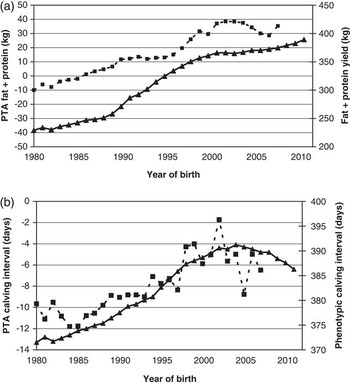
The coefficients of the linear function of traits in a breeding goal are generally derived using profit functions or bioeconomic models (Shalloo et al., Reference Shalloo, Dillon, Rath and Wallace2004) evaluating the impact of altering individual traits on performance (usually profit) for the entire farm or sector. The outcome of such an analysis is the relative weighting on each trait within the breeding goal; where the breeding goal is profit these weights are termed (relative) economic values. An animal rarely excels in all contributing factors to the breeding goal so, therefore, the economic weights prioritises the individual traits, offsetting weakness of individual animals by their strengths. Antagonisms among traits, as long as not unity, can be resolved through selection on a breeding goal. Arguably the most familiar genetic antagonism in dairy cattle is between milk production and fertility, yet simultaneous improvements in both traits is possible with a balanced breeding goal (Figure 1), albeit reductions in genetic gain in the respective traits must be accepted compared with selection on either of the traits alone.
Phenotypic (broken line and squares) and genetic merit (predicted transmitting ability (PTA); continuous lines and triangles) for (a) fat + protein yield and (b) calving interval for Irish Holstein-Friesian dairy cows across different years of birth.

One difficulty in the derivation of weighting factors is the prediction of the futuristic costs and prices within the production system; futuristic predictions are necessary since breeding is long-term. Furthermore, the economic implications of some traits, such as environmental footprint, are not explicit or do not (currently) have any market value. They have nonetheless public good value. Methods have being proposed for the derivation of weightings within breeding goals for traits with no explicit market value based on choice experiments for quantifying preferences and measuring the willingness to pay (or sacrifice gains in other traits) for different characteristics (Nielsen and Amer, Reference Nielsen and Amer2007). Desired gains approaches (Cameron, Reference Cameron1997) may also be used to compute the weighting that should be placed on traits in breeding goals to achieve a desired genetic gain in each trait (if possible). Where the desired gain in a trait is zero (e.g. live-weight and average daily gain in the calculation of residual feed intake; RFI) then the index is termed a restricted index (Cameron, Reference Cameron1997); RFI (Koch et al., Reference Koch, Swiger, Chambers and Gregory1963) a commonly used measure of feed efficiency over a given time period is a restricted selection index.
Knowledge of the optimal production system is necessary for inclusion in the bioeconomic model, and robustness of the economic weights, and thus the breeding goal, across differing production systems should be quantified. Where necessary, alternative breeding goals may be required for different production systems to account for economic-by-environment interactions on the relative weightings. Accounting for genotype-by-environment interactions (Berry et al., Reference Berry, Buckley, Dillon, Evans, Rath and Veerkamp2003a) in the estimation of genetic merit of individual animals may also be required. Consideration, however, needs to be given to whether or not different environments require different breeding programmes. The justification will be dependent on the extent of genotype-by-environment (G × E) interactions, as well as the resource implications of having additional breeding programmes to service alternative environments.
A pertinent breeding goal for dairy (and other) production systems, focusing solely on reducing the environmental footprint (which is not recommended but will be undertaken here for illustrative purposes) may be ‘A reduction in environmental load per unit product produced’. At a herd (or sector) level such a breeding goal will include both milk production output and environmental load from the herd or production sector (including replacement animals) and also probably the entire agricultural sector. For simplicity, no cognisance here is taken of outputs from the sale of surplus animals, including cull cows, and their impact on environmental load.
Milk production may be defined as milk yield, fat yield and protein yield as is commonly used in most national breeding objectives (Miglior et al., Reference Miglior, Muir and Van Doormaal2005). However, other traits which may influence the profitability of the product through a higher-value added product portfolio should also be considered. Such traits may include milk fatty acid and protein profile, as well as milk processing characteristics.
Environmental load within a system (which can subsequently be expressed on a per lactation basis) is influenced by many factors, such as calving pattern, number of nulliparae (as well as other non-producing animals), feed intake and direct measurement of environmental emissions/excreta per animal, such as greenhouse gas emissions or nitrogen excretion per animal. Some of these traits, such as calving pattern and cow longevity (a factor of replacement rate) as well as feed intake are associated with milk production and this association should be accounted for in the economic values or the estimated genetic merit of the animal depending on the statistical model used in the genetic evaluations. As previously stated, not included here is the impact of surplus (e.g. male) animals on environmental load. However, the impact on environmental load outside of the dairy farm gate should be included here. For example, animals with higher feed intake may have a greater environmental load, over an above that accounted for through direct environmental emissions/excreta, when a full life-cycle analysis is undertaken. The production and harvesting of grass silage (or other conserved forages) generates carbon dioxide for energy use and releases nitrous oxide from the soil. The impact of compromised health on milk production will be captured through the genetic evaluations for milk production, thereby avoiding double-counting of the effect in the entire breeding goal. Other factors, such as nulliparae mortality will also influence environmental output but its impact is also ignored here.
Some animal characteristics are not included in this breeding goal, primarily because of a lack of data on their contribution to environment load or that their contribution may be relatively small. For example animals of inferior health may require antibiotics or other treatments which themselves have an environmental impact. The impact of increased intake on diet digestibility (Van Es, Reference Van Es1978) and rumen pH (and, therefore, volatile fatty acid production; Bannink et al., Reference Bannink, France, Lopez, Gerrits, Kenreab, Tamminga and Dijkstra2008) and subsequently methane emissions will be captured in the breeding value of methane emissions and its associated economic value.
Some advocate the use of ratio traits like methane emissions per unit intake to be included as goal traits in breeding objectives. The disadvantages of using ratio traits in a breeding programme include (1) a likely increase in the error variance as a proportion of the total variance in the statistical analysis, and (2) strong correlations between the ratio trait and its component traits, such as feed intake. The expected responses to selection on ratio traits are, therefore, difficult to ascertain (Gunsett, Reference Gunsett1984) because of the poor statistical properties of ratio traits because of the antagonism between the desirable response in the numerator and the denominator and the unknown relative selection pressure on each. Therefore, methane emissions is the proposed goal trait here; similarly for other environmental traits.
Genetic gain
Annual genetic gain can be summarised as (Rendel and Robertson, Reference Rendel and Robertson1950):
 $$\rDelta G\, = \,\frac{{i\, \cdot \,r\, \cdot \,{{\sigma }_{\rm{g}}}}}{L}$$
where ΔG is annual genetic gain; i is the intensity of selection; r is the accuracy with which the genetic merit of each animal is known, σ g is the genetic standard deviation; and L is the generation interval.
There are many misconceptions about the term ‘heritability’ and it is prudent here to clarify the relationship between heritability and genetic gain. Heritability (which in most instances, including here, refers to narrow sense heritability) is the proportion of phenotypic variation that is attributable to additive gene effects that are passed on from one generation to the next. Heritability varies from zero (not heritable) to one (highly heritable) and if the heritability is high, we can expect a large proportion of the phenotypic differences of the parents to be passed on to the progeny. Moreover, the greater the heritability, the greater the expressed phenotype resembles the additive genetic merit of the animal. Low heritability does not mean (1) that the remaining variation is all because of management, and (2) that genetic gain is not possible.
The denominator in the estimate of heritability is phenotypic variance, which is the sum of additive genetic, non-additive genetic and remaining environmental variation including residual variation. Therefore, one contributor to low heritability is recording errors (including pedigree recording), as well as other sources of residual variation, such as misdiagnosis of health ailments and the insemination of animals at the incorrect stage of the oestrus cycle.
Heritability influences the accuracy of selection, which is a contributing parameter to genetic gain. However, the genetic variance of a trait is equally important in achieving genetic gain and the coefficient of genetic variation in fertility traits is similar to that for production traits (Berry et al., Reference Berry, Buckley, Dillon, Evans, Rath and Veerkamp2003b). For a given number of progeny, the accuracy of selection for a low heritability trait will be less than that for a high heritability trait and, therefore, genetic gain for the former will be less (Berry et al., Reference Berry, Bermingham, Good and More2011a). High accuracy of selection (i.e. 99%) for low heritability traits is nonetheless possible negating any impact of heritability on genetic gain. The limitation with most low heritability traits is the difficulty in collection of accurate data (on a large population of animals), which in some instances is no doubt a contributing factor to the low heritability in the first place. This, therefore, emphasises the importance of a structured breeding programme to achieve high accuracy of selection across all traits but also the importance of an accurate and complete phenotyping strategy.
Selection index
Once the traits to be included in the breeding goal and the relative weightings applied to these traits has been decided, the complement of traits that should be included in a selection index to achieve genetic gain in the breeding goal must be determined; this process should take cognisance of the difficulty and expense associated with the collection of the necessary information for these traits. The optimal weighting on the traits in the selection index are such to maximise the correlation between the selection index and the breeding goal.
Milk production
Accurate prediction of genetic merit for milk production traits is relatively easy because milk production traits are moderately heritable, and therefore only a relatively small number of phenotypic records are required to achieve high accuracy of selection. Phenotypic records for milk production are automatically collected during routine milk recording. Mid-infrared (MIR) spectroscopy of milk is the method used to predict milk fat, protein and lactose composition but recent research clearly shows a potential of this technology to predict more detailed milk components like milk fatty acid content (Soyeurt et al., Reference Soyeurt, Dehareng, Gengler, McParland, Wall, Berry and Coffey2011), detailed protein composition (De Marchi et al., Reference De Marchi, Bonfatti, Cecchinato, Di Martino and Carnier2009b) and milk processing characteristics (De Marchi et al., Reference De Marchi, Fagan, O'Donnell, Cecchinato, Dal Zotto, Cassandro, Penasa and Bittante2009a). Because MIR information is available on all milk recorded samples, and many of these component traits are heritable (Bastin et al., Reference Bastin, Berry, Soyeurt and Gengler2012), these traits are, therefore, amenable to inclusion in a breeding goal to further improve profitability.
Fertility and longevity
There is a common misconception that breeding cannot contribute to improvements in fertility and functional longevity yet few argue that past breeding programmes did not contribute to the observed deterioration in reproductive performance in Holstein-Friesian dairy cattle. Most past breeding programmes selected aggressively for milk production with little or no cognisance of functional traits (Milgior et al., 2005). It is now well accepted that an antagonistic genetic correlation exists between milk production and fertility performance in lactating dairy cows (Veerkamp and Beerda, Reference Veerkamp and Beerda2007) signifying that genetic selection for milk production alone will result in poorer fertility. The ramifications of this in the Irish dairy cow population is illustrated in Figure 1 where selection for milk production alone before the year 2001 resulted in a considerable improvement in genetic merit and phenotypic performance for milk production (Figure 1a) but a deterioration in genetic merit and phenotypic performance for calving interval (Figure 1b).
Improvements in genetic merit (and phenotypic performance) for calving interval have, however, been observed in Ireland since the introduction of the national dairy cattle breeding objective, the economic breeding index (EBI; Berry et al., Reference Berry, Shalloo, Cromie, Olori, Veerkamp, Dillon, Amer, Evans, Kearney and Wickham2007b), in 2001. This improvement has occurred without a reduction in genetic merit for milk production and the trends are similar to observed elsewhere with the broadening of international breeding objectives to now include functional, non-production traits (Miglior et al., Reference Miglior, Muir and Van Doormaal2005).
The improvements in fertility internationally, as well as the differences in fertility observed in controlled experiments of different genotypes of cows (Coleman et al., Reference Coleman, Pierce, Berry, Brennan and Horan2009) are despite the low heritability commonly reported for fertility traits (Veerkamp and Beerda, Reference Veerkamp and Beerda2007). The low heritability is negated against through access to phenotypic records on a large population of animals, thereby resulting in accurate estimates of genetic merit for animals with large progeny group sizes (Berry et al., Reference Berry, Bermingham, Good and More2011a). Furthermore, phenotypic information on correlated traits, such as body condition score (Berry et al., Reference Berry, Buckley, Dillon, Evans, Rath and Veerkamp2003b) can be exploited to augment further the accuracy of selection for reproductive traits (Berry et al., Reference Berry, Buckley, Dillon, Evans, Rath and Veerkamp2003b). The potential use of milk fatty acids predicted by milk MIR has recently been advocated to increase the accuracy of selection for fertility (Bastin et al., Reference Bastin, Berry, Soyeurt and Gengler2012). The latter option is particularly promising since MIR information is available on all milk recorded samples; the predictive ability for fertility could possibly be augmented further by relating the MIR directly to the fertility trait of interest. Similarly low heritability estimates have been documented for longevity and survival but because phenotypic records are potentially available on all animals, assuming pedigree is accurately recorded, genetic gain in longevity is also feasible. Age at first calving, although sometimes not strictly defined as a fertility trait, will also influence environmental load since the animal will be in a non-producing state for longer although animals calving for the first time at an older age have higher lactation yields (Berry and Cromie, Reference Berry and Cromie2009). Age at first calving is also heritable with considerable genetic variation (Berry et al., Reference Berry, Kearney, Twomey and Evans2013).
Improving fertility and longevity can reduce the environmental load of the production system. Of course, improving longevity will increase the generation interval thereby reducing annual genetic gain; the impact needs to be quantified once genetic parameters for environmental traits are available. Garnsworthy (Reference Garnsworthy2004) documented, using modelling, that if dairy cow fertility in the UK national herd could be restored to 1995 levels from 2003 levels then herd methane emissions could be reduced by 10% to 11% whereas ammonia emissions could be reduced by 9% under a milk quota environment; the respective reductions were 21% to 24% and 17%, if ideal fertility levels were achieved. A reduction of 4% to 5% in herd methane emissions was expected in the United Kingdom, if fertility levels were restored to 1995 levels from 2003 levels where no milk quota existed (Garnsworthy, Reference Garnsworthy2004). These improvements were primarily because of a reduced number of non-producing replacement animals and to a lesser extent greater milk yield when fertility was improved. No cognisance was taken here of the impact of replacement rate on genetic gain.
The impact of fertility on environmental load differs also through alterations on the diet fed and the associated implications, especially in seasonal calving production systems, most notably in Ireland and New Zealand. For example, additional energy and nitrogen fertiliser is required to produce conserved forages or concentrates; this results in greater production of carbon dioxide and greater release of nitrous oxide from soils, respectively. The analysis of Garnsworthy (Reference Garnsworthy2004) on the impact of improved fertility on methane emissions was limited to within the farm gate and did not take cognisance of upstream effects, such as the production of concentrates. O'Brien et al. (Reference O'Brien, Shalloo, Grainger, Buckley, Horan and Wallace2010), however, undertook a complete life-cycle analysis of Irish production systems; they reported a reduction in greenhouse gas emissions (carbon dioxide, methane and nitrous oxide) in animals with high milk solids and excellent fertility. O'Brien et al. (Reference O'Brien, Shalloo, Grainger, Buckley, Horan and Wallace2010) reported a difference of 9% in emissions per kilogram of milk yield between two genotypes of Holstein–Friesian animals differing mainly in replacement rate (18% v. 35%). Weiske et al. (Reference Weiske, Vabitsch, Olsen, Schelde, Michel, Friedrich and Kaltschmitt2006), using a whole-farm modelling approach, reported a 13% improvement in greenhouse gas emissions per kilogram of milk following a 10% reduction in replacement rate. Neither study accounted for the impact of differing replacement rate on genetic gain although the impact is likely to be small.
Feed intake
Genetic differences in feed intake among dairy cattle clearly exist (Koenen and Veerkamp, Reference Koenen and Veerkamp1998; Berry et al., Reference Berry, Horan, O'Donovan, Buckley, Kennedy, McEvoy and Dillon2007a). Breeding, however, requires routine access to a large quantity of information on selection candidates. This information may be phenotypic or genomic and may be on the trait itself (i.e. feed intake) or genetically correlated heritable traits (e.g. milk production, live-weight). For example, following a meta-analysis of up to 39 studies in beef cattle, Berry and Crowley (Reference Berry and Crowley2013) showed, using selection index theory, that 90% of the genetic variation in feed intake in growing cattle could be explained by four traits routinely measured in national breeding programmes. Using parameters from the literature, an equivalent figure of 89% of the genetic variation in feed intake in lactating dairy cattle could be explained by four routinely available traits. Therefore, the benefit of physical measurement of feed intake may be marginal, whereas the cost could be substantial. However, precise estimates of genetic and phenotypic (co)variances between feed intake in dairy cattle and other performance traits are lacking.
Collection of feed intake information for inclusion in a breeding programme or otherwise is expensive. Possible low-cost solutions to prediction of feed intake is discussed in detailed elsewhere (Berry and Crowley, Reference Berry and Crowley2013). However, in dairy cows, McParland et al. (Reference McParland, Banos, Wall, Coffey, Soyeurt, Veerkamp and Berry2011 and Reference McParland, Banos, McCarthy, Lewis, Coffey, O'Neill, O'Donovan, Wall and Berry2012), using MIR analysis of milk, documented correlations between actual and MIR predicted energy intake across two contrasting production systems of up to 0.75 when assessed using external validation. Similar accuracy of predicting daily dry matter intake was observed from near-infrared spectroscopy analysis of faecal samples in growing bulls (Huntington et al., Reference Huntington, Leonard and Burns2011). Although dependent on the heritability of the actual and predicted intake phenotypes, as well as the residual correlation between the two traits, in most instances the residual correlation is weaker than the phenotypic correlation. This suggests that the genetic correlation, which is of primary interest in animal breeding, may actually be stronger than 0.75.
Incorporation of genome-wide information into genetic evaluations (Meuwissen et al., Reference Meuwissen, Hayes and Goddard2001) can be used to augment the accuracy of selection and this approach, termed genomic selection, is now implemented in most national dairy cattle breeding programmes (Hayes et al., Reference Hayes, Bowman, Chamberlain and Goddard2009; Van Raden et al., Reference Van Raden, Van Tassell, Wiggans, Schnabel RD Talyor and Schenkel2009) resulting in increased accuracy of selection and thus genetic gain. Implementation of genomic selection, however, still requires access to large numbers of genotyped animals with phenotypes for the trait(s) under investigation (Daetwyler et al. Reference Daetwyler, Villanueva and Woolliams2008). Incorporation of genomic information within genetic evaluations is more beneficial for traits that suffer from some of the limitations of traditional quantitative genetics such as (1) the phenotype measured contains error (i.e. low heritability trait), (2) the phenotype may not be measurable in both genders (e.g. milk yield in dairy cattle), (3) adult performance cannot be measured in juveniles although it can be predicted and some traits like longevity require a long time horizon to measure, (4) the animal may need to be sacrificed to obtain the phenotype, (5) antagonistic genetic correlations between traits of interest cannot be easily resolved and (6) genotype by environment interactions may exist, which complicate the statistical analysis (Berry et al., Reference Berry, Meade, Butler, Diskin, Morris and Creevey2011b) but also traits that are difficult or expensive to measure and are not strongly genetically correlated with other heritable traits that are easy to measure. An example of a trait that is difficult to measure is feed intake, as well as some direct measures of environmental impact.
Direct environmental measures
Methane emissions
Significant breed differences in methane emissions have been reported in dairy cattle (Thackaberry et al., Reference Thackaberry, Deighton, O'Loughlin, Boland and Buckley2011) suggesting that indeed genetic differences exist among dairy cattle in methane emissions; furthermore between animal variation in methane emissions and methane intensity (i.e. methane per unit intake) have also been reported in animals fed the same diet suggesting genetic variation (Vlaming et al., Reference Vlaming, Lopez-Villalobos, Brookes, Hoskin and Clark2008). However, caution must be taken when interpreting statistics generated from the analysis of methane intensity defined as methane per unit dry matter intake. The denominator of methane intensity (i.e. dry matter intake) is known to be heritable (Koenen and Veerkamp, Reference Koenen and Veerkamp1998; Berry et al., Reference Berry, Horan, O'Donovan, Buckley, Kennedy, McEvoy and Dillon2007a) and even if the numerator (i.e. daily methane emissions) is not heritable methane intensity may still exhibit heritable variation. To prove this, the data set used by Crowley et al. (Reference Crowley, McGee, Kenny, Crews, Evans and Berry2010) to estimate variance components for feed intake (and other traits) in beef cattle was used here; the data set consisted of 2605 growing bulls. Daily methane emissions per animal were sampled from a normal probability distribution with a mean of 300 g/day and a standard deviation of 40 g/day. Methane intensity was defined as daily methane emissions divided by daily feed intake. As expected, the heritability of the simulated daily methane emissions was zero; the heritability of feed intake was 0.49 (Crowley et al., Reference Crowley, McGee, Kenny, Crews, Evans and Berry2010). However, the heritability of methane intensity was 0.19 (0.05). Therefore, the observed genetic variation in methane intensity was solely because of the genetic variation in feed intake. If the true genetic variation in methane emissions is required, the adjustment of daily methane emissions for dry matter intake is required. This may be undertaken before analysis by regressing daily methane emissions on feed intake (and other variables of interest) like undertaken for RFI (Koch et al., Reference Koch, Swiger, Chambers and Gregory1963) – this trait may be termed residual methane production. Similarly feed intake may be included as covariate in the statistical analysis. Using this approach in the sample data set used here, the heritability of the residual methane trait was, as expected, zero.
Heritability estimates of actual methane emissions are lacking in the literature for dairy cattle, primarily because of a paucity of phenotypic data on a sufficiently sized sample population to generate precise estimates. The aforementioned studies refer to where methane emissions were actually measured (here the SF6 tracer method was assumed to be a measurement of methane) and not estimated from prediction equations which include known heritable component traits.
De Haas et al. (Reference De Haas, Windig, Calus, Dijkstra, De Haan, Bannink and veerkamp2011) estimated a heritability of 0.35 for predicted methane emissions in Dutch cows; predicted methane emissions were derived from feed intake and maintenance and, therefore, is likely to be heritable given the heritability of dry matter intake and live-weight (Koenen and Veerkamp, Reference Koenen and Veerkamp1998; Berry et al., Reference Berry, Horan, O'Donovan, Buckley, Kennedy, McEvoy and Dillon2007a). The heritability of methane emissions is, however, likely to be lower if methods, such as the sulphur hexafluoride (SF6) tracer gas technique are used to estimate methane emissions since these measurements are likely to contain greater sampling variation (McGinn et al., Reference McGinn, Beauchemin, Iwaasa and McAllister2006) contributing to a proportionally greater denominator value in the estimation of heritability. Therefore, the marginal benefit of such measurements in breeding programmes over and above other already routinely available likely correlated traits (e.g. milk production and live-weight) in breeding for reduced environmental load need to be quantified. Nonetheless, several approaches, which are amenable to national use (at least on selected herds) are being investigated for measuring methane emissions (Dehareng et al., Reference Dehareng, Delfosse, Froidmont, Soyeurt, Martin, Gengler, Vanlierde and Dardenne2012; Lassen et al., Reference Lassen, Løvendahl and Madsen2012). Dehareng et al. (Reference Dehareng, Delfosse, Froidmont, Soyeurt, Martin, Gengler, Vanlierde and Dardenne2012) attempted to use MIR analysis of individual cow milk to predict methane emissions. The biological rational was the known association between volatile fatty acids and methane (Demeyer and Fievez, Reference Demeyer and Fievez2000) and between milk fatty acids in milk (measured using gas chromatography) and methane emissions (Chilliard et al., Reference Chilliard, Martin, Rouel and Doreau2009). Because some individual fatty acids in milk can be accurately predicted with milk MIR (Soyeurt et al., Reference Soyeurt, Dehareng, Gengler, McParland, Wall, Berry and Coffey2011) the relationship with milk fatty acid content, as well as other milk components (e.g. lactose) should be identifiable within the milk MIR spectrum. Albeit on a limited data set of 11 lactating Holstein cows with methane emissions measured using the SF6 tracer method, the ratio of the standard error of prediction of methane to the standard deviation of the methane emissions in the 11 cows was as high as 2.19 (Dehareng et al., Reference Dehareng, Delfosse, Froidmont, Soyeurt, Martin, Gengler, Vanlierde and Dardenne2012) suggesting this method could indeed be a useful indicator trait in a selection index for methane. This approach needs further investigation in a larger data set and possibly using more accurate assessments of methane emissions.
RFI (Koch et al., Reference Koch, Swiger, Chambers and Gregory1963) has also been proposed as an indirect predictor of methane emissions (Hegarty et al., Reference Hegarty, Goopy, herd and McCorkell2007). Few correlation estimates, however, exist between methane production and RFI (Nkrumah et al., 2006); most studies documented differences in methane production between animals stratified on RFI (Hegarty et al., Reference Hegarty, Goopy, herd and McCorkell2007). RFI is strongly correlated with feed intake (Berry and Crowley, Reference Berry and Crowley2013) and, as evidenced by the lack of differences in methane per unit intake between animals divergent on RFI (Hegarty et al., Reference Hegarty, Goopy, herd and McCorkell2007), the cause and effect of the observed association between RFI and methane emissions needs to be elucidated. Using the correlation of 0.44 and 0.38 between daily methane production and both RFI and dry mater intake, respectively, as well as the mean correlation of 0.72 between RFI and dry matter intake from the meta-analysis of Berry and Crowley (Reference Berry and Crowley2013), 26% of the phenotypic variation in daily methane production could be explained by RFI after accounting for differences in feed intake. However, this needs further investigation. Nonetheless, advocating selection on RFI, which is highly correlated to feed intake (Berry and Crowley, Reference Berry and Crowley2013), should be undertaken with caution since reducing feed intake, even if production is held constant, may reduce methane emissions per day, but unless appropriately addressed within the breeding goal, may result in greater negative energy balance and body tissue mobilisation in lactating cows which is known to have unfavourable consequences for dairy cow health and fertility (Roche et al., Reference Roche, Friggens, Kay, Fisher, Stafford and Berry2009), thereby negating or even increasing methane emissions within the herd.
Nitrogen use efficiency
Urea is the main end product of nitrogen metabolism by the cow and the majority is excreted in the urine. The quantity of urea excreted in the urine is directly proportional to the urea concentration in the blood (Ciszuk and Gebregziabher, Reference Ciszuk and Gebregziabher1994). Urea in the blood easily diffuses across mammary tissue reaching equilibrium concentrations of urea between blood and milk (Gustafsson and Palmquist, Reference Gustafsson and Palmquist1993). Therefore, the urea concentration in the blood is directly proportional to the urea concentration in milk (Jonker et al., Reference Jonker, Kohn and Erdman1998). This is advantageous because MIR analysis of milk can be used to predict milk urea nitrogen content (Arunvipas et al., Reference Arunvipas, VanLeeuwen, Dohoo and Keefe2003), and because milk MIR spectral data are available on all milk test-day records, routine access to such information facilitates breeding for improved milk urea nitrogen within a balanced breeding goal assuming genetic variation in milk urea nitrogen exists. Many studies across several international dairy cattle populations clearly show that significant genetic variation in milk urea nitrogen does indeed exist. Heritability estimates for milk urea nitrogen content range from 0.14 to 0.44 (Wood et al., Reference Wood, Boettcher, Jamrozik, Jansen and Kelton2003; Mitchell et al., Reference Mitchell, Rogers, Dechow, Vallimont and Cooper2005; de Stoop et al., Reference De Stoop, Bovenhuis and van Arendonk2007). The genetic standard deviation for milk urea nitrogen range from 1.62 to 2.47 mg/100 g (Wood et al., Reference Wood, Boettcher, Jamrozik, Jansen and Kelton2003; de Stoop et al., Reference De Stoop, Bovenhuis and van Arendonk2007; Miglior et al., Reference Miglior, Sewalem, Jamrozik, Bohmanova, Lefebvre and Moore2007; König et al., Reference König, Chang, Borstel, Gianola and Simianer2008); the coefficient of genetic variation varied from 8% to 20% (Wood et al., Reference Wood, Boettcher, Jamrozik, Jansen and Kelton2003; de Stoop et al., Reference De Stoop, Bovenhuis and van Arendonk2007; Miglior et al., Reference Miglior, Sewalem, Jamrozik, Bohmanova, Lefebvre and Moore2007; König et al., Reference König, Chang, Borstel, Gianola and Simianer2008). Therefore, breeding to reduce milk urea nitrogen is possible and is a logical trait to concentrate efforts on evaluating its usefulness in a breeding programme to select directly for reduced environmental footprint in dairy cattle.
The speed at which genetic change in nitrogen use efficiency can be achieved not only depends on the accuracy of the genetic evaluations (dictated by heritability and quantity of information) and the genetic variation present, but also on the strength and direction of the genetic correlations with other traits in the breeding goal such as milk production, reproduction performance, feed intake and other environmental measures. Across most dairy cow populations, positive genetic correlations have been documented between milk urea nitrogen and milk yield (de Stoop et al., Reference De Stoop, Bovenhuis and van Arendonk2007; König et al., Reference König, Chang, Borstel, Gianola and Simianer2008) although no genetic correlation was found between these two traits in Canadian Holsteins (Miglior et al., Reference Miglior, Sewalem, Jamrozik, Bohmanova, Lefebvre and Moore2007); using random regression models across a trajectory of days in milk, Mucha and Strandberg (Reference Mucha and Strandberg2011) reported that the genetic correlation between milk urea nitrogen and milk yield changed from positive in early lactation to negative in late lactation. A positive genetic correlation between milk yield and milk urea nitrogen implies that selection for reduced milk urea nitrogen, within a balanced breeding goal that also includes milk yield, will reduce the rate of genetic gain in milk yield and will, therefore, reduce the revenue received for milk output assuming no financial incentive is provided for lower milk urea nitrogen. Genetic correlations between milk urea nitrogen and fertility are inconsistent across studies (Mitchell et al., Reference Mitchell, Rogers, Dechow, Vallimont and Cooper2005; König et al., Reference König, Chang, Borstel, Gianola and Simianer2008; Mucha and Strandberg, Reference Mucha and Strandberg2011) but this appears to be a function of the fertility trait under investigation and the stage of lactation when milk urea nitrogen was assessed. Precise estimates of these genetic parameters are required for the development of selection indexes and quantification of the impact of selection on milk urea nitrogen on genetic gain in other traits, and vice versa.
Breeding programmes
Genomic selection is being heralded as the ‘most promising application of molecular genetics in livestock populations since work began almost 20 years ago’ (Sellner et al., Reference Sellner, Kim, McClure, Taylor, Schnabel and Taylor2007). There is a misconception, however, among some, that genomic selection eliminates the necessity for phenotypes. This is untrue. Firstly accurate estimation of genetic marker effects (i.e. associations between each genetic marker and the phenotype of interest) requires a very large data set of both genotyped and phenotyped animals (Daetwyler et al., Reference Daetwyler, Villanueva and Woolliams2008). In addition, for the foreseeable future all of the genetic variation in the phenotypes under selection will not be fully explained by the genetic markers, therefore, requiring phenotypic information to explain the remaining polygenic variation. Some genomic evaluations include a polygenic effect in their genomic prediction algorithm (Hayes et al., Reference Hayes, Bowman, Chamberlain and Goddard2009). In addition, as linkage disequilibrium between the typed genetic marker and the functional mutation disintegrates over generations because of meiosis during gamete formation, phenotypes on recent generations will be required to re-estimate the genetic marker effects.
Future breeding schemes will need to be profit-driven and include all traits that influence profit, including environmental impact. However, analyses need to be undertaken on the most cost-beneficial approach to including environmental traits in breeding objectives. For example, Berry and Crowley (Reference Berry and Crowley2013) using information on four routinely available traits were able to account for 90% of the genetic variance in feed intake, thereby questioning the benefit of measuring daily feed intake of individual animals. The evidence is clear that improving milk production and reproductive performance can reduce greenhouse gas emissions intensity and maybe investment on improving the accuracy of selection, especially for fertility traits, may achieve greater genetic gain in reducing environmental footprint. Genetic and phenotypic (co)variance components for the environmental traits are, nonetheless, required to undertake this exercise and these parameters are currently not available in cattle at least.
Genotype-by-environment interaction (G × E) is a phenomenon where the performance of an individual may differ and, therefore, the relative differences between individuals may change, depending on the environment in which the genotype is being expressed. Genotype-by-environment interactions can result in re-ranking or re-scaling and the likelihood of G × E interactions is a function of both the extent of the difference between environments and also between the genotypes of animals (Falconer and Mackey, Reference Falconer and Mackay1996). Genotype-by-environment interactions have been observed for feed efficiency traits like RFI and feed conversion ratio (Durunna et al., Reference Durunna, Mujibi, Goonewardene, Okine, Basarab, Wang and Moore2011; Durunna et al., Reference Durunna, Colazo, Ambrose, McCartney, Baron and Basarb2012). Re-ranking of animals across different diets has also been reported for methane emissions (Goopy and Hegarty, Reference Goopy and Hegarty2004). Genotype-by-environment interactions have implications for genetic gain in breeding programmes but justification for separate breeding programmes where G × E interactions exist depend on factors such as the genetic correlation between the same trait in the different environments as well as the resources available in each environment to successfully and efficiently operate a breeding programme.
Gaps in knowledge
Breeding goals and selection indexes are key to achieving genetic gain for overall herd performance. In addition to uncertainty on the ideal goal trait to reflect environmental footprint, also lacking is knowledge of the relative emphasis that should be placed on goal traits reflecting environmental impact within an overall breeding goal. Such weightings can be derived based on expected responses to selection estimated using selection index theory. However, estimates of the genetic and phenotypic variance components for the environmental traits are required, as well as precise estimates of the genetic and phenotypic covariances with other performance traits. Such (co)variance components should ideally be estimated using a relatively large data set (required size of data set is a function of the heritability of the traits, which is currently unknown) with accurate phenotypic records on all traits from a sample population producing in an environment reflective of where the germplasm will be used. These (co)variance components can also be used to determine the expected responses to selection on reduced environmental impact. Finally, for the accurate estimation of genetic merit of individual animals (i.e. estimated breeding values or predicted transmitting ability), routine access to information on which to genetically evaluate animals is required. This information may be genomic or phenotypic including information generated from ‘-omic’ technologies. Despite some thinking, genomic markers are very unlikely to explain a large proportion of the genetic variation in environmental traits in the short-to-medium term and, therefore, routine access to (a large number of) phenotypes to estimate the remaining polygenic effects will be required – the number of phenotypes required is a function of the heritability of the environmental traits and their genetic correlations with other routinely measured traits. It is important to remember that although indictor traits may be poor phenotypic predictors of environmental impact, differences in heritability estimates between the traits, as well as residual correlations weaker than the phenotypic correlations (which is usually the case) can result in strong indicator traits of genetic merit for environmental load over and above suggested by the phenotypic analysis.
However, because breeding for environment load can be achieved through several approaches, cost : benefit analyses of alternative measures to reduce environmental load should be undertaken; to-date such analyses are lacking primarily because of a lack of precise estimates of the necessary genetic parameters. This cost : benefit must exploit knowledge on selection index theory.
Conclusions
Discussions on reducing environmental load must also take cognisance of the increasing food demand by the growing and more affluent human population. Ideally such discussions should be undertaken at a global level following complete life-cycle analyses, but at least should be undertaken at a national level. Goal traits to reduce environmental load per unit output are already implicitly included in almost all national dairy breeding objectives mainly through selection for increased milk output simultaneous with improved fertility and survival. The cost : benefit of selecting directly on environmental traits (as opposed to other traits) should immediately be undertaken once precise estimates of genetic parameters exist; selection index theory must form an integral part of these calculations.
Further information
The Dairy Solutions Symposium is a biennial event that covers a wide variety of themes and topics of relevance and importance to the dairy industry. The aim is to provide high level, up-to-date information and research to dairy professionals, technologists and scientists. In 2012, the theme addressed the biggest challenge facing all those involved in dairy production: optimising production efficiency while lowering environmental impact. For more information, please visit www.dairycowsolutions.com or contact dairycowsolutions@alltech.com.