



1. Introduction and results
As is well known, the Riemann zeta function is of great importance in mathematics and physics alike (see, e.g., [Reference Bourgade, Keating, Duplantier, Nonnenmacher and Rivasseau1] and [Reference Montgomery, Nikeghbali and Rassias6]). Being objects of interest in different areas of mathematics and physics, fixed points (and dynamical systems), as far as we know, have not been well studied for the Riemann zeta function. Seeking a precise asymptotic estimate for the number of fixed points of the Riemann zeta function leads us to find a precise and explicit asymptotic estimate for the characteristic of the function
 $\zeta $
. Let us start by first recalling that the Riemann zeta function
 $\zeta $
is defined by the Dirichlet series
 $$\begin{align*}\zeta(s):= \sum_{n=1}^{\infty} \frac{1}{n^{s}}, \quad s=\sigma+it \end{align*}$$
for
 $\sigma>1$
, which admits an analytical continuation as a meromorphic function in the complex plane
 $\mathbb {C}$
with only one singularity, namely a simple pole at
 $s=1$
. Recall also that the only zeros of
 $\zeta (s)$
in the domain
 $\sigma <0$
are the poles of
 $\Gamma (s/2)$
and all the zeros in
 $\sigma \ge 0$
, called nontrivial zeros, lie in the open critical strip
 $0<\sigma <1$
. All the nontrivial zeros are expected to lie on the critical line
 $\Re s=1/2$
, as the yet unproven Riemann hypothesis asserts.
Let
 $N(T)$
be the number of nontrivial zeros (counting multiplicities) of
 $\zeta $
in
 $0<t\le T$
. Then the Riemann-von Mangoldt formula, an important result in the theory of the Riemann zeta function (see, e.g., [Reference Titchmarch13, pp. 212 and 214]), states that
 $$ \begin{align} N(T)=\frac{1}{2\pi}T\log T-\frac{1+\log 2\pi}{2\pi}T+\frac{7}{8}+S(T)+O\bigg(\frac{1}{T}\bigg), \end{align} $$
where
 $S(T):=\frac {1}{\pi }\arg \zeta (\frac {1}{2}+iT)$
satisfies that
 $S(T)=O(\log T)$
, which can be strengthened explicitly to the following estimate:
 $$\begin{align*}|S(T)|\le 0.112 \log T + 0.278\log\log T + 2.510 \end{align*}$$
for
 $T\ge e$
, see [Reference Trudgian15] and references therein for historical improvements on the numerical coefficients. For a-points of
 $\zeta $
, i.e., the solutions of
 $\zeta (s)=a$
, where a is a complex number, a Riemann-von Mangoldt formula also holds, see [Reference Levinson3], [Reference Selberg and Bombieri11], and [Reference Steuding12]. While zeros or a-points of
 $\zeta $
are not the subject of our concern in the present paper, the Riemann-von Mangoldt formula for them provides a motivation for us to estimate the number of fixed points of
 $\zeta $
, i.e., the solutions of
 $\zeta (s)=s$
. It was observed in [Reference Li and Steuding4] that the distribution of fixed points of
 $\zeta $
is different from that of zeros or a-points of
 $\zeta $
; in fact, the fixed points of
 $\zeta $
cannot lie in the critical strip with at most finitely many exceptions and the number of fixed points of
 $\zeta $
satisfies the following asymptotic estimate:
 $$ \begin{align} N\bigg(r, \frac{1}{\zeta-p}\bigg) = \frac{1}{\pi}r\log r+O(r) \end{align} $$
with
 $p(s)=s$
(or a polynomial, see [Reference Li and Steuding4] for the details). Here,
 $N(r, \frac {1}{f})$
denotes the (integrated) counting function for the zeros of f lying in the disc
 $|s|\le r$
(instead of the strip in (1.1) for the above-mentioned reason), which is the usual counting function from value distribution theory of meromorphic functions and its various applications, to measure the number and distribution of the zeros of f, see (1.3) below for the general definition together with the proximity and characteristic functions of f.
The initial goal of the present paper is to refine the asymptotic estimate (1.2), as prompted by the Riemann-von Mangoldt formula mentioned above. The method for (1.2) used in [Reference Li and Steuding4], which relies on estimates of derivatives and logarithmic derivatives of
 $\zeta $
, does not serve our purpose. A different approach will be used with no derivatives or logarithmic derivatives involved at all. We will first establish a precise and explicit asymptotic estimate for the characteristic of the Riemann zeta function
 $\zeta $
with an error of
 $O(\frac {\log r}{r})$
(with even an explicit constant term), which is a different problem of independent interest that was studied previously in the literature for different purposes (see below). Then a corresponding asymptotic estimate will be obtained for the number of fixed points of
 $\zeta $
. The method turns out to work equally for solutions of
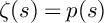 $\zeta (s)=p(s)$
with p being a nonconstant polynomial and is different from the existing methods for a-points of
 $\zeta $
(see [Reference Levinson3], [Reference Selberg and Bombieri11], [Reference Steuding12], [Reference Ye16], etc.).
Let us now recall that for a meromorphic function f in the complex plane, the characteristic
 $T(r,f)$
of f (see, e.g., [Reference Nevanlinna8, pp. 165–167] and [Reference Ru10, pp. 4–5]) is defined as
 $$\begin{align*}T(r,f):=m(r,f)+N(r,f) \end{align*}$$
for
 $r\ge 0$
, where
 $$\begin{align*}m(r, f) := \frac{1}{2\pi} \int_0^{2\pi} \log^{+}|f(re^{i\theta})| d\theta \end{align*}$$
(
 $\log ^{+}x=\log \max \{x, 1\}$
) is the so-called proximity function and
 $$ \begin{align} N(r, f):= \int_{0}^{r} \frac{n(t, f)-n(0, f)}{t} dt + n(0, f)\log r \end{align} $$
is the counting function, where
 $n(r, f)$
is the number of poles of f (counting multiplicities) lying in the disc
 $|s|\le r$
. The counting function
 $N(r,\frac {1}{f})$
for the zeros of
 $f\ (\not \equiv 0)$
is obtained by replacing f in (1.3) with
 $\frac {1}{f}$
.
The characteristic
 $T(r, f)$
is of great significance for asymptotic properties of meromorphic functions (as noted in [Reference Nevanlinna8, p. 167]) and is the core quantity in value distribution theory of meromorphic functions and its various applications. It was proved in [Reference Ye16] that
 $$\begin{align*}T(r, \zeta)=\frac{1}{\pi}r\log r+O(r) \end{align*}$$
and in [Reference Liao and Yang5] that
 $$\begin{align*}T(r, \zeta)=\frac{1}{\pi}r\log r+Br+O(\log^2 r), \end{align*}$$
where B is some absolute (but unknown) constant. We refer to [Reference Liao and Yang5], [Reference Steuding12, Chapter 7], and [Reference Ye16] for different purposes and motivations for estimating
 $T(r, \zeta )$
and related results.
We obtain the following precise asymptotic estimate for the characteristic of the Riemann zeta function with the error term
 $O(\frac {\log r}{r})$
and with all explicit numerical coefficients, including the constant term.
Theorem 1.1. The characteristic of
 $\zeta $
satisfies the asymptotic formula
 $$ \begin{align} \begin{aligned} T(r, \zeta) &= \frac{1}{\pi}r\log r - \bigg(2+\log2\pi-\frac{\pi}{2}\bigg)\frac{r}{\pi}\\ & + \frac{5}{4}\log r - \frac{1}{4}\log2\pi + O\bigg(\frac{\log r}{r}\bigg) \end{aligned} \end{align} $$
for
 $r\ge 3$
.
Since
 $\zeta $
has only one (and simple) pole at
 $s=1$
, we have
 $N(r, \zeta )=\log ^{+} r$
(see Lemma 2.3). Thus, Theorem 1.1 gives an asymptotic estimate for the proximity function
 $m(r, \zeta )$
as well.
Remark. From the proof of Theorem 1.1 (see (3.14)), the following asymptotic estimate holds:
 $$ \begin{align*} \begin{aligned} T(r, \zeta) &= \frac{1}{\pi}r\log r - \bigg(2+\log2\pi-\frac{\pi}{2}\bigg)\frac{r}{\pi} + \frac{5}{4}\log r - \frac{1}{4}\log2\pi\\ & + \frac{1}{\pi r}\int_{0}^{1}\log^{+}|\zeta(\sigma+ir)|d\sigma + O\bigg(\frac{1}{r}\bigg). \end{aligned} \end{align*} $$
Using the known estimates on
 $\zeta (s)$
for
 $\sigma \in [0, 1]$
under the Riemann hypothesis (see [Reference Montgomery and Vaughan7, Section 13.2]), it can be shown that
 $$ \begin{align*} T(r, \zeta) &= \frac{1}{\pi}r\log r - \bigg(2+\log2\pi-\frac{\pi}{2}\bigg)\frac{r}{\pi}\\ & + \frac{5}{4}\log r - \frac{1}{4}\log2\pi + \frac{1}{8\pi}\frac{\log r}{r} + O\bigg(\frac{\log r}{r(\log\log r)^{2}}\bigg), \end{align*} $$
assuming that the Riemann hypothesis is true. We omit the details here.
Due to the significance of the characteristic function as mentioned above, the asymptotic estimate for
 $T(r, \zeta )$
or
 $m(r, \zeta )$
and the method employed are expected to play a useful role in studying the value distribution of the Riemann zeta function. Using a method similar to that for the proof of Theorem 1.1, we obtain the following asymptotic estimate for the number of the fixed points of
 $\zeta $
, which follows from the estimate below by taking
 $p(s)\equiv s$
and substantially sharpens the estimate (1.2) with explicit numerical coefficients and the error term
 $O(\frac {\log \log r}{r})$
.
Theorem 1.2. Let
 $p\in \mathbb {C}[X]$
be a polynomial of degree
 $d\ge 1$
. Then,
 $$ \begin{align*} N\bigg(r, \frac{1}{\zeta-p}\bigg) &= \frac{1}{\pi}r\log r - \bigg(2+\log2\pi-\frac{\pi}{2}\bigg)\frac{r}{\pi}\\ & + \bigg(\frac{d}{2}+\frac{5}{4}\bigg)\log r - \frac{1}{4}\log2\pi + \frac{1}{2}\log|a_{d}| + \log\frac{1}{|c|}\\ & + \frac{1}{2\pi}\bigg(d-\frac{1}{2}\bigg)^{2}\frac{\log r}{r} + O\bigg(\frac{\log\log r}{r}\bigg) \end{align*} $$
for
 $r\ge 3$
, where
 $a_d$
is the leading coefficient of the polynomial p and c is the first nonzero coefficient of the Taylor series of
 $\zeta -p$
at
 $s=0$
. The implicit constant in
 $O(\frac {\log \log r}{r})$
depends on p.
We will give the proofs of Theorems 1.1 and 1.2 in §3 and §4, respectively, and some further remarks in §5.
2. Auxiliary lemmas
In this section, we prepare some auxiliary results that are needed for the proofs of our theorems.
Lemma 2.1. For
 $x,\delta \in \mathbb {R}$
, we have
 $|\log ^{+}(x+\delta )-\log ^{+}x|\le |\delta |$
.
Proof. By symmetry, we may assume
 $\delta \ge 0$
. When
 $x+\delta \le 1$
, the assertion is trivial. When
 $x\ge 1$
, the assertion follows by
 $$\begin{align*}|\log^{+}(x+\delta)-\log^{+}x| = \int_{x}^{x+\delta}\frac{du}{u} \le \delta. \end{align*}$$
For the remaining case
 $1-\delta <x<1$
, we have
 $$\begin{align*}|\log^{+}(x+\delta)-\log^{+}x| = \log(x+\delta) \le \log(1+\delta) \le \delta. \end{align*}$$
This completes the proof.
Lemma 2.2. For
 $x,y\in \mathbb {R}_{>0}$
, we have
 $|\log ^{+}(xy)-\log ^{+}x|\le |\log y|$
.
Proof. Recalling that
 $\log ^+(xy)\le \log ^+x+\log ^+y$
and
 $|\log y|=\log ^+y+\log ^+(1/y)$
we have
 $$ \begin{align*} \log^{+}(xy)-\log^{+}x\le \log^+x+\log^+y-\log^+x=\log^+y\le |\log y| \end{align*} $$
and
 $$ \begin{align*} \log^+x-\log^{+}(xy)=\log^+(xy(1/y))-\log^+{(xy)}\le \log^+(1/y)\le |\log y|. \end{align*} $$
This completes the assertion.
Lemma 2.3. For a polynomial
 $p\in \mathbb {C}[X]$
and
 $r\ge 0$
, we have
 $$\begin{align*}N(r,\zeta-p) = \log^{+}r. \end{align*}$$
Proof. Since
 $(\zeta -p)(s)$
has only one simple pole at
 $s=1$
, it is clear that
 $$\begin{align*}N(r, \zeta) = \int_{0}^{r}\frac{n(t, \zeta-p)}{t}dt = \int_{1}^{r}\frac{dt}{t} = \log r \end{align*}$$
for
 $r\ge 1$
and
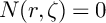 $N(r,\zeta )=0$
for
 $0\le r<1$
.
Lemma 2.4. For
 $\sigma \ge 2$
, we have
 $\zeta (s)=1+O(2^{-\sigma })$
.
Proof. By the Dirichlet series representation of
 $\zeta $
, we have
 $$\begin{align*}\zeta(s) = 1+O\bigg(\sum_{n=2}^{\infty}\frac{1}{n^{\sigma}}\bigg) = 1+O\bigg(\frac{1}{2^{\sigma}}\sum_{n=2}^{\infty}\bigg(\frac{2}{n}\bigg)^{\sigma}\bigg) = 1+O\bigg(\frac{1}{2^{\sigma}}\bigg). \end{align*}$$
This gives the lemma.
Lemma 2.5. We have
 $$\begin{align*}\zeta(s)=2^s\pi^{s-1}\sin\frac{s\pi}{2}\Gamma(1-s)\zeta(1-s). \end{align*}$$
Proof. This is the functional equation of
 $\zeta (s)$
(see, e.g., [Reference Titchmarch13, Theorem 3.5, p. 13]).
Lemma 2.6. For
 $1<\sigma \le 2$
, we have
 $$\begin{align*}\bigl|\log|\zeta(s)|\bigr| \ll \log\frac{1}{\sigma-1}+1. \end{align*}$$
Proof. By using the Dirichlet series representations
 $$\begin{align*}\zeta(s)=\sum_{n=1}^{\infty}\frac{1}{n^{s}} \quad\text{and}\quad \frac{1}{\zeta(s)}=\sum_{n=1}^{\infty}\frac{\mu(n)}{n^{s}}, \end{align*}$$
where
 $\mu (n)$
is the Möbius function, we get
 $$\begin{align*}(\sigma-1) \ll \frac{1}{\zeta(\sigma)} \le |\zeta(s)| \le \zeta(\sigma) \ll \frac{1}{\sigma-1} \end{align*}$$
and so the assertion holds.
We write
 $\ll _{a_{1},\ldots ,a_{n}}$
to express that the implicit constant in
 $\ll $
depends on the parameters
 $a_{1},\ldots ,a_{n}$
.
Lemma 2.7. Let
 $C,\delta>0$
. For
 $|t|\ge 2$
, we have
 $$ \begin{align} \zeta(s) & \ll_{\delta}1\qquad\qquad\qquad\ \ \text{for } \sigma\in[1+\delta,\infty), \end{align} $$
 $$ \begin{align} \zeta(s) & \ll\log|t| & \text{for } \sigma\in[1,\infty), \end{align} $$
 $$ \begin{align} \zeta(s) & \ll|t|^{\frac{1}{2}}\log|t| & \text{for } \sigma\in[0,1], \end{align} $$
 $$ \begin{align} \zeta(s) & \ll_{C}|t|^{\frac{1}{2}-\sigma}\log|t| & \text{for } \sigma\in[-C,0], \end{align} $$
 $$ \begin{align} \zeta(s) & \ll_{C,\delta}|t|^{\frac{1}{2}-\sigma} & \text{for } \sigma\in[-C,-\delta]. \end{align} $$
Proof. This is well-known but we need the uniformity over
 $\sigma \ge -C$
. The bound (2.1) follows by using the Dirichlet series expression. The bound (2.2) is [Reference Titchmarch13, p. 49]. Then, (2.4) and (2.5) follow by the functional equation of
 $\zeta (s)$
, Stirling’s formula (see, e.g., [Reference Titchmarch14, pp. 150–151]), (2.2), and (2.1). Finally, (2.3) follows by the Phragmén–Lindelöf principle (see, e.g., [Reference Rademacher9, Theorem 2, p. 195]) together with (2.2) and (2.4).
Lemma 2.8. For
 $s=\sigma +it=re^{i\theta }$
with
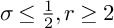 $\sigma \le \frac {1}{2}, r\ge 2$
and
 $\theta \in (0,\pi )$
, we have
 $$ \begin{align*} \log |\zeta(s)| &= -(\log r-\log2\pi-1)r\cos\theta + \bigg(\theta-\frac{\pi}{2}\bigg)r\sin\theta + \frac{1}{2}\log r\\ & -\frac{1}{2}\log2\pi +\log|\zeta(1-s)| +\log|1-e^{is\pi}| +O\bigg(\frac{1}{r}\bigg). \end{align*} $$
Proof. By the functional equation, we deduce that
 $$ \begin{align} \begin{aligned} \log|\zeta(s)| &= r\cos\theta\log2\pi + \frac{\pi}{2}r\sin\theta + \log|\Gamma(1-s)|\\ & +\log|\zeta(1-s)|-\log2\pi+\log|e^{is\pi}-1| \end{aligned} \end{align} $$
for all s except negative even integers in view of the fact that
 $$\begin{align*}\bigg|\sin\frac{s\pi}{2}\bigg| = \bigg|\frac{1}{2i}(e^{\frac{is\pi}{2}}-e^{-\frac{is\pi}{2}})\bigg| = \frac{1}{2}e^{\frac{r\pi \sin \theta}{2}}|e^{is\pi}-1|. \end{align*}$$
By Stirling’s formula (see, e.g., [Reference Titchmarch14, pp. 150–151]), we have
 $$\begin{align*}\log\Gamma(s) = \bigg(s-\frac{1}{2}\bigg)\log s-s+\frac{1}{2}\log2\pi+O_{\epsilon}\bigg(\frac{1}{|s|}\bigg) \end{align*}$$
uniformly for
 $-\pi +\epsilon \le \arg s\le +\pi -\epsilon $
and
 $|s|\ge \epsilon $
with
 $\epsilon>0$
and
 $\log s$
is the holomorphic branch of the logarithm with
 $-\pi <\arg s<+\pi $
. When
 $\sigma \le \frac {1}{2}$
and
 $r\ge 2$
, we have
 $1-\sigma \ge \frac {1}{2}$
and
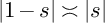 $|1-s|\asymp |s|$
. Thus, we can apply Stirling’s formula to obtain that
 $$ \begin{align*} \log\Gamma(1-s) &= \bigg(\frac{1}{2}-s\bigg)\log (1-s) + s-1 + \frac{1}{2}\log2\pi + O\bigg(\frac{1}{|s|}\bigg) \\ &= \bigg(\frac{1}{2}-s\bigg)\log(-s) + s + \frac{1}{2}\log2\pi + O\bigg(\frac{1}{|s|}\bigg). \end{align*} $$
Since
 $\arg (-s)=\theta -\pi $
when
 $\theta \in (0,\pi )$
, this gives
 $$ \begin{align*} \log|\Gamma(1-s)|&=\Re(\log\Gamma(1-s))\\ &= -r\cos\theta\log r +\frac{1}{2}\log r +r\sin\theta\arg(-s) +r\cos\theta +\frac{1}{2}\log2\pi +O\bigg(\frac{1}{r}\bigg)\\ &= -r\cos\theta\log r +(\theta-\pi)r\sin\theta +\frac{1}{2}\log r +r\cos\theta +\frac{1}{2}\log2\pi +O\bigg(\frac{1}{r}\bigg). \end{align*} $$
Combining this with (2.6) yields the assertion.
Lemma 2.9. For
 $s=\sigma +it=re^{i\theta }$
with
 $\theta \in (0,\pi )$
, we have
 $$\begin{align*}\bigl|\log|1-e^{is\pi}|\bigr| \le \log(1-e^{-\pi t})^{-1}. \end{align*}$$
Proof. By using the Taylor expansion of
 $\log (1-z)$
, we have that for
 $|z|<1$
,
 $$\begin{align*}\bigl|\log|1-z|\bigr| \le |\log(1-z)| \le |z|+\frac{1}{2}|z|^{2}+\frac{1}{3}|z|^{3}+\cdots = \log(1-|z|)^{-1}. \end{align*}$$
Applying this to
 $z=e^{is\pi }$
with
 $|z|=e^{-\pi t}$
, we obtain the lemma.
For the proof of Theorem 1.2, we need the following lemmas.
Lemma 2.10 (Borel–Carathéodory theorem)
For a holomorphic function
 $f(z)$
on the disk
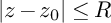 $|z-z_{0}|\le R$
and
 $r\in (0,R)$
, we have
 $$\begin{align*}\sup_{|z-z_{0}|\le r}|f(z)| \le \frac{2r}{R-r} \sup_{|z-z_{0}|=R}\Re(f(z)) + \frac{R+r}{R-r}|f(z_{0})|. \end{align*}$$
Proof. see, e.g., [Reference Titchmarch14, Section 5.5, pp.174–175].
Lemma 2.11. For a holomorphic function
 $f(z)$
on
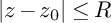 $|z-z_{0}|\le R$
such that
 $$ \begin{align} \sup_{|z-z_{0}|=R}\bigg|\frac{f(z)}{f(z_{0})}\bigg|\le e^{M} \end{align} $$
and
 $r\in (0,R)$
, we have
 $$\begin{align*}0\le \sum_{|\rho-z_{0}|\le r}\log\frac{R}{|\rho-z_{0}|} \le M \quad\text{and}\quad \sum_{|\rho-z_{0}|\le r}1 \le \frac{M}{\log\frac{R}{r}}, \end{align*}$$
where
 $\rho $
runs over zeros of
 $f(z)$
counted with multiplicity.
Proof. By Jensen’s formula (see [Reference Titchmarch14, Section 3.6, p. 125]), we have
 $$\begin{align*}\sum_{|\rho-z_{0}|\le R}\log\frac{R}{|\rho-z_{0}|} = \frac{1}{2\pi}\int_{0}^{2\pi}\log\bigg|\frac{f(z_{0}+Re^{i\theta})}{f(z_{0})}\bigg|d\theta \end{align*}$$
and so the assertion follows by the assumption (2.7).
The next lemma is essentially the Poisson–Jensen formula combined with the Borel–Carathéodory theorem.
Lemma 2.12. Under the same assumption as Lemma 2.11, we have
 $$\begin{align*}\log|f(z)| = - \sum_{|\rho-z_{0}|\le\frac{3}{4}R} \log\frac{R}{|z-\rho|} + \log|f(z_{0})| + O(M) \end{align*}$$
for
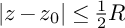 $|z-z_{0}|\le \frac {1}{2}R$
, where
 $\rho $
runs over zeros of
 $f(z)$
counted with multiplicity.
Proof. We may assume
 $z_{0}=0$
without loss of generality. Let
 $$\begin{align*}g(z):= f(z)\prod_{|\rho|\le\frac{3}{4}R}\frac{R^{2}-\overline{\rho}z}{R(z-\rho)}. \end{align*}$$
Then,
 $g(z)$
is holomorphic and non-zero in the disk
 $|z|\le \frac {3}{4}R$
. We can thus take a holomorphic logarithm
 $h(z)=\log (g(z)/g(0))$
in the disk
 $|z|\le \frac {3}{4}R$
with
 $h(0)=0$
. Also, on the circle
 $|z|=R$
, we have
 $$\begin{align*}\bigg|\frac{g(z)}{g(0)}\bigg| = \bigg|\frac{f(z)}{f(0)}\bigg| \prod_{|\rho|\le\frac{3}{4}R}\frac{|\rho|}{R} \le e^{M} \end{align*}$$
and so, by the maximum modulus principle, on the circle
 $|z|=\frac {3}{4}R$
, we have
 $$\begin{align*}\Re h(z) = \log\bigg|\frac{g(z)}{g(0)}\bigg| \le M. \end{align*}$$
By applying the Borel–Carathéodory theorem (Lemma 2.10) to
 $h(z)$
with replacing
 $R,r$
by
 $\frac {3}{4}R,\frac {1}{2}R$
, respectively, we get
 $$ \begin{align} \Biggl|\log\bigg|\frac{g(z)}{g(0)}\bigg|\Biggr| = |\Re(h(z))| \le |h(z)| \le 4\sup_{|z-z_{0}|=\frac{3}{4}R}\Re(h(z)) \le 4M \end{align} $$
in the disk
 $|z|\le \frac {1}{2}R$
. On the other hand, by the definition of g, we have
 $$\begin{align*}\log\bigg|\frac{g(z)}{g(0)}\bigg| = \log\bigg|\frac{f(z)}{f(0)}\bigg| + \sum_{|\rho|\le\frac{3}{4}R} \log\bigg|\frac{R^{2}-\overline{\rho}z}{R(z-\rho)}\bigg| - \sum_{|\rho|\le\frac{3}{4}R} \log\frac{R}{|\rho|}. \end{align*}$$
For
 $|z|\le \frac {1}{2}R$
, we have that
 $\frac {5}{8}\le |\frac {R^{2}-\overline {\rho }z}{R^{2}}|\le \frac {11}{8}$
and thus
 $$\begin{align*}\log\bigg|\frac{g(z)}{g(0)}\bigg| = \log\bigg|\frac{f(z)}{f(0)}\bigg| + \sum_{|\rho|\le\frac{3}{4}R} \log\frac{R}{|z-\rho|} + O\bigg( \sum_{|\rho|\le\frac{3}{4}R} \log\frac{R}{|\rho|} \bigg). \end{align*}$$
By combining this formula with (2.8), we obtain
 $$\begin{align*}\log|f(z)| = - \sum_{|\rho|\le\frac{3}{4}R} \log\frac{R}{|z-\rho|} + \log|f(0)| + O\bigg( M + \sum_{|\rho|\le\frac{3}{4}R} \log\frac{R}{|\rho|} \bigg). \end{align*}$$
By using Lemma 2.11, we obtain the assertion.
Lemma 2.13. Let
 $a>0$
and
 $\varphi $
be an even integrable real-valued function on
 $(-a,+a)$
which is non-increasing on
 $(0,a)$
. Then, for any Lebesgue measurable set
 $E\subset (-a,+a)$
with the Lebesgue measure
 $2b$
, we have
 $$\begin{align*}\int_{E}\varphi(x)dx \le \int_{-b}^{+b}\varphi(x)dx. \end{align*}$$
Proof. See [Reference Goldberg and Ostrovskii2, Lemma 7.2, p. 38].
3. Proof of Theorem 1.1
We may assume r is large since otherwise the assertion is trivial. By the definition of
 $m(r, \zeta )$
and noting that
 $\overline {\zeta (re^{i\theta })}=\zeta (re^{-i\theta })$
, we can write
 $$ \begin{align} m(r, \zeta) &= \frac{1}{\pi}\int_{0}^{\pi}\log^{+}|\zeta(re^{i\theta})|d\theta\nonumber\\ &= \frac{1}{\pi} \Biggl( \int_{2<\sigma\leq r} + \int_{1<\sigma\le 2} + \int_{0\le\sigma\le 1} + \int_{-r\le\sigma<0} \Biggr) \nonumber\\ &:= I_1+I_2+I_3+I_4, \end{align} $$
where
 $s=\sigma +it=re^{i\theta }$
and we used an abuse of the notation for the integrals over the obvious intervals of corresponding
 $\theta $
with
 $0\le \theta \le \pi $
.
For the integral
 $I_{1}$
, by Lemmas 2.1 and 2.4, we have
 $$ \begin{align} I_{1} \ll \int_{0}^{\arccos\frac{2}{r}}\frac{d\theta}{2^{r\cos\theta}} = \int_{\arcsin\frac{2}{r}}^{\frac{\pi}{2}}\frac{d\theta}{2^{r\sin\theta}} \le \int_{\arcsin\frac{2}{r}}^{\frac{\pi}{2}}\frac{d\theta}{2^{\frac{2}{\pi}r\theta}} \ll \frac{1}{r} \end{align} $$
since
 $\sin \theta \ge \frac {2}{\pi }\theta $
for
 $\theta \in [0,\frac {\pi }{2}]$
.
For the integral
 $I_{2}$
, we change variables via
 $\sigma =r\cos \theta $
so that
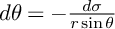 $d\theta =-\frac {d\sigma }{r\sin \theta }$
. By Lemma 2.6 and
 $\sin \theta \gg 1$
in
 $I_{2}$
, we obtain that
 $$ \begin{align} I_{2} = \frac{1}{\pi r}\int_{1}^{2}\log^{+}|\zeta(re^{i\theta})|\frac{d\sigma}{\sin\theta} \ll \frac{1}{\pi r} \int_{1}^{2} \bigg(\log\frac{1}{\sigma-1}+1\bigg)d\sigma \ll \frac{1}{r}. \end{align} $$
In the integral
 $I_{3}$
, we again change variables via
 $\sigma =r\cos \theta $
. By using
 $\sin \theta =1+O(\frac {1}{r^{2}})$
for
 $0\le \sigma \le 1$
and Lemma 2.7, we have
 $$ \begin{align} I_{3} &= \frac{1}{\pi r} \int_{0}^{1} \log^{+}|\zeta(re^{i\theta})|\frac{d\sigma}{\sin\theta}\nonumber\\ &= \frac{1}{\pi r} \int_{0}^{1} \log^{+}|\zeta(re^{i\theta})|d\sigma + O\bigg(\frac{\log r}{r^{3}}\bigg). \end{align} $$
In this integral, we have
 $$ \begin{align} re^{i\theta} = \sigma+ir\sin\theta = \sigma+ir+O\bigg(\frac{1}{r}\bigg). \end{align} $$
Let
 $\delta :=\frac {1}{\log r}$
. By Lemma 2.7, we have
 $\zeta (s)\ll |t|^{\frac {1}{2}+\delta }\log |t|\ll r^{\frac {1}{2}}\log r$
for
 $\sigma \in [-\delta , 1+\delta ]$
and
 $|t-r|\le 1$
. Set
 $$\begin{align*}g(s)=\frac{\zeta(\sigma+ir+s)-\zeta(\sigma+ir)}{2M}, \end{align*}$$
where M is the maximum of
 $\zeta (\sigma +ir+s)$
in
 $|s|\le \delta $
, which satisfies
 $M=O(r^{\frac {1}{2}}\log r)$
. Noting that
 $g(0)=0$
and
 $|g(s)|\le 1$
in
 $|s|\le \delta $
, we obtain by the Schwarz lemma (see, e.g., [Reference Titchmarch13, p. 168]) that
 $|g(s)|\le \frac {|s|}{\delta }=|s|\log r$
for
 $|s|\le \delta $
, which clearly implies, in view of (3.5), that
 $$\begin{align*}\zeta(re^{i\theta}) = \zeta(\sigma+ir) + O\bigg(\frac{(\log r)^{2}}{r^{\frac{1}{2}}}\bigg) \end{align*}$$
in
 $I_{3}$
. On inserting this formula into (3.4) and using Lemma 2.1, we obtain
 $$ \begin{align} I_{3} = \frac{1}{\pi r}\int_{0}^{1}\log^{+}|\zeta(\sigma+ir)|d\sigma + O\bigg(\frac{(\log r)^{2}}{r^{\frac{3}{2}}}\bigg). \end{align} $$
Consider finally the integral
 $I_{4}$
in (3.1) over
 $-r\le \sigma <0$
, i.e.,
 $\frac {\pi }{2}<\theta \le \pi $
. In order to estimate
 $I_{4}$
, we use Lemma 2.8. Let
 $$\begin{align*}Z(s) := \frac{\zeta(s)}{1-e^{is\pi}} \quad\text{so}\quad \zeta(s)=Z(s)(1-e^{is\pi}). \end{align*}$$
By Lemma 2.2, we then have
 $$\begin{align*}I_{4} = \frac{1}{\pi}\int_{\frac{\pi}{2}}^{\pi}\log^{+}|Z(re^{i\theta})|d\theta + O\bigg( \int_{\frac{\pi}{2}}^{\pi}\bigl|\log|1-e^{is\pi}|\bigr|d\theta \bigg). \end{align*}$$
For the error term, by using Lemma 2.9, we deduce that
 $$ \begin{align} \int_{\frac{\pi}{2}}^{\pi}\bigl|\log|1-e^{is\pi}|\bigr|d\theta &\le \int_{\frac{\pi}{2}}^{\pi} \log(1-e^{-\pi r\sin\theta})^{-1}d\theta\nonumber\\ &= \int_{0}^{\frac{\pi}{2}} \log(1-e^{-\pi r\sin\theta})^{-1}d\theta\nonumber\\ &\le \int_{0}^{\frac{\pi}{2}} \log(1-e^{-2r\theta})^{-1}d\theta\nonumber\\ &\le \frac{1}{2r} \int_{0}^{\infty} \log(1-e^{-\theta})^{-1}d\theta \ll \frac{1}{r} \end{align} $$
since
 $\sin \theta \ge \frac {2}{\pi }\theta $
for
 $\theta \in [0,\frac {\pi }{2}]$
. We thus have
 $$ \begin{align} I_{4} = \frac{1}{\pi}\int_{\frac{\pi}{2}}^{\pi}\log^{+}|Z(re^{i\theta})|d\theta + O\bigg(\frac{1}{r}\bigg). \end{align} $$
For the function
 $Z(s)$
, Lemma 2.8 gives
 $$ \begin{align} \begin{aligned} \log |Z(s)| &= -(\log r-\log2\pi-1)r\cos\theta + \bigg(\theta-\frac{\pi}{2}\bigg)r\sin\theta\\ & + \frac{1}{2}\log r -\frac{1}{2}\log2\pi +\log|\zeta(1-s)| +O\bigg(\frac{1}{r}\bigg). \end{aligned} \end{align} $$
When
 $\theta \in [\frac {\pi }{2},\pi ]$
, we have
 $$\begin{align*}-(\log r-\log2\pi-1)r\cos\theta\ge 0 \quad\text{and}\quad \bigg(\theta-\frac{\pi}{2}\bigg)r\sin\theta\ge0 \end{align*}$$
and so, by Lemma 2.7, we have
 $$\begin{align*}\log|Z(s)|\ge\frac{1}{2}\log r+O(\log\log r)\ge 0. \end{align*}$$
Thus, (3.8) becomes
 $$ \begin{align} I_{4} = \frac{1}{\pi}\int_{\frac{\pi}{2}}^{\pi}\log|Z(re^{i\theta})|d\theta + O\bigg(\frac{1}{r}\bigg). \end{align} $$
We then integrate the right-hand side of (3.9) termwise to obtain that
 $$ \begin{align} \begin{aligned} \frac{1}{\pi} \int_{\frac{\pi}{2}}^{\pi} (-(\log r-\log2\pi-1)r\cos\theta)d\theta &= \frac{1}{\pi}r\log r - \frac{1}{\pi}(1+\log 2\pi)r,\\ \frac{1}{\pi} \int_{\frac{\pi}{2}}^{\pi} \bigg(\theta-\frac{\pi}{2}\bigg)r\sin\theta d\theta &=\frac{1}{\pi}\bigg(\frac{\pi}{2}-1\bigg)r,\\ \frac{1}{\pi} \int_{\frac{\pi}{2}}^{\pi} \bigg(\frac{1}{2}\log r-\frac{1}{2}\log2\pi\bigg)d\theta &= \frac{1}{4}\log r-\frac{1}{4}\log2\pi. \end{aligned} \end{align} $$
By arguing similarly to
 $I_{1},I_{2}$
, we also deduce that
 $$ \begin{align} \int_{\frac{\pi}{2}}^{\pi}\log|\zeta(1-s)|d\theta \ll \int_{-r\le\sigma<-2} + \int_{-2\le\sigma<0} \ll \frac{1}{r}. \end{align} $$
Combining (3.9), (3.10), (3.11), and (3.12), we thus obtain that
 $$ \begin{align} \begin{aligned} I_{4} &= \frac{1}{\pi}r\log r -\bigg(2+\log2\pi-\frac{\pi}{2}\bigg)\frac{r}{\pi}\\ & + \frac{1}{4}\log r - \frac{1}{4}\log2\pi + O\bigg(\frac{1}{r}\bigg). \end{aligned} \end{align} $$
By substituting (3.2), (3.3), (3.6), and (3.13) into (3.1), we obtain
 $$ \begin{align} \begin{aligned} m(r, \zeta) &= \frac{1}{\pi}r\log r - \bigg(2+\log2\pi-\frac{\pi}{2}\bigg)\frac{r}{\pi} + \frac{1}{4}\log r - \frac{1}{4}\log2\pi\\ & + \frac{1}{\pi r}\int_{0}^{1}\log^{+}|\zeta(\sigma+ir)|d\sigma + O\bigg(\frac{1}{r}\bigg). \end{aligned} \end{align} $$
Recall that
 $T(r,\zeta )=m(r,\zeta )+N(r,\zeta )$
. By Lemma 2.3 and using Lemma 2.7 to bound the integral in (3.14), we obtain (1.4). This completes the proof.
4. Proof of Theorem 1.2
By Jensen’s formula (see, e.g., [Reference Goldberg and Ostrovskii2, p. 13]) and Lemma 2.3, we have
 $$\begin{align*}N\bigg(r,\frac{1}{\zeta-p}\bigg) = \frac{1}{2\pi} \int_{0}^{2\pi} \log|\zeta-p|(re^{i\theta})d\theta + \log r + \log\frac{1}{|c|}, \end{align*}$$
where c is the first nonzero coefficient in the Taylor expansion of
 $\zeta -p$
at
 $s=0$
. We thus only need to estimate the integral
 $$\begin{align*}I = I(p):= \frac{1}{2\pi}\int_{0}^{\pi} \log|\zeta-p|(re^{i\theta}) d\theta \end{align*}$$
since the integral over
 $\pi $
to
 $2\pi $
is reduced to the integral over
 $0$
to
 $\pi $
in view of the fact that
 $(\zeta -p)(re^{-i\theta })=\overline {\zeta (re^{i\theta })-\overline {p}(re^{i\theta })}$
(cf. (3.1)), that is,
 $$ \begin{align} N\bigg(r,\frac{1}{\zeta-p}\bigg) = I(p)+I(\overline{p})+\log r+\log\frac{1}{|c|}. \end{align} $$
We shall calculate
 $I=I(p)$
. Let
 $$\begin{align*}\sigma_{\pm}:= -\bigg(d-\frac{1}{2}\bigg)\pm\frac{B}{\log r}, \end{align*}$$
where
 $B\ge 0$
will be chosen later. We then decompose the integral I as
 $$ \begin{align} I &= \frac{1}{2\pi} \Biggl( \int_{2<\sigma\leq r} + \int_{\sigma_{+}<\sigma\le2} + \int_{\sigma_{-}<\sigma\le\sigma_{+}} + \int_{-r\le\sigma\le\sigma_{-}} \Biggr)\nonumber\\ &:= I_1+I_2+I_3+I_{4}. \end{align} $$
We assume that r is large in terms of B and so our choice of B will be independent of r.
We first estimate
 $I_{1}$
. For
 $\sigma \ge 2$
, we have
 $|\zeta (s)|\le \zeta (2)$
. We also have
 $$ \begin{align} |p(re^{i\theta})|=|a_d|r^{d}\bigg(1+O\bigg(\frac{1}{r}\bigg)\bigg), \end{align} $$
where
 $a_d$
is the leading coefficient of the polynomial p. In this proof, all implicit constants may depend on p. Hence, we have that
 $$\begin{align*}\log|\zeta-p|(re^{i\theta}) = \log|p(re^{i\theta})| + \log\bigg|1-\frac{\zeta}{p}\bigg|(re^{i\theta}) = \log|p(re^{i\theta})|+O\bigg(\frac{1}{r}\bigg) \end{align*}$$
for
 $2<\sigma \le r$
and thus that
 $$ \begin{align} I_{1} = \frac{1}{2\pi}\int_{2<\sigma\le r}\log|p(re^{i\theta})|d\theta + O\bigg(\frac{1}{r}\bigg). \end{align} $$
We then estimate
 $I_{2}$
. By Lemma 2.7, we have
 $$\begin{align*}\zeta(s) \ll |t|^{\max(\frac{1}{2}-\sigma,\frac{1}{2})}\log|t| \ll r^{\frac{3}{4}}\log r \ll r^{d}e^{-B} \quad\text{for } -\tfrac{1}{4}<\sigma\le2 \end{align*}$$
and
 $$\begin{align*}\zeta(s) \ll |t|^{\frac{1}{2}-\sigma} \ll r^{d}e^{-B} \quad\text{for }\sigma_{+}<\sigma\le-\tfrac{1}{4} \end{align*}$$
if r is large in terms of B (but the implicit constants here are independent of B). Thus, by taking B large enough, we get
 $$\begin{align*}|\zeta(s)|\le\frac{1}{2}|p(s)| \quad\text{and so}\quad \log|\zeta-p|(re^{i\theta}) = \log|p(re^{i\theta})| + O(1) \end{align*}$$
for large r. Note also that the argument
 $\theta $
of s on the arc for the integral over
 $\sigma _{+}<\sigma \le 2$
varies by a quantity
 $O(\frac {1}{r})$
. Thus, we deduce that
 $$ \begin{align} I_{2} = \frac{1}{2\pi} \int_{\sigma_{+}<\sigma\le 2} \log|p(re^{i\theta})|d\theta + O\bigg(\frac{1}{r}\bigg) \end{align} $$
for large r.
We next estimate
 $I_{3}$
. By changing the variable via
 $\sigma =r\cos \theta $
, we have
 $$ \begin{align} I_{3} = \frac{1}{2\pi r} \int_{\sigma_{-}}^{\sigma_{+}} \log|\zeta-p|(re^{i\theta})\frac{d\sigma}{\sin\theta}. \end{align} $$
Let
 $\phi _{-}$
be the acute angle satisfying
 $$\begin{align*}r\sin\phi_{-} = d-\frac{1}{2}+\frac{B}{\log r} = -\sigma_{-}. \end{align*}$$
Then,
 $\sin \theta \ge \sin (\frac {\pi }{2}+\phi _{-})=\cos \phi _{-}\gg 1$
in
 $I_{3}$
. We use Lemma 2.12 with
 $$\begin{align*}f(z):=(\zeta-p)(z),\quad z_{0}:= 2+ir,\quad R:= 2(d+3). \end{align*}$$
For the bound (2.7), by Lemma 2.7, we can obtain
 $$ \begin{align} \begin{aligned} \frac{f(z)}{f(z_{0})} &= \frac{(\zeta-p)(z)}{(\zeta-p)(2+ir)}\\ &\ll \frac{r^{2d+\frac{9}{2}}}{|\zeta(2+ir)-p(2+ir)|} \ll \frac{r^{2d+\frac{9}{2}}}{|p(2+ir)|-\zeta(2)} \ll r^{d+\frac{9}{2}} \end{aligned} \end{align} $$
for
 $|z-z_{0}|\le R$
and large r. We can thus take
 $M:=(d+\frac {9}{2})\log r$
. Since now
 $\log R=O(1)$
, Lemmas 2.11 and 2.12 then gives
 $$ \begin{align} \log|\zeta-p|(z) = \sum_{|\rho-(2+ir)|\le\frac{3}{4}R} \log|z-\rho| + O(\log r) \end{align} $$
for
 $|z-(2+ir)|\le d+3$
. For large r, we have
 $\sigma \in [-d,-(d-1)]$
and
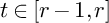 $t\in [r-1,r]$
in the integral
 $I_{3}$
and so the range of integration is covered by the disk
 $|s-(2+ir)|\le d+3$
. We can thus use (4.8),
 $\sigma _{+}-\sigma _{-}\ll _{B}\frac {1}{\log r}$
and
 $\sin \theta \gg 1$
in (4.6) to get
 $$ \begin{align} I_{3} = \frac{1}{2\pi r} \sum_{|\rho-(2+ir)|\le\frac{3}{4}R} \int_{\sigma_{-}}^{\sigma_{+}} \log|re^{i\theta}-\rho| \frac{d\sigma}{\sin\theta} + O_{B}\bigg(\frac{1}{r}\bigg), \end{align} $$
where the subscript B of the Landau symbol expresses that the implicit constant here depends on B. Since
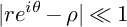 $|re^{i\theta }-\rho |\ll 1$
in (4.9), by using Lemma 2.11 with (4.7), we have
 $$ \begin{align} I_{3} \le O_{B}\bigg( \frac{1}{r\log r\cos\phi_{-}} \sum_{|\rho-(2+ir)|\le\frac{3}{4}R} 1 + \frac{1}{r} \bigg) = O_{B}\bigg(\frac{1}{r}\bigg). \end{align} $$
For the lower bound, note that in (4.9), we have
 $$\begin{align*}\log|re^{i\theta}-\rho| = -\log\frac{1}{|re^{i\theta}-\rho|} \ge -\log\frac{1}{|\sigma-\beta|} \ge -\log^{+}\frac{1}{|\sigma-\beta|}, \end{align*}$$
where we write
 $\beta :=\Re \rho $
. Thus, by changing the variable, we obtain
 $$ \begin{align} I_{3} &\ge - \frac{1}{2\pi r\cos\phi_{-}} \sum_{|\rho-(2+ir)|\le\frac{3}{4}R} \int_{\sigma_{-}}^{\sigma_{+}} \log^{+}\frac{1}{|\sigma-\beta|}d\sigma + O_{B}\bigg(\frac{1}{r}\bigg)\nonumber\\ &= - \frac{1}{2\pi r\cos\phi_{-}} \sum_{|\rho-(2+ir)|\le\frac{3}{4}R} \int_{\sigma_{-}-\beta}^{\sigma_{+}-\beta} \log^{+}\frac{1}{|\sigma|}d\sigma + O_{B}\bigg(\frac{1}{r}\bigg). \end{align} $$
Note that the function
 $\log ^{+}\frac {1}{|\sigma |}$
is integrable over
 $(-a,+a)$
for any
 $a>0$
and non-increasing for
 $(0,a)$
. Also, the Lebesgue measure of the interval
 $[\sigma _{-}-\beta ,\sigma _{+}-\beta ]$
is
 $2B/\log r$
. Thus, by using Lemma 2.11 with (4.7) and Lemma 2.13 in (4.11), we get
 $$ \begin{align} I_{3} &\ge - \frac{1}{2\pi r\cos\phi_{-}} \sum_{|\rho-(2+ir)|\le\frac{3}{4}R} \int_{-\frac{B}{\log r}}^{+\frac{B}{\log r}} \log^{+}\frac{1}{|\sigma|}d\sigma + O_{B}\bigg(\frac{1}{r}\bigg)\nonumber\\ &= O_{B}\bigg(\frac{\log\log r}{r\log r} \sum_{|\rho-(2+ir)|\le\frac{3}{4}R} 1 + \frac{1}{r} \bigg) = O_{B}\bigg(\frac{\log\log r}{r}\bigg). \end{align} $$
By (4.10) and (4.12), we obtain
 $$ \begin{align} I_{3} \ll_{B} \frac{\log\log r}{r}. \end{align} $$
We finally consider
 $I_{4}$
. We take acute angles
 $\psi ,\eta $
satisfying
 $$ \begin{gather*} r\sin\psi = d+\frac{5}{2},\quad r\sin\eta = \frac{1}{r(\log r)^{2}}, \end{gather*} $$
respectively. Then,
 $\frac {\pi }{2}+\phi _{-}<\frac {\pi }{2}+\psi <\pi -\eta $
for large r and the range of the angle
 $\theta $
in the integral
 $I_{4}$
is
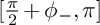 $[\frac {\pi }{2}+\phi _{-},\pi ]$
. We then decompose
 $I_{4}$
as
 $$ \begin{align} I_{4} = I_{41}+I_{42}+I_{43}+I_{44}, \end{align} $$
where
 $$ \begin{align*} I_{41} &:= \frac{1}{2\pi} \int_{\frac{\pi}{2}+\phi_{-}}^{\pi-\eta} \log|\zeta(re^{i\theta})|d\theta,\\ I_{42} &:= \frac{1}{2\pi} \int_{\frac{\pi}{2}+\phi_{-}}^{\frac{\pi}{2}+\psi} \log\bigg|1-\frac{p}{\zeta}\bigg|(re^{i\theta})d\theta,\\ I_{43} &:= \frac{1}{2\pi} \int_{\frac{\pi}{2}+\psi}^{\pi-\eta} \log\bigg|1-\frac{p}{\zeta}\bigg|(re^{i\theta})d\theta,\\ I_{44} &:= \frac{1}{2\pi} \int_{\pi-\eta}^{\pi} \log|\zeta-p|(re^{i\theta})d\theta. \end{align*} $$
For
 $I_{41}$
, we integrate the right-hand side of Lemma 2.8 termwise. We can use (3.7), (3.11), and (3.12) obtained in the proof of Theorem 1.1 together with
 $$ \begin{align*} &\frac{1}{2\pi} \int_{\frac{\pi}{2}}^{\frac{\pi}{2}+\phi_{-}} (-(\log r-\log2\pi-1)r\cos\theta)d\theta\\ &= \frac{1}{4\pi}\phi_{-}^{2}(\log r-\log2\pi-1)r+O_{B}(\phi_{-}^{4}r\log r)\\ &= \frac{1}{4\pi}\bigg(d-\frac{1}{2}\bigg)^{2}\frac{\log r}{r} +O_{B}\bigg(\frac{1}{r}\bigg) \end{align*} $$
and
 $$ \begin{gather*} \frac{1}{2\pi} \int_{\frac{\pi}{2}}^{\frac{\pi}{2}+\phi_{-}} \bigg(\theta-\frac{\pi}{2}\bigg)r\sin\theta d\theta \ll_{B} \frac{1}{r},\\ \frac{1}{2\pi} \int_{\frac{\pi}{2}}^{\frac{\pi}{2}+\phi_{-}} \bigg(\frac{1}{2}\log r-\frac{1}{2}\log2\pi\bigg)d\theta = \frac{1}{4\pi}\bigg(d-\frac{1}{2}\bigg) \frac{\log r}{r}+O_{B}\bigg(\frac{1}{r}\bigg),\\ r\log r\int_{\pi-\eta}^{\pi}d\theta \ll \frac{1}{r} \end{gather*} $$
to obtain
 $$ \begin{align} \begin{aligned} I_{41} &= \frac{1}{2\pi}r\log r - \bigg(2+\log2\pi-\frac{\pi}{2}\bigg)\frac{r}{2\pi} \\ & + \frac{1}{8}\log r - \frac{1}{8}\log2\pi - \frac{1}{4\pi}\bigg(d^{2}-\frac{1}{4}\bigg)\frac{\log r}{r} +O_{B}\bigg(\frac{1}{r}\bigg). \end{aligned} \end{align} $$
We then estimate
 $I_{42}$
. In the integral
 $I_{42}$
, since
 $r\sin \theta \ge r\sin (\frac {\pi }{2}+\psi )\ge 1$
for large r, Lemma 2.9 gives
 $\bigl |\log |1-e^{is\pi }|\bigr |\le \log (1-e^{-\pi })^{-1}$
. Also, we have
 $r\cos \theta \le \sigma _{-}$
and
 $(\theta -\frac {\pi }{2})\sin \theta \ge 0$
. Thus, by (2.1) and Lemma 2.8, we have
 $$ \begin{align} \log|\zeta(s)| &\ge -(\log r-\log2\pi-1)\sigma_{-}+\frac{1}{2}\log r+O(1)\nonumber\\ &\ge d\log r+B+O\bigg(1+\frac{B}{\log r}\bigg) \ge \log|p(s)|+1 \end{align} $$
by taking B sufficiently large if r is large in terms of B. We thus obtain
 $$ \begin{align} I_{42} = \frac{1}{2\pi} \int_{\frac{\pi}{2}+\phi_{-}}^{\frac{\pi}{2}+\psi} \log\bigg|1-\frac{p}{\zeta}\bigg|(re^{i\theta})d\theta \ll \psi-\phi_{-} \ll \frac{1}{r}. \end{align} $$
In the integral
 $I_{43}$
, Lemma 2.9 and
 $r\sin \theta \ge r\sin (\pi -\eta )=\frac {1}{r(\log r)^{2}}$
give
 $$\begin{align*}\bigl|\log|1-e^{is\pi}|\bigr|\le\log(1-e^{-\frac{\pi}{r(\log r)^{2}}})^{-1}=\log r+O(\log\log r). \end{align*}$$
Thus, similarly to (4.16), we get
 $$ \begin{align*} \log|\zeta(s)| &\ge (\log r-\log2\pi-1)\bigg(d+\frac{5}{2}\bigg)-\frac{1}{2}\log r+O(\log\log r)\\ &\ge (d+2)\log r+O(\log\log r) \ge \log|p(s)|+\log r \end{align*} $$
and so
 $$ \begin{align} I_{43} = \frac{1}{2\pi} \int_{\frac{\pi}{2}+\psi}^{\pi-\eta} \log\bigg|1-\frac{p}{\zeta}\bigg|(re^{i\theta})d\theta \ll \frac{1}{2\pi} \int_{\frac{\pi}{2}+\psi}^{\pi-\eta} \bigg|\frac{p}{\zeta}\bigg|(re^{i\theta})d\theta \ll \frac{1}{r}. \end{align} $$
For
 $I_{44}$
, by changing the variable via
 $r\sin \theta =t$
so
 $d\theta =\frac {dt}{r\cos \theta }$
, we have
 $$ \begin{align} I_{44} = \frac{1}{2\pi r} \int_{0}^{\frac{1}{r(\log r)^{2}}} \log|\zeta-p|(re^{i\theta})\frac{dt}{|\cos\theta|}. \end{align} $$
Take
 $m\in \mathbb {N}$
by
 $2m-1\le r\le 2m+1$
. We then use Lemma 2.12 with
 $$\begin{align*}f(z):=(\zeta-p)(z),\quad z_{0}:= -2m,\quad R:= 4. \end{align*}$$
For the bound (2.7), since Lemma 2.8 give
 $$\begin{align*}\log|\zeta(z)| \le r\log r+\log(1+e^{-\pi t}) + O(r) = O(r\log r) \end{align*}$$
for
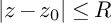 $|z-z_{0}|\le R$
, by using
 $\zeta (-2m)=0$
, we can obtain
 $$ \begin{align} \bigg|\frac{f(z)}{f(z_{0})}\bigg| = \bigg|\frac{(\zeta-p)(z)}{p(-2m)}\bigg| \le e^{O(r\log r)} \end{align} $$
for
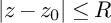 $|z-z_{0}|\le R$
and large r. We can thus take
 $M=O(r\log r)$
. Since now
 $\log R=O(1)$
, Lemmas 2.11 and 2.12 then gives
 $$ \begin{align} \log|\zeta-p|(z) = \sum_{|\rho+2m|\le3} \log|z-\rho| + O(r\log r) \end{align} $$
for
 $|z+2m|\le 2$
. For large r, we have
 $\sigma \in [-2m-\frac {3}{2},-2m+\frac {3}{2}]$
and
 $t\in [0,\frac {1}{2}]$
in the integral
 $I_{44}$
and so the range of integration is covered by the disk
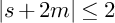 $|s+2m|\le 2$
. We can thus insert (4.21) into (4.19) to get
 $$ \begin{align} I_{44} = \frac{1}{2\pi r} \sum_{|\rho+2m|\le 3} \int_{0}^{\frac{1}{r(\log r)^{2}}} \log|re^{i\theta}-\rho|\frac{dt}{|\cos\theta|} + O\bigg(\frac{1}{r}\bigg). \end{align} $$
Since
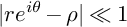 $|re^{i\theta }-\rho |\ll 1$
in (4.22), by using Lemma 2.11 with (4.20) and the bound
 $|\cos \theta |\ge \cos \eta \gg 1$
, we have
 $$ \begin{align} I_{44} \le O\bigg( \frac{1}{(r\log r)^{2}} \sum_{|\rho+2m|\le3} 1 + \frac{1}{r} \bigg) = O\bigg(\frac{1}{r}\bigg). \end{align} $$
For the lower bound, note that in (4.22), we have
 $$\begin{align*}\log|re^{i\theta}-\rho| = -\log\frac{1}{|re^{i\theta}-\rho|} \ge -\log\frac{1}{|t-\gamma|} \ge -\log^{+}\frac{1}{|t-\gamma|}, \end{align*}$$
where we write
 $\gamma :=\Im \rho $
, and so, by changing the variable, we obtain
 $$ \begin{align} I_{44} &\ge - \frac{1}{2\pi r\cos\eta} \sum_{|\rho+2m|\le3} \int_{0}^{\frac{1}{r(\log r)^{2}}} \log^{+}\frac{1}{|t-\gamma|}dt + O\bigg(\frac{1}{r}\bigg)\nonumber\\ &= - \frac{1}{2\pi r\cos\eta} \sum_{|\rho+2m|\le3} \int_{-\gamma}^{\frac{1}{r(\log r)^{2}}-\gamma} \log^{+}\frac{1}{|t|}dt + O\bigg(\frac{1}{r}\bigg). \end{align} $$
Note that the function
 $\log ^{+}\frac {1}{|t|}$
is integrable over
 $(-a,+a)$
for any
 $a>0$
and non-increasing for
 $(0,a)$
. Thus, by using Lemma 2.11 with (4.20), Lemma 2.13, and
 $\cos \eta \gg 1$
in (4.24), we get
 $$ \begin{align} I_{44} &\ge - \frac{1}{2\pi r\cos\eta} \sum_{|\rho+2m|\le3} \int_{-\frac{1}{2r(\log r)^{2}}}^{+\frac{1}{2r(\log r)^{2}}} \log^{+}\frac{1}{|t|}dt + O\bigg(\frac{1}{r}\bigg)\nonumber\\ &= O\bigg( \frac{1}{r^{2}\log r} \sum_{|\rho+2m|\le3} 1 + \frac{1}{r} \bigg) = O\bigg(\frac{1}{r}\bigg). \end{align} $$
By (4.23) and (4.25), we obtain
 $$ \begin{align} I_{44} \ll \frac{1}{r}. \end{align} $$
On inserting (4.15), (4.17), (4.18), and (4.26) into (4.14), we get
 $$ \begin{align} \begin{aligned} I_{4} &= \frac{1}{2\pi}r\log r - \bigg(2+\log2\pi-\frac{\pi}{2}\bigg)\frac{r}{2\pi}\\ & + \frac{1}{8}\log r - \frac{1}{8}\log2\pi - \frac{1}{4\pi}\bigg(d^{2}-\frac{1}{4}\bigg)\frac{\log r}{r} +O_{B}\bigg(\frac{1}{r}\bigg). \end{aligned} \end{align} $$
Finally, on inserting (4.4), (4.5), (4.13), and (4.27) into (4.2) and fixing a large B, we obtain
 $$ \begin{align*} I(p) &= \frac{1}{2\pi}r\log r - \bigg(2+\log2\pi-\frac{\pi}{2}\bigg)\frac{r}{2\pi} \\ & + \frac{1}{8}\log r - \frac{1}{8}\log2\pi - \frac{1}{4\pi}\bigg(d^{2}-\frac{1}{4}\bigg)\frac{\log r}{r}\\ & + \frac{1}{2\pi} \int_{\sigma_{+}\leq\sigma\le r} \log|p(re^{i\theta})|d\theta + O\bigg(\frac{\log\log r}{r}\bigg). \end{align*} $$
For the last integral, by using (4.3), we have
 $$ \begin{align*} &\frac{1}{2\pi} \int_{\sigma_{+}\leq\sigma\le r} \log|p(re^{i\theta})|d\theta\\ &= \frac{1}{2\pi} \int_{\sigma_{+}\leq\sigma\le r} (d\log r+\log|a_{d}|)d\theta + O\bigg(\frac{1}{r}\bigg)\\ &= \frac{1}{2\pi} \bigg(\frac{\pi}{2} + \arcsin\bigg(\frac{d-\frac{1}{2}}{r}-\frac{B}{r\log r}\bigg) \bigg) d\log r + \frac{1}{4}\log|a_{d}| + O\bigg(\frac{1}{r}\bigg)\\ &= \frac{d}{4}\log r + \frac{1}{4}\log|a_{d}| + \frac{1}{2\pi}d\bigg(d-\frac{1}{2}\bigg)\frac{\log r}{r} + O\bigg(\frac{1}{r}\bigg). \end{align*} $$
Thus, we obtain
 $$ \begin{align*} I(p) &= \frac{1}{2\pi}r\log r - \bigg(2+\log2\pi-\frac{\pi}{2}\bigg)\frac{r}{2\pi} + \bigg(\frac{d}{4}+\frac{1}{8}\bigg)\log r\\ & - \frac{1}{8}\log2\pi + \frac{1}{4}\log|a_{d}| + \frac{1}{4\pi}\bigg(d-\frac{1}{2}\bigg)^{2}\frac{\log r}{r} + O\bigg(\frac{\log\log r}{r}\bigg). \end{align*} $$
Finally, combining this with (4.1), we arrive at the conclusion.
5. Remarks on the distribution of fixed points
As mentioned in §1, the distribution of fixed points of
 $\zeta $
is different from that of zeros of
 $\zeta $
, for which all the nontrivial zeros are located only inside the critical strip and conjectured to lie on the critical line
 $\sigma =\frac {1}{2}$
by the Riemann hypothesis. We include here a further remark on the distribution of fixed points of
 $\zeta $
or, more generally, zeros of
 $\zeta -p$
by comparing the size of
 $\zeta $
and the polynomial p. From the estimates on
 $\zeta -p$
used in the proof of Theorem 1.2, (see the arguments for
 $I_{3}$
and
 $I_{44}$
in the proof of Theorem 1.2), one can verify that: All zeros of
 $\zeta -p$
, except those bounded by some constant depending on p, lie only in a shrinking vertical strip
 $$\begin{align*}-\bigg(d-\frac{1}{2}\bigg)-\frac{B}{\log(|t|+4)} \le \sigma \le -\bigg(d-\frac{1}{2}\bigg)+\frac{B}{\log(|t|+4)} \end{align*}$$
for some constant
 $B>0$
depending on p, which has the vertical axis
 $$\begin{align*}\sigma=-\bigg(d-\frac{1}{2}\bigg) \end{align*}$$
as its asymptote and in a shrinking horizontal strip
 $$\begin{align*}|t|\le\frac{1}{(|\sigma|+1)(\log(|\sigma|+1))^{2}} \quad\text{with}\quad \sigma\le 0 \end{align*}$$
or, more strongly,
 $$ \begin{align} |t|\le\exp(-(1+o(1))|\sigma|\log|\sigma|)\quad(\sigma\to-\infty) \quad\text{with}\quad \sigma\le 0 \end{align} $$
which has the real axis as its asymptote. This phenomenon for fixed points of
 $\zeta $
contrasts with the case for zeros of
 $\zeta $
, since it is unknown if the nontrivial zeros of
 $\zeta $
are even asymptotic to the critical line
 $\sigma =\frac {1}{2}$
. Note also that with a standard application of Rouché’s theorem, one can show an even stronger claim on the zeros of
 $\zeta -p$
in the above horizontal strip: All zeros of
 $\zeta -p$
in the range (5.1), except those bounded by some constant depending on p, are simple and associated with each of the trivial zeros
 $s=-2m$
of
 $\zeta $
. Clearly, if p is real (e.g., in the case
 $p(s)=s$
of fixed points), then all zeros of
 $\zeta -p$
, with the exceptions mentioned above, are real.



