1. Introduction
Following the established tradition of Language Teaching, which is committed to highlighting the development of teaching and learning languages other than English, such as Japanese (Mori & Mori, Reference Mori and Mori2011), German (Eckerth, Schramm, & Tschirner, Reference Eckerth, Schramm and Tschirner2009; Eckerth & Tschirner, Reference Eckerth and Tschirner2010), Spanish (Antón, Reference Antón2011) and Italian (Macaro, Reference Macaro2010), this paper reviews 60 empirical studies on Chinese language teaching and learning that were published in five leading mainland Chinese journals during the period 2014–2018. The Chinese government has been promoting the teaching and learning of CSL/CFL while it has made concerted efforts to improve individual citizens' English competence since the 1970s (Wang & Gao, Reference Wang and Gao2008; Gao, Liao, & Li, Reference Gao, Liao and Li2014; Ma, Gong, Gao, & Xiang, Reference Ma, Gong, Gao and Xiang2017). Over the last two decades Chinese has been increasingly taught and learned as an important foreign or second language both inside and outside China, partly driven by generous government investment (Zhao & Huang, Reference Zhao and Huang2010). On 27 September 2014, the Confucius Institute, as an extension of China's economic power and a symbol of its soft power, celebrated its tenth anniversary and launched the first Confucius Institute Day. The Chinese Language Council International (often referred to as Hanban) also launched the first series of HSK (Hanyu Shuiping Kaoshi, the official, standardized Chinese proficiency test) Standard course books in 2014. By December 2014, 1,326 Confucius Institutes and Classrooms had been founded to teach Chinese to more than 1.1 million students in 126 countries around the globe (Hanban, 2015).
The growth of CSL/CFL teaching and learning has been associated with intensive research on critical issues concerning the teaching of Chinese to non-Chinese learners worldwide. Since the late 1970s, the number of studies on the teaching and learning of CSL/CFL has steadily increased (e.g. Zhao & Huang, Reference Zhao and Huang2010; Zhao, Reference Zhao2011; Jiang & Cohen, Reference Jiang and Cohen2012; Gong, Lyu, & Gao, Reference Gong, Lyu and Gao2018; Yang, Reference Yang2019). In the last 15 years this growth has been particularly noteworthy, not only in terms of the explosive growth in the number of publications in journals, books, dissertations and conference proceedings, but also regarding the theoretical and methodological refinement in CSL/CFL research. However, as an increasing number of studies on CSL/CFL learning and teaching have been published in international journals, there has been a noticeable disconnection between international and mainland Chinese journals in terms of CSL/CFL scholarship since very few publications in mainland Chinese journals get cited in CSL/CFL-related articles in international journals (e.g. Gong et al., Reference Gong, Lyu and Gao2018). In light of the rise of Chinese as a major international language, this disconnection is unfortunate, but it is also understandable because of differences in scholarly traditions and practices between international and mainland Chinese journals (e.g. Gao et al., Reference Gao, Liao and Li2014). In particular, CSL/CFL-related articles in mainland Chinese journals are published in Chinese and may not be accessible to readers who do not have a working knowledge of Chinese. Nevertheless, it is a significant knowledge loss for the international scholarly community because knowledge production and access have been constrained by the dominance of English as the medium of academic publication. Therefore, it is important to provide a review of relevant studies on CSL/CFL learning and teaching so that the achievements of Chinese scholars may be appreciated and shared directions in future CSL/CFL-related research can be pursued.
It has often been assumed that researchers working on the teaching of Chinese to non-Chinese learners could learn much from research on the teaching of English as an international language since English has long been a global means of communication. To document the progress in CSL/CFL learning and teaching research as well as verify such an assumption, it is important to know what Chinese researchers have done and are doing to address critical issues in Chinese language education for non-Chinese learners. To achieve these ends, we conducted this review of research on the teaching and learning of Chinese to non-Chinese learners published in mainland Chinese journals. In the light of similar reviews of foreign language teaching and learning research in China and beyond (e.g. Gao et al., Reference Gao, Liao and Li2014), this review examines relevant studies published in Chinese journals in mainland China from 2014 to 2018 in order to investigate the methodological and topical trends and identify individual studies for in-depth analysis so as to address the following research questions:
1. How have mainland Chinese scholars drawn on research on the teaching and learning of other languages (e.g. English) in conducting research on CSL/CFL teaching and learning?
2. What contributions could research on the teaching and learning of CSL/CFL in mainland Chinese journals make to the field of language teaching and learning in general?
2. The review
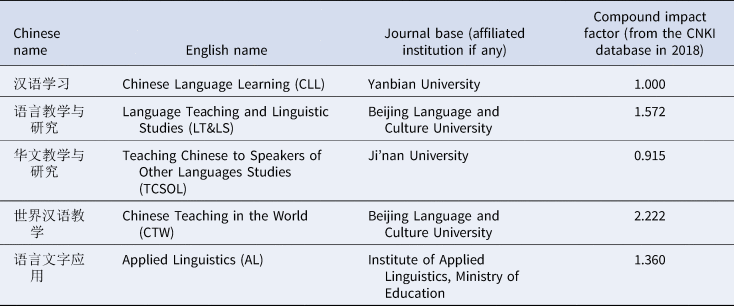
Considering the sociocultural and historical differences between different contexts within the Greater China region (e.g. the use of traditional or simplified Chinese characters), this review focused on journals published in mainland China, excluding Taiwan, Hong Kong and Macau. The review was also limited to flagship journals that specifically mention the teaching and learning of CSL/CFL in their mission statements, and to journals listed in the China Social Science Citation Index. Five leading journals related to the teaching and learning of Chinese to non-Chinese learners were identified (see Table 1). These journals are regarded as core journals in the field, in which Chinese language researchers, teachers and policy makers compete to publish their research. Doctoral dissertations were excluded from this review because mainland China's universities normally require doctoral students to publish journal articles in indexed journals before graduation. For this reason, articles published in the identified journals are likely to include research from doctoral dissertation projects.
Five journals reviewed

As suggested by the editor of Language Teaching, the review was confined to research published during the period 2014–2018. As mentioned earlier, the year 2014 witnessed a range of significant events marking China's ambition to diversify ‘the world's lingua franca’ and carve out a share of the global language education market for itself (Zhao & Huang, Reference Zhao and Huang2010, p. 127). The review did not include studies on ethnic minority students' learning of Chinese, which can be found in journals on ethnic minority education. Research on ethnic minority students' learning of Chinese is certainly related to research on the teaching and learning of CSL/CFL, but it often has to do with the promotion of a national language within China rather than with the present review's focus on the increasing importance of Chinese worldwide. Thus, this review covered studies on non-Chinese nationals learning CSL/CFL in mainland China and elsewhere.
The first step in this review involved the search strings (JN = ‘世界汉语教学’ (Chinese Teaching in the World) + ‘汉语学习’ (Chinese Language Learning) + ‘语言教学与研究’ (Language Teaching and Linguistic Studies) + ‘华文教学与研究’ (Teaching Chinese to Speakers of Other Languages Studies) + ‘语言文字应用’ (Applied Linguistics)) and (YE = 2014 + 2015 + 2016 + 2017 + 2018) in the China National Knowledge Infrastructure (CNKI) database (中国知网), which resulted in 1,701 articles being found. Two inclusion criteria were then applied to select articles for review: (1) the article should be related to the teaching and learning of CSL/CFL among non-Chinese learners; and (2) the article should contain clear descriptions of data collection and analysis. Review articles, if they contain explicit presentation of the review process (as we do here), were also treated as ‘empirical studies’ for inclusion in the analysis. The resulting 1,701 article titles and abstracts were evaluated and their relevant methodological sections or descriptions were examined by at least two members of the team. After this intensive evaluation and examination, 336 articles were identified as relevant.
After all the ‘empirical’ studies had been identified for analysis, every study was read in full by two members of the team. In this process, descriptions of the methodology used in each study were analysed to determine which methodological approach had been adopted. The titles and the abstracts of the reviewed papers were also analysed to determine the topics addressed by these papers. Drawing on an existing recent review of relevant studies on the teaching and learning of CSL/CFL (Ma et al., Reference Ma, Gong, Gao and Xiang2017), the following themes were used to categorize the 336 empirical studies: (1) language pedagogy (curriculum development, classroom teaching practices and textbooks, dictionaries and other teaching and learning materials); (2) language learning (learners' Chinese character, phonetic, lexical and grammatical development, learner factors like learning ability and individual backgrounds, and learning beliefs and strategies); and (3) teacher development (teacher education and teacher cognition). In the review process, new themes were added or the sub-categories under each existing theme were refined to reflect what was found during the review process (see Table 2).
The number of selected articles on each theme published between 2014 and 2018

Overall, the findings suggest that CSL/CFL research has been dominated by a positivist paradigm that views language teaching and learning as an objective ‘reality’, which can be scientifically explained and predicted based on measurable outcomes (Ma et al., Reference Ma, Gong, Gao and Xiang2017; Gong et al., Reference Gong, Hu and Lai2018). In contrast, the interpretivist paradigm, which regards language teaching and learning as a socially constructed experience with multiple interpretations, was rarely employed by Chinese researchers. In addition, CSL/CFL research in the Chinese journals varied greatly in the presentation of details on data collection and analysis. While a few articles include methodological information, most lack a clear research design and methodological justification. They often do not even provide clear methodological descriptions.
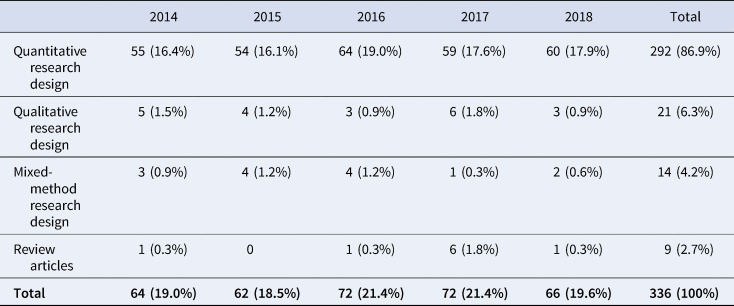
The analysis found that the leading Chinese journals published a high proportion of quantitative studies (292 out of 336, 86.9% in total) during the period 2014–2018 as well as a small number of qualitative (21 out of 336, 6.3% in total) and mixed-method (9 out of 336, 4.2% in total) studies (see Table 3). The majority of the empirical studies report the use of statistical analysis and measured CSL/CFL teaching and learning with methods including corpus analysis (e.g. Wang & Li, Reference Wang and Li2015; Wang, Reference Wang2017), questionnaire surveys (e.g. Guo, Reference Guo2014; Wei, Wang, Zhu, & Wen, Reference Wei, Wang, Zhu and Wen2015) and test tasks (e.g. Zhou, Reference Zhou2014; Hong & Zhang, Reference Hong and Zhang2017). As mentioned earlier, a few studies (e.g. Sun, Meng, & Wen, Reference Sun, Meng and Wen2015) demonstrate an awareness of the importance of methodological rigour by presenting well-documented procedures for data collection and analysis as well as providing details on both the control group and the experimental group. It is noteworthy that qualitative studies typically use content analysis (e.g. Zhang & Peng, Reference Zhang and Peng2014) and interviews (e.g. Zhu & Kong, Reference Zhu and Kong2017), while mixed-method studies apply both statistical and content analyses (e.g. H. Liu, Reference Liu2014).
Methodological trends (2014–2018) (N = 336)

A proportional stratified sampling strategy was adopted in this review because it guaranteed coverage of all the identified themes in CSL/CFL research and allowed an equal probability of all the articles being selected, based on the proportion of the theme coverage among all the articles (Neyman, Reference Neyman1934; Hirzel & Guisan, Reference Hirzel and Guisan2002). After the sampling process, 60 articles were selected to represent major achievements and provide a balanced methodological representation in research on these topics. The numbers of selected articles under each category are shown in Table 4 (the reference details of the 60 articles are available upon request).
The number of selected articles on each theme between 2014 and 2018

After this selection had been made, the literature reviews and reference lists from the 60 selected articles were analysed to decide how these studies had drawn on previous research on the teaching and learning of other languages (e.g. English). Specifically, articles using key references (e.g. theories, concepts) associated with research on the learning and teaching of other languages (e.g. English) were identified. The discussion/conclusion sections of these articles and their subsequent citations were also examined to determine the contributions that these studies had made to language teaching and learning in mainland China and beyond. Specifically, www.cnki.net (CNKI, China's version of the Web of Science) was used to analyse the articles' citations in order to see whether they were cited in studies on the learning and teaching of other languages (e.g. English). After this analysis, these studies and their results were examined individually for in-depth discussion.
To address the first research question, citation analysis was employed for each article. Citations are traditionally viewed as formal acknowledgement of previously published sources of information that relate to the citing author's research output. They are seen as a measure of a study's dependency on a previous body of research. Therefore, the number of times that a publication has been cited by other researchers indicates to some extent its overall scientific utility (e.g. Leimu & Koricheva, Reference Leimu and Koricheva2005). In this review, citations were categorized into six types: (1) Chinese language publications on CSL/CFL research; (2) Chinese language publications on English and/or other languages education research; (3) Chinese language publications unrelated to language education research; (4) English language publications on CSL/CFL research; (5) English language publications on English and/or other languages education research; and (6) English language publications unrelated to language education research. To address the second research question, content analysis was adopted to examine the extent to which CSL/CFL research adopted and supplemented prevalent theories or concepts in language teaching and learning.
3. General observations on empirical studies concerning the teaching and learning of CSL/CFL
In total, the 60 empirical research articles contain 1,254 citations, including 477.5 Chinese language publications on CSL/CFL research, 97 Chinese language publications on English and/or other languages education research, 76 Chinese language publications unrelated to language education research, 64.5 English language publications on CSL/CFL research, 353 English language publications on English and/or other languages education research, and 160 English language publications unrelated to language education research (see Table 5). Overall, more Chinese language publications (650.5 in total) were cited than English ones (603.5 in total), suggesting that Chinese researchers referred more to their Chinese colleagues' publications. In contrast, it was found that English language publications on CSL/CFL research were cited least. At the same time, however, a strong engagement with research in Western contexts was noted, in that Chinese researchers cited many English language publications on English and/or other languages education research, in contrast to Chinese language publications on English and/or other languages education research.
Citation trends (2014–2018) (N = 1,254)

C-CSL/CFL = Chinese language publications on CSL/CFL research.
C-E&O = Chinese language publications on English and/or other language education research.
C-Un = Chinese language publications unrelated to language education research.
E-CSL/CFL = English language publications on CSL/CFL research.
E-E&O = English language publications on English and/or other language education research.
E-Un = English language publications unrelated to language education research.
The content analysis revealed that Chinese researchers showed a significant engagement with research theories and concepts that had originated elsewhere, including attempts to introduce, verify or supplement well-established theories and concepts generated by scholars in Western contexts. Specifically, 22 studies contextualized, three studies supported, and two studies supplemented a variety of theories of and concepts in teaching and learning CSL/CFL. Cui, Zhang, and Sun (Reference Cui, Zhang and Sun2018), for example, introduced the concept of ‘linguistic distance’ proposed by Hart-Gonzalez and Lindemann (Reference Hart-Gonzalez and Lindemann1993) and examined its appropriateness in the CSL/CFL teaching and learning context in China. Chen and Li (Reference Chen and Li2016) drew on Larsen-Freeman's (Reference Larsen-Freeman2006) ‘dynamic system theory’ of language learning to examine the language development of Korean Chinese language learners in Chinese universities and confirmed that the CSL/CFL learners' Chinese language was a dynamic, non-linear system, and that there existed competition and cooperation between the learners' lexical complexity and syntactic complexity. Wang (Reference Wang2017) tested the effect of the framework of ‘lexical richness’ proposed by Read (Reference Read2000) by analysing international students' Chinese essays. This analysis revealed that the framework needed to be substantially revised in order to be used as a measure of CSL/CFL learners' writing in the context of Chinese language education.
Unfortunately, although Chinese researchers referred to Western scholars' publications and also attempted to import and borrow foreign theories and concepts, the majority of the empirical studies (33 out of 60) are not theoretically grounded or informed by research on English and other languages. Some (17 out of 60) do not include relevant literature reviews or provide information about their theoretical or conceptual frameworks. In addition, it was found that most of the studies concentrated on teaching and learning CSL/CFL in tertiary settings, while almost no research concerned primary or secondary schools. In the coming sections, we shall elaborate our critical examination of the identified 60 studies under three themes: language pedagogy, language learning and teacher development.
4. Language pedagogy
In this review, language pedagogy concerns curriculum/pedagogical development, classroom teaching practices and the preparation of textbooks, dictionaries and other teaching and learning materials. The selected empirical studies on this theme show a range of initiatives designed and promoted to enhance non-Chinese learners' learning, especially in the context of tertiary education. In these studies, researchers explored how CSL/CFL teachers developed their own pedagogical awareness and teaching competence, such as through formulaic sequence instruction, to improve learners' listening, speaking, reading and writing skills. The researchers also reported on the incorporation of Information Communications Technology (ICT) into Chinese teaching and learning. Before discussing individual studies in detail, we believe it is necessary to present three general observations about this group of empirical studies.
First, given the long tradition and important role of assessment in education in China, it is hardly surprising that there were many empirical studies investigating how to assess international students' language learning achievement effectively – with respect to oral proficiency, Chinese characters, and the HSK (e.g. Y. Liu, Reference Liu2014; Zhao, Reference Zhao2016; Wu, Hong, & Deng, Reference Wu, Hong and Deng2017). New instructional approaches and strategies have played a crucial role in helping CSL/CFL teachers to improve non-Chinese learners' Chinese proficiency. Some studies also explored the factors influencing student Chinese assessment outcomes, such as learner background variables (Wang & Wang, Reference Wang and Wang2016) and writing method (H. Liu, Reference Liu2014).
Second, it is in tertiary settings that Chinese language teachers have been developing tailor-made approaches and programmes to address the pressing need to improve the quality of Chinese teaching in response to an increasingly diverse student population with varying Chinese proficiency levels. Since Chinese is a language with four acoustic tones and a logographic writing system, international students' speaking proficiency is often inconsistent with their character identification ability. At the same time, in CSL/CFL education, recognizing and writing Chinese characters is always a significant challenge for both teachers' instruction and learners' acquisition (Shen & Xu, Reference Shen and Xu2015). As a result, considerable efforts have been invested in helping teachers to identify CSL/CFL learners' learning needs and develop programmes targeting all aspects of Chinese proficiency.
Finally, pedagogical initiatives at the course level were to some extent driven by ICT integration and emerging educational perspectives (e.g. Chen, Reference Chen2016; Wu & Duan, Reference Wu and Duan2016). CSL/CFL teachers were also found to have attempted to incorporate new strategies (e.g. input enhancement and input modality) and innovative technology into their teaching.
4.1 Curriculum and pedagogical development
Chinese researchers have been highly aware of the importance of conducting proficiency assessment and needs analysis for students before developing any tailor-made programmes for CSL/CFL learners. For instance, Zhao (Reference Zhao2016) surveyed 59 international students to determine their Chinese spoken language proficiency and learning needs before developing spoken Chinese courses. Unlike other studies of Chinese spoken language proficiency, Zhao (Reference Zhao2016) recruited student participants at different levels. The study found that students at different levels displayed different features of spoken Chinese and required different types of pedagogical support. Specifically, beginners normally lacked basic linguistic knowledge and sentence generation competence for communication. Consequently, Zhao concluded that spoken Chinese courses should help such learners imitate and practise Chinese tones and intonation and memorize simple sentences for daily communication. Learners at the intermediate level needed to improve their normative language use, while advanced learners of Chinese typically lacked interactive strategies for communication. Thus, according to Zhao, spoken Chinese courses for learners at the intermediate and advanced levels should focus on developing learners' interactive strategies, providing them with background knowledge for oral practice on new topics, and guiding them in memorizing organized Chinese expressions. The measurement tool for spoken Chinese proficiency in Zhao (Reference Zhao2016) was tested to ensure its validity and reliability before being adopted.
In light of research on English language learners' communication strategy use, Jiang (Reference Jiang2015) explored difficulties and strategies that non-Chinese learners faced and used when speaking Chinese. Jiang investigated 155 American Chinese language learners at three different proficiency levels (HSK 2, 3 and 4) through a questionnaire survey, oral expression tasks and interviews. The study revealed that the American students in general faced a variety of challenges in Chinese oral communication, including a lack of vocabulary, uncertainty about expressions, a lack of accuracy, and falling behind native Chinese speakers. This study further suggested that spoken Chinese teachers should first understand foreign students' difficulties in speaking Chinese before designing effective training courses to improve their communicative competence. It is a pity that Jiang did not fully discuss her findings with reference to results in prior studies (i.e. Wu, Reference Wu2008) since, in our view, the learning context may influence learners' choices of communication strategies, which itself deserves further research.
H. Liu (Reference Liu2014) examined the impact of three writing methods (direct writing, writing via translation and outline writing) on CSL/CFL learners’ writing time and writing quality. He argued that outline writing could be regarded as the best approach to achieving high-quality writing within a limited time. At the same time, Liu further noted that writing via translation, a highly recommended writing method in English and other language education (i.e. Uzawa, Reference Uzawa1996), was not effective for CSL/CFL learners. The results tentatively suggested that although teachers may need to use the outline writing method to promote learners' writing, further research is needed. While we share H. Liu's (Reference Liu2014) enthusiasm that the outline writing method can be used in the Chinese language classroom, we doubt whether the study has generated sufficient evidence to support the claim. Liu's argument regarding the benefits of using the outline writing method needs to be better supported by the collection of more CSL/CFL learners' writing output and rigorous analysis of writing data.
4.2 Classroom teaching practices
In addition to efforts to improve the effectiveness of classroom teaching, Chinese researchers have also explored how different pedagogical theories and technologies could be used to improve CSL/CFL teaching and enhance students' capacity for learning. As an example, Zhou (Reference Zhou2014) argued that CFL teaching is the application of four aspects of Memetics – assimilation, retention, imitation and transmission (Dawkins, Reference Dawkins2006; He, Reference He2005) – to help Chinese learners internalize language input for communication. Zhou also proposed a ‘reciting-imitating-creating' teaching approach and contended that this approach could significantly improve students' listening, speaking, reading, writing and translating, based on the findings from an experimental research study on 28 international students. He concluded that CSL/CFL teachers needed to incorporate Memetics into their classroom practices. Though Zhou did not refer to the findings of previous studies examining Memetics in language education, his research was unusual because it interpreted the results with reference to Memetics, and to some extent revealed the importance of memorization in learning and teaching Chinese. Therefore, there is a need for further research to examine whether memorization and imitation are the most effective methods of learning Chinese.
Zhang and Pan (Reference Zhang and Pan2015), by analysing the data from a self-built corpus on Chinese language teachers' feedback, found that in the CSL/CFL classroom, repetition was the feedback technique most frequently used by teachers, while negotiation yielded more responses and elicitation received more repairs than other techniques. Zhang & Pan concluded that Chinese language teachers should not only pay attention to students' correction rates in elementary Chinese classes but also reflect on their own feedback and give students enough time to correct their spoken Chinese errors.
Studies involving classroom-based research looked into how Chinese language learners' participation could be enhanced by improving teachers' instructional strategies and behaviours. Informed by the theorization of cognitive style by Witkin (Reference Witkin1967), Wu and Duan (Reference Wu and Duan2016) investigated 62 CSL/CFL teachers' classroom teaching strategies with a questionnaire survey, classroom observations and interviews. The researchers identified differences between teacher participants in teaching strategies because of their different cognitive styles. We concur with these researchers that Chinese language teachers should understand their own cognitive styles so as to construct effective teaching strategies. Since Chinese language teachers are generally working in educational contexts with different sociocultural features, it is also crucial to explore the importance of contextual mediation for the development of teachers' cognitive styles and teaching strategies.
Apart from research on improving the effectiveness of classroom teaching, researchers studied the application of new technology and attempted to integrate innovative elements into Chinese language education. For example, Sun et al. (Reference Sun, Meng and Wen2015) conducted experimental research with 100 CSL/CFL beginners (50 in the control group and 50 in the experimental group) at a university to explore the effect of flipped teaching. On the basis of the experiment involving two 40-minute classes, the researchers reported that the Chinese class adopting the flipped classroom mode was better than the traditional Chinese class in terms of the student learning process, teacher–student interaction, the content students acquired, and teacher and student evaluations. Furthermore, they suggested that the application of a flipped classroom in CSL/CFL teaching promotes student participation, thereby enhancing engagement. In conjunction with high-quality teaching videos, this approach is likely to ensure pedagogical quality and effectiveness in facilitating language learning. However, in spite of widespread enthusiasm among both language researchers and teachers concerning technology-enhanced pedagogical strategies, it cannot be concluded that the traditional educational mode was less effective than the flipped teaching mode, since the participants in this study were still at the preliminary level of developing their Chinese proficiency. At the same time, we suggest that it would have been useful if Sun et al. had conducted a delayed post-test to find out whether the participating students would have benefited from flipped teaching in the long term.
In another study on learners' Chinese character input development in and with electronic facilities, Chen (Reference Chen2016) proposed a ‘Pinyin + Typing' teaching mode for beginner CSL/CFL students with regard to Chinese character learning. By examining a teaching process comprising six steps – new character instruction, reading characters with Pinyin, providing character-use context knowledge, experiencing character writing, typing, and re-experiencing character writing – the researcher reported that the participating students displayed more interest in Chinese character writing because they thought it had become easier and more acceptable. At the same time, however, Chen noted that the ‘Pinyin + Typing’ instructional mode may have led to several patterns of typing errors, such as homophone errors (i.e. 他 and 她, 完 and 玩), similar form character errors (i.e. 明 and 日月, 还 and 这), and missing marker words (i.e. 儿 and 有). Chen suggested that these typing errors could be reduced by providing detailed character-use context information, building character recognition networks, and typing practice tasks for completing sentences. The results suggested that more support measures involving the use of technology should be developed to ensure that the above-mentioned innovative teaching practices could help Chinese language learners effectively.
4.3 Textbooks, dictionaries and other teaching and learning materials
Textbooks, dictionaries and other teaching and learning materials were generally seen as important means for teachers to implement language curricula and guide classroom teaching practices. For example, following the principles of the production-oriented approach (POA) proposed by Chinese scholars for English language education in mainland China (i.e. Wen, Reference Wen2018), Gui and Ji (Reference Gui and Ji2018) reported on the process of adapting teaching materials from a Chinese textbook. They claimed that the adapted textbook could better serve Chinese language learners as the textbook enhanced learning motivation, highlighted key learning points, provided various proficiency-related exercises, and promoted learners' capacity for receptive and productive language use. Although Gui and Ji (Reference Gui and Ji2018) argued in favour of the potential implications of the POA for Chinese teaching and learning, it may be wise to observe its development in English instruction carefully at different educational levels as ‘[t]he POA is still in its early stages’ (Wen, Reference Wen2018, p. 538). At the same time, more research needs to be conducted with a variety of learners and teachers in different settings to generate empirical evidence to inform the incorporation of the POA into CSL/CFL education.
5. Language learning
Empirical studies on CSL/CFL learning were mainly related to learners' Chinese character, phonetic, lexical and grammatical development, learner factors, and learning beliefs and strategies. We were particularly impressed by the number of studies on this theme in our selected corpus (39 out of 60), which provide the insights and knowledge needed to inform the development of appropriate language curricula and pedagogy. As revealed in the studies selected, Chinese researchers have made strenuous efforts to explore non-Chinese learners' Chinese character, phonetic, lexical and grammatical acquisition. This is because the learning of Chinese has been assumed to be a challenging task for international students, especially for students from Western countries. Chinese researchers have also showed a strong interest in the factors that may affect non-Chinese learners' Chinese language development. In addition, they have started to examine non-Chinese learners' beliefs about and strategies for Chinese learning over the past decades. Before discussing the studies on these sub-themes in detail, we offer the following general observations with regard to this group of studies.
First, the majority of studies continued to concentrate on traditional problem areas for Chinese language learners, such as phonetics and phonology (e.g. Tang, Reference Tang2014; Wang, Reference Wang2015; Xuan, Reference Xuan2018), Chinese characters (e.g. Hao, Reference Hao2018), lexical acquisition (e.g. Zhang & Zhu, Reference Zhang and Zhu2016; J. Zhang, Reference Zhang2017; Zhao, Reference Zhao2018) and grammatical development (e.g. Ding & Cao, Reference Ding and Cao2014), along with other areas such as the development of language skills (e.g. Ma, Reference Ma2017; Zhu & Kong, Reference Zhu and Kong2017) and the development of pragmatic competence (e.g. Sun & Niu, Reference Sun and Niu2014; Wang & Li, Reference Wang and Li2015; Wang, Reference Wang2016).
Second, the recognition of language learners as individuals with various capacities and aptitudes prompted Chinese researchers to look inward to the effects of motivation (e.g. Zhang, Reference Zhang2015) and learning ability (e.g. Fan & Li, Reference Fan and Li2018; Mitsui, Reference Mitsui2018), and externally to the effects of students' backgrounds (e.g. Hu, Chang, & Zheng, Reference Hu, Chang and Zheng2018; Wu & Zhao, Reference Wu and Zhao2018) on their learning progress.
Finally, Chinese researchers were noticeably interested in importing and adopting theories and concepts generated in other research contexts (e.g. Wang, Reference Wang2015, Reference Wang2017; Zhang, Reference Zhang2015). It is noteworthy that some of the theories and concepts borrowed in these studies are quite outdated in terms of their applicability. Nevertheless, a few studies have confirmed and even supplemented these theories and concepts (e.g. Chen & Li, Reference Chen and Li2016; Zheng, Li, & Wang, Reference Zheng, Li and Wang2016; Wang, Reference Wang2017) in the context of CSL/CFL teaching and learning. We believe that such theory- and concept-integration studies are crucial and promising as they shed light on the uniqueness of Chinese language education and non-Chinese learners' learning processes. We also believe that empirical evidence from these studies can inform the development of appropriate language curricula and pedagogy in the context of CSL/CFL education.
5.1 Learners' Chinese character, phonetic, lexical and grammatical development
One of the central concerns in CSL/CFL education has been learners' development of Chinese listening, reading and writing skills. Chinese researchers have directed their efforts towards learners' phonetic acquisition. Based on the assimilation concept in Trask's (Reference Trask2000) Chinese version of ‘A dictionary of phonetics and phonology’, Wang (Reference Wang2015) analysed pronunciation data from Korean Chinese language learners in an interlanguage corpus and discovered that the learners' cognitive assimilation in general led to plosive, affricate and fricative errors when acquiring the initial consonants of Chinese. Xuan (Reference Xuan2018) confirmed that, with regard to the acquisition of Chinese tongue vowels, the sequence of difficulty for Korean students was u < ü < i < ɑ < e < o, which was understandable given the conditioned variants of each vowel in modern Chinese, which Korean vowels do not have. In a study on non-Chinese learners' intonation of Chinese declarative sentences, Y. Liu (Reference Liu2014) examined differences in intonation between learners and native Chinese speakers in terms of full range, sub-range, pitch of syllables and intonation patterns. It was found that pitch range was the most difficult area for non-Chinese learners in acquiring Chinese intonation.
Tang (Reference Tang2014) examined advanced Japanese students' prosodic errors in the Chinese neutral tone by means of a self-built pronunciation corpus and found that errors were usually due to the tonal pattern, the tone sphere and the duration. The findings above indicated that language teachers should pay attention not only to the pronunciation quality of individual syllables/Chinese characters (i.e. initials, finals and tones) but also to the sound quality of words and sentences so that they can help learners become aware of the need to adjust their intonation (i.e. speech pauses, stress, and rising and falling pitch) and produce appropriate intonation meanings. While the issues examined in these studies are significant for language teachers when teaching Chinese pronunciation, to some extent we have reservations about whether all the features examined should be regarded as ‘errors’ or as features of emerging varieties of Chinese. Furthermore, we doubt whether it is reasonable to use native-speaker Chinese language performance as the standard against which to evaluate non-Chinese learners. It may be more appropriate and practical to establish a standard of intelligible Chinese language for non-Chinese learners based on the corpora of the best learners' Chinese.
Learning Chinese characters is a significant challenge for many CSL/CFL learners. As an example, based on 35 advanced level foreign students' performance in recognizing 1,200 commonly used Chinese characters, Hao (Reference Hao2018) investigated the factors influencing Chinese character recognition. The researcher reported that the frequency of utilization was the most important factor, with semantic concreteness, the regularity of pronunciation and the number of word formations also acting as significant factors in predicting Chinese character recognition. However, stroke number and the complexity of the component structure had no significant influence on the students' recognition performance. These findings suggest that researchers should rethink the differences between CSL/CFL learners and native Chinese speakers in memorizing and recognizing Chinese characters. As there are a large number of Chinese characters with similar forms, such as ‘江’ and ‘汪’, ‘粒’ and ‘拉’, we suggest that it may also be necessary and useful to examine the impact of form similarity on Chinese character recognition and learning.
Chinese researchers have been greatly interested in CSL/CFL learners' lexical and grammatical acquisition. For instance, J. Zhang (Reference Zhang2017) explored the receptive vocabulary size of 139 CSL/CFL students in tertiary institutions in Beijing using a self-designed measurement instrument. The study found that the receptive vocabulary sizes of elementary, intermediate and advanced level students were 2,464, 5,464 and 6,697, respectively. With the increase in lexical difficulty, the accuracy of these students' receptive vocabulary decreased. The intermediate and advanced level students showed similar trends in their accuracy, while the elementary students showed a different trend. This study suggests that when teaching vocabulary, teachers should reconsider their instructional practices for learners at different levels in order to help the learners develop appropriate vocabulary learning strategies.
There are many two-syllable compound words in modern Chinese; Zhang and Zhu (Reference Zhang and Zhu2016) explored foreign students' recognition of this type of word through word recognition tasks. It was revealed that the first and the last morphemes both had significant effects on the lexical access of two-syllable compound words. Moreover, recognition of the words was significantly affected by semantic transparency, and the pattern of recognition was closely related to the students' Chinese proficiency level. This rigorous analysis has helped to identify critical issues that need to be addressed pedagogically.
Gan (Reference Gan2014), using two eye-movement experiments, investigated vocabulary learning among 16 European and American students and 16 Japanese and Koreans. The researcher discovered that the Japanese and Korean students, who had a Chinese character background, performed much better than their European and American peers, who did not have a Chinese character background. Furthermore, pre-target word-context learning was more effective than post-target word-context learning, and synonym context was more effective than antonym context in vocabulary learning. What makes this study particularly interesting is that Gan (Reference Gan2014) adopted a user-behaviour tracking technology to record the participating students' vocabulary learning behaviours during Chinese reading, which allowed the researcher to collect valuable information about learners' behaviours when completing tasks, such as time spent on each word and time spent on each sentence. We suggest it might be useful for researchers to consider adopting more user-behaviour tracking technologies in studies involving the collection of data on language learners' observable behaviours.
Su (Reference Su2015) examined CSL learners' mixed use of 35 Chinese monosyllabic quantitative adjective words (i.e. 大, 小, 早, 晚, 迟), based on a large-scale interlanguage corpus. The researchers found 80 pairs of commonly misused words and demonstrated that the mixed use of these words was very common and complex. To be specific, mixed use was mostly ‘many-to-many’, and bi-directional misuse was dominant. Both the misuse frequency and the number of commonly misused words showed unbalanced distributions; for example, positive quantitative adjective words were more commonly misused than negative ones. The finding suggests that language teachers should not only teach word meanings but also draw their students' attention to the pragmatic function and the context of language use.
Chinese researchers have also put effort into investigating CSL/CFL learners' learning of grammatical features, with varying success. For instance, focusing on one of the most challenging grammar points for international students, Ding and Cao (Reference Ding and Cao2014) explored Southeast Asian students' awareness of the conditions of use of the aspect article zhe (着) and the order of acquisition of this aspect article, based on three types of corpora. The analysis revealed that the students generally had a clear understanding of the semantic features of the verbs attached to zhe (-end). Moreover, the direction of learning of all types of zhe structures was generally from the static meaning to the dynamic meaning, from the basic meaning to the non-basic meaning, and from the simple structure to the complex structure. The learning of zhe was mainly influenced by the complexity of sentence structure and meaning, the degree of clarity of the use forms, and the frequency of utilization in the target language.
Cheng and Xiao (Reference Cheng and Xiao2017) used an interlanguage corpus to examine the learning of Chinese binomial coordinate objects and found that CSL/CFL learners normally used ten principles under three categories. These consisted of the significance principle, familiarity principle and culture principle (category of semantic focus from strong to weak), the development principle, logical relation principle and importance principle (category of semantic focus from weak to strong), and the spatial sequence principle, time sequence principle, correspondence principle and formation principle (category of no semantic focus), which are also used by native Chinese speakers. At the same time, the CSL/CFL learners used two new ordering principles (from small to big and personal familiarity), which native Chinese speakers do not use. Furthermore, the results indicated that while both CSL/CFL learners and native Chinese speakers used the significance principle, they displayed significant differences in the use of the others (i.e. the formation principle and the development principle).
It seems that corpus analysis has been a widely used research method in mainland China as typical examples and statistical data can be employed to inform pedagogical decisions in language education (e.g. Gao et al., Reference Gao, Liao and Li2014). However, we have reservations as to whether such data-mining analyses, such as those carried out by Ding and Cao (Reference Ding and Cao2014) and Cheng and Xiao (Reference Cheng and Xiao2017), have taken the complexity of learners' natural language data sufficiently into account. Careful analyses of data from naturally occurring language use by CSL/CFL learners should also be encouraged to generate more insights into CSL/CFL learners' language development.
5.2 Learners' factors
The participants in these studies were mainly CSL/CFL learners and teachers in tertiary settings, and the studies have largely explored the influence of learners' backgrounds on their learning. For instance, the Sinosphere background (also referred to as Chinese-character cultural circle) is often regarded as an important factor influencing learners' Chinese language learning. Hu et al. (Reference Hu, Chang and Zheng2018) identified differences between English- and Japanese-speaking learners' written production of Chinese topic-comment constructions in the HSK dynamic composition corpus, but they also found that the learners' first language had no significant influence on the use of Chinese topic-comment constructions. In another study, on the basis of test tasks Wu and Zhao (Reference Wu and Zhao2018) reported that there were significant differences between English- and Korean-speaking learners in the acquisition of two Chinese negative markers (不 bu and 没 mei). Their study also suggested that the learners' first language can be a factor significantly affecting their performance in using bu and mei. However, it is still difficult to conclude that the Sinosphere background is a decisive factor in Chinese language learning, although learner background information has crucial pedagogical implications for teachers when international students of diverse linguistic backgrounds are studying in mainland China. Therefore, researchers need to continue to explore the potential impact of the Sinosphere background on Chinese language acquisition and use.
5.3 Learning beliefs and strategies
Chinese researchers have also examined how individual difference factors such as motivation, strategies and learning ability mediate CSL/CFL learners' acquisition and use of the language. Regarding learners' motivation to learn the language, Zhang (Reference Zhang2015) investigated the relationship between American students' motivation and their Chinese academic performance. Using an adapted version of Gardner's (Reference Gardner1985) Attitude/Motivation Test Battery, Zhang surveyed 118 university students at the beginner and intermediate levels and identified a significant correlation between their motivation and their written exam scores. Specifically, the results indicated that the correlation level of non-Asian students was much higher than that of Asian students, and the correlation level of students at the intermediate level was significantly higher than that of students at the beginner level. These variations deserve more in-depth qualitative inquiries to identify the underlying reasons.
Chinese language teachers still face the challenges of motivating their learners and sustaining this motivation during the learning process. By means of quantitative and qualitative research methods, Mitsui (Reference Mitsui2018) explored the autonomous learning ability of 30 Chinese language learners from Japan. The study reported that the learners' autonomous learning ability was mainly concerned with determining learning objectives, determining learning content, selecting learning methods and techniques, and monitoring learning processes. It further found that the learners' Chinese comprehension ability was positively related to their autonomous learning ability.
Using a newly developed questionnaire, Fan and Li (Reference Fan and Li2018) investigated the learning barriers experienced by students in preparatory programmes and found that their learning was undermined by the teacher resource barrier, the L2 barrier, the confidence barrier, and the time barrier. Fan and Li (Reference Fan and Li2018) also found that the L2 barrier was the most important factor, whereas the teacher resource barrier was the least significant. These studies (Fan & Li, Reference Fan and Li2018; Mitsui, Reference Mitsui2018) remind researchers and teachers that learners with different language proficiency levels may face significantly different challenges, and hence, they may hold significantly different beliefs and strategies with regard to learning Chinese.
6. Teacher development
Since language teachers play an important role in implementing relevant language curricula and improving the effectiveness of language teaching, their professional development should be a priority issue in research (Gao et al., Reference Gao, Liao and Li2014). Unfortunately, empirical studies on CSL/CFL teacher development in the five leading Chinese journals are relatively few in number (only five out of 60), and all the studies selected were conducted in university settings. Moreover, most of them focused on in-service Chinese language teachers.
One crucial issue that has been investigated in these studies is the influence of teachers' knowledge and perceptions on the pedagogical process. For example, Ke, Lu, and Pan (Reference Ke, Lu and Pan2015) studied the connection between second language acquisition (SLA) theory and language pedagogy in CSL/CFL education, and presented a model for assessing Chinese language teachers' understanding of SLA. The results from the 38 teacher participants indicated satisfactory reliability and validity for this assessment model. In addition, the researchers argued that semi-structured interviews, oral review tasks on teaching videos and standardized online tests can be also incorporated into the assessment to guarantee the usefulness of this model.
Based on a self-developed questionnaire, Yan (Reference Yan2017) surveyed 241 Chinese language teachers from a university in Beijing and analysed the differences between the teachers at five development stages (beginner, novice, experienced, senior and expert) regarding their strategic knowledge of Chinese phonetic teaching. Yan found that the teachers' phonetic teaching strategies could be divided into three categories: thinking-oriented strategies, knowledge assimilation strategies and process monitoring strategies. The first two were commonly used by all participating teachers, while the last one could be regarded as a significant feature differentiating the expert teachers from the other four kinds of teachers. In another study, Wu (Reference Wu2016) studied teachers' perceptions of the relationship between SLA and language pedagogy with 80 CSL/CFL teachers from 12 universities. On the basis of an adapted version of Nassaji's (Reference Nassaji2012) survey questionnaire, Wu reported three factors that influenced the teachers' perceptions: their attitudes towards the contribution of SLA to language teaching, the relationship between the language teacher and the researcher, and the value of research methods and theories of SLA. The author further called for teacher education and development programmes to provide courses on research methods and statistics. Language teachers' pursuit of professional excellence seems to be a protracted and tortuous process, which needs ongoing investment from teachers themselves, teacher educators and other educational stakeholders to support their professional development. At the same time, the studies by Yan (Reference Yan2017) and Wu (Reference Wu2016) would have been even more interesting and valuable had the researchers provided data about the participating teachers' reflections on their professional development in terms of instructional approaches and pedagogical content knowledge.
There is also interest in job burnout among Chinese teachers. Guo (Reference Guo2014) used the Maslach Burnout Inventory (Maslach & Jackson, Reference Maslach and Jackson1981) to explore 154 teachers' occupational burnout and found that their overall burnout situation was not serious, but in terms of emotional exhaustion there was moderate burnout. Moreover, while gender and professional title variables had no impact on the teacher participants' burnout, educational background was a significant variable influencing their diminished personal accomplishment. Also, their year(s) of teaching had a significant effect on the teachers' emotional exhaustion. If this issue is to be properly addressed, future studies may also need to take educational and teaching experience into account when exploring teacher attrition and teacher dropout rates.
Rather than concentrating on in-service teachers, Wu (Reference Wu2018) reported on a content analysis inquiry into pre-service teachers' teaching plans related to CSL/CFL writing. This inquiry analysed 78 pre-service teachers' teaching plans and compared them to those of expert teachers in terms of teaching objectives, teaching aims, knowledge presentation, model essay selection and instruction, basic writing skills, language errors, writing requirements, writing processes, and criteria for student writing assessments. Wu reported that many aspects of the pre-service teachers' teaching plans needed to be improved, such as the proportion of instructional components, instructional design, pre-writing guides, approaches to teaching writing and comments on students' written work. However, it is a pity that this research did not clearly document the similarities and differences between pre-service teachers' and expert teachers' teaching plans, although Wu did claim that pre-service teachers needed to learn from expert teachers with regard to their professional knowledge and skills. Thus, we doubt whether the methodological approach in this study can generate sufficient evidence to support this claim, and Wu's efforts in relation to pre-service teachers' professional development may be better supported by a rigorous comparison of pre-service and expert teachers' lesson plans.
7. Conclusion
With the aim of identifying major issues in, and the direction of, current CSL/CFL research, this article reviewed 60 selected empirical studies from a total of 336 articles on CSL/CFL teaching and learning published in five leading mainland Chinese journals between 2014 and 2018. The review showed how CSL/CFL researchers have drawn on second/foreign language education research (e.g. English) and also demonstrated how the findings have implications for language education researchers, in particular, CSL/CFL researchers, in undertaking their research endeavours.
First of all, the results provide an opportunity for language education researchers to reconsider their understanding of second/foreign language education, which has been developed primarily through an examination of commonly taught English or other European languages (Eckerth & Tschirner, Reference Eckerth and Tschirner2010; Macaro, Reference Macaro2010; Antón, Reference Antón2011). For instance, rote practice (in Chinese: 死记硬背) has been criticized by scholars in the field of second/foreign language education because it has always been associated cognitively with ‘short-term memory’ and pedagogically with ‘meaningless chunks learned’. As Brown (Reference Brown2000) noted: ‘In a meaningful process like second language learning, mindless repetition, imitation, and other rote practices in the language classroom have no place’ (p. 92). However, a ‘reciting-imitating-creating’ teaching mode has been found to be an effective approach to promoting non-Chinese learners' listening, speaking, reading, writing and translating capabilities (Zhou, Reference Zhou2014), although further research is needed to substantiate these findings. Further, an examination of the correlation between lexical richness and the writing performance of CSL learners has yielded evidence suggesting that the existing analytical framework of lexical richness employed by English language education researchers may not apply to CSL/CFL teaching and learning (Wang, Reference Wang2017).
Second, while we have found that CSL/CFL research to some extent contributes to the advancement of language teaching and learning research in general, we must also acknowledge that the work of most Chinese researchers is mainly in response to local needs and interests. That is, the majority of the Chinese studies remain problem-oriented and local-learner-oriented, and the findings of these studies have implications mainly for CSL/CFL teaching and learning in mainland China. Although Chinese scholars have followed international trends and drawn on theories and concepts generated by their Western counterparts, their theoretical contributions to second/foreign language education are relatively limited and peripheral. This lopsided coverage should be adjusted or changed, and CSL/CFL research as a whole should be encouraged to examine a broader range of non-Chinese learners, both in- and outside China, who learn and use Chinese in diverse contexts. Such an expansion should encourage researchers to conduct studies that are not only conducted on theoretical or conceptual grounds but also informed by research on other languages. In this way, research on CSL/CFL teaching and learning in mainland China can make meaningful contributions to the scholarly community concerned with language teaching and learning. To effectively introduce, supplement and generalize the theories, concepts and topics prevalently reported in international publications, Chinese research and educational institutions need to consider recruiting more researchers with bilingual or multilingual competence, especially in Chinese and English. These researchers could play a positive role in bridging CSL/CFL research conducted by mainland Chinese and international scholars, as well as connecting the findings from CSL/CFL research with those from the teaching and learning of other international languages (Wang & Bale, Reference Wang and Bale2019).
Third, it was noted in the review process that CSL/CFL research has been dominated by and explored from a conventional quantitative perspective. CSL/CFL researchers in China may now want to adopt diverse theoretical perspectives and methodological approaches such as those associated with sociocultural theory or the Douglas Fir Framework (2016) in order to shed new light on language learning and teaching. For instance, the sociocultural approach to learning has become more influential over the past decade, human learning is now viewed as ‘a dynamic social activity that is situated in physical and social contexts’ (Johnson, Reference Johnson2006, p. 237). The newly developed Douglas Fir Framework (2016), which consists of three levels of social factors influencing SLA, can be used to inform investigations into CSL/CFL learners' learning, too. To use these theoretical perspectives in research, first, CSL/CFL researchers need to view both language learners and teachers as ‘social beings who have their own agency and subjectivity but are situated in communities’ (Mori & Mori, Reference Mori and Mori2011, p. 475). Second, researchers need to improve their ability to conduct qualitative research in accordance with quality research standards and rigorous research procedures, such as enhancing their theoretical framework articulation, data collection and analysis procedures, and providing a systematic well-grounded presentation of their results. In this regard, educational institutions in mainland China should find ways to enhance CSL/CFL researchers' awareness, knowledge and capability in producing quality research, such as investing more resources in and providing more opportunities for professional development (e.g. attending research methodology training) and international exposure (e.g. promoting collaborative studies, supporting their participation in international conferences) (Gao, Reference Gao2019). They should also support mainland Chinese researchers' efforts to undertake more collaborative studies and cross-border projects with their international counterparts in other contexts so that they can verify, supplement or generalize the research findings on CSL/CFL teaching and learning (Gong, Hu, & Lai, Reference Gong, Hu and Lai2018).
Finally, we believe that leading journals in mainland China have an important role to play in promoting and expanding quality empirical research because of their profound influence on Chinese researchers' academic directions. The journals should continue to publish more evidence-based quantitative and qualitative studies in order to maximize the impact of Chinese scholarship and optimize Chinese language education research. On the basis of the findings on teacher development in this study, we call for leading journals to prioritize the publication of studies on language teacher education so that they can encourage Chinese researchers to pay more attention to the development of Chinese language teachers, including both pre-service and in-service teachers at all levels of education. For instance, journals can devote special sections to publishing studies on teacher development or major review studies of critical professional issues for pre-service and in-service CSL/CFL. We also hope that leading Chinese journals will continue to serve as platforms for introducing updated educational theories, concepts and methods to Chinese language teachers and researchers. The journals should play a critical role in raising the standards of empirical research so that relevant empirical evidence can be used to inform the development and implementation of new pedagogical initiatives and practices.
Acknowledgements
We would like to thank Dr Graeme Porte for his support and the reviewers for their constructive comments on both our proposal for conducting this review and the earlier versions of this article.
Gong Yang (Frank), Ph.D., Assistant Professor at the Faculty of Education, University of Macau, Macau SAR, China. His research interests include Chinese education, language teacher education, intercultural education, and technology and language education. His publications have appeared in journals including Teaching and Teacher Education, Computers and Education, System and Journal of Multilingual and Multicultural Development.
Gao Xuesong (Andy) is associate professor in TESOL at the School of Education, University of New South Wales. He has published extensively on topics including language learning strategy, language teacher education and language education policy. He co-edits System: An International Journal of Educational Technology and Applied Linguistics for Elsevier.
Lyu Boning is a Ph.D. student at the Faculty of Education, University of Hong Kong, Hong Kong SAR, China. Her research interests include teaching CSL/CFL, technology-enhanced language learning, and informal learning.