Introduction
Alzheimer's disease (AD) is a progressive neurodegenerative disorder that is mainly characterized by episodic memory disorder, visuospatial impairment, attentional impairment, and executive dysfunction (Perry et al., Reference Perry, Watson and Hodge2000; Baudic et al., Reference Baudic2006). During the course of this disease, aberrant motor behaviors are reportedly observed as behavioral and psychological symptoms of dementia (BPSD) (Mega et al., Reference Mega, Cummings, Fiorello and Gornbein1996; Devanand et al., Reference Devanand1997).
The prevalence of aberrant motor behaviors is estimated to be in the range of 14–60% among patients with AD (Mega et al., Reference Mega, Cummings, Fiorello and Gornbein1996; Devanand et al., Reference Devanand1997; Liu et al., Reference Liu2004; Chiu et al., Reference Chiu, Chen, Yip, Hua and Tang2006). On the other hand, the prevalence of aberrant motor behaviors among patients with frontotemporal lobar degeneration (FTLD) has been reported to be about 60–92% (Mendez et al., Reference Mendez, Perryman, Miller and Cummings1998; Liu et al., Reference Liu2004; Chiu et al., Reference Chiu, Chen, Yip, Hua and Tang2006).
Murman et al. (2002) reported that BPSD in patients with AD significantly increases the direct costs of care. In particular, aberrant motor behaviors in patients with dementia can create a distressful burden and cause suffering among caregivers, triggering or predicting nursing home placement (Donaldson et al., Reference Donaldson, Tarrier and Burns1997; Shinoda-Tagawa et al., Reference Shinoda-Tagawa2004; Scarmeas et al., Reference Scarmeas2007). Thus, research on the etiology and treatment of these disturbances in patients with AD is urgently needed.
From a neuroanatomical aspect, the manifestation of aberrant motor behaviors in patients with neurodegenerative disease is associated with the right dorsal anterior cingulate cortex (dACC) and left premotor cortex in voxel-based morphometry (VBM) studies using magnetic resonance imaging (MRI) (Rosen et al., Reference Rosen, Allison, Schauer, Gorno-Tempini, Weiner and Miller2005). However, a single-photon emission computed tomography (SPECT) study indicated that AD patients with wandering had a more severe decline in regional cerebral blood flow (rCBF) in the left parietal-temporal lobe (Rolland et al., Reference Rolland2005).
From the neuropsychological perspective, previous studies have reported that behavioral problems or aberrant behaviors, such as wandering, purposeless activity and inappropriate activities, in patients with AD were significantly correlated with a decline in the Mini-mental State Examination (MMSE) score, which reflects global cognitive function (Folstein et al., Reference Folstein, Folstein and McHugh1975; Devanand et al., Reference Devanand1997; Harwood et al., Reference Harwood, Barker, Ownby and Duara2000). Moreover, in those studies, a positive correlation between the level of activities of daily living (ADL) and the severity of the aberrant motor behaviors in patients with AD was reported (Devanand et al., Reference Devanand1997; Harwood et al., Reference Harwood, Barker, Ownby and Duara2000). Chiu et al. (Reference Chiu2004) stated that behaviors that led to AD patients getting lost and beginning to wander might be caused not only by visuospatial impairments (O'Brien et al., Reference O'Brien2001), but also by executive and attentional dysfunction when navigating in unfamiliar environments. In another study, the severity and frequency of aberrant motor behaviors in patients with AD were associated with a decline in the scores of the behavioral assessment scale reflecting frontal lobe features (Engelborghs et al., Reference Engelborghs2006).
For these reasons, the association between aberrant motor behaviors and cognitive impairment remains unclear, and the relationship between frontal lobe dysfunction and aberrant motor behavior is controversial. The Frontal Assessment Battery (FAB) is an easily administered test that can be completed at bedside within 10 minutes (Dubois et al., Reference Dubois, Slachevsky, Litvan and Pillon2000; Nakaaki et al., Reference Nakaaki2007). Moreover, the FAB total and subtest scores differ significantly between FTLD and AD, but the MMSE scores do not; the ability of FAB to reflect frontal lobe function was previously confirmed in two studies examining different types of degenerative diseases (Slachevsky et al., Reference Slachevsky2004; Lipton et al., Reference Lipton2005). We previously reported that the manifestation of delusional thoughts in patients with AD was associated with a reduction in the FAB scores (Nagata et al., Reference Nagata2009), reflecting executive function. However, the manifestation of aberrant motor behaviors has not been discussed as a cognitive aspect in conjunction with frontal lobe function. In the present cross-sectional study, we investigated the relationship between frontal lobe function and aberrant motor behavior using the FAB.
Methods
Participants
Seventy-five consecutive AD patients who had been referred to the Jikei University Kashiwa Hospital outpatient clinic were enrolled in this study. All the patients were diagnosed as having probable AD based on the National Institute of Neurology and Communicative Disorder and Stroke/Alzheimer Disease and Related Disorder Association (NINCDS/ADRDA) criteria (McKhann et al., Reference McKhann1984). All diagnoses were made after an examination of the patients’ past medical history, an evaluation of physical or neurological examinations, routine blood tests, and magnetic resonance imaging (MRI) findings by a geriatric psychiatrist (one of the four authors). The exclusion criteria were a history of alcohol or other substance abuse, brain injury, major depressive or psychotic disorder, epilepsy, delirium, metabolic disorder, or treatment with acetylcholine esterase inhibitor. Neuropsychological tests (FAB and MMSE) were administrated by a clinical psychologist. To determine the severity of each patient's dementia, the geriatric psychiatrists used the Clinical Dementia Rating scale (global CDR scores ranging from 0 to 3, where 0 = normal; 0.5 = questionable; 1 = mild; 2 = moderate; 3 = severe) (Hughes et al., Reference Hughes, Berg, Danziger, Coben and Martin1982) while interviewing each patient's caregiver. To recruit patients with mild- or moderate-stage AD, we selected patients (N = 50) with a global CDR score of either 1 or 2. Patients with a global CDR score of either 0.5 or 3 were excluded from this study. The patients were divided into two groups: an aberrant motor behaviors (AMB) group, and a non-aberrant motor behaviors (NAMB) group. The manifestation of aberrant motor behavior was assessed based on information obtained from a structured interview with each patient's caregiver by the same geriatric psychiatrists, and the aberrant motor behaviors were rated using the “activity disturbance” score of the Behavioral Pathology in Alzheimer's Disease (Behave-AD) scale (Reisberg et al., Reference Reisberg, Borenstein, Salob, Ferris, Franssen and Georgotas1987). The four geriatric psychiatrists and clinical psychologist were experienced at performing neuropsychological and behavioral examinations, and the inter-rater validity of the scales was sustained by periodic discussions and exchanges of views. This study was approved by the Ethics Committee of the Jikei University School of Medicine.
Definition of aberrant motor behaviors
To determine whether the patients had aberrant motor behaviors, we used the activity disturbance scale of the Behave-AD (total behavioral or psychological problems scale). This scale was completed based on the results of an interview with each patient's caregiver, who was asked whether the patient had experienced any of the following aberrant motor behaviors in the previous four weeks: (1) “wandering away from home or caregivers”, (2) “purposeless activity”, and (3) “inappropriate activity” (Reisberg et al., Reference Reisberg, Borenstein, Salob, Ferris, Franssen and Georgotas1987). The severity range of each score was from 0 to 3, and the range of the total activity disturbance score was from 0 (not present) to 9 points. If the total score was ≥1 point, the patient was classified in the aberrant motor behaviors (AMB) group. If the total score was 0, the patient was classified in the non-aberrant motor behaviors (NAMB) group.
FAB assessment
The Japanese FAB version consists of six subtests: (1) similarities (conceptualization); (2) lexical fluency (mental flexibility); (3) motor series (programming); (4) conflicting instructions (sensitivity to interference); (5) go – no go (inhibition control); and (6) prehension behavior (environmental autonomy) (Takagi et al., Reference Takagi, Kajimoto, Kamiyoshi, Miwa and Kondo2002). Each subtest was rated from 3 to 0, with the total score ranging from 18 to 0.
Statistical analysis
SPSS 16.0J for Windows (SPSS Japan Inc) was used for all statistical analyses. To compare differences between the two groups, we used a one-way ANOVA with post-hoc testing for age, education (years), duration of illness (months), the MMSE total score, the CDR Scale sum of boxes (CDR SB: ranging from 0 to 18), the FAB total score, and the FAB subtest scores. The sex ratio (female to male) was assessed using a χ2 test. Other behavioral or psychological problems (delusion, hallucination, and anxiety score of the Behave-AD subscale) were compared between the two groups using a one-way ANOVA with Tukey post-hoc test. Pearson correlation coefficients were used to evaluate the associations between FAB or MMSE and the activity disturbance score (ranging from 0 to 9). Finally, a stepwise multiple regression analysis was performed to examine the contribution of age, sex, education, duration of illness, FAB total score, MMSE score and CDR SB score as independent variables of the activity disturbance score. A p value <0.05 was considered statistically significant.
Results
Patient characteristics
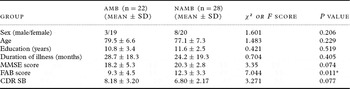
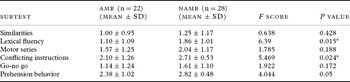
Fifty AD patients (11 males and 39 females; average age, 78.2 ± 7.1 years; range, 59–91 years) were classified as belonging to either the AMB group (n = 22) or the NAMB group (n = 28). These two groups were not significantly different with regard to the sex ratio (χ2 = 1.601; df = 1; P = 0.206), age (F = 1.483; df = 1; P = 0.229), duration of illness (months) (F = 0.421; df = 1; P = 0.405), education (years) (F = 0.704; df = 1; P = 0.519), MMSE score (F = 3.350; df = 1; P = 0.074), or CDR SB score (F = 3.271; df = 1; P = 0.077). However, the FAB total scores (F = 7.044; df = 1; P = 0.011) were significantly different between the two groups (Table 1). The mean ± standard deviations (SDs) of the FAB scores were 12.3 ± 3.3 (NAMB) and 9.3 ± 4.5 (AMB). The two subscores of the FAB, lexical fluency (F = 6.390; df = 1; P = 0.015) and conflicting instructions (F = 5.469; df = 1; P = 0.024), were both significantly lower in the AMB group than in the NAMB group (Table 2). The mean ± SDs of the lexical fluency scores were 1.86 ± 1.01 (NAMB) and 1.10±1.09 (AMB), while those of the conflicting instrument scores were 2.71±0.53 (NAMB) and 2.10±1.26 (AMB).
Subject characteristics (mean ± SD)

AMB = aberrant motor behavior, NAMB = non-aberrant motor behavior; CDR SB = Clinical Dementia Rating Scale sum of boxes (ranging from 0 to 18).
*P<0.05 (ANOVA with post-hoc test).
The sex ratio was analyzed using the χ2 test.
FAB subtest scores (mean ± SD)

AMB = aberrant motor behavior; NAMB = non-aberrant motor behavior.
*P<0.05 (ANOVA with post-hoc test).
Other behavioral and psychological problems including delusion, hallucination and anxiety in the two groups
We also compared other behavioral and psychological problems that might have influenced the aberrant motor behaviors between the AMB group and the NAMB group. The two groups were not significantly different with regard to the delusion score (F = 0.473; df = 1; P = 0.495), the hallucination score (F = 1.874; df = 1; P = 0.177), or the anxiety score (F = 2.016; df = 1; P = 0.162) of the Behave-AD subscales.
Contribution of age, sex, education, duration of illness, FAB total scores, MMSE scores and CDR sum of boxes scores to the severity of aberrant motor behaviors
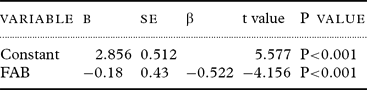
The FAB score was significantly correlated with the activity disturbance score (r = −0.490; P<0.001) and the MMSE score (r = 0.670; P<0.001). The MMSE score was also significantly correlated with the activity disturbance score (r = −0.317; P<0.001). A stepwise regression analysis showed that the FAB score significantly affected the activity disturbance score (P <0.001; R2 = 0.273) (Table 3).
Stepwise multiple regression analysis for activity disturbance scores of Behave-AD

Stepwise multiple regression analysis of FAB score, age, sex, education, duration of illness, MMSE score, and CDR sum of boxes for activity disturbance scores (N = 50).
B = partial regression coefficient; SE = standard error; β = standardized partial regression coefficient.
R = 0.522, R2 = 0.273.
Subtypes of aberrant motor behaviors
Although 22 patients had experienced aberrant motor behaviors, several types overlapped in one patient. Purposeless activity (e.g. opening and closing a pocketbook, packing and unpacking clothing, repeatedly putting on and removing clothing, insistently repeating demands or questions) was the most frequently reported aberrant motor behavior (N = 15). Inappropriate activity (e.g. storing and hiding objects in inappropriate places, throwing clothing in a waste basket or putting empty plates in the oven; inappropriate sexual behaviors such as inappropriate exposure) was reported in 13 patients, while wandering was reported in three patients.
Discussion
The results indicate that the FAB total score in patients with AD was significantly related to the presence of aberrant motor behaviors. While the MMSE total score reflects global cognitive function weighted on orientation and memory function (Folstein et al., Reference Folstein, Folstein and McHugh1975), the FAB has been confirmed to reflect executive function and working memory in patients with FTLD (Dubois et al., Reference Dubois, Slachevsky, Litvan and Pillon2000; Nakaaki et al., Reference Nakaaki2007). Moreover, the FAB total and subtest scores significantly differ between FTLD and AD, emphasizing the validity of using the FAB to reflect frontal lobe function (Slachevsky et al., Reference Slachevsky2004; Lipton et al., Reference Lipton2005; Nakaaki et al., Reference Nakaaki2007). The FAB was also shown to be a valid frontal function test in a SPECT study (Yoshida et al., Reference Yoshida2009), with a positive correlation observed between the left callosomarginal and precentral rCBF.
Some previous studies have reported that global cognitive and functional impairments in AD patients are associated with several BPSD, including aberrant motor behaviors (Mega et al., Reference Mega, Cummings, Fiorello and Gornbein1996; Devanand et al., Reference Devanand1997; Harwood et al., Reference Harwood, Barker, Ownby and Duara2000). Although some studies have indicated that aberrant motor behaviors are associated with cognitive or ADL decrements, only a few studies have indicated an association between frontal lobe function and aberrant motor behavior (Swanberg et al., Reference Swanberg, Tractenberg, Mohs, Thal and Cummings2004; Engelborghs et al., Reference Engelborghs2006). In the present study, the activity disturbances score was significantly correlated with the MMSE score (r = −0.317; P<0.001), but a stronger correlation (r = −0.490; P<0.001) and association with the FAB was revealed using a statistical regression analysis. Among several aspects of neurocognitive dysfunction, we were particularly interested in the association between frontal lobe dysfunction and aberrant motor behavior from a neuropsychological aspect.
The FAB subtests (lexical fluency, conflicting instructions) were significantly lower in AD patients with aberrant motor behavior. Dubois et al. (Reference Dubois, Slachevsky, Litvan and Pillon2000) described that in the lexical fluency task, patients needed the ability to recall as many words as possible starting with a given letter within a limited number of seconds. Such literal fluency tasks also require self-organized retrieval from semantic memory and flexible behavioral adaptations to new situations (Dubois et al., Reference Dubois, Slachevsky, Litvan and Pillon2000). Therefore, the aberrant motor behaviors, including wandering or inappropriate activity, might be caused by an inability to react flexibly with variable stimuli in their environment. The conflicting instruments subtest resembles the Stroop test task and requires the ability to perform a contrary reaction to each of two pattern directions effectively (Dubois et al., Reference Dubois, Slachevsky, Litvan and Pillon2000). In patients with AD, in addition to memory disorders and visuospatial impairments, the lack of such self-correction in executive functions might particularly cause impairments in their ability to carry out these tasks efficiently, leading to wandering, inappropriate activity or purposeless activity resembling stereotypical behaviors as a result. Moreover, several studies have reported associations between each subtest and specific regions of frontal lobes using various neuroimaging methods. For example, functional magnetic resonance imaging (fMRI) or position emission tomography (PET) studies have reported an association between lexical fluency and the medial frontal cortex, including the anterior cingulate gyrus (Waburton et al., Reference Warburton1996; Crosson et al., Reference Crosson1999) and between the conflicting instruments and the right orbito-frontal and anterior cingulate cortex (Bench et al., Reference Bench1993). These reports partially support the results of a previous voxel-based morphometry study in patients with neurodegenerative disease and might imply an association between the anterior cingulate cortex and the aberrant motor behaviors (Rosen et al., Reference Rosen, Allison, Schauer, Gorno-Tempini, Weiner and Miller2005).
In the present study, among the 22 AD patients (44%) with aberrant motor behaviors, only three exhibited wandering, 15 exhibited purposeless activity, and 13 exhibited inappropriate activity. Previous studies have shown that the prevalence of aberrant motor behaviors in patients with mild- or moderate-stage AD ranges from about 12% to 67% (Mega et al., Reference Mega, Cummings, Fiorello and Gornbein1996; Devanand et al., Reference Devanand1997), similar to our reported data. Schonfeld et al. (Reference Schonfeld2007) also showed that wandering in nursing homes was frequently (21%) observed in patients with severe cognitive impairments.
The present study has some limitations. First we must consider the relatively small sample size and the lack of objective measures, with only two neuropsychological assessments – the FAB and the MMSE – being performed. In particular, the subjects with wandering might have a high risk of visuospatial memory or perception impairments leading to “getting lost” (Chiu et al., Reference Chiu2004). Secondly, the present study was limited to subjects with mild- to moderate-stage AD whose CDR scores were 1 or 2, because even though the FAB tasks can be performed without tools or instruments, the tasks do contain relatively complex question forms that include several steps. Thirdly, apraxia symptoms as focal signs of AD should be quantitatively assessed, as subjects with severe ideational apraxia cannot carry out sequences of action to achieve an intended purpose in the correct order (Zadikoff et al., Reference Zadikoff, Lang and Klein2005). Fourthly, because the FAB score was significantly correlated with the MMSE score (r = 0.670; P<0.001), we might have used two relevant neuropsychological tests. Therefore, we confirmed that the activity disturbances score was more strongly associated with the FAB score than with the MMSE score or the CDR SB using a stepwise regression analysis. Finally, this study had a cross-sectional design, and significant associations with other BPSD symptoms (delusional ideation, hallucination and anxiety) were not observed. If the clinical courses of the patients were to be pursued longitudinally, another BPSD symptom might be added, resulting in a worsening of the aberrant motor behaviors.
In spite of these limitations, the present study supported the hypothesis that frontal lobe dysfunction might be related to aberrant motor behaviors in patients with AD, supporting the results of neuroimaging studies. Moreover, these results suggest that a simple neuropsychological screening test reflecting frontal lobe function and including mainly executive function – such as the FAB – might be useful for predicting the manifestation of aberrant motor behaviors in patients with AD, providing important information regarding the selection of treatment stages that might reduce the early burden placed on caregivers.
Conflict of interest
None.
Description of authors' roles
Tomoyuki Nagata designed this study, examined the subjects, and wrote the paper. Shunichiro Shinagawa gave advice, including the analysis methods, and reviewed the manuscript. Hirohide Kada, Yusuke Ochiai and Hiroo Kasahara examined the patients with AD at the Jikei University School of Medicine, Kashiwa Hospital. Kazutaka Nukariya and Kazuhiko Nakayama reviewed and commented on the final manuscript.