



1. Introduction
Stars are born in groups. Those remaining gravitationally bound are the star clusters that we witness today. In contrast to globular clusters that have retained integrity since formation, open clusters due to generally hostile disk environments continue to disintegrate due to (1) internal relaxation, leading to mass segregation, with lower-mass members occupying w progressively greater radii, followed by stellar evaporation, with the lowest-mass members particularly vulnerable to being ejected from the system, and (2) external tidal forces to stretch the structure and to strip away members in the outer skirts. Simulations (e.g., Lamers et al. Reference Lamers, Gieles and Bastian2005) suggest a time scale of about 1 Gyr for complete disintegration. As a result, old but populous survivors, the targets of our study, are therefore rare.
Cantat-Gaudin et al. (Reference Cantat-Gaudin, Anders and Castro-Ginard2020) employed the UPMASK (Unsupervised Photometric Membership Assignment) method to identify open cluster members using Gaia DR2 data, and applied an artificial neural network to estimate cluster parameters. We selected eight outliers in their catalog, namely, Collinder 261, NGC 2158, NGC 2477, NGC 2506, NGC 6791, NGC 6819, NGC 7786, and Trumpler 5, each being a few billion years old, yet still hosting thousands of members. Our goal is to understand their longevity as rich open clusters.
2. Data Analysis and Results
We used astrometric (position, proper motion, parallax) and photometric (G,
 $G_{BP}$
,
 $G_{RP}$
) data from Gaia DR3 (Gaia Collaboration et al. 2023). To ensure data quality, we restricted the analysis to
 $G \lesssim 20.5$
mag, where uncertainties remain below
 $\sim1$
mas in astrometry and
 $\sim6$
mmag in photometry. Pan-STARRS1 DR1 (Chambers et al. Reference Chambers, Magnier and Metcalfe2016) was additionally used to assess Gaia completeness at the faint end. We illustrate here our methodology using NGC 6791 as an example.
The cluster center is determined as the stellar density peaks, with an exponential radial profile plus a constant offset to separate the cluster from the field populations. A comparison field of equal sky area is used to estimate contamination. For NGC 6791, the center is at
 $(\alpha_{J2000}, \delta_{J2000})=(290.2189^{\circ}, 37.7772^{\circ})$
with a radius of 17.89 arcmin; the comparison field ranges from 54.1 to 57 arcmin. Member candidates have been selected iteratively using position, proper motion, and parallax grouping, yielding a mean motion of
 $(-0.42 \pm 0.13, -2.28 \pm 0.15)$
mas yr
 $^{-1}$
, mean parallax
 $0.22 \pm 0.10$
mas, leading to
 $\sim4000$
members.
The color-magnitude diagram (Figure 1) shows member candidates and a “false-positive” sample, which shares the same proper motion and parallax criteria, but is located in the comparison field. Isochrone fitting with PARSEC models (Bressan et al. Reference Bressan, Marigo and Girardi2012), adopting
 $E(B-V)=0.105$
(An et al. Reference An, Terndrup and Pinsonneault2015), comparable to an extinction of
 $A_{V}=0.33$
after considering a nominal reddening law from Cardelli et al. (Reference Cardelli, Clayton and Mathis1989), and a metallicity of
 $Z=0.034$
(Donor et al. Reference Donor, Frinchaboy and Cunha2020), yielded an age of 8.5 Gyr and distance of 4.4 kpc. To reduce the effect of unresolved binaries, the isochrone was fitted to the lower main sequence envelope.
The Gaia color-magnitude diagram of NGC 6791. Member candidates are presented by red symbols, along with the isochrone model from PARSEC shown by the black dashed curve and shifted by the reddening vector marked as the black arrow. The labeled stellar mass as a function of apparent G magnitude is estimated from PARSEC. False-positives are shown as blue open circles. Typical Gaia photometric and color errors are marked by black crosses.

The luminosity function was derived from the Gaia G magnitudes of the member candidates, after subtracting the false-positive sample from the cluster region, and then converted to the mass function using PARSEC isochrones (Bressan et al. Reference Bressan, Marigo and Girardi2012), assuming a uniform reddening and distance. The power-law mass function by (Salpeter Reference Salpeter1955) has the following form:
 $\xi(\log M)=\frac{dN}{d \log M} \propto M^{-\Gamma}$
, where M is the stellar mass, and N is the number of stars in the intervals of
 $\log M$
and
 $\log M + d \log M$
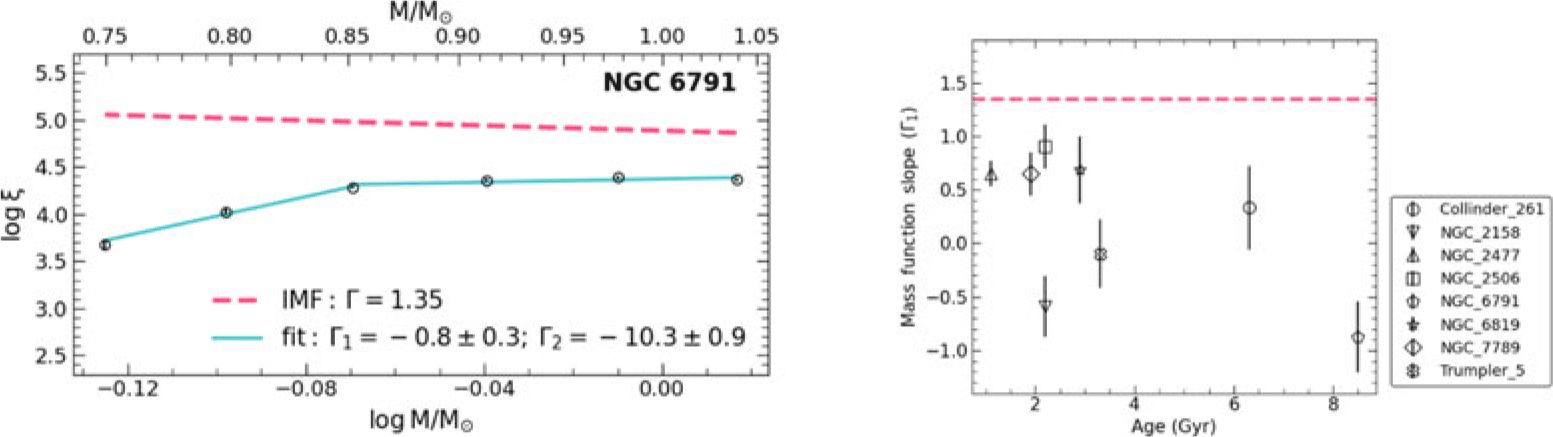
. We fitted the mass function (only for main-sequence stars about solar masses) with two power-law segments: for NGC 6791,
 $\Gamma_{1}=-0.8 \pm 0.3$
at the high-mass end and
 $\Gamma_{2}=-10.3 \pm 0.9$
at the low-mass end. A relative depletion of lower-mass members is seen. All our 8 target clusters show this top-heavy trend, likely due to evaporation of low-mass stars. The right panel suggests older clusters having flatter mass functions, implying more advanced dynamical disintegration.
(Left) The mass function of NGC 6791 (black open circles), fitted with a broken power law (green lines). The nominal Salpeter initial mass function (pink line, Salpeter Reference Salpeter1955) is shown for comparison. (Right) The mass function slope for the higher mass sample (
 $\Gamma_{1}$
) versus the cluster age. The pink horizontal line indicates the Salpeter IMF slope of 1.35.

3. Discussion
Sollima (Reference Sollima2019) reported a Gaia DR3 completeness in the range of
 $12\lt G\lt17$
mag, and it starts to decrease significantly fainter than
 $G\approx19-20$
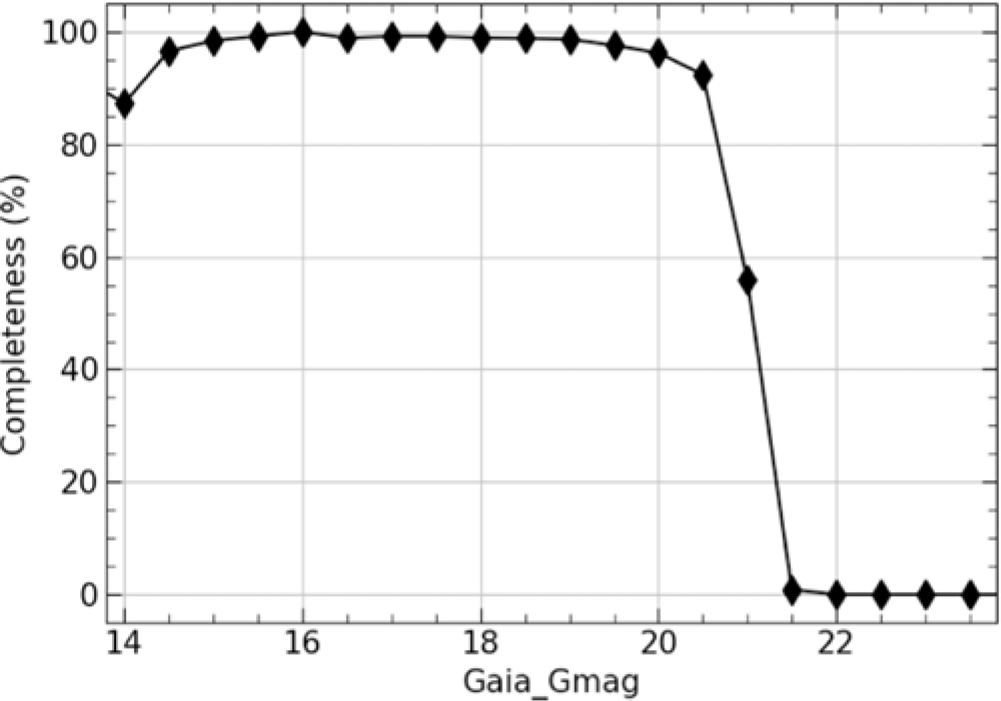
mag. We compared Gaia DR3 (photometric limits of 21.5 mag) with PS1 DR1 (photometric limits of 23.3 mag). Using stars in the reference field around NGC 6791, we cross-matched Gaia and PS1 DR1 sources and derived the completeness as a function of magnitude. Figure 3 shows completeness
 $\gt90\%$
down to
 $G=20.5$
to 21 mag, indicating that our sample of
 $G\lesssim 20.5$
mag does not suffer from data incompleteness, and the top-heavy mass functions are intrinsic to our target clusters. The controversy seems to arise from the fact that Sollima (Reference Sollima2019) made use of PS1 DR2, which contains multi-epoch entries, thereby overestimating the number of sources.
Gaia DR3 catalog completeness as a functional of G magnitude in comparison with PS1 DR1 data. Brighter than about 14 mag, PS1 catalog itself is incomplete due to saturation. The Gaia DR3 is complete over 90% down to
 $G\sim20.5$
mag.

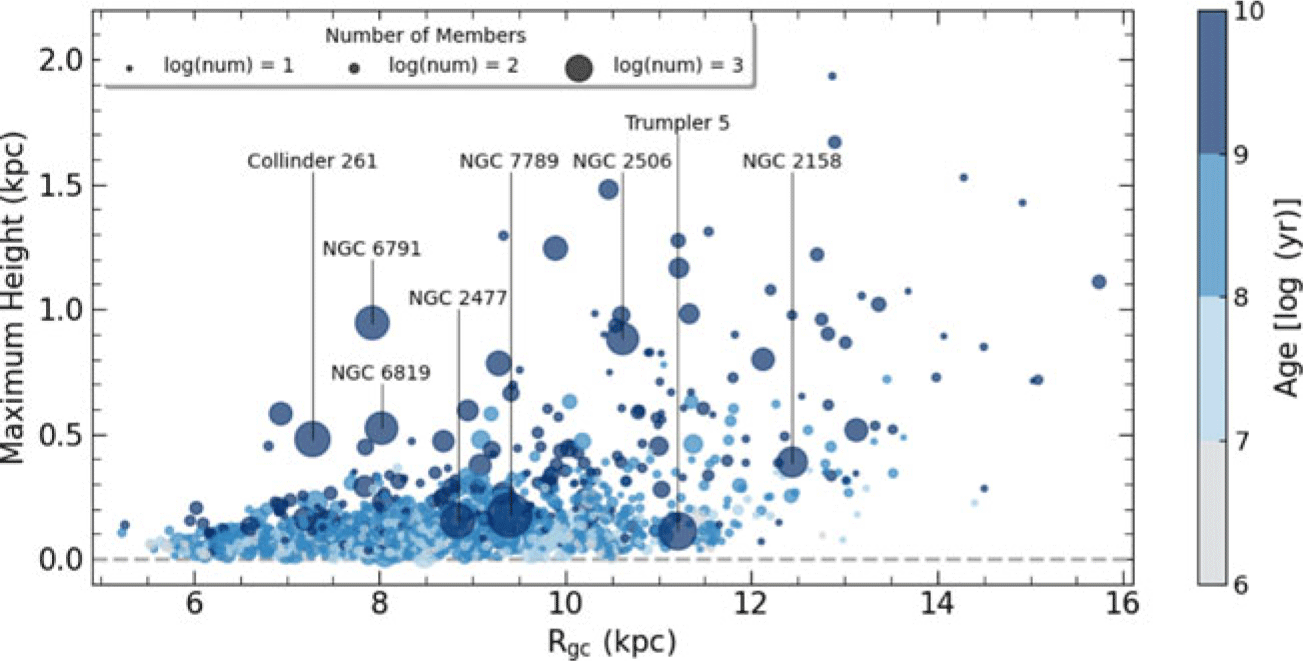
Tarricq et al. (Reference Tarricq, Soubiran and Casamiquela2021) derived orbital parameters of 1382 open clusters using Gaia DR2 and GALPY (Bovy Reference Bovy2015), and show that younger clusters (
 $\lesssim 300$
Myr) are closer to the plane, whereas older ones can reach maximum heights more than 400 pc. Our eight clusters are labeled in Figure 4; most have relatively larger maximum heights. A critical condition of their longevity may be the large galactocentric distances, near or beyond the solar orbital circle, where the disk density and hence the tidal (including encounters with giant clouds or clusters) or disk-crossing disruption is reduced. A rich cluster at birth at the outer disk would have a higher chance of survival. As the cluster ages, mass segregation plus stellar evaporation continues to harden the core (gravitationally tighter) and to elevate the scale height, making the disk crossing ever less frequently, prolonging its life expectancy.
Galactocentric distance (
 $R_{gc}$
) versus the maximum height from the Galactic plane of 1382 Galactic open clusters (data from Tarricq et al. Reference Tarricq, Soubiran and Casamiquela2021). Symbols are color-coded for age, with the size representing the number of members. Our eight old but rich clusters are each labeled.

To conclude, we have selected reliable members, with which to derive the parameters, of eight open clusters, each older than 1 Gyr and still hosting more than 1000 members: Collinder 261, NGC 2158, NGC 2477, NGC 2506, NGC 6791, NGC 6819, NGC 7789, and Trumpler 5. All these star clusters exhibit evidence of an advanced stage of dynamical mass segregation and a flat present-day mass function, i.e., a relative deficiency of stars less massive than solar, plausibly due to stellar evaporation. Our study provides support to the notion of longevity of open clusters away from the Galactic center where orbital isolation leads to reduced tidal and disk-crossing disturbances.

 Γ1
 G∼20.5
 Rgc


