INTRODUCTION
The continuing interest on research into language endangerment/language death has served to refocus our attention on issues of language shift (Bradley & Bradley 2002, Crystal 2000, Skutnabb-Kangas 2000, Nettle & Romaine 2000, Mufwene 2002, Phillipson 2003). Although most of the literature on language endangerment has centered on the Americas, Australasia, and the Pacific, the African context has frequently been invoked (e.g., Nettle & Romaine 2000, Mufwene 2002). Most directly, Nettle & Romaine note that English spread “is leading to the top-down displacement of numerous other tongues” (2000:144). Similarly, Phillipson (1999:6) writes about the threat posed by English, including in southern Africa, “to other languages and cultures,” perhaps even portending language attrition and “a loss of cultural vitality” (1999:176). Implicating the learning of English in “postethnicity,” he contrasts to it the use of African languages, which, he implies, carry the “wellsprings of ethnic identification” (1999:104). In common with the mainstream of the literature on language rights and language endangerment, he assumes that English currently represents the greatest threat to “indigenous” languages in Africa. There is now, in addition, a growing literature explicitly directed to Africa that draws its inspiration from research into language endangerment from other geographical regions (see Batibo 1992, 1998, 2001, 2005; Trail 1995).
Much of the literature is analytically rooted in the binary notion of “indigenous” and “dominant” languages – one that is often put forward as though it usefully describes and explains the contexts of all of the world's speakers of allegedly threatened “indigenous” languages. Such a conception tends toward the primordialization of languages and other artifacts, such as customary law, which are thus conceived as if they were authentic, timeless, “stable depositor[ies] of culture” (Fabian 1986:5). That approach reductively treats language shift from the standpoint of its purported effects on allegedly authentic, “traditional” African culture, to the exclusion of considering its signaling the emergence of new and creative adaptive strategies (Batibo 2005).
Despite powerful critiques by such scholars as Mudimbe 1988, Ranger 1989, and Mamdani 1996, which highlight the socially and historically constructed nature of ideas about Africa, ethnicity, and other social processes, much work on African languages remains rooted in an essentialist/primordial paradigm. In this article, we analyze the reasons for and the effects of the language shift in Zimbabwe represented by the increasing use and spread of pan-ethnic lingua francas of local origin. When essentialist/primordial assumptions about the nation's “indigenous” languages are replaced by a more complex understanding of their historical and social constructions and their current linguistic makeup, ongoing processes of language shift and change require greater analytical depth than the paradigm of language endangerment provides. Our argument is thus that, whatever the merits of such paradigms for specific contexts, they are far from having universal validity, and they are particularly inapt when applied to postcolonial Zimbabwe.
In particular, notions that the peoples of Zimbabwe are uniformly, or even primarily, concerned with preserving ethnic affiliations through the use and promotion of language boundaries that mark ethnicity fail to capture the sociolinguistic dynamic. Rather, the Zimbabwean context features:
- closely related – generally partially or even fully mutually intelligible – languages that make up a southern African regional language continuum, rather than an ecology of independent systems;
- a situation in which precolonial identities have been reconstructed to the point that their reconstitution is impossible, while neither the colonial-constructed ethnicities (Ranger 1989) nor the postcolonial Zimbabwean unified identity exert a particularly strong hold;
- a sociopolitical crisis of government and a concomitant (or perhaps precipitating) economic collapse that has pushed basic survival strategies to the forefront of everyday experience. Further aggravating the endemic problems is the perception, or reality – as in much of the global South – that urban location provides a privileged socioeconomic status, which the recent urban removals undertaken by the Mugabe regime have made even more precarious.
In these specific conditions, a considerable portion of language use among many Zimbabweans aims at asserting neither ethnic nor national affiliation, but at an urban identity conveyed through what are known as urban vernaculars. Because these conditions, though currently unusually acute in Zimbabwe, more or less prevail throughout much of sub-Saharan Africa, the Zimbabwean experience can illuminate processes seen on a larger regional and continental level, as witnessed by the rise of such languages as Wolof in Senegal, Lingala in Congo, Town Bemba in Zambia, and isiCamtho in South Africa.
“INDIGENOUS” LANGUAGES AND CULTURAL AUTHENTICITY
The premise that “indigenous” languages are in need of special protection (Nettle & Romaine 2000, Skutnabb-Kangas 2000) has relied in large part on the assumption that they constitute the authentic products of indigenous cultures. Recent work has shown that such seemingly common-sense assumptions require substantial modification in light of the complex legacy of colonialism. In southern Africa, historical examination of languages like Tswana, Zulu, Xhosa, and chiShona reveals a much more complicated picture.
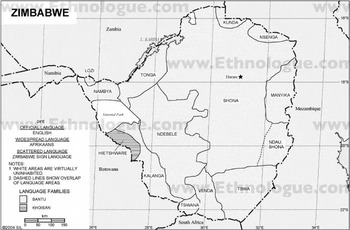
Current national boundaries in southern Africa were purely colonial impositions, for the most part without precolonial precursors. Linguistically, much of the entire region was dominated by a language ecology consisting of widespread language continua over large areas, bordering on other language continua that belonged to closely related linguistic systems. This situation was true, for example, of the geographical whole of present-day Zimbabwe. Though we cannot with precision re-create the precolonial language ecology, all available evidence agrees on the absence of both a unified language encompassing entire presently recognized identities (like chiShona or isiNdebele) as well as of the subidentities, or dialects, into which these are divided (e.g., in the case of chiShona, the varieties chiZezuru, chiKoreKore, chiManyika, chiKaranga, and chiNdau [Ranger 1989]). In Zimbabwe, the current language ecology – as represented, for example, in the Ethnologue, whose classification of the world's languages figures so prominently in the language endangerment literature – is represented as consisting of two main indigenous ethnic languages, chiShona and isiNdebele. ChiShona divides into a number of major dialects, with some other languages/dialects more or less proximate to each, and the status of some of these as independent languages or dependent dialects is subject to some dispute (Ethnologue); isiNdebele has no known dialects (see Map 1).

The languages of Zimbabwe (Ethnologue.com; reproduced with permission).
The role of colonialism in the construction of indigenous languages
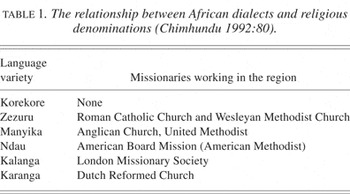
The representation of such a linguistic ecology is the product of colonialism, and it unfolded in two stages. The first stage entailed the creation of standard versions of what came to be labeled “dialects” by European Christian missionaries. Their concerns were twofold: (i) to learn the languages for the purpose of proselytizing among the people living there; and (ii) to create written versions of these languages for the primary purpose of translating the Bible (and other religious tracts) into them. A missionary put it this way in 1905: “We never forget that the primary object of our work is to give the native the bible and enable him to read it” (quoted in Ranger 1989:127). Faced with complex linguistic ecologies featuring continua that defied easy categorization, European missionaries differentiated or grouped together what they saw as “dialects,” often based on rudimentary understanding and superficial investigation of local language practices (see Makoni 2003; Brutt-Griffler 2002; MacGonagle 2001). As such, the principal dialects recognized today correspond not to precolonial indigenous linguistic, ethnic, or even regional divisions, but to the location and spheres of influence of the major missionary denominations – their ability to exert religious hegemony by creating, reifying, and spreading the dialects and the concomitant “ethnic affiliations” those dialects came to represent, or allegedly to represent (since they had no precolonial antecedents).
The relationship between African dialects and religious denominations (Chimhundu 1992:80).

Decades later, after colonial boundaries had arbitrarily carved up African societies and regimes had been established on the usual basis of force, the British colonial regimes of southern Africa conceived that the pragmatic demands of administration required what Brutt-Griffler calls the “manufacture [of] national languages to correspond with colonial boundaries” (2002:82). That project was the synthetic product of two constituent components: the contest for control by the missionary bodies, and the imposition of a particular linguistic model by a leading South African linguist of the 1930s, Clement Doke. The Southern Rhodesia administration in 1929 appointed a colonial commission of missionaries, colonial officers and Doke, which decreed that the “four or five languages” spoken in the part of the colony they named Mashonaland were really “four or five dialects of one language.” The imprint of the missionaries in the process was unmistakable, as they vied for advantage by asserting the respective claims of the dialect in which their literature was translated, their schools conducted, and their followers trained.
Doke, though he lacked substantive proficiency in the language he was called upon to codify, served as arbiter, overseeing the creation of a vocabulary by choosing representative words from each of the different languages and working out a standard grammar (Brutt-Griffler 2002:81–82). The resulting language was standardized on the basis of two dialects, chiZezuru and chiKaranga, with the former serving as the primary basis of Shona syntax and orthography. He justified this political choice on the dubious grounds that Zezuru had less phonetic variation than the other dialects. Elements of Korekore and Ndau were omitted because he judged them to be “Zuluisms.” Because of these judgments and subsequent revisions of Shona orthography in 1955 and 1967, phonemes such as /l/ and /x/ used in Ndau, Karanga, and Korekore were omitted, meaning that for speakers of these dialects, the written language became quite distinct from their spoken variety.
In this standardization and codification process, native speakers of southern African languages were displaced and rendered irrelevant to the process of codifying their “own” languages, the alleged repositories of their cultural authenticity. One of the missionaries who took part in the work (on chiShona), for example, relied on an English-speaking Mozambican teacher who knew isiZulu, who in turn relied on a few children as informants. The direct sources of the constructed language were, therefore, at best second-language speakers of the language they were recording (Makoni & Mashiri forthcoming).
The colonial commission created to aid the Southern Rhodesian administration opted to call the language it had created “Shona,” although even that body could find no reasonable basis for its choice:
It has been widely felt that the name ‘Shona’ is inaccurate and unworthy, that it is not the true name of any of the peoples whom we propose to group under the term ‘Shona-speaking people’ and further, that it lies under strong suspicion of being a name given in contempt by the enemies of the tribes. It is pretty certainly a foreign name, and as such is very likely to be uncomplimentary. It is true that the name ‘Mashona’ is not pleasing to the natives, but that may simply because it is a group name imposed from without, and ignoring all true tribal distinctions. Certainly no people in the country claim the name Mashona as their tribal name, and each would prefer to be described by the proper name of his particular group. (quoted in Brutt-Griffler 2002:82).
The dialectal/“ethnic” names were just as contrived: Some, like Ndau, were derogatory terms used by raiding communities, and others, like Korekore and Zezuru, were drawn from topographical features. Since the colonialists were not merely giving names to existing identities but actually creating them, the problem did not lie with nomenclature. Although the Shona peoples possessed many common cultural traits, they did not have a sense of belonging to a common ethnic identity: “Between the Shona culture as a whole, and the local chiefly group there existed no intermediate concept of ethnicity” (Ranger 1989:121).
Shona, like other “indigenous” languages produced by colonial administrations,1
ChiShona is not unique as a constructed language. Similar processes occurred in numerous cases throughout southern Africa and the British empire elsewhere. Missionaries in South Africa and eastern Transvaal forged Tsonga, Ronga, and other languages out of diverse speech forms, creating both new and linguistic and political identities (Harries 1989). In Nigeria, missionaries from neighboring Sierra Leone codified a diverse group of languages under the name Yoruba, itself a Hausa word not too familiar to those whose language it purportedly denoted. On the other hand, colonial officials opted to make separate languages of Zulu and Xhosa, although the two were as close as the languages unified in other cases.
The effects of this standardization project on language use had to be profound. Apart from the influence of a written standard more or less arbitrarily decreed, processes of language change today bear the unmistakable traces of the politically motivated decisions of missionaries and colonial officials. For instance, Kalanga, though mutually intelligible with the dialects of Shona, was, for reasons of geographical proximity, classified and treated as a dialect of Ndebele. Since Kalanga speakers would therefore be educated in standard Ndebele rather than Shona, spoken Kalanga has inevitably become more remote from Shona dialects and ever closer to Ndebele.2
Note that the opposite is also the case: Speakers may regard speech forms that are not mutually intelligible as constituting the same language. For instance, the Chagga people at the foot of Mount Kilimanjaro in East Africa regard themselves as speaking the same language, although linguists can identify at least three mutually unintelligible languages there (Batibo 2005:2).
Awareness that the emergence of indigenous languages represented a consequence of colonialism remained present among the Africans for whom the newly distinct, codified, and standardized languages/dialects were henceforth to serve as mother tongues. They expressed this consciousness in the names they gave to the languages they were being assigned to speak. For example, the variety of chiShona associated with European missionary evangelical work in Zimbabwe was generically referred to as chibaba ‘the language of the priests’. More specifically, depending on the geographical region in which the missionaries were working, they might call it “Church Manyika Language” (Chimhundu 1992). Similarly, in the Republic of the Congo, since the term “Kituba” associated with the colonial state was a colonial invention, it was referred to as kikongo ya leta ‘Kikongo of the state’ (l'etat) (Mufwene 2001:176).
The resulting languages, named, codified and standardized by colonial agents, were then assigned to southern Africans in rather arbitrary ways as part of what Brutt-Griffler 2002 calls the containment policy of limiting the spread of English, often for purposes of undertaking education in the “mother tongue” together with the pragmatic demands of colonial administration. While the set of assumptions on which the language endangerment movement operates includes the notion of the imposition of English as part of a European policy of linguistic imperialism (Phillipson 1992), the colonial reality in Zimbabwe was ironically one of the European imposition of these European-generated versions of African languages. These “vernaculars” became the basis of the primary education that was alone available to the vast majority of Africans. These written languages – produced as much by colonial agency as by southern African, and bearing at times little resemblance to the spoken language of the region's peoples – became, in effect, mother tongues in search of speakers.
What is Shona today?
What is called chiShona comprises today a very complex linguistic construct and legacy of its colonial pedigree.3
The general trend in southern African linguistics is to use the word “Shona” as an adjective to refer to the speakers of the language, and “chiShona” as a noun to refer to the language and the culture.
Two additional factors complicate this sociolinguistic picture. First, language boundaries retain, if not exactly their precolonial shape, at least something of their precolonial fluidity. As such, the attempt to capture, as Ethnologue and national censuses do, the contours of language use on dialect maps and via tables setting out the number of speakers of each dialect render a misleading and largely meaningless picture of language use in Zimbabwe. If anything, it more reflects statist (in this case, via a postcolonial policy that essentially reproduces the colonial) attempts to impose order for purposes of governance on an inherently unstable linguistic terrain. Second, much everyday interaction and primary language socialization outside (and increasingly, perhaps, within) formal schooling takes place not in either written chiShona or even in the codified dialects but increasingly in urban vernaculars like chiHarare (cf. Childs 1997, Mufwene 2001).
“ChiShona” in this article refers to the written standard language, a stable system but one that is something of an ideal variety realized primarily as a literary style, based largely on ChiZezuru, the dominant dialect of the capital city, but with some aspects taken from the other four main language varieties or dialects, ChiKaranga, ChiManyika, ChiNdau, and ChiKorekore. The dialects of ChiShona are mutually intelligible. While the written standard is stable, the spoken versions are quite unstable.
THE URBAN AFRICAN CONTEXT AND LANGUAGE USE: A SOCIOHISTORICAL NOTE ON ZIMBABWE AND HARARE
In this section, we turn to an examination of language use in urban contexts in Harare, Zimbabwe. Zimbabwe, like many other African countries, is made up of many indigenous groups along with a significant number of Africans from other parts of southern Africa, notably Malawi, Zambia, Mozambique, and South Africa. The ethnic divisions are further complicated by a legacy of racial divisions, which separates off those of European and Asian descent and those of mixed ancestry (so-called Coloreds) (Muzondidya 2002). Zimbabwean politics and scholarship have tended to focus on the relations between the dominant ethnic and racial groups – the Shona, the Ndebele, and the whites – to the exclusion of the African immigrant communities (Muzondidya 2002). In this article we depart from this tradition and focus in part on the use of urban vernaculars by Zimbabweans of Malawian origin.
Zimbabwe's capital and largest city, Harare, has a diverse population of some 1.2 million, including a relatively large immigrant community from Malawi. In the 1950s they made up almost 60% of the people who worked for the City Council. There was a second wave of immigrants from Malawi in the early 1980s after Zimbabwe gained its independence.
Any understanding of language shift necessarily begins in this urban context, since, like much of the rest of the world, Zimbabwe has been undergoing rapid urbanization that has brought different language groups together in a small geographic space. Moreover, though it is sometimes assumed that urban and rural areas are cut off – the former constituting sites of language shift, and the latter sites of ethnic language maintenance (e.g., Nettle & Romaine 2000) – the economy of migration that links them means that their linguistic fates are inextricably intertwined. The phenomenon of cyclical migration is neither new nor restricted to Zimbabwe. For example, a tradition exists of the young “leaving for adventure” to experience work and life elsewhere during the seasonal break (Canut 2001). What occurs in the towns and cities, therefore, has profound ramifications in nonurban contexts as well. Given the patterns of rural–urban migrations, both permanent and transient, the analysis of rural language use given in our data (extract 4) is an indispensable complement to studies of urban language use.
Drawing on the assumptions of the dominant/indigenous binary that is constructed as the exclusive lens through which language shift must be interpreted, it has been assumed since colonial times that, as “Westernized” areas, urban spaces are sites in which ethnic African or Asian languages give way to European languages. Until recently there has been little interest in language shift that does not involve English or French, reflecting a belief that a shift that does not cross the dominant/indigenous divide can hardly constitute a case of real language shift. Indeed, if it did not involve some incorporation of English or French, some commentators would find nothing of interest in it whatsoever. It is, then, precisely in this type of language shift that the paradigmatic limitations of dominant vs. indigenous break down. For the vast majority of the profound language shifts taking place throughout Africa are precisely of this kind.
Within Zimbabwe's African urban space, “indigenous” languages have entered into new linguistic configurations in light of speakers' adaptive responses in the form of linguistic practice to their changing environment and the new communicative needs it presents (cf. Mufwene 2001). We have selected as our case study Harare, Zimbabwe, a city that linguistically exemplifies other African urban locations in three important respects:
- social interactions take place in a multilingual environment;
- they rest on the assumption that speakers are able to comprehend a number of local languages and are willing to accommodate their interlocutors;
- Harare embodies the pattern of migration to cities that brings people from different linguistic and socioeconomic backgrounds to the same urban space.
The linguistic results of these processes, known as urban vernaculars, are languages made up of discourse elements, lexical items, and syntactic forms drawn from a number of different languages. These ensembles have been reported in different parts of Africa, including Mali, Kenya, Congo, Zambia, South Africa and Senegal (Canut 2002), all of which have experienced extreme economic deprivation and political oppression.
The defining feature of urban vernaculars is not merely that they are mixed languages, but that their individual speakers may not necessarily be able to develop full competence in each of the languages that make up the amalgam (Njoroge 1986). For example, some chiShona speakers produce and use utterances of mixed chiShona and chiChewa but display very limited knowledge of chiChewa. It is not uncommon to hear chiShona speakers comically exchange greetings with chiChewa-speaking acquaintances, such as Muri bwanji here aPhiri? ‘How are you Mr. Phiri?’. The speaker's limited competence in chiChewa in this example is evident at the phonological level. Standard chiChewa uses lateral /l/ where chiShona uses trill /r/, and it employs a high tone to mark the interrogative whereas chiShona uses the interrogative morpheme here ‘yes/no’. Thus, put in standard chiChewa, the greeting above would be Muli bwanji (aPhiri)?
The widespread use and social importance of these urban vernaculars in southern Africa has been given market recognition, for example in their presence as a staple of television and radio programs, particularly those targeting youth. There has been, however, no similar institutional recognition, which has profound implications for educational policy. While urban vernaculars are the mother tongues of many urban children, children continue to be tested in “indigenous” languages that sound foreign to their users. It has been noted in the South African context that many serious problems arise from the teaching of standard Zulu in classrooms for Zulu children whose language repertoires vary greatly, and this is a challenge to Zulu teachers, who compare the teaching of standard Zulu to teaching in a foreign language.
A main reason for this discrepancy between actual language use and educational language policy is the reification of the colonial linguistic heritage of written standards that do not correspond to language-in-use. While official indigenous languages remain to a large extent mother tongues in search of speakers, urban vernaculars have been rendered spoken languages in search of legitimacy. Because the language rights and language endangerment movements have successfully reduced language policy to the unanalyzed categories of dominant vs. indigenous without sufficient historical or empirical investigation, they find themselves in the ironic position of defending the colonially imposed “standard indigenous languages” against those that more directly express the cultural legacy that is supposed to be preserved.
Language use in urban public transport
Some 60% to 80% of Zimbabweans commute daily to work by small minivans or buses. Such daily commuting brings together speakers of a variety of languages and ethnic backgrounds, including Afrikaans, chiChewa, English, isiNdebele, chiShona, Portuguese, and Sotho. Encounters between drivers and passengers provide us with the opportunity to explore the dynamics of communication, and more specifically the use of urban vernaculars in a clearly delineated social and linguistic space (Rakodi 1995).
To understand the use of urban vernaculars among adults, we carried out an ethnographic study in the densely populated Harare suburb of Mbare, specifically in Zata Street, where the majority of residents are of Malawian origin. We identified families in which one of the heads of household was of Malawian origin but had lived in Zimbabwe for at least a decade, while the other was ethnically Zimbabwean. The informant was also expected to have had a job that required that he or she leave the family home and interact with the general public constantly. Through participant observation, we both recorded interactions within the family and followed the informants and, with their permission, recorded their interactions with non-family members as part of their professional and social life to see how the informants used urban vernaculars to negotiate their identities in different spaces. We observed five families, in which the husbands were all of Malawian origin and the wives ethnically Zimbabwean. The couples had been married for at least five years.
Below we report on the data collected for one subject, whom we will call “Mr. Phiri.” This informant was born in Malawi and attended elementary school there and high school in Zimbabwe. When these data were collected on 18 June 2002, he was working as a bus conductor for a local company.
At 6:30 a.m., as he is preparing to leave his rented house on Zata Street, Mbare, he converses with his ethnically chiShona wife (Ms. Phiri) about the transport problems facing the public:

By line 5, both husband and wife are near the road; they bid each other farewell, and the wife returns into the house and the bus conductor walks to the main bus depot in Mbare, where he works.
In the intimacy of a private conversation within their family, this couple uses an amalgam of chiChewa and chiShona. Mr. Phiri's discourse comprises 28% chiShona, 58% chiChewa, 11% English, and 3% consisting of words belonging to both chiShona and chiChewa. Ms. Phiri's discourse consists of 30% chiShona, 60% chiChewa, and 10% English. Her chiShona is strongly marked by a chiZezuru accent.
The word amai in line 1 (which may mean either ‘one's mother’ or can be used to refer to ‘one's wife’) belongs simultaneously to both chiChewa and chiShona – in this case, specifically the chiZezuru dialect that is dominant in the Harare region. In line 3, Mr. Phiri responds initially in what may be classified as chiChewa before concluding the sentence with a chiZezuru word. In line 6, Ms. Phiri initially responds in chiChewa, but again concludes her response with a chiZezuru phrase. By drawing phrases that alternate between chiChewa and chiShona when saying there is no transport (hakuna, kulibe) she seems to emphasize the gravity of the poor transport situation by crossing language boundaries – using the chiShona word followed by its chiChewa equivalent. While Ms. Phiri's incorporation of an English word involves no morphosyntactic alteration, all of Mr. Phiri's utterances where English is the source language show significant morphosyntactic alteration. Thus, mabhazi ‘buses’ takes the form Shona plural morpheme + Shonalized (via vowel insertion at the end) English noun. He also uses two words derived from the English morpheme “queue”: makiyu (Shona plural morpheme + Shonalized [via vowel insertion at the end] English noun); but also pamaqueue (Shona morpheme + non-Shonalized English noun).
The next excerpt finds the bus conductor at the bus depot in Mbare. He is now addressing passengers who are pushing each other to get into the bus, shouting at the top of his voice:

Extract (2) illustrates the nature of language use in a public domain that takes the form of an amalgam of chiShona and English, a variety referred to as chiHarare (Chimhundu 1983). This spoken variety is used in everyday communication. Unlike the standard chiShona, chiHarare is quite unstable, often an admixture of ChiShona and English, plus switches and borrowings from other languages. ChiHarare is a byproduct of urbanization or cosmopolitanism.
The meaning of English words in such an urban vernacular at times radically differs from their meaning in Standard English. For example, the noun phrase muface in line 1 combines the chiShona prefix mu + English noun face. In this context, it is used to mean ‘my acquaintance’. A similar case is the word bigaz (English big) (literally ‘the senior one’, in line 5). The phonological rules used in bigaz depart from those in Shona because it ends with a consonant when most Shona syllables end with vowels. The pattern of the chiShona prefix plus the English noun is repeated frequently. For example, the phrase kubackseat in line 3 combines the chiShona locative ku + English noun back seat; mapassengerz is morphologically marked by double pluralization – a prefix drawn from chiShona and a suffix -s. Zatchigororo is analyzed as Chewa and Shona because the first part, zatchigo, is Chewa, but the second part, -roro, is Shona or Shonalized Chewa, since proper Chewa would use the lateral /l/ rather than the roll /r/, common in Shona.
Semantic alternation also takes place in the case of many words that chiShona speakers borrow from English. In Standard English, people talking about a soft drink clearly distinguish the container (bottle) from the contents. In everyday chiShona, when one says Unoda bhotoro ripi?, literally ‘Which bottle do you prefer?’, the speaker implies the content (e.g Coca-cola, Sprite) and not the container. The word kokokora ‘Coca-cola’ is also commonly used generically to imply any other type of soft drink.
Another striking feature of the combined chiShona and English discourse is the use of kinship and other terms suggestive of intimate relations when the crew refers to passengers. We observe this tendency in the bus conductor's use of muface (line 1), sisi ‘sister’ (line 2), and bigaz ‘the senior one’ (line 5) (cf. Mashiri 2002). From a linguistic perspective, the use of words such as sisi can be read as incorporation of abbreviated forms of urban discourse. The strategy of abbreviating English terms as they get incorporated into urban vernaculars made up of predominantly chiShona and English shows that the phenomenon we are dealing with is much more complicated than simple borrowing. In both urban and rural communities, the abbreviated forms are widespread. Examples of this process include the nouns ma-vegi ‘vegetables’, ma-mini ‘miniskirts’, ma-exams ‘examinations’, and ma-phone ‘telephone’. The abbreviated expressions are often interchanged with the full forms, resulting in “double” plurals, chiShona plural prefix ma- (class 6) + English noun + English plural suffix. For example, ma-vegi is at times used interchangeably with ma-vegetables, ma-mini with miniskirts, ma-exams with ma-examinations, and ma-phone with ma-telephones. The double morphological forms illustrate the variation within urban vernaculars. The full form, when used in a social interaction, conjures up a more formal relationship with the addressee.
Although we are referring to some of these terms as abbreviated, it is not obvious that the users perceive them as such. It is also likely that some users of the abbreviated expressions may not have encountered the expressions in their full form in English. An abbreviated form may not necessarily be an elliptical form from the perspective of the users, particularly those with limited exposure to English. We thus do not know whether the users regard sisi as an abbreviated form of sister, or ma-vegi as an abbreviated form of vegetables.
In extract (3), the bus conductor is conversing with conductors from other buses. Mr. Phiri's Shona colleague Mr. Mazo teases the bus conductor, who does not seem amused by his jokes:

In this short sample, a Shona bus conductor addresses Mr. Phiri in Chewa, albeit a Harare or second-language variant of chiChewa that we may regard as “mock Chewa.” While Kubwera is chiChewa, the syntax of Ndiri kubwera is Harare Chewa. The typical Chewa syntax is ndikubwera. Although Mr. Phiri responds in Chewa, he seems to feel offended, perhaps because he regards being addressed in Chewa in public among non-intimate acquaintances as disclosing an alien identity he was trying to mask. The attempt to cross over to a Chewa identity is not reciprocated by Mr. Phiri.
The use of chiHarare has social significance in a city where there is a relatively large number of speakers of other minority languages, particularly from Malawi, who are threatened with marginalization decades after their ancestors' migration. Thus, while Mr. Phiri's chiHarare in the private domain draws heavily on chiChewa, the situation is different when he is interacting with passengers in the public domain. His chiHarare seems to draw more on a combination of English and chiShona. In doing so, he both refuses to accept a socially ascribed Malawian ethnic identity (the foreign other) and claims the status he covets – not that of an ethnic Shona, nor even a Zimbabwean national, but a cosmopolitan urbanite. ChiHarare, which as a mixture of English and chiShona is distinct from both, allows him to do so. The emergence of such a tendency is also reported, for instance, in studies of urban language use in West Africa, particularly in Dakar in Senegal (McLaughlin 2001:170). This suggests that in analyzing language use in multiethnic contexts, we need to take cognizance of the ability of urban dwellers to move out of old ethnicities and create new identities centered on the urban experience (cf. Mufwene 2002).
Urban vernaculars and non-urban contexts: The impact of urban/rural migration
Urban vernaculars have been studied and analyzed with respect to urban contexts almost exclusively. Given, however, the close interconnection of these two spaces that results from the high level of migration in the African context, we also collected data in a rural community to see to what extent urban vernaculars had spread to rural communities.
Although the term urban vernaculars might signal that they are limited to urban spaces, migration patterns in Zimbabwe allow language practice to be “transported” to some non-urban dwellers as well. As we stated earlier, some 60% to 80% of Zimbabweans travel to work in urban places. Many of them come from the areas surrounding the city, and some travel from non-urban places, in a nation that is approximately three-fifths rural. We were interested in how the local language practices of people of Malawian descent in non-urban places resemble those in urban Harare. The data from two informants, Mr. G and Ms. G, come from a community called Chiundura in the Midlands province of Zimbabwe, near the city of Kwekwe. The data are part of our ethnographic study carried out in Zimbabwe in the summer of 2002. The interviews with our informants were conducted in their house. The conversation was recorded on a late summer afternoon and was held in chiShona. Mr. G is a prominent subsistence farmer. He and his wife are in their early sixties. The interviewer was a former school principal, now a successful farmer in Chiundura, who therefore is familiar with the local context. The objective of the research project was to investigate the nature of language use in a rural domestic environment.

Mr. G's language use exhibits fragments that belong to different languages. For example, he incorporates English adverbs to describe his knowledge of languages, as in chiShonausually ‘I usually use Shona at home’ and chiNdevere ndirigood ‘my Ndebele is good’. In addition to identifying the languages he speaks and displaying some linguistic expressions from those languages, Mr. G evaluates his knowledge of those languages. He feels he is proficient in chiShona, isiNdebele, and chiChewa (chiNyanja), demonstrating his knowledge of the latter two with the incorporation of fragments. He describes his knowledge of English as good considering his level of education.
In addition to elements from English, he draws upon linguistic expressions particularly from chiNyanja, as if to display his knowledge of chiNyanja, and in MaZuzuru sagula mowa ‘the Shona do not buy beer’. He uses this linguistic expression that he has most likely heard used by chiNyanja speakers when referring to chiShona speakers when they meet in pubs, describing their reluctance to buy beer. In the Ndebele greeting Livhuke njani? lit. ‘How did you wake up?’ the prefix /li-/ ‘you plural’ is a new phenomenon in Ndebele. Originally Ndebele had no honorific plural as is found in chiShona. While Shona distinguishes the use of the subject concords /wa-/ ‘you singular past’, as in Warara sei? ‘How did you sleep?’ and /ma-/ ‘you plural past’ in greetings, Ndebele does not. It uses /u-/ ‘you singular’ to express both singular and plural. Therefore, it is acceptable in Ndebele to greet an adult with Uvhuke njani? Yet it would be considered rude in Shona to greet an adult using the singular subject concord (wa-). The use of /li-/ as demonstrated by Mr. G. is not limited to chiShona speakers but is becoming quite acceptable, especially among urban Ndebele speakers.
It is interesting that when he lists chiShona as his first language, Mr. G quickly corrects himself to say chiZezuru. Later, he reverts to calling it chiShona in describing what contexts he uses it in. In the same description, he switches again to the use of maZuzuru where he might have been expected to use maShona, though in this case the choice is ascribed to the chiChewa speakers he is, in effect, quoting. That he does not feel constrained to overrule their naming of his ethnic identity – and that he himself is as comfortable using the one as the other in interacting with a fellow chiShona speaker – suggests that the collective Shona identity has not entirely supplanted that of the Zezuru, even among prominent members of this rural community. The association of chiShona with chiZezuru may in part reflect the historically dominant role that chiZezuru plays in the construction of chiShona. But it also strongly suggests that he is laying claim to the cosmopolitanism that his occupation entails, since he references his use of English when he goes into town. Indeed, his lengthy response to the question of where he uses the languages he is proficient in, complete with phrases from each language as if to confirm his claim to his listener (a former educational official), foregrounds his sense of his performing multiple identities – of being a cosmopolitan, though of rural residence, who goes into town, joins friends at the beer hall, and lives in a multilingual world.
Mr. G's linguistic repertoire differs from that of Ms. G. Their language is in part shaped by their social responsibilities and the social roles they play in the communities. Ms. G has no formal education and does not claim to have any knowledge of English. She plays, however, an active role in the education of her grandchildren, and she does so in chiShona by teaching them community values:

Ms. G typifies the results of this study in that the language experience of our informants is not necessarily made up of complete language systems, but of integrated fragments that make up an inventory on which the speaker draws. For example, Ms. G in the sentence ChiShona ndirinumber one, mbuya vakandidzidzisa vaitaura chiShona vana kana vabva kuchikoro ndinovadzidzisa zviragwe-kurumba handi kusvika, draws from standard Shona for the greater part of the sentence, English in the phrase number one, the Karanga dialect of Shona in the word zviragwe ‘riddles’, and the Ndau dialect in the proverb kurumba handi kusvika.
In her interview, she also indicates that she is familiar with chiNdau, another chiShona “dialect” spoken in the eastern part of Zimbabwe. She has learned and experienced chiNdau because her sister lives in eastern Zimbabwe where chiNdau is frequently spoken. Her language experiences are therefore partly shaped by her family and social relationships and the role she plays in the socialization of her grandchildren. She resorts to the use of proverbs when asked how good her Shona is. She keeps returning to the proverb Mugona wepwere ndiye asina ‘the person who can bring up children is the one who doesn't have them’, or she cites another proverb she uses when socializing her children about the dangers of being in a hurry (Kurumba handikusvika, line 4).
Interestingly, she cites that chiNdau proverb and the Karanga word for ‘riddles’ to demonstrate how she educates her grandchildren in chiShona – that is, via dialects used in distant regions of Zimbabwe. This usage suggests that what interests her is not so much the transmission of the chiShona language as the knowledge she wishes to impart through its usage. Moreover, she describes her proficiency in chiShona with an English-like expression (though she may not know the origin of the words she employs). In this respect, Ms. G's language use is perhaps even more telling than that of her spouse. In response to questions that might have been expected to yield unmixed chiShona, her first language, she not only displays the competence of a multilingual but also incorporates multilingual elements in her discourse. She disclaims knowledge of English when the interviewer asks her for her address (using the English loanword with chiShona phonetics and morphosyntax). There are, however, some English-like expressions that recur in her language production. For example, when she describes her family's social status in the village as the most prominent family, she uses the English phrase number one. This seems to suggest that the idea of unmixed chiShona is extremely rare. Even the speech of non-educated speakers contains English-like expressions.
In any case, rural Zimbabweans do not perform pure, authentic, unmixed languages. Rather, their usage reflects the web of social relations in which they are enmeshed, crossing region, urban/rural, and ethnic lines. Though perhaps not to the same extent as in cities, language usage in rural areas nevertheless reflects the same cosmopolitan influences that have produced the urban vernaculars that establish urbanity.
In sum, individuals will develop comparable linguistic inventories to the extent that they share similar social and economic experiences, as the examples of Mr. G and Ms. G point out. The exact details of the linguistic inventories may vary depending on the individual's social and urban networks and, for example, her or his gender role in the speech communities. For Mr. G, knowledge of a language is defined as the ability to use and draw on “different” languages (Ndebele, Nyanja, and English) in interactions with people from different ethnic groups in his everyday life and as part of his occupational needs as a subsistence farmer. Even then, rural areas, whose residents are sometimes viewed as custodians of ethnic identity, present not a homogenous cultural/ethnic domain but a multilingual one in which language use indexes the ability to function in a changing socioeconomic environment. This already represents something of a transition to an urban environment in which performance of the urban variety indexes a coveted urban identity. Not cultural authenticity but social capital governs language use.
DISCUSSION
A study of language use in Zimbabwe shows that speakers move with relative ease across language boundaries. For example, Mr. Phiri, of Malawian origin, may use an amalgam of Chewa, Shangani, and Nambya in intraethnic communication, with the interaction accompanied by song and dance, depending on the context (Makoni & Mashiri forthcoming). Though Malawians and other African immigrants in Zimbabwe tend to live in the same neighborhoods, as the case of Mr. and Ms. Phiri demonstrates, there is much interethnic marriage; hence, even these community interactions require multilingualism, as Mr. and Ms. Phiri's home use of an amalgam of chiChewa and chiShona illustrates. A short while later, we observe Mr. Phiri using an urban vernacular with other township residents in a situation in which he seeks to downplay his ethnicity as a marker and to foreground his urban identity. He may then use English in situations where he wants to stress his social status and education. For urbanites like Mr. Phiri, primary language socialization involves learning to interact in an amalgam of chiChewa and urban Shona/English (and occasionally Afrikaans), and learning how to deploy his linguistic resources depending on the nature and goal of the interaction. The communicative practices of Africans like Mr. Phiri are “composed of an ensemble of varying subsystems in contact and in the process of permanent transformation and evolution” (Canut 2002:39).
This understanding provides an alternative account to the “dystopic vision of linguistic catastrophe” or language endangerment (Jacquemet 2005:1). Rather than suggesting that “indigenous” languages are in the process of extinction in African urban contexts, we show how speakers incorporate “indigenous” languages and the “dominant” one to move across different ethnic and social classes.
Within that movement, urban vernaculars form an important part of their linguistic repertoire. The Harare urban vernacular is a linguistic hybrid or amalgam similar to those found in other parts of Africa (Abdulaziz & Osinde 1997, Githiora 2002). It is important to note that such a linguistic description should not be construed to mean that the speakers themselves see their language use in this way. Thus, Mrs. G sees no contradiction in demonstrating her chiShona proficiency not only with elements of chiKaranga and chiNdau, but even with English. She focuses on the contextually appropriate meaning rather than on the dialectal or linguistic system it is taken from. Speakers do not inherit knowledge of the history of a language (cf. McLaughlin 2001:121). As with other languages, an intimate knowledge of the etymology of the language of everyday interactions requires specialized study. The term “hybrid” may also lead us to misconstrue the sociolinguistic situation. For example, speakers of linguistic hybrids may differ considerably in the nature of their linguistic repertoire. Ms. G has a different repertoire from her husband, Mr. G, as a consequence of their different social experiences.
Radical differences in repertoire are not restricted to urban vernaculars in Zimbabwe. For example, in Senegal, the urban vernaculars are made up of urban Wolof, French, and other Senegalese languages for some people, while for others the amalgam may be perceived as monodialectal, made up of urban Wolof alone. Consequently, the same amalgam may be said to belong either to a single language or to different languages simultaneously – a form of multivalency (Woolard & Schieffelin 1994). To describe the linguistic amalgams as code-switching might be inappropriate because some of the speakers may not have any substantial proficiency in the unmixed forms of the languages represented in the amalgams (McLaughlin 2001). Thus, in the case of Zimbabweans, if a speaker's production includes fragments from English, chiShona, and chiNyanja, this does not necessarily mean he is able to speak any of those languages separately.
Languages like chiHarare seem to derive from the shared social experience of living in a postcolonial urban environment. In order to survive in the African city, one has to improvise, and this improvisation extends to language use (McLaughlin 2001). Becoming urban means being able to adopt a new identity. For example, Mr. Phiri's language use demonstrates how he moves in and out of a Malawian-origin identity and adopts a Harare identity. Such a shift from one identity into another is not restricted to Harare. When addressed by a non-Malawian co-worker in chiChewa, Mr. Phiri is offended by what he apparently views as the inappropriateness of such an ethnic essentialization of his identity in an urban, multiethnic space where an urban vernacular is more appropriate. He thus appears to see language use as context-specific. Similarly, McLaughlin 2001 writes that for many Senegalese,
slipping out of one identity and into another as easily as if they were changing clothes … is a common experience as they travel backwards and forwards to urban and rural areas. There is an awareness of the fluidity of identity as they speak Wolof in one way in Dakar as opposed to rural areas with some claiming that even their ethnicity changed when they were in the city: ‘Quand je suis chez moi je suis Haalpularr, quand je suis a Dakar je suis Wolof’ ‘When I am at home I am Haalpularr, when I am in Dakar I am Wolof’. (2001:156)
Urban vernaculars may represent an attempt to redefine the public space in countries such as Senegal. At times they may even be construed as a challenge to the socioeconomic and ruling elite. It is thought, for example, that Sheng, an urban vernacular of Nairobi, Kenya, emerged and developed in the lower socioeconomic classes in the Nairobi ghetto – a similar origin to that of Johannesburg, South Africa's Isicamtho. Sheng apparently spread owing to the influx of migrants into Nairobi in the early 1960s after Kenya had attained independence and was widely used by Kikuyu ex-Mau Mau, school dropouts (as Isicamtho is said to have evolved among prison inmates and township gangs). Sheng spread away from the Eastlands because of its widespread use in the informal sector, for example by shoe shiners, curio sellers, hawkers, and parking attendants. There is also some evidence that street children may have Sheng as their primary language. Whatever its exact origins, Sheng has spread widely in Nairobi. Young people, in particular, use it as their language of interaction. It dominates the discourse practices of primary and secondary school students. Sheng is, however, not strictly a youth language; adults also report using it. ChiHarare's use by persons of Malawian origin – often targets of anti-immigration sentiment – fits a similar pattern. In that sense, Mr. Phiri's preference to be addressed by co-workers in chiHarare is an assertion of the primacy of urban identity over national origin and ethnicity in contemporary Zimbabwe. Such a hierarchization of identities derives from the postcolonial socioeconomic and political realities of Zimbabwe(and other parts of Africa) discussed earlier.
The degree to which urban vernaculars are an integral part of urban life is apparent in their use in popular songs, in the routines of comics such as Boy Dakar in Senegal (Spitulnik 1988), and even in the news media. Because of the social significance of writing, the use of urban vernaculars in written form in particular may serve as a form of social legitimation.
Though urban vernaculars are intimately linked to the city cultures in which they emerge, to identify them as exclusively city-based (as the names chiHarare or Town Bemba imply) is misleading, given their presence in rural areas. Hence, as we have found evidence of chiHarare in rural Zimbabwe, Bamako has also been found to serve as a lingua franca in rural Mali (Canut 2002). When used in rural areas, urban vernaculars tend to diverge considerably from “traditional” rural dialects (themselves possibly also a product of modernity, as in the case of the dialects of chiShona).
CONCLUSION
We have presented a historical account of the notion of “indigenous” language with the goal of refining the study of language endangerment. We suggest that the classification of languages into “dominant” and “indigenous” requires modification to include an understanding of languages as products of history. The analytical framework of language endangerment that often consists in dividing all languages into “indigenous” and “dominant” – and the misleading notion of linguistic diversity that accompanies it – actually serves to obscure significant processes of language shift in Zimbabwe and other African settings. The sociolinguistic significance of the development of languages like chiHarare is something that has not been contemplated in the language endangerment literature: In Zimbabwe, and perhaps in other parts of sub-Saharan Africa, urban identity trumps national, which standard chiShona might represent, or the colonial-constructed ethnic, which dialects might reflect.
Though it has been widely argued that English poses the greatest threat to the world's linguistic diversity because of its global power (Phillipson 1992, Nettle & Romaine 2000, Skutnabb-Kangas 2000), there is not much evidence of the emergence of monolingual English speakers of African origin as a significant factor in Africa, where English speakers remain bilinguals. In the most comprehensive survey of language shift on the continent to date, Mufwene 2002 concludes, “We should not overrate the importance of European languages regarding language endangerment.” On the contrary, because English is not a lingua franca, indigenous lingua francas have developed to fill the void. Mufwene notes:
The new indigenous lingua francas (such as Wolof, Swahili and Lingala) have gained economic power and prestige, and have gradually displaced (other) ancestral ethnic languages. It is these that can be said to have endangered indigenous languages, to the extent that some rural populations have been shifting to the urban vernaculars, abandoning some of their traditional cultural values for those practiced in the city. (2002:175–76)
By bringing data from Zimbabwe, we have shown how local language practices signal the speakers' attempts to abandon easy ethnic classifications on the basis of one's “ethnic” language. Urban vernaculars like chiHarare provide such a means for Zimbabweans like Mr. Phiri.
A mechanical application of the dominant-encroaching-on-indigenous paradigm that has been a prominent feature of much of the language endangerment literature risks a reductivist interpretation of the rise of urban lingua francas like chiHarare. Such a view would focus exclusively on the admixture of lexis and, less often, structural elements of English within the emerging languages or existing languages as evidence that, in all cases of language shift, the direction is from indigenous to dominant. First, that overstates and overvalues the actual influence of English on indigenous languages, subsuming even cases in which English influence is nonexistent or minimal under the category of English dominance and encroachment. Such an approach actually trivializes the “indigenous” languages that are said to be the objects of preservation efforts, since it regards differences among them as unimportant in comparison to their overarching distinctness from “exogenous” languages – for example, in the notion of African languages as used in both Nettle & Romaine 2000 and Phillipson 1992. To say that language shift from one “indigenous” African language to another that is lexically and structurally English-influenced amounts to a shift from an indigenous language to English would be akin to arguing that English is really linguistically subsumed under the French that exerted an enormous impact on it – certainly far greater than the impact of English on African languages. Speakers of English-influenced vernaculars in Africa are no more anglophone than English speakers are francophone. Such arguments seem to construct the object of language preservation in terms of maintaining an impossible and nonexistent indigenous purity rather than variety, as though the real object were to protect indigenous languages from contamination rather than to preserve patterns of language use (cf. Mufwene 2001, 2002). In such terms, those speakers who shift to vernaculars are already lost to cultural purity, and so are really no longer indigenous at all – a self-contradictory argument that, if anything, only points to the crudely reductionist nature of the categories employed. Thus, the literature on language endangerment implicitly argues that if Europeans arbitrarily and artificially create standard, written versions of indigenous languages, that does not negate their character as authentic representations of “indigenous” society and culture that should be preserved. If, on the other hand, language contact does in Africa what it has done everywhere else – leave its mark on the lexis and structure of languages – then the languages so affected are dangerous to the linguistic processes (or language ecology) that produced them, along with every other natural language.
The point of this article is certainly not to question the social status of English. On the contrary, it is to point to a hitherto largely ignored and rather unexpected effect of withholding it from speakers of African languages: It accelerates a language shift disguised by the employment of political rather than linguistic analytical tools and categories. The effects are not, however, limited to the realm of language endangerment; they are more significant and tangible for the speakers involved. Even so seemingly simple a principle as mother-tongue-medium education is complicated by this circumstance. It leads to the ironic phenomenon in many parts of Africa, so far entirely ignored by the language rights movement, that “mother tongues” as they are used in schools are less and less the home languages of the students educated through them. What is euphemistically labeled “mother-tongue education” thus becomes a vehicle for mother tongues in search of speakers. It is strange that language rights advocates have apparently ignored this violation of the basic tenets of mother-tongue education, to which African sociolinguistics has increasingly called attention (cf. Childs 1997). To be sure, to criticize it would call attention to the point Mufwene 2002 has made about the real threats to the indigenous languages they seek to protect: that they are threatened not by English but by urban vernaculars. They would then essentially have to alter the way they have theorized indigenous vs. dominant languages. They would have to give greater attention to the tendency toward language change in multilingual settings. When the complexities of such linguistic contexts are restored, the neat and tidy political narrative of language endangerment gives way.
This study adds to the growing body of evidence that language use in many parts of Africa is undergoing a process of transformation from a function of ethnic affiliation to one determined more by degree of urbanization, adding to that the caveat that we need to see the urban/rural divide as more of a continuum. As we have demonstrated, the results of this process are not accurately described in terms of a reduction of linguistic diversity, a notion that relies on a very static perception of language use and ignores language change. Even if the officially recognized “indigenous languages” of Zimbabwe were somehow to disappear (though none is actually endangered), the result would not be a reduction in the complexity of language use. On the contrary, speakers in Zimbabwe possess a remarkable range of linguistic competencies that represent a form of linguistic diversity that has hitherto received too little consideration.