

I. Introduction
Wine grape growers contend with several environmental factors that can negatively affect grape production throughout the growing season in the Mid-Atlantic region of the United States. One issue that affects fruit quality is Botrytis cincerea (bunch rot or gray mold), which thrives in humid environments and is exacerbated by rain and temperatures between 15.5 and 23.9°C (Wilcox, Reference Wilcox2007). These conditions are prevalent in the Mid-Atlantic region during harvest. Certain Vitis vinifera cultivars, such as those with high-density berry clusters, are more susceptible to the disease (Gabler et al., Reference Gabler, Smilanick, Mansour, Raming and Mackey2003). With the potential to lose 25 to 40 percent of grapes at harvest, according to data collected in New York State, growers consider removing leaves to increase air circulation and exposure to sunlight in the canopy to be an acceptable control measure (Wilcox, Reference Wilcox2007).
Another decision growers must make is whether to plant a cover crop or to apply herbicides to control weeds under the vines. Continually applying herbicides could lead to overuse, which can result in increased soil erosion, degradation, leaching, and water runoff (Karl, Reference Karl2015; see also Centinari, Reference Centinari2016).
While growers consider growing more “environmentally friendly” grapes, they need to evaluate the potential costs of addition labor and machinery needed to remove leaves and plant cover crops and whether wine consumers value these practices enough that they will continue to buy these wines even if prices increase.
Several studies suggest considerable consumer interest in sustainable wines. Pomarici and Vecchio (Reference Pomarici and Vecchio2014) investigate Italian millennials’ interest in sustainable products and find that although 53 percent of survey respondents were willing to buy sustainable food products, 75 percent were willing to buy sustainable wines. Pertaining to price, compared to conventional wines, 77.9 percent of Spanish survey participants were willing to pay a premium of 13 percent on average (Sellers-Rubio and Nicolau-Gonzalbez, Reference Sellers-Rubio and Nicolau-Gonzalbez2016). However, in the United States, Delmas and Grant (Reference Delmas and Grant2014) find that eco-certification leads to a price premium, while the use of the eco-label does not.
Interest in sustainable wines is evident, but there is much to learn about consumers’ likelihood to buy wine made from grapes grown using “environmentally friendly” production practices, even if a surcharge is added to cover the additional cost for labor and machinery. Additionally, with little data available that describe the price Mid-Atlantic consumers are willing to pay for wine, a base price for wines needs to be established.
II. Materials and Methods
A. Internet Survey
We collected data through a fifteen-minute Internet survey conducted on 28 and 30 March 2016 via SurveyMonkey.com, which was administered to Survey Sampling International, LLC, panelists residing in three states (New Jersey, New York, and Pennsylvania). Panelists were also screened for not participating in the wine industry, for being at least twenty-one years old, and for having purchased and drank wine at least once within the previous year. For the survey, 753 participants opened and attempted the survey, with 604 qualifying and completing the entire questionnaire. Panelists received an electronic consent statement along with a link to the survey developed by researchers and approved by the Office of Research Protections at The Pennsylvania State University (University Park, PA). We provided incentives to participate in the form of points, cash, or the ability to donate rewards earned to charity.
B. Attribute Selection and Conjoint Analysis Plan
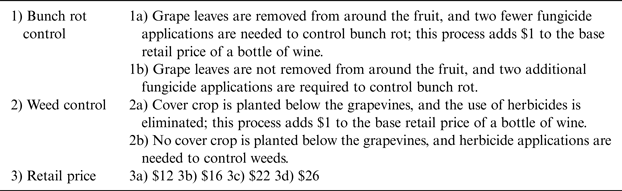
We investigated participants’ interest in purchasing 750mL glass bottles of wine depending on vineyard management practices and the final retail price. We chose four retail prices based on an informal investigation of prices that Pennsylvania wineries typically charge for standard bottles of wine ($12, $16, $22, and $26; see Table 1). Both vineyard management attributes were selected based on methods employed at commercial vineyards, with each attribute having two control options (levels). Bunch rot control levels included i) removing grapevine leaves from around the fruit to increase air circulation and potentially reduce, but not eliminate, the number of fungicide applications to control bunch rot and ii) no leaf removal but two additional fungicide applications to control the disease. Weed control levels included i) planting a cover crop below the grapevines to suppress weeds and ii) applying an herbicide below grapevines to control weeds.
Description of Wine Attributes

We employed conjoint analysis to present the individual attributes in combinations (Moskowitz and Moskowitz, Reference Moskowitz, Moskowitz, Beckley, Paredes and Lopetcharat2012). An orthogonal array using OrthoPlan resulted in eight nonrepeating combinations of bunch rot control, weed control, retail base price (the retail price plus an additional $1 added for combinations presented where labor would be needed to plant the cover crop below the grapevines and/or remove grapevine leaves from around the fruit), and two holdout cases. The outcome identified the order in which attributes were important to survey participants and which levels within each attribute were appealing.
After responding to demographic, psychographic, and behavioral questions, participants were asked to read two short statements. The first was about how bunch rot reduces the number of healthy grapes on a vine and how removing grapevine leaves from around the fruit can reduce the likelihood that the disease will occur and that two fewer fungicide applications will be needed. The second was about the use of herbicides under the grapevine trellis to control weeds and how soil left bare from herbicide use can erode and run off, whereas planting a cover crop under the grapevines may control weeds while reducing or eliminating herbicide use and soil erosion. When participants evaluated combinations that included leaf removal (to control bunch rot) and/or cover crop (to suppress weeds), they were informed that an addition $1 for each practice would be added to the retail base price to offset the additional labor needed to remove grapevine leaves to control bunch rot or for machinery and labor used to establish and maintain cover crops to control weeds. For example, if the base retail price were $12 and if leaves were removed to control bunch rot, an additional $1 would be added to the price of a bottle, resulting in a final retail price of $13. If leaves were removed and a cover crop were grown beneath the grapevines, then $2 ($1 for each labor-intensive treatment) would be added to the base retail price, resulting in a final retail price of $14. The decision to add $1 for each practice was made based on machinery and labor costs associated with planting cover crops and removing leaves at a vineyard located in the Finger Lakes Wine Region of New York (Yeh, Gómez, and White, Reference Yeh, Gómez and White2014).
After being informed of what a combination entailed (retail base price, weed control treatment, and bunch rot treatment), participants were asked to rate their likelihood of purchasing each option on a 7-point Likert scale (1 = very unlikely; 7 = very likely).
III. Data and Results
A. Conjoint Analysis Average Importance and Utilities
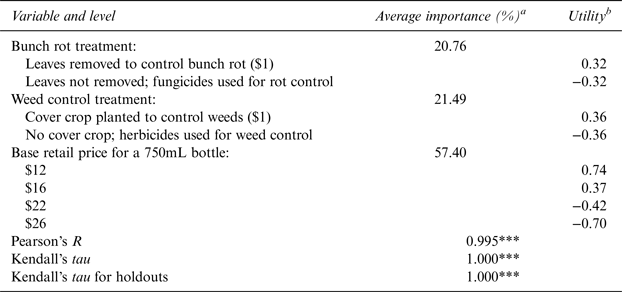
For the 604 useable responses, we regressed the wines’ purchase ratings on their attributes. Pearson's R-statistic, with a value of 0.995, was significant, with a P-value < 0.001 indicating a general agreement between the estimated utilities of the labels and the participants’ rankings (Table 2).
Conjoint Analysis Ratings for Scenarios Based on All Participants (n = 604)

a Higher average importance values indicate greater importance. b More positive utilities indicate more desirable levels. Significance level is ***(0.1%).
Conjoint analysis produces a utility for each attribute level, which “represents the relative ‘worth’ of the attribute” (Levy, Reference Levy1995, 35), with the utility values for all attribute levels equally zero (Orme, Reference Orme2010). Positive values are indicative of positive consumer preference, while negative values are less preferred. In addition, the importance of each attribute is calculated as a percentage, with the totals for all attributes adding up to 100 percent. These percentages indicate “how much difference each attribute could make in the total utility of a product” relative to the other attributes, with the ‘difference’ being “the attribute's utility values” (Orme, Reference Orme2010, 79). Each attribute's importance for each participant was calculated; it was then averaged and referred to as the average importance. The resulting average importance for our three attributes were retail base price (57.40%), weed control (21.49%), and bunch rot control (20.76%). With the average importance for retail base price being greater than for the other two attributes, retail base price was considered more important than either weed management strategy or bunch rot control to participants when rating the combinations (Table 2).
Within the retail price attribute, the two lowest retail base prices ($12 and $16) had positive utility values of 0.74 and 0.37, respectively, suggesting that consumers preferred these prices compared to the two higher base prices ($22 and $26), which had negative utilities.
Within the weed control attribute, the presence of a cover crop, with an additional $1 charged per 750mL bottle to cover labor and machinery costs, had a positive utility rating of 0.36, while the absence of a cover crop under the grapevine and weeds controlled with herbicides was not as favored by participants and had a –0.36 utility rating. Removing the leaves around the fruit to control bunch rot and adding $1 to cover labor costs had a positive utility rating of 0.32, but not removing leaves to control bunch rot and applying fungicide to control the disease had a negative utility rating of –0.32.
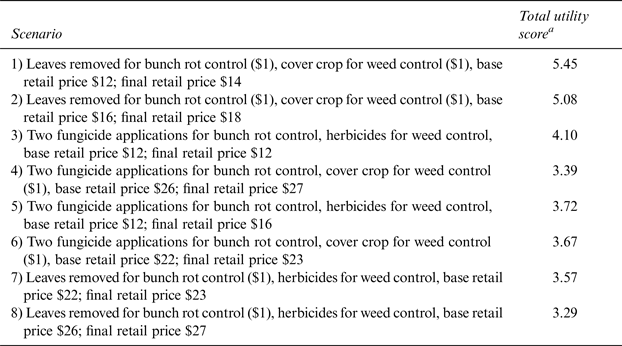
We calculated total utility scores for each scenario by adding the base utility generated by SPSS Conjoint Analysis and obtained from the output file, which was a constant of 4.03, to the corresponding utility estimates for each level (e.g., –0.32 for not removing leaves to control bunch rot, –0.36 for not planting a cover crop to control weeds, and 0.74 for a $12 retail value).
Based on these calculated scores, the scenario with the highest total utility (i.e., 5.45) was removing leaves to control bunch rot, planting a cover crop to control weeds, and charging a base retail price of $12, which resulted in a final retail price of $14 for this bottle (Table 3). The second-most-preferred scenario (total utility of 5.08) also included removing the leaves to control bunch rot and planting a cover crop to control weeds but had a slightly higher base retail price of $16 and a final retail price of $18. The third-most-preferred scenario (total utility of 4.10) included the leaf removal option and a base retail price of $12; however, instead of planting a cover crop under the grapevines, herbicides would need to be applied to control weeds.
Ranked Total Utility Scores for All Scenarios

Evaluated by all 604 survey participants based on level utility estimates generated by SPSS Conjoint Analysis.
a Calculation: Constant (4.03) + (bunch rot control utility estimate) + (cover crop utility estimate) + (base retail utility estimate).
B. Conjoint Analyses Based on Behavioral Segmentation
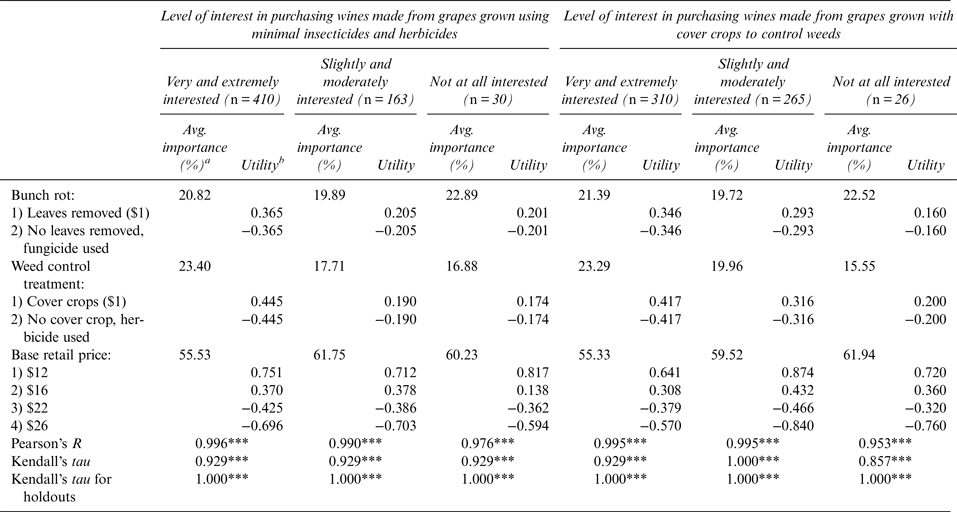
Ratings were segmented based on participants’ interest in purchasing wine grown with i) minimal pesticides (insecticides, herbicides, and/or fungicides) used in the vineyard and ii) cover crops used in the vineyard to control weeds and then subjected to conjoint analysis to determine whether averaged importance or utility differed based on participants’ levels of interest (not at all interested; slightly and somewhat interested; and very and extremely interested). Due to nonresponse, 603 respondent ratings were used in the conjoint analysis based on their level of interest in the growers’ use of minimal pesticides, and 601 respondent ratings were used in the analysis pertaining to their interest in the growers’ use of cover crops. The results are shown in Table 4.
Conjoint Analysis Ratings for Scenarios Based on Segmenting Survey Participants

Responses based on level of interest in minimal insecticides and herbicides used to grow grapes (n = 603) and cover crops to control weeds (n = 601). aHigher average importance values indicate greater importance. bMore positive utilities indicate more desirable levels. Significance level is ***(0.1%).
In both instances, the average importance for base retail price was greater for those who responded that they were “not at all interested” in the vineyard practices (60.23% for “minimal use of pesticides” and 61.94% for the “use of crop covers”) than participants who were “very” or “extremely interested” (55.53% and 55.33%, respectively) in these practices’ being implemented.
Within the price attribute, regardless of vineyard practices and participants’ levels of interest in the practice, the two lowest retail base prices ($12 and $16) had positive utility ratings, and the two highest prices ($22 and $26) had negative utility ratings. For the weed control and the bunch rot control attributes, regardless of participants’ levels of interest, removing the leaves around the fruit to control bunch rot and planting a cover crop to control weeds had positive utility ratings.
IV. Conclusions
Wine industry members should be aware of consumers’ interest in purchasing wines made from grapes grown using these practices, but they should also be aware that consumers’ purchasing decisions are greatly influenced by base retail prices. Although the average importance of weed control and bunch rot control methods was much lower than that of price, it is important to note that the “environmentally friendly” options (cover crops to suppress weeds and leaf removal to reduce bunch rot) had positive utility estimates, even though each would require a $1 surcharge to cover labor and machinery costs. Perhaps participants were not dissuaded by a modest price increase because they were made aware of the potential benefits that the two “sustainable” options would provide. Only the $12 and $16 retail base prices had positive utilities; however, the next-highest retail base price tested was $22. Thus, it is necessary to evaluate responses to base prices between $17 and $22 to determine whether any prices above $16 would receive positive utility estimates. Additionally, individual vineyard and winery owners should determine whether the $1 surcharge for each practice would be appropriate for their operations and how their customers would react to these price increases.
Our main finding—that consumers are willing to pay more for wine produced under environmentally friendly conditions, especially within the lower price bracket—should be interpreted with caution for three reasons noted below. Additional research is needed to more fully understand consumers’ demand for wines produced using environmentally friendly practices in the Mid-Atlantic region of the United States.
First, because leaf removal and cover crops exhibit similar effects on participants’ levels of interest, we cannot be certain that these effects actually correlate with the respective treatments. Other treatments may have resulted in similar effects. In fact, even fictitious nonsense treatments or “decoy treatments” (see, e.g., Costanigro and Lusk, Reference Costanigro and Lusk2014) may affect consumer valuation, as long as they are wrapped in a good story.
Second, it needs to be explored whether, in our nonsensory experimental context, sensory effects may have dominated extrinsic environmental attributes. For instance, when analyzing consumers’ willingness to pay (WTP) for wine, Schmit, Rickard, and Taber (Reference Schmit, Rickard and Taber2013) find that environmentally friendly practices increased demand and led to higher premiums only if consumers’ sensory expectations were met on quality.
Third, our results may not be robust with respect to changes in framing (i.e., whether the treatments are presented positively or negatively). For instance, when analyzing consumers’ WTP for food containing various ingredients, Liaukonyte et al. (Reference Liaukonyte, Streletskaya, Kaiser and Rickard2013) find significant differences between “Contains X” and “Free of X” labels.