Toddlers' emerging feelings of discomfort, unease, anxious arousal, or distress in the aftermath of transgressions or mishaps have been long seen as reflecting the ascent of important self-conscious emotions, a significant and adaptive landmark in normative socioemotional development and conscience development (Abe & Izard, Reference Abe and Izard1999; Barrett, Reference Barrett and Bybee1998; Baumeister, Stillwell, & Heatherton, Reference Baumeister, Stillwell and Heatherton1994; Dienstbier, Reference Dienstbier, Izard, Kagan and Zajonc1984; Hoffman, Reference Hoffman, Higgins, Ruble and Hartup1983; Kagan, Reference Kagan, Carlo and Edwards2005; Kagan & Lamb, Reference Kagan and Lamb1987; Kochanska, Reference Kochanska1993; Kochanska, Gross, Lin, & Nichols, Reference Kochanska, Gross, Lin and Nichols2002; Kochanska & Thompson, Reference Kochanska, Thompson, Grusec and Kuczynski1997; Lagattuta & Thompson, Reference Lagattuta, Thompson, Tracy, Robins and Tangney2007; Lewis, Sullivan, Stanger, & Weiss, Reference Lewis, Sullivan, Stanger and Weiss1989; Sears, Rau, & Alpert, Reference Sears, Rau and Alpert1965; Tangney & Fischer, Reference Tangney and Fischer1995; Thompson, in press; Tracy, Robins, & Tangney, Reference Tracy, Robins and Tangney2007; Zahn-Waxler & Kochanska, Reference Zahn-Waxler, Kochanska and Thompson1990). Callousness, the failure to experience such discomfort, concern, or remorse, or experiencing them in a relatively shallow way may be markers of an early risk for an antisocial developmental trajectory, given that a lack of guilt is a core symptom of future antisocial and externalizing disorders (Blair, Reference Blair2005; Blair, Peschardt, Budhani, Mitchell, & Pine, Reference Blair, Peschardt, Budhani, Mitchell and Pine2006; Cleckley, Reference Cleckley1982; Damasio, Reference Damasio1994, Reference Damasio1996; Damasio, Tranel, & Damasio, Reference Damasio, Tranel, Damasio, Levin and Eisenberg1991; Fowles & Dindo, Reference Fowles, Dindo and Patrick2006; Frick & Morris, Reference Frick and Morris2004; Frick et al., Reference Frick, Cornell, Bodin, Dane, Barry and Loney2003; Frick & White, Reference Frick and White2008; Lykken, Reference Lykken1995; Wakschlag, Tolan, & Leventhal, Reference Wakschlag, Tolan and Leventhal2010).
Although most developmental psychologists agree that the awareness of standards, self-conscious emotions, and the emotional response in the aftermath of transgressions that includes distress, tension, embarrassment, and concern about reparation emerge in the second year, very few studies have examined toddlers' responses to transgressions or mishaps in the laboratory, using observations in standard paradigms. Guilt and associated self-conscious emotions are difficult to study observationally because, in contrast to basic emotions, they lack a very clear expressive component, particularly in young children. Darwin (1872/Reference Darwin1965), when writing about guilt in a toddler, referred to gaze aversion, unnatural brightness, and an odd, affected manner, impossible to describe. Much still remains to be learned about those responses, and several issues are not yet settled.
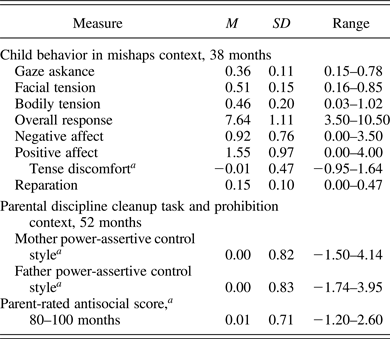
In pioneering studies, Barrett, Zahn, Waxler and Cole (Reference Barrett, Zahn-Waxler and Cole1993) and Cole, Barrett, and Zahn-Waxler (Reference Cole, Barrett and Zahn-Waxler1992), and then Barrett (Reference Barrett2005), coded toddlers' subtle emotional responses and attempts at reparation in carefully scripted mishap paradigms that led the child to believe he or she had broken or damaged an object. Those studies revealed that toddlers display negative emotion, frustration, distress, tension, worry, and concerned reparation following presumed transgressions. Barrett et al. (Reference Barrett, Zahn-Waxler and Cole1993) and Barrett (Reference Barrett2005) further suggested that, even at an early age, emotions of guilt, indexed by reparation, may be distinguished from emotions of shame or embarrassment, indexed by distress and avoidance. Although extensive research has confirmed such distinction in adults and older children, it remains controversial whether it can be reliably made in toddlers. Several researchers who have used mishaps modeled after that early work with larger samples of toddlers (Baker, Baibazarova, Ktistaki, Shelton, & van Goozens, Reference Baker, Baibazarova, Ktistaki, Shelton and van Goozen2012; Kochanska et al., Reference Kochanska, Gross, Lin and Nichols2002; Kochanska, Barry, Jimenez, Hollatz, & Woodard, Reference Kochanska, Barry, Jimenez, Hollatz and Woodard2009; Kochanska, Casey, & Fukumoto, Reference Kochanska, Casey and Fukumoto1995; Kochanska, Forman, & Coy, Reference Kochanska, Forman and Coy1999) have felt that such distinction may be premature. Those researchers have referred to posttransgression distress and arousal, or a blend of various emotions, or simply indicated that they were labeling such distress as “guilt.” Given the paucity of empirical data, in the current study we focus on capturing empirically, using microscopic codes and overall ratings, children's emotional and behavioral responses to transgressions, including gaze avoidance, several indices of distress, tension, concern, and attempts at reparation. We avoid inferring the underlying emotion, such as guilt, shame, embarrassment, remorse, regret, and self-reproach.
Over the course of early socialization, the emergence of posttransgression distress in the middle of the second year (Kagan, Reference Kagan1981; Kochanska et al., Reference Kochanska, Gross, Lin and Nichols2002; Lewis et al., Reference Lewis, Sullivan, Stanger and Weiss1989) dovetails synergistically with the onset of parental demands. Parents begin to ask toddlers to observe the family's rules and standards of behavior and to comply with daily requests and prohibitions. When children misbehave, parents often express displeasure, and children gradually begin to be aware of rules and behavioral standards and to feel uneasy and uncomfortable when they have violated them intentionally or accidentally. In turn, parents may then recruit and capitalize on those feelings to facilitate the child's internalization of their rules and demands and to prevent future transgressions without the need to rely on coercive discipline (Dienstbier, Hillman, Lehnhoff, Hillman, & Valkenaar, Reference Dienstbier, Hillman, Lehnhoff, Hillman and Valkenaar1975; Hoffman, Reference Hoffman, Higgins, Ruble and Hartup1983). The child's distress following transgressions is adaptive: over time, transgressions become “somatically marked.” The affective visceral memories of past wrongdoing activate unpleasant emotions and serve as effective internal regulators that inhibit future transgressions and, more broadly, prevent the child from embarking on a path to antisocial behavior problems (Damasio, Reference Damasio1996; Frick & Morris, Reference Frick and Morris2004; Frick & White, Reference Frick and White2008; Raine, Reference Raine2008).
Children vary substantially in how easily, how often, and how strongly they experience and express distress following misbehavior, in part because self-conscious emotions are linked to temperament (Baker et al., Reference Baker, Baibazarova, Ktistaki, Shelton and van Goozen2012; Kagan, Reference Kagan, Carlo and Edwards2005; Kagan & Fox, Reference Kagan, Fox, Damon, Lerner and Eisenberg2006; Kochanska et al., Reference Kochanska, Gross, Lin and Nichols2002; Rothbart, Ahadi, & Hershey, Reference Rothbart, Ahadi and Hershey1994; Rothbart & Bates, Reference Rothbart, Bates, Damon, Lerner and Eisenberg2006). Children not prone to discomfort and anxious arousal may appear relatively unconcerned in the aftermath of transgressions. Consequently, for parents of such children, it is more difficult to resort to subtle discipline strategies that capitalize on the child's spontaneous feelings of unease in the context of socialization demands. We have shown in past work that, to be effective, parents of such less reactive children should rely on alternative strategies that draw from mutual positive feelings and responsiveness between the parent and child (Kochanska, Reference Kochanska1995, Reference Kochanska1997). Some parents, however, may respond by deploying more power-assertive control, which in turn likely leads to the child's rejection of parental agenda, resentment, opposition, disregard for rules of conduct, and more broadly, antisocial behavior problems.
We have also shown that the quality of the early parent–child relationship is an important moderator of future socialization processes. In particular, the maladaptive developmental cascades from the child's difficulty to parental power assertion to children's antisocial outcomes are typically set in motion in parent–child dyads that had been insecurely attached in infancy. In secure dyads, such dynamics are defused (Kochanska, Barry, Stellern, O'Bleness, Reference Kochanska, Barry, Stellern and O'Bleness2009; Kochanska & Kim, Reference Kochanska and Kim2012).
The main goal of the current article is to examine the links between children's responses to transgressions at toddler age and future externalizing, antisocial, and disruptive behavior problems in the context of early parent–child relationships that vary in their quality. Based on the existing research, we expected that links between children's relatively low distress and future behavior problems would be present (or significantly stronger) in the context of suboptimal relationships but absent (or significantly weaker) in the context of optimal, positive relationships.
Data were drawn from two large longitudinal studies of normally developing young children. The Family Study involved mothers, fathers, and children from two-parent community families followed from infancy to age 8. The Play Study involved ethnically diverse, low-income mothers and toddlers followed from 30 to 40 months. In the Family Study, the quality of the parent–child relationship was indexed by security of attachment in infancy with the mother and the father. In the Play Study, it was indexed by maternal responsiveness to the child at age 2.5. Although we did not have data on children's security in the latter study, responsiveness is broadly viewed as a key parenting dimension that is typically considered a significant factor in the formation of secure attachment (DeWolff & van IJzendoorn, Reference DeWolff and van IJzendoorn1997). Thus, both parent–child security and parental responsiveness are legitimate measures of the quality of the early parent–child relationship.
The secondary goal in the Family Study was to examine the relations among children's responses to transgressions, parental control style, and children's antisocial behavior problems in the contexts of insecure and secure relationships. We expected that in insecure or more negative relationships, children who are relatively less affected by their transgressions may elicit stricter, more power-assertive parental control strategies aimed at preventing them from transgressing (Bates & Pettit, Reference Bates, Pettit, Grusec and Hastings2007; Bell, Reference Bell1968; Lytton, Reference Lytton1990; Shaw, Owens, Vondra, Keenan, & Winslow, Reference Shaw, Owens, Vondra, Keenan and Winslow1996). Such discipline may in turn increase the risk for future antisocial or disruptive behavior problems due to well-understood maladaptive processes that evolve in coercive relationships, including the child's anger and resentment toward the parent and his or her rejection of parental influence (Dodge, Coie, & Lynam, Reference Dodge, Coie, Lynam, Damon, Lerner and Eisenberg2006; Gershoff, Reference Gershoff2002; Grusec & Goodnow, Reference Grusec and Goodnow1994; McCord, Reference McCord1997; Pardini, Reference Pardini2008; Patterson, Reid, & Dishion, Reference Patterson, Reid and Dishion1992). We further expected such maladaptive developmental cascades to be weakened or defused in secure, positive relationships. Consequently, we tested a moderated mediation model that posited parental control style as a mediator of the links between children's distress and tension following transgressions and their antisocial problems, and early security as a moderator of such path.
The behavioral transgression paradigms and observational coding, developed and refined in our laboratory, were fully comparable across the two studies to allow for a rigorous replication of the findings. The codes captured toddlers' emotional and behavioral responses elicited in situations when they believed they had transgressed by breaking a valued object. The quality of the parent–child relationships was observed as the organization of attachment in infancy in the Strange Situation with each parent (secure vs. insecure) and as maternal responsiveness to the child in the Play Study. Parents' control style (in the Family Study only) was observed at preschool age in typical parent–child contexts that involved requests and prohibitions. Although generally parents used power-assertive techniques infrequently, they did vary in the amount of applied pressure. Children's antisocial behavior problems were rated by parents at 6½ and 8 years in the Family Study and at 40 months in the Play Study.
In both studies, the major emphasis was on behavioral measures, although established parental report instruments were also employed to assess externalizing or antisocial outcomes. Multiple teams of coders reached reliability typically on approximately 20% of cases, and they followed with frequent realignments to prevent drift. Kappas were used for discrete variables. For continuous variables, either alphas or intraclass correlations (ICCs) were used. Note that the best practices in that regard have varied over the last 10 years, when the data reported here were collected, but both approaches are essentially equivalent (Bravo & Potvin, Reference Bravo and Potvin1991; Shrout & Fleiss, Reference Shrout and Fleiss1979). We programmatically deployed extensive data aggregation strategies whenever appropriate to create robust constructs (Rushton, Brainerd, & Pressley, Reference Rushton, Brainerd and Pressley1983).
Family Study
Method
Participants
Two-parent families (N = 102) volunteered for a longitudinal study by responding to ads posted broadly in community venues in eastern Iowa. When the study began, the families represented a wide range of education attainment (25% of mothers and 30% of fathers having no more than a high school education, and 21% of mothers and 20% of father having postgraduate education) and annual income (25% made less than $40,000, and 49% made over $60,000). Ninety percent of mothers and 84% of fathers were White, 3% of mothers and 8% of fathers were Hispanic, 2% of mothers and 3% of fathers were African American, 1% of mothers and 3% of fathers were Asian, 1% of mothers were Pacific Islander, and 3% of mothers and 2% of fathers were other non-White. In 20% of families, one or both parents were non-White.
This article draws from the assessments at 15 months (N = 101, 51 girls), at 38 months (N = 100, 50 girls), at 52 months (N = 99, 49 girls), at 80 months (N = 90, 43 girls), and at 100 months (N = 87, 41 girls). At 15, 52, and 80 months, female visit coordinators conducted two 2- to 3-hr laboratory sessions, one with each parent (in randomized order). At 38 months, there was one home and one laboratory session, with each parent participating in half of each, and at 100 months, there was only one laboratory session (only questionnaire data collected at 100 months are reported here). The sessions were videotaped for future coding. The laboratory includes two rooms, a naturalistic living room that contains, among other furnishings, a low shelf with extremely attractive toys, designated as off limits to the child (the parent issued the prohibition upon entry to the room), and a sparsely furnished play room.
Assessment of children's early parent–child relationships: Attachment security to mothers and fathers at 15 months
Paradigm and coding
The Strange Situation (Ainsworth & Wittig, Reference Ainsworth, Wittig and Foss1969) was conducted as the first procedure with each parent and coded by professional coders at another university (one coder coded a given child with one parent only). Reliability κs were 0.78 for the four main attachment categories (avoidant, secure, resistant, and disorganized or unclassifiable) and 0.85 for the coding of secure versus insecure attachment. All cases coded with low confidence by one coder and all disorganized or unclassifiable cases were double-coded and adjudicated. In this article, we focus on comparisons between secure children and the combined group of insecure children (avoidant, resistant, and disorganized or unclassifiable).
Attachment security with mothers and fathers
Fifty-six children (55%) were rated as secure with mothers, and 45 (45%) were rated as insecure. Sixty-six children (66%) were rated as secure with fathers and 34 (34%) were rated as insecure. (One child did not participate in the father–child paradigm.) Forty children were secure with both parents, 18 were insecure with both parents, 26 were insecure with the mother and secure with the father, and 16 were secure with the mother and insecure with the father.
There were no significant differences in the distribution of security versus insecurity with mothers in girls and boys, Pearson χ2 (1) = 2.22, ns, or fathers, Pearson χ2 (1) < 1. The security status with the mother was unrelated to that with the father, Pearson χ2 (1) = 1.67, ns. There were no effects of the order of the session (mother or father first) on security with the mother or the father; both Pearson χ2 (1) values < 1.
Assessment of children's responses following transgressions (the mishaps context), 38 months
Paradigms
The paradigms were described earlier (Kochanska et al., Reference Kochanska, Gross, Lin and Nichols2002; Kochanska, Barry, Jimenez, et al., Reference Kochanska, Barry, Jimenez, Hollatz and Woodard2009). Children were observed in two highly scripted, contrived “mishaps,” one during each half of the laboratory session (with each parent). The female visit coordinator handed a toy to the child and asked him or her “to be very careful” while handling it, because it was her “special” toy (a toy boat and a musical toy were used). Soon after the child touched the object, it fell apart in a salient manner. At that point, the female visit coordinator expressed mild regret by saying, “Oh, my (name of object),” sat quietly for 60 s, and then asked several standard questions, such as “what happened” and “who did it” (~60 s). The female visit coordinator then left the room for 30 s to “fix” the object, returned with an undamaged exact replica, and reassured the child that the damage had not been the child's fault, until he or she was fully comfortable. The coding began at the point of the mishap and continued for up to 60 s after the female visit coordinator returned with the “fixed” object. The parent was seated in the corner of the room and had been asked to remain neutral and engaged with questionnaires.
Coding and data aggregation
Several child emotion and behavior codes were applied to every 5-s segment. Those included gaze downward or askance (included covering face, eyes closed; reliability αs = 0.99–1.00); facial tension (e.g., biting lips, moving lips in an odd manner, grimacing; αs = 0.97–0.98); and bodily tension (e.g., squirming, twisting or shrinking body, hunching shoulders, rubbing hands, hanging down head), ranging from 0 (none), to 2 (multiple and/or strong signs of tension, κs = 0.69–0.87). Reparation attempts (e.g., trying to put back the broken object αs = 0.99–.1.00) were also coded for each 5-s segment prior to the female visit coordinator's departure to fix the object.
Several codes were applied to the entire longer “epochs” within the paradigm (60 s after the mishap, 60 s during the female visit coordinator's queries, 30 s during the female visit coordinator's absence to fix the toy, and 60 s after the female visit coordinator's return with the fixed object). For each of the first three epochs, overall response was coded (1 = unaffected, oblivious; 2 = notices mishap, briefly affected; 3 = affected, stilling, appears uneasy and concerned; 4 = strongly affected, uneasy; reliability κs = 0.68–0.76). For each of the four epochs, if present, negative and positive affect were also coded κs = 0.64–0.69 (neutral affect was also coded but not used here).
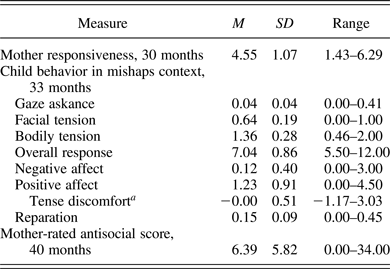
The instances of all 5-s codes were tallied and divided by the numbers of segments (gaze askance was weighted by 2 if it lasted throughout the segment). The overall response codes and affect codes were added across the coded epochs (strong affect was weighted by 2). Each of the above scores was then averaged across the two mishaps to represent the entire coded mishaps context. The descriptive statistics for those variables (prior to standardization) are in Table 1.
Family Study: Descriptive data

aA composite of constituent standardized scores.
Finally, we created an overall score of tense discomfort that included gaze askance, facial tension, bodily tension, overall response, and negative and positive affect scores (following the reversal of positive affect scores and standardization of all scores). The Cronbach α was 0.71. Reparation, the relative score of attempts to repair the object, was kept separate (see Table 1).
Assessment of parents' control style in discipline contexts, 52 months
The observed contexts
The child was observed with each parent during several naturalistic but scripted control contexts that occasioned parental interventions. One context (10 min with each parent) involved a cleanup task, when the parent asked the child to clean up many small toys and pieces of the craft project they had just completed. The prohibition contexts revolved around the very attractive, off-limits toys (cumulative time 65 min for each parent). Data were available for 98 mother–child and 98 father–child dyads.
Coding and data aggregation
The parent's style of control was coded for every 30-s segment throughout the cleanup and for every 30-s segment during the episodes when the child was involved with the prohibited toys (the onsets and offsets of those episodes had been first identified by separate teams of coders; coding reliability αs = 0.83–0.94). The codes used to create the measure of control style included the global ratings for each segment and the coding of physical techniques in each segment. The mutually exclusive global ratings included “no interaction,” “social exchange” (but no attempt to control), “gentle guidance” (subtle, gentle control), “assertive control” (matter-of-fact, somewhat assertive, decisive control), and “forceful, negative control” (control delivered with an angry, threatening, combative, negative tone). Kappas ranged from 0.60 to 0.76. The physical codes (both codeable in one segment) included “assertive interventions” (holding the child's hand firmly, physically preventing the child from touching the toys), and “forceful interventions” (taking away a toy abruptly, handling the child roughly). Kappas ranged from 0.68 to 0.83.
For each parent, we tallied all instances of each global and physical code and divided by the number of segments. The descriptive data were as follows. In the cleanup task, for mothers, no interaction, M = 0.01, SD = 0.03; social exchange, M = 0.08, SD = 0.11; gentle guidance, M = 0.77, SD = 0.23; assertive control, M = 0.14, SD = 0.19; forceful, negative control, M = 0.01, SD = 0.04; physical assertive, M = 0.01, SD = 0.04; physical forceful, not observed; for fathers, no interaction, M = 0.02, SD = 0.06; social exchange, M = 0.07, SD = 0.12; gentle guidance, M = 0.74, SD = 0.25; assertive control, M = 0.16, SD = 0.19; forceful, negative control, M = 0.01, SD = 0.04; physical assertive, M = 0.01, SD = 0.06, physical forceful, M = .00, SD = .02.
In the prohibition context, for mothers, no interaction, M = 0.14, SD = 0.13, social exchange; M = 0.65, SD = 0.17; gentle guidance, M = 0.16, SD = 0.10; assertive control, M = 0.05, SD = 0.08; forceful, negative control, M = 0.00, SD = 0.01; physical assertive, M = 0.01, SD = 0.04; physical forceful, not observed; for fathers, no interaction, M = 0.18, SD = 0.14; social exchange, M = 0.63, SD = 0.18; gentle guidance, M = 0.13, SD = 0.09; assertive control, M = 0.04, SD = 0.08; forceful, negative control, M = 0.00, SD = 0.01; physical assertive, M = 0.01, SD = 0.03, physical forceful, M = 0.00, SD = 0.00.
We then weighed those scores to reflect the amount of applied pressure (Kochanska, Aksan, Penney, & Boldt, Reference Kochanska, Aksan, Penney and Boldt2007). Weights were as follows: –2 for no interaction, –1 for social exchange, 1 for gentle guidance, 2 for control, 3 for forceful negative control, 4 for physical assertive, and 5 for physical forceful, 5. We then summed the weighed scores; for the cleanup task, mothers, M = 1.01, SD = 0.40, fathers, M = 1.05, SD = 0.60, and for the prohibition context, mothers, M = −0.61, SD = 0.50, fathers, M = −0.74, SD = 0.49. Finally, we standardized the scores and averaged them across the cleanup task and the prohibition context for each parent. Although parental pressure was low in general, this final score was normally distributed (see Table 1).
Assessment of children's antisocial behavior, 80 and 100 months
Inventory of Callous–Unemotional Traits (ICU)
The ICU (Frick, Reference Frick2004; Frick & White, Reference Frick and White2008) captures a lack of concern for others and disregard for rules and standards of behavior (e.g., “does not seem to know right from wrong,” “seems very cold and uncaring,” “does not care if s/he is in trouble,” “feelings of others are unimportant”). Mothers and fathers completed the ICU at 80 and 100 months, and the Cronbach αs were 0.86 and 0.80 for mothers and 0.82 and 0.84 for fathers, respectively. We averaged across all 24 items (each ranging from 0 = not at all, to 3 = definitely true), to create one score for each parent at each time; at 80 months, mothers, M = 0.78, SD = 0.34; fathers, M = 0.77, SD = 0.28, and at 100 months, mothers, M = 0.71, SD = 0.30; fathers, M = 0.75, SD = 0.29.
Child Symptom Inventory—4 (CSI-4)
The CSI-4 (Gadow & Sprafkin, Reference Gadow and Sprafkin2002; Gadow, Sprafkin, & Nolan, Reference Gadow, Sprafkin and Nolan2001; Sprafkin, Gadow, Salisbury, Schneider, & Loney, Reference Sprafkin, Gadow, Salisbury, Schneider and Loney2002) is an established clinical instrument that corresponds to DSM-IV. For both parents, we used symptom severity scoring, where each item is rated from 0 = never to 3 = very often. For each parent, we created the externalizing behavior score, which was the sum of 8 items for oppositional defiant disorder (e.g., defies, refuses, deliberately annoys) and 15 items for conduct disorder (e.g., bullies others, lies). At 80 months, mothers, M = 8.00, SD = 4.47; fathers, M = 7.23, SD = 4.42; and at 100 months, mothers, M = 6.67, SD = 4.25; fathers, M = 6.26, SD = 3.68.
Overall antisocial behavior scores, 80–100 months
We created an overall composite score across both parents, both scores (ICU and CSI-4 externalizing score), and both times of assessment (all scores were first standardized). N's for the instruments ranged from 82 (fathers at 100 months) to 88 (mothers at 80 months), to 90 for the overall final composite score. The Cronbach α was 0.86, indicating that such score was highly internally consistent; the item-total correlations ranged from .52 to .67, and there was no item whose removal would increase the alpha (see Lengua, Bush, Long, Kovacs, & Trancik, Reference Lengua, Bush, Long, Kovacs and Trancik2008, for a review of the benefits of such approach). The data are in Table 1.
Results and discussion
Preliminary analyses
Correlations among the variables, presented in Table 2, indicated that tense discomfort and reparation were negatively related. Reparation was unrelated to any other variables. Children who showed less tense discomfort at 38 months received more power-assertive control from both parents at 52 months. Both parents' use of power assertion was related to more antisocial behavior in children from age 6.5 to 8. Mothers' and fathers' power assertion scores were positively related.
Family Study: Correlations among children's tense discomfort and reparation at 38 months, maternal and paternal power asseration at 52 months, and children's antisocial behavior at 80–100 months
**p < .025. ***p < .01. ****p < .001.
Analyses of variance were conducted for children's tense discomfort and reparation as the dependent variables. Children's security with each parent (0 = insecure, 1 = secure) and child gender (0 = girl, 1 = boy) were the between-subject factors. For tense discomfort, there were two main effects, of security, F (1, 91) = 7.09, p < .01, and child gender, F (1, 91) = 8.15, p < .01. Children who had been insecure with their mothers at 15 months showed more tense discomfort, M = 0.11, SD = 0.53, than those who had been secure, M = –0.10, SD = 0.40, and girls expressed more tense discomfort than boys, girls, M = 0.12, SD = 0.49, boys, M = –0.13, SD = 0.42. There were no significant effects for reparation.
Analyses of variance were also conducted for the mothers' and fathers' power assertion, with the child's security with the respective parent and child gender as the between-subject factors. There was no effect of security on either parent's power assertion. There was a significant effect of gender, F (1, 94) = 4.10, p < .05, for maternal power-assertive style, with girls receiving less power than boys, M = –0.18, SD = 0.56, and M = 0.17, SD = 0.98, respectively. There were no significant findings for the father's power assertion.
Children's security at 15 months as a moderator of links between children's tense discomfort and reparation at 38 months and antisocial behavior at 80–100 months
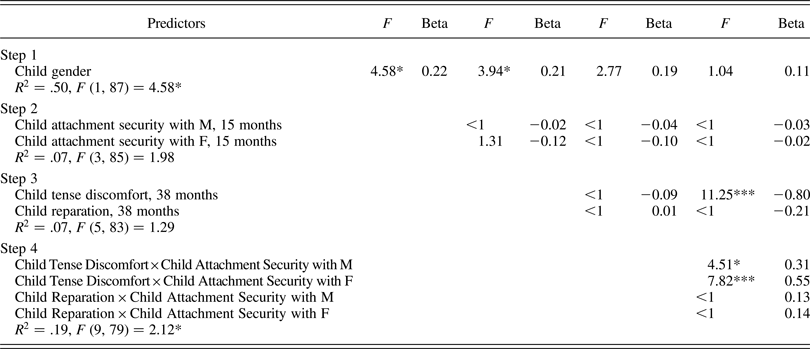
A hierarchical multiple regression was conducted to examine children's security with their mothers and their fathers as the moderators of the links between tense discomfort and reparation and antisocial behavior. Child gender (the covariate) was entered at Step 1, security with the mother and security with the father at Step 2, child tense discomfort and reparation at Step 3, and the four interaction terms (Tense Discomfort × Attachment Security with each parent and Reparation × Attachment Security with each parent) at Step 4. Table 3 presents the results of the hierarchical multiple regressions.
Family Study: Infants' attachment to mothers and to fathers and their tense discomfort and reparation at toddler age as predictors of antisocial behavior problems at 6.5–8 years
Note: Predictors were entered as follows: at Step 1, child gender (0 = girl, 1 = boy); at Step 2, security with mother and security with father (0 = insecure, 1 = secure); at Step 3, child tense discomfort and reparation; and at Step 4, four interaction terms: Child Tense Discomfort × Attachment Security with mother, Child Tense Discomfort × Attachment Security with father, Child Reparation × Attachment Security with mother, and Child Reparation × Attachment Security with father. M, mother; F, father.
*p < .05. ***p < .01.
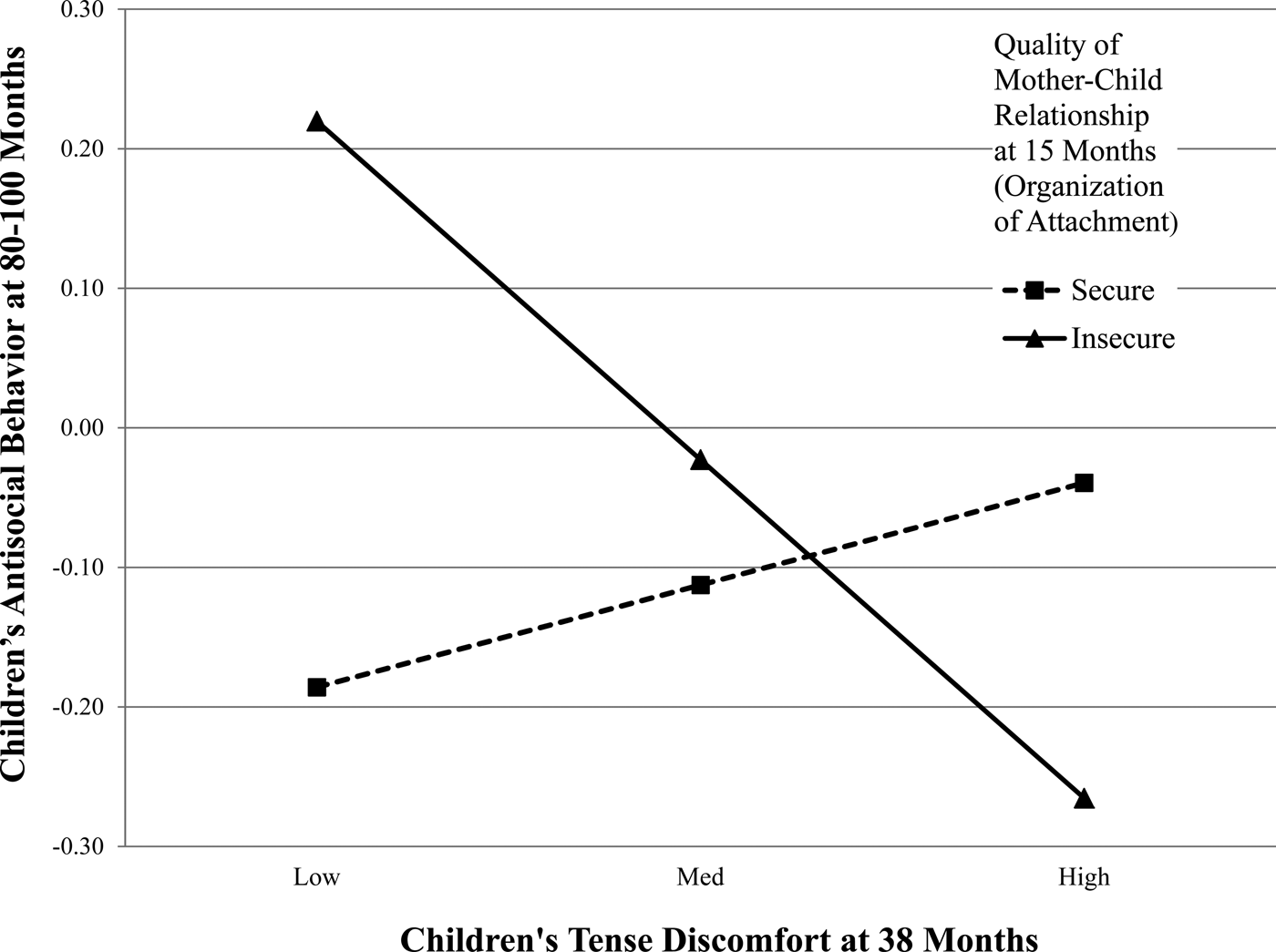
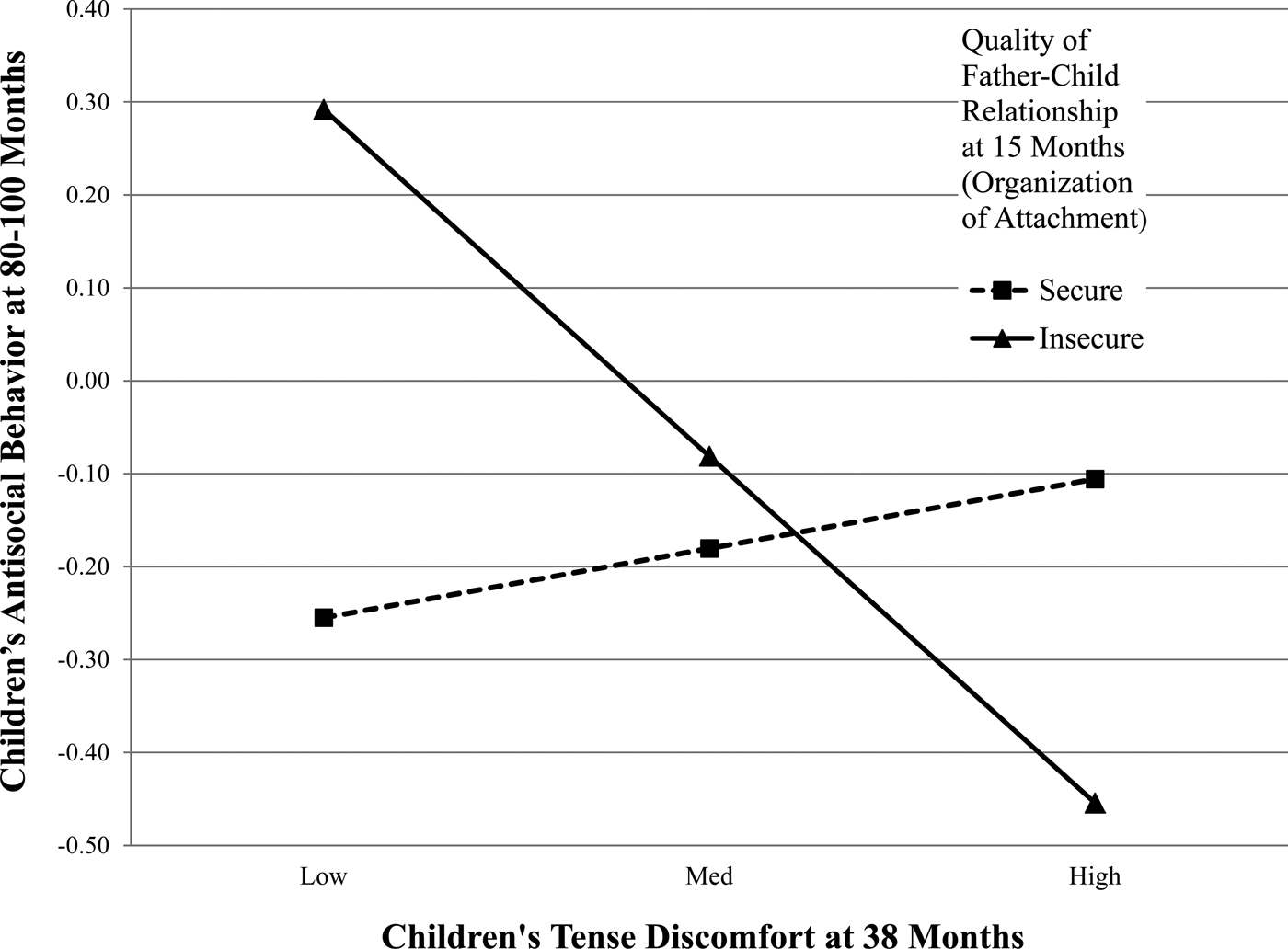
Security with either parent had no main effect on the child's antisocial behavior. Tense discomfort predicted (negatively) children's future antisocial behavior problems. That effect, however, was qualified by two significant interactions: Tense Discomfort × Security with the mother and Tense Discomfort × Security with the father. There were no significant findings for reparation. Figure 1 and Figure 2 present the follow-up analyses of the interactions, using simple slopes (Aiken & West, Reference Aiken and West1991). In those figures, tense discomfort is considered the independent variable, and security with the mother (Figure 1) and with the father (Figure 2) are the moderators (with child gender as the covariate).
In the Family Study the quality of the mother–child relationship at 15 months (security of attachment) moderates the link between children's tense discomfort at 38 months and antisocial behavior at 80–100 months. Although not depicted, children's gender was a covariate. The solid line represents the significant simple slope, and the dashed line represents the nonsignificant simple slope.
In the Family Study the quality of the father–child relationship at 15 months (security of attachment) moderates the link between children's tense discomfort at 38 months and antisocial behavior at 80–100 months. Although not depicted, the children's gender was a covariate. The solid line represents the significant simple slope, and the dashed line represents the nonsignificant simple slope.
In Figure 1, the simple slope of children's tense discomfort on their antisocial behavior for children who had been insecure with their mothers was significant (b = –0.50, SE = 0.23, p < .05), but for those who had been secure it was not significant (b = 0.15, SE = 0.25, ns). Thus, the variation in children's tense discomfort was associated with future antisocial behavior only for children who had failed to form a secure relationship with their mothers in infancy. In insecure relationships, children's lower tense discomfort was associated with higher antisocial scores. Such association was absent for children who had been secure.
The pattern was much the same in Figure 2. The simple slope of children's tense discomfort on their antisocial behavior was significant for children who had been insecure with their fathers (b = –0.82, SE = 0.32, p < .025), but for those who had been secure it was not significant (b = 0.16, SE = 0.20, ns). Again the variation in children's tense discomfort was linked with future antisocial scores only in insecure relationships, where children who displayed less discomfort had higher antisocial scores. There was no such link in secure relationships.
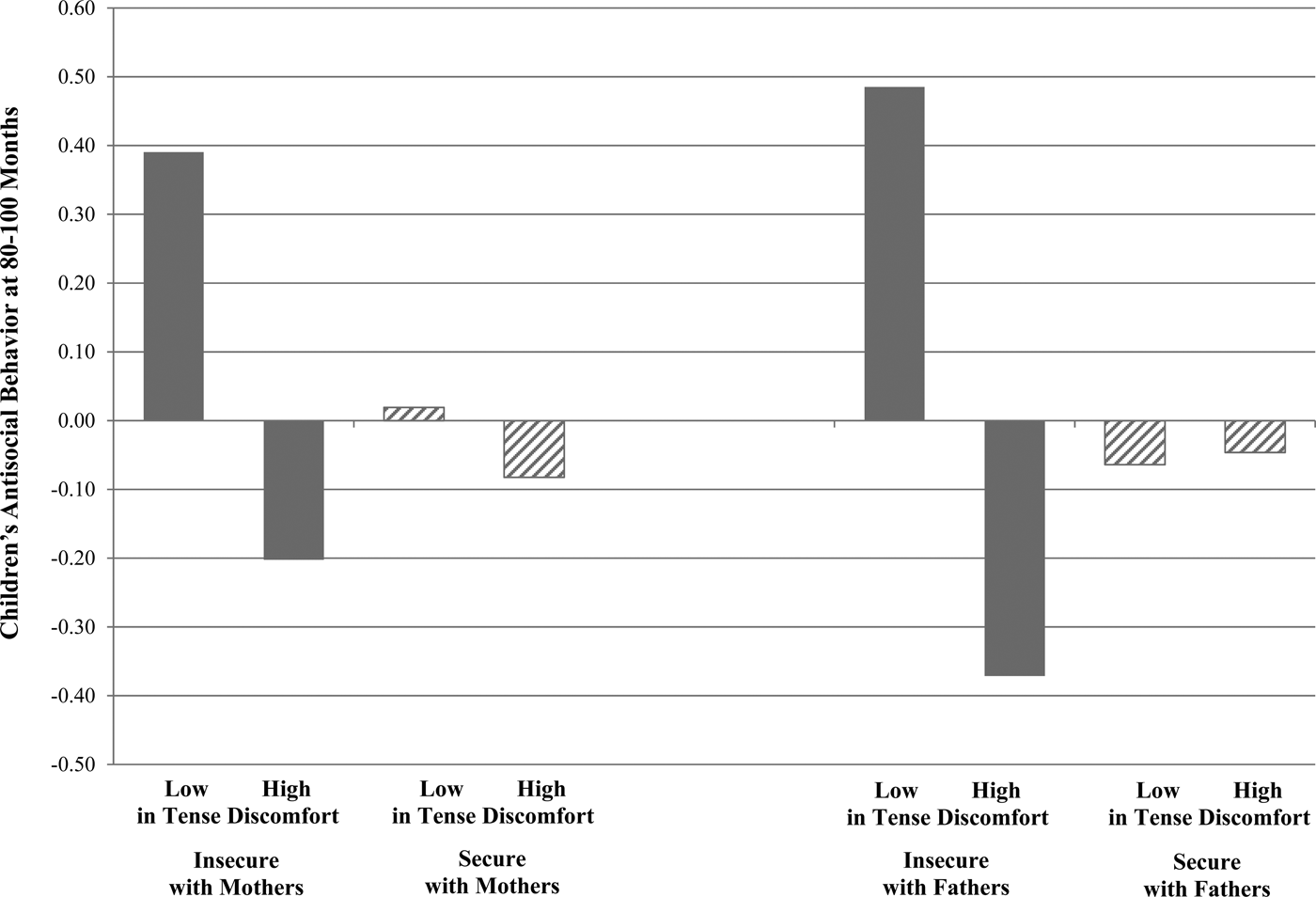
For purely illustrative purposes, we graphed the antisocial behavior scores for insecure and secure children who were low and high on tense discomfort (based on the median score) for the observed rather than estimated values. Figure 3 presents the data.
The Family Study: the observed means of children's antisocial behavior at 80–100 months in mother–child and father–child dyads (insecure and secure at 15 months) for children with low and high tense-discomfort scores at 38 months.
The Tukey test for multiple group comparisons revealed that in mother–child relationships, the insecure–low discomfort group had higher antisocial behavior scores than the insecure–high discomfort group (p < .05). In father–child relationships, the insecure–low discomfort group had higher antisocial behavior scores than the insecure–high discomfort group (p < .01), and higher antisocial scores than both secure groups (ps < .05). The insecure–high discomfort group did not differ from the secure groups in either mother– or father–child relationships.
Parental power assertion as a mediator of links between children's tense discomfort and reparation and antisocial behavior: Moderated mediation analyses
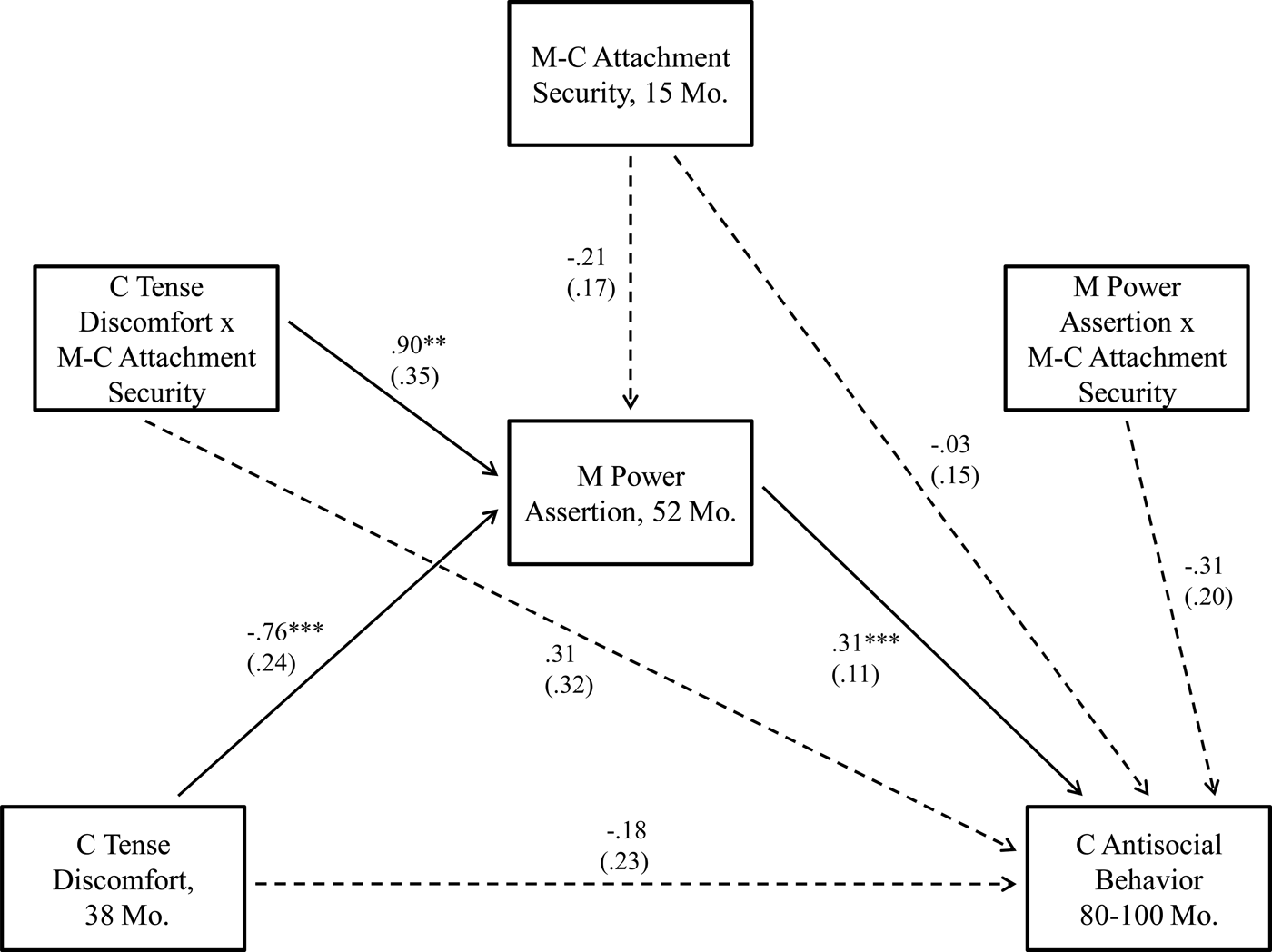
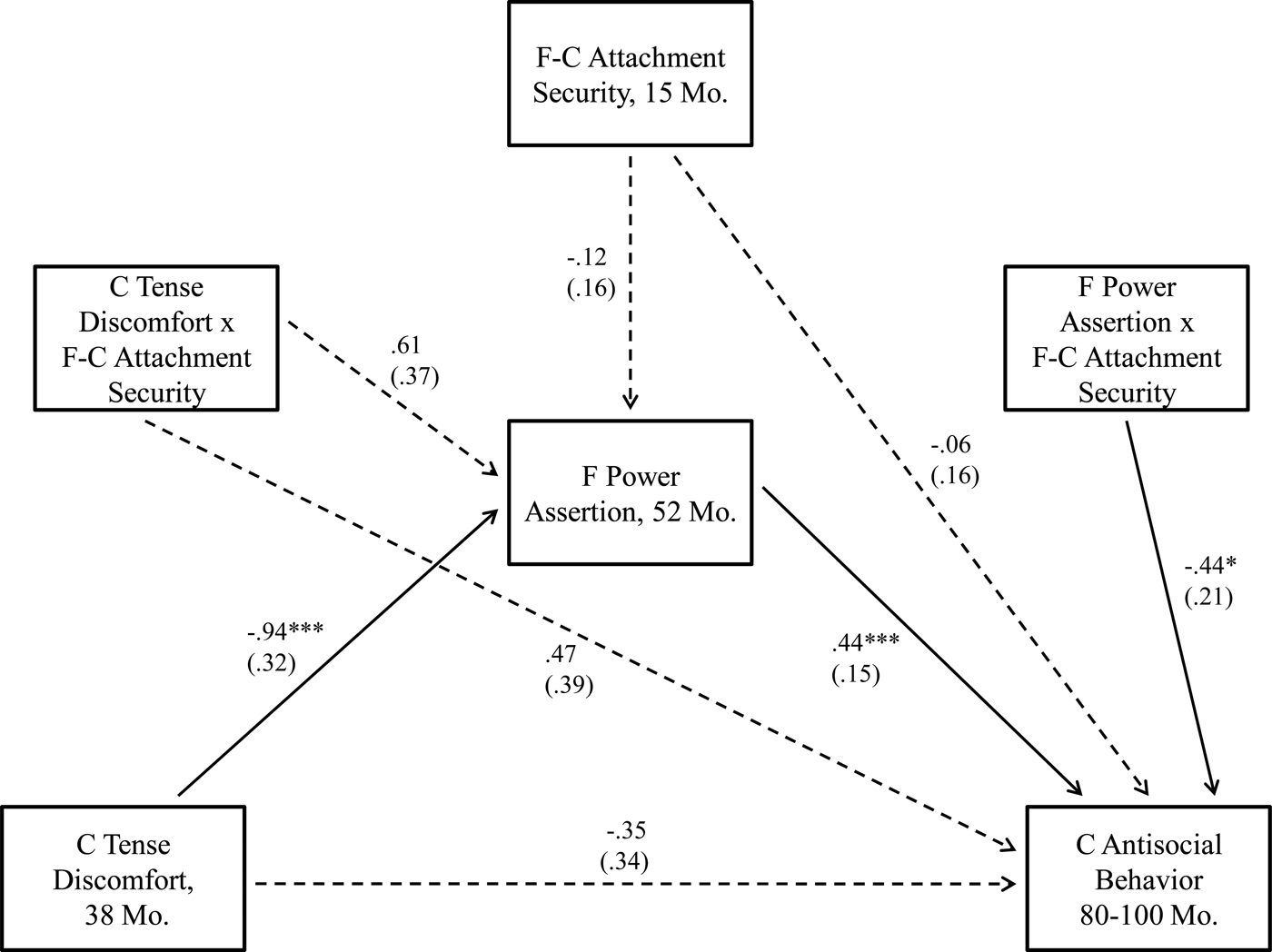
We adopted Preacher, Rucker, and Hayes' (Reference Preacher, Rucker and Hayes2007) approach to the testing of moderated mediation models. In these models, children's tense discomfort at 38 months was again treated as the predictor, parent–child attachment security at 15 months as the moderator, and children's antisocial behavior at 80–100 months as the dependent variable. In addition, we considered parents' power assertion at 52 months as the putative mediator of the link between tense discomfort and antisocial behavior, and we estimated different indirect effects of tense discomfort on antisocial behavior, depending on the level of the moderator (security). In particular, the parent–child attachment security (moderator) was modeled to moderate both the effect of tense discomfort on power assertion and the effect of power assertion on antisocial behavior simultaneously. The results of the moderated mediation models are presented in Figure 4 for mother–child relationship and in Figure 5 for father–child relationship. Child gender was included as a covariate in both models, but not depicted for brevity.
The Family Study: the moderated mediation model predicting mothers' power assertion at 52 months as the mediator and children's antisocial behavior at 80–100 months as the dependent variable, with children's tense discomfort at 38 months as the predictor and mother–child attachment security at 15 months as the moderator. Although not depicted, children's gender was a covariate. Solid lines represent significant effects, and dashed lines represent nonsignificant effects. M, Mother; C, child. **p < .025, ***p < .01.
The Family Study: the moderated mediation model predicting fathers' power assertion at 52 months as the mediator and children's antisocial behavior at 80–100 months as the dependent variable, with children's tense discomfort at 38 months as the predictor and father–child attachment security at 15 months as the moderator. Although not depicted, children's gender was a covariate. Solid lines represent significant effects, and dashed lines represent nonsignificant effects. F, Father; C, child. *p < .05, ***p < .01.
In mother–child relationships (Figure 4), children's lower tense discomfort was associated with mothers' increased power assertion; mothers' higher power assertion, in turn, was associated with children's higher antisocial behavior scores. The interaction between children's tense discomfort and mother–child attachment security was significant such that the effect of tense discomfort on power assertion was significant in insecure mother–child relationships, but not in secure relationships.
Children's tense discomfort had no direct effect on their antisocial behavior. In insecure relationships only, however, discomfort had a significant indirect effect on antisocial behavior through the mother's power assertion (b = –0.24, SE = 0.12, p < .05). The bootstrapping analysis confirmed the significant conditional indirect effect: bias-corrected and accelerated bootstrap confidence interval (–0.92, –0.02) did not include zero at the α = –0.05 level. In secure mother–child relationships, the conditional indirect effect was not significant (b = –0.0003, SE = 0.05, ns, 95% CI = –0.14, 0.09).
The pattern of the moderated mediation was similar for father–child relationships (Figure 5). Children's lower tense discomfort was associated with fathers' increased use of power assertion, and it, in turn, was associated with children's higher antisocial behavior scores. The interaction between fathers' power assertion and father–child attachment security was significant: the effect of power assertion on antisocial behavior was significant in insecure father–child relationships, but it was not significant in secure relationships.
Children's tense discomfort had no direct effect on their antisocial behavior, but, as in mother–child relationships, it had a significant indirect effect on antisocial behavior through the father's power assertion. This, however, occurred only in insecure relationships (b = –0.42, SE = 0.21, p < .05). The bias-corrected and accelerated bootstrap confidence interval for the indirect effect (–1.58, –0.03) did not include zero at the α = 0.05 level. The conditional indirect effect was not significant in secure father–child relationships (b = 0.003, SE = 0.05, ns, 95% CI = –0.14, 0.11).
We conducted the parallel analyses replacing children's tense discomfort with reparation. There were no significant effects.
Summary and discussion
Children's tense discomfort in the aftermath of transgressions and their efforts to repair the broken objects were modestly negatively related. All significant effects were associated with tense discomfort, and there were no findings for reparation. There was one main effect of security on tense discomfort: Toddlers who as infants had been insecure with their mothers displayed more tense discomfort when they believed they had transgressed than did those who had been secure. Because almost nothing is known about links between attachment security and self-conscious emotions, this finding is valuable in and of itself.
There was compelling evidence that the quality of the early parent–child relationship, reflected in secure attachment, moderated future links between children's tense discomfort at toddler age and their antisocial behavior problems at early school age. It is notable that the pattern was replicated across mother–child and father–child relationships, even though the quality of attachment organization with the mother was unrelated to that with the father. The links between discomfort following transgressions at toddler age and future antisocial behavior problems during early school years were found only for children whose early attachment relationships were insecure. In those relationships, differences in children's response to transgressions significantly predicted future behavior problems. Among the insecure toddlers, those who appeared relatively less affected by and more indifferent to their apparent mishaps were seen as more oppositional, callous, aggressive, and more likely to disregard rules at early school age than the toddlers who appeared relatively remorseful and distressed following the mishaps. For toddlers who had been secure with their parent, such a link was absent. It was further developmentally meaningful that, in terms of observed rather than predicted scores, the groups of insecure children who did show relatively high tense distress were nevertheless not significantly better off in terms of their outcomes than any secure groups.
As proposed earlier, parents are often able to capitalize on the child's spontaneous concerned response following transgressions: when the child is already mildly negatively aroused, the parent may not need to resort to salient external disciplinary contingencies to promote rules and standards of behavior (Dienstbier, Reference Dienstbier, Izard, Kagan and Zajonc1984). Conversely, children who are relatively unconcerned may elicit more parental pressure. The moderated mediation analyses suggest that the broadly accepted models depicting some children as “pulling” for relatively stronger parenting pressure and, ultimately, embarking on an antisocial trajectory (Bell, Reference Bell1968; Lipscomb et al., Reference Lipscomb, Leve, Harold, Neiderhiser, Shaw and Ge2011; Lorber & Egeland, Reference Lorber and Egeland2011; Lytton, Reference Lytton1990; Patterson et al., Reference Patterson, Reid and Dishion1992; Pardini, Reference Pardini2008) may apply particularly to parent–child dyads that have failed to form a secure attachment in infancy. Early insecurity with the mother or the father may be a context in which such dynamic is likely to emerge, but there was no evidence of a similar process in secure dyads.
As a note of caution, in those community families, power assertion was infrequent and children's externalizing scores were generally within the normative range. Nevertheless, the expected patterns of relations were detected. Research with at-risk samples, where parents resort to power-assertive techniques frequently and where children often have elevated behavior problem scores, may provide much more robust support for the proposed model.
Play Study
Method
Participants
Mothers of young children volunteered for another study broadly advertised in the same community as the Family Study. In particular, locations frequented by low-income families (e.g., Women, Infants, and Children nutritional program offices; local Department of Health and Human Services offices; thrift stores; free medical clinics; pediatric offices; Head Start locations; mobile home parks; subsidized housing complexes) were targeted. To be eligible, the mother had to receive or qualify for some form of aid from a federal, state, or faith-based agency, or for Earned Income Tax Credit.
One hundred eighty-six mothers of toddler-age children (90 girls) were accepted. The average annual family income was $20,385 (SD = $13,010); 5% of mothers had not completed high school, 50% had a high school education or GED, and 45% had an associate, bachelor's, or technical degree. Mothers' average age was 27.58 years (SD = 4.88). The sample was ethnically diverse (11% Hispanic and 88% not Hispanic; 73% White, 15% African American, 2% Asian, 2% American Indian, and 8% more than one race or unreported).
The assessments took place when children were approximately 30, 33, and 40 months (M = 30.33 months, SD = 5.40; M = 33.34 months, SD = 5.48; and M = 39.98 months, SD = 5.56, respectively). After the first assessment, at 30 months, the mothers were randomized into two groups that received different forms of parenting interventions for approximately 10 weeks (child-oriented play vs. play as usual). There were no group differences in any variables reported in this article that were collected after the randomization attributable to the intervention. Thus, the groups were combined. At each assessment, mothers and children were observed in approximately 3-hr sessions in the laboratory, similar to that described in the Family Study, conducted by female visit coordinators. The sessions were videotaped for future coding.
Assessment of children's early mother–child relationship: Mothers' responsiveness to their children at 30 months
Paradigms
Mothers' responsiveness to their children was observed in naturalistic yet scripted contexts during the laboratory sessions, typical for daily situations in toddlers' lives. There were seven contexts encompassing a total of 62 min (introduction to the laboratory, mother busy, snack, play, chores, free time, and opening a gift).
Coding and data aggregation
The approach was adapted from the classic responsiveness coding system by Ainsworth, Bell, and Stayton (Reference Ainsworth, Bell, Stayton and Schaffer1971). The coders rated maternal responsiveness for each context from 1 = highly unresponsive to 7 = highly responsive). That overall judgment integrated Ainsworth's original scales of sensitivity–insensitivity, acceptance–rejection, and cooperation–interference. Reliability (ICCs) across teams of coders ranged from 0.81 to 0.93.
The scores across all seven contexts cohered; the Cronbach α was 0.89. Consequently, they were aggregated into one score.
Assessment of children's responses following transgressions (the mishaps context), 33 months
Paradigms and coding
The paradigms and coding were fully comparable to those in the Family Study. The mishaps involved a toy boat and a musical toy. Reliability of coding for the 5-s codes ranged from 0.96 to 0.99 (ICCs) and from 0.60 to 0.82 (κs). Reliability for the child's overall response κs = 0.63–0.95, and for overall affect κs = 0.71–0.86.
Data aggregation
The approach to data aggregation followed the same steps as in the Family Study. The Cronbach αs for the tense discomfort composite was 0.67.
Assessment of children's externalizing behavior problems, 40 months
Mothers completed a well-established instrument, the Early Childhood Inventory (ECI-4; Gadow & Sprafkin, Reference Gadow and Sprafkin2000), developed for younger children by the same research team as the CSI-4, used in the Family Study. ECI-4 is a clinical instrument for children aged 3–5 that produces scores for multiple disorders; we again used the symptom severity scoring approach, where the items are rated as 0 = never, 1 = sometimes, 2 = often, or 3 = very often. We then created an externalizing behavior score, analogous to that in the Family Study (the sum of 8 items targeting oppositional defiant disorder and 10 items for conduct disorder). All descriptive data are in Table 4.
Play Study: Descriptive data
aA composite of constituent standardized scores.
Results and discussion
Preliminary analyses
There was only one significant correlation among the measures: children's tense discomfort at 33 months was negatively related to externalizing problems at 40 months, r (162) = –.21, p < .01. There was one significant gender difference, with girls expressing more tense discomfort than boys (girls, M = 0.11, SD = 0.58; boys, M = –0.11, SD = 0.42), t (166) = 2.91, p < .005.
Mothers' responsiveness at 30 months as a moderator of links between children's tense discomfort and reparation at 33 months and externalizing behavior problems at 40 months
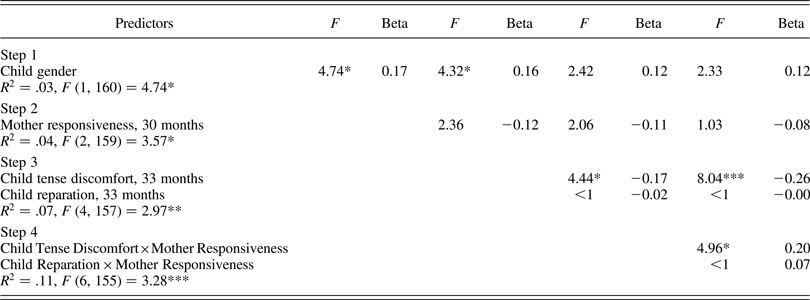
A hierarchical multiple regression was conducted to examine mothers' responsiveness as the moderator of the link between tense discomfort and reparation and externalizing behavior. Child gender (the covariate) was entered at Step 1, mothers' responsiveness (standardized) at Step 2, child tense discomfort and reparation at Step 3, and the interaction terms (Tense Discomfort × Responsiveness and Reparation × Responsiveness) at Step 4. Table 5 presents the results of the hierarchical multiple regressions.
Play Study: Mothers’ responsiveness at 30 months and children's tense discomfort and reparation at 33 months as predictors of externalizing behavior problems at 40 months
Note: Predictors were entered as follows: at Step 1, child gender (0 = girl, 1 = boy); at Step 2, mother responsiveness; at Step 3, child tense discomfort and reparation; and at Step 4, the interaction terms: Child Tense Discomfort × Mother Responsiveness and Child Reparation × Mother Responsiveness.
*p < .05. **p < .025. ***p < .01.
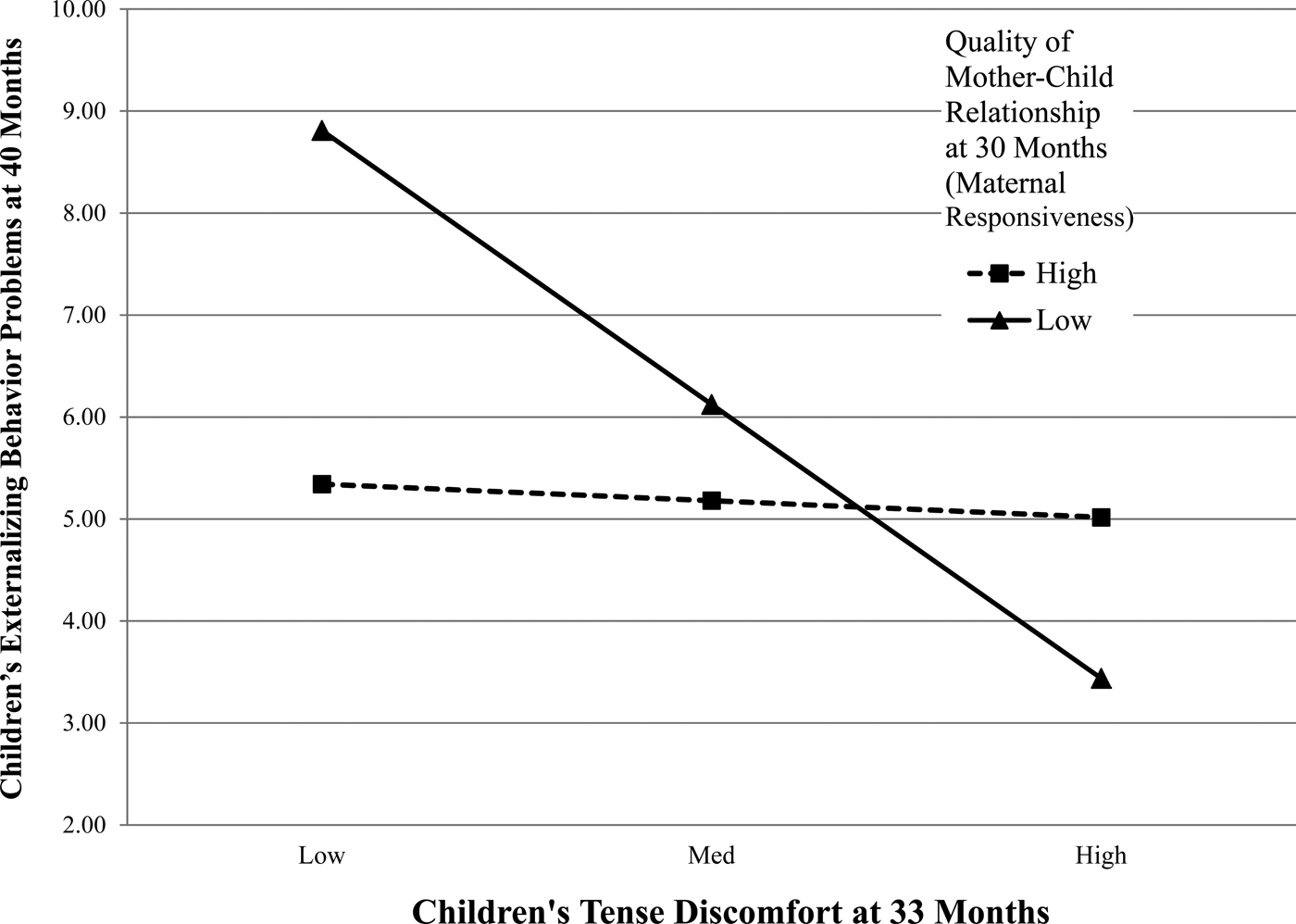
Children's tense discomfort had a significant (negative) effect on externalizing problems, but that effect was qualified by the interaction with maternal responsiveness. Reparation produced no significant main or interaction effects. The follow-up analysis of the interaction, using simple slopes (Aiken & West, Reference Aiken and West1991), is depicted in Figure 6.
In the Play Study the quality of mother–child relationship at 30 months (maternal responsiveness) moderates the link between children's tense discomfort at 33 months and externalizing behavior problems at 40 months. Although not depicted, children's gender was a covariate. The solid line represents the significant simple slope, and the dashed line represents the nonsignificant simple slope.
The simple slope of children's tense discomfort assessed at 33 months on their externalizing problems at 40 months was significant for children whose mothers had been less responsive at 30 months (1 SD below the mean, b = –5.36, SE = 1.85, p < .01), but not for children whose mothers had been more responsive (1 SD above the mean, b = –0.50, SE = 1.04, ns). In dyads with unresponsive mothers, lower tense-discomfort scores were associated with more future externalizing problems, but such a link was absent in dyads with responsive mothers.
Summary and discussion
The pattern of results in this short-term longitudinal study was entirely consistent with that in the Family Study, despite the differences in the population, studied ages, and the measure of the quality of the mother–child relationship. Because attachment security in the Strange Situation was not assessed in the Play Study, we adopted maternal responsiveness as another classic indicator of the quality of the mother–toddler relationship. Because there was no assessment between 33 months, when children's response to mishaps were assessed, and 40 months, when the measures of children's externalizing behavior problems were collected, we could not conduct moderated mediation analyses analogous to the Family Study that involved maternal style of discipline.
The findings were straightforward: the quality of the mother–child relationship moderated the relation between children's tense discomfort and their future externalizing problems. Children who appeared relatively less affected by the apparent mishap were at a higher risk for future externalizing problems than were children who appeared relatively more concerned and uncomfortable. This relation, however, was present only for children whose mothers were relatively unresponsive; for children of responsive mothers, the variation in children's response to transgressions was unrelated to externalizing problems. As in the Family Study, there were no significant findings for reparation (which was unrelated to tense discomfort).
General Discussion
This research makes several contributions to developmental psychology and psychopathology. Although in both of our studied samples most children were in the normative range of behavior problems, this work nevertheless may inform our understanding of early risks for a future maladaptive trajectory leading to an increased occurrence of antisocial behavior problems in young children. We bring together the study of early self-conscious emotions, attachment, parenting, and adjustment. The findings elucidate the adaptive role of children's early distress following transgressions in social–emotional development, and suggest that children who display relatively few signs of such distress may be at risk for future antisocial behavior problems. Furthermore, the data reveal how early parent–child relationships can serve either to amplify or offset those risks and how different developmental cascades may be set in motion in varying relationship contexts (Cox, Mills-Koonce, Propper, & Gariepy, Reference Cox, Mills-Koonce, Propper and Gariepy2010).
Despite a strong interest in moral emotions (e.g., Tangney, Stuewig, & Mashek, Reference Tangney, Stuewig and Mashek2007; Tilghman-Osborne, Cole, & Felton, Reference Tilghman-Osborne, Cole and Felton2010), there have been very few behavioral investigations involving young children because such emotions are very difficult to study using observational methods. It is very challenging to implement standardized yet naturalistic paradigms that effectively lead the young child to believe he or she has transgressed. It is also difficult to code subtle emotional and behavioral responses to such events, given that moral emotions such as guilt, shame, embarrassment, or remorse do not have distinct affective signatures, and they share many overlapping characteristics (Darwin, 1872/Reference Darwin1965; Zahn-Waxler & Kochanska, Reference Zahn-Waxler, Kochanska and Thompson1990). Furthermore, at the toddler age, those emotions, linked to the developing self, are just in the process of emerging and forming and may often present as blends or constellations of arousal, discomfort, tension, and reparation (Thompson, in press). Consequently, the empirical body of developmental literature on young children's reactions to transgressions is very thin.
We have examined children's responses to transgressions in our research program using mishap paradigms adapted from the original work by Barrett et al. (Reference Barrett, Zahn-Waxler and Cole1993) and Cole et al. (Reference Cole, Barrett and Zahn-Waxler1992). Our previous research has shown that arousal and distress in such contrived mishaps can be seen as aspects of early conscience. Children's responses to mishaps were meaningfully related to children's concurrent sensitivity to flawed objects presented in another paradigm (Kochanska et al., Reference Kochanska, Casey and Fukumoto1995). In addition, individual differences in children's distress and tension in mishap paradigms predicted their future antisocial, disruptive, externalizing behavior problems. Across two longitudinal studies, children who appeared oblivious to and relatively unaffected by their apparent transgressions, and who showed low or no discomfort following such events, were at a greater risk for future antisocial outcomes than their peers who appeared concerned about the mishaps. The antisocial outcomes encompassed rule-breaking behavior, observed in the laboratory (Kochanska et al., Reference Kochanska, Gross, Lin and Nichols2002) and disruptive, antisocial behavior problems, rated by parents and teachers (Kochanska, Barry, Jimenez, et al., Reference Kochanska, Barry, Jimenez, Hollatz and Woodard2009). However, we did not examine whether that risk is moderated by the context of the parent–child relationship.
The key findings reported in the present article are robustly replicated across two studies, a remarkable outcome given the differences between those investigations. The studies differed in the populations (two-parent community families vs. low-income mothers); the children's ages when the assessments of the parent–child relationship, mishaps, and antisocial or externalizing outcome occurred (at 15, 38, and 80–100 months in the Family Study and at 30, 33, and 40 months in the Play Study, respectively); and the type of assessment of the quality of the parent–child relationship (attachment security in the Family Study and maternal responsiveness in the Play Study). The measures of children's responses to transgressions and of antisocial outcomes were kept comparable across the studies. Furthermore, in the Family Study, the findings were replicated across the mother– and father–child relationships (even though there was no concordance in the attachment organization across the parents). We note that in both studies we relied on parents' reports of antisocial outcomes. This is a limitation, and examining behavioral outcomes, such as observed disregard for rules, would also be important.
It is also notable that our findings involving children's responses to transgressions were replicated, even though they were observed in very benign and subtle situations. Both for ethical reasons and for the sake of ecological validity, our paradigms simulated minor and brief mishaps that routinely happen in daily lives of toddlers, such as knocking down an object, breaking a toy, spilling food or drink, and dropping food. The expressions of discomfort were on average quite mild. Nevertheless, our coding system was sensitive enough to capture the various signs of children's overall tense discomfort that formed a coherent emotional–behavioral pattern and to reveal its meaningful links with the antisocial trajectory in the specific relationship contexts. Furthermore, we again detected gender differences, with girls displaying more discomfort, consistent with our and others' past work (e.g., Zahn-Waxler & Kochanska, Reference Zahn-Waxler, Kochanska and Thompson1990).
We have now demonstrated across several longitudinal studies, different populations, various children's ages, and a range of measures that the processes linking the qualities of the individual child, parental discipline, and antisocial outcomes consistently differ in suboptimal and optimal parent–child relationship contexts. We have shown that certain qualities of the child, for example, a difficult, angry temperament (as in Kochanska & Kim, Reference Kochanska and Kim2012) or the relatively low distress following one's own transgressions as in the current article, can be seen as forms of early risk for maladaptive cascades that lead to future antisocial behavior, often through increasing parental pressure. But such cascades between such early risks and antisocial behavior are moderated by the parent–child relationship context. In insecure or unresponsive parent–child relationships, such associations are amplified. In secure, responsive relationships, they appear attenuated or defused.
In this study, given the sample size, the different insecure groups (avoidant, resistant, disorganized) were combined; it would be valuable, however, to examine the links among children's responses to transgressions, parental control, and adjustment outcomes for children differing in the type of insecurity. It would further be valuable to examine whether children who present socialization challenges (difficult, callous) are less likely to form a secure bond with the parent in the first place.
It is worth noting that our findings are conceptually compatible with data from other laboratories. For example, Marsh, McFarland, Allen, McElhaney, & Land (Reference Marsh, McFarland, Allen, McElhaney and Land2003) and Allen et al. (Reference Allen, Marsh, McFarland, McElhaney, Land and Jodl2002) found that adolescents' attachment style moderated the links between their mothers' behavior and the adolescents' internalizing problems, risky behaviors, and social skills. Allen, Moore, Kuperminc, and Bell (Reference Allen, Moore, Kuperminc and Bell1998) explicitly emphasized the need to modify theories of parenting in a way that incorporates the organization of parent–child attachment as a moderator. Alink, Cicchetti, Kim, and Rogosch (Reference Alink, Cicchetti, Kim and Rogosch2009) found that child security moderated the causal chain from a history of maltreatment to poor emotion regulation to behavior problems.
The Family Study has additionally offered a window into a plausible mechanism that might mediate the link between relatively low distress following transgressions and future antisocial behaviors in children in insecure relationships. The moderated mediation analyses demonstrated that in insecure relationships for mothers and children and fathers and children there was a significant path from the child's apparent, relatively low discomfort following transgressions to the parent's relatively more power-assertive control style to the child's future conduct problems. The comparable path was not significant in secure relationships. The findings were obtained even though the parental power assertion in this study was quite low. We have reported parallel findings for links among children's individual characteristics (difficult temperament), parental power assertion, and somewhat comparable antisocial outcomes at 80 months in an earlier article (Kochanska & Kim, Reference Kochanska and Kim2012). It appears that power assertion may be especially “toxic” in suboptimal relationships; in positive parent–child relationships, its effects appeared benign.
We suggested (Kochanska & Kim, Reference Kochanska and Kim2012) that in negative, insecure relationships, such a developmental chain may be reinforced by parents' and children's negative internal working models of each other (Bugental & Johnston, Reference Bugental and Johnston2000; George & Solomon, Reference George and Solomon1996, Kochanska, Barry, Stellern, et al., Reference Kochanska, Barry, Jimenez, Hollatz and Woodard2009). Parents increasingly perceive children as difficult, and children increasingly perceive parental power as hostile, unfair, and mean spirited. By contrast, in secure, positive relationships, parents' and children's views of each other and of the relationship are accepting and trusting. Thus, children may be primed to perceive parental power as benevolent, well intentioned, and legitimate.
This work has several limitations that should be addressed in future research. The overall level of power assertion in this study was very low and is better described as a degree of “control.” This is typical for families observed in a laboratory (e.g., see, Joosena, Mesman, Bakermans-Kranenburg, & van IJzendoorn, Reference Joosena, Mesman, Bakermans-Kranenburg and van IJzendoorn2012), particularly after children pass the toddler age. It would be very useful to observe abusive parents, who would likely produce much more robust observed measures of harsh parenting. Another limitation, in both studies, was the children's generally subclinical level of behavior problems that corresponded to normative samples used in the development of CSI-4 and ECI-4 (thus, the outcomes are better described as externalizing “tendencies” rather than problems). It would be also useful to include children screened for the presence of elevated problematic behaviors. We note, however, that significant anticipated effects were obtained despite the overall low level of parental applied pressure and within generally normative developmental outcomes, suggesting that the studied process may be quite robust. Finally, in future work, it may be informative to engage parents rather than strangers in interactions that involve contrived mishaps. In the current work, parents were neutral and uninvolved, preventing us from coding potential emotional exchanges within the parent–child dyad.
This research demonstrates how sequences involving children's characteristics, parental discipline, and antisocial outcomes form different developmental cascades in varying relationship contexts, illustrating the multifinality principle in development (Cicchetti & Rogosch, Reference Cicchetti and Rogosch1996). Furthermore, it encourages researchers to search beyond main effects when studying complex developmental cascades (Masten & Cicchetti, Reference Masten and Cicchetti2010). Early relationships may not necessarily directly predict future outcomes, but they may set the stage for future complex dynamics between the parent and child and for developmental trajectories (Sroufe, Reference Sroufe2005; Sroufe, Carlson, Levy, & Egeland, Reference Sroufe, Carlson, Levy and Egeland1999). Together, those findings open promising avenues of research, and they contribute to developmental psychology and psychopathology. They may ultimately inform parenting intervention programs by elucidating specific, long-term risks and indirect sequelae of early suboptimal parent–child relationships. In particular, it appears that efforts to enhance the quality of early relationships may produce complex benefits: not necessarily main effects, but rather changes in the future developmental process and dynamic within the parent–child dyad.