1. Introduction
Gaussian processes and, more precisely, Brownian motion play a prominent role in modeling factor dynamics in standard financial models considering the optimal timing of irreversible decisions in the presence of uncertainty. In the benchmark setting all the uncertainty affecting the decision is summarized in a single probability measure describing completely the probabilistic structure of the underlying intertemporally fluctuating factor dynamics. However, as originally pointed out in [Reference Knight25], in reality there are circumstances where a decision-maker faces unmeasurable uncertainty on the plausibility or credibility of a particular probability measure (so-called Knightian uncertainty). In such a case a decision-maker may have to make a decision based on several different measures or even a continuum of different measures describing the probabilistic structure of the alternative states of the world.
Ambiguity was first rigorously axiomatized by [Reference Gilboa and Schmeidler21], based on the pioneering work of [Reference Knight25], in an atemporal multiple-priors setting (for further refinements, see also [Reference Bewley7], [Reference Klibanoff, Marinacci and Mukerji24], [Reference Maccheroni, Marinacci and Rustichini28], [Reference Nishimura and Ozaki32]). The atemporal axiomatization was subsequently extended into an intertemporal recursive multiple-priors setting by, among others, [Reference Epstein and Wang18], [Reference Chen and Epstein9], [Reference Epstein and Miao16], and [Reference Epstein and Schneider17]. The impact of ambiguity on optimal timing decisions was originally studied in [Reference Nishimura and Ozaki31] in a job search model. The authors of [Reference Nishimura and Ozaki31] subsequently extended their original analysis, in [Reference Nishimura and Ozaki33], by considering the impact of Knightian uncertainty on the optimal timing decisions of irreversible investment opportunities in a continuous-time model based on geometric Brownian motion. The paper [Reference Alvarez1] focused on the impact of Knightian uncertainty on monotone one-sided stopping problems and expressed the values as well as the optimality conditions for the stopping boundaries in terms of the minimal excessive mappings of the underlying diffusion under the worst-case measure. The paper [Reference Riedel38], in turn, analyzed discrete-time optimal stopping problems in the presence of ambiguity-aversion and developed a general minmax martingale approach for solving the problems under consideration (see also [Reference Miao and Wang29] for an analysis of the problem for general discrete-time Feller-continuous Markov processes). The paper [Reference Bayraktar, Karatzas and Yao3] considered the intertemporal minimization of a general convex risk measure defined with respect to the underlying process. By utilizing martingale and stochastic analysis techniques, the authors of [Reference Bayraktar, Karatzas and Yao3] stated general conditions under which the problem has a value and under which the associated worst-case measure and stopping strategy constitute a saddle point of the associated game. The papers [Reference Bayraktar and Yao4] and [Reference Bayraktar and Yao5] developed a general approach based on g-expectations, a concept originally introduced in the pioneering studies [Reference Peng35] and [Reference Peng36], for solving optimal stopping problems in the presence of nonlinear expectations. They considered and solved both the standard robust optimal stopping problems arising in the literature on focusing on ambiguity-aversion and the cooperative problems where nature cooperates with the decision-maker and chooses a probability measure maximizing the expected value of the objective functional. They solved these stopping problems by utilizing the lower and upper Snell envelopes based on nonlinear g-expectations. The paper [Reference Cheng and Riedel10], in turn, focused on robust stopping problems in a continuous-time diffusion setting and identified the value of the considered class of problems as the smallest right-continuous g-martingale dominating the payoff process. The paper [Reference Christensen11] investigated the optimal stopping of linear diffusions by ambiguity-averse decision-makers in the presence of Knightian uncertainty and identified explicitly the minimal excessive mappings generating the worst-case measure, as well as the appropriate class of supermartingales needed for the characterization of the value of the optimal policy. The paper [Reference Ekren, Touzi and Zhang14] studied a robust stopping problem with respect to a weakly compact but nondominated class of probability measures, developing a nonlinear Snell envelope and characterizing the optimal stopping policy in terms of this envelope. The paper [Reference Nutz and Zhang34] considered a general class of stochastic zero-sum games where one of the players chooses the stopping policy and the other the probability measure; the authors delineate a set of general circumstances under which the considered game has a value and the optimal exercise date is the first instant at which the underlying coincides with the Snell envelope. More recently, [Reference Alvarez and Christensen2] extended the approach developed in [Reference Christensen11] to a multidimensional setting and investigated the impact of Knightian uncertainty on the optimal timing policies of ambiguity-averse investors in the case where the exercise payoff is positively homogeneous and the underlying diffusion is a two-dimensional geometric Brownian motion. They found that in the multidimensional case, ambiguity not only affects the optimal policy by altering the rate at which the underlying processes are expected to grow, it also affects the rate at which the problem is discounted.
Given the findings in [Reference Alvarez and Christensen2], our objective in this paper is to analyze the impact of Knightian uncertainty on the optimal timing policy of an ambiguity-averse decision-maker in the case where the underlying follows a multidimensional Brownian motion. We study the general stopping problem and identify two special cases under which the problem can be explicitly solved by reducing its dimensionality and then utilizing the approach developed in [Reference Christensen11] for the two particular cases considered. We characterize the value and optimal timing policies as the smallest majorizing element of the exercise payoff in a parameterized function space. Our results demonstrate that Knightian uncertainty not only accelerates the optimal timing policy in comparison with the unambiguous benchmark case, but may also lead to stationary behavior in the controlled system even when the underlying system does not possess a long-run stationary distribution. This observation illustrates how ambiguity may in some cases have a nontrivial impact on the stochastic dynamics of the underlying processes under the worst-case measure.
The contents of this paper are as follows. In Section 2 we present the underlying stochastic dynamics, state the class of optimal stopping problems we consider, and state a characterization of the impact of ambiguity on the optimal timing policy and its value. In Section 3 we focus on payoffs depending on linear combinations of the driving factors. In Section 4 we focus on radially symmetric payoffs. Section 5 concludes our study.
2. Underlying dynamics and problem setting
Let
 $\textbf W$
be a d-dimensional standard Brownian motion under the measure
 $\mathbb{P}$
, and assume that
 $d\geq 2$
. As usually in models subject to Knightian uncertainty, let the degree of ambiguity
 $\kappa>0$
be given, and denote by
 $\mathcal{P}^\kappa$
the set of all probability measures that are equivalent to
 $\mathbb{P}$
with density process of the form
 \begin{equation*}\mathcal{M}_t^{{\boldsymbol{\theta}}}=e^{-\int_0^t {\boldsymbol{\theta}}_s d\textbf{W}_s - \frac{1}{2}\int_0^t \|{\boldsymbol{\theta}_s}\|^2 ds}\end{equation*}
for a progressively measurable process
 $\{{\boldsymbol{\theta}}_t\}_{t\geq 0}$
satisfying the inequality
 $\|{\boldsymbol{\theta}}_t \|^2\leq \kappa^2$
for all
 $t\geq 0$
. That is, we assume that the density generator processes satisfy the inequality
 $\sum_{i=1}^d\theta_{it}^2\leq \kappa^2$
for all
 $t\geq 0$
.
Assume now that
 $\textbf{X}_t=\textbf{x}+\textbf{W}_t$
denotes the underlying diffusion under the measure
 $\mathbb{P}$
. Our objective is to consider the optimal stopping problem
 \begin{align}V_\kappa({\textit{\textbf{x}}}) = \sup_{\tau\in \mathcal{T}}\inf_{\mathbb{Q}^{{\boldsymbol{\theta}}}\in \mathcal{P}^\kappa}\mathbb{E}_{{\textit{\textbf{x}}}}^{{\mathbb{Q}^{{\boldsymbol{\theta}}}}}\left[e^{-r\tau}F(\textbf{X}_\tau)\mathbb{1}_{\{\tau
< \infty\}}\right],\end{align}
where
 $F\,:\,\mathbb{R}^d\mapsto \mathbb{R}$
is a measurable function which will be specified below in the two cases considered in this paper. As usually, we denote by
 $C_\kappa=\{{\textit{\textbf{x}}}\in \mathbb{R}^d\,:\,V_\kappa({\textit{\textbf{x}}})>F({\textit{\textbf{x}}})\}$
the continuation region where stopping is suboptimal. The specification of this stopping problem results in the following lemma characterizing the impact of ambiguity on the optimal stopping policy and its value in a general setting.
Lemma 1. Increased ambiguity accelerates optimal timing by decreasing the value of the optimal policy and thus shrinking the continuation region where waiting is optimal. Formally, if
 $\hat{\kappa}>\kappa$
, then
 $V_{\hat{\kappa}}({\textit{\textbf{x}}})\leq V_{\kappa}({\textit{\textbf{x}}})$
for all
 ${\textit{\textbf{x}}}\in\mathbb{R}^d$
and
 $C_{\hat{\kappa}}\subseteq C_{\kappa}$
.
Proof. Assume that
 $\hat{\kappa}>\kappa$
. Since
 $\{{\boldsymbol{\theta}}\in \mathbb{R}^d\,:\,\|{\boldsymbol{\theta}} \|^2\leq \kappa^2\}\subset \{{\boldsymbol{\theta}}\in \mathbb{R}^d\,:\,\|{\boldsymbol{\theta}} \|^2\leq \hat{\kappa}^2\}$
, we notice that
 \begin{equation*}\inf_{\mathbb{Q}^{{\boldsymbol{\theta}}}\in \mathcal{P}^{\hat{\kappa}}}\mathbb{E}_{{\textit{\textbf{x}}}}^{{\mathbb{Q}^{{\boldsymbol{\theta}}}}}\left[e^{-r\tau}F(\textbf{X}_\tau)\mathbb{1}_{\{\tau < \infty\}}\right]\leq \inf_{\mathbb{Q}^{{\boldsymbol{\theta}}}\in \mathcal{P}^{\kappa}}\mathbb{E}_{{\textit{\textbf{x}}}}^{{\mathbb{Q}^{{\boldsymbol{\theta}}}}}\left[e^{-r\tau}F(\textbf{X}_\tau)\mathbb{1}_{\{\tau
< \infty\}}\right],\end{equation*}
implying that
 $V_{\hat{\kappa}}({\textit{\textbf{x}}})\leq V_{\kappa}({\textit{\textbf{x}}})$
for all
 ${\textit{\textbf{x}}}\in\mathbb{R}^d$
. Assume now that
 ${{\textit{\textbf{x}}}}\in C_{\hat{\kappa}}$
. Since in that case
 $V_{\kappa}({\textit{\textbf{x}}})\geq V_{\hat{\kappa}}({\textit{\textbf{x}}}) > F({\textit{\textbf{x}}})$
, we notice that
 ${{\textit{\textbf{x}}}}\in C_{\kappa}$
as well. Consequently,
 $C_{\hat{\kappa}}\subseteq C_{\kappa}$
, completing the proof of our lemma.

Lemma 1 shows that the sign of the relationship between the degree of ambiguity and optimal timing is positive. At the same time, increased ambiguity decreases the value of the optimal stopping policy, showing that the highest value is attained in the absence of ambiguity. This mechanism is naturally not that surprising, since it essentially states that the larger the set of potentially detrimental outcomes gets, the smaller the achievable value is.
We now notice that under the measure
 $\mathbb{Q}^{{\boldsymbol{\theta}}}$
defined by the likelihood ratio
 \begin{equation*}\frac{d\mathbb{Q}^{{\boldsymbol{\theta}}}}{d\mathbb{P}}=\mathcal{M}_t^{{\boldsymbol{\theta}}}\end{equation*}
we naturally have that
 \begin{equation*}\textbf{X}_t = \textbf{x} -\int_{0}^{t}{\boldsymbol{\theta}}_sds + \textbf{W}_t^{{\boldsymbol{\theta}}},\end{equation*}
where
 $\textbf{W}_t^{{\boldsymbol{\theta}}}$
denotes a
 $\mathbb{Q}^{{\boldsymbol{\theta}}}$
-Brownian motion. We introduce the following differential operator associated with the underlying processes
 $\textbf{X}$
under the measure
 $\mathbb{Q}^{{\boldsymbol{\theta}}}\in \mathcal{P}^\kappa$
:
 \begin{equation*}\mathcal{A}^{{\boldsymbol{\theta}}}=\frac{1}{2}\sum_{i=1}^d\frac{\partial^2}{\partial x_i^2}-\sum_{i=1}^d\theta_i\frac{\partial}{\partial x_i}.\end{equation*}
For a twice continuously differentiable function
 $u\,:\,\mathbb{R}^d\mapsto \mathbb{R}_+$
the Itô–Döblin theorem yields that under the measure
 $\mathbb{Q}^{{\boldsymbol{\theta}}}\in \mathcal{P}^\kappa$
we have
 \begin{align*}\begin{split}e^{-rt}u(\textbf{X}_{t})=u(\textbf{x}) + \int_0^{t}e^{-rs}\big(\big(\mathcal{A}^{{\boldsymbol{\theta}}}u\big)(\textbf{X}_{s})-ru(\textbf{X}_{s})\big)ds+\int_0^t e^{-rs}\nabla u(\textbf{X}_{s})\cdot d\textbf{W}_s^{{\boldsymbol{\theta}}}.\end{split}\end{align*}
Now, minimizing
 $(\mathcal{A}^{{\boldsymbol{\theta}}}u)({{\textit{\textbf{x}}}})$
with respect to
 ${\boldsymbol{\theta}}$
under the condition
 $\|{\boldsymbol{\theta}}\|^2\leq \kappa^2$
leads to the worst-case density generator
 \begin{equation*}{{\boldsymbol{\theta}}}^*_t=\kappa \frac{\nabla u(\textbf{X}_{t})}{\|\nabla u(\textbf{X}_{t})\|},\end{equation*}
where
 $\|{{\cdot}}\|$
denotes the standard Euclidean norm. In particular, we notice that under
 $\mathbb{Q}^{{\boldsymbol{\theta}}^\ast}$
we have
 \begin{align*}\begin{split}e^{-rt}u(\textbf{X}_{t})= & u(\textbf{x}) + \int_0^{t}e^{-rs}\left(\frac{1}{2}(\Delta u)(\textbf{X}_{s})-\kappa \|\nabla u(\textbf{X}_{s})\|-ru(\textbf{X}_{s})\right)ds\\
&+\int_0^t e^{-rs}\nabla u(\textbf{X}_{s})\cdot d\textbf{W}_s^{{\boldsymbol{\theta}}^\ast}.\end{split}\end{align*}
Consequently, if
 $u(\textbf{x})\geq F(\textbf{x})$
and
 $\frac{1}{2}(\Delta u)(\textbf{x})-\kappa \|\nabla u(\textbf{x})\|-ru(\textbf{x})\leq 0$
for all
 $\textbf{x}\in \mathbb{R}^d$
, then
 \begin{align*}\begin{split}u(\textbf{x})\geq e^{-rt}F(\textbf{X}_{t})-\int_0^t e^{-rs}\nabla u(\textbf{X}_{s})\cdot d\textbf{W}_s^{{\boldsymbol{\theta}}^\ast},\end{split}\end{align*}
which indicates how a candidate value for the stopping problem under consideration can be obtained by relying on a set of nonlinear variational inequalities. As was originally established in [Reference Cheng and Riedel10], all these observations can be summarized in a nonlinear Hamilton–Jacobi–Bellman equation,
 \begin{align}\max\left\{F(\textbf{x})-u(\textbf{x}),\frac{1}{2}(\Delta u)(\textbf{x})-\kappa \|\nabla u(\textbf{x})\|-ru(\textbf{x})\right\}=0.\end{align}
The authors of [Reference Cheng and Riedel10] state a set of sufficient conditions under which a solution of this equation indeed constitutes the value of the optimal policy in a general multidimensional diffusion setting. Unfortunately, it is typically impossible to solve the Hamilton–Jacobi–Bellman equation (2.2) explicitly. Fortunately, there are two cases where dimension reduction techniques apply and permit the transformation of the original multidimensional problem into a solvable one-dimensional setting. We will focus on these problems in the following sections.
3. Payoff depending on a linear combination of factors
Linear combinations of independent normally distributed random variables are normally distributed. On the other hand, linear combinations of independent Brownian motions are continuous martingales and hence constitute a time change of Brownian motion. Given these observations, consider now the case where the exercise payoff reads as
 \begin{align}F({\textbf{x}})= \,\hat{\!F}\left(\textbf{a}^T\textbf{x}\right) = \,\hat{\!F}\left(\sum_{i=1}^{d}a_ix_i\right),\end{align}
where
 $\textbf{a}\in \mathbb{R}^d$
is a constant parameter vector and
 $\,\hat{\!F}\,:\,\mathbb{R}\mapsto \mathbb{R}$
is a measurable function. Focusing now on functions
 \begin{equation*}u({\textbf{x}})= h\left(\textbf{a}^T\textbf{x}\right) \end{equation*}
results in the worst-case prior, characterized by the density generator
 \begin{equation*}{{\boldsymbol{\theta}}}^*=\kappa \text{sgn}\left(h^{\prime}\left(\textbf{a}^T\textbf{x}\right)\right) \frac{{{\textit{\textbf{a}}}}}{\|{{\textit{\textbf{a}}}}\|}.\end{equation*}
In this case, solving
 \begin{equation*}\frac{1}{2}\|\textbf{a}\|^2h^{\prime\prime}\big(\textbf{a}^T\textbf{x}\big)-\kappa\| \textbf{a} \| |h^{\prime}\big(\textbf{a}^T\textbf{x}\big)|-r h\big(\textbf{a}^T\textbf{x}\big)=0\end{equation*}
is equivalent to solving
 \begin{equation*}\frac{1}{2}\|\textbf{a}\|^2h^{\prime\prime}\big(\textbf{a}^T\textbf{x}\big)-\kappa\| \textbf{a} \| h^{\prime}\big(\textbf{a}^T\textbf{x}\big)-r h\big(\textbf{a}^T\textbf{x}\big)=0\end{equation*}
on
 $\{{{\textit{\textbf{x}}}}\,:\,h^{\prime}(\textbf{a}^T\textbf{x})\geq 0\}$
and
 \begin{equation*}\frac{1}{2}\|\textbf{a}\|^2h^{\prime\prime}(\textbf{a}^T\textbf{x})+\kappa\| \textbf{a} \| h^{\prime}\big(\textbf{a}^T\textbf{x}\big)-r h\big(\textbf{a}^T\textbf{x}\big)=0\end{equation*}
on
 $\{{{\textit{\textbf{x}}}}\,:\,h^{\prime}(\textbf{a}^T\textbf{x})<0\}$
. Defining the constants
 \begin{align*}\psi_{\kappa} &=\frac{\kappa}{\|\textbf{a}\|}+\sqrt{\frac{\kappa^2}{\|\textbf{a}\|^2}+\frac{2r}{\|\textbf{a}\|^2}},\\[5pt]
\varphi_{\kappa} &=\frac{\kappa}{\|\textbf{a}\|}-\sqrt{\frac{\kappa^2}{\|\textbf{a}\|^2}+\frac{2r}{\|\textbf{a}\|^2}},\end{align*}
 $\hat{\psi}_\kappa=-\varphi_\kappa$
, and
 $\hat{\varphi}_\kappa=-\psi_\kappa$
then shows that
 \begin{equation*}h(y)=c_1 e^{\psi_{\kappa} y} + c_2 e^{\varphi_{\kappa} y}\end{equation*}
on
 $\{y\,:\,h^{\prime}(y)\geq 0\}$
and
 \begin{equation*}h(y)=\hat{c}_1 e^{\hat{\psi}_\kappa y} + \hat{c}_2 e^{\hat{\varphi}_\kappa y}\end{equation*}
on
 $\{y\,:\,h^{\prime}(y)< 0\}$
. Given these functions, let
 $c\in \mathbb{R}$
be an arbitrary reference point, and define the function
 $U_c\,:\,\mathbb{R}\mapsto \mathbb{R}$
by
 $U_c(y)=\max(h_{1c}(y),h_{2c}(y))$
, where
 \begin{align*}h_{1c}(y)&= \frac{\psi_{\kappa}}{\psi_{\kappa}-\varphi_{\kappa}}e^{\varphi_{\kappa} (y-c)}-\frac{\varphi_{\kappa}}{\psi_{\kappa}-\varphi_{\kappa}}e^{\psi_{\kappa} (y-c)},\\[4pt]
h_{2c}(y)&= \frac{\hat{\psi}_{\kappa}}{\hat{\psi}_{\kappa}-\hat{\varphi}_{\kappa}}e^{\hat{\varphi}_{\kappa} (y-c)}-\frac{\hat{\varphi}_{\kappa}}{\hat{\psi}_{\kappa}-\hat{\varphi}_{\kappa}}e^{\hat{\psi}_{\kappa} (y-c)}\end{align*}
are two mappings satisfying the conditions
 $h_{1c}(c)=h_{2c}(c)=1$
and
 $h^{\prime}_{1c}(c)=h^{\prime}_{2c}(c)=0$
. Since the functions
 $h_{1c}(y)$
and
 $h_{2c}(y)$
are strictly convex and the maximum of convex functions is convex, we notice that
 $U_c(y)$
is strictly convex as well. The twice continuous differentiability of the functions
 $h_{1c}(y)$
and
 $h_{2c}(y)$
and the boundary conditions
 $h_{1c}(c)=h_{2c}(c)=1$
and
 $h^{\prime}_{1c}(c)=h^{\prime}_{2c}(c)=0$
, in turn, guarantee that
 $U_c(y)$
is continuously differentiable on
 $\mathbb{R}$
. Finally, noticing that
 $U^{\prime\prime}_c(c{+}) = 2r/\|\textbf{a}\|^2 = U^{\prime\prime}_c(c{-})$
demonstrates that
 $U_c(y)$
is twice continuously differentiable on
 $\mathbb{R}$
. Therefore, we have established that the function
 $U_c(y)$
constitutes the solution of the boundary value problem
 \begin{align*}&\frac{1}{2}\|\textbf{a}\|^2U^{\prime\prime}_c\big(\textbf{a}^T\textbf{x}\big)-\kappa \text{sgn}\big(\textbf{a}^T\textbf{x}-c\big)\| \textbf{a} \| U^{\prime}_c\big(\textbf{a}^T\textbf{x}\big)-r U_c\big(\textbf{a}^T\textbf{x}\big)=0,\\&U_c(c)=1,\quad U^{\prime}_c(c)=0.\end{align*}
Analogously, we let
 $U_{-\infty}(y)=e^{\psi_{\kappa} y}$
and
 $U_{\infty}(y)=e^{\hat{\varphi}_\kappa y}$
denote the solutions associated with the extreme cases where
 $c=-\infty$
or
 $c=\infty$
. As was demonstrated in [Reference Christensen11], these functions generate a useful class of supermartingales for solving optimal stopping problems in the presence of ambiguity. To see that this is indeed the case in this multidimensional setting as well, we notice from applying the Itô–Döblin theorem to the function
 $U_c$
that
 \begin{align*}e^{-rT}U_c\big(\textbf{a}^T{\textbf{X}}_T\big) =\, & U_c\left(\textbf{a}^T\textbf{x}\right)+\int_0^Te^{-rt}\left(\kappa \text{sgn}\big(\textbf{a}^T\textbf{X}_t-c\big)\|\textbf{a}\|-\textbf{a}^T{{\boldsymbol{\theta}}}_t\right)U^{\prime}_c\big(\textbf{a}^T\textbf{X}_t\big)dt\\
&+\int_0^T e^{-rt}U^{\prime}_c\big(\textbf{a}^T\textbf{X}_t\big)\textbf{a}^Td\textbf{W}_t^{{\boldsymbol{\theta}}}.\end{align*}
Since
 $-\kappa\|\textbf{a}\|\leq -\textbf{a}^T{\boldsymbol{\theta}} \leq \kappa\|\textbf{a}\|$
for admissible density generators satisfying the condition
 $\|{\boldsymbol{\theta}}\|^2\leq \kappa^2$
, we observe that
 $\left(\kappa \text{sgn}(\textbf{a}^T\textbf{x}-c)\|\textbf{a}\|-\textbf{a}^T{{\boldsymbol{\theta}}}\right)U^{\prime}_c(\textbf{a}^T\textbf{x})\geq 0$
for all
 $\textbf{x}\in \mathbb{R}^d$
, and therefore that
 \begin{align*}e^{-rT}U_c\big(\textbf{a}^T{\textbf{X}}_T\big) \geq U_c\left(\textbf{a}^T\textbf{x}\right)+ \int_0^T e^{-rt}U^{\prime}_c\big(\textbf{a}^T\textbf{X}_t\big)\textbf{a}^Td\textbf{W}_t^{{\boldsymbol{\theta}}},\end{align*}
with equality only when
 ${\boldsymbol{\theta}}_t={\boldsymbol{\theta}}_t^\ast=\kappa \text{sgn}(\textbf{a}^T\textbf{X}_t-c).$
Consequently, we notice that in the present case
 \begin{align*}\mathbb{E}^{\mathbb{Q}^{{\boldsymbol{\theta}}}}_{\textbf{x}}\left[e^{-rT}U_c\big(\textbf{a}^T{\textbf{X}}_T\big)\right] \geq \mathbb{E}^{\mathbb{Q}^{{\boldsymbol{\theta}}^\ast}}_{\textbf{x}}\left[e^{-rT}U_c\big(\textbf{a}^T{\textbf{X}}_T\big)\right] = U_c\left(\textbf{a}^T\textbf{x}\right)\end{align*}
for all
 $\mathbb{Q}^{{\boldsymbol{\theta}}}\in \mathcal{P}^\kappa$
. Standard optional sampling arguments show that the process
 $\{e^{-rt}U_c(\textbf{a}^T{\textbf{X}}_t)\}_{t\geq 0}$
is actually a positive
 $\mathbb{Q}^{{\boldsymbol{\theta}}^\ast}$
-martingale and, therefore, a supermartingale.
Here it is also worth pointing out that the process
 $Y_t=\textbf{a}^T\textbf{X}_t$
satisfies the stochastic differential equation (SDE)
 \begin{align}dY_t = \textbf{a}^Td\textbf{X}_t=-\textbf{a}^T{\boldsymbol{\theta}}_tdt+\textbf{a}^Td\textbf{W}_t^{{\boldsymbol{\theta}}},\quad Y_0=\textbf{a}^T\textbf{x}.\end{align}
Since
 $-\kappa\|\textbf{a}\|\leq -\textbf{a}^T{\boldsymbol{\theta}}_t \leq \kappa\|\textbf{a}\|$
for admissible density generators satisfying the condition
 $\|{\boldsymbol{\theta}}_t\|\leq \kappa$
, we notice that (3.2) has a unique strong solution. Moreover, utilizing a comparison theorem for solutions of SDEs (cf. Theorem 1.1 in [Reference Ikeda and Watanabe23]) demonstrates that
 $Y_t$
satisfies with probability one the inequality
 $\tilde{Y}^{-\kappa}_t\leq Y_t \leq \tilde{Y}^{\kappa}_t$
, where
 \begin{equation*}\tilde{Y}^{\kappa}_t = \textbf{a}^T\textbf{x}+\kappa\|\textbf{a}\| t + \textbf{a}^T\textbf{W}_t^{{\boldsymbol{\theta}}}\end{equation*}
is a
 $\mathbb{Q}^{{\boldsymbol{\theta}}}$
-Brownian motion with drift. Consequently, we notice that
 $\inf\{Y_s;\ s\leq t\}\leq \inf\{\tilde{Y}_s^{\kappa};\ s\leq t\}$
and
 $\sup\{Y_s;\ s\leq t\}\geq\sup\{\tilde{Y}_s^{-\kappa};\ s\leq t\}$
 $\mathbb{Q}^{{\boldsymbol{\theta}}}$
-almost surely. From known properties of the processes
 $\tilde{Y}^{\kappa}_t, \tilde{Y}^{-\kappa}_t$
, it now follows that the hitting times to arbitrary constant boundaries are
 $\mathbb{Q}^{{\boldsymbol{\theta}}}$
-almost surely finite for all
 $\mathbb{Q}^{{\boldsymbol{\theta}}}\in \mathcal{P}^\kappa$
(that is, first hitting times to constant boundaries are universally almost surely finite; see Section 3.3 in [Reference Cheng and Riedel10]).
In particular, under
 $\mathbb{Q}^{{\boldsymbol{\theta}}^\ast}$
we have
 \begin{align}dY_t=-\kappa\|\textbf{a}\|\text{sgn}(Y_t-c)dt+\textbf{a}^Td\textbf{W}_t^{{\boldsymbol{\theta}}^\ast},\quad Y_0=\textbf{a}^T\textbf{x},\end{align}
which is a standard Brownian motion with alternating drift. Interestingly, we observe that while standard Brownian motion does not have a stationary distribution, the controlled process does. More precisely, for a fixed reference point c the stationary distribution of the controlled diffusion reads as (a Laplace-distribution)
 \begin{equation*}p\big(\textbf{a}^T\textbf{x}\big)=\frac{\kappa}{\|\textbf{a}\|}e^{-\frac{2\kappa}{\|\textbf{a}\|}|\textbf{a}^T\textbf{x}-c|}.\end{equation*}
Moreover, under
 $\mathbb{Q}^{{\boldsymbol{\theta}}^\ast}$
the process
 $Y_t$
is positively recurrent, meaning that hitting times to constant boundaries are almost surely finite.
Having characterized the underlying dynamics and the class of harmonic functions leading to the class of supermartingales needed in the characterization of the value, we now observe that the conditions of Theorem 1 in [Reference Christensen11] are satisfied and, therefore, that we can characterize the value in a semi-explicit form, as stated in the following.
Theorem 1. (A) For all
 $\textbf{x}\in \mathbb{R}^d$
we have that
 \begin{align}V_\kappa\big({\textit{\textbf{x}}}\big) = \inf\big\{\lambda U_c(\textbf{a}^T\textbf{x})\,:\,c\in[{-}\infty,\infty],\lambda\in[0,\infty],\lambda U_c\big(\textbf{a}^T\textbf{x}\big)\geq \,\hat{\!F}\big(\textbf{a}^T\textbf{x}\big)\big\},\end{align}
and the infimum with respect to the reference point c is a minimum.
(B) A point
 $\textbf{x}\in \mathbb{R}^d$
is in the stopping region
 $\Gamma_{\kappa}=\{\textbf{x}\in \mathbb{R}^d\,:\, V_\kappa({\textit{\textbf{x}}})=\,\hat{\!F}(\textbf{a}^T\textbf{x})\}$
if and only if there exists a
 $c\in [{-}\infty,\infty]$
such that
 $${y_c} \in argmax\left\{ {{{{\mkern 1mu} \widehat{F}(y)} \over {{U_c}(y)}}} \right\}$$
and
 $\textbf{a}^T\textbf{x}=y_c$
.
Proof. The claims are direct implications of Theorem 1 in [Reference Christensen11].
Theorem 1 above extends the findings of Theorem 1 in [Reference Christensen11] to the present case. The main reason for the validity of this extension is naturally the fact that even though the process
 $\textbf{X}_t$
is multidimensional, the process
 $\textbf{a}^T\textbf{X}_t$
is not, and we can therefore analyze the problem in terms of the one-dimensional characteristics. The representation (3.4) is naturally useful in the determination of the value and the associated worst-case prior, since it essentially reduces the analysis of the original problem to the analysis of a ratio with known properties without requiring strong smoothness or regularity conditions. An interesting implication of Theorem 1, characterizing how ambiguity affects optimal timing and the value of the optimal policy, is summarized in the following lemma, which extends the result of Lemma 1 to the present setting.
Lemma 2. An increased degree of ambiguity increases
 $U_c(y)$
for all
 $y\in\mathbb{R}\backslash\{c\}$
and all reference points
 $c\in[{-}\infty,\infty]$
. Moreover, higher ambiguity decreases the value of the optimal policy and accelerates optimal timing by shrinking the continuation region where waiting is optimal.
Proof. Denote by
 $\hat{U}_c\,:\,\mathbb{R}\mapsto \mathbb{R}$
the solution of the boundary value problem
 \begin{align*}&\frac{1}{2}\|\textbf{a}\|^2\hat{U}^{\prime\prime}_c(y)-\hat{\kappa}\text{sgn}(y-c)\| \textbf{a} \| \hat{U}^{\prime}_c(y)-r \hat{U}_c(y)=0,\\&\hat{U}_c(c)=1,\quad \hat{U}^{\prime}_c(c)=0,\end{align*}
where
 $\hat{\kappa}>\kappa$
. Consider now the function
 \begin{equation*}L(y)=\frac{U^{\prime}_c(y)}{S^{\prime}(y)}\hat{U}_c(y)-\frac{\hat{U}^{\prime}_c(y)}{S^{\prime}(y)}U_c(y),\end{equation*}
where
 \begin{equation*}S^{\prime}(y)=e^{-\frac{2\kappa}{\sigma}(y-c)}\vee e^{\frac{2\kappa}{\sigma}(y-c)}\end{equation*}
denotes the density of the scale function of the diffusion (3.3). It is clear that
 $L(c)=0$
. On the other hand, differentiating and invoking the boundary value problem above shows that
 \begin{equation*}L^{\prime}(y)=\frac{2(\kappa-\hat{\kappa})}{\| \textbf{a} \|}\hat{U}^{\prime}_c(y)U_c(y)e^{-\frac{2\kappa}{\sigma}(y-c)}<0\end{equation*}
for all
 $y>c$
. Consequently, we find that
 $U^{\prime}_c(y)/U_c(y)<\hat{U}^{\prime}_c(y)/\hat{U}_c(y)$
for all
 $y>c$
. Integrating this inequality yields
 $\ln U_c(y) < \ln \hat{U}_c(y)$
, which finally proves that
 $U_c(y) < \hat{U}_c(y)$
for all
 $y>c$
. Establishing the validity of this inequality on
 $({-}\infty,c)$
is completely analogous. The negativity of the impact of higher ambiguity on the value of the optimal policy follows from the representation (3.4). Finally, if
 $y\in C_{\hat{\kappa}} \,:\!=\,\{y\in\mathbb{R}\,:\,V_{\hat{\kappa}}(y)>\,\hat{\!F}(y)\}$
, then the inequality
 $V_{\kappa}(y) > V_{\hat{\kappa}}(y)>\,\hat{\!F}(y)$
guarantees that
 $y\in C_{\kappa} \,:\!=\,\{y\in\mathbb{R}\,:\,V_{\kappa}(y)>\,\hat{\!F}(y)\}$
as well, and, consequently, that
 $C_{\hat{\kappa}}\subset C_{\kappa}$
, completing the proof of our lemma.
In order to illustrate the usefulness of the result of Theorem 1, we now consider an interesting class of exercise payoffs leading to an explicitly solvable symmetric setting within this class of models. Our main findings on these problems are summarized in the following.
Theorem 2. Assume that the exercise payoff
 $\,\hat{\!F}(x)$
is even, that is, that
 $\,\hat{\!F}(x)=\,\hat{\!F}({-}x)$
for all
 $x\geq 0$
. Then the ratio
 $\,\hat{\!F}(x)/U_0(x)$
is even as well, and if there exists a unique threshold
 $${x^ * } = \mathop {argmax}\limits_{_{x > 0}} \left\{ {{{{\mkern 1mu} \widehat{F}(x)} \over {{U_0}(x)}}} \right\},$$
so that
 $\,\hat{\!F}(x)/U_0(x)$
is increasing on
 $(0,x^\ast)$
and decreasing on
 $(x^\ast,\infty)$
, then the value of the optimal stopping policy
 $\inf\{t\geq 0\,:\,\textbf{a}^T\textbf{X}_t\not\in ({-}x^\ast,x^\ast)\}$
reads as
 \begin{align}V_\kappa(\textbf{x})=\begin{cases}\,\hat{\!F}\big(\textbf{a}^T\textbf{x}\big),&\textbf{a}^T\textbf{x}\not\in ({-}x^\ast,x^\ast),\\[7pt]
\frac{\,\hat{\!F}(x^\ast)}{U_0(x^\ast)}U_0(\textbf{a}^T\textbf{x}),&\textbf{a}^T\textbf{x}\in ({-}x^\ast,x^\ast).\end{cases}\end{align}
Moreover, the optimal density generator resulting in the worst-case measure is
 \begin{equation*}{{\boldsymbol{\theta}}}_t^*=\kappa \text{sgn}\big(\textbf{a}^T\textbf{X}_t\big) \frac{{{\textit{\textbf{a}}}}}{\|{{\textit{\textbf{a}}}}\|}.\end{equation*}
Proof. We first observe, utilizing the identities
 $\hat{\varphi}_\kappa = -\psi_\kappa$
and
 $\hat{\psi}_\kappa=-\varphi_\kappa$
, that
 $U_0(x)=U_0({-}x)$
for all
 $x\geq 0$
. Consequently, we notice that the ratio
 $\,\hat{\!F}(x)/U_0(x)$
is even, as claimed. Assume now that there exists a unique maximizer
 $x^\ast >0$
of the ratio
 $\,\hat{\!F}(x)/U_0(x)$
, so that
 $\,\hat{\!F}(x)/U_0(x)$
is increasing on
 $(0,x^\ast)$
and decreasing on
 $(x^\ast,\infty)$
.
Denote by
 $\tau^\ast=\inf\{t\geq 0\,:\, \textbf{a}^T \textbf{X}_t\not\in ({-}x^\ast,x^\ast)\}$
the first exit time of the process
 $\textbf{a}^T\textbf{X}_t$
from the set
 $({-}x^\ast,x^\ast)$
, and by
 $\hat{V}_\kappa(\textbf{x})$
the proposed value function (3.5). It is clear that since
 $\mathbb{Q}^{{\boldsymbol{\theta}}^\ast}\in\mathcal{P}^\kappa$
we have for any admissible stopping time
 $\tau\in \mathcal{T}$
that
 \begin{align*}\inf_{\mathbb{Q}^{{\boldsymbol{\theta}}}\in \mathcal{P}^\kappa}\mathbb{E}_{\textbf{x}}^{\mathbb{Q}^{{\boldsymbol{\theta}}}}\left[e^{-r\tau}\,\hat{\!F}\big(\textbf{a}^T\textbf{X}_{\tau}\big)\mathbb{1}_{\{\tau<\infty\}}\right]\leq \mathbb{E}_{\textbf{x}}^{\mathbb{Q}^{{\boldsymbol{\theta}}^\ast}}\left[e^{-r\tau}\,\hat{\!F}\big(\textbf{a}^T\textbf{X}_{\tau}\big)\mathbb{1}_{\{\tau<\infty\}}\right].\end{align*}
Consequently, we find that
 \begin{equation*}V_\kappa(\textbf{x})\leq \sup_{\tau\in \mathcal{T}}\mathbb{E}_{\textbf{x}}^{\mathbb{Q}^{{\boldsymbol{\theta}}^\ast}}\left[e^{-r\tau}\,\hat{\!F}\big(\textbf{a}^T\textbf{X}_{\tau}\big)\mathbb{1}_{\{\tau<\infty\}}\right].\end{equation*}
Consider now the process
 \begin{equation*}\mathcal{M}_t=e^{-rt}U_0\big(\textbf{a}^T\textbf{X}_{t}\big).\end{equation*}
As was shown earlier,
 $\mathcal{M}_t$
is a positive
 $\mathbb{Q}^{{\boldsymbol{\theta}}^\ast}$
-martingale. Moreover, since the process characterized by the SDE
 \begin{equation*}dY_t=-\kappa\|\textbf{a}\|\text{sgn}(Y_t)dt+\textbf{a}^Td\textbf{W}_t^{{\boldsymbol{\theta}}^\ast},\quad Y_0=\textbf{a}^T\textbf{x},\end{equation*}
is positively recurrent, we know that the first exit time
 \begin{equation*}\tau^\ast=\inf\{t\geq 0\,:\, Y_t\not\in ({-}x^\ast,x^\ast)\}=\inf\big\{t\geq 0\,:\, \textbf{a}^T \textbf{X}_t\not\in \big({-}x^\ast,x^\ast\big)\big\}\end{equation*}
is
 $\mathbb{Q}^{{\boldsymbol{\theta}}^\ast}$
-almost surely finite. Consequently, the assumed maximality of the ratio
 $\,\hat{\!F}(x^\ast)/U_0(x^\ast)=\,\hat{\!F}({-}x^\ast)/U_0({-}x^\ast)$
guarantees that Theorem 4 of [Reference Beibel and Lerche6] applies and we find that
 \begin{equation*}\hat{V}_\kappa(\textbf{x})=\sup_{\tau\in \mathcal{T}}\mathbb{E}_{\textbf{x}}^{\mathbb{Q}^{{\boldsymbol{\theta}}^\ast}}\left[e^{-r\tau}\,\hat{\!F}\big(\textbf{a}^T\textbf{X}_{\tau}\big)\mathbb{1}_{\{\tau<\infty\}}\right]\end{equation*}
(see also [Reference Lerche and Urusov26], [Reference Christensen and Irle13], and [Reference Gapeev and Lerche20]), proving that
 $V_\kappa(\textbf{x})\leq \hat{V}_\kappa(\textbf{x})$
for all
 $\textbf{x}\in \mathbb{R}^d$
. In order to reverse this inequality we first observe that if
 $\textbf{x}\in\{\textbf{x}\in\mathbb{R}^d\,:\,\textbf{a}^T\textbf{x}\in ({-}x^\ast,x^\ast)\}$
then we naturally have that
 \begin{align*}V_\kappa(\textbf{x})&\geq \inf_{\mathbb{Q}^{{\boldsymbol{\theta}}}\in \mathcal{P}^\kappa}\mathbb{E}_{\textbf{x}}^{\mathbb{Q}^{{\boldsymbol{\theta}}}}\left[e^{-r\tau^\ast}\frac{\,\hat{\!F}\big(\textbf{a}^T\textbf{X}_{\tau^\ast}\big)}{U_0\big(\textbf{a}^T\textbf{X}_{\tau^\ast}\big)}U_0\big(\textbf{a}^T\textbf{X}_{\tau^\ast}\big)\mathbb{1}_{\{\tau^\ast<\infty\}}\right]\\
&\geq\left(\frac{\,\hat{\!F}({-}x^\ast)}{U_0({-}x^\ast)}\wedge\frac{\,\hat{\!F}(x^\ast)}{U_0(x^\ast)}\right)\inf_{\mathbb{Q}^{{\boldsymbol{\theta}}}\in \mathcal{P}^\kappa}\mathbb{E}_{\textbf{x}}^{\mathbb{Q}^{{\boldsymbol{\theta}}}}\left[e^{-r\tau^\ast}U_0\big(\textbf{a}^T\textbf{X}_{\tau^\ast}\big)\mathbb{1}_{\{\tau^\ast<\infty\}}\right]\\
&=\frac{\,\hat{\!F}(x^\ast)}{U_0(x^\ast)}\mathbb{E}_{\textbf{x}}^{\mathbb{Q}^{{\boldsymbol{\theta}}^\ast}}\left[e^{-r\tau^\ast}U_0\big(\textbf{a}^T\textbf{X}_{\tau^\ast}\big)\mathbb{1}_{\{\tau^\ast<\infty\}}\right]=\frac{\,\hat{\!F}(x^\ast)}{U_0(x^\ast)}U_0\big(\textbf{a}^T\textbf{x}\big)=\hat{V}_\kappa(\textbf{x}),\end{align*}
proving that
 $\hat{V}_\kappa(\textbf{x})=V_\kappa(\textbf{x})$
for all
 $\textbf{x}\in\{\textbf{x}\in\mathbb{R}^d\,:\,\textbf{a}^T\textbf{x}\in ({-}x^\ast,x^\ast)\}$
and that
 $V_\kappa(\textbf{x})=\,\hat{\!F}(\textbf{a}^T\textbf{x})$
for
 $\textbf{x}\in\{\textbf{x}\in\mathbb{R}^d\,:\,\textbf{a}^T\textbf{x}=-x^\ast \textrm{or }\textbf{a}^T\textbf{x}=x^\ast\}$
. Finally, if
 $\textbf{x}\in\{\textbf{x}\in\mathbb{R}^d\,:\,\textbf{a}^T\textbf{x}\not\in ({-}x^\ast,x^\ast)\}$
, then
 $\tau^\ast=0$
 $\mathbb{Q}^{{\boldsymbol{\theta}}}$
-almost surely and
 \begin{align*}V_\kappa(\textbf{x})&\geq \inf_{\mathbb{Q}^{{\boldsymbol{\theta}}}\in \mathcal{P}^\kappa}\mathbb{E}_{\textbf{x}}^{\mathbb{Q}^{{\boldsymbol{\theta}}}}\left[e^{-r\tau^\ast}\,\hat{\!F}\big(\textbf{a}^T\textbf{X}_{\tau^\ast}\big)\mathbb{1}_{\{\tau^\ast<\infty\}}\right]\\[5pt]
&= \,\hat{\!F}\big(\textbf{a}^T\textbf{x}\big) =\hat{V}_\kappa(\textbf{x}),\end{align*}
completing the proof of our theorem.
Remark 1. It is worth pointing out that the positive homogeneity of degree
 $-1$
of the constants
 $\psi_\kappa,\varphi_\kappa,\hat{\psi}_\kappa,\hat{\varphi}_\kappa$
as functions of the parameter vector
 $\textbf{a}$
guarantees that the function
 $U_c$
remains unchanged for parameter vectors of equal Euclidean length, that is, for vectors satisfying the condition
 $\|\textbf{a}_1\|=\|\textbf{a}_2\|$
. Consequently, solving the stopping problem with respect to one
 $\textbf{a}_1 \in \mathbb{R}^d$
results in an optimal policy and value for an entire class of problems constrained by the requirement that
 $\|\textbf{a}_1\|=\|\textbf{a}_2\|$
.
It is furthermore interesting to note that already in dimension
 $d=1$
the underlying process under the worst-case measure is a Brownian motion with broken drift, as studied in [Reference Mordecki and Salminen30]. Therefore, in the class of problems studied in this paper, optimal stopping problems with broken drift arise naturally. Here, however, the breaking point always lies in the continuation set.
Theorem 2 characterizes the optimal timing policy in the symmetric case where the exercise payoff is even and the ratio
 $\,\hat{\!F}(y)/U_0(y)$
attains a unique global maximum on
 $\mathbb{R}_+$
(and by symmetry also on
 $\mathbb{R}_-$
). The findings of Theorem 2 clearly indicate that in the present setting symmetry is useful in the characterization of the value and the worst-case measure. To see that this is indeed the case, we now present a general observation valid for symmetric periodic payoffs.
Theorem 3. Assume that the exercise payoff
 $\,\hat{\!F}(x)$
satisfies the following conditions:
-
(A) The function
 $\,\hat{\!F}(x)$
is periodic with period length
$P>0$
.
-
(B) There exists a threshold
$x_1\in \mathbb{R}$
such that
$\,\hat{\!F}(x_1)\geq \,\hat{\!F}(x) \geq \,\hat{\!F}(x_0)$
, where
$x_0=x_1-P/2$
, for all
$x\in \mathbb{R}$
. -
(C) The function
$\,\hat{\!F}(x)$
satisfies the symmetry condition
$\,\hat{\!F}(x_0-x)=\,\hat{\!F}(x_0+x)$
for all
$x\in[0,P/2]$
.


Assume also that there exists a unique interior threshold
 $${x^ * } = \mathop {argmax}\limits_{_{x \in [{x_0},{x_1}]}} \left\{ {{{{\mkern 1mu} \widehat{F}(x)} \over {{U_{{x_0}}}(x)}}} \right\},$$
so that
 $\,\hat{\!F}(x)/U_{x_0}(x)$
is increasing on
 $(x_0,x^\ast)$
and decreasing on
 $(x^\ast,x_1)$
. Then the value of the optimal stopping policy
 $\inf\{t\geq 0\,:\,\textbf{a}^T\textbf{X}_t\not\in \cup_{n\in \mathbb{Z}}(y_n^\ast,z_n^\ast)\}$
reads as
 \begin{align}V_\kappa(\textbf{x})=\begin{cases}\,\hat{\!F}\big(\textbf{a}^T\textbf{x}\big),&\textbf{a}^T\textbf{x}\not\in \cup_{n\in \mathbb{Z}}(y_n^\ast,z_n^\ast),\\[7pt]
\frac{\,\hat{\!F}(x^\ast)}{U_{x_0}(x^\ast)}U_{x_0}\big(\textbf{a}^T\textbf{x}\big),&\textbf{a}^T\textbf{x}\in \cup_{n\in \mathbb{Z}}(y_n^\ast,z_n^\ast),\end{cases}\end{align}
where
 $y_n^\ast=2x_0-x^\ast + nP$
and
 $z_n^\ast=x^\ast + n P$
,
 $n\in \mathbb{Z}$
. Moreover, the optimal density generator leading to the worst-case measure is
 \begin{equation*}{{\boldsymbol{\theta}}}_t^\ast=\begin{cases}-\kappa\frac{{{\textit{\textbf{a}}}}}{\|{{\textit{\textbf{a}}}}\|}, & \textbf{a}^T\textbf{X}_t\in\cup_{n\in \mathbb{Z}}[x_0+nP,x_1+nP],\\[8pt]
\kappa\frac{{{\textit{\textbf{a}}}}}{\|{{\textit{\textbf{a}}}}\|}, & \textbf{a}^T\textbf{X}_t\in\cup_{n\in \mathbb{Z}}[x_1+nP,x_0+(n+1)P].\end{cases}\end{equation*}
Proof. The assumed periodicity and symmetry of the exercise payoff
 $\,\hat{\!F}$
implies that we can focus on the behavior of the ratio
 $\,\hat{\!F}(y)/U_{x_0}(y)$
on
 $[x_1-P,x_1]$
(from one maximum to the next). It is clear that since
 $\hat{\psi}_{\kappa}=-\varphi_\kappa$
and
 $\hat{\varphi}_{\kappa}=-\psi_\kappa$
we have
 \begin{align*}U_{x_0}(x_0-x)&= \frac{\hat{\psi}_{\kappa}}{\hat{\psi}_{\kappa}-\hat{\varphi}_{\kappa}}e^{-\hat{\varphi}_{\kappa} x}-\frac{\hat{\varphi}_{\kappa}}{\hat{\psi}_{\kappa}-\hat{\varphi}_{\kappa}}e^{-\hat{\psi}_{\kappa} x}\\&= \frac{\psi_{\kappa}}{\psi_{\kappa}-\varphi_{\kappa}}e^{\varphi_{\kappa} x}-\frac{\varphi_{\kappa}}{\psi_{\kappa}-\varphi_{\kappa}}e^{\psi_{\kappa} x} = U_{x_0}(x_0+x)\end{align*}
for
 $x\in[0,P/2]$
. Consequently, the assumption (C) guarantees that
 \begin{equation*}\frac{\,\hat{\!F}(x_0+x)}{U_{x_0}(x_0+x)}=\frac{\,\hat{\!F}(x_0-x)}{U_{x_0}(x_0-x)}\end{equation*}
for all
 $x\in[0,P/2]$
. On the other hand, our assumption on the existence of an interior maximizing threshold
 $x^\ast$
and the symmetry of
 $\,\hat{\!F}$
guarantees that
 $$2{x_0} - {x^ * } = \mathop {argmax}\limits_{_{x \in [{x_1} - P,{x_0}]}} \left\{ {{{{\mkern 1mu} \widehat{F}(x)} \over {{U_{{x_0}}}(x)}}} \right\}$$
and
 \begin{equation*}\frac{\,\hat{\!F}(x^\ast)}{U_{x_0}(x^\ast)}=\frac{\,\hat{\!F}(2x_0-x^\ast)}{U_{x_0}(2x_0-x^\ast)}.\end{equation*}
Combining this result with the assumed periodicity of the payoff then shows that
 \begin{align*}z_n^ * = {x^ * } + nP = \mathop {argmax}\limits_{_{x \in [{x_0} + nP,{x_1} + nP]}} \left\{ {{{{\mkern 1mu} \widehat{F}(x)} \over {{U_{{x_0} + nP}}(x)}}} \right\},\\[5pt]
y_n^ * {\rm{\& }} = 2{x_0} - {x^ * } + nP = \mathop {argmax}\limits_{_{x \in [{x_1} + (n - 1)P,{x_0} + nP]}} \left\{ {{{{\mkern 1mu} \widehat{F}(x)} \over {{U_{{x_0} + nP}}(x)}}} \right\}.\end{align*}
The claimed optimality and characterization of the optimal density generator now follow from arguments identical to those in the proof of Theorem 2.
3.1. Discontinuous asymmetric digital option
In order to illustrate our general findings, we now focus on the discontinuous asymmetric digital option case, with
 $\,\hat{\!F}(x)=(k_2 x + k_3)\mathbb{1}_{\{x\geq0\}}-k_1 x\mathbb{1}_{\{x<0\}}$
, where
 $k_1,k_2,k_3\in \mathbb{R}_+$
are known positive constants. In the present setting it suffices to investigate the behavior of the functions
 $\Pi_1(x)=(k_2 x + k_3)/h_{1c}(x)$
and
 $\Pi_2(x)=-k_1 x/h_{2c}(x).$
Standard differentiation yields
 $\Pi^{\prime}_1(x)=f_1(x)/h_{1c}^2(x)$
and
 $\Pi^{\prime}_2(x)=k_1f_2(x)/h_{2c}^2(x)$
, where
 \begin{align*}f_1(x) &=k_2 h_{1c}(x) - h^{\prime}_{1c}(x)(k_2 x + k_3),\\f_2(x) &= h^{\prime}_{2c}(x)x- h_{2c}(x).\end{align*}
Since
 $f_1(c)=k_2>0$
,
 $f_2(c)=-1<0$
,
 \begin{align*}f^{\prime}_1 (x) &= - h^{\prime\prime}_{1c}(x)(k_2 x + k_3),\\f^{\prime}_2 (x) &= h^{\prime\prime}_{2c}(x)x,\end{align*}
 $\lim_{x\rightarrow\infty}f_1(x)=-\infty$
, and
 $\lim_{x\rightarrow-\infty}f_2(x)=\infty$
, we notice that there exist two thresholds
 $x_1^\ast(c)>c\vee -k_3/k_2$
and
 $x_2^\ast(c)<c\wedge 0$
such that the first-order conditions
 $f_1(x_1^\ast(c))=0,\\ f_2(x_2^\ast(c))=0$
are satisfied. Moreover, the thresholds
 $x_1^\ast(c), x_2^\ast(c)$
are increasing as functions of the reference point c and satisfy the limiting conditions
 $\lim_{c\rightarrow-\infty}x_1^\ast(c)=-k_3/k_2+1/\psi_\kappa$
,
 $\lim_{c\rightarrow-\infty}x_2^\ast(c)=-\infty$
,
 $\lim_{c\rightarrow\infty}x_1^\ast(c)=\infty,$
and
 $\lim_{c\rightarrow\infty}x_2^\ast(c)=1/\hat{\varphi}_\kappa$
. Thus, we notice by utilizing our results above that
 \begin{align*}\lim_{c\rightarrow-\infty}\Pi_1(x_1^\ast(c))&=0,\\\lim_{c\rightarrow\infty}\Pi_1(x_1^\ast(c))&=\infty,\\\lim_{c\rightarrow-\infty}\Pi_2(x_2^\ast(c))&=\infty,\\\lim_{c\rightarrow\infty}\Pi_2(x_2^\ast(c))&=0.\end{align*}
Consequently, there is a unique
 $\hat{c}$
such that
 $\Pi_1(x_1^\ast(\hat{c}))=\Pi_2(x_2^\ast(\hat{c}))$
. Two cases arise. If
 $x_1^\ast(\hat{c})\geq 0$
, then
 $c^\ast=\hat{c}$
is the optimal state at which the density generator switches from one extreme to another, and the value of the optimal policy reads as
 \begin{equation*}V_\kappa(\textbf{x})=\begin{cases}k_2 \textbf{a}^T\textbf{x} + k_3,&\textbf{a}^T\textbf{x}\geq x_1^\ast(c^\ast),\\[4pt]
\Pi_1(x_1^\ast(c^\ast))U_{c^\ast}\big(\textbf{a}^T\textbf{x}\big),&x_2^\ast(c^\ast) < \textbf{a}^T\textbf{x}
< x_1^\ast(c^\ast),\\[4pt]
-k_1 \textbf{a}^T\textbf{x},&\textbf{a}^T\textbf{x}\leq x_2^\ast(c^\ast).\end{cases}\end{equation*}
In particular, the value satisfies the smooth-fit condition at the optimal boundaries
 $x_1^\ast(c^\ast)$
and
 $x_2^\ast(c^\ast)$
. This case is illustrated in Figure 1 under the assumptions that
 $\kappa=0.01$
,
 $\|\textbf{a}\| = 0.1$
,
 $r = 0.02$
,
 $k_1=1$
,
 $k_2 = 0.5$
, and
 $k_3 = 0.35$
(implying that
 $c^\ast=-0.0941818$
,
 $x_2^\ast=-0.616587$
, and
 $x_1^\ast=0.205943$
).
The value function (solid) and exercise payoff (dashed).

However, if
 $x_1^\ast(\hat{c})< 0$
then the situation changes, since in that case 0 becomes an optimal stopping boundary at which the value coincides with the payoff in a nondifferentiable way. In that case the value reads as
 \begin{equation*}V_\kappa(\textbf{x})=\begin{cases}k_2 \textbf{a}^T\textbf{x} + k_3,&\textbf{a}^T\textbf{x}\geq 0,\\[4pt]
\Pi_2(x_2^\ast(c^\ast))U_{c^\ast}\big(\textbf{a}^T\textbf{x}\big),&x_2^\ast(c^\ast) < \textbf{a}^T\textbf{x}
< 0,\\[4pt]
-k_1 \textbf{a}^T\textbf{x},&\textbf{a}^T\textbf{x}\leq x_2^\ast(c^\ast),\end{cases}\end{equation*}
where the optimal boundary and the critical switching state are the unique roots of the equations
 \begin{align*}h^{\prime}_{2c^{\ast}} (x_2^\ast(c^\ast))x_2^\ast(c^\ast)&=h_{2c^\ast}(x_2^\ast(c^\ast)),\\-\frac{k_1 x_2^\ast(c^\ast)}{h_{2c^\ast}(x_2^\ast(c^\ast))} &= \frac{k_3}{h_{1c^\ast}(0)}.\end{align*}
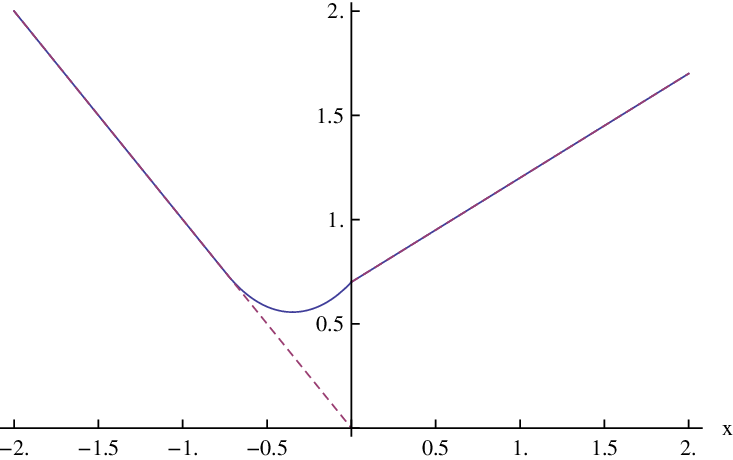
This case is illustrated in Figure 2 under the assumptions that
 $\kappa=0.01$
,
 $\|\textbf{a}\| = 0.1$
,
 $r = 0.02$
,
 $k_1=1$
,
 $k_2 = 0.5$
, and
 $k_3 = 0.7$
(implying that
 $c^\ast=-0.348597$
,
 $x_2^\ast=-0.739769$
, and
 $x_1^\ast=0$
).
The value function (solid) and exercise payoff (dashed).

It is worth pointing out here that in the case where
 $k_3=0$
and
 $k_1=k_2$
, the exercise payoff is continuous and even, and the findings of Theorem 2 apply. In that case, the optimal boundaries can be obtained from the optimality condition
 \begin{equation*}\psi_\kappa e^{\psi_\kappa x^\ast}(1-\varphi_\kappa x^\ast)=\varphi_\kappa e^{\varphi_\kappa x^\ast}(1-\psi_\kappa x^\ast).\end{equation*}
3.2. Periodic and even payoff
In order to illustrate how the approach applies in the periodic setting, resulting in multiple boundaries, consider the periodic payoff
 $\,\hat{\!F}(x)=\cos(x)$
. Since the payoff is even, attains its maxima at the points
 $y_n = 2n\pi$
, attains its minima at the points
 $x_n = (2n+1)\pi$
, and is symmetric on the sets
 $[2n\pi,2(n+1)\pi]$
,
 $n\in \mathbb{Z}$
, we notice that we can extend the findings of Theorem 2 and make an ansatz that the optimal reference point is
 $c_n^\ast=x_n$
. To see that this is indeed the case, we first observe that if
 $y\in [y_n,x_n]$
, then
 $\Pi_{x_n}(x_n+y)=\Pi_{x_n}(x_n-y)$
, since
 $\cos(x_n-y)=\cos(x_n+y)$
and
 \begin{align*}U_{x_n}(x_n-y)&=\frac{\hat{\psi}_{\kappa}}{\hat{\psi}_{\kappa}-\hat{\varphi}_{\kappa}}e^{-\hat{\varphi}_{\kappa} y}-\frac{\hat{\varphi}_{\kappa}}{\hat{\psi}_{\kappa}-\hat{\varphi}_{\kappa}}e^{-\hat{\psi}_{\kappa} y}\\&=-\frac{\varphi_{\kappa}}{\psi_{\kappa}-\varphi_{\kappa}}e^{\psi_{\kappa} y}+\frac{\psi_{\kappa}}{\psi_{\kappa}-\varphi_{\kappa}}e^{\varphi_{\kappa} y}=U_{x_n}(x_n+y)\end{align*}
for all
 $y\in \mathbb{R}$
and
 $n\in \mathbb{Z}$
. Consequently, it is sufficient to investigate the ratio
 $\Pi_{x_n}(y)$
on
 $[x_n,y_{n+1}]$
. Standard differentiation yields
 $\Pi^{\prime}_{x_n} (y)=u_n(y)/U_{x_n}^2(y)$
, where
 \begin{equation*}u_n(y) = \frac{\varphi_{\kappa}}{\psi_{\kappa}-\varphi_{\kappa}}e^{\psi_{\kappa} (y-x_n)}(\!\sin(y)+\psi_\kappa \cos(y))-\frac{\psi_{\kappa}}{\psi_{\kappa}-\varphi_{\kappa}}e^{\varphi_{\kappa} (y-x_n)}(\!\sin(y)+\varphi_\kappa \cos(y)).\end{equation*}
Noticing now that
 $u_n(x_n)=0$
,
 \begin{equation*}u_n(y_{n+1})=\frac{\psi_{\kappa}\varphi_{\kappa}}{\psi_{\kappa}-\varphi_{\kappa}}\left(e^{\psi_{\kappa} \pi}-e^{\varphi_{\kappa} \pi}\right)<0,\end{equation*}
and
 \begin{equation*}u^{\prime}_n (y) = \left(\varphi_{\kappa}(\psi_{\kappa}^2+1)e^{\psi_{\kappa} (y-x_n)}-\psi_{\kappa}(\varphi_{\kappa}^2+1)e^{\varphi_{\kappa} (y-x_n)}\right)\frac{\cos(y)}{\psi_{\kappa}-\varphi_{\kappa}},\end{equation*}
we observe that the equation
 $u_n(y)=0$
has a unique root
 $z_n^\ast\in(x_n+\frac{\pi}{2},y_{n+1})$
such that
 $$z_n^ * = \mathop {argmax}\limits_{y \in [{x_n},{y_{n + 1}}]} {\Pi _{{x_n}}}(y).$$
It is now clear that the value of the optimal stopping policy reads as
 \begin{equation*}V_\kappa(\textbf{x})=\begin{cases}\Pi_{x_n}(z_n^\ast) U_{x_n}\big(\textbf{a}^T\textbf{x}\big),& \textbf{a}^T\textbf{x}\in \cup_{n\in \mathbb{Z}}(x_n-z_n^\ast,x_n+z_n^\ast),\\[5pt]
\cos\!\big(\textbf{a}^T\textbf{x}\big),&\textbf{a}^T\textbf{x}\not\in \cup_{n\in \mathbb{Z}}(x_n-z_n^\ast,x_n+z_n^\ast).\end{cases}\end{equation*}
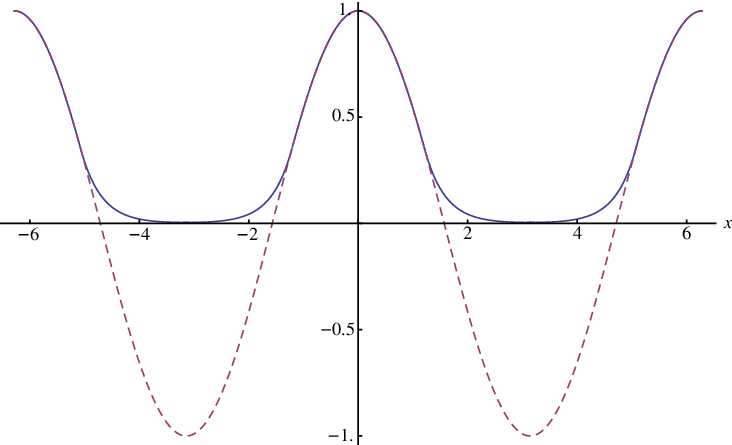
This value and the optimal policies are illustrated for
 $y\in[{-}2\pi,2\pi]$
in Figure 3 under the assumptions that
 $\kappa = 0.02$
,
 $r = 0.03,$
and
 $\sigma = 0.1$
(implying that the optimal thresholds are
 $-5.07233$
,
 $-1.21086$
,
 $1.21086$
,
 $5.07233$
).
The value function (solid) and exercise payoff (dashed) in the periodic case.

It is worth noticing that the worst-case prior is induced in the present case by the density generator
 \begin{equation*}{{\boldsymbol{\theta}}}^\ast=\begin{cases}\kappa\frac{{{\textit{\textbf{a}}}}}{\|{{\textit{\textbf{a}}}}\|}, &(2n+1)\pi \leq \textbf{a}^T\textbf{x} \leq 2(n+1)\pi,\\[6pt]
-\kappa\frac{{{\textit{\textbf{a}}}}}{\|{{\textit{\textbf{a}}}}\|}, &2n\pi \leq \textbf{a}^T\textbf{x} \leq (2n+1)\pi,\end{cases}\end{equation*}
for all
 $n\in \mathbb{Z}$
. Essentially, the optimal density generator tends to drive the dynamics of the underlying diffusion towards the minimum points
 $x_n$
of the exercise payoff.
4. Radially symmetric payoff
It is well known from the literature on linear diffusions that the radial part of a multidimensional Brownian motion constitutes a Bessel process. Our objective is now to exploit this connection by focusing on exercise payoffs which are radially symmetric. More precisely, we now assume that the payoff is of the form
 \begin{align}F({\textbf{x}})=\,\hat{\!F}\left(\|{\textit{\textbf{x}}}\|^2\right) = \,\hat{\!F}\left(\sum_{i=1}^dx_i^2\right),\end{align}
where
 $\,\hat{\!F}\,:\,\mathbb{R}_+\mapsto \mathbb{R}$
is a known measurable function. We now make an ansatz and focus on functions which are radially symmetric, that is, on functions of the form
 \begin{align*}u({\textbf{x}})= h\big(\|{\textit{\textbf{x}}}\|^2\big) = h\left(\sum_{i=1}^dx_i^2\right),\end{align*}
where
 $h\,:\,\mathbb{R}_+\mapsto \mathbb{R}_+$
is assumed to be twice continuously differentiable on
 $\mathbb{R}_+$
. In this case, a short calculation yields that the worst-case prior becomes
 \begin{equation*}{{\boldsymbol{\theta}}}^*=\kappa \text{sgn}\big(h^{\prime}\big(\|{{\textit{\textbf{x}}}}\|^2\big)\big) \frac{{{\textit{\textbf{x}}}}}{\|{{\textit{\textbf{x}}}}\|},\end{equation*}
so that the worst-case drift points either towards the origin or away from it. In this case, solving
 \begin{equation*}(\mathcal{A}^{{\boldsymbol{\theta}}^\ast}u)({{\textit{\textbf{x}}}})=ru({{\textit{\textbf{x}}}})\end{equation*}
is equivalent to solving
 \begin{equation*}2\big(\|{{\textit{\textbf{x}}}}\|^2\big)h^{\prime\prime}\big(\|{{\textit{\textbf{x}}}}\|^2\big)+\left(d-2\kappa\|{{\textit{\textbf{x}}}}\|\right)h^{\prime}\big(\|{{\textit{\textbf{x}}}}\|^2\big)=rh\big(\|{{\textit{\textbf{x}}}}\|^2\big)\end{equation*}
on
 $\{{{\textit{\textbf{x}}}}\in \mathbb{R}^d\,:\,h^{\prime}\big(\|{{\textit{\textbf{x}}}}\|^2\big)\geq 0\}$
and
 \begin{equation*}2\big(\|{{\textit{\textbf{x}}}}\|^2\big)h^{\prime\prime}\big(\|{{\textit{\textbf{x}}}}\|^2\big)+\left(d+2\kappa\|{{\textit{\textbf{x}}}}\|\right)h^{\prime}\big(\|{{\textit{\textbf{x}}}}\|^2\big)=rh\big(\|{{\textit{\textbf{x}}}}\|^2\big)\end{equation*}
on
 $\{{{\textit{\textbf{x}}}}\in \mathbb{R}^d\,:\,h^{\prime}\big(\|{{\textit{\textbf{x}}}}\|^2\big)\leq0\}$
. Denote now by
 $M_{a,b}$
and by
 $W_{a,b}$
the Whittaker functions of the first and second type, respectively, and define the functions
 $\psi_1(y)=u_{\kappa}(\sqrt{y})$
,
 $\varphi_1(y)=v_{\kappa}(\sqrt{y})$
,
 $\psi_2(y)=u_{-\kappa}(\sqrt{y})$
, and
 $\varphi_2(y)=v_{-\kappa}(\sqrt{y})$
, where
 \begin{align*}u_{\kappa}(y)&= y^{\frac{1-d}{2}}e^{\kappa y}M_{a_\kappa,b}\left(2\sqrt{2r+\kappa^2}y\right),\\v_{\kappa}(y)&= y^{\frac{1-d}{2}}e^{\kappa y} W_{a_\kappa,b}\left(2\sqrt{2r+\kappa^2}y\right),\end{align*}
 $b=d/2-1$
, and
 \begin{equation*}a_\kappa=\frac{\kappa(d-1)}{2\sqrt{\kappa^2+2r}}.\end{equation*}
Making the substitution
 $h\big(\|{{\textit{\textbf{x}}}}\|^2\big)=v(\|{{\textit{\textbf{x}}}}\|)$
shows that the solutions of these ordinary differential equations read as
 \begin{align*}h\big(\|{\textit{\textbf{x}}}\|^2\big) = c_1\psi_1\big(\|{\textit{\textbf{x}}}\|^2\big)+c_2\varphi_1\big(\|{\textit{\textbf{x}}}\|^2\big)\end{align*}
on
 $\{{{\textit{\textbf{x}}}}\in \mathbb{R}^d\,:\,h^{\prime}\big(\|{{\textit{\textbf{x}}}}\|^2\big)\geq 0\}$
and as
 \begin{align*}h\big(\|{\textit{\textbf{x}}}\|^2\big) = \hat{c}_1\psi_2\big(\|{\textit{\textbf{x}}}\|^2\big)+\hat{c}_2\varphi_2\big(\|{\textit{\textbf{x}}}\|^2\big)\end{align*}
on
 $\{{{\textit{\textbf{x}}}}\in \mathbb{R}^d\,:\,h^{\prime}\big(\|{{\textit{\textbf{x}}}}\|^2\big)\leq 0\}$
(cf. [Reference Linetsky27]). As in the previous subsection, we now let
 $c\in \mathbb{R}_+$
be an arbitrary reference point and define the function
 $U_c\,:\,\mathbb{R}_+\mapsto \mathbb{R}_+$
by
 $U_c(\|\textbf{x}\|^2)=\max(\hat{h}_{1c}(\|\textbf{x}\|^2),\hat{h}_{2c}(\|\textbf{x}\|^2))$
, where
 \begin{align*}\hat{h}_{1c}\big(\|\textbf{x}\|^2\big)&=B_1^{-1}\left(\frac{\psi^{\prime}_1(c)}{S^{\prime}_1(c)}\varphi_1\big(\|\textbf{x}\|^2\big)-\frac{\varphi^{\prime}_1(c)}{S^{\prime}_1(c)}\psi_1\big(\|\textbf{x}\|^2\big)\right),\\[4pt]
\hat{h}_{2c}\big(\|\textbf{x}\|^2\big)&=B_2^{-1}\left(\frac{\psi^{\prime}_2(c)}{S^{\prime}_2 (c)}\varphi_2(\|\textbf{x}\|^2)-\frac{\varphi^{\prime}_2 (c)}{S^{\prime}_2 (c)}\psi_2\big(\|\textbf{x}\|^2\big)\right),\\[4pt]
B_{1}&=\frac{\sqrt{2r+\kappa^2}\Gamma(d-1)}{\Gamma\left(\frac{d-1}{2}-a_\kappa\right)},\\[4pt]
B_{2}&=\frac{\sqrt{2r+\kappa^2}\Gamma(d-1)}{\Gamma\left(\frac{d-1}{2}-a_{-\kappa}\right)},\\[4pt]
S^{\prime}_1 (y)&=e^{2\kappa\sqrt{y}}y^{-\frac{d}{2}},\\[4pt]
S^{\prime}_2 (y)&=e^{-2\kappa\sqrt{y}}y^{-\frac{d}{2}}.\end{align*}
We first observe that
 $U_c(y)$
is continuously differentiable on
 $\mathbb{R}_+$
, since
 $U_c(c{-})=U_c(c{+})=1$
and
 $U^{\prime}_c (c{-})=U^{\prime}_c (c{+})=0$
. Moreover, since
 $U^{\prime\prime}_c (c{-})=r/(2c)=U^{\prime\prime}_c (c{+})$
we again find that
 $U_c(y)$
is twice continuously differentiable on
 $\mathbb{R}_+$
and, consequently, that
 $U_c(y)$
constitutes the solution of the boundary value problem
 \begin{align}\begin{split}&2\big(\|{{\textit{\textbf{x}}}}\|^2\big)U^{\prime\prime}_c \big(\|{{\textit{\textbf{x}}}}\|^2\big)+\left(d-2\kappa\|{{\textit{\textbf{x}}}}\|\text{sgn}(\|{{\textit{\textbf{x}}}}\|^2-c)\right)U^{\prime}_c \big(\|{{\textit{\textbf{x}}}}\|^2\big)-rU_c\big(\|{{\textit{\textbf{x}}}}\|^2\big)=0,\\&U_c(c)=1,\quad U^{\prime}_c (c)=0.\end{split}\end{align}
As in the case of the previous subsection, we define the two cases associated with the extreme reference points by
 \begin{align*}U_0(y)=\psi_1(y) =&(2\sqrt{\kappa^2+2r})^{\frac{d-1}{2}} e^{\left(\kappa-\sqrt{\kappa^2+2 r}\right)\sqrt{y}}\\[4pt]
& \cdot \tilde{M}\left(\frac{(d-1)}{2} \left(1-\frac{\kappa}{\sqrt{\kappa^2+2 r}}\right),d-1,2 \sqrt{\kappa^2+2 r} \sqrt{y}\right),\\[4pt]
U_\infty(y)= \varphi_2(y) =&(2\sqrt{\kappa^2+2r})^{\frac{d-1}{2}} e^{-\left(\sqrt{\kappa^2+2 r}+\kappa\right)\sqrt{y}}\\[4pt]
& \cdot \tilde{U}\left(\frac{(d-1)}{2} \left(1+\frac{\kappa}{\sqrt{\kappa^2+2 r}}\right),d-1,2 \sqrt{\kappa^2+2 r}\sqrt{y}\right),\end{align*}
where
 $\tilde{M}$
and
 $\tilde{U}$
denote the confluent hypergeometric functions of the first and second type, respectively. It is worth noticing that since the lower boundary is entrance for the underlying diffusion process, we have that
 \begin{align*}\lim_{y\rightarrow 0+}\hat{h}_{ic}(y)&=\infty,\\\lim_{y\rightarrow 0+}\frac{\hat{h}^{\prime}_{ic} (y)}{S^{\prime}_i (y)}&=B_i^{-1}\frac{\psi^{\prime}_i (c)}{S^{\prime}_i (c)}\lim_{y\rightarrow 0+}\frac{\varphi^{\prime}_i (y)}{S^{\prime}_i (y)}>-\infty\end{align*}
when
 $c\in(0,\infty)$
(cf. [8, p. 19]). The upper boundary is, in turn, natural for the underlying diffusion process, and hence we have that
 \begin{align*}\lim_{y\rightarrow \infty}\hat{h}_{ic}(y)&=+\infty,\\\lim_{y\rightarrow \infty}\frac{\hat{h}^{\prime}_{ic} (y)}{S^{\prime}_i (y)}&=+\infty\end{align*}
when
 $c\in(0,\infty)$
(cf. [8, p. 19]). However, in contrast with natural boundary behavior, we now notice that in the extreme case,
 \begin{equation*}\lim_{y\rightarrow0+}\psi_1(y)= \big(2\sqrt{\kappa^2+2r}\big)^{\frac{d-1}{2}}.\end{equation*}
Again, we observe that the function
 $U_c$
is strictly convex.
Lemma 3. The function
 $U_c(y)$
is strictly convex on
 $\mathbb{R}_+$
.
Proof.
 $U_c(y)$
is nonnegative and decreasing on (0, c]. Consequently, we notice by invoking (4.2) that
 \begin{equation*}2yU^{\prime\prime}_c (y)=rU_c(y)-\left(d+2\kappa\sqrt{y}\right)U^{\prime}_c (y)>0,\end{equation*}
demonstrating that
 $U_c(y)$
is strictly convex on (0, c]. On the other hand, (4.2) also implies that on
 $(c,\infty)$
we have
 \begin{equation*}\frac{2yU^{\prime\prime}_c (y)}{S^{\prime}_1 (y)}=\frac{r(U_c(y)-yU^{\prime}_c (y))}{S^{\prime}_1 (y)}-\left(d-2\kappa\sqrt{y}-ry\right)\frac{U^{\prime}_c (y)}{S^{\prime}_1 (y)}.\end{equation*}
Since
 \begin{equation*}\frac{d}{dy}\frac{U_c(y)-yU^{\prime}_c (y)}{S^{\prime}_1 (y)}=\left(d-2\kappa\sqrt{y}-ry\right)U_c(y)m^{\prime}_1 (y),\end{equation*}
where
 $m^{\prime}_1 (y)=1/(2yS^{\prime}_1 (y))$
, we notice by integrating from c to y that
 \begin{equation*}r\frac{U_c(y)-yU^{\prime}_c (y)}{S^{\prime}_1 (y)} = \frac{r}{S^{\prime}_1 (c)}+r\int_c^y \left(d-2\kappa\sqrt{t}-rt\right)U_c(t)m^{\prime}_1(t)dt.\end{equation*}
Since
 \begin{equation*}\frac{U^{\prime}_c(y)}{S^{\prime}_1(y)} = r\int_c^yU_c(t)m^{\prime}_1(t)dt,\end{equation*}
we finally find that
 \begin{equation*}\frac{2yU^{\prime\prime}_c(y)}{S^{\prime}_1(y)}=\frac{r}{S^{\prime}_1(c)}+r\int_c^y \left(2\kappa(\sqrt{y}-\sqrt{t})+r(y-t)\right)U_c(t)m^{\prime}_1(t)dt >0,\end{equation*}
proving that
 $U_c(y)$
is strictly convex on
 $(c,\infty)$
as well.
Utilizing the Itô–Döblin theorem now shows that the process
 $Y_t=\|\textbf{X}_t\|^2$
satisfies the SDE
 \begin{align}dY_t = \Big(d-2\kappa\sqrt{Y_t}\text{sgn}(Y_t-c)\Big)dt+2\sqrt{Y_t}d\tilde{W}_t^{{\boldsymbol{\theta}}_c},\quad Y_0=\|\textbf{x}\|^2,\end{align}
where
 $\tilde{W}_t^{{\boldsymbol{\theta}}_c}$
is a Brownian motion under the measure
 $\mathbb{Q}^{{\boldsymbol{\theta}}_c}$
characterized by the density generator
 \begin{equation*}{\boldsymbol{\theta}}_{ct}=\kappa \text{sgn}\big(\|\textbf{X}_t\|^2-c\big) \frac{\textbf{X}_t}{\|\textbf{X}_t\|}.\end{equation*}
Hence, we again observe that the controlled process has a stationary distribution for a fixed reference point c. In the present case it reads as
 \begin{equation*}p_c(y)=\frac{m^{\prime}_c (y)}{m_c(0,\infty)},\end{equation*}
where
 \begin{equation*}m^{\prime}_c (y)=\frac{1}{2}y^{\frac{d}{2}-1}e^{-2\kappa|\sqrt{y}-\sqrt{c}|}\end{equation*}
and
 \begin{equation*}m_c(0,\infty)=\frac{1}{2}(2\kappa)^{-d}\left(e^{2\kappa\sqrt{c}}\Gamma(d,2\kappa \sqrt{c})+e^{-2\kappa\sqrt{c}}\int_0^{2\kappa\sqrt{c}}t^{d-1}e^{t}dt\right).\end{equation*}
It is also worth noticing that applying the Itô–Döblin theorem to the process
 $Z_t\,:\!=\,\sqrt{Y_t}=\|\textbf{X}_t\|$
results in the SDE
 \begin{equation*}dZ_t=\left(\frac{d-1}{2Z_t}-\kappa \text{sgn}(Z_t-\sqrt{c})\right)dt+d\tilde{W}_t^{{\boldsymbol{\theta}}_c},\quad Z_0=\|\textbf{x}\|,\end{equation*}
which constitutes a Bessel process of order
 $d/2-1$
with an alternating drift.
It is at this point worth emphasizing that as in the case of the previous section, the underlying process is bounded for any
 $\mathbb{Q}^{{\boldsymbol{\theta}}}\in \mathcal{P}^\kappa$
between the processes
 $\hat{Y}_t^{-\kappa}$
and
 $\hat{Y}_t^{\kappa}$
, where
 \begin{equation*}d\hat{Y}_t^{\kappa} =\left(d+2\kappa \sqrt{\hat{Y}_t^{\kappa}}\right)dt+2\sqrt{\hat{Y}_t^{\kappa}}dW_t^\theta.\end{equation*}
Since the boundaries are unattainable for the processes
 $\hat{Y}_t^{-\kappa}$
and
 $\hat{Y}_t^{\kappa}$
, the universal finiteness of the stopping times follows from the properties of the derivative of the scale function
 \begin{equation*}S^{\prime}_{\kappa}(y)=y^{-\frac{d}{2}}e^{2\kappa \sqrt{y}}\end{equation*}
and the fact that the bounding processes can be viewed as exponentially killed diffusions.
A modified characterization of the representation presented in Theorem 1 is naturally valid in this case as well, since in the present case the set of admissible reference points is
 $[0,\infty]$
. The positivity of the sign of the relationship between the degree of ambiguity and the function
 $U_c(y)$
is naturally true in this case as well. Consequently, higher ambiguity decreases value and accelerates exercise by shrinking the continuation region. It is also worth noticing that the function
 $U_c(y)$
is no longer symmetric; hence, representations similar to the ones developed in Theorem 2 and in Theorem 3 are no longer possible. Moreover, since the lower boundary is entrance for the underlying process, policies which are radically different from the case considered in the previous section may appear. We will illustrate this point explicitly in the following subsection. We emphasize that the results of Lemma 2 are valid in this case as well. More precisely, an increased degree of ambiguity increases
 $U_c(y)$
for all
 $y\in\mathbb{R}_+\backslash\{c\}$
and all reference points
 $c\in[0,\infty]$
. The proof of this claim is completely analogous to the proof of Lemma 2.
4.1. Nonlinear straddle option
In order to illustrate the peculiarities associated with the present case, let us consider the nonlinear straddle option case
 $\,\hat{\!F}(y)=|\sqrt{y}-K|$
, where
 $K>0$
is an exogenously set fixed strike price. Consider first the behavior of the function
 \begin{equation*}\big(\mathcal{L}_{\psi_{1}}\,\hat{\!F}\big)(y)=\big(\sqrt{y}-K\big)\frac{\psi^{\prime}_{1} (y)}{S^{\prime}_1(y)}-\frac{1}{2\sqrt{y}}\frac{\psi_{1}(y)}{S^{\prime}_1(y)}.\end{equation*}
We notice that
 $(\mathcal{L}_{\psi_{1}}\,\hat{\!F})(0{+})=0$
and
 \begin{equation*}\big(\mathcal{L}_{\psi_{1}}\,\hat{\!F}\big)^{\prime}(y)=\left(r\big(\sqrt{y}-K\big)+\kappa - \frac{d-1}{2\sqrt{y}}\right)\psi_{1}(y)m^{\prime}_1(y),\end{equation*}
demonstrating that
 \begin{equation*}\big(\mathcal{L}_{\psi_{1}}\,\hat{\!F}\big)(y)=\int_0^y\left(r\big(\sqrt{t}-K\big)+\kappa - \frac{d-1}{2\sqrt{t}}\right)\psi_{1}(t)m^{\prime}_1(t)dt.\end{equation*}
Since
 $r(\sqrt{y}-K)+\kappa - (d-1)/(2\sqrt{y})$
is monotonically increasing and satisfies the inequality
 \begin{equation*}r(\sqrt{y}-K)+\kappa - (d-1)/(2\sqrt{y})\gtreqqless 0\end{equation*}
for
 $y\gtreqqless \tilde{y}_0$
, where
 $\tilde{y}_0$
is the unique root of
 $r(\sqrt{y}-K)+\kappa - (d-1)/(2\sqrt{y})=0$
, we find that for
 $y>\hat{y}>\tilde{y}_0$
,
 \begin{align*}(\mathcal{L}_{\psi_{1}}\,\hat{\!F})(y)&=(\mathcal{L}_{\psi_{1}}\,\hat{\!F})(\hat{y})+\int_{\hat{y}}^y\left(r\big(\sqrt{t}-K\big)+\kappa - \frac{d-1}{2\sqrt{t}}\right)\psi_{1}(t)m^{\prime}_1(t)dt\\
&\geq (\mathcal{L}_{\psi_{1}}\,\hat{\!F})(\hat{y})+\left(r\big(\sqrt{\hat{y}}-K\big)+\kappa - \frac{d-1}{2\sqrt{\hat{y}}}\right)\int_{\hat{y}}^y\psi_{1}(t)m^{\prime}_1(t)dt\\
&= (\mathcal{L}_{\psi_{1}}\,\hat{\!F})(\hat{y})+\left(r\big(\sqrt{\hat{y}}-K\big)+\kappa - \frac{d-1}{2\sqrt{\hat{y}}}\right)\frac{1}{r}\left(\frac{\psi^{\prime}_{1}(y)}{S^{\prime}_1(y)}-\frac{\psi^{\prime}_{1} (\hat{y})}{S^{\prime}_1(\hat{y})}\right).\end{align*}
Hence,
 \begin{equation*}\lim_{y\rightarrow\infty}(\mathcal{L}_{\psi_{1}}\,\hat{\!F})(y)=\infty,\end{equation*}
demonstrating that there is a unique
 $y^{\ast}_{K}>\tilde{y}_0$
satisfying the condition
 $$({{\cal L}_{{\psi _1}}}{\mkern 1mu} \hat{\!F})(y_K^ * ) = 0.$$
Noticing that
 \begin{equation*}\frac{d}{dy}\frac{\sqrt{y}-K}{\psi_{1}(y)}=-\frac{S^{\prime}_1(y)}{\psi_{1}^2(y)}(\mathcal{L}_{\psi_{1}}\,\hat{\!F})(y)\end{equation*}
in turn demonstrates that
 $y^{\ast}_{K}>K^2$
is the unique threshold at which the ratio
 \begin{equation*}\Pi_0(y)=\frac{\sqrt{y}-K}{\psi_{1}(y)}\end{equation*}
is maximized. Moreover,
 $\partial y^{\ast}_{K}/\partial K >0$
,
 $\lim_{K\rightarrow\infty}y^{\ast}_{K}=\infty$
, and
 $\lim_{K\rightarrow0+}y^{\ast}_{K}=y^{\ast}_{0}>0$
, where the threshold
 $y^{\ast}_{0}\in \mathbb{R}_+$
is the unique root of the first-order optimality condition
 \begin{equation*}\psi_1(y^\ast_{0})=2\psi^{\prime}_1(y^\ast_{0})y^{\ast}_{0}.\end{equation*}
We now define the monotonically increasing and continuously differentiable function
 $\tilde{V}_\kappa\,:\,\mathbb{R}_+\mapsto \mathbb{R}_+$
by
 \begin{equation*}\tilde{V}_\kappa(y)= \psi_{1}(y)\sup_{x\geq y}\left\{\frac{\sqrt{x}-K}{\psi_{1}(x)}\right\}=\begin{cases}\sqrt{y}-K,&y\in \big[y^{\ast}_{K},\infty\big),\\[5pt]
\Pi_0\big(y^{\ast}_{K}\big)\psi_{1}(y),&y\in\big(0,y^{\ast}_{K}\big).\end{cases}\end{equation*}
Since
 $\tilde{V}_\kappa(y)$
is nonnegative and dominates
 $\sqrt{y}-K$
for all
 $y\in \mathbb{R}_+$
, it dominates
 $(\sqrt{y}-K)^+$
as well. Hence, we observe by utilizing similar arguments as in the proof of Theorem 2 that
 \begin{equation*}\tilde{V}_\kappa(y)=\sup_{\tau\in\mathcal{T}}\mathbb{E}_{y}^{\mathbb{Q}^{{\boldsymbol{\theta}}_0}}\left[e^{-r\tau}\left(\sqrt{Y_\tau}-K\right)^+\right].\end{equation*}
Given this function we immediately notice that if the condition
 \begin{equation*}\lim_{y\rightarrow 0+}\Pi_0\big(y^{\ast}_{K}\big)\psi_{1}(y) = \Pi_0\big(y^{\ast}_{K}\big)\big(2\sqrt{\kappa^2+2r}\big)^{\frac{d-1}{2}}\geq K\end{equation*}
is met, then
 $\tilde{V}_\kappa(y)$
dominates the exercise payoff
 $|\sqrt{y}-K|$
for all
 $y\in \mathbb{R}_+$
as well. Therefore, we notice that in that case
 \begin{equation*}\tilde{V}_\kappa(y)=\sup_{\tau\in\mathcal{T}}\mathbb{E}_{y}^{\mathbb{Q}^{{\boldsymbol{\theta}}_0}}\left[e^{-r\tau}|\sqrt{Y_\tau}-K|\right].\end{equation*}
However, if
 \begin{align}\lim_{y\rightarrow 0+}\Pi_0\big(y^{\ast}_{K}\big)\psi_{1}(y) = \Pi_0\big(y^{\ast}_{K}\big)\big(2\sqrt{\kappa^2+2r}\big)^{\frac{d-1}{2}}<K,\end{align}
then the optimal policy is no longer a standard single-boundary policy. To see that this is indeed the case, consider the behavior of the ratio
 \begin{equation*}\hat{\Pi}_c(y)=\frac{|\sqrt{y}-K|}{U_c(y)}\end{equation*}
for all
 $c\in (0,\infty)$
and
 $y\in \mathbb{R}_+$
. For an arbitrary state
 $y\in \mathbb{R}_+$
, define the continuous difference
 $D\,:\,\mathbb{R}_+\mapsto \mathbb{R}$
as
 \begin{equation*}D(c)=\sup_{w\geq y}\hat{\Pi}_c(w)-\sup_{w\leq y}\hat{\Pi}_c(w).\end{equation*}
Consider first the extreme case D(0). It is clear from our analysis of the single-boundary case treated above that
 $\hat{\Pi}_0(y)$
is monotonically decreasing on
 $(0,K^2)\cup (y_K^\ast,\infty)$
and monotonically increasing on
 $(K^2,y_K^\ast)$
, and that it satisfies the limiting conditions
 $\lim_{y\rightarrow \infty}\hat{\Pi}_0(y)=0$
and
 \begin{equation*}\lim_{y\rightarrow 0}\hat{\Pi}_0(y) = \big(2\sqrt{\kappa^2+2r}\big)^{\frac{1-d}{2}}K>\Pi_0(y^{\ast}_{K}),\end{equation*}
by the assumption (4.4). Combining these observations shows that
 $\hat{\Pi}_0(0)>\hat{\Pi}_0(y)$
for all
 $y\in \mathbb{R}_+$
and, consequently, that
 $D(0)<0$
. Consider now the other extreme setting,
 $D(\infty)$
. Utilizing arguments completely analogous to the previous ones, we notice that
 $\hat{\Pi}_\infty(y)$
is monotonically increasing on
 $(K^2,\infty)$
and bounded for
 $y\in(0,\infty)$
, and that it satisfies the limiting conditions
 $\hat{\Pi}_\infty(0)=0$
and
 $\lim_{y\rightarrow\infty}\hat{\Pi}_\infty(y)=\infty.$
Consequently, we notice that for
 $y\in(0,\infty)$
we have
 \begin{equation*}\sup_{w\leq y}\hat{\Pi}_\infty(w)<\infty, \qquad\sup_{w\geq y}\hat{\Pi}_\infty(w)=\infty,\end{equation*}
and, therefore,
 $\lim_{c\rightarrow\infty}D(c)=\infty$
. Combining these results with the continuity of the difference D(c) proves that there is at least one
 $c^\ast\in\mathbb{R}_+$
such that
 $D(c^\ast)=0$
, implying that
 \begin{equation*}\sup_{w\geq y}\hat{\Pi}_{c^\ast}(w)=\sup_{w\leq y}\hat{\Pi}_{c^\ast}(w).\end{equation*}
Moreover, the optimal thresholds
 $y_i^\ast$
,
 $i=1,2$
, satisfy the ordinary first-order optimality conditions
 \begin{equation*}\frac{h_{ic^\ast}(y_i^\ast)}{2\sqrt{y_i^\ast}}=h_{ic^\ast}^{\prime}(y_i^\ast)(\sqrt{y_i^\ast}-K), \qquad i=1,2.\end{equation*}
In this case the value reads as
 \begin{equation*}V_\kappa(y)=\begin{cases}\sqrt{y}-K,&y\geq y_1^\ast,\\[4pt]
\hat{\Pi}_{c^\ast}(y_1^\ast)h_{1c^\ast}(y),&y_2^\ast<y<y_1^\ast,\\[4pt]
K-\sqrt{y},&y\leq y_2^\ast.\end{cases}\end{equation*}
Naturally, the set
 $(0,y_2^\ast)\cup(y_1^\ast,\infty)$
constitutes the stopping set in the present example.
In order to illustrate our findings numerically, we now assume that
 $r = 0.1$
,
 $\kappa = 0.02$
, and
 $d = 5$
(implying that the critical cost below which the problem becomes a single-boundary problem is
 $K\approx 0.975222$
). The two-boundary setting is illustrated in Figure 4 under the assumption that
 $K=4$
(implying that
 $y_2^\ast=3.85108$
,
 $y_1^\ast=63.4344$
, and
 $c^\ast=9.07278$
). The single-boundary setting is illustrated in Figure 5 under the assumption that
 $K=0.85$
(implying that
 $y_{0.85}^\ast=4.7294$
).
The value (solid) and exercise payoff (dashed).

The value (solid) and exercise payoff (dashed).

4.2. A truly two-dimensional modification
The explicit solvability of the problem described before is based on the dimension reduction due to the symmetry of the situation. If this symmetry is even slightly broken, there is usually no hope of finding such explicit solutions anymore. In the rest of this section, we will illustrate this by an example and show how these more general problems may be treated. We consider again the radially symmetric payoffs (4.1), but instead of assuming
 $\|{\boldsymbol{\theta}}_t \|^2\leq \kappa^2$
for the density process, we now assume that
 \begin{equation*}\|{\boldsymbol{\theta}}_t \|_\infty\leq \kappa, \quad \mbox{ i.e., }\max\{|\theta_{1t}|,|\theta_{2t}|\}\leq \kappa,\end{equation*}
and denote the set of all corresponding probability measures by
 $\hat{\mathcal P}^\kappa.$
We note that this ambiguity structure has been considered in [Reference Alvarez and Christensen2]. We write
 \begin{align*}\hat V_\kappa({\textit{\textbf{x}}}) = \sup_{\tau\in \mathcal{T}}\inf_{\mathbb{Q}^{{\boldsymbol{\theta}}}\in \hat{\mathcal{P}}^\kappa}\mathbb{E}_{{\textit{\textbf{x}}}}^{{\mathbb{Q}^{{\boldsymbol{\theta}}}}}\left[e^{-r\tau}F(\textbf{X}_\tau)\mathbb{1}_{\{\tau
< \infty\}}\right]\end{align*}
and
 $\hat C_\kappa$
for the corresponding continuation set. As
 $\frac{1}{\sqrt{d}}\|{\cdot}\|\leq \|{\cdot}\|_\infty\leq \|{\cdot}\|$
, it is clear that for all
 ${\textit{\textbf{x}}}$
 \begin{equation*}V_{\kappa \sqrt{d}}({\textit{\textbf{x}}})\leq \hat V_\kappa({\textit{\textbf{x}}})\leq V_{\kappa}({\textit{\textbf{x}}}) \end{equation*}
and therefore
 \begin{equation*}C_{\kappa\sqrt{d}}\subseteq \hat C_{\kappa}\subseteq C_{\kappa}.\end{equation*}
For the sake of simplicity, we now restrict our attention to the case
 $d=2$
and
 $F(y)=y$
. In this case, it is—using the results of this section—easily seen that
 $C_{\kappa\sqrt{d}}$
and
 $C_\kappa$
are circles around 0. Although there is little hope of finding
 $\hat V_\kappa$
and
 $\hat C_{\kappa}$
explicitly, it is easy to infer the structure of the solution: the worst-case measure is characterized by the density generator
 \begin{equation*}\hat{{\boldsymbol{\theta}}}^\ast=(\kappa \text{sgn}(x_{1}),\kappa \text{sgn}(x_{2})).\end{equation*}
Because of the symmetry of the situation, the optimal stopping problem to be solved can be written as
 \begin{equation*}\hat V_\kappa({\textbf{x}})=\sup_{\tau\in \mathcal{T}}\mathbb{E}_{{\textit{\textbf{x}}}}^{\hat{{\boldsymbol{\theta}}}^\ast}\left[e^{-r\tau}F(\textbf{X}_\tau)\mathbb{1}_{\{\tau
< \infty\}}\right],\end{equation*}
for x in the upper quadrant
 $\mathbb{R}_+^2$
, where X is a Brownian motion with drift
 $({-}\kappa,-\kappa)$
and (orthogonal) reflection on the boundaries of
 $\mathbb{R}_+^2$
. Note that reflected Brownian motion in the quadrant has been studied extensively; see [Reference Harrison and Reiman22], [Reference Williams39], to mention just two works. Recently, the Green kernel has been found semi-explicitly (in the transient case); see [Reference Franceschi19]. This opens the door to characterizing the unknown optimal stopping boundary using integral equation techniques; see [Reference Peskir and Shiryaev37] for the general theory and [Reference Christensen, Crocce, Mordecki and Salminen12] for a specific setting quite close to this one.
5. Conclusions
We analyzed the impact of Knightian uncertainty on the optimal timing policy of an ambiguity-averse decision-maker in the case where the underlying follows a multidimensional Brownian motion. We identified two special cases under which the problem can be explicitly solved and illustrated our findings in explicitly parameterized examples. Our results indicate that Knightian uncertainty not only accelerates the optimal timing policy in comparison with the unambiguous benchmark case, it may also add stability to the dynamics of the underlying under the worst-case measure. More precisely, even though the underlying multidimensional Brownian motion does not converge in the long run to a stationary distribution, the controlled process does. This observation shows that ambiguity may in some circumstances have a profound and nontrivial impact on the underlying dynamics.
This study modeled the underlying random factor dynamics as a multidimensional Brownian motion and focused on two functional forms permitting the utilization of dimension reduction techniques, in this way leading to stopping problems of linear diffusions. There are at least three natural directions in which our chosen modeling framework might be extended. First, even though most standard factor models rely on linear combinations of the driving factors, it would naturally be of interest to analyze how potential nonlinearities would affect the optimal timing decision in the presence of ambiguity. In particular, introducing state-dependent factors would cast light on the mechanisms of how nonlinearities in factor dynamics affect the decisions of ambiguity-averse decision-makers. Second, carrying out a thorough analysis of the truly two-dimensional modification presented in Subsection 4.2 would provide valuable information on the difference between problems that allow dimensionality reduction and problems that do not. Third, it would be interesting to add Bayesian learning, much in the spirit of the recent study [Reference Epstein and Ji15], to the class of problems considered. All these extensions are extremely challenging and at present beyond the scope of this study.
Acknowledgements
The authors are grateful to two anonymous referees for constructive comments and suggested improvements.