


Highlights
Baseline AHI and minimum SpO2 predict 12-month dyspnea in mild ALS with preserved daytime function.
Exploratory PSG thresholds (AHI ≥ 5/h; SpO2 nadir ≤ 88%) identify higher-risk patients and are associated with faster decline.
Nocturnal monitoring shows potential to enable earlier intervention than standard daytime assessments.
Introduction
Amyotrophic lateral sclerosis (ALS) is a relentlessly progressive neurodegenerative disorder characterized by degeneration of upper and lower motor neurons, leading to muscle weakness and respiratory failure, which remains the principal cause of death in most patients. Reference Anjum, Bakhuraysah, Alsharif, Mohammad, Shamsi and Hassan1,Reference Štětkářová and Ehler2 Timely detection of respiratory decline is critical, as early initiation of noninvasive ventilation (NIV) can improve survival and quality of life. Reference Maciel, Resqueti and Costa3,Reference Réginault, Wibart, Mathis, Le Masson, Pillet and Grassion4 However, conventional daytime measures such as forced vital capacity (FVC) often remain within normal limits during the mild stage, despite underlying respiratory muscle involvement. Reference Benzo-Iglesias, Rocamora-Pérez, Valverde-Martínez, García-Luengo, Benzo-Iglesias and López-Liria5,Reference Peller, Trevisan and Bujia6
Recent work highlights that nocturnal hypoventilation and sleep-disordered breathing (SDB) are common in ALS, frequently preceding daytime respiratory impairment. Reference Nuredini, Bottignole and Stragliati7 In a multicenter prospective study, Georges et al. found that almost half of ALS patients with preserved daytime FVC exhibited nocturnal desaturation, which predicted earlier NIV requirement. Reference O’Brien, Stavroulakis and Baxter8 Meta-analytic evidence indicates elevated apnea–hypopnea index (AHI) and low nocturnal oxygen saturation correlate with faster disease progression. Reference Zhang, Ren and Yang9 Vrijsen et al. demonstrated that nocturnal oxygen desaturation, with minimum SpO2 often below 88%, was associated with impaired sleep quality and respiratory events in ALS patients, highlighting a dissociation between nocturnal and daytime respiratory function, which may precede declines in daytime measures like FVC. Reference Vrijsen, Testelmans, Belge, Vanpee, Van Damme and Buyse10 Boentert et al. emphasized polysomnography (PSG)’s value for early detection but noted the lack of longitudinal data in asymptomatic, mild-stage patients. Reference Boentert11
Despite these observations, prospective longitudinal data are scarce regarding the utility of specific PSG parameters in predicting the onset of patient-reported respiratory symptoms among a rigorously defined cohort of ALS patients with preserved daytime pulmonary function and no dyspnea – those with FVC ≥ 80% predicted and Dyspnea-ALS-15 [DALS-15] = 0 at baseline. To address this gap, we conducted an exploratory longitudinal cohort study in mild-stage ALS (ALS Functional Rating Scale-Revised [ALSFRS-R] ≥ 37), hypothesizing that baseline nocturnal metrics, analyzed both as continuous variables and using clinically oriented thresholds (AHI ≥ 5 events/h, minimum SpO2 ≤ 88%), would identify individuals at high risk of developing dyspnea within 12 months. This approach aims to provide novel evidence for PSG as an early biomarker of respiratory vulnerability, potentially preceding conventional FVC-based monitoring in clinical practice.
Materials and Methods
Study design and participants
This prospective exploratory longitudinal cohort study was conducted at the Neurology Department of the Second Affiliated Hospital of Nanchang University. The study protocol was approved by the Ethics Committee of the Second Affiliated Hospital of Nanchang University, and written informed consent was obtained from all participants in accordance with the Declaration of Helsinki prior to enrollment.
We enrolled 41 patients with mild-stage ALS, diagnosed as definite or probable ALS according to the revised El Escorial criteria, Reference Brooks, Miller, Swash and Munsat12 with disease staging defined by an ALSFRS-R score ≥ 37. Reference Rani, Chandan and Devi13 Inclusion criteria for ALS patients included preserved ambulation, normal spirometry FVC ≥ 80% predicted, forced expiratory volume in 1 s (FEV1) ≥ 75% predicted, and absence of self-reported dyspnea (DALS-15 score = 0). Additionally, 41 age-matched (±3 years), sex-matched, and body mass index (BMI)-matched (±3 kg/m2) healthy controls were recruited from the local community or accompanying family members without neurological or respiratory disorders.
Exclusion criteria for both groups included diagnostic uncertainty (suspected ALS), comorbidities that could confound PSG results (e.g., chronic obstructive pulmonary disease, congestive heart failure, severe obesity [BMI ≥ 35 kg/m2], untreated thyroid dysfunction, or active malignancy), use of medications affecting sleep or respiration (e.g., benzodiazepines, opioids, or muscle relaxants within 2 weeks prior to enrollment), history of sleep disorders (e.g., diagnosed obstructive sleep apnea [OSA] or insomnia), psychiatric conditions (e.g., major depression or anxiety per DSM-5 criteria), or inability to complete overnight PSG due to cognitive impairment or logistical issues. Controls were further excluded if they had any self-reported sleep complaints or abnormal pulmonary function tests.
Participants underwent baseline clinical evaluations, pulmonary function testing, and overnight PSG. ALS patients were followed longitudinally for 12 months with quarterly assessments of ALSFRS-R, pulmonary function (FVC, FEV1, maximum voluntary ventilation [MVV]), and dyspnea (DALS-15 score > 0 indicating onset). Of the 41 ALS patients, 37 completed the 12-month follow-up; 4 discontinued due to relocation (n = 2) or voluntary withdrawal (n = 2). No significant differences were observed in baseline characteristics between completers and dropouts (all P > 0.05, Mann–Whitney U test).
This study tests two principal hypotheses: (1) mild-stage ALS patients with preserved daytime pulmonary function may exhibit distinct PSG signatures compared to matched controls, potentially characterized by elevated AHI (≥ 5 events/h), reduced mean oxygen saturation (mean SpO2 ≤ 95%), Reference Boentert11 and nadir SpO2 ≤ 88% (thresholds derived from ALS-specific literature indicating early SDB predictive of respiratory decline), for example, studies showing AHI ≥ 5 associated with worse survival Reference Engel, Glatz, Helmle, Young, Dräger and Boentert14 and SpO2 nadir ≤ 88% linked to nocturnal hypoventilation; Reference Vrijsen, Testelmans, Belge, Vanpee, Van Damme and Buyse10 and (2) these nocturnal parameters may predict accelerated daytime functional decline within 12 months, contributing to redefining early respiratory monitoring in ALS.
Polysomnography
All participants underwent a single-night, in-laboratory PSG using a standardized system (a Canadian-made overnight video PSG device) without an adaptation night, as is common in resource-limited settings for exploratory studies. PSG recordings included electroencephalography (C3/A2, C4/A1, O1/A2, O2/A1), electrooculography, submental electromyography, nasal pressure cannula, oronasal thermistor, thoracic and abdominal respiratory inductance plethysmography, pulse oximetry (SpO2), and electrocardiography (ECG). Sleep stages were scored in 30-s epochs according to American Academy of Sleep Medicine (AASM) criteria.
Respiratory events were defined as follows: apnea was scored as ≥ 90% reduction in airflow for ≥ 10 s, and hypopnea as ≥ 30% reduction in airflow for ≥ 10 s associated with ≥ 3% oxygen desaturation or arousal. The AHI was calculated as the number of apneas and hypopneas per hour of sleep. Obstructive, central, and mixed events were differentiated based on effort belts. Nocturnal oxygenation parameters included minimum SpO2 (nadir), mean SpO2, and time spent with SpO2 < 90% (T90). PSG data were manually scored by a certified sleep technologist blinded to participant group, with inter-scorer reliability > 90%.
Participants were categorized into high-risk and low-risk groups according to predefined thresholds. Patients meeting any of the risk criteria were assigned to the high-risk group, while those meeting none were classified as low-risk. Among the 37 patients who completed the 12-month follow-up, 25 were in the high-risk group and 12 in the low-risk group. This grouping was used for subsequent comparisons of functional status, respiratory parameters, and clinical outcomes.
Clinical assessments
Baseline and follow-up evaluations included:
ALSFRS-R for functional status, including its respiratory subscores (Items 10–12: dyspnea, orthopnea, respiratory insufficiency).
Pulmonary function tests (spirometry: sitting FVC, FEV1, and MVV) using a calibrated spirometer (MasterScreen, Jaeger, Germany), expressed as % predicted based on age, sex, height, and ethnicity.
DALS-15 questionnaire for dyspnea assessment.
Anthropometric measures (height, weight, and BMI).
Neurological examination for bulbar involvement (e.g., dysarthria and dysphagia).
Assessments were performed by trained neurologists blinded to PSG results.
Statistical analysis
All statistical analyses were performed using SPSS version 26.0. Data distribution was assessed with the Shapiro–Wilk test. Continuous variables were compared using independent t-tests or Mann–Whitney U tests, as appropriate; categorical variables were analyzed by χ2 or Fisher’s exact test. Longitudinal changes within patients were evaluated with paired t-tests or Wilcoxon signed-rank tests according to normality. Associations between baseline measures were examined using Spearman’s rank correlation. Dyspnea-free survival was analyzed with multivariable Cox proportional hazards regression, adjusting for age, BMI, baseline ALSFRS-R, and bulbar involvement; proportional hazards assumptions were verified by Schoenfeld residuals. PSG metrics were analyzed as continuous variables and, in secondary analyses, as categorical thresholds (AHI ≥ 5 events/h; minimum SpO2 ≤ 88%; mean SpO2 ≤ 95%). Effect sizes were expressed as Cohen’s d. Bonferroni correction was applied for multiple comparisons. A priori power analysis (G*Power 3.1) indicated > 80% power to detect moderate effect sizes in primary comparisons.
Results
Baseline characteristics
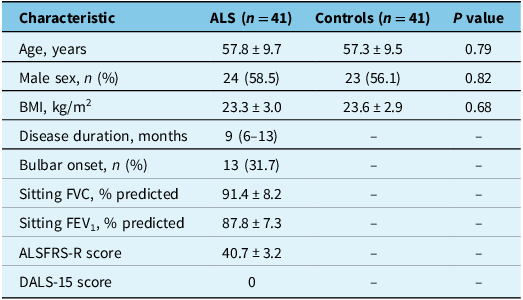
Baseline demographic and anthropometric data for 41 ALS patients and 41 matched controls are summarized in Table 1. Groups were comparable in age, sex distribution, BMI, and daytime pulmonary function (all P > 0.05). ALS patients had a median disease duration of 9 months (IQR 6–13) and a mean ALSFRS-R score of 40.7 ± 3.2; 32% had bulbar involvement. None reported dyspnea (DALS-15 = 0) at baseline.
Baseline demographic, anthropometric, and pulmonary function characteristics of ALS patients and matched controls

ALS = amyotrophic lateral sclerosis; BMI = body mass index; FVC = forced vital capacity; FEV1 = forced expiratory volume in 1 second; ALSFRS-R = ALS Functional Rating Scale-Revised; DALS-15 = Dyspnea ALS Scale.
Data are mean ± SD or median [IQR] for continuous variables; categorical variables are n (%). P values from independent t tests or Mann–Whitney U tests for continuous variables, and χ2 or Fisher’s exact tests for categorical variables (two-tailed).
Polysomnographic findings: ALS versus controls
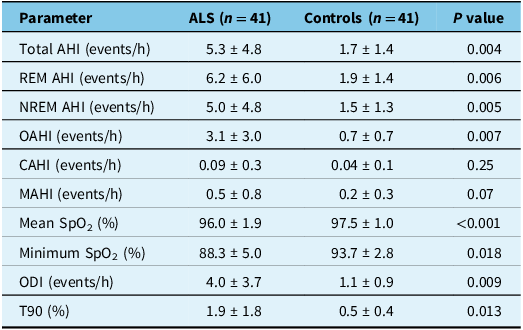
Compared with controls, ALS patients showed shorter total sleep time, lower sleep efficiency, and greater wake after sleep onset. Stage N1 percentage was higher and stage N3 lower in ALS; rapid eye movement (REM) proportion did not differ significantly. Respiratory indices revealed higher total AHI in ALS, driven by elevated obstructive AHI, and lower mean nocturnal SpO2; minimum SpO2 was also lower (Table 2). Central and mixed AHI indices did not differ significantly.
Baseline polysomnographic sleep architecture and respiratory parameters in ALS patients versus controls

ALS = amyotrophic lateral sclerosis; TST = total sleep time; AHI = apnea–hypopnea index; OAHI = obstructive AHI; CAHI = central AHI; MAHI = mixed AHI; ODI = oxygen desaturation index; SpO2 = peripheral oxygen saturation; REM = rapid eye movement; NREM = non-REM sleep.
Values are mean ± SD. Sleep stages are % of TST. Respiratory indices calculated per hour of sleep. P values from independent t or Mann–Whitney U tests.
Correlations of PSG parameters with clinical factors in ALS
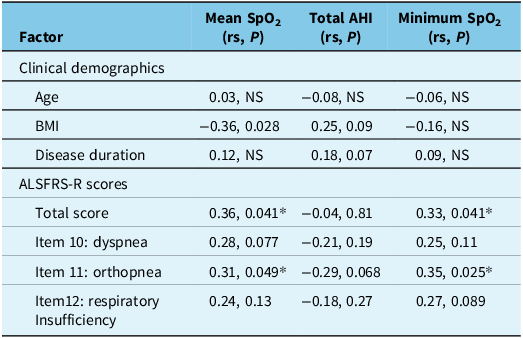
In ALS patients, higher BMI correlated with lower mean nocturnal SpO2 (rs = –0.36, P = 0.028). Regarding functional status, both mean and minimum SpO2 were positively correlated with ALSFRS-R scores (P = 0.041 for both). To further elucidate the relationship between functional respiratory symptoms and nocturnal metrics, we analyzed specific ALSFRS-R respiratory subscores (Items 10–12). As shown in Table 3, the orthopnea score (Item 11) demonstrated significant positive correlations with both mean SpO2 (rs = 0.31, P = 0.049) and minimum SpO2 (rs = 0.35, P = 0.025). The dyspnea (Item 10) and respiratory insufficiency (Item 12) subscores did not show statistically significant associations with PSG parameters in this early-stage population. Total AHI showed a weak, nonsignificant correlation with disease duration. No significant associations were found with age or sex (Table 3).
Spearman’s correlations between polysomnographic parameters and clinical measures (including ALSFRS-R respiratory subscores) in ALS (n = 41)

ALS = amyotrophic lateral sclerosis; NS = not significant (P > 0.05). rs = Spearman’s correlation coefficient; AHI = apnea–hypopnea index; BMI = body mass index; ALSFRS-R = ALS Functional Rating Scale-Revised; SpO2 = peripheral oxygen saturation.
Spearman’s rs (two-tailed) from rank correlation analysis. * P < 0.05. Values for clinical scores are mean ± SD: ALSFRS-R Total (40.7 ± 3.2), Item 10 (3.8 ± 0.4), Item 11 (3.9 ± 0.3), and Item 12 (3.7 ± 0.5). ALSFRS-R respiratory subscore range: 0–4 (higher indicates better function).
Longitudinal outcomes and predictive modeling
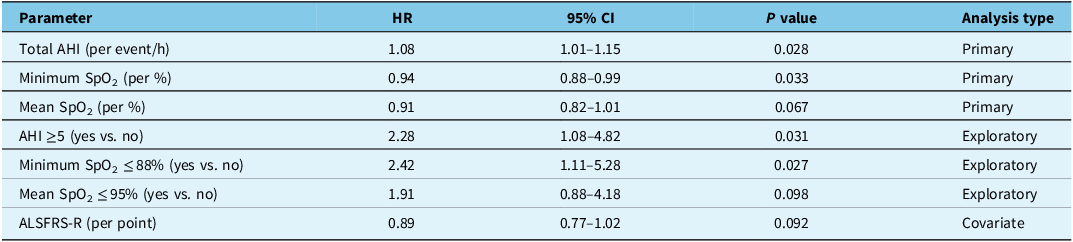
Over 12 months, ALS patients showed progressive declines in FVC and ALSFRS-R, with greater deterioration in those developing dyspnea. Cox regression analysis identified baseline AHI and minimum SpO2 as independent predictors of dyspnea onset: each 1-event/h increase in AHI conferred an 8% higher risk (adjusted HR 1.08; 95% CI 1.01–1.15; P = 0.028), and each 1% reduction in minimum SpO2 a 6% increase (HR 0.94; 95% CI 0.88–0.99; P = 0.033). Mean SpO2 showed a borderline association (P = 0.067) (Table 4).
Cox proportional hazards regression models for dyspnea onset in ALS (n = 37)

ALS = amyotrophic lateral sclerosis; AHI = apnea–hypopnea index; ALSFRS-R = ALS Functional Rating Scale-Revised; SpO2 = peripheral oxygen saturation; HR = hazard ratio; CI = confidence interval.
Models adjusted for age, BMI, baseline ALSFRS-R, and bulbar involvement. P values two-tailed.
Exploratory subgroup analyses: High-risk versus low-risk ALS patients
Applying exploratory thresholds (AHI ≥ 5 events/h, minimum SpO2 ≤ 88%, or mean SpO2 ≤ 95%) classified 67.6% of ALS patients as high-risk. Over 12 months, this subgroup showed a trend toward greater declines in FVC (–12.8% vs. –7.3% predicted) and ALSFRS-R (–8.8 vs. –5.2 points) than low-risk patients, with borderline P values after correction. Dyspnea incidence was higher in the high-risk group (36.0% vs 25.0%), though not statistically significant (P = 0.11) (Table 5).
Longitudinal changes in high-versus low-risk ALS patients over 12 months

ALS = amyotrophic lateral sclerosis; AHI = apnea–hypopnea index; SpO2 = peripheral oxygen saturation; FVC = forced vital capacity; ALSFRS-R = ALS Functional Rating Scale-Revised; NS = not significant.
High risk is defined by baseline AHI ≥ 5 events/h, minimum SpO2 ≤ 88%, or mean SpO2 ≤ 95%; low-risk is below all thresholds. P values from Mann–Whitney U tests for continuous variables and Fisher’s exact for dyspnea incidence. Bonferroni-adjusted α applied.
Discussion
This exploratory prospective longitudinal cohort study provides preliminary evidence that nocturnal respiratory dysfunction, as assessed by PSG, may be associated with indicators suggestive of impending daytime respiratory decline in mild-stage ALS patients with preserved pulmonary function. Our primary findings indicate that baseline AHI and minimum SpO2, analyzed as continuous variables, were statistically associated with dyspnea onset within 12 months (adjusted HR 1.08 per event/h for AHI and 0.94 per % for minimum SpO2). Exploratory categorical thresholds (AHI ≥ 5 events/h and minimum SpO2 ≤ 88%) were also associated with increased risk, while mean SpO2 ≤ 95% showed a nonsignificant trend. Additionally, high-risk patients (meeting ≥ 1 threshold) exhibited trends toward accelerated FVC and ALSFRS-R decline over the follow-up period.
The independent predictive value of nocturnal AHI and minimum SpO2 for dyspnea onset – despite preserved daytime pulmonary function – is consistent with the possibility of distinct pathophysiology of sleep-related respiratory impairment in ALS. Reference Tress, Luecke, Stegemann-Koniszewski, Lux, Singla and Schreiber15 Notably, at baseline, the ALSFRS-R orthopnea subscore (Item 11) correlated positively with nocturnal SpO2, suggesting that even subtle positional respiratory discomfort may reflect underlying SDB in this early-stage cohort. This reinforces the link between patient-reported symptoms and objective nocturnal respiratory vulnerability. This progression involves a multi-step mechanistic cascade rooted in anatomical and neurological vulnerabilities. Early bulbar motor neuron degeneration induces pharyngeal muscle hypotonia, heightening susceptibility to airway collapse during sleep, as evidenced by our cohort’s elevated obstructive AHI, consistent with prior studies implicating upper motor neuron loss in obstructive events. Reference Du, Zhu, Chen, Li, Zhang and Huang16,Reference Sancho and Ferrer17 Crucially, REM sleep exacerbates diaphragmatic insufficiency due to intercostal muscle suppression, leading to profound desaturations. Reference Ansari, Wen and Karabala18 Ogna et al. demonstrated such REM-specific vulnerabilities in ALS, linking lower SpO2 nadir to respiratory muscle weakness. Reference Ogna, Quera Salva and Prigent19
These nocturnal hypoxic episodes initiate a self-perpetuating cycle of neurodegeneration. Hypoxia induces oxidative stress and neuroinflammation, accelerating motor neuron loss – a phenomenon corroborated by meta-analyses associating SDB with faster functional decline. Reference El Amine, Fournier and Minoves20–Reference Ozdinler22 Our data further support this, revealing a correlation between minimum SpO2 and ALSFRS-R, suggesting nocturnal oxygenation integrity preserves functional status. Concurrently, hypothalamic dysfunction in ALS disrupts sleep–wake regulation via impaired orexin pathways, destabilizing breathing, while sleep fragmentation from SDB impairs glymphatic clearance. Reference Gnoni, Zoccolella and Giugno23,Reference Chang, Teo, Shaw, Dupuis, Ngo and Steyn24 This promotes accumulation of neurotoxic transactive response DNA-binding protein 43 kDa (TDP-43) aggregates, a pathological hallmark of ALS. Thus, baseline PSG abnormalities (e.g., elevated AHI, reduced SpO2) reflect early respiratory compromise that, untreated, exacerbates neurodegeneration through hypoxia, inflammation, and proteostatic failure, culminating in daytime dyspnea. Reference Biswas, Sethi and Woldeyohannes25,Reference Zuo, Zhou and Li26
Our findings support and extend current best practice recommendations, such as the Canadian guidelines for ALS care, which already advocate for nocturnal respiratory monitoring (e.g., PSG or oximetry) when SDB is suspected. Reference Shoesmith, Abrahao and Benstead27 The baseline AHI and predominance of obstructive events mirror meta-analytic data from early ALS cohorts, while the association between minimum SpO2 ≤ 88% and accelerated FVC decline echoes recent cohort studies. Reference Zhang, Ren and Yang9 Clinically, these findings advocate for incorporating PSG into early ALS monitoring, potentially enabling earlier NIV initiation than FVC-based guidelines alone. A pilot placebo-controlled randomized trial by Gruis et al. (n = 54) demonstrated that early NIV in mild ALS patients, guided by PSG parameters such as nocturnal hypoventilation, showed a trend toward delayed FVC decline and comparable quality of life outcomes between active and sham NIV groups. Reference Jacobs, Brown, Baek, Migda, Funckes and Gruis28 By identifying a high-risk subgroup (e.g., via AHI ≥ 5 or minimum SpO2 ≤ 88%), our thresholds could refine risk stratification, though their borderline significance in subgroup analyses underscores the need for validation.
Limitations must be acknowledged. The small sample size (n = 41 ALS patients, 37 completers) and single-center design limit statistical power and generalizability, potentially contributing to nonsignificant trends. Dropout rate was low, and sensitivity analyses confirmed robustness, but unmeasured confounders like genetic factors (e.g., C9orf72 status) were not assessed. Furthermore, our respiratory assessment was based on sitting spirometry; we did not perform supine FVC measurements or assess peak cough flow. The addition of supine FVC (to evaluate diaphragmatic dysfunction via sitting–supine difference) and cough efficacy metrics could provide a more comprehensive picture of early respiratory muscle impairment. PSG was performed without adaptation nights, which may overestimate SDB in some participants, though this is common in resource-limited exploratory studies. Reference Newell, Mairesse, Verbanck and Neu29 Follow-up PSG was not conducted in all patients, precluding detailed progression analysis beyond exploratory changes. Additionally, our thresholds, while literature-informed, are exploratory and require optimization in larger cohorts. Future research should validate these findings in multicenter studies with larger samples (e.g., n > 200) and integrate PSG with advanced respiratory assessments, such as diaphragmatic ultrasound or sniff nasal inspiratory pressure. Reference Iglesias, Cascón and Maimó30 Randomized trials testing PSG-guided versus standard NIV initiation could assess impacts on survival and quality of life, as suggested by recent guidelines emphasizing early monitoring. Reference Graustein, Carmona and Benditt31 In summary, our study highlights the potential utility of PSG parameters as predictors of respiratory decline in mild ALS, supporting a shift toward nocturnal monitoring to facilitate timely interventions.
Conclusions
This exploratory longitudinal study provides novel evidence that specific nocturnal polysomnographic parameters – namely, the AHI and minimum SpO2 – are significant predictors of impending patient-reported respiratory symptom onset in a rigorously defined cohort of mild ALS patients with preserved daytime pulmonary function (sitting FVC ≥ 80% predicted) and no baseline dyspnea. By prospectively linking baseline PSG metrics to the development of dyspnea within 12 months, our findings advance the existing knowledge in several key aspects: (1) they demonstrate that quantifiable SDB and nocturnal hypoxia are present and clinically meaningful before conventional respiratory decline is detectable; (2) they establish AHI ≥ 5 events/h and minimum SpO2 ≤ 88% as exploratory risk thresholds with prognostic potential, offering a potential objective tool for risk stratification earlier than conventional FVC decline; and (3) they reinforce the physiological link between nocturnal dysfunction and daytime symptoms, as evidenced by the correlation between orthopnea subscores and nocturnal oxygenation. While these results are preliminary and require validation in larger, multicenter cohorts, they strengthen the rationale for integrating nocturnal respiratory monitoring into the management of early ALS. Our study suggests that PSG could help identify a subgroup of patients at high risk for near-term respiratory progression, potentially enabling more personalized and timely interventions, such as closer follow-up or early discussion of NIV, even before standard daytime spirometry criteria are met.
Data availability statement
The data that support the findings of this study are available from the corresponding author, Enwang Xu, upon reasonable request, subject to privacy and ethical restrictions.
Acknowledgements
The authors sincerely thank all the study participants and their families for their time and contribution. We are also grateful to the colleagues and nursing staff at the participating departments for their invaluable assistance in patient recruitment, data collection, and study coordination.
Author contributions
Xueming Li contributed to Conceptualization, Methodology, Formal Analysis, Investigation, and Writing – Original Draft. Weijiang Ding was involved in Methodology, Formal Analysis, Investigation, and Writing – Original Draft. Yan Lu carried out Investigation and Data Curation. Meiying Sun also participated in Investigation and Data Curation. Enwang Xu took part in Conceptualization, Supervision, Project Administration, and Writing – Review & Editing. All authors have read and agreed to the published version of the manuscript.
Funding statement
This work was supported by the Health Commission of Jiangxi Province, China (Grant/Award Number: 202610452).
Competing interests
The authors have no conflicts of interest to declare.
Ethical approval
The study was conducted in accordance with the Declaration of Helsinki and was approved by the Ethics Committee of the Second Affiliated Hospital of Nanchang University. Written informed consent was obtained from all participants.




Target article
Nocturnal Hypoxia and Sleep-Disordered Breathing as Potential Early Biomarkers of Respiratory Progression in Mild ALS
Related commentaries (1)
Reviewer Comment on Li et al. “Nocturnal Hypoxia and Sleep-Disordered Breathing as Potential Early Biomarkers of Respiratory Progression in Mild ALS”