I. INTRODUCTION
In the beginning of the seventeenth century, the Sephardic Jews settled and built their synagogue in Amsterdam in the neighbourhood on and around the Houtgracht (later renamed Waterlooplein) and Zwanenburgwal. A few decades later, Ashkenazi Jews from Poland and the German states increasingly started to settle in the same neighbourhood, around Stroomarkt (also later renamed Waterlooplein), Nieuwe Amstelstraat and Korte Houtstraat, and these newcomers established their own synagogue close to that of their Sephardic co-religionists, who they soon outnumbered.Footnote 1 Even after the legal emancipation of Jews in 1796 and the withdrawal of restrictive settlement rules, Jews continued to reside primarily in the eastern part of Amsterdam, which for centuries was known as ‘the Jewish area’ and was seen as the centre of Jewish life in the Netherlands. This neighbourhood is often referred to as the Jewish ghetto, as this term expresses the social climate and local atmosphere of this area.Footnote 2
Stories and pictorial impressions of the life and culture in the Jewish neighbourhood can be found in weeklies and books written by, for example, Meyer Sluyser, the official narrator of nostalgic Jewish Dutch history.Footnote 3 In 1916, an exhibition was organised with the title Het Verdwijnend Amsterdamse Getto in Beeld (‘The Vanishing Amsterdam Ghetto in Pictures’), as more Jews moved to other Amsterdam districts and renovations got underway in the ghetto itself. In the 1920s and 1930s, the Sunday market in the Jewish quarter attracted many non-Jewish visitors from outside of Amsterdam. The significance of the Jewish neighbourhood is, however, much deeper than tourism and nostalgia would suggest. It gives us the opportunity to study a general phenomenon in societies: minority groups who live side by side with one another or, rather, live side by side without one another, as Wirth stressed in his study of Jewish ghettos.Footnote 4 While more than half of the Jews in the Netherlands lived in Amsterdam, they constituted an ethnic–religious minority of about 10 per cent within the Dutch capital. By focusing on residential segregation of Jews in Amsterdam on the eve of the Shoah, or Holocaust, this study expands on what we know about the process of Jewish assimilation in the Netherlands.
II. THEORETICAL NOTION AND RESEARCH QUESTIONS ON RESIDENTIAL SEGREGATION
Louis Wirth was a student of Robert Park, one of the founding fathers of the Chicago School and a pioneer in the study of urban immigrants' experiences of assimilation in the first decades of the twentieth century. Park's point of departure was his notion that social relations are inevitably linked to spatial relations.Footnote 5 In his canonical, multidimensional concept of assimilation Milton Gordon did not explicitly include residential mobility,Footnote 6 but other studies, such as those of Otis Duncan and Beverley Duncan, and Otis Duncan and Stanley Lieberson, focused on this dimension. Their contribution resulted in the introduction of segregation indices such as the index of dissimilarity (ID), later known as the Pax Duncana.Footnote 7
Broadly speaking, residential segregation is the degree to which ethnic groups live separately from one another in an urban environment. This general understanding glosses over the multidimensionality of residential segregation. Douglas Massey and Nancy Denton distinguished and examined five dimensions of residential segregation: evenness, exposure, concentration, centralisation, and clustering. Of these five dimensions, Massey and Denton indicated evenness to be the most important dimension when it comes to investigating the level of spatial segregation.Footnote 8 Evenness, first proposed by Otis and Beverley Duncan, has since been widely used in segregation research.Footnote 9 Daniel Hiebert, for instance, used the ID to compare the level of Jewish segregation with that of other ethnic groups in Toronto in 1931, while Ceri Peach used this index to compare the levels of Jewish segregation in Canadian cities at the beginning of the 1990s.Footnote 10
In his spatial assimilation model, Massey considers the spatial distribution of groups to reflect their states of assimilation.Footnote 11 Following this notion, the first question we address here is the extent to which Jews were residentially segregated in Amsterdam on the eve of the Shoah. Rob van Engelsdorp Gastelaars, Jacqueline Vijgen and Michiel Wagenaar have shown a drop in the degree of residential segregation of Jews in Amsterdam between the late eighteenth century and the 1930s, and Wout Ultee and Ruud Luijkx have shown a drop in the period between 1906 and 1941, both indicating an ongoing process of assimilation.Footnote 12 There is an expectation that residential mobility will have an inherent generational dynamic, based on the notion of ‘straight-line assimilation’ which holds that the process of assimilation comprises a sequence of generational steps, with each generation representing a new step of adjustment to the host society. This theory of straight-line assimilation was challenged by Herbert Gans, who introduced the useful concept of the ‘bumpy-line’ trajectory and argued that the degree of assimilation of successive generations is not always greater than the degree to which previous generations were assimilated.Footnote 13 Changes in structural conditions such as the housing market, the urban economy and the scale of immigration, as put forward by Massey, can produce ‘bumps’ or interruptions in the assimilation process.Footnote 14 By calculating indices of spatial segregation in 1941 and comparing them with indices calculated for earlier moments in the twentieth century, this paper aims to test the impact of both housing and immigration during the 1930s on Jewish residential patterns. After the First World War, the demolition of slums in the Jewish neighbourhood and the construction of council housing outside this neighbourhood that continued into the 1930s allowed Jews new opportunities to relocate beyond the Jewish district. Furthermore, in the 1930s, thousands of Jewish refugees, mainly from Germany, also resettled in Amsterdam, often outside the historic Jewish district.
Massey's spatial assimilation model includes three hypotheses. First, the degree of spatial assimilation between any two groups is a function of social, economic and cultural distance. Second, spatial assimilation is a function of socio-economic mobility. Third, spatial assimilation is a function of acculturation. We will focus in this study on the last hypothesis. Because the Dutch Jewish minority had already lived in the Netherlands for centuries by the twentieth century, acculturation – adoption of certain values and manners, and acquisition of the Dutch language – had occurred to a great degree among Dutch Jews. Study of spatial assimilation as a function of acculturation allows us to relate spatial assimilation to other aspects of assimilation, such as interreligious marriages and religious affiliation. The first question to be addressed in this study is the extent to which Amsterdam Jews lived in segregated neighbourhoods on the eve of the Shoah. The second question is the extent to which religiously unaffiliated Jews, Jews married to non-Jews, and Jews who converted to Christianity lived in separate residential areas from Jews belonging to a Jewish congregation.
Furthermore, residential mobility is seen as an intermediate step on the way to assimilation.Footnote 15 While Lieberson stated that residential segregation has an effect on other aspects of assimilation, Gordon pointed to structural assimilation as the ‘keystone of the arch of assimilation’.Footnote 16 In Gordon's framework, structural assimilation entails large-scale entrance into cliques and clubs, while other types of assimilation include assimilation by marriage or through the adoption of new identity.Footnote 17 Within this framework, large-scale entrance of a minority into majority-dominated clubs or institutions inevitably leads to substantial intermarriage.Footnote 18 Although, as mentioned above, residential mobility was not included in Gordon's model, it fits into his idea of structural assimilation, since, according to Richard Alba and Victor Nee, it expands the ethnic mix of everyday social contacts, especially for the generation growing up in mixed neighbourhoods.Footnote 19
In the assimilation theory developed by Alba and Nee, the spanning and altering of boundaries represent keys to assimilation.Footnote 20 The residential distinction between a minority group and the majority group in a society may be seen as a boundary, since such distinctions restrict certain daily social interactions between the groups to assimilation. In this study, we examine the impact of the residential segregation of Jews on other aspects of their assimilation in pre-Second World War Amsterdam. We will do so by relating the addresses of residence in a subject's youth to their religious intermarriage and religious affiliation. This raises the further question of the extent to which residential segregation affects religious intermarriage and religious affiliation. We address the two previously stated research questions at the group level, but we examine this last question at the individual level. The data we use are described in the following section.
III. SOURCES AND DATA
The last documented information on Jews in the Netherlands before their persecution under the Nazi occupation comes from the 1941 registration of Jews carried out by Dutch authorities and civil servants on behalf of the Nazis. In January 1941, the Nazis ordered all persons living in the Netherlands who had one or more Jewish grandparents to be registered. Each individual had to fill out a questionnaire seeking twenty items of information, including his or her address. Supplementary legislation to the Nuremberg Laws defined a person who had three or four Jewish grandparents, or who had two Jewish grandparents and either belonged to a Jewish congregation or was married to a Jew to be a ‘full’ Jew.Footnote 21 Jacob Lentz, the director of the State Inspection of the Registry and one of the Dutch authorities involved in carrying out this order, was of the opinion that hardly anyone who qualified as a ‘full’ Jew under the Nuremberg definition failed to register in the 1941 survey.Footnote 22 Dutch historians also generally believe that practically all so-called ‘full’ Jews complied with the order to register.Footnote 23 Most ‘full’ Jews were known in their social network as being Jewish or being of Jewish origin. Besides, although we are now well aware of the intentions of the Nazis in registering the Jews,Footnote 24 at the time Jews could hardly have anticipated the life-threatening measures that would be taken by the Nazis in the years to come and therefore had little reason to refuse to be registered, particularly as all citizens of the Netherlands reported their religious denominations at each decennial census, information which the Nazis could easily find in the municipal register. Finally, in 1939 and 1940 individuals had to go to the Registry to obtain a ration card which also served as a sort of identity card, since the ration card was matched to the individual's personal card held at the local registry. In 1940, cardholders needed to have a photograph attached as well.Footnote 25
The German registration list of Amsterdam Jews contains only ‘full’ Jews, a total of 77,233 persons.Footnote 26 It was drawn up in May 1941,Footnote 27 before the Nazis took drastic anti-Jewish measures in the Netherlands, and before systematic deportation of Jews to concentration and death camps began.Footnote 28 The list also gives information on place and date of birth, nationality, religious affiliation, address, occupation and marital status for each person, and the addresses included on the list provide an excellent overview of Jewish residential patterns in Amsterdam at the end of the 1930s and the beginning of the 1940s.Footnote 29 Besides the addresses, the present study also utilises the list's information on marital status, religious affiliation and nationality. As non-Jews were not included on the list, married Jews living at an address where there was just one married person listed are coded as having a non-Jewish spouse, although it is possible that some Jewish spouses may have been temporarily living elsewhere. Religious affiliation tells us whether a person of Jewish origin belonged to a Jewish congregation, had converted to Christianity, or did not belong to any religious congregation at all.Footnote 30 Finally, the nationality reported on the registration list gives an indication as to which Jews were foreigners.Footnote 31
The German registration list of Amsterdam Jews offers a data source which provides the names of descendants of Jewish grandparents. While in most assimilation research it is difficult to assess which part of the second and third generation has left the confinement of their religious–ethnic minority milieu,Footnote 32 this list provides the names and addresses of individuals who had Jewish grandparents, but who themselves may no longer have belonged to any Jewish congregation. We are thus able to investigate the degree and process of assimilation and residential segregation of the grandchildren of families of Jewish origin.
In order to answer our first two research questions, the addresses given on the German registration list of Amsterdam Jews were used. First of all, the districts in which these addresses lay were determined. In 1941 the city of Amsterdam was divided into 56 districts.Footnote 33 The total number of inhabitants per district is needed to calculate the percentage of Jews in each district and the indices of segregation; the required values are found in the Statistical yearbook of Amsterdam 1940–1944.Footnote 34 Next, we used the addresses in combination with the information on marital status and religious affiliation to determine differences in residential patterns between Jews who belonged to a Jewish congregation, unaffiliated Jews, religiously intermarried Jews and Jews who had converted to Christianity.
In order to answer our third research question on the impact of residential segregation on other aspects of assimilation we took four samples of the ‘full’ Jews on the German registration list of Amsterdam Jews. This allowed us to include in our study persons who did not belong to a Jewish congregation but were of Jewish origin, something which is impossible when one draws a sample from the population register or birth certificates. First, we took a random sample of 395 ‘full’ Jews, most of whom belonged to a Jewish congregation. The second sample consisted of 110 religiously unaffiliated ‘full’ Jews and the third sample comprised 110 ‘full’ Jews who had converted to Christianity. Finally, the fourth sample contained 110 ‘full’ Jews who were married to a Gentile. All 725 Jews in the four samples were born in Amsterdam between 1883 and 1922. Next, using individuals' names and dates of birth, the Historical Sample of the Population of the Netherlands (HSN) was able to collect data from the population registers and marriage certificates in the Amsterdam archive for 717 individuals from the samples.Footnote 35 In this way, we obtained life history data for each of these individuals including details of his or her religion, household situation, occupational and marital history, along with information on migration, including the addresses and the corresponding administrative codes of the Amsterdam areas in which he or she lived from birth to the end of the 1930s.Footnote 36
IV. LEVELS OF RESIDENTIAL SEGREGATION: INDEX OF DISSIMILARITY AND ISOLATION INDICES
In this section, we calculate and compare levels of Jewish residential segregation in the Netherlands for several moments in time, beginning in 1795, a year before Jews in the Netherlands were granted full civic rights. Of the five dimensions of residential segregation, Massey and Denton found evenness to be the most important dimension to evaluate residential segregation.Footnote 37 Evenness is best measured using the ID.Footnote 38 The ID varies between 0 and 100, and represents the proportion of group members who would have to relocate for the minority group to have the same spatial distribution as the remainder of a city's population. The higher this index, the more residentially segregated a group is; values of 70 or more are seen as very high, in the 60s as moderately high, and in the 50s as high. Next to the ID, we also focus on residential exposure; the degree of potential contact or the possibility of interaction between minority and majority members within an area. This is measured by the interaction or isolation index which was reintroduced in the beginning of the 1980s by Lieberson.Footnote 39 Following Massey and Denton we calculated the jP*j index, indicating the average chance of a Jew meeting another Jew.Footnote 40 This index also varies between 0 and 100, and a higher index value indicates a higher degree of spatial segregation.
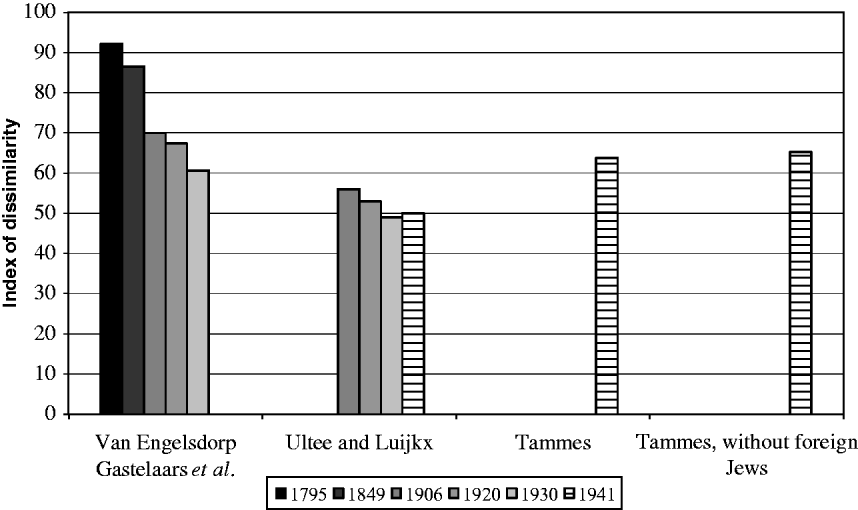
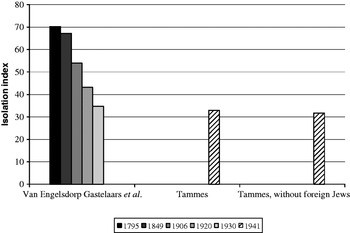
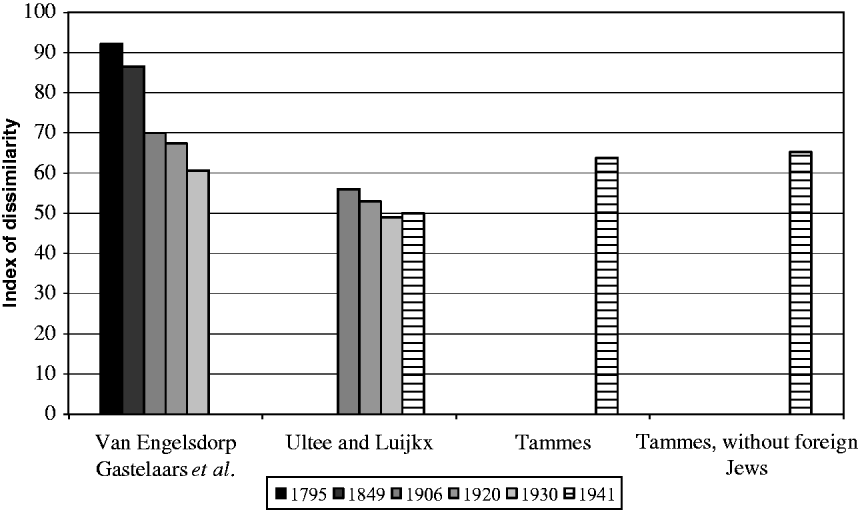
Based on earlier findings on the segregation of Jews in Amsterdam, we derive several hypotheses about the degree of residential segregation of Jews in Amsterdam in 1941. In 1985, van Engelsdorp Gastelaars et al. calculated the ID and the isolation index for 1795, 1849, 1906, 1920 and 1930.Footnote 41 In the sources they used, Jews were defined as individuals belonging to the Portuguese or Dutch Jewish congregation. As presented in Figures 1 and 2, between 1795 and 1906 both the ID and the isolation index dropped by approximately 20 points, indicating decreasing residential segregation of Jews in Amsterdam, and from 1906 to 1941 ID dropped a further 10 points and the jP*j dropped almost 20 points. Van Engelsdorp Gastelaars et al. attributed the decrease in residential segregation after 1906 to the introduction of the Public Housing Act at the beginning of the twentieth century, which offered local authorities the possibility to improve housing conditions.Footnote 42 Because it was overcrowded and included many houses unfit for habitation, the Jewish neighbourhood was the first district to benefit from renewal projects through the Act. In 1916, 1926 and the 1930s, respectively, slums in Uilenburg, Marken and Jodenhouttuinen were demolished.Footnote 43 As a result of the reconstruction of the Jewish neighbourhood and the large increase in the construction of council housing in quarters elsewhere in the city, thousands of Jews jumped at new opportunities to leave the Jewish neighbourhood. State-supported Jewish and socialist housing corporations concentrated their activities in Amsterdam's eastern and south-eastern districts,Footnote 44 which led many Jews leaving the Jewish neighbourhood to relocate to these districts.
Indices of dissimilarity calculated by Van Engelsdorp Gastelaars et al., Ultee and Luijkx, and Tammes.
Isolation indices calculated by Van Engelsdorp Gastelaars et al., and Tammes.

In their 1998 study, Ultee and Luijkx calculated the ID for Jews in Amsterdam for the years 1906, 1920, 1930 and 1941.Footnote 45 They regrouped Amsterdam's districts and reduced the number of districts to 11 to compare the ID with those of 5 other European cities (Berlin, Budapest, Frankfurt-on-Main, Riga and Vienna). Although this regrouping means that their calculated ID is lower than that of van Engelsdorp Gastelaars et al., it shows a similar pattern to that of the latter study for 1906–1930, as can be seen in Figure 1. For 1941, Ultee and Luijkx calculated an ID based on persons having one or more Jewish grandparents instead of his or her belonging to a Jewish congregation, making it not strictly comparable with the IDs they had calculated for the previous years. We have nevertheless included their 1941 ID in Figure 1.Footnote 46 This figure shows a small increase in ID between 1930 and 1941, suggesting an increase in the level of residential segregation. According to Ultee and Luijkx, the segregation of Jews increased across the 1930s because of the influx of thousands of Jewish refugees from Germany from 1933 to 1939 into the newly built suburbs in the southern part of Amsterdam.Footnote 47
Given the historical trend calculated by van Engelsdorp Gastelaars et al. and the opportunities to leave the Jewish neighbourhood offered by the Public Housing Act, in 1941 we would have expected to see both a more even distribution of Jews across Amsterdam districts, and therefore a further decrease in the ID, and an increase in the degree of potential contact between Jews and non-Jews, and therefore a further decrease in the isolation index.
However, following the findings and line of reasoning of Ultee and Luijkx, we would expect a more uneven distribution of Jews among Amsterdam districts in 1941 as foreign Jews settled in a restricted number of districts, and therefore an increase in the ID, but an increase in the degree of potential contact between Jews and non-Jews as these foreign Jews had settled outside the Jewish neighbourhood and the areas surrounding it, entailing a further decrease of the isolation index in 1941.
While the German registration list of Amsterdam Jews contains the address of residence for ‘full’ Jews to continue the trend line of van Engelsdorp Gastelaars et al., we should restrict ourselves to those individuals on the list who belonged to a Jewish congregation. Of the 70,880 such individuals, we know the address of residence for 70,365, since dozens of addresses listed were outside Amsterdam and a few hundred Amsterdam addresses were either untraceable or illegible. According to calculations based on these ‘full’ Jews belonging to a Jewish congregation, the ID is 63.7. Adding this ID for 1941 to Figure 1 and comparing it with the value for 1930 calculated by van Engelsdorp Gastelaars et al. we see that the trend of the ID did not continue to drop but slightly increased, indicating a more uneven distribution than in the previous period. This finding seems to support the expectation that predicted an increase of the ID as a result of the 1930s settlement of foreign Jewish refugees in, primarily, southern districts of Amsterdam. Subsequently, we calculated the ID again for only Jews with Dutch citizenship. The ID calculated without non-Dutch Jews is even a bit higher, namely 64.9, an unexpected finding.
Although not all foreign Jews entered the Netherlands after 1933, most of them did.Footnote 48 However, the settlement patterns of this immigrant influx during the 1930s do not seem to have been the main cause of the increase in the ID in 1941. Instead, Dutch Jews themselves seem to have moved to districts where a considerable number of Jews already lived, contradicting the expectation that the demolition of slums in the Jewish neighbourhood and the large increase in the construction of council housing in quarters outside this neighbourhood would lead to a decrease in the ID. One of these newly built housing areas was the Transvaalplein, and Ab Caransa noted that entire Jewish families moved to this newly built square so that a large proportion of the first occupants of this new square was Jewish.Footnote 49 Close social ties arose between these Jewish occupants and most of them did not move away. Such Jewish networks may also have served to draw other Jews to move to the newly built areas or to areas adjacent to them.Footnote 50 Such transplanted networks, to use the concept introduced by Charles Tilly, may have resulted in new areas of Jewish concentration.Footnote 51 Assuming that the situation recorded by Caransa concerning the Transvaalplein was a general trend among Jews moving to newly built areas, the reconstruction of the Jewish neighbourhood and the construction of council housing elsewhere might at first, in the 1920s, have resulted in a decrease of the ID, but continued demolition and construction activity may eventually have led thousands of Jews to reconvene, as it were, in newly built areas, resulting in an increase in the ID.
In addition, the economic crisis of the 1930s should be considered. Many Jews who had moved out of the Jewish neighbourhood in the first decades of the twentieth century and became unemployed during the Depression eventually returned to less expensive housing in the Jewish neighbourhood or adjacent districts.Footnote 52 Moreover, because of the straightened times parents and their adult children increasingly started to live together in the same house, sometimes accompanied by other Jews: extended family or non-relatives.Footnote 53 Although exact numbers of those returning and the number of adult family members living at the same address are not known, the economic crisis may have contributed to the increase of the ID during the 1930s.
The isolation index for all ‘full’ Jews belonging to a Jewish congregation in 1941 was also calculated to continue the historical trend given by van Engelsdorp Gastelaars et al.Footnote 54 The isolation index for 1941, at 32.9, is slightly lower than that for 1930, namely 34.7, as is shown in Figure 2. This indicates that the probability of a Jew meeting another Jew hardly decreased, i.e. the probability of meeting a non-Jew hardly increased, rejecting our expectations of a further decrease of the isolation index. In another test, we calculated the isolation index without the non-Dutch Jews. According to this calculation, the probability of meeting another Jew decreased further, to 31.7, supporting the expectation on the impact of the Public Housing Act, rather than the expectation on the impact of the influx of immigrants. Although Jews clustered in newly constructed areas, resulting in an increase in the ID, they did not cluster in districts where a substantial percentage of the inhabitants was already Jewish, resulting in a moderate decrease in the isolation index.
V. RESIDENTIAL PATTERNS AMONG JEWS IN AMSTERDAM
The ID and index of isolation show the degree of segregation and interaction between two groups. Stanley Waterman and Barry Kosmin have emphasised the degree of intra-group spatial cohesiveness of an ethnic or minority group. In their study of Jews in three London boroughs, synagogue membership was seen to vary between these boroughs.Footnote 55 Similarly, we compare Amsterdam districts in terms of the percentage of each district's Jews who belonged to a Jewish congregation, using the German registration list of Amsterdam Jews. Next, within the Jewish population we distinguish Jews who assimilated to certain degrees, i.e. Jews who had left Judaism and Jews who had married Gentiles, and consider their residential patterns.
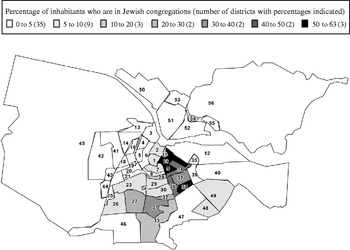
In 1941, the streets of the first Jewish settlers in the seventeenth century were located in the district called ‘Overige Jodenbuurt en Hoogte Kadijk’, district number 10 on the map in Figure 3.Footnote 56 The Amsterdam municipal statistical office calculated that 57.6 per cent of the inhabitants in this district were Jewish in 1941.Footnote 57 This percentage, however, is calculated including all persons having one or more Jewish grandparents regardless of their religious affiliations, and therefore overestimates the number and proportion of Jews belonging to a Jewish congregation. Carolus Reijnders also calculated the percentage of Jewish inhabitants for 17 of the 56 Amsterdam districts in 1941, based on what he called ‘the basic material’.Footnote 58 Unfortunately, the source of this ‘basic material’ is unknown. Since the number of foreign Jews was missing from Reijnders's sources, he estimated the number of foreign Jews. He calculated that 56 per cent of the inhabitants in the district ‘Overige Jodenbuurt en Hoogte Kadijk’ were Jewish. Based on the information on the German registration list, we calculated that 53.9 per cent of the inhabitants of the district ‘Overige Jodenbuurt en Hoogte Kadijk’ were Jewish according to the Nuremberg Laws, meaning that they had three or four Jewish grandparents. When we only count those persons belonging to a Jewish congregation, the percentage is 52.9.
Map showing the percentage of inhabitants in 56 Amsterdam districts who belonged to the Dutch or Portuguese Jewish congregation in 1941. a ‘En omgeving’ (and environs). b Overige Jodenbuurt en Hoogte Kadijk, district 10, contained the streets housing the first Jewish settlers in the seventeenth century. (Source: See Section III: Sources and Data.)

From the beginning of the twentieth century onward, more and more Jews started to live in streets in adjacent districts of the ‘Overige Jodenbuurt en Hoogte Kadijk’, such as the Vrolikstraat, Blasiusstraat, Swammerdamstraat and the ‘s Gravesandebuurt.Footnote 59 From 1920 on, Jews were also more likely to move to other districts, such as ‘Noorder en Zuider Amstellaan en omgeving’ (district 31, Figure 3), a newly constructed area in the southern part of Amsterdam, and the Transvaalbuurt in the district ‘Afrikaansche buurt’ (district 38, Figure 3); the tram coming from this area going through the old Jewish neighbourhood was nicknamed the ‘Jewish tram’.Footnote 60
By 1941, which districts had the highest percentages of inhabitants belonging to the Dutch and Portuguese Jewish congregations? Streets such as Swammerdamstraat and part of the Blasiusstraat were located in the district ‘Weesperstraat en omgeving’ (district 9, Figure 3), next to the district ‘Overige Jodenbuurt en Hoogte Kadijk’. In that district in 1941, 40.5 per cent of the inhabitants belonged to the Dutch or Portuguese Jewish congregations. The other part of the Blasiusstraat, the aforementioned Vrolikstraat, and the ‘s Gravesandebuurt were located in the district ‘Oosterparkbuurt’ (district 37, Figure 3) adjoining the ‘Weesperstraat en omgeving’ and therefore situated further from the ‘Overige Jodenbuurt en Hoogte Kadijk’ district. In the district ‘Oosterparkbuurt’, 32 per cent of the inhabitants belonged to a Jewish congregation. In 3 of the 56 Amsterdam districts over 50 per cent of district residents belonged to a Jewish congregation, as can be seen in Figure 3. In 1941 the district with the highest percentage of residents belonging to a Jewish congregation was no longer ‘Overige Jodenbuurt en Hoogte Kadijk’, where 52.9 per cent fitted this description, but the district ‘Weesperstraat en omgeving’ (62.1 per cent). In the district ‘Afrikaanse buurt’ (district 38, Figure 3) 52.7 per cent of inhabitants belonged to a Jewish congregation. Amongst more remote districts, the southern district ‘Noorder en Zuider Amstellaan en omgeving’ (district 31, Figure 3) also had 33.4 per cent of its inhabitants belonging to a Jewish congregation, due to a preference amongst German Jewish refugees for settling in the southern districts of Amsterdam.
From the interviews taken and used by Selma Leydesdorff in her study, one may conclude that living more remotely from the Jewish neighbourhood would lead individuals to break away from Judaism and also to have more contact with Gentiles, resulting in a process of accelerated assimilation.Footnote 61 We expect that higher concentrations of assimilated Jews would live in the districts farther away from the Jewish neighbourhood. To test this notion, we investigated the residential pattern of those individuals who were descendants of three or four Jewish grandparents but who were themselves religiously unaffiliated in 1941, of which there were 5,745 in total on the German registration list. The concentration of religiously unaffiliated Jews in a district is calculated as the proportion of the total number of religiously unaffiliated Jews in Amsterdam who lived in that district. In the southern districts ‘Apollolaan en omgeving’ (district 27, Figure 3), ‘Noorder en Zuider Amstellaan en omgeving’ (district 31) and ‘Museum-, Concertgebouw- en Willemsparkbuurt’ (district 23, Figure 3) the highest concentrations of religiously unaffiliated Jews were to be found, ranging between 12 and 13 per cent. These districts are all in the south of the city and relatively remote from the original Jewish neighbourhood.
Some of those individuals having three or four Jewish grandparents had converted to Christianity. In total, the German registration list of Amsterdam Jews counts 520 Jews who had converted to Christianity, or 0.7 per cent of all descendants of three or four Jewish grandparents. Nearly half of these Jewish converts lived in the three districts mentioned previously: 16.9 per cent in ‘Museum-, Concertgebouw- en Willemsparkbuurt’, 16.5 per cent in ‘Apollolaan en omgeving’ and 12.1 per cent in ‘Noorder en Zuider Amstellaan en omgeving’. Converted Jews seem to show a similar pattern to the religiously unaffiliated Jews, as both groups were concentrated in the three southern districts.
Some of those having three or four Jewish grandparents had married a non-Jewish spouse. In total, 6,379 of the 40,124 married Jews on the German registration list had married a Gentile; that is, 15.9 per cent of all married Jews. When we calculate the concentration of ‘full’ Jews married to Gentiles, the district ‘Noorder en Zuider Amstellaan en omgeving’ had the highest concentration of intermarried Jews: 10.4 per cent of all intermarried Jews lived in this district, followed by the ‘Apollolaan en omgeving’ (7 per cent), ‘Afrikaansche buurt’ (6.5 per cent) and ‘Oosterparkbuurt’ (6.1 per cent) districts. Intermarried Jews seem to have lived across a wider range of districts and closer to the Jewish neighbourhood than those of Jewish origin who were religiously unaffiliated or had converted to Christianity.
Alba and Nee define assimilation generally as the decline and, at its endpoint, the disappearance of an ethnic or racial distinction and the cultural and social differences that express it.Footnote 62 When studying the process of assimilation of Jews, the individual's religious affiliation is an important distinction. It can thus be argued that those persons of Jewish origin belonging to a Jewish congregation are least assimilated, those of Jewish origin who marry a Gentile are more assimilated, religiously unaffiliated Jews are yet more, and Jews who convert to Christianity are the most assimilated of all the categories. Based on this ranking of Jews by degree of assimilation, we might expect those of Jewish origin belonging to a Jewish congregation to live in neighbourhoods with the highest concentrations of people descended from three or four Jewish grandparents, followed by religiously intermarried Jews, then religiously unaffiliated Jews, and finally Jews who converted to Christianity, the last of whom we would expect to reside in neighbourhoods reflecting the lowest concentrations of ‘full’ Jews of the four categories.
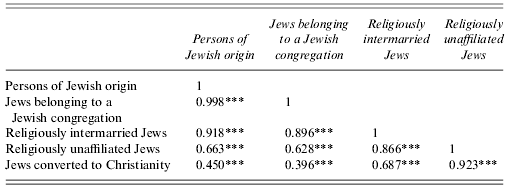
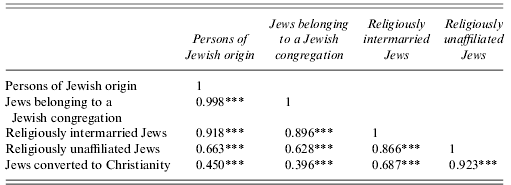
To analyse the relationship between assimilation and residential district, we calculated Pearson correlations between the concentrations of the different groups of assimilated Jews in the districts of Amsterdam, and these are presented in Table 1.Footnote 63 It appears that the predicted ranking of the different kinds of assimilated groups is supported by the Pearson correlations. The results show that the spatial concentrations of those of Jewish origin belonging to a Jewish congregation and those married to Gentiles are highly correlated with the spatial concentration of all inhabitants of Jewish origin. Although intermarried Jews had married a Gentile, most of them were probably still religiously or socially attached to the Jewish community. However, the spatial concentration of intermarried Jews is also highly correlated with the spatial concentration of religiously unaffiliated Jews, expressing the in-between position of those who had married a Gentile – some of whom had also left Judaism. The spatial concentrations of religiously unaffiliated Jews and of Jewish converts to Christianity are only moderately correlated with the spatial concentration of inhabitants of Jewish origin. Moreover, the calculated correlations show that the spatial concentrations of religiously unaffiliated Jews and of converts to Christianity are also only moderately correlated with the spatial concentration of those of Jewish origin belonging to a Jewish congregation. Based on these results, we conclude that those of Jewish origin who were more assimilated lived mainly in different districts from those who were less assimilated.
Pearson correlations between concentrations of different groups of assimilated Jews in 56 Amsterdam districts in 1941
*** Correlation is significant (p<0.001; two-tailed).
Source: See Section III: Sources and Data.
VI. THE IMPACT OF RESIDENTIAL SEGREGATION ON OTHER ASPECTS OF ASSIMILATION
In this section, we test the impact of residential segregation on other aspects of assimilation as first proposed and tested by Otis Duncan and Lieberson.Footnote 64 Peach later retested and confirmed the inverse relationship between spatial segregation and exogamy proposed by Otis Duncan and Lieberson, using better data to identify intermarriages. In Peach's study, however, the data on residential segregation were based on the addresses of the marrying population.Footnote 65 It is therefore hard to indicate a causal relationship. In her study of the Jewish proletariat in Amsterdam in the first decades of the twentieth century, Leydesdorff noticed that relocation to the ‘Oosterparkbuurt’ district, adjacent to the Jewish neighbourhood, represented the first step away from the Jewish neighbourhood and a first move toward assimilation. She hinted therefore at a causal relationship between leaving the Jewish neighbourhood and other aspects of assimilation of Jews in Amsterdam.Footnote 66 Based on Leydesdorff's observation and the time order relationship between structural and marital assimilation in Gordon's framework,Footnote 67 it might be expected that residence outside the Jewish neighbourhood is a precondition for religious intermarriage and also for changes in the individual's religious affiliation.
To test these two hypotheses, we analyse the residential patterns of a sample of 717 research subjects of Jewish origin by examining their places of residence at two moments in their life. First, we look at each individual's residence at birth. The area in which a person lived during his or her adolescence – the years in which one meets potential marriage partners – is chosen as the second moment; for this, each subject's address at about age 17 years is used. The addresses or the corresponding administrative area codes of the residences mentioned on the family cards in the Amsterdam population register are then matched to the addresses and living areas which are said to constitute the Jewish neighbourhood.Footnote 68 Using the dates of residence at the addresses, it is possible to determine who was born in the Jewish neighbourhood and who lived in that area during adolescence.Footnote 69
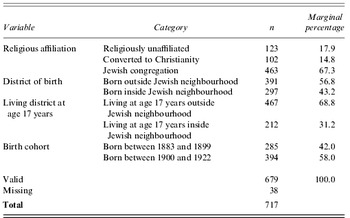
First, we investigate the impact of residential segregation on religious affiliation using multinomial logistic regression.Footnote 70 For this analysis, we use the latest information on religious affiliation available; the information found on the German registration list of Amsterdam Jews. In our group of subjects, about two-thirds belonged to a Jewish congregation in 1941, about 18 per cent were religiously unaffiliated, and about 15 per cent had converted to Christianity (see Table 2). In the multinomial logistic regression analysis, those of Jewish origin who belonged to a Jewish congregation function as the reference category.
Descriptions of dependent and independent variables used in the analysis concerning religious affiliation

Source: See Section III: Sources and Data.
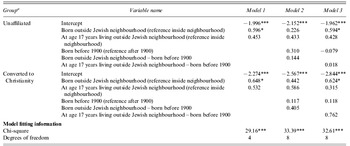
The model fitting information in Table 3 shows whether the presented models fit the data better than an intercept-only model. Since the chi-square values for all the models are significant, we can conclude that our models outperform an intercept-only model. In the top half of model 1 in Table 3, the results show that those persons in the research samples born outside the Jewish neighbourhood were more likely to be religiously unaffiliated than those born inside the Jewish neighbourhood. In this same model, we can see that the research subjects living outside the Jewish neighbourhood at the age of 17 years did not have a higher probability of becoming religiously unaffiliated. The results in the bottom half of model 1 show that research subjects born outside the Jewish neighbourhood were more likely to convert to Christianity than those born inside this neighbourhood. Those living outside the Jewish neighbourhood at the age of 17 years did not have a higher likelihood of conversion to Christianity. In models 2 and 3 we introduce two birth cohorts, divided into those born before 1900 and those born after 1900. We expect that district of residence will have less influence over religious affiliation for the younger cohort in view of the decline in residential segregation ongoing until the 1930s (see Figures 1 and 2). Neither the birth cohort nor the interactions between birth cohort and area of residence at birth (model 2) or at age 17 years (model 3) show any significant effect on religious affiliation.
Multinomial logistic regression effects on the likelihood of being religiously unaffiliated or converting to Christianity

a Reference category is belonging to the Portuguese or Dutch Jewish congregation.
* p<0.05, *** p<0.001.
Source: See Section III: Sources and Data.
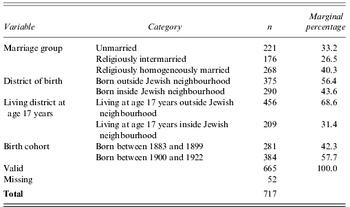
Using a second multinomial logistic regression, we investigate the impact of residential segregation on marital status using the information given on the family cards on marital status and the religious affiliation of an individual's spouse around the time of their first marriage. In this way, it was possible to determine which individuals in the sample were married and which remained unmarried until 1940. Among the research subjects, about one-third were unmarried and about two-thirds were or had been married during our research period (see Table 4); this includes individuals who had been divorced or widowed. Next, using the religious affiliation of the spouse we divided married individuals into those who married Gentiles, that is, intermarried, and those who married a Jew, that is, were in religiously homogeneous marriages.Footnote 71 In this analysis, those persons who married other Jews function as the reference category.
Descriptions of dependent and independent variables used in the analysis concerning (interreligious) marriage

Source: See Section III: Sources and Data.
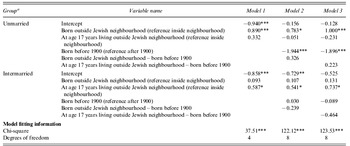
Since the chi-square values presented in the model fitting information in Table 5 are significant, we can again conclude that our models outperform an intercept-only model. In the top half of model 1 in Table 5, the results show that research subjects born outside the Jewish neighbourhood were more likely to be unmarried than to have married other Jews, compared with those born inside the Jewish neighbourhood; the living address at age 17 years shows no significant effect. The results from an analysis not presented here show that those born outside the Jewish neighbourhood were also more likely to be unmarried than to have married someone of a different religion, perhaps indicating that Jews born outside the Jewish neighbourhood had more difficulties finding a marriage partner at all than Jews born inside the Jewish neighbourhood.
Multinomial logistic regression effects on the likelihood of being unmarried or being married to a Gentile

a Reference category is religiously homogeneously married Jews.
* p<0.05, ** p<0.01, *** p<0.001.
Source: See Section III: Sources and Data.
The results in the bottom half of model 1 in Table 5 show that those research subjects born outside the Jewish neighbourhood did not have a significantly higher probability of marrying a Gentile. Those who resided outside the Jewish neighbourhood at age 17 years, however, were more likely to marry a Gentile. This result indicates that the place of residence during adolescence is more important than the place of birth in relation to the probability of marrying a Gentile.
In models 2 and 3 in Table 5 we again introduce two cohorts, comprising those born before 1900 and those born after 1900, to analyse whether there is a cohort effect. In the top half of the second model, we can see that those born after 1900 were more likely to be unmarried at the end of our research period. This result is not surprising, since those born before 1900 had more time to find a marriage partner. Being born before or after 1900 does not have a significant effect on being religiously intermarried. Neither the interaction between birth cohort and district of residence at birth (model 2) nor the interaction between birth cohort and district of residence at age 17 years (model 3) show significant effects on being unmarried or being married to a Gentile.
Since being born at an address outside the Jewish neighbourhood had a significant relationship with an individual's becoming religiously unaffiliated or converting to Christianity, this address probably reflected the individual's parents' weaker connection to the Jewish congregation, the Jewish community, and Jewish religious traditions so that they did not greatly stimulate their children to become affiliated with a Jewish congregation. The address during adolescence had a significant relationship with the probability that the individual would marry a Gentile. Those who married a Gentile had to meet or come into contact with Gentiles. The address during adolescence was more important than the birth address for meeting potential Gentile marriage partners.
VII. CONCLUSION
Some scholars argue that the address of residence does not necessarily represent the area where people interact socially,Footnote 72 and question the simple relationship between spatial concentration of minorities and the formation of communities often taken for granted in studies of integration.Footnote 73 Because Amsterdam's Jewish neighbourhood was founded centuries ago and generations of Jews had lived there, for Jews living in this neighbourhood at the beginning of the twentieth century it was not just a place to sleep, but a neighbourhood with its own social atmosphere and culture where people maintained both work and social day-to-day contacts.
In Dutch Jewish history, the beginning of the 1940s can be marked as the final years before drastic anti-Jewish measures began. From the summer of 1942 on, the German occupiers deported Jews from the Netherlands to concentration- and death-camps, decimating about three-quarters of the Jewish population of Amsterdam. The German registration list of Amsterdam Jews undertaken in early spring 1941, and containing the addresses of virtually every Jew in the city, therefore gives us the last overview of the Jewish community in Amsterdam before the Shoah, making it possible to study their residential patterns.
For decades, residential patterns have been of particular concern in assimilation research because residential segregation is viewed as an indicator of assimilation. The ID and the isolation index are generally accepted standards which measure residential segregation.Footnote 74 From the end of the nineteenth century, Jews in Amsterdam started to assimilate both socially and residentially. The process of residential assimilation is described through the decrease of the ID and the isolation index.Footnote 75 Although the trend for both the indices continued to fall in the twentieth century, the downward trajectory of these trends had come to a halt by 1941, as the calculated ID and index of isolation show.
Nearly half of the thousands of Jewish immigrants and refugees flocking to Amsterdam in the 1930s settled in two of the city's southern districts. This particular choice of residence halted the decline in the ID and index of isolation. Calculations omitting foreign Jews, however, show a greater increase of the ID, and a more moderate decline in the isolation index than when all Jews are considered, suggesting that the native-born Jews had also become increasingly concentrated in particular residential areas of the city in the 1930s.
Initially, a continuing decrease in these indices was expected as a result of the demolition of slums in the Jewish neighbourhood and the large increase in the construction of council housing in quarters outside this neighbourhood after the First World War. As with Tilly's transplanted networks,Footnote 76 Jewish settlement in the newly built areas could have attracted other Jews to these areas, resulting in new areas of Jewish concentration. However, a halt in the process of spatial assimilation was observed, which aligns with a decrease in Jewish–Gentile marriages in the second half of the 1930s,Footnote 77 suggesting that the assimilation of Jews in the 1930s did not continue on a straight-line trajectory from previous decades, but followed a ‘bumpy’ course, to use Gans's term.Footnote 78
The individuals included in the German registration list of Amsterdam Jews were all descended from three or four Jewish grandparents but they had achieved varying levels of assimilation, allowing the residential patterns of assimilated Jews in particular to be investigated. Correlation calculations show that the districts of residence of those of Jewish origin who had assimilated to a higher degree only moderately overlapped the districts of those who still belonged to a Jewish congregation, indicating that district of residence can reflect progress through the process of assimilation.
Some scholars, such as Lieberson,Footnote 79 have argued that residential segregation affects other aspects of assimilation. Our analyses have shown that those of Jewish origin born outside the Jewish neighbourhood were more likely to become religiously unaffiliated or to convert to Christianity. On the other hand, living outside the Jewish neighbourhood during adolescence had no effect on individuals' religious affiliation but seemed to be a precondition for intermarriage with Gentiles. These results not only support the hypothesis that residential segregation has an impact on other aspects of assimilation, but they also refine our understanding of the impact of residential segregation.
ACKNOWLEDGEMENTS
This research was supported by a Veni grant of the Netherlands Organisation for Scientific Research (NWO 257-52-007). A first draft of this article was presented at the Second Contact Day Jewish Studies on the Low Countries conference, University of Antwerp, 20 May 2009. I would like to thank the participants for their comments and Leo Lucassen for his comments and suggestions.