Introduction
Management researchers have studied the ‘dark side’ of leadership using labels such as tyrannical leadership, destructive leadership, bullying, and toxic leadership (Pelletier, Reference Pelletier2010), but one of the most widely studied leadership styles to date is that of abusive supervision (ABS) (Bennett et al., Reference Bennett, Deen, Harvey, Leonard, Li, Mackey and Restubog2018; Blomme, Kodden, & Beasley-Suffolk, Reference Blomme, Kodden and Beasley-Suffolk2015; Tepper, Simon, & Park, Reference Tepper, Simon and Park2017). Tepper (Reference Tepper2000, p. 178) defines ABS as ‘subordinates’ perception of their supervisors’ engagement in a sustained display of hostile verbal and nonverbal behaviors, excluding physical contact.’ Schyns and Schilling (Reference Schyns and Schilling2013) noted that scholars have shown a keen interest in the subject because of its pervasiveness and damaging effects, which are likely due to the direct daily interaction between a supervisor and subordinate, the frequency of which makes supervisors more prone to being perceived as abusive (Purcell & Hutchinson, Reference Purcell and Hutchinson2007; Schyns, Felfe, & Schilling, Reference Schyns, Felfe and Schilling2018).
Several authors have grounded discussions about subordinates' retaliation against the supervisors' hostile treatment in social exchange theory (Inness, Barling, & Turner, Reference Inness, Barling and Turner2005; Tepper, Duffy, & Shaw, Reference Tepper, Duffy and Shaw2001; Zellers, Tepper, & Duffy, Reference Zellers, Tepper and Duffy2002). Which states that irrespective of power gap, subordinates retaliate against abusive supervisor; however, they may not be able to show their resentment explicitly for fear of retaliation, punishment, or lost rewards. Therefore, they change their discretionary behaviors which are not part of their job descriptions, are not evaluated through formal processes, and are largely unobservable and not punishable (Aryee, Chen, Sun, & Debrah, Reference Aryee, Chen, Sun and Debrah2007; Liu & Wang, Reference Liu and Wang2013; Mitchell & Ambrose, Reference Mitchell and Ambrose2007; Tepper, Carr, Breaux, Geider, Hu, & Hua, Reference Tepper, Carr, Breaux, Geider, Hu and Hua2009; Tepper, Henle, Lambert, Giacalone, & Duffy, Reference Tepper, Henle, Lambert, Giacalone and Duffy2008; Thau, Bennett, Mitchell, & Marrs, Reference Thau, Bennett, Mitchell and Marrs2009). Such discretionary behaviors include counter-productive work behaviors (CWB) and organizational citizenship behaviors (OCB) (Martin, Guillaume, Thomas, Lee, & Epitropaki, Reference Martin, Guillaume, Thomas, Lee and Epitropaki2016). OCB are behaviors that support an organization's social and psychological environments (Organ, Reference Organ1997), while CWB is any intentional behavior that is contrary to an organization's legitimate interests (Sackett, Reference Sackett2002).
For quite a long period of time ABS has been considered a subjective phenomenon, as it depends on a subordinate's perceptions and personality (Tepper et al., Reference Tepper, Carr, Breaux, Geider, Hu and Hua2009). Likewise, reaction against ABS has also been considered idiosyncratic and reliant on the interaction between a subordinate's perception and their specific personality type; hence, the majority of previous studies have tried to explore personality and individual-based factors as potential antecedents of a subordinate's reaction to supervisory abuse (Tepper, Reference Tepper2007; Tepper, Simon, & Park, Reference Tepper, Simon and Park2017; Zellers, Tepper, & Duffy, Reference Zellers, Tepper and Duffy2002). In contrast, a study has argued that in certain circumstances, contextual perceptions supersede personality factors, thus minimizing the effect of personality-based subjectivity on an employee (Vidyarthi, Liden, Anand, Erdogan, & Ghosh, Reference Vidyarthi, Liden, Anand, Erdogan and Ghosh2010). Vidyarthi et al. (Reference Vidyarthi, Liden, Anand, Erdogan and Ghosh2010) argued that when studying the leader–subordinate relationship, overlooking the contextual factors has become a major limitation because of the fact that employees work in groups and group's context has a considerable influence on an individual's behavior. In this context, management scholars have highlighted the phenomenon of group differentiated leadership (Chen, He, & Weng, Reference Chen, He and Weng2018; Wu, Tsui, & Kinicki, Reference Wu, Tsui and Kinicki2010). An assumption to the supervisors' behavior is that they exhibit differentiated behaviors toward subordinates – supervisor supports some subordinates while abusing others, thereby establishing an in-group and an out-group (Dalal, Lam, Weiss, Welch, & Hulin, Reference Dalal, Lam, Weiss, Welch and Hulin2009; Forret & Sue Love, Reference Forret and Sue Love2008; Wu, Tsui, & Kinicki, Reference Wu, Tsui and Kinicki2010). On the other hand, abused subordinates asses the supervisor's mistreatment in their own social context, so the perception that how others are treated by the same leader can influence their responses (Hannah et al., Reference Hannah, Schaubroeck, Peng, Lord, Trevino, Kozlowski and Doty2013; Skarlicki & Rupp, Reference Skarlicki and Rupp2010; Spencer & Rupp, Reference Spencer and Rupp2009). Abused employees consider themselves to be members of an out-group whose other members encounter similar mistreatment, so they are attracted to and support each other in order to exert greater retaliation against the source of mistreatment (supervisors) and that source's allies (non-abused coworkers) (Heider, Reference Heider1958; Hobman, Restubog, Bordia, & Tang, Reference Hobman, Restubog, Bordia and Tang2009; Priesemuth & Schminke, Reference Priesemuth and Schminke2019; Salancik & Pfeffer, Reference Salancik and Pfeffer1978). The network formed in response to ABS leads to a person's developing diverse inter-personal discretionary behaviors, such as support toward other abused peers (OCB-AP) and CWB toward the supervisor (CWB-S) and non-abused peers (CWB-NP). This study argues that abused subordinates perceive support from other abused peers as strength to fight against ABS.
This work therefore extends social exchange principle to examine (a) the mediating role of OCB-AP between ABS and CWB-S and CWB-NP and (b) the diverse reactions of abused subordinates toward other organizational members – supervisors, other abused and non-abused peers. Hence, it evaluates not only the negative effect of ABS on the supervisor–subordinate relationship but also that on subordinate–subordinate relationships linkages (Scott & Lane, Reference Scott and Lane2000).
This study makes three primary contributions. First, it extends the literature by explaining the reactions of abused subordinates toward diverse peer-group members and abusive supervisor. Much of the work on ABS has examined the reaction of abused subordinates without taking into account the contextual factors (Vidyarthi et al., Reference Vidyarthi, Liden, Anand, Erdogan and Ghosh2010). This study considers OCB-P, which represents support of abused peers as a mediating factor between ABS and retaliation against it.
The second contribution of this work is explaining one of the mechanisms through which an abused employee becomes inclined to retaliate against his or her supervisor through the mediating effect of group support. Tepper, Simon, and Park's (Reference Tepper, Simon and Park2017) meta-analysis revealed that, since its emergence in 2000, many studies have examined the direct and moderating effects of ABS on CWB without accounting for underlying mechanisms. They argued that, although the previous literature had provided useful information, the reason for subordinates' responding to ABS with CWB remains unclear. They suggested that there is a need to explore more mechanisms and corresponding theoretical perspectives that affect the relationship between ABS and CWB under certain circumstances.
Third contribution of this study is its focus on the context of Pakistan. ABS has been studied mainly in the context of western societies, although eastern cultures and developing countries have their own boundary conditions (Martinko, Harvey, Brees, & Mackey, Reference Martinko, Harvey, Brees and Mackey2013). For instance, in Pakistan's high levels of power distance and unemployment may hinder subordinates from retaliating against ABS (Hofstede, Hofstede, & Minkov, Reference Hofstede, Hofstede and Minkov2010; Pakistan Bureau of Statistics, 2017). On the other hand, its high level of collectivism may provide subordinates an opportunity to develop bonds with each other, which can give them strength to fight back (Hofstede, Hofstede, & Minkov, Reference Hofstede, Hofstede and Minkov2010). This study clarifies subordinates' reactionary mechanism against abusive supervisors under the prevailing conditions in Pakistan.
The next section discusses the behavioral exchanges that abused subordinates have with their supervisors and co-workers under the premise of social exchange theory, and the nomological network of abused employees' discretionary behaviors. Subsequently, the theoretical framework and research hypotheses are developed.
Theory and Hypotheses
Social exchange relations in response to ABS
The essence of social exchange theory is based on the norm of reciprocity of actions (Gouldner, Reference Gouldner1960). Management researchers have studied social exchange theory extensively through perspectives and interactions such as an individual's relationship with his or her leader, co-workers, employing organizations, customers, and suppliers and have shown that these exchanges are discrete, each with its own antecedents and effects. Nevertheless, individuals manifest targeted reactions, depending on whose action they intend to reciprocate (Cropanzano & Mitchell, Reference Cropanzano and Mitchell2005; Paillé, Reference Paillé2010; Wayne, Shore, & Liden, Reference Wayne, Shore and Liden1997).
The studies grounded on social exchange theory pertaining to injustice perceptions and its reaction provided the foundation for contemporary studies on ABS. It implies that abused subordinate's reaction would be in accordance with the actions of distinct factors of organization (Podsakoff, Whiting, Podsakoff, & Blume, Reference Podsakoff, Whiting, Podsakoff and Blume2009; Wat & Shaffer, Reference Wat and Shaffer2005). Since a stream of studies suggested discretionary behaviors as a safe reaction against supervisory mistreatment (Tepper, Reference Tepper2007) but a high variability is seen in the findings of the previous studies (Ilies, Nahrgang, & Morgeson, Reference Ilies, Nahrgang and Morgeson2007). The possible reason could be that leadership behaviors have discrete effects on various OCB and CWB dimensions that are OCB/CWB toward organization, OCB/CWB toward leader or OCB/CWB toward co-workers and most of the studies considered OCB and CWB as a general construct, hence not painted a true picture (Ilies, Nahrgang, & Morgeson, Reference Ilies, Nahrgang and Morgeson2007). Realizing this gap Dalal et al. (Reference Dalal, Lam, Weiss, Welch and Hulin2009) suggested studying different facets of discretionary behaviors exclusively. Following the same line of thought, the current study catered the abused subordinate's reaction in compliance to opposite party's action – CWB toward those parties, who are perceived to be either part of ABS (Supervisor) or a beneficiary of it (non-abused coworkers) and OCB toward those who are perceived as a support (abused coworkers).
Nomological network of the discretionary behaviors of a supervisory-abused subordinate
Industrial/organizational psychology has admitted the significant effect of discretionary behaviors (OCB and CWB) on job performance as it works as a catalyst for task activities (Dalal, Reference Dalal2005; Organ & Paine, Reference Organ, Paine, Cooper and Robertson1999; Priesemuth & Schminke, Reference Priesemuth and Schminke2019; Sackett, Berry, Wiemann, & Laczo, Reference Sackett, Berry, Wiemann and Laczo2006). Discretionary behaviors are important from the perspective of assessing the employee's overall contribution to an organization (Dalal et al., Reference Dalal, Lam, Weiss, Welch and Hulin2009).
In classical literature, these behaviors had been considered extremely opposite to each other (Bennett & Stamper, 2002; Fisher, Locke, & Henne, Reference Fisher, Locke and Henne1992; Organ & Paine, Reference Organ, Paine, Cooper and Robertson1999). Contemporary scholars have negated the notion and established that the association between the two is just moderate (Dalal, Reference Dalal2005; Spector & Fox, Reference Spector and Fox2002). Dalal (Reference Dalal2005) identified that 38 out of 49 prior studies have concluded that the relationship between OCB and CWB was merely modest. Hence, he asserted that OCB and CWB are not opposite poles of the same continuum; the presence of one does not guarantee the absence of the other. Spector and Fox (Reference Spector, Fox, Fox and Spector2005) specified that a close examination suggests some parallels in these two forms of behaviors, therefore, these behaviors should be tested in integration to each other. According to them, positive or negative behaviors both depend on an individual's perception of the environment at a particular instance, both of the opposite behaviors can co-occur and can be exhibited by the same person. Thus, associating a unique permanent behavior with a person is not appropriate due to the varying situations in organizations.
Moreover, lately, scholars have highlighted that OCB and CWB had been mostly studied at one level only i.e. between the individuals while ignoring the within-person approach (Dalal et al., Reference Dalal, Lam, Weiss, Welch and Hulin2009). Dalal et al. (Reference Dalal, Lam, Weiss, Welch and Hulin2009) averred that there is a great emotional variability within a person, depending on the on-going emotional state, though the reaction may vary in intensity depending on the personality type and position of an individual. Dalal et al. (Reference Dalal, Lam, Weiss, Welch and Hulin2009) also noted episodical nature of different facets of discretional behaviors and emotional variability within a person – implying that a person may show OCB at one time and CWB at another. Hereafter, behaviors have been shifted from a nomological network of between-person approach to within-person approach. Recently, the literature has moved a step further by claiming that in certain circumstances even OCB itself become antecedence for CWB (Merritt, Effron, & Monin, Reference Merritt, Effron and Monin2010). This new face of OCB seems in contradiction with the classical literature and yet understudied (Podsakoff & MacKenzie, Reference Podsakoff and MacKenzie1997). Merritt, Effron, and Monin (Reference Merritt, Effron and Monin2010) suggested exploring more situations where these two seemingly opposite behaviors (OCB and CWB) work in integration. The model proposed in the current study complies with the contemporary approach of co-occurrence of opposite behaviors (OCB and CWB) in result of supervisory actions.
Direct effect of ABS on CWB-S/CWB-NP
Leadership studies based on social exchange theory have declared ABS as one of the most frequent supervisory mistreatments perceived by subordinates, which results in change of subordinate's discretionary behaviors (Aquino, Tripp, & Bies, Reference Aquino, Tripp and Bies2006; Harmon, Scotti, Behson, & Farias, Reference Harmon, Scotti, Behson and Farias2003; Jones, Reference Jones2009; Martinko et al., Reference Martinko, Harvey, Brees and Mackey2013; Rudolph, Roesch, Greitemeyer, & Weiner, Reference Rudolph, Roesch, Greitemeyer and Weiner2004; Tepper, Reference Tepper2000, Reference Tepper2007). Scholars have suggested that when employees perceive to be mistreated, they feel like losing behavioral balance with their supervisors and try to regain it through changing their discretionary behaviors – implies that poor exchange relations tend to end up in employee's deviation from accepted work-place norms and behaviors in the form of CWB (Dansereau, Graen, & Haga, Reference Dansereau, Graen and Haga1975; Martin et al., Reference Martin, Guillaume, Thomas, Lee and Epitropaki2016; Zellers, Tepper, & Duffy, Reference Zellers, Tepper and Duffy2002). Following the same line of thought, this study proposes a positive relationship between ABS and CWB toward a supervisor.
Though earlier studies established the splitting of subordinates into groups in response to ABS, yet none of them explored the influence of such groups on the discretionary behaviors manifested by abused employees (Dalal et al., Reference Dalal, Lam, Weiss, Welch and Hulin2009). In this regard, scholars averred that perception of supervisor's abusive and discriminatory behavior makes an employee feel like getting less respectful treatment as compared to one's co-workers (Cohen-Charash & Spector, Reference Cohen-Charash and Spector2001; Vidyarthi et al., Reference Vidyarthi, Liden, Anand, Erdogan and Ghosh2007). Hence, creating the emotion of enviousness among employees and ultimately leads to targeted CWB toward co-workers. They suggested for more research in this regard. To fill this gap, the current study proposes two different groups in response to supervisor's abusive behavior – abused and non-abused. Abused subordinates bear feelings according to their respective group affiliations – having OCB toward members of the identical group (abused group members) and CWB toward members of the opponent group (non-abused group members) (Merritt, Effron, & Monin, Reference Merritt, Effron and Monin2010). The role of OCB (AP) is discussed in the next section. Here the point of consideration is a direct relationship of ABS with CWB (NP).
In this regard, Mitchell and Ambrose (Reference Mitchell and Ambrose2007) proclaimed that employees not only react against the perceived source of abuse but it has collateral damages too, such as deviation against factors they perceive contributed in abuse but the collateral damage still remains low as compared to the direct target. Baron, Neuman, and Geddes (Reference Baron, Neuman and Geddes1999) supported this notion by stating that supervisory-abused employees retaliate more often toward supervisors as compared to their own subordinates or co-workers yet, they still react against co-workers and the magnitude of this reaction is so far understudied in the literature.
On the other hand, to date, research on ABS have mostly been confined to individual's own-perception (Tepper, Reference Tepper2007) and ignored the fact that people react more aggressively against any unwanted behavior when they perceive that their co-workers have the same emotions toward organizational factors (Aquino & Douglas, Reference Aquino and Douglas2003). Harris, Harvey, Harris, and Cast (Reference Harris, Harvey, Harris and Cast2013) studied direct along with vicarious ABS. They described vicarious ABS as hearing it from co-workers who perceived to have a bad experience with supervisors, whereas, direct ABS is one's own perception of being abused by the supervisor. Harris et al. (Reference Harris, Harvey, Harris and Cast2013) found that the effect of direct ABS, when combined with vicarious ABS is higher than direct ABS alone.
Based on the discussion in the literature, it is posited that a subordinate perceived to be abused along with his/her peers, collaborate to strengthen each-other to retaliate against ABS and this retaliation is mostly targeted toward supervisors and non-abused peer-group members. Thus, it is expected:
Hypothesis 1a
ABS is positively associated with CWB-S.
Hypothesis 1b
ABS is positively associated with CWB-NP.
The mediating role of OCB-AP in the positive relation of ABS and CWB-S/CWB-NP
When a group of people perceive any kind of organizational injustice, they develop identification and bonding among each other, while a detachment from the source of injustice. Further, this identification and bonding give each member of the deprived group a strength to react against the target, that otherwise would not be possible for them (Kelloway, Francis, Prosser, & Cameron, Reference Kelloway, Francis, Prosser and Cameron2010).
Moreover, Canham (Reference Canham2002) averted that individuals in an organization primarily gang together to cater insecurity and uncertainty of being alone and hence become more vulnerable to be counter-attacked. In the same context, Priesemuth, Arnaud, and Schminke (Reference Priesemuth, Arnaud and Schminke2013) established that overall perception of injustice provokes small group associations; it may decrease deprived employees' collaboration and engagement with the organizational group and prompts members to withdraw from the bigger group and join small groups. Later, these small groups work in collaboration to fight against the source of mistreatment.
Hung, Chi, and Lu (Reference Hung, Chi and Lu2009) found that organizational employees compare themselves with co-workers and in case they perceive any injustice happening to them, they create co-workers division, which consequents in the formation of groups. Members of deprived group collaborate with each other to create a bigger impact against the source of injustice. This stream of research implies that under any unfavorable situation, deprived employees develop OCB among each other to gain strength. This strength further enables each of the group members to retaliate against the higher-ups.
In the specific context of ABS, it was established that ABS perceived by a group of subordinates as compared to ABS perceived by an individual subordinate alone has great persuasion toward CWBs (Peng, Schaubroeck, & Li, Reference Peng, Schaubroeck and Li2014). The subordinates who perceive supervisor as abusive develop a sentiment of empathy for each other and consequently facilitate each other to cope up with the situation (Peng, Schaubroeck, & Li, Reference Peng, Schaubroeck and Li2014).
Furthermore, a stream of research on norms established that employees, who have close association with co-workers, who are involved in CWB, get influenced and tend to be involved in a similar kind of behaviors (Basford & Offermann, Reference Basford and Offermann2012; Geurts, Buunk, & Schaufeli, Reference Geurts, Buunk and Schaufeli1994; Harrison & Shaffer, Reference Harrison and Shaffer1994; Johns, Reference Johns1994; Mathieu & Kohler, Reference Mathieu and Kohler1990). Several management scholars also take an extreme position by asserting that an employee tends to engage in CWB only, if their co-workers engage in similar behaviors and support them (Duffy, Shaw, Scott, & Tepper, Reference Duffy, Shaw, Scott and Tepper2006; Glomb & Liao, Reference Glomb and Liao2003; Robinson & O'Leary-Kelly, Reference Robinson and O'Leary-Kelly1998). In summary, previous empirical studies observed that employees look toward their co-workers as a guide for appropriate behavior and feel secure to act as a member of a group rather than indulging in a counter-productive behavior alone (Tepper et al., Reference Tepper, Henle, Lambert, Giacalone and Duffy2008).
Based on the facts established by the previous studies, this study proposes that to make retaliation possible the abused employees associate together and form OCB among each other, this OCB makes possible for each of them to retaliate against the abusive supervisor and his/her allies. Hence, OCB-AP acts as a mediating variable between ABS and CWB (supervisor and non-abused peers). Thus we expect:
Hypothesis 2a
OCB (AP) plays a mediating role between ABS and CWB (S).
Hypothesis 2b
OCB (AP) plays a mediating role between ABS and CWB (NP).
Method
Sample and data
Middle-level employees from 20 multi-sector organizations in Pakistan volunteered to participate in the survey. Among these, seven were from the government sector, eight were from the private sector, and five from non-governmental organizations. Middle-level employees as subordinates were deemed suitable for this study for two reasons: (1) have daily face-to-face interactions with their supervisors (Gong, Chang, & Cheung, Reference Gong, Chang and Cheung2010; Morgeson & Hofmann, Reference Morgeson and Hofmann1999) and (2) work in a group under one supervisor, this makes possible for the focal person to assess coworkers' behaviors and perception about the same supervisor. Employees working in the group of 3–5 individuals were randomly selected (Colquitt, Noe, & Jackson, Reference Colquitt, Noe and Jackson2002; Priesemuth, Schminke, Ambrose, & Folger, Reference Priesemuth, Schminke, Ambrose and Folger2014). All participants were briefed about the research purposes and were guaranteed the confidentiality of shared information.
Lists of employees' e-mails were attained from the human resource offices of respective organizations. The targeted employees were personally contacted by the researchers through e-mails with the consent of their respective supervisors. The questionnaire was in English, as middle-level employees have sufficient knowledge to read, comprehend, and respond to questions asked in that language. The questionnaire is comprised of two main sections. In the first section, demographics such as age, gender, and tenure were obtained. In the second section, a clear operational definition of ABS is provided followed by questions so that respondents have a clear idea of the term while filling the questionnaire.
In total, 2,000 questionnaires were distributed among the randomly selected employees, 1,280 respondents completed the survey; 920 questionnaires were found useful, with a 46% response rate. About 61% of the respondents were male, and the average age was 33.4 years. The average job tenure was 10.3 years.
Measures
Abusive supervisor
To assess ABS, five items were adapted from Peng, Schaubroeck, and Li (Reference Peng, Schaubroeck and Li2014). First three reflect active aggressive while later two reflect passive aggressive abuse toward subordinates. Subordinates were asked to rate the extent to which they agreed with the statement such as ‘My leader … tells me my thoughts and feelings are stupid.’ The same items were modified to capture perceptions of abuse targeted toward the coworkers such as ‘My leader … tells some of my peers that their thoughts and feelings are stupid.’ Both the measures were averaged together to obtain the perception of abuse about one own-self and about the peers (Priesemuth et al., Reference Priesemuth, Schminke, Ambrose and Folger2014). Ratings were obtained on a 5-point Likert scale, ranging from 1 (never) to 5 (almost always).
OCB (abused peer group)
To assess OCB (abused peer group), this study used a scale adapted from Dalal et al. (Reference Dalal, Lam, Weiss, Welch and Hulin2009). The scale of OCB among the peer group was modified in a way that inquires specifically about the behaviors of abused coworkers. An example of the items included in the study for OCB (abused peer group) is ‘Some of my co-workers and I have bad experiences with our supervisor, so we go out of the way to be nice to each other’ (Giacalone & Promislo, Reference Giacalone and Promislo2014). Data were collected on 5-point Likert Scale ranging from 1 (never) to 5 (always).
CWB (toward the supervisor) and CWB (toward the non-abused peer group)
The scale developed by Dalal et al. (Reference Dalal, Lam, Weiss, Welch and Hulin2009) for CWB (toward the supervisor) and CWB (toward the non-abused peer group) was modified according to the need of the study. The questions included targeted non-abused employees and the abusive supervisor. Each scale consisted of six items scored on 5-point Likert Scale, ranging from 1 (never) to 5 (always). An example of items included in CWB (toward the supervisor) is, ‘I behave in an unpleasant manner towards my supervisor.’ An example of the items included in CWB (toward non-abused peers) is, ‘I behave in an unpleasant manner toward other co-workers who are favored by my supervisor.’
Control variables
Three demographic factors were identified from the literature that could affect CWB, so should be controlled (Peng, Schaubroeck, & Li, Reference Peng, Schaubroeck and Li2014). These are the subordinate's gender (1 = male, 2 = female), the subordinate's age (1 = 20–30 years, 2 = 31–40 years, 3 = 41–50 years, 4 = 51 years and above), and the subordinate's tenure (1 = less than 1 to 5 years, 2 = 6 to 10 years, 3 = 11 to 15 years, 4 = 16–20 years, 5 = 21 years and above).
Results
The discussion of the results is organized into several sections: first section discusses the measurement model employed to test the validity and reliability of the latent constructs. Subsequent section discusses the pre- and post-remedial procedures adopted to remove common method variance and non-response bias. Next section reports the Pearson's correlations coefficients among variables in order to determine the degree and direction of association among them and the last section explicates the results of testing the hypotheses.
Validity and reliability
A confirmatory test was conducted to examine how well established scales represent the latent constructs and fit the study model (Schreiber, Nora, Stage, Barlow, & King, Reference Schreiber, Nora, Stage, Barlow and King2006). All items were loaded on their corresponding hypothesized latent constructs as specified in the study model. The four-factor model showed reasonable fit statistics (AGFI = .855, GFI = .876, RMSEA = .059, CFI = .932, and TLI = .924).
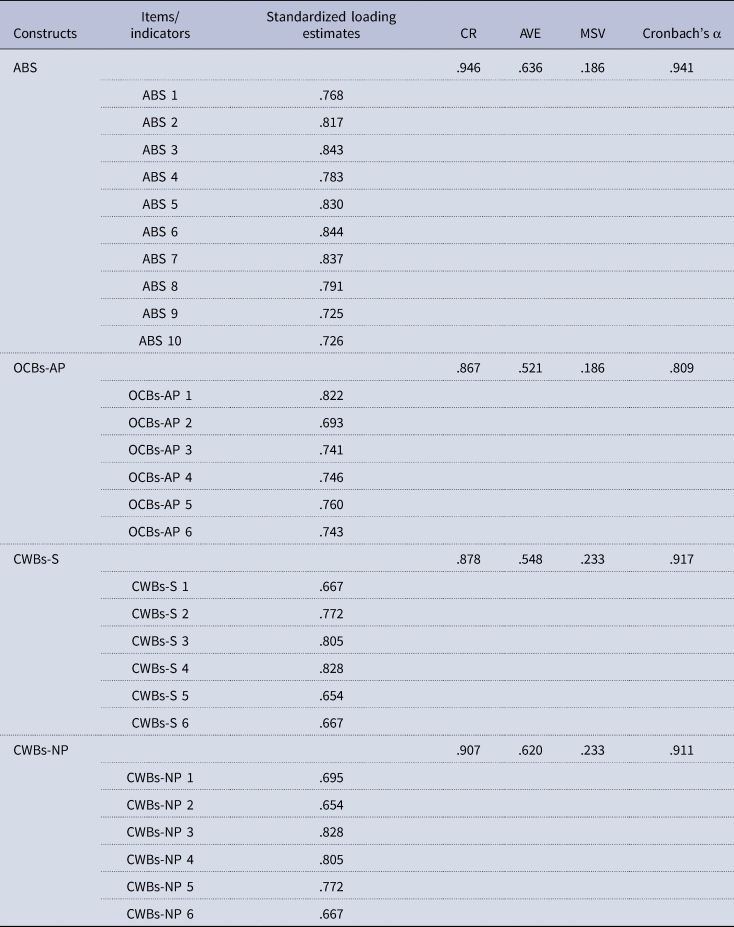
In addition to the fitness of the model, the validity and reliability of the latent constructs were tested (Hair, Black, Babin, Anderson, & Tatham, Reference Hair, Black, Babin, Anderson and Tatham2007). Standardized loading estimates obtained through the confirmatory test in a tutorial developed by Gaskin (Reference Gaskin2016a) were used to test the convergent and discriminant validity. Convergent validity was estimated by considering the indicators' factor loadings estimates and then calculating the average variance extract (AVE) scores for the latent constructs. The results (Table 1) revealed that all indicators had loading scores greater than .50 and were significant at p < .01 on their parent constructs this indicates that all indicators have sufficient weights on their corresponding latent constructs, therefore supporting reasonable convergent validity. The AVE values greater than .50 (Fornell & Larcker, Reference Fornell and Larcker1981), corroborate that convergent validity is established.
Standardize loading estimates, CR, AVE, MSV and Cronbach's α

ABS, abusive supervision own and peer group; OCBs-AP, organizational citizenship behavior toward abused peers; CWBs-S, counter-productive work behavior toward supervisor; CWBs-NP, counter-productive work behavior toward non-abused peers; CR, construct reliability; AVE, average variance extract; MSV, Maximum shared squared variance.
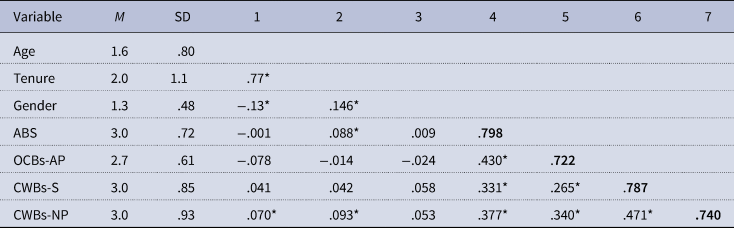
Discriminant validity was examined by comparing the values of maximum shared squared variance (MSV) with AVE. The comparison revealed that, in all cases, MSV values are lower than AVE, which confirms discriminant validity. Moreover, the square root of AVEs was composed of paired-correlation coefficients (Table 2). The comparison revealed that the square roots of AVEs are greater than the paired-correlation coefficients, further supporting the discriminant validity.
Mean, standard deviation and correlation

Note: Bold values in diagonals are the square root of AVE scores of latent constructs.
**Correlation is significant at .01 (two tailed).
*Correlation is significant at .05 (two tailed).
The reliability of the latent constructs was examined by computing the composite reliability and Cronbach's α. Table 1 shows the composite reliability values and Cronbach's αs are greater than the suggested values of .80 and .70, respectively, (Fornell & Larcker, Reference Fornell and Larcker1981) implies that the measures of latent constructs are reliable.
Common method bias
Several precautions were taken to minimize common method biases (Podsakoff, MacKenzie, & Podsakoff, Reference Podsakoff, MacKenzie and Podsakoff2012): (a) data on independent and dependent variables were collected in different times (with a gap of three weeks) in order to minimize the common method variance, (b) participants were ensured the confidentiality of information provided by them, and (c) finally, in order to decrease the evaluation concerns, it was stressed that there were no correct or incorrect answers for the given items in the survey.
Moreover, to remove any possibility of common method bias, as a pre-remedial strategy questions were designed in such a way that each employee had to rate his or her peers' behavior (Podsakoff, MacKenzie, & Podsakoff, Reference Podsakoff, MacKenzie and Podsakoff2012). Harman's single-factor test was applied as a post-remedial strategy, which reports that the data are free from common method bias as the maximum variance explained by the single factor model was 32%, which is less than the recommended maximum of 50%. Furthermore, a one-factor model in confirmatory factor analysis (CFA) showed a poor fit statistic, which corroborates that common method bias is not an issue in this study (AGFI = .325, GFI = .401, RMSEA = .173, CFI = .399, and TLI = .361).
Non-response bias
Non-response bias was assessed by comparing early to late respondents (Armstrong & Overton, Reference Armstrong and Overton1977). This comparison indicates no significant differences between early and late respondents. However, earlier respondents were slightly lower than later respondents in terms of mean difference; for ABS mean difference = .00043, p = .989; for OCB-P mean difference = .00051, p = .988; for CWB-S mean difference = .01486, p = .812 and for CWP-NP mean difference = .11993, p = .075. Based on these results, nonresponse bias did not appear to affect the framework of this study.
Correlations
Table 2 shows the correlation and descriptive statistics. The correlations established through this study demand that the employees' age and experience be controlled when testing the relationship between CWB-NP. The results proved that gender was not correlated with any of the dependent, so it was excluded from the hypotheses testing (Peng, Schaubroeck, & Li, Reference Peng, Schaubroeck and Li2014).
Hypotheses tests
Mediation analysis was carried out in AMOS using bootstrapping procedure with 95% bias corrected confidence intervals (CIs) and 5,000 bootstrapped samples. A structural model in AMOS was constructed by specifying the effects of ABS as exogenous variable on OCB-P as mediator variables, and CWB-S and CWB-NP as endogenous variables (Gaskin, Reference Gaskin2016b). None of the control variables were related to CWBs-S; therefore were not included while testing CWBs-S. In the case of CWBs-NP, only age and tenure were correlated, hence both the variables were controlled while testing CWBs-NP. However, when age and tenure were added as control variables, the results remain unchanged (Peng, Schaubroeck, & Li, Reference Peng, Schaubroeck and Li2014).
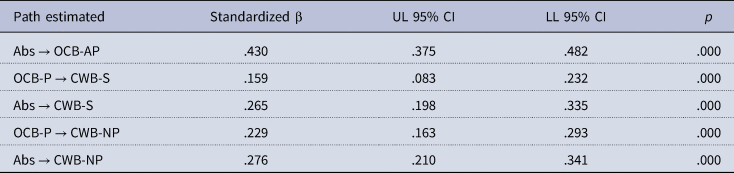
To test the hypotheses, a just identified initial model established the presence of significant direct effects of ABS on CWB-S (β = .265, p = .000), CWB-NP (β = .229, p = .000), and OCB-P (β = .430, p = .000); (Table 3). The direct effects of OCB-P on both CWB also proved to be significant; CWB-S (β = .159, p = .000) and CWB-NP (β = .229, p = .000) (Table 3). Hence, hypotheses 1a and 1b are fully supported.
Standardize direct effects

UL, upper-boundary limit; LL, lower-boundary limit; CI, confidence interval.
AMOS estimand (Gaskin, Reference Gaskin2016b) was used to test the indirect effect of the ABS on CWB-S through OCB-P. OCB-P demonstrated significant indirect effects from the predictor (ABS) and to the outcome variable (CWB-S) (β = .068, p = .005) (95% CI: .043, .123; Table 4). Therefore, hypothesis 2a was partially supported. Similarly, OCB-P established a significant indirect effect from ABS affect to CWB-NP (β = .098, p = .005) (95% CI: .089, .174; Table 4). Hence, hypothesis 2b was also partially supported.
Standardize indirect effects

Discussion
This study tested three effects: (a) the direct effect of ABS on CWB-S, (b) the direct effect of ABS on CWB-NP, and (c) the mediation effect of OCB-AP between ABS and both CWB (CWB-S and CWB-NP). Positive association of ABS and CWB and partial mediation of OCB-AP provides an answer to the research questions being addressed by this study. Findings of the study proved that abused subordinates retaliate against their supervisors and the non-abused peers by using support of other abused peers.
The significant and positive relationship between ABS and CWB toward supervisors is consistent with quite a number of previous studies of ABS that were constructed under social exchange theory (Jones, Reference Jones2009; Mitchell & Ambrose, Reference Mitchell and Ambrose2007; Tepper, Reference Tepper2000; Zellers, Tepper, & Duffy, Reference Zellers, Tepper and Duffy2002). Moreover, this study's findings reveal that abused employees exhibit negative behaviors toward non-abused peers as they consider them allies of the abusive supervisor. Heider (Reference Heider1958) provides a good explanation for this behavior, stressing that employees compare themselves with their peers, and when they feel that they are not treated fairly, they retaliate against the source of the treatment and its supporters. Several other studies have also recognized collateral damage, along with direct targets, in response to ABS, but they claimed collateral damages remain low compared to retaliation against the direct source (Baron, Neuman, & Geddes, Reference Baron, Neuman and Geddes1999; Blanken, van de Ven, Zeelenberg, & Meijers (Reference Blanken, van de Ven, Zeelenberg and Meijers2014); Mitchell & Ambrose, Reference Mitchell and Ambrose2007). This study shows contradictory results, as CWB-NP (B = .265) are higher than CWB-S (B = .279). This finding can be explained by the fact that, in a country like Pakistan, where power distance and unemployment rate is moderately high (Hofstede, Hofstede, & Minkov, Reference Hofstede, Hofstede and Minkov2010; Pakistan Bureau of Statistics, 2018) it is difficult to retaliate against supervisors aggressively. In this context, Abubakar, Megeirhi, and Shneikat (Reference Abubakar, Megeirhi and Shneikat2018) argued that in under developed countries such as Pakistan where employment options are quite low, quitting the job is the last option. Nonetheless, ABS generates negative emotions and emotional pain; consequently abused subordinates react in other ways than quitting, such as reacting against comparatively soft targets such as non-abused peers as an alternative channel of catharsis (Abubakar, Yazdian, & Behravesh, Reference Abubakar, Yazdian and Behravesh2018; Haar, de Fluiter, & Brougham, Reference Haar, de Fluiter and Brougham2016).
This study proposed a two-way positive relationship: an employee being abused performing OCB toward his or her abused peers and the employee performing CWB toward non-abused peers. In this context, the management literature reveals that social interactions in an organization depend on supervisors' discretionary behavior; a supervisor's favoritism toward specific subordinates and abusive treatment toward others generates feelings of resentment among the privileged and non-privileged employees (Graen & Uhl-Bien, Reference Graen and Uhl-Bien1995; Priesemuth et al., Reference Priesemuth, Schminke, Ambrose and Folger2014). Consequently, two conflicting groups are formed in the organization, and employees' behaviors are led by the affiliation they have to their group (Kim, O'Neill, & Cho, Reference Kim, O'Neill and Cho2010; Peng, Schaubroeck, & Li, Reference Peng, Schaubroeck and Li2014).
This study also established that OCB-AP work as mediators between ABS and CWB because the power gap makes it difficult for abused subordinates to react against an abusive supervisor. Therefore, abused employees use group collaboration to retaliate against higher-ups. In this process, the seemingly opposite behaviors (OCB and CWB) work as catalysts for each other. This phenomenon can be justified through moral licensing theory; which states that an employee who practices moral behaviors toward one group is licensed by that group to involve in CWB against another group without distorting his or her good image (Merritt, Effron, & Monin, Reference Merritt, Effron and Monin2010; Miller & Effron, Reference Miller and Effron2010).
The mediating role of OCB-AP has its roots in earlier management studies, according to which members of the abused group perceive to identify with each other and detach from the source of injustice, so each member of the group feels secure in protesting because he or she perceives to get support from those in a similar state (Cohen & Mueller, Reference Cohen-Charash and Mueller2007; Hung, Chi, & Lu, Reference Hung, Chi and Lu2009; Kelloway et al., Reference Kelloway, Francis, Prosser and Cameron2010).
Salancik and Pfeffer (Reference Salancik and Pfeffer1978) averred that members experiencing common adverse environmental conditions are most likely to have similar perceptions that later define their responses toward organizational factors (Salancik & Pfeffer, Reference Salancik and Pfeffer1978). Employing the notion, Peng, Schaubroeck, and Li (Reference Peng, Schaubroeck and Li2014) stated that if a group of employees perceives supervisory abuse, the group members empathize and support each other to confront the antagonistic conditions; the current study supports the same concept by proving that abused subordinates use the support of other abused coworkers to show two way reactions – toward supervisor and non-abused coworkers.
This study was conducted under the specific boundary conditions of Pakistan. The results established that despite the high power distance in Pakistan (Hofstede, Hofstede, & Minkov, Reference Hofstede, Hofstede and Minkov2010), there is a little acceptance of ABS and employees do retaliate against it. This is for the reason that Pakistan is a highly collectivist society (Hofstede, Hofstede, & Minkov, Reference Hofstede, Hofstede and Minkov2010) and when power distance causes subordinates to refrain from retaliation, collectivism gives them strength to retaliate without damaging their reputations.
Theoretical implications
Tepper et al. (Reference Tepper, Carr, Breaux, Geider, Hu and Hua2009) stated that, despite the power gap and other risks involved, subordinates retaliate against abusive supervisors and this social exchange process is still under-studied. The current study adds to the ABS literature by investigating the process and presenting one of the scenarios through which abused employees support each other to attain the power to retaliate against their supervisors.
Most of the literature on ABS is based on the individual level even though organizations consist of groups of individuals (Duffy et al., Reference Duffy, Shaw, Scott and Tepper2006; Priesemuth et al., Reference Priesemuth, Schminke, Ambrose and Folger2014), particularly in a country like Pakistan, which is a collectivist society (Hofstede, Hofstede, & Minkov, Reference Hofstede, Hofstede and Minkov2010). The current study contributes to the group literature by showing how an employee's attitude changes with the perception of affiliation with a specific group. The study shows that an employee who is affiliated with an abused group shows negative behavior toward members of non-abused groups.
Practical implications
Findings of this study suggest that abusive behavior threatens the relationship not only between the supervisor and the subordinate but also between subordinates. Therefore, managers should be aware of the potentially harmful impact of their behaviors on the interpersonal social interactions that ultimately shape the work environment.
Organizations should conduct training programs for managers to improve their sensitivity and awareness of the direct and indirect reciprocal influences of ABS. ABS has such an immense affect that, if the situation occurs, the supervisor should be subject to corrective disciplinary action.
Moreover, organizations should establish an ethical code of conduct that establishes a psychologically safe environment by enabling employees to respond to their supervisors' inappropriate behavior (Brown, Treviño, & Harrison, Reference Brown, Treviño and Harrison2005).
Limitations and future research directions
This study is subject to certain limitations. First, it is based on a cross-sectional design, as data were collected from the same source and at one point in time. Although pre- and post-remedial strategies were used to check for common method bias, to have a clearer and more comprehensive picture, future studies can use a longitudinal design and multiple sources when collecting data.
Second, the data collected for this study were based on subordinates' perceptions; no attempt was made to determine whether they were actual abuse. A causal influence of ABS on interpersonal relationships may be more plausible when supervisor–subordinate relationship is reported by supervisor (Sin, Nahrgang, & Morgeson, Reference Sin, Nahrgang and Morgeson2009). Future research may seek to capture objectively observable ABS in determining its impact on the subjects.
Conclusion
This study examined the response of subordinates using social exchange theory, who perceive supervisory abuse, along with their peer groups. The study posits that abused subordinates retaliate against abusive supervisors and non-abused co-workers by gaining strength from other abused peer group. The study findings indicate that the direct effects of ABS on CWB-S and CWB-NP were positive and significant. A partial mediation effect of OCB-AP is also proved to be significant.
The findings revealed that the effects of ABS are far more detrimental than once expected, as it affects not only the supervisor–subordinate relationship but also subordinate–subordinate relationships, hence a greater understanding of ABS and its consequences is required by organizations to take corrective actions against it.