Maradona good, Pelé better, George Best Footnote 1
— Soccer fan slogan
By the time George Weah was sworn in as president of Liberia in January 2018, he was already a veteran of several national election campaigns stretching back to 2005. But the prelude to Weah’s ascendancy to the country’s highest office began even earlier, to a time when he was widely considered one of the best soccer players in the world.Footnote 2 In 1995, a full decade before he ran for president of Liberia for the first time, Weah had been crowned the world’s best player in an annual election for the so-called “Ballon d’Or” (Golden Ball).Footnote 3 A prolific striker for Italy’s dominant AC Milan, “King George” was the first and only African player to come out on top for the most prestigious award in the world’s most popular sport; he also had been selected the best player on that continent on three occasions (1989, 1994, and 1995) before being designated African Player of the Century.
The link between sports celebrity and political office is old, long, and occasionally distinguished. Even if a global soccer celebrity becoming President of an African country is a novelty, Weah’s involvement in Liberian politics is not as unusual as one might think. At least since American decathlete Bob Mathias, a two-times Gold medalist in the 1948 and 1952 Olympics, who parlayed his fame into an acting career and a seat in the U.S. House of Representatives, there has been a veritable assembly line of famous athletes holding public office, including sporting greats like Bill Bradley (basketball), Jim Bunning (baseball), Ben Nighthorse Campbell (judo), Kevin Johnson (basketball), Jack Kemp (American football), and many more.Footnote 4
The politics of sports celebrity is not exclusively an American phenomenon, nor is it confined to sports superstars holding public office (Street Reference Street2018).Footnote 5 Celebrity activists are commonplace, advocating on behalf of political candidates and causes, including climate change and racial injustice. In addition, sports celebrities exercise power beyond the conventional realms of electoral politics, policy-making, and advocacy, by acting as symbols and influencers in the marketplace. They are sewn into the fabric of consumer and corporate culture—the collaboration of American football star Colin Kaepernick with sports apparel manufacturer Nike’s “Just Do It” campaign is but the latest highly visible example of the potent link between production and consumption that undergirds the capitalist economy (Marshall Reference Marsh, Hart and Tindall2014; Smart Reference Scannell2005).
While politics and sports celebrity frequently go hand in hand, we know little about why some athletes are more likely to be celebrated by experts, peers, and the public. To begin, they are elite sportsmen and -women who gain “well knownness” (Boorstin Reference Boorstin1972) through their sporting performances. However, even at the elite level of sport—and especially in team sports like soccer—there usually are several athletes who can claim to be “the best” and whose well knownness goes beyond their sporting achievements. As a result, contests to formally select “the best” have become valuable markers of distinction and sources of political and economic capital among global sporting celebrities.
We investigate here the oldest such contest—the Ballon d’Or—the most prestigious award bestowed on a player in the world’s most popular sport. Celebrity elections have a long history, and they have become ever more ubiquitous as technology has radically reduced the costs of aggregating people’s preferences.Footnote 6 Soccer is no exception; the growth of soccer celebrity has gone hand in hand with growth in the global soccer economy as well as changes in the media landscape. In an age when a reality TV star can be elected president of the United States, understanding what drives people’s affinity for one icon over another matters.
Even though leisure pursuits occupy a more important place in people’s lives than politics, political scientists have paid little attention to sport or celebrity (exceptions include the Eurovision song contest and Olympic figure skating; see e.g., Ginsburgh and Noury Reference Gilens and Page2008; Spierdijk and Vellekoop Reference Smart2009; Sala, Scott, and Spriggs Reference Prior2007). This is surprising, in part because political scientists have a theoretical and methodological arsenal they can bring to bear to help make sense of people’s choices in elections, regardless of context. We thus venture outside the conventional domain of electoral politics to examine voting behavior in the Ballon d’Or to identify the technical skills that experts reward among soccer stars, which may, in turn, translate into mass popularity. We also examine whether the characteristics of players receiving recognition have changed over time and what kinds of individual-level attitudes shape the popularity of players among fans today.
Our investigation of historical Ballon d’Or results since 1956 reveals that there is a bias in favor of attacking players. Moreover, we detect a notable trend toward a decreasing number of competitive candidates from an increasingly exclusive set of leagues and clubs for the honor of being named the best player in the world. Thus, we document a convergence and concentration at the very top of soccer stardom. Our follow-up analysis of fans’ choices in 2016 suggests that a political science concept like partisanship can help us understand soccer celebrity elections. The data support the idea that player popularity is driven both by partisan identity (in the form of support for a candidate’s club) as well as beliefs about how soccer ideally should be played. Together, this suggests that soccer fans define “best” in different but identifiable ways.
The Power of Soccer Celebrity
Played in every corner of the world, soccer is the biggest, most popular participant- and spectator-sport in the world.Footnote 7 The English Premier League, the UEFA Champions League, and the FIFA World Cup tournament are broadcasting and commercial bonanzas, with audiences in the billions watching and following teams and competitions. Given soccer’s popularity, it is not surprising that its most outstanding and most visible performers have become global celebrities with the power to drive attention and potentially influence many millions of people.
The political capital of soccer superstars is rooted in the logics of the celebrity economy. The demand for soccer celebrity is immense and growing (Smart Reference Scannell2005). Supply has inexorably increased as well, driven by changes in media technology and content delivery. Today’s soccer celebrities thus are hybrid creatures who combine athletic excellence with easy commodification. On the field, the best players ply their trade for the biggest clubs in the best leagues. Off the field, they are fodder for celebrity content, act as club and brand ambassadors, and in some cases have turned themselves into independent brands and commercial entities.
The Consequences of Sports Celebrity
From John Wayne to Marilyn Monroe and Wilt Chamberlain to Muhammad Ali, entertainment and sports celebrities have long been active in supporting political parties, candidates, and causes. Yet understanding how they fit into the life of modern political economies is not a question traditionally asked by political scientists (West and Orman Reference Turner2003). In recent years, however, a nascent body of research has revealed that celebrities matter for elections and issue advocacy, and a number of scholars have begun to assess when and why issue advocacy or endorsements by celebrities are effective (Atkinson and DeWitte Reference Atkinson and DeWitt.2018; Brockington Reference Brockington2014; Cooper Reference Clarke and Ingham2008; Nownes Reference Morgan2012; Street, Inthorn, and Scott Reference Street2015; West and Orman Reference Turner2003). Growing evidence suggests that celebrities help shape political debates and drive voters’ attention toward support for specific candidates in elections (Atkinson and de Witte Reference Atkinson and DeWitt2016; Marsh, ‘t Hart and Tindall Reference Markovits and Rensmann.2010; Street Reference Street2012; Wheeler Reference Whannel and Roche2013). Aside from the obvious case of reality-TV star Donald Trump in 2016, perhaps the best-known example is Oprah’s endorsement of Barack Obama in the 2008 presidential primary (Garthwaite and Moore Reference Galeano2013; Nownes Reference Morgan2012; Pease and Brewer Reference Partzsch2008).
The power of celebrity endorsements is not lost on politicians; in countries over the world where soccer is by far the most popular sport, soccer stars and teams have long been politicians’ celebrities of choice. Thus, Silvio Berlusconi famously named his political party “Forza Italia” after the chant of Italian soccer fans rooting for the national team, and it was no coincidence that Berlusconi owned AC Milan, the club George Weah played for at the time.Footnote 8 Numerous other politicians have tried to piggyback on the popularity of soccer to boost their own popularity, and for good reason: sporting events produce a positive halo effect.Footnote 9
Beyond the positive impact of sports celebrities on politicians’ fortunes, the economic and cultural power of sport is considerable. This is especially true of soccer. Billions on every continent follow their favorite teams and players week in and week out, and the global soccer market continues to grow (Deloitte Reference Critcher, Clarke, Critcher and Johnson2017).Footnote 10 Soccer celebrities and brands are not just commercial projects, however. Investments into teams and leagues by sovereign wealth funds from the Middle East (Qatar, UAE) as well as state-supported financing entities and businesses (e.g., China) have introduced a significant dose of geopolitics and soft power dynamics into the sport.
As a result, soccer’s global celebrities are imbued with political capital and have the power to move opinion. Players have become ambassadors for clubs, sponsors, owners, and even nation-states, and they routinely monetize the hundreds of millions of social media followers they have. In recent years, individual celebrity players even have become global brands in their own right, with greatly enhanced power to drive attention. Perhaps no player personifies this trend more than Cristiano Ronaldo, the Portuguese superstar who exceeded 330 million social media followers in 2018, making him the most followed person in the world and helping him earn tens of millions of dollars in endorsements from sponsors (KPMG Reference Kittilson2018). And for good reason: celebrity endorsements draw attention and increase sales (Agrawal and Kamakura Reference Agrawal and Kamakura1995; Farrell et al. Reference Duke2000). In fact, business consultants KPMG concluded in a report titled “Ronaldo Economics” that the player’s move from Real Madrid to Juventus Turin in July 2018 was as much a merger as a player transfer. The economic rationale behind the move from Madrid to Turin was simple: Ronaldo “can be an accelerator of the visible growth that Juventus FC have already experienced.” In other words, Ronaldo the brand will sustain and grow the business that is Juventus Turin the soccer club.Footnote 11
Ronaldo is but the most visible and recent exemplar of the market power soccer celebrities can harness, and his success serves as an important data point in the historical evolution of sports celebrity. As manufacturing industries declined and service industries grew during the course of the twentieth century, celebrity shifted away from business and professions to entertainment and sport (Smart Reference Scannell2005, 11). Simply put, celebrities went from representing “idols of production” to representing “idols of consumption.” Yet the exact nature of the power that sports celebrities can wield and where it originates are less clear. Celebrities exercise coercive power “over” (Weber Reference Weber1978/1922) as well as in concert “with” others (Arendt Reference Arendt1970), and that power can be exercised in visible, hidden, and invisible ways (Partzsch Reference Nownes2015). Given that much of the literature on politics and celebrity is framed in terms of leadership and how celebrity leaders affect politics (Street Reference Street2018), why select celebrity actors command high-levels of attention in the public realm and therefore hold prospects for influence remains largely an open question.
Sources of Celebrity Capital
To understand the nature and power of global soccer celebrity, we build on celebrity theory. Speaking generally, this multi-disciplinary scholarship is united by a focus on the “nexus between fame and consumption” (Morgan Reference Miguel, Saiegh and Satyanath2011, 104), and an emphasis on the mass production of images and narratives about unusual and therefore noteworthy public individuals. Athletes have long figured in these narratives (Turner Reference Tsaliki, Frangonikolopoulos and Huliaras2004).Footnote 12 They are public figures who transcend their original achievements to become celebrities—that is, they come to the public’s attention because of their superior qualities that then arouse interest beyond the field of play.
Their celebrity status is powerful exactly because they embody positive values of achievement that are easily commodified (Smart Reference Scannell2005). Moreover, because they personify the illusion that even ordinary individuals have a chance to realize their special qualities and become celebrities (Giulianotti Reference Ginsburgh and Noury1999, 118-19), they provide legitimacy to the ideological foundation of liberalism and capitalism through their achievement-focused authenticity (Marshall Reference Marshall2015). In the twenty-first century, the successful commodification of sports celebrities results from the increasingly powerful and highly symbiotic relationships among athletes, brands, and mass media that turn an athletic superstar into a celebrity while, at the same time, enhancing brands by lending them legitimacy. In parallel, mass media and soccer clubs also have become mutually dependent for exposure and content as clubs have gone from producing matches and players to producing soccer content consumed across various media platforms (Marshall Reference Marsh, Hart and Tindall2014).
The importance of image rights in the compensation of players serves as a marker of this shift: while players used to be paid for playing soccer, today they are also paid for the rights to reproduce their images. A long-term process of celebritization has shaped and changed who becomes a global soccer celebrity in the first place —namely, those who can most easily be personalized and commodified via global mass media (see also Driessens Reference Dolan, Kavetsos, Krekel, Mavridis, Metcalfe, Senik, Szymanski and Ziebarth2013; Fiske Reference Fechtig1987). At the same time, changes in the media landscape also have made political capital a more viable currency: the boundaries between “entertainment” and “news” have become blurred (Prior Reference Pease and Brewer2005), opening pathways for celebrities to enter and shape politics, and for political actors of all stripes to use and be used by entertainment media (Lawrence and Boydstun Reference Lawrence, Boydstun, Van Aelst and Walgrave2017). The convenient conflation of news and entertainment is driven by supply as well as demand, as citizens happily self-select into different news environments, with a significant portion preferring entertainment to news (Prior Reference Pease and Brewer2005, Reference Prior2007).
While soccer superstars accumulate political capital from their celebrity status, only a tiny number of them look to acquire political power via so-called migration—the move from the playing field to political office. Instead, the vast majority possess informal power because of their ability to mobilize a wide range and great number of people on a global scale (Partzsch Reference Partzsch2018). Informal celebrity political capital is not as stable as other power resources, however. In fact, because few athletes cross the threshold to being well known for their well knownness where celebrity becomes disconnected from sporting achievement, for most soccer stars, celebrity status is temporary: celebrity culture demands innovation, turnover, and the thrill of the new (Horne et al. Reference Hornby1999), and celebrity status therefore needs to be continuously reconfirmed.
For soccer’s biggest stars, the traditional way of ensuring the continuous confirmation of well knownness has been via on-field success like winning the World Cup or other championships. However, because trophies are shared with teammates and coaches, individual awards like the Ballon d’Or—the prize for being singled out as the best player on the planet—help validate and build a player’s individual claim to greatness. In fact, contests like the Ballon d’Or have become increasingly important for bestowing superstar status on participants as the global soccer and celebrity industries have evolved. Audiences rely on status signals to infer the value of players and these “status shifts can translate into changes in how audiences perceive actors, resulting in benefits for unearned status gains and costs for unearned status losses” (Bowers and Prato Reference Bowers and Prato2018).
Taken together, then, soccer celebrity is two-faced: on one hand, it bestows political, social, and economic power on those who possess it; at the same time, it is in constant need of affirmation. As a result, celebrity awards are one important mechanism for validating and reaffirming celebrity status, and there has been a notable increase in attention paid to them. Doing well in the Ballon d’Or election is therefore an invaluable stamp of approval that authenticates and personalizes achievement and confers power and status to those who place near the top. This also means that understanding the sources of celebrity popularity—the characteristics that propel experts and fans to classify some players as more deserving of recognition than others—is important. The question thus becomes: what kind of election is the Ballon d’Or, who wins it, and why?
The Politics of the Ballon d’Or
The Ballon d’Or (Golden Ball) is an annual election to select the best soccer player in the world. Held since 1956, the competition’s rules have changed several times, most importantly with regard to candidate eligibility rules and who gets to vote in the election.Footnote 13 Between 1956 and 2006, the electorate was composed of a jury of soccer journalists accredited to the national soccer federations within UEFA, the European soccer governing body. After 2007, the pool of eligible voters was expanded to include a jury of specialist journalists as well as the coaches and captains of national teams from each of the national soccer associations around the world. Finally, there have been different mechanisms of candidate nomination and voting over the years, with the editorial board of France Football acting as a nomination board for the final list of candidates (typically ranging from 23 to 30). Voters were asked to cast ballots for five of the candidates on the list, indicating their preferences in the form of a ranking by allocating 5 points to their first ranked candidate, 4 points for the second-ranked candidate, and so on. The candidate with the most points would be elected the winner. Since 2010, electors have been able to cast only three ballots by ranking their top three candidates who, in turn, received 5, 3, and 1 votes, respectively.Footnote 14
Over time, the politics of the Ballon d’Or have revolved around what it means for a player to be the best, as well as why the electorate makes the choices it does. For clarity, France Football has defined “best” by providing several criteria to be considered by voters, including on-field performance as well as a player’s behavior on and off the field. Among others, voters were instructed to consider a player’s individual and team performances during the previous twelve months, including championships won, his skill and fair play on the field, and his career accomplishments. Interestingly, the definition of “best” also includes a player’s appeal—his personality and charisma (or what the French call “rayonnement” and the Germans refer to as “Ausstrahlung”).
In the end, deservingness and thus popularity lie squarely in the eye of the individual voter; fans and candidates alike often raise questions about why one player won over another, or why some fail to be nominated in the first place. Even those coming close to winning occasionally cry foul. Cristiano Ronaldo, for example, when commenting on the outcome of the 2012 election where he finished second behind Lionel Messi, commented that “it’s not a question of life and death—it’s not the end of the world. But I still haven’t understood the criteria. One year it’s about performance, the next it’s about silverware.”Footnote 15
While Ronaldo may have been a sore loser, he understands—perhaps better than anyone—that Ballon d’Or elections matter as a highly visible mechanism to assign celebrity status, under the auspices of a media company, no less.
Of course, who should a priori be expected to win and how voters evaluate candidates in elections has long been of interest to political scientists. Long-standing research programs have examined the backgrounds of candidates for public office, for instance, and how they affect voters’ assessments of their quality as representatives (e.g., Dolan Reference Dixon2014; Lawless and Fox Reference Kuper and Szymanski2004; Kittilson Reference Kavetsos and Szymanski2006; Carnes and Lupu Reference Carnes and Lupu2016; Hutchings and Valentino Reference Huddy, Mason and Aarøe2004). At the core of this research are two questions: first, on the supply side, which candidates choose to run, have the necessary qualifications, and thus deserve to serve; second, on the demand side, are there recognizable physical and demographic characteristics of candidates that matter for the choices voters make?
Ballon d’Or Elections: Historical Patterns
While political science research would suggest that successful Ballon d’Or candidates should differ on specific dimensions important to voters, exactly what those dimensions are is unclear. Perhaps the most obvious of these are soccer-specific characteristics like club, league, or playing position that may help players become recognized as high achievers on the field of play in the first place. To investigate the characteristics that are associated with success in the Ballon d’Or, we assembled data on all elections since 1956. Specifically, we collected the three highest-ranked players’ names, their nationalities, the clubs they played for, and the leagues their clubs competed in. In addition, we gathered soccer-specific data about the player’s position on the field.Footnote 16 Out of the billions of boys who have kicked the ball since 1956, the members of this elite group have been considered the very best.
Leagues and Clubs
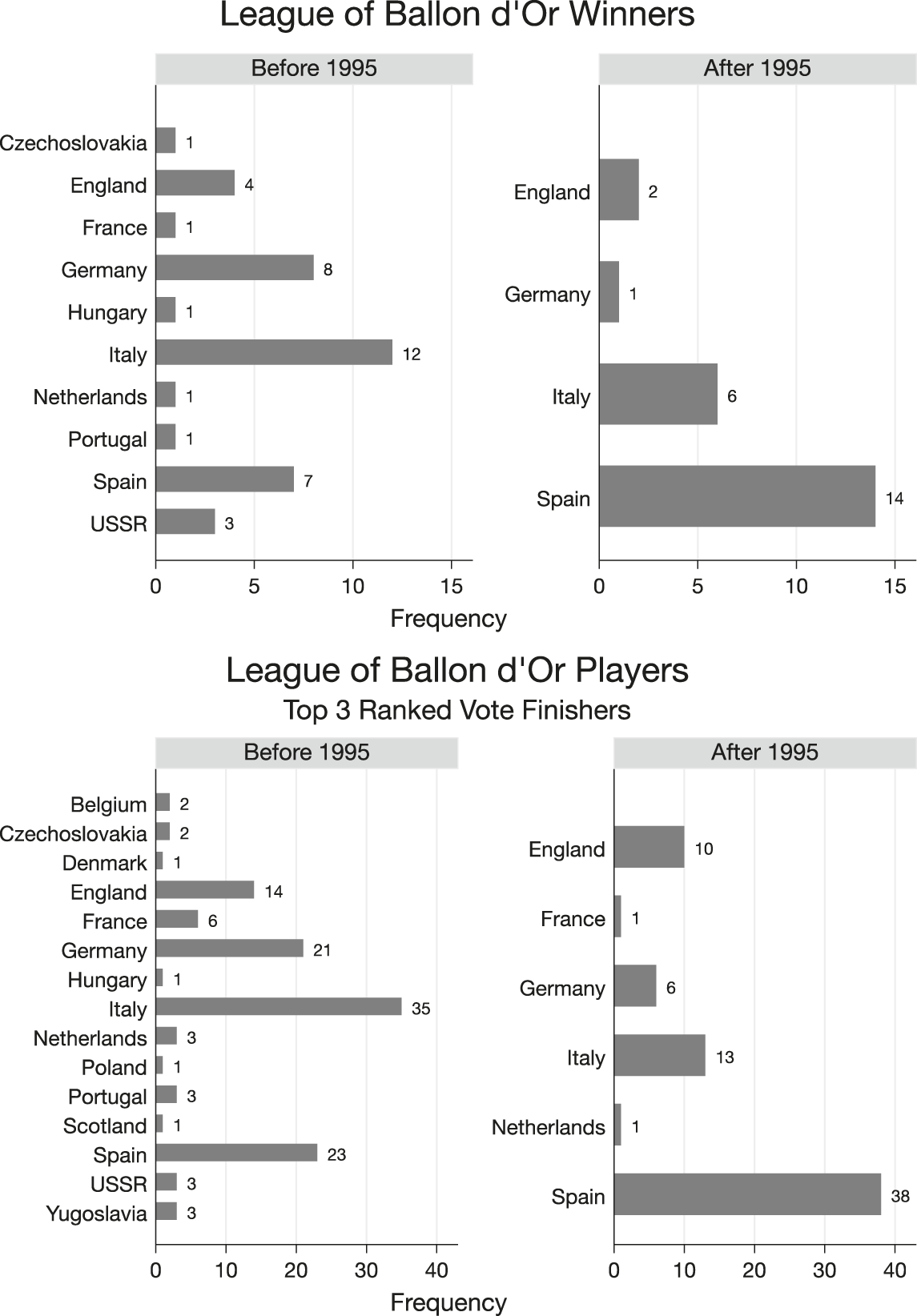
The data show that Ballon d’Or results are far from random. Considering the provenance of players in terms of their nationality, league, and team, several patterns stand out. First, the leagues players compete in and the teams they play for are not created equal when it comes to supplying Ballon d’Or winners. Even though there are roughly 30 professional leagues on the European continent, the biggest leagues in Europe—the top divisions in England, France, Germany, Italy, and Spain—are far more likely to be represented among top vote getters. In fact, as figure 1 shows, there is a clear hierarchy that has become ever more concentrated over time: Ballon d’Or winners and the top three finishers are more likely to play in the top five leagues than in any other. Moreover, the data reveal a trend away from a broader array of leagues in the earlier decades toward the four biggest leagues (England, Germany, Italy, and Spain), with Spain’s La Liga supplying more winners and top finishers than the other big leagues combined.Footnote 17
Ballon d’Or winners by league

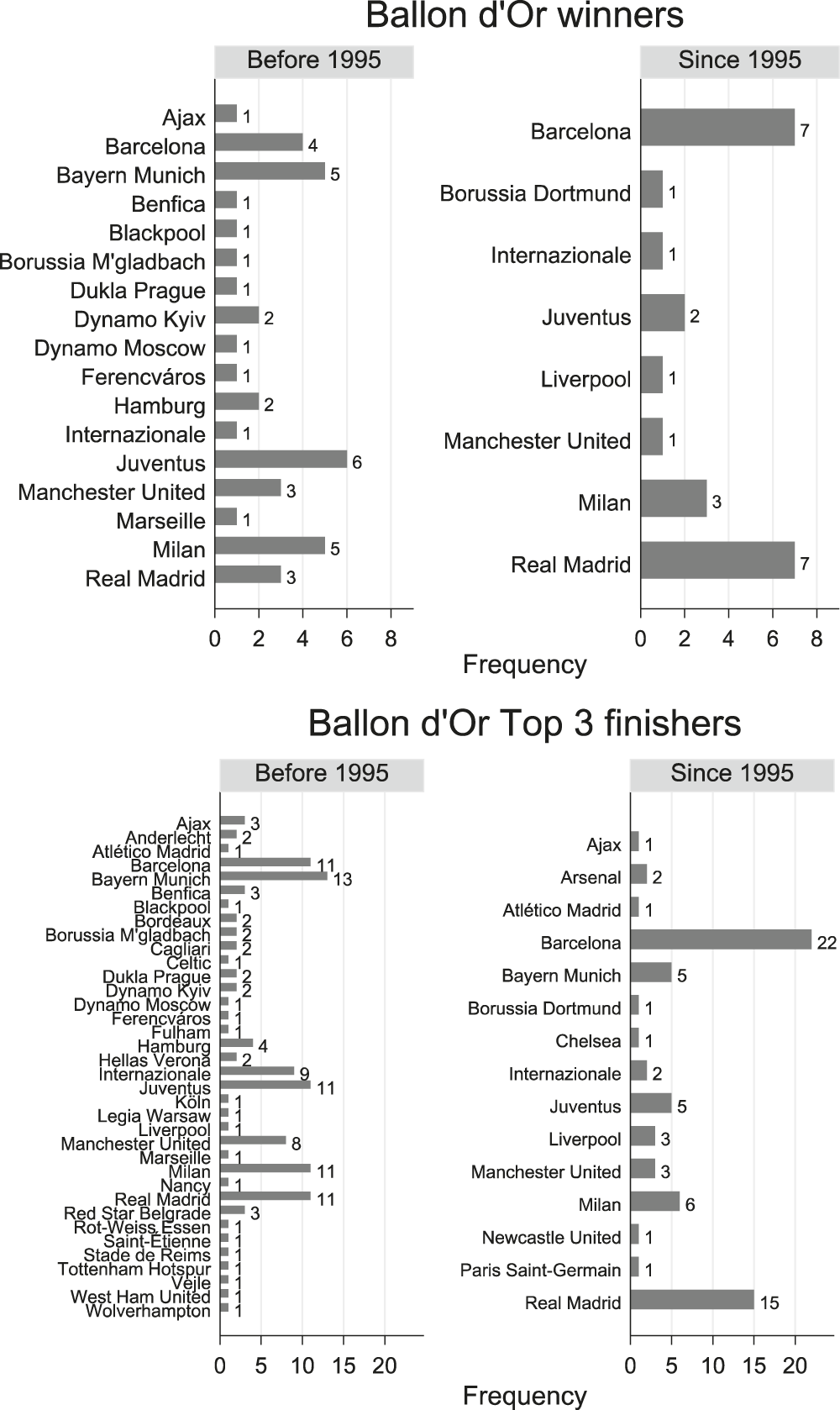
This tendency of soccer celebrities to come from certain leagues is also reflected in the clubs where winners and top vote getters ply their trade (figure 2), with the big Spanish clubs—Barcelona and Real Madrid—providing most of the winners since 1995. While the dominance of the Spanish league and Madrid and Barcelona has been buttressed by two of the best players in the history of the game (Messi and Ronaldo) playing there, these clubs have always been among the most likely to have the best players, even going back to the 1950s, with great players like Alfredo Di Stefano and Ferenc Puskás representing Real Madrid in the 1950s, for instance.
Ballon d’Or winners by club

In turn, over time the smaller clubs in smaller leagues have started to lose out. This is especially evident when considering top finishers before 1995: while a stable of big clubs (e.g., Juventus Turin, AC Milan, Inter Milan, Bayern Munich), has consistently provided Ballon d’Or contenders, historically a number also played for smaller clubs in lesser leagues. Thus, not only is playing for one of the biggest clubs in Spain a better guarantee for having a chance at winning the Ballon d’Or than anything else, this tendency has only become more pronounced over time.
Nationality and Playing Position
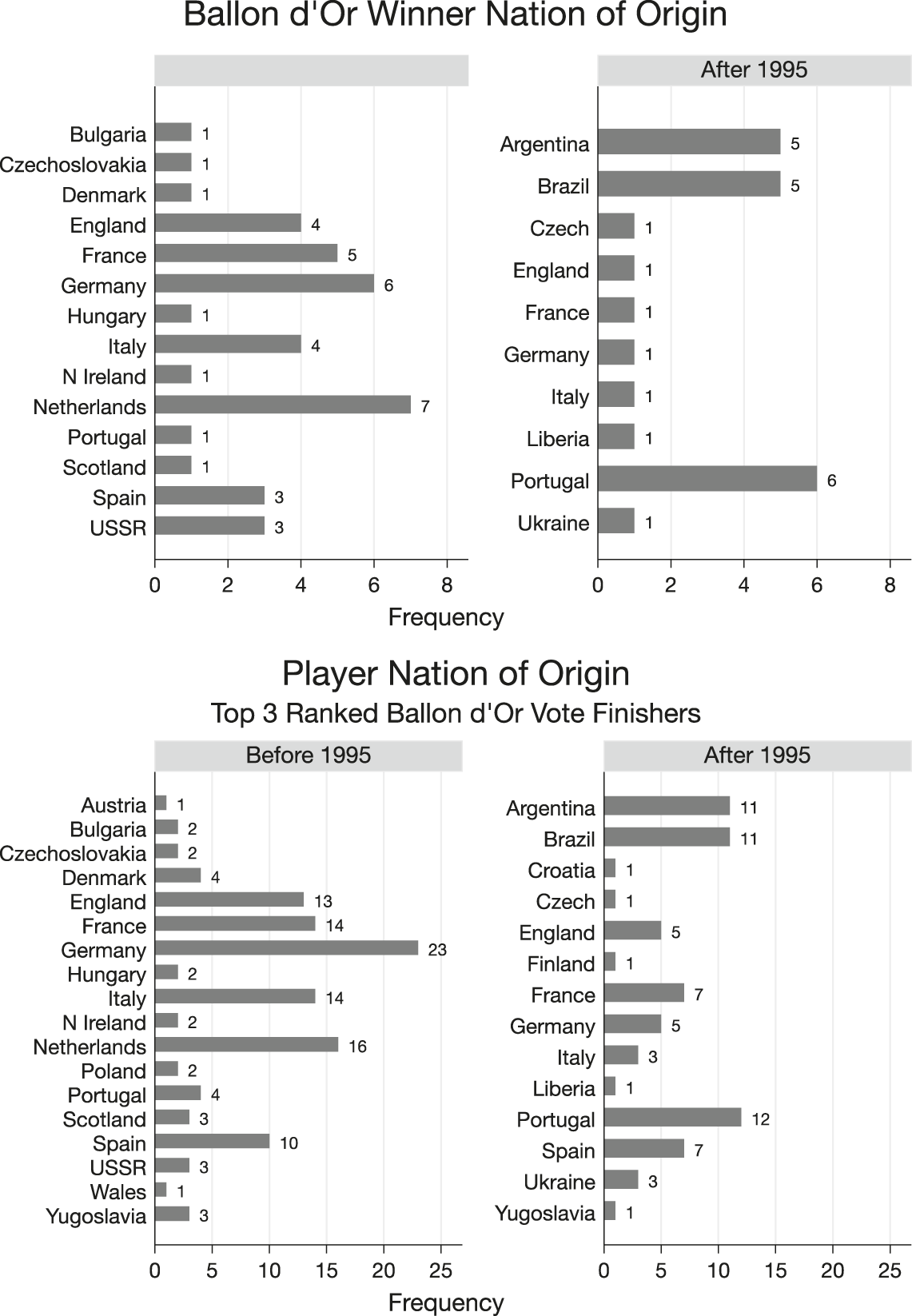
Soccer is a global industry that has long seen significant labor migration across countries and continents, with the best players seeking out the most lucrative opportunities.Footnote 18 Looking at the national backgrounds of the Ballon d’Or contenders, two patterns stand out (shown in figure 3): first, the big soccer nations of the world produce disproportionately more Ballon d’Or winners and vote getters, and this has been the case for a long time. Second, while there is more heterogeneity in national origin than other characteristics, the biggest “exporters” of elite soccer players—Argentina and Brazil—are also more likely to provide contenders for the Ballon d’Or since non-Europeans became eligible in 1995.
Ballon d’Or winners by nationality

When it comes to success on the field of play, soccer is a team game, with specific tactical formations, roles, and positions for individual players. Positions are categorized by whether a player’s job is to score goals or prevent them. Goalkeepers and defenders are tasked primarily with preventing the opposition from scoring, while strikers are attacking players whose job it is to score goals. Midfielders occupy a role between defense and attack.
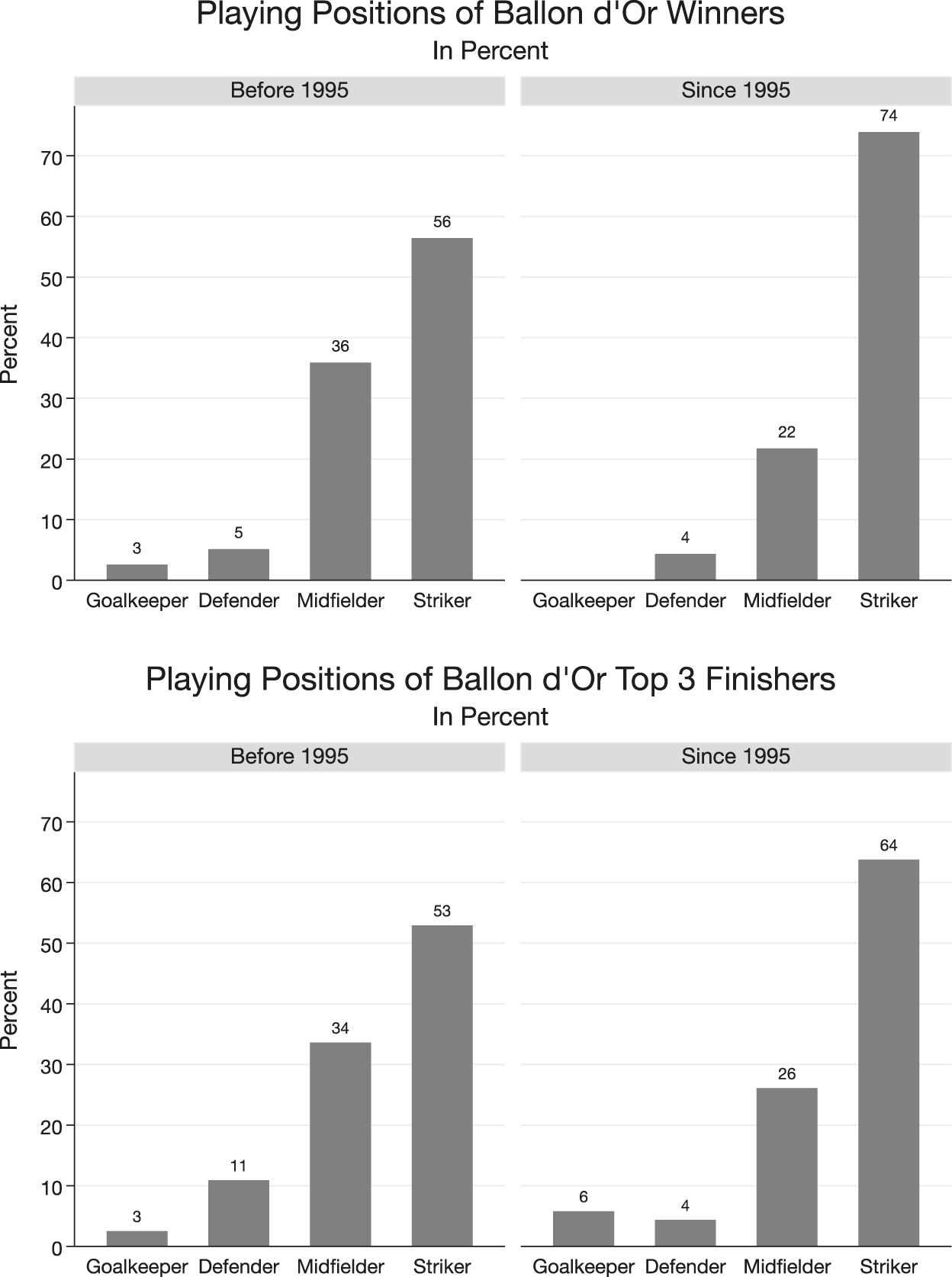
Looking at the positions of players who have won the Ballon d’Or or received most of the ballots reveals a striking pattern: the odds of doing well in the Ballon d’Or increase as players’ positions move them further up the field. Both before and since 1995, many more strikers did well in the Ballon d’Or than any of the other positions (figure 4). Strikers have won more Ballons d’Or than any of the other positions combined and, as with the concentration of players in particular leagues, this pattern has become more pronounced over time: since 1995, strikers have been more than three times more likely (17 versus 5) to win than midfielders (one single defender won during this time). In contrast, only a single goalkeeper—the legendary Lev Yashin of Russia (USSR)—ever won the award over the entire history of the Ballon d’Or (in 1963).
Playing positions of Ballon d’Or winners

Taken together, then, our historical analysis of the popularity of soccer superstars suggests several patterns. Over the last six decades, the Ballon d’Or has been bestowed on a great variety of individuals, but with a clear and, over time, ever more pronounced preference for the biggest leagues and the biggest clubs, especially in Spain and Italy, and perhaps most importantly, for players who score goals rather than prevent them. On its face, the increasing concentration of votes on certain positions, leagues, and clubs might indicate that the market for players has become more efficient. But regardless of the underlying cause, the notable bias in favor of attacking players like Messi, Ronaldo, or Weah suggests that glory is apportioned by voters in a very particular way: experts as well as fans like to see goals and idolize those who score them.
In part, this reflects the evolution of soccer. Viewed over many decades, tactics have become more defensive, goals have become rarer and more precious, and attacking players have become the most expensive players (Anderson and Sally Reference Anderson and Sally2013; Wilson Reference Williams2013). Aside from this on-field logic, the increasing tendency of Ballon d’Or voters to elevate attacking players may also lie in the media’s role in narrating “the events of sport, transforming them into stories with stars and characters; heroes and villains” (Whannel Reference Whannel1998, 23). In particular, a key contributor to the construction of these characters has been the way soccer matches are staged and produced, with TV broadcasts strongly emphasizing certain elements in viewers’ minds. Nowhere is this more obvious than in the glorification of attacking players and goal scorers via specific camera angles and moments of the game (Buscombe Reference Buscombe1975; Whannel Reference West and Orman1992): “Much of the routine coverage of a live soccer match simply follows the action through [camera] C1 and C2 . . . . It is only when goals are scored that television’s visual coverage moves into a different gear. It no longer follows the action. It produces its own visual narrative” (Scannell Reference Sala, Scott and Spriggs2014, 162). Goals thus have a significant impact on who wins the Ballon d’Or and becomes a soccer celebrity because the dominant production aesthetic of the new television culture turns the most precious moments of the game into focal events (Fiske Reference Fechtig1987). In these moments, star players are isolated, shown in close-ups, and dramatized.Footnote 19
Messi versus Ronaldo: Understanding Fans’ Choices of Soccer Celebrities
In recent years, two players—Lionel Messi and Cristiano Ronaldo—have been able to consistently lay claim to being the best in the world, scoring the most goals in the best leagues, sharing most of the best player awards, and achieving unparalleled global recognition. The 2016 Ballon d’Or election followed a familiar script, turning yet again into a two-horse race. In the end, it was Ronaldo’s year; he won the award for the fourth time as his club, Real Madrid, triumphed in the UEFA Champions League and his country, Portugal, won the European Championship.Footnote 20
The 2016 contest raises several questions, however. Messi and Ronaldo are both strikers who played for two of the biggest clubs in the world in the same league (Spain). In this way, they fit the prototypical Ballon d’Or winner documented above to a T. However, given their similarities, how do fans arrive at their choice of one over the other? To better understand the motivations of individual voters in celebrity election contests, we sought to take advantage of fans’ familiarity with the Ballon d’Or competition by conducting our own election survey and allowing any fan anywhere in the world to cast a vote for their favorite player (refer to the online appendix).Footnote 21
Soccer Partisanship and Values: Hypotheses
Given that their background categories did not strongly differentiate Ronaldo and Messi, we focused on two factors derived from political science scholarship that could motivate support for soccer celebrities: partisanship—affinity for a particular team—and values—beliefs people have about how soccer should be played.
Most soccer fans support or feel close to a particular team. To understand this attachment, we draw on scholarship on party identification, perhaps the most important variable for understanding how people vote. The original conceptualization put forward by the authors of The American Voter defined party identification as an “individual’s affective orientation to an important group-object in his environment” (Campbell et al. Reference Campbell, Converse, Miller and Stokes1960, 121). This conceptualization views partisanship as deeply rooted in a person’s social identity and an enduring part of an individual’s self-conception (Greene Reference Green, Palmquist and Schickler1999).Footnote 22 This kind of “expressive partisanship” is similar to people’s attachment to soccer clubs and akin to “teammanship” (see also Green, Palmquist and Schickler Reference Goldblatt2002); like club supportership, it is grounded in social identities where in- and out-group considerations are important (Huddy, Mason and Aarøe Reference Horne, Tomlinson, Whannel and Woodward2015):
The social identity model of partisan politics is not very different from that advanced to explain the ardor and actions of sports fans. Weakly identified fans may attend games when the team is doing well and skip those where defeat is likely, but strong fans persevere and participate, even when the team is sure to lose, in order to boost their team’s chances of victory (Huddy, Mason, and Aarøe Reference Horne, Tomlinson, Whannel and Woodward2015, 3)
Upon closer inspection, expressive partisanship parallels club partisanship in important ways. The longevity and loyalty of support for a particular team is a striking fact; several ethnographic studies have investigated the origins of this support and the processes by which individuals become socialized into being supporters. This research indicates that the socialization process starts at an early age and melds individual and club identities. Moreover, there is a powerful influence of family, usually fathers, early in life. Thus, as with political partisanship, kinship acts as a transmission belt of support for the club through the generations (Crawford Reference Coppock, Leeper and Mullinix2004; Dixon 2013; see also Duke Reference Driessens2002; for an economic view on fandom, see Kuper and Szymanski Reference Kuper2018).Footnote 23
Nick Hornby’s autobiographic novel Fever Pitch is perhaps the most famous statement of becoming a soccer fan, and how fandom evolves over time. Hornby, a supporter of Arsenal FC in London, powerfully evokes the fusion of club support and social identity and the power of socialization to produce support in the first place: “I was chained to Arsenal and my dad was chained to me, and there was no way out for any of us.” Hornby’s compelling account suggests that, in many ways, support for a soccer team is not perceived as a choice.
Moreover, to this day local or regional identities commonly overlap with soccer partisanship, with clubs often serving as vehicles for fans to express a partisan or geographic identity (Kuper 1994). To be sure, as a result of the commodification of soccer, the contemporary sources of support are no longer exclusively tied to geography (Taylor Reference Street, Inthorn and Scott1971; Critcher Reference Crawford1979; Duke Reference Driessens2002), and it has become more common for fans from around the globe to identify with a team even if they never set foot inside its stadium (Giulianotti Reference Giulianotti2002).Footnote 24 Yet even though children in particular gravitate toward certain clubs because they have celebrity players, a player’s presence does not sustain support for a club. While a superstar player can be the initial trigger, people will stick with the club when the player moves on, irrespective of its fortunes (Giulianotti Reference Giulianotti2005). For most people, this means that becoming a supporter is something that is learned early in life, “hereditary,” and sticky; in many ways, it is akin to partisanship.
Our own survey supports this conjecture. When asked why they supported the club they did, 65% of respondents who expressed support for a team indicated that it was the team they supported since they were young. Moreover, by a two-to-one margin, they reported that their parents or grandparents supported the same team.Footnote 25 Thus, for individuals who self-identify as followers of a club, affiliation can be expected to be a strong motivation to support a candidate from that club.Footnote 26
But if soccer partisans are like Huddy, Mason, and Aarøe’s expressive, social identity partisans, they do not simply root for their team; expressive partisanship also implies rooting against other teams (see Iyengar, Sood, and Lelkes Reference Hutchings and Valentino.2012). In this way, too, affinity for a club is similar to partisanship as social identity. Put another way, if selecting someone as the “best” player is as simple as picking the best striker in one’s favorite club, then the choice between Ronaldo and Messi should be driven by attachment to the clubs they play for. However, if being a club supporter is like being an expressive partisan, it should also make it significantly less likely that partisans will vote for the superstar of a rival team.
Beyond partisanship, we sought to examine the impact that values may have on voter preferences. Since soccer’s beginnings, players, coaches, and fans have debated the importance of winning versus playing the game a particular way. Although everyone likes winning while also doing so in the right way—however defined—there may be times when the two come into conflict. When they do, some believe it is more important to win, no matter how, while others believe it is more important to play a particular way, even at the risk of losing the game (Anderson and Sally Reference Anderson and Sally2013; Goldblatt Reference Giulianotti2008). Sometimes referred to as “right-wing” (practical, win at all cost) and “left-wing” (idealist, play beautifully) philosophies (Wilson Reference Williams2013), there is no other sport in the world where this essential tradeoff is as hotly debated as it is in soccer and where the beliefs that underlie the tradeoff between playing style and winning are as deeply embedded or as connected to social identity. As the Uruguayan author Eduardo Galeano famously pointed out in his seminal treatise Soccer in Sun and Shadow: “I play therefore I am.”
We sought to define and measure soccer values and examine their effects on voters’ preferences for one player over another. While both Ronaldo and Messi are extremely competitive athletes with extraordinary desire to win, Ronaldo’s image has been that of the alpha male blessed with superior athleticism; in contrast, the diminutive Messi’s image is that someone who wins on style, clever play, and being part of the team’s collective tactics and movements. A priori, the impact that values may have on voter choices can be conceptualized in two ways. First, it would be reasonable to expect Messi and Ronaldo voters to like winning trophies as well as playing in a particular way. After all, both have won multiple trophies, and both have a recognizable style of play. In this case, the importance of winning and style should have similar and independent effects on votes for Ronaldo and Messi.
Alternatively, if people believe that there is a tradeoff between winning and style, soccer values may be thought of as a continuum where placing a priority on winning defines one pole and putting a priority on style the other. While some voters might value winning at all cost and others style above else, those somewhere in the middle might value both.Footnote 27 One of the potential implications of the carefully crafted soccer personalities of Ronaldo and Messi may be that they have come to reflect the trade-off between winning and style in fans’ minds: if Ronaldo and Messi represent opposing soccer “ideologies,” respectively, then voters motivated by the importance of winning should be more likely to vote for Ronaldo, while Messi voters should be motivated to a greater degree by a player’s style.
Measures
Dependent Variables
We estimated the impact of club affiliation and soccer values on fans’ preferences as expressed by the Ballon d’Or voting system. In this scenario, voters were asked to rank-order their top three candidates for the award, assigning 5, 3, and 1 points, respectively. The contest was tight: while Messi received a higher percentage of first place votes on the ranked choices (24.1% versus 23.1%), Ronaldo achieved an average of 1.78 points to Messi’s 1.73 points as a result of receiving a greater proportion of second place votes.
Independent Variables
Based on a question asking respondents which club they support, we constructed dummy variables for Real Madrid fans (Ronaldo’s club) and Barcelona fans (Messi’s club) (refer to the online appendix); 10.5% of respondents indicated that they were supporters of either club. In addition, we measured soccer values by asking respondents why they watch soccer—whether they prefer to see a well-played game or whether they prefer to see their team win. We also gauged people’s reasons for the choices they made: a player’s superior level of skill and talent, because he helped his team win games and trophies, or because the respondent preferred the player’s style of play. Finally, we also included a set of standard demographic variables, including gender, age, living in a city, religiosity, education, and marital status.
Results
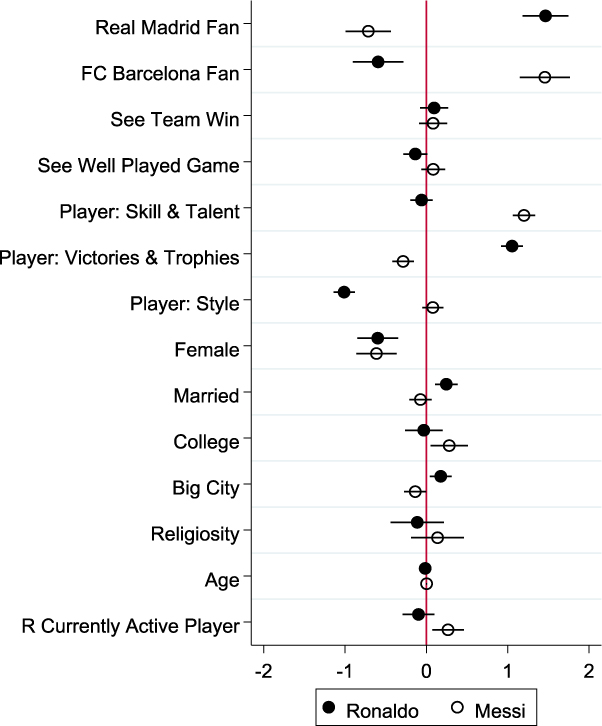
The results of our multivariate regressions reveal several patterns consistent with our conjectures (figure 5 and the online appendix). First, Real Madrid fans are significantly more likely to vote for Ronaldo, while Barcelona fans were significantly more likely to vote for Messi. Moreover, consistent with the idea that soccer partisanship is a social identity, the reverse holds as well, with Real Madrid fans ranking Messi significantly less highly and Barcelona fans ranking Ronaldo less highly. Interestingly, despite the presence of multiple Barcelona and Madrid players in the candidate pool, the effect sizes are virtually identical. Being a Barca or Real Madrid fan increased each candidate’s overall point tally by almost 1.5 points, and reduced it by roughly half that amount among fans of the rival team. Thus, there is a sizable positive effect for soccer partisanship, and the effect is about twice the size as the negative effect of not voting for another team’s candidate.
Determinants of vote choice for best soccer player
Note: Unstandardized least squares coefficients; random-effects models using GLS estimators with countries as panel variables. Dots represent point estimates, while horizontal lines depict 95% confidence intervals.

To fully appreciate the strength of the relationship, it is important to recall that the Ballon d’Or is a heavily “candidate-centered” election that is neither overtly political, nor were voters presented with club (partisan) identifying information (the club they play for) next to the candidates’ names. Moreover, Ronaldo and Messi were not the only candidates from their respective clubs who made the 30-player shortlist. While Barcelona had four finalists (Messi, Luis Suarez, Neymar, and Andrés Iniesta), Real Madrid had a total of six (Ronaldo, Gareth Bale, Pepe, Toni Kroos, Luka Modric, and Sergio Ramos). Thus, support for the club could not be expected to be synonymous with support for Messi or Ronaldo and both sets of supporters had several candidates to choose from, thus potentially diluting the effect.
Taken together, our results indicate that Messi’s and Ronaldo’s ability to attract votes is to a significant extent derived from the clubs they play for. Conversely, our results cast doubt on the notion that either or any player, regardless of skill, would be able to win the Ballon d’Or if they played for a club in a much weaker league. While the relationship between star athlete and his platform (the club) is undoubtedly symbiotic, the club brand is much older and affinities to clubs much deeper than the bonds that tie fans to individual players.
The variables measuring people’s motivations to watch soccer—to see a well-played game or see their team win—had no measurable effect on support for Ronaldo or Messi. Aside from support for a player’s club, the most notable differentiator between Messi and Ronaldo can be found in the variables tapping into people’s reasons for their vote: those who say that the player’s skill and talent were important also were significantly more likely to vote for Messi, while this variable had no effect on votes for Ronaldo.
With regard to the tradeoff between winning and style, the results are consistent with expectations, with an important caveat. While winning games and trophies mattered greatly for Ronaldo voters, the opposite was true for Messi supporters, though to a much lesser degree. In parallel, respondents who indicated that they liked a player’s style were significantly less likely to rank Ronaldo highly but no more likely to vote for Messi. Thus, the evidence that soccer values indeed constitute a continuum that ranges from valuing style on one end to prizing winning over anything else on the other is mixed: while winning goes with Ronaldo and style against him, soccer values also distinguish Ronaldo voters much more clearly than Messi voters.
We report on several robustness tests in the online appendix. Taken together, our results suggest that Messi’s and Ronaldo’s popularity are deeply intertwined with fans’ affinities for their respective clubs and the antipathies they have toward other clubs. Beyond this shared and consistent partisan effect, Ronaldo’s support is strongly and positively driven by respondents’ attitudes about a player’s association with being a winner, while those who valued style were significantly less likely to prefer Ronaldo’s candidacy. In contrast, style did not strongly affect Messi’s support, while those who prized winning were slightly less likely to cast their ballots for him. Instead, votes for Messi were votes for skill as a key criterion. In this way, the results suggest that considerations of winning and style were more about Ronaldo than Messi, and that the two do not cleanly constitute two sides of the soccer values coin. At a minimum, the results show that consideration of who is “best” triggers consideration of soccer values beyond the importance of scoring goals.
Conclusion
Two years before Adolf Hitler’s infamous staging of the 1936 Olympic Games in Berlin, Benito Mussolini was busy fixing the 1934 soccer World Cup in Italy, primarily by bribing the referees and thereby ensuring that Italy won the tournament. Today’s soccer politics is less nefarious and more glamorous; instead of serving as an overt tool of propaganda and political power, it has become an instrument of global commercial and soft power—soccer has become big business, and the best players are global celebrities with the power to influence many millions of people.
To understand who becomes a soccer celebrity and thus has the potential to influence millions of people, we investigated one of the sources of celebrity popularity—the oldest and most prestigious award for the best player in the world, the so-called Ballon d’Or. Specifically, we sought to pinpoint the characteristics that propel experts to classify some players as more deserving of recognition than others, and we identified the individual-level attitudes that influence the popularity of particular players among fans. Our analysis shows that “best” is defined in a particular way. Not only are the players who score goals considered better than the rest, but there also is a clear trend in favor of players who play for an ever more exclusive set of leagues and clubs. Moreover, player popularity is shaped both by partisan identity (in the form of support for a candidate’s club) and ideas about the best way to play the game.
We believe our analysis contributes to the study of politics as well as celebrity. Expanding the study of elections beyond the conventional realm of democratic politics allows researchers to broaden the definition of politics and to examine the boundaries of political science concepts and methodological approaches. In an era when people are increasingly asked to express their views about a variety of subjects—which products they prefer, which participants should remain on or leave TV reality shows, and which is the best song—the application of political science ideas and insights may be productive, for two reasons: first, such contests offer political scientists the opportunity to examine theories of voter behavior in new settings; second, given the rise of celebrity politics around the world, existing political science concepts can contribute to the growing body of knowledge about the nexus of politics and superstardom in a specific domain.
The study of partisanship—a staple in electoral research—serves as an example of the potential utility of political science concepts in a “non-political” context. We argue and show that partisanship as team support helps us understand how attachments to soccer clubs translate to support for soccer celebrities. Thus, expressive partisanship can be adapted to and has significant leverage in a non-political setting. Moreover, this kind of partisanship connects to broader discussions of political knowledge and citizen competence (e.g., Lupia Reference Leeper and Slothuus2016). Even the earliest voting studies recognized that attachment to a party reduced the need for information: “For many people, votes are not perceived as decisions to be made in each specific election. For them voting traditions are not changed much more often than careers are chosen, religions drifted into or away from, or tastes revised” (Berelson, Lazarsfeld, and McPhee Reference Berelson, Lazarsfeld and McPhee1954, 17).
The fans in our survey sample are even more knowledgeable and committed than voters in regular elections who also tend to be more informed and committed than non-voting citizens. And yet, even among these soccer “sophisticates” and “fanatics,” partisanship and values matter greatly for explaining which superstar receives their support. This suggests that it is not enough to simply be a superior athlete to win celebrity contests like the Ballon d’Or, but that one has to be affiliated with the right club and have a discernible profile. In turn, this suggests that the political influence of soccer celebrities may well be heavily constrained by the team they play for rather than just their well knownness, given that the political messages of soccer stars are likely to be interpreted through the prism of the club they play or played for (see also Zaller Reference Wood, Corbett and Flinders1992).Footnote 28
In addition to our desire to push the boundaries of established political science concepts like partisanship, we sought to contribute to the study of celebrity by heeding Turner’s (Reference Turner2010, 19) call to focus on the production of celebrity power and to expand the range of methodologies employed in the study of celebrity. By examining sports celebrity elections through the lens of political science and with the help of commonplace analytical tools we hoped to provide rigor to discussions about these contests.
Beyond the study of politics and celebrity, our findings may also have normative implications. Contests like the Ballon d’Or serve a broader function in contemporary political economies: while students of politics usually see elections as instruments of democracy, they are equally powerful devices for legitimizing the existing political order that underpins capitalist democracy (see, e.g., Anderson et al., Reference Anderson, Blais, Bowler, Donovan and Listhaug2005). This is ironic. In many ways, soccer is the most democratic of elite sports. Unlike basketball, it does not favor a particular body shape, and unlike ice hockey or American football, it requires very little equipment. Moreover, the contemporary celebration of soccer stardom contributes to the illusion that fame and fortune are not just desirable but possible and achieved regularly the world over. The reality is quite different and much harsher: not only is the selection process to become an elite player thoroughly Darwinian, the success of soccer’s global celebrities follows the logic of so-called “winner-take-all markets” where rewards are apportioned asymmetrically “in the hands of a few top performers, with small differences in talent or effort often giving rise to enormous differences in incomes” (Frank and Cook Reference Fiske1996, 24). Inequalities in the compensation of professional soccer players have been growing for years and mirror similar inequalities in labor markets for other skills in post-industrial economies.Footnote 29
In this way, our study confirms that inequality is a pervasive feature of sports celebrity. The winners of the Ballon d’Or are increasingly strikers (the “individual stars”) from the wealthiest, most dominant clubs. Their celebrity is positioned at the intersection of liberal democracy and consumer capitalism, both of which prize individualism and “are nurtured by the supreme technology of hyper-individualization (commercial television)” (Marshall Reference Marsh, Hart and Tindall2014, 1). This kind of celebrity helps cement in place existing orders and hierarchies while, at the same time, creating a political space and capital for individual elites who are unelected and unaccountable. As such, the rise of sports celebrities and the attention and influence they command raises complex questions of legitimacy in an increasingly unequal and elite-dominated political realm.
On the positive side of the ledger, the power of global influencers, while informal, can be significant. Celebrities are able to exercise power in multiple ways via visible and invisible means (Tsaliki, Frangonikolopoulos, and Huliaras Reference Taylor and Cohen2011; Partzsch Reference Nownes2015). This power can be used to hold officeholders accountable for their actions in ways that are more effective than what individual citizens or marginalized groups can accomplish. In this way, celebrities can help to counteract growing inequalities in political representation by giving voice to the powerless (e.g., Gilens and Page Reference Garthwaite and Moore2014).
At the same time, the power of celebrities raises questions of democratic legitimacy. After all, celebrities have louder voices and are able to be heard in ways average citizens cannot. Given the challenge of holding celebrities accountable for their political action, except perhaps through market action (see also Partzsch Reference Partzsch2017), a lack of democratic control could become problematic if celebrities convey more radical positions that are not generally endorsed by those they claim to represent, the international community, or democratic consensus (Partzsch Reference Partzsch2018).
The inequalities that abound in politics, sports, and celebrity call for further investigation. One issue easily overlooked in the context of soccer celebrity is gender. Candidates for the Ballon d’Or have been exclusively male, as are the vast majority of soccer fans around the world. While soccer is no exception to the gendered production and consumption of sports and sports celebrity, recent years have seen significant changes in how women interact with soccer as players and fans on a global scale (Markovits and Rensmann Reference Lupia2010). Women‘s entry as producers—players, coaches, and celebrities—occurred in spaces that provided very different pre-conditions. In contrast to the U.S. where women entered a soccer space that was marginal, in Europe and elsewhere women’s soccer and women as soccer fans still do not belong to the core of the hegemonic sports culture centered around male soccer (Fechtig Reference Farrell, Karels, Monfort and McClatchey1995).
While the gendered production of soccer is changing—albeit more slowly than many would like—we have no systematic evidence whether or how the global appeal of soccer celebrities extends to women. In our own survey, we find that female respondents express slightly less interest in the sport than men (6.6 versus 8.2 on a 0-10 scale). We also find that women and men differ with regard to the traits that make for an admirable soccer player. Women were less likely to rank either of the top two candidates highly, reducing both Messi’s and Ronaldo’s points tally by more than half a point. Thus, women showed a greater willingness to vote for perhaps less obvious or famous candidates in the field. Moreover, women were less likely to say they voted for a particular player because he won trophies and more likely to say that their vote was based on the player being the best in his team or country.
Whether such differences reflect gendered ways of consuming soccer and soccer celebrity is beyond the scope of this paper. The introduction of a separate Ballon d’Or election for best female player in the world finally occurred in 2018; only time will tell whether women as producers and consumers will incorporate their own meanings into the sport or seek to imitate the male narrative (Williams Reference Wheeler2003). In the end, given the huge importance it has for many people around the globe, soccer is an almost ideal context in which to study not just celebrity politics, but questions of popularity, elections, migration, inequality, and even civil war (e.g., Miguel, Saiegh, and Satyanath Reference Marshall2011). As historian David Goldblatt has noted, “No history of the modern world is complete without an account of soccer” (Goldblatt Reference Giulianotti2008, xviii). We would only slightly paraphrase Goldblatt by noting that no politics of modern times is complete without an account of the politics of soccer.
Supplemental Materials
Appendix A. The Votefoot Survey and Sample
Appendix B. Question Wording
Appendix C. Summary Statistics
Appendix D. Regression Results
To view supplementary material for this article, please visit https://doi.org/10.1017/S1537592719002391