Introduction
Patients in the post-Fontan period experience Fontan-associated diseases such as protein-losing enteropathy, plastic bronchitis, liver disease, thrombosis, renal insufficiency, and arrhythmias, which may lead to Fontan failure over time. Reference Pundi, Johnson and Dearani1,Reference Ohuchi2 Elevated Fontan pressure is widely accepted as a risk factor for poor outcomes Reference Pundi, Johnson and Dearani1,Reference Ohuchi, Miyazaki and Negishi3,Reference Miranda, Borlaug, Hagler, Connolly and Egbe4 ; however, Fontan failure can occur even in cases with normal Fontan pressure, as previously reported. Reference Book, Gerardin, Saraf, Marie Valente and Rodriguez5 This may be attributable to various factors influencing Fontan pressure, such as the presence of fenestration, veno-venous collaterals, and cardiac index in the late post-Fontan period. Specifically, a high Fontan pressure may be potentially mitigated if the cardiac index is low, and an increased right-to-left shunt at the fenestration or veno-venous collaterals may reduce the Fontan pressure. Analysis of catheterisation data in the early period (approximately one year) from Fontan circulation revealed several effective haemodynamic predictors of poor outcomes. Reference Inai, Inuzuka and Ono6,Reference Ohuchi, Yasuda and Miyazaki7 A better assessment of modified haemodynamics of late Fontan circulation is important. Symptomatic adult patients with Fontan circulation may show decreased systemic vascular resistance index with a normal cardiac index. Reference Hebson, McCabe and Elder8 High cardiac index with an elevated Fontan pressure is reported as a risk factor for mortality in patients during the late post-Fontan period, whose systemic vascular resistance index is decreased. Reference Ohuchi, Miyazaki and Negishi3 Thus, cardiac index and systemic vascular resistance index, in addition to Fontan pressure, are likely to be important haemodynamic variables. However, the complex interplay of cardiac index, systemic vascular resistance, and Fontan pressure remains not fully understood.
The objective of this study was to identify catheterisation-derived haemodynamic predictors of heart transplantation or death, other than Fontan pressure, in patients during the late post-Fontan period. The cardiac index and systemic vascular resistance index of each patient were plotted on a previously reported cardiac index-systemic vascular resistance plot, and the utility of the cardiac index-systemic vascular resistance plot to predict the outcome in the late post-Fontan period was evaluated. Reference Kawasaki, Sasaki and Kobayashi9
Methods
This was a retrospective study to evaluate patients who underwent the Fontan operation and a post-Fontan haemodynamic evaluation via cardiac catheterisation at age ≥ 10 years at the Children’s Hospital of Michigan between 1993 and 2018. Eligible patients were identified by searching the cardiac surgery and cardiac catheterisation databases. Patients with insufficient data for cardiac index and systemic vascular resistance index calculations were excluded from this study. Data from the last catheterisation were used to analyse patients who underwent multiple cardiac catheterisations. This study was approved by the Wayne State University Institutional Research Board and the Detroit Medical Center Research Review and was conducted in accordance with the Declaration of Helsinki.
Patients’ demographics, operative history, protein-losing enteropathy/plastic bronchitis/death/heart transplantation events, and clinical variables at the time of cardiac catheterisation, including NYHA classification, medications, pacemaker use, and laboratory and echocardiographic findings, were collected from medical records. Patients with moderate-to-severe atrioventricular regurgitation on echocardiography were considered significant atrioventricular regurgitation. Ventricular dysfunction was considered significant if systemic ventricular systolic dysfunction was moderate or worse. Coarctation of the aorta and subaortic stenosis were considered present when the pressure gradient was > 30 mmHg. When fenestration was identified, the recorded mean pressure gradient was analysed. Haemodynamic data collected via cardiac catheterisation before and after the Fontan procedure were reviewed. Cardiac output was calculated using the Fick technique with the assumed oxygen consumption by LaFarge’s formula and indexed by body surface area. systemic vascular resistance index (WU · m2) was calculated as (mean systemic arterial pressure−Fontan pressure)/cardiac index. Reference LaFarge and Miettinen10 Femoral arterial pressure was mostly adopted as systemic arterial pressure; however, it was complemented with aortic pressure if the former was deficient in some cases. Pulmonary blood flow was calculated using an assumed pulmonary vein saturation of 97% or directly measured pulmonary venous saturation in the same fashion as the cardiac index and was indexed by the body surface area. The pulmonary vascular resistance index was calculated as follows: (mean pulmonary artery pressure–pulmonary capillary wedge pressure)/pulmonary blood flow.
Haemodynamic data were plotted on a cardiac index-systemic vascular resistance plot for each patient (Figure 1). In the systemic circulation, perfusion pressure = mean systemic arterial pressure–Fontan pressure = cardiac index × systemic vascular resistance index. Therefore, a perfusion pressure between 20 and 100 mmHg is shown as a curved line on the cardiac index-systemic vascular resistance plots. The lower left quadrant of the plot represents a lower perfusion pressure. Patients were classified based on perfusion pressure < 53 mmHg or ≥ 53 mmHg to compare the differences in outcomes. The cut-off value of perfusion pressure was set based on the result of the receiver operating characteristic curve analysis (best cut-off value, 52.5; area under the curve, 0.74; 95% confidence interval, 0.58–0.90). Furthermore, patients were classified into four categories according to their cardiac index (L/min/m2) and systemic vascular resistance index (WU · m2). A cut-off value of 3 L/min/m2 for cardiac index was derived from the data reported by Ouchi et al. Reference Ohuchi, Miyazaki and Negishi3 A cut-off value of 13 WU · m2 was set for systemic vascular resistance index based on the results of the receiver operating characteristic curve analysis (best cut-off value, 13.5; area under the curve, 0.66; 95% confidence interval, 0.43–0.89) and systemic vascular resistance index border between the groups with and without increased cardiac output, which was described by Ohuchi et al. Reference Ohuchi, Miyazaki and Negishi3 Patients were categorised as follows: Category A (cardiac index ≥ 3, systemic vascular resistance index ≥ 13), B (cardiac index < 3, systemic vascular resistance index ≥ 13), C (cardiac index ≥ 3, systemic vascular resistance index < 13), and D (cardiac index < 3, systemic vascular resistance index < 13) (Figure 1). Clinical and haemodynamic variables were compared among the haemodynamic categories (A–D).
CI-SVR plot of all patients (n = 79). Different perfusion pressures, ranging from 20 to 100 mmHg, are described by curved lines per 10 mmHg. White dots indicate no endpoints. Grey dots indicate positive endpoints. The circular dots indicate Fontan pressure (FP) < 14 mmHg. Square dots indicate FP ≥ 14 mmHg. Patients are categorised as follows: category a (CI ≥ 3, SVRI ≥ 13), category B (CI < 3, SVRI ≥ 13), category C (CI ≥ 3, SVRI < 13), and category D (CI < 3, SVRI < 13). CI cardiac index, SVRI systemic vascular resistance index.

The primary endpoint of the study was freedom from heart transplantation or death. Freedom from the endpoint was compared between the patients with perfusion pressure < 53 mmHg and ≥ 53 mmHg and among the haemodynamic categories (A–D). Clinical variables, including haemodynamic categories, were analysed to identify the predictors of the endpoint. All statistical analyses were conducted using EZR (Saitama Medical Center, Jichi Medical University, Saitama, Japan), which is a graphical user interface for R (The R Foundation for Statistical Computing, Vienna, Austria). Reference Kanda11 Categorical variables are presented as percentages and were compared using the chi-square test or Fisher’s exact test. Continuous variables are presented as median (range) and were compared using the Mann–Whitney U test or Kruskal–Wallis test. The Kaplan–Meier product–limit method and log-rank test were used to analyse freedom from the endpoints between the haemodynamic groups. The timing of cardiac catheterisation was defined as time zero. The Cox proportional hazards model was used to identify significant risk factors for the endpoints. To evaluate if the perfusion pressure or haemodynamic category is an independent predictor from Fontan pressure for the outcome, each of them was adjusted for Fontan pressure in the multivariable analysis. Further, due to the small number of patients who reached the study endpoint, multivariable analysis was performed in seven models using the haemodynamic category, Fontan pressure, and one more basic demographic or clinical variable, which were significant predictors in the univariable analysis. The duration after the Fontan procedure was included in one of the models because it has been reported to influence the outcomes. The risk for each variable was expressed as hazard ratio and 95% confidence interval. Statistical significance was set at p < 0.05.
Results
The study cohort comprised 79 patients who met the inclusion criteria. The median age at cardiac catheterisation was 15.7 years (range: 10.1–50.2 years). Indications for cardiac catheterisation included surveillance evaluation in 31 patients (40%), cyanosis in 12 (15%), protein-losing enteropathy/plastic bronchitis in 9 (11%), fatigue in 26 (33%), and pleural effusion in 1 (1%).
The patients’ characteristics and haemodynamic data are summarised in Table 1. Basic demographics did not differ among the four haemodynamic categories, except for sildenafil medication, which was more frequently prescribed in category C than in categories A and B. Category C included more patients with NYHA class III/IV than category A (p = 0.02). The Fontan pressure did not significantly differ among the four categories. The mean systemic pressure and perfusion pressure in category C were significantly lower than those in category A. The pulmonary vascular resistance index/systemic vascular resistance index was significantly higher in category C than in categories A and B. Patients in category C showed a higher incidence of desaturation (systemic arterial oxygen saturation [SaO2] < 90%) than those in category A.
Comparison of clinical and haemodynamic variables between haemodynamic categories in patients in the late post-Fontan period

Data are expressed as number (percentage) and median (range). ACEI angiotensin converting enzyme inhibitor, ARB angiotensin receptor blocker, AVVR atrioventricular valve regurgitation, Cath, catheterisation, CI cardiac index, CoA coarctation of aorta, HLHS hypoplastic left heart syndrome, NYHA New York Heart Association functional classification, PAP pulmonary arterial pressure, PB plastic bronchitis, PCWP pulmonary capillary wedge pressure, PG pressure gradient, PLE protein-losing enteropathy, PP perfusion pressure, PVRI pulmonary vascular resistance index, Qp/Qs pulmonary flow/systemic flow, RV right ventricular, SaO 2 systemic arterial oxygen saturation, SP systemic pressure, SvO 2 systemic venous oxygen saturation, SVRI systemic vascular resistance index, TPG transpulmonary gradient. *a Category A vs. category B. *b Category A vs. category C. *c Category A vs. category D. *d Category B vs. category C. *e Category B vs. category D. *f Category C vs. category D. *g More than moderate. *h>30 mmHg.
The median follow-up period was 1.9 years (range: 0.1–18.8 years). Ten patients (13%) had the primary endpoint: two patients underwent heart transplantation due to protein-losing enteropathy, and eight died (Figure 2a). The cause of death was heart failure in three patients, complete atrioventricular block in one, cerebral stroke in one, infection in one, and unknown in one. Freedom from the endpoint was significantly shorter in patients with perfusion pressure < 53 mmHg than in those with perfusion pressure ≥ 53 mmHg (p < 0.01) (Figure 2b). Comparing the four categories, patients in category C had significantly shorter freedom from the endpoint than those in both categories A (p < 0.01) and B (p = 0.04) (Figure 2c). The estimated 5-year freedom from the endpoint was 94% in category A and 87% in category B.
Kaplan–Meier curves comparing freedom from heart transplantation or death. ( a ) all patients (n = 79). ( b ) comparison between patients with PP ≥ 53 mmHg and < 53 mmHg. ( c ) comparison between the four haemodynamic categories. CI cardiac index, PP perfusion pressure, SVRI systemic vascular resistance index.

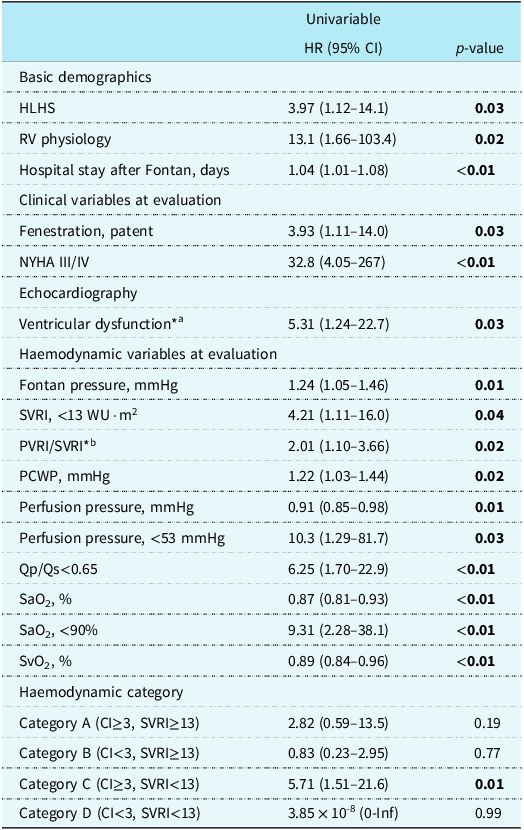
Univariate analysis identified several factors associated with shorter freedom from the endpoint (Table 2) (full data are shown in Supplementary Table S1 ). Low perfusion pressure, indicating the lower-left position of the cardiac index-systemic vascular resistance plot, and perfusion pressure < 53 mmHg were the significant haemodynamic predictors. Among the four haemodynamic categories, category C predicted the endpoint. In the multivariable analysis adjusted for Fontan pressure, each of perfusion pressure < 53 mmHg and category C were predictors of the endpoint independent from Fontan pressure (hazard ratio 4.36 [1.12–17.0], p = 0.03 for perfusion pressure < 53 mmHg; hazard ratio 8.87 [1.12–70.1], p = 0.04 for category C) (Supplementary Table S2 ). In the multivariable analysis, adjusting for Fontan pressure and one more clinical variable, perfusion pressure < 53 mmHg and category C emerged as independent predictors in several models (Supplementary Tables S3 and S4 ). Fontan pressure was an independent predictor in models 2, 4, 5, and 7 of multivariable analysis for perfusion pressure < 53 mmHg (Supplementary Table S3 ) and in models 1, 2, and 4 of multivariable analysis for category C (Supplementary Table S4 ).
Univariable analysis for predictors of heart transplantation and mortality in patients during the late post-Fontan period

CI cardiac index, 95% CI 95% confidence interval, HLHS hypoplastic left heart syndrome, HR hazards ratio, NYHA New York Heart Association functional classification, PCWP pulmonary capillary wedge pressure, PVRI pulmonary vascular resistance index, Qp/Qs pulmonary flow/systemic flow, RV right ventricular, SaO 2 systemic arterial oxygen saturation, SvO 2 systemic venous oxygen saturation, SVRI systemic vascular resistance index. *a More than moderate. *b Per 0.1.
Discussion
This study assessed the utility of catheterisation-derived haemodynamic markers in predicting outcomes in late Fontan patients. Category C and perfusion pressure on the cardiac index-systemic vascular resistance plot were identified as valuable markers independent of Fontan pressure.
Fontan pressure has been consistently identified as a risk factor for worse Fontan outcomes. Reference Ohuchi, Miyazaki and Negishi3,Reference John, Johnson, Khan, Driscoll, Warnes and Cetta12,Reference Kawasaki, Sasaki, Forbes, Ross and Kobayashi13 In Fontan circulation, Fontan pressure can be derived using the following formula: Fontan pressure = atrial pressure + cardiac index × pulmonary vascular resistance index. As shown in our study, high pulmonary capillary wedge pressure and pulmonary vascular resistance index/systemic vascular resistance index were significant risk factors. Low SaO2 has been reported as a risk factor for mortality, Reference Ohuchi, Miyazaki and Negishi3 which is consistent with our study findings. Notably, various haemodynamic variables tend to correlate with each other in post-Fontan catheterisation. For instance, low SaO2 often corresponds to low SvO2. In this study, our aim was to identify independent predictive markers alongside the well-established predictor of Fontan pressure.
Low perfusion pressure, especially perfusion pressure < 53 mmHg, was found to be a significant predictor, which has not been extensively analysed in previous Fontan haemodynamic studies. Reference Inai, Inuzuka and Ono6,Reference Alsaied, Bokma and Engel14 A critical, detailed explanation of Fontan circulation is provided in the figure in a review by Ohuchi et al. (Supplementary Fig. S1 ). Reference Ohuchi2 In Fontan circulation, perfusion pressure is diminished due to high central venous pressure and low systemic pressure, which are related to decreased cardiac preload. Perfusion pressure is one of the most important haemodynamic variables influencing post-Fontan outcomes. Impaired renal function, which is generally affected by perfusion pressure, is a significant risk factor for poor outcomes in patients with Fontan circulation. Reference Book, Gerardin, Saraf, Marie Valente and Rodriguez5,Reference Saito, Uchino, Takinami, Uezono and Bellomo15,Reference Ohuchi, Negishi, Hayama, Miyazaki, Shiraishi and Ichikawa16 Besides, low perfusion pressure is speculated to be one of the causes of protein-losing enteropathy. The critical closing pressure of abdominal organs is higher than that of the brain or heart. Therefore, intestinal tissue perfusion is disrupted easily when perfusion pressure is decreased, which promotes injury to the enterocyte membrane, predisposing to protein-losing enteropathy. Reference Barracano, Merola, Fusco, Scognamiglio and Sarubbi17 Thus, maintaining a high perfusion pressure may be essential for a favourable clinical course in patients in the post-Fontan period. In the cardiac index-systemic vascular resistance plot, each level of perfusion pressure can be simply described as a curved line, indicating that the upper-right curve is an ideal condition.
Late Fontan survivors with normal or increased cardiac index and elevated Fontan pressure have higher mortality rates than those with low cardiac index and an elevated Fontan pressure. Reference Ohuchi, Miyazaki and Negishi3,Reference Miranda, Borlaug, Hagler, Connolly and Egbe4 William et al. reported the haemodynamic profiles according to Fontan pressure and cardiac index in 84 adult patients who underwent the Fontan procedure. Reference Miranda, Borlaug, Hagler, Connolly and Egbe4 The patients with normal cardiac index/high Fontan pressure (cardiac index ≥ 2.5 L/min/m2/Fontan pressure ≥ 15 mmHg) had worse survival than those with other haemodynamic profiles, including low cardiac index/high Fontan pressure (p = 0.02). Further, the systemic vascular resistance index of the patients with normal cardiac index/high Fontan pressure was significantly lower than that of those with low cardiac index/high Fontan pressure (938 ± 244 vs. 1436 ± 284 dynes⋅sec⋅cm-5). Cardiac index is believed to decrease after Fontan palliation, causing systemic vascular resistance to increase in response. Reference Saiki, Kuwata and Iwamoto18 However, there is a group of patients with worse outcomes whose haemodynamic profiles typically show decreased systemic vascular resistance and maintained or increased cardiac index. On the cardiac index-systemic vascular resistance index plot, those patients are classified in category C. Haemodynamic characteristics of category C consisted of lower systemic pressure, lower perfusion pressure, higher pulmonary vascular resistance index/systemic vascular resistance index, and higher frequency of SaO2 ≤ 90% than category A. Category C was an independent predictor of heart transplantation or death after adjusted by Fontan pressure and still was a significant predictor in several multivariable analysis models with Fontan pressure and one more significant clinical variable. These results indicated that category C had various haemodynamic characteristics that were found to be risk factors in the univariable analysis and could be independent predictors from Fontan pressure. Although an elevated Fontan pressure has been identified as a risk factor for mortality, Fontan pressure alone does not fully predict the outcome of patients with Fontan circulation. Reference Pundi, Johnson and Dearani1,Reference Ohuchi, Miyazaki and Negishi3,Reference Book, Gerardin, Saraf, Marie Valente and Rodriguez5,Reference Ohuchi, Yasuda and Miyazaki7,Reference Poh and d’Udekem19,Reference Egbe, Connolly and Miranda20 This study provides an additional method to assess Fontan haemodynamics further.
The speculated pathophysiology of category C involves a vicious cycle of cyanosis, vasodilatation, and increased cardiac index. The vasodilative effect of cyanosis, occurring under the right-to-left shunt window, leads to increased cardiac index, subsequently elevating Fontan pressure and exacerbating desaturation. Reference Waypa and Schumacker21 Notably, in the present patient population, SaO2 and systemic vascular resistance index were weakly but positively correlated (r = 0.33, 95% confidence interval: 0.12–0.51, p < 0.01). Fontan-associated liver disease may also contribute to vasodilatation through mechanisms akin to hyperdynamic heart failure in patients with liver cirrhosis. Reference Møller and Bendtsen22,Reference Nagata, Sakamoto and Fukuoka23 Systemic artery vasoconstrictor therapy has been attempted to prevent the rapid deterioration of haemodynamics in patients with Fontan failure characterised by high cardiac output. Miike et al. reported that such therapy elevated systemic blood pressure, systemic vascular resistance, and SaO2 without significantly altering Fontan pressure or cardiac index. Reference Miike, Ohuchi and Hayama24 The improvement resulting from systemic artery vasoconstrictive therapy, as depicted on the cardiac index-systemic vascular resistance plot, manifests as a movement toward the upper section, thereby aiding in the understanding of haemodynamic changes. Therefore, optimising Fontan haemodynamics to achieve the upper-right position, thereby increasing perfusion pressure, as depicted on the cardiac index-systemic vascular resistance plot, is desired.
Half the patients in category C were classified as NYHA class III/IV. In multivariable analysis incorporating category C, Fontan pressure, and NYHA class III/IV, neither category C nor Fontan pressure emerged as significant risk factors. Alternatively, it may be posited that category C reflects the haemodynamic profile of patients with more symptomatic Fontan circulation and poorer outcomes. Category D did not emerge as a significant predictor of mortality despite exhibiting the lowest perfusion pressure. This observation may be attributed to the patient population in this research representing “survivor cohorts” following the attrition of patients classified as category D during childhood. Reference Book, Gerardin, Saraf, Marie Valente and Rodriguez5 It is conceivable that patients with the most severe haemodynamic impairment in category D may have already been lost during childhood.
This study has some limitations. This was a single-center, retrospective study. The small patient population rendered the study unable to identify statistically significant differences in the clinical variables between the categories and perform multivariable analysis using sufficient variables in the Cox proportional hazards model. Not all patients underwent catheterisation as a regular surveillance, which might have led to patient selection bias, although the present results could demonstrate the haemodynamic status in the clinically ill patients. Fontan-associated liver disease, renal function, thrombotic events, and exercise capacity were not analysed in this study. Additionally, pulmonary blood flow calculation using 97% of pulmonary vein oxygen saturation may overestimate the pulmonary vascular resistance. Longitudinal observation of each patient’s haemodynamic category may reveal haemodynamic transitions over time in patients with Fontan circulation. This may help determine the optimal haemodynamic adjustment at the ideal time to maintain good Fontan circulation.
In conclusion, perfusion pressure < 53 mmHg and category C (cardiac index ≥ 3, systemic vascular resistance index < 13) on the cardiac index-systemic vascular resistance plot were independent predictors for heart transplantation or death, even adjusted by Fontan pressure. Category C represented patients with more severe conditions. Haemodynamic profiling of patients with Fontan circulation using the cardiac index-systemic vascular resistance plot aids to comprehend the post-Fontan status and predict clinical prognosis. cardiac index-systemic vascular resistance plot may guide the haemodynamic modification and its timing.
Supplementary material
The supplementary material for this article can be found at https://doi.org/10.1017/S104795112500023X.
Data availability
The datasets used in the current study are available from the corresponding author upon reasonable request.
Acknowledgments
Current affiliation of Dr YK and TS: Division of Pediatric Cardiology, Osaka City General Hospital Pediatric Medical Center, Osaka, Japan.
Current affiliation of Dr DK: Division of Cardiology, St Louis Children’s Hospital, Department of Pediatrics, Washington University in St Louis, St Louis, MO, USA.
The authors thank all medical doctors and coworkers at the Children’s Hospital of Michigan for their kindness and support.
Author contributions
YK: Conceptualisation, Methodology, Data curation, Writing- Original draft preparation. TS: Conceptualisation, Writing-Review and Editing. DK: Supervision, Validation, Writing-Review and Editing.
Financial support
No funds, grants, or other support was received.
Competing interests
The authors have no conflict of interest to declare.
Ethical standard
This study was approved by the Wayne State University Institutional Research Board and the Detroit Medical Center Research Review and was conducted in accordance with the Declaration of Helsinki. The need for informed consent was waived owing to the retrospective study design.