1. Introduction
The unusual occurrence of flow banding in a sequence of well-preserved basaltic pillow lavas within the stratigraphically uppermost part of the volcanic sequence of the Palaeoarchaean Hooggenoeg Complex (previously the Hooggenoeg Formation, see de Wit, Furnes & Robins, in press) of the Barberton Greenstone Belt, South Africa, has been documented in a previous account (Robins et al. Reference Robins, Sandstå, Furnes and de Wit2010). The flow banding is ascribed to mingling of two coexisting varieties of basaltic lava. The concentric banding present in tubular pillows resulted from the stretching and folding of a dispersion of the two lavas during laminar flow, while mushroom-like patterns were suggested to be the result of counter-rotating Dean vortices induced by flow through bends (Dean, Reference Dean1928; Berger, Talbot & Yao, Reference Berger, Talbot and Yao1983).
While describing these lavas in the field, we discovered pillows that showed flow-banded margins and conspicuous sharply bounded cores of distinctive, purplish black, homogeneous metabasalt. These cores differ in both texture and composition both from the flow-banded pillow margins and the dark variolitic metabasalt present in the centres of some flow-banded pillows that was described in an earlier account (Robins et al. Reference Robins, Sandstå, Furnes and de Wit2010). This brief paper describes these exceptional pillows exposed along the Komati River, shows that the cores have compositional similarities with a younger, 19 m thick massive flow in the same section and presents a hypothesis for their origin as initially partially drained pillows that have subsequently been refilled during a later eruption.
2. Pillows with distinctive cores
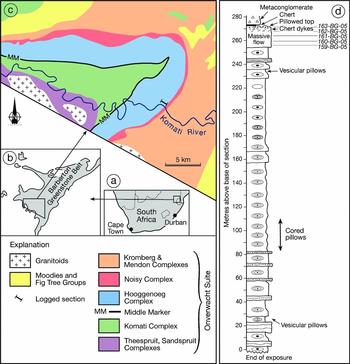
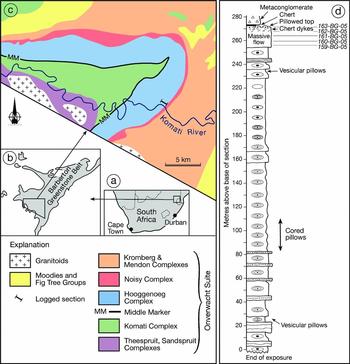
Thirty pillows with dark purple to black massive cores have been noted in the sequence of flow-banded pillow lava in the 82–110 m interval in the section logged through the stratigraphically uppermost part of the Hooggenoeg Complex as exposed along the Komati River (Figs 1, 2). They include some of the largest pillows recorded in the section, including one measuring 440 cm in the originally horizontal direction and 140 cm in the vertical (stratigraphic) direction. In this particular pillow, the massive core is 220 cm wide and 90 cm high. A nearby similar pillow is exceptional in being higher (320 cm) than it is wide (281 cm). However, the dark core in this pillow has a more normal aspect ratio, being 256 cm wide and 206 cm high.
(a, b, c) Location and simplified geological map of the southern part of the Barberton Greenstone Belt showing the logged section through the uppermost part of the volcanic sequence of the Hooggenoeg Complex as exposed along the Komati River. The recently defined Noisy Complex consists of felsic volcanic, volcaniclastic and shallow intrusive rocks (de Wit, Furnes & Robins, in press). (d) Stratigraphic log (after Robins et al. Reference Robins, Sandstå, Furnes and de Wit2010) showing the distribution of thin massive units (flow banding indicated by wavy lines), basaltic pillows (single ovals), flow-banded pillows (concentric ovals), leucocratic varioles (solid dots) and the locations of the analysed samples from the uppermost massive flow and the cored pillows described in the text.
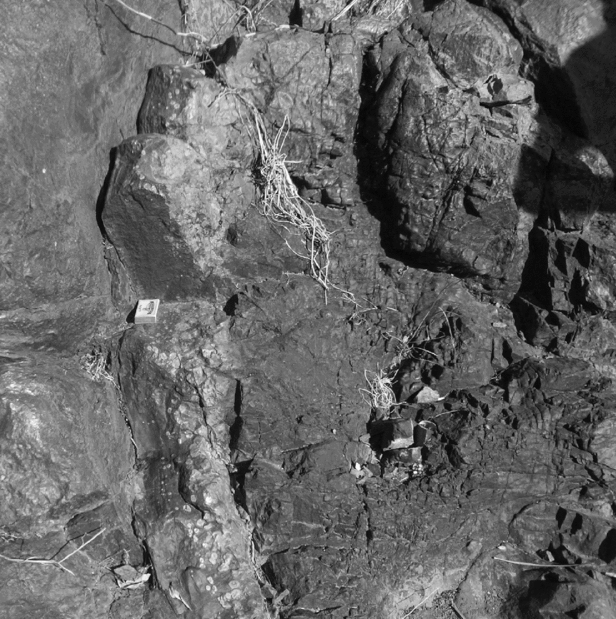
Upper margin of a large pillow with a 16 cm thick flow-banded carapace containing large individual and impinging varioles along the outer side of the sharp contact with a massive, purplish black core. The edge of the pillow is visible in the upper part of the picture and the base of the core is just within the right margin of the photograph. Stratigraphic up is to the left. The matchbox (c. 50 mm long) is placed just within the upper margin of the pillow. The loosened block in the centre of the picture is one of the samples collected for analysis. See http://journals.cambridge.org/geo for a colour version of this figure.
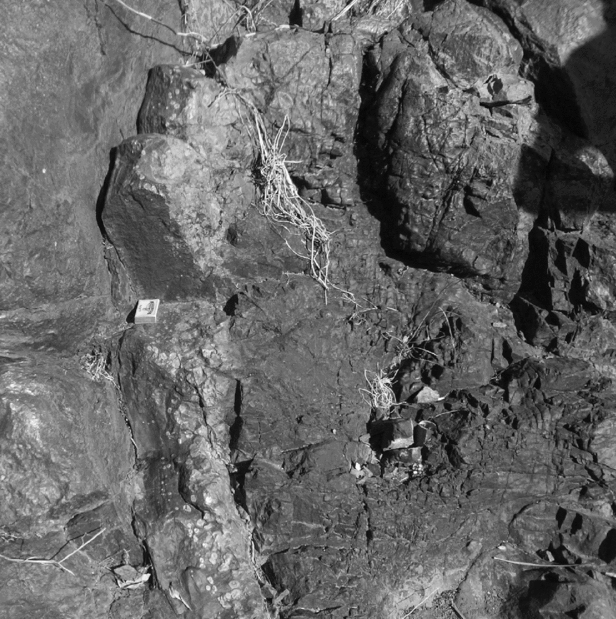
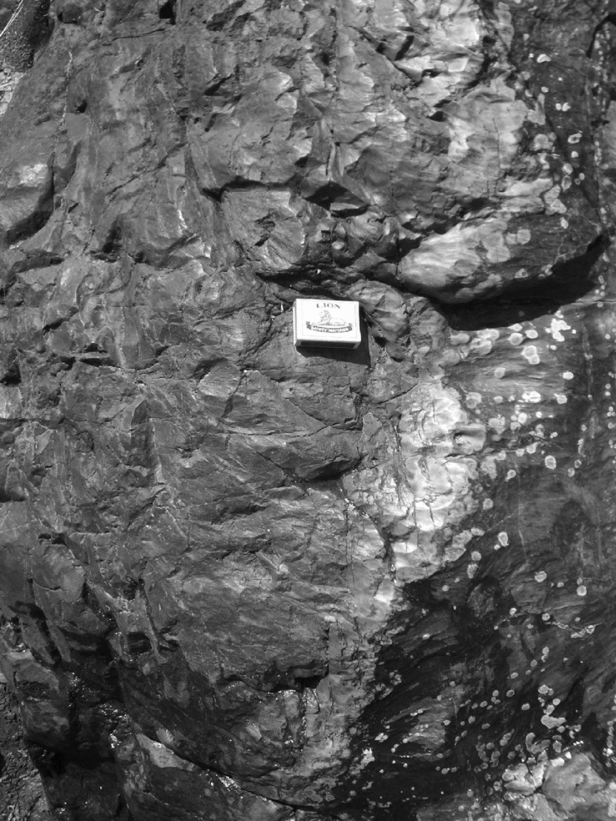
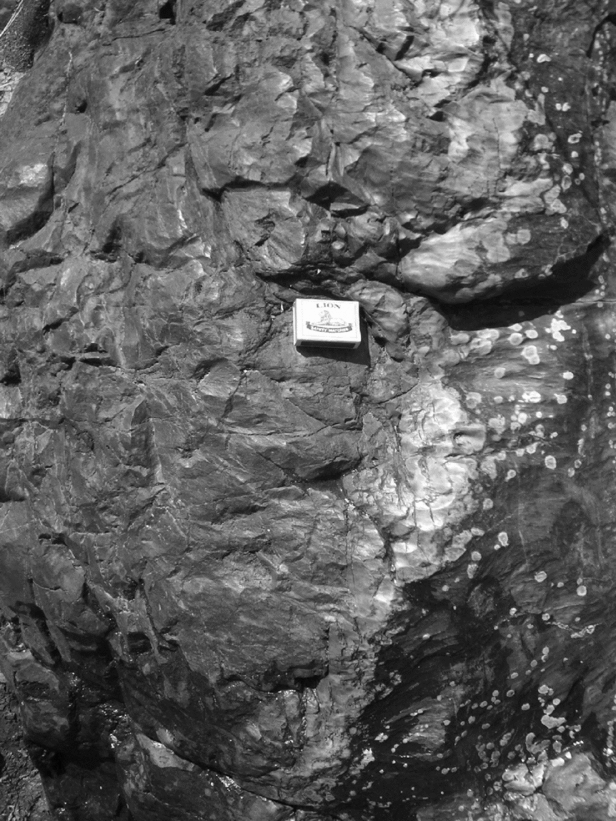
The pillows have flow-banded, aphyric, non-vesicular margins exhibiting alternating bands of pale green spherulitic and darker variolitic metabasalt of variable thickness (Robins et al. Reference Robins, Sandstå, Furnes and de Wit2010). These margins can be as narrow as 7 cm, even around large pillows (Fig. 2). Radial fractures, generally commonly developed in pillows elsewhere, are absent in these particular examples. In all pillows, the number and size of the varioles present in the dark green variety of metabasalt generally increases inwards from the variole-free margins. Where the massive cores are in contact with the dark variety of metabasalt, there is generally a continuous band of pale-weathering impinging varioles along the contact (Fig. 3). The large leucocratic varioles that characterize the dark green variety of metabasalt are interpreted as altered plagioclase spherulites (Sandstå et al. in press).
The variolitic carapace of a large pillow with a band of impinging varioles along the sharp contact of the massive, aphanitic, purplish black core. Stratigraphic up is to the right. The matchbox (c. 50 mm long) is placed just within the contact of the core. See http://journals.cambridge.org/geo for a colour version of this figure.
The characteristically purplish black weathering cores have sharp, aphanitic contacts with the flow-banded carapaces. They are massive, lack flow banding, varioles and vesicles, and commonly exhibit polygonal jointing. Single or multiple flat-bottomed drainage cavities are relatively common in flow-banded pillows in the section investigated (see Sandstå et al. in press), but none have been noted in the black cores.
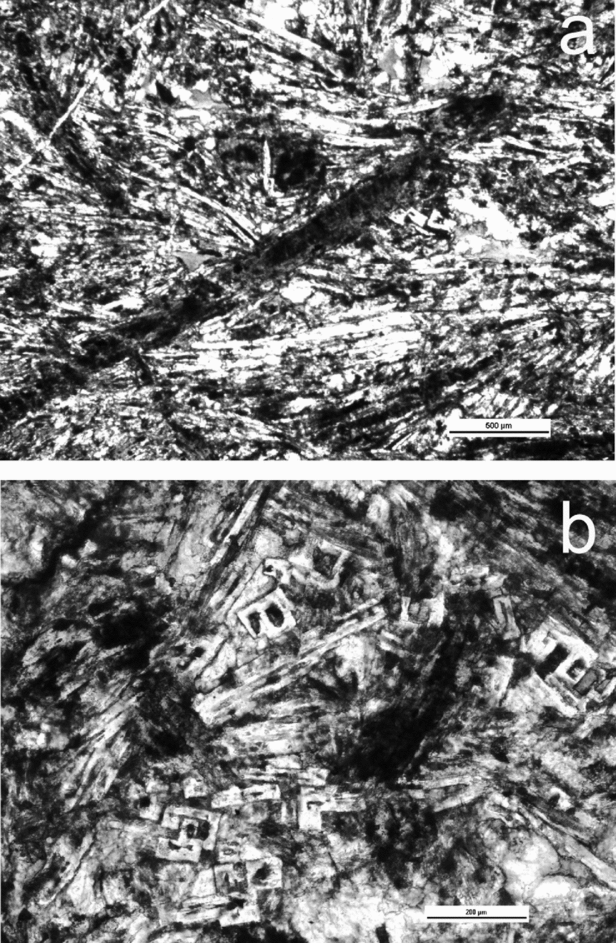
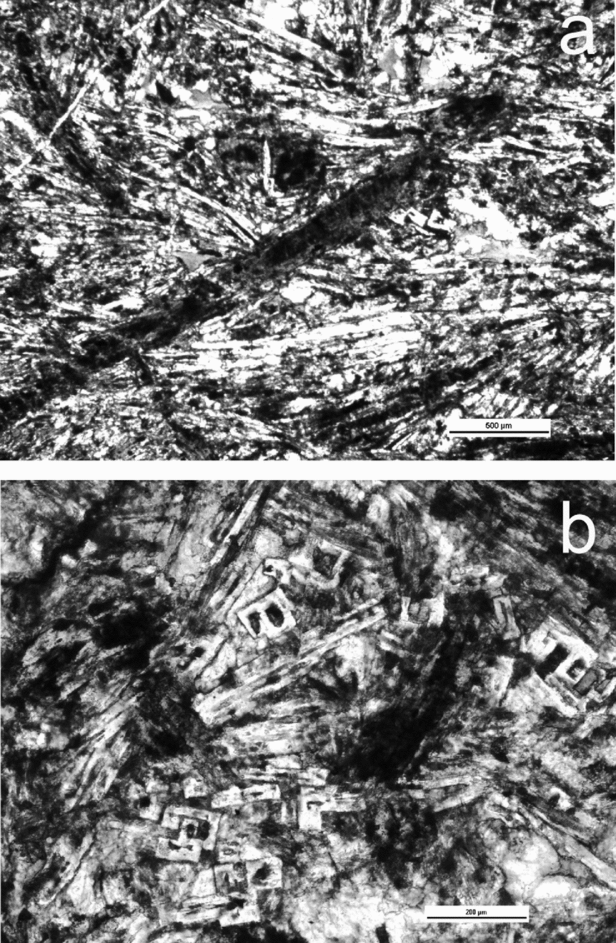
The interiors of some of the larger cores are relatively coarse grained and, owing to the lack of penetrative deformation, primary textures are well preserved despite the thorough transformation to low-grade metamorphic mineral assemblages. Centimetre-long pseudomorphs of actinolite after randomly or radially orientated prismatic crystals of pyroxene are conspicuous in outcrop and reside in a felsic groundmass. In thin-section, the pseudomorphs have brown bastite-like cores and rims of green actinolite, suggesting that the original pyroxenes were compositionally zoned from Mg-Fe-rich cores to Ca-rich margins (Fig. 4a). The matrix consists largely of skeletal albite that in places forms open, bow-tie spherulites (Fig. 4b). These textures are unlike those in pillow carapaces that contain pseudomorphs after dendritic olivine and open, bow-tie or radial pyroxene spherulites in the pale green metabasalt, or altered plagioclase spherulites consisting of feathery, outwardly branching crystals of albite in the dark green metabasalt (see Robins et al. Reference Robins, Sandstå, Furnes and de Wit2010, Fig. 5).
(a) Photomicrograph of metabasalt from the dark core of a large pillow showing a pseudomorph with a brown, bastite-like core and a margin of green actinolite, probably after a prismatic zoned pyroxene, within a matrix of spherulitic albite (after primary plagioclase). Scale bar is 500 μm. (b) Detail of the feldspathic matrix in (a), showing the skeletal albite, presumably preserving the shape of the original plagioclase. Scale bar is 200 μm. See http://journals.cambridge.org/geo for a colour version of this figure.
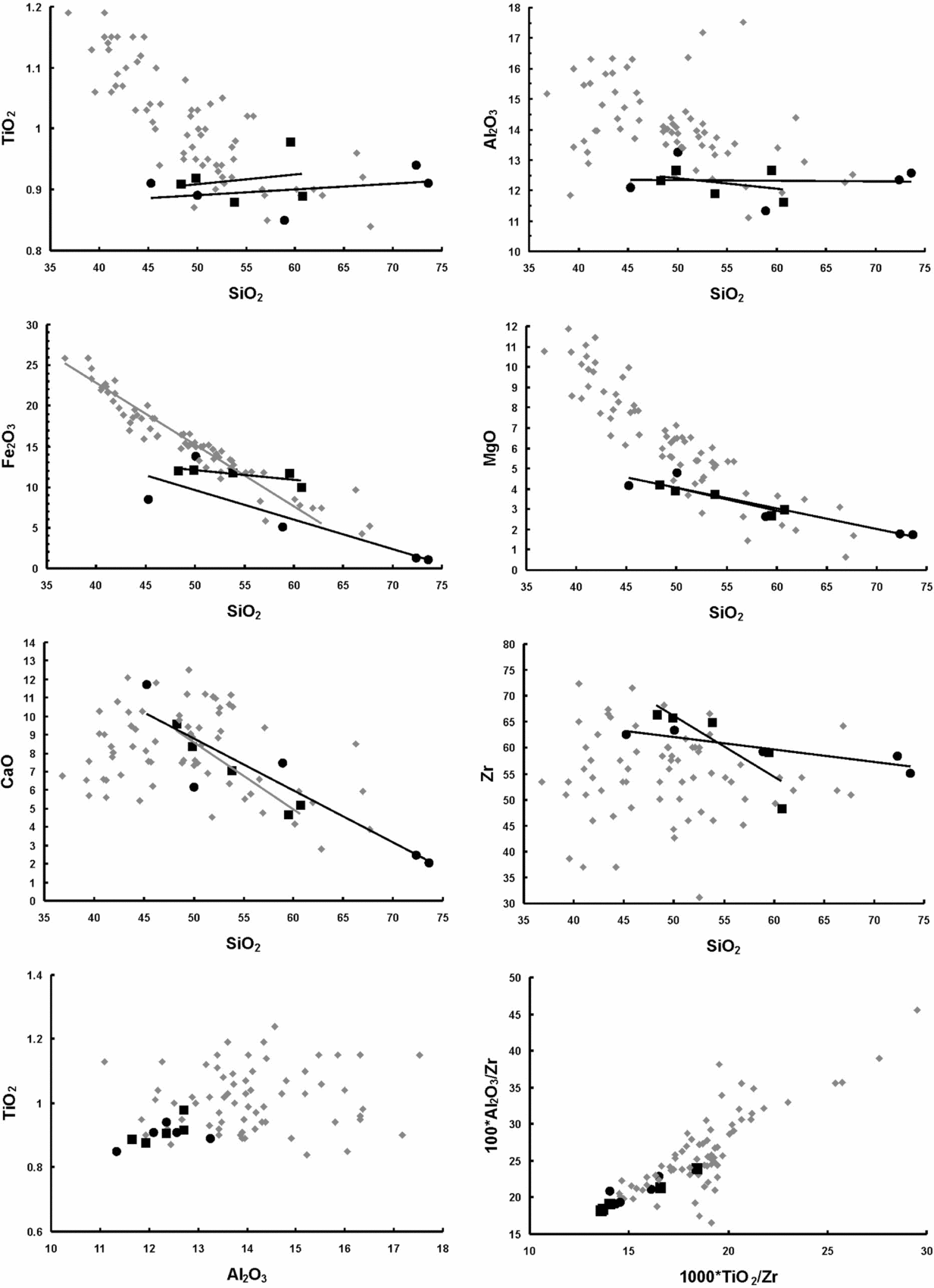
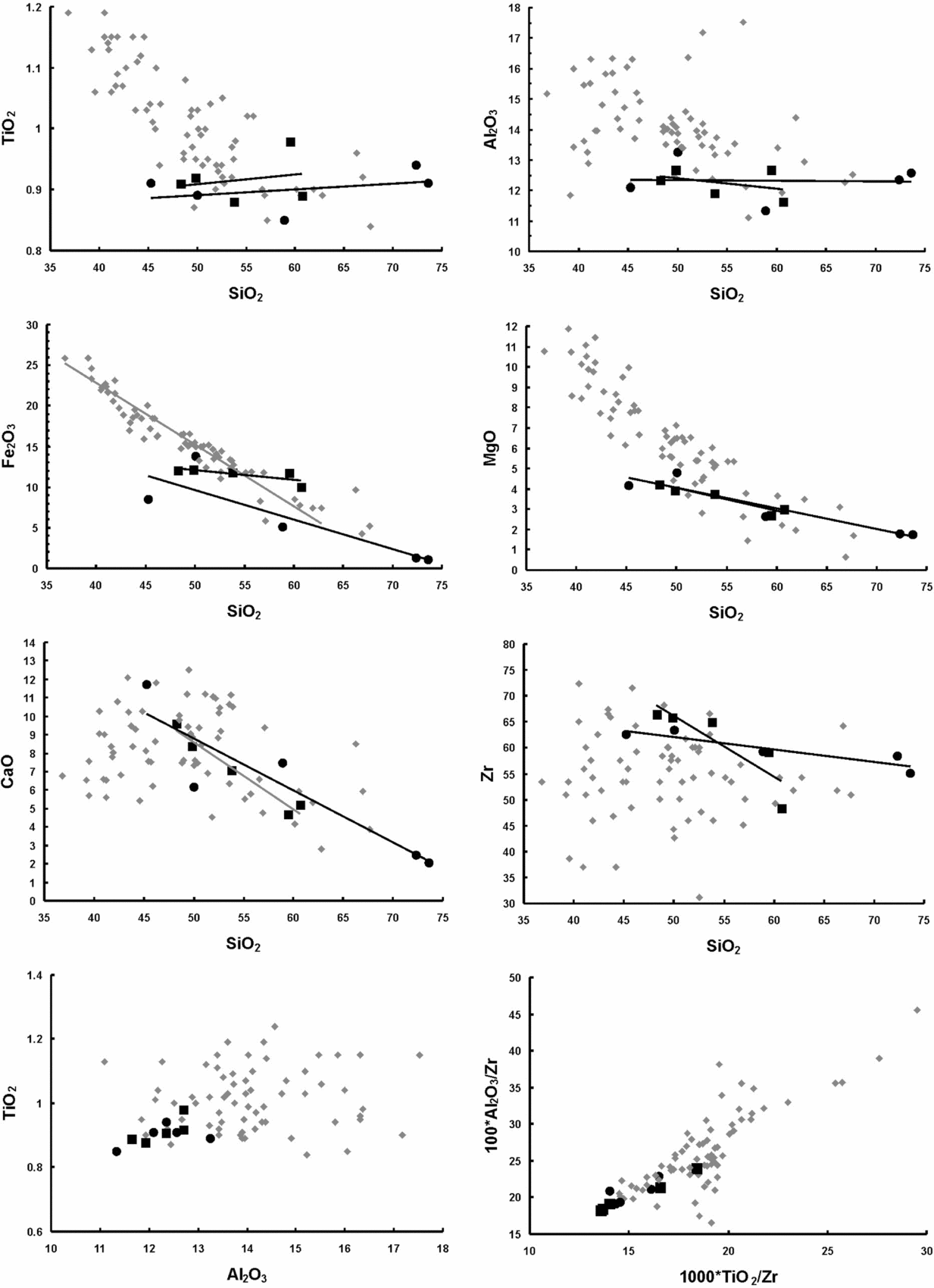
Harker-type and other diagrams showing analytical data (and in some diagrams linear regression lines) for samples from pillow cores (squares), the silicified massive flow (circles) from Table 1, as well as samples of flow-banded lava and individual flow bands (diamonds) from Robins et al. (Reference Robins, Sandstå, Furnes and de Wit2010) for comparison.
3. Geochemistry of the pillow cores
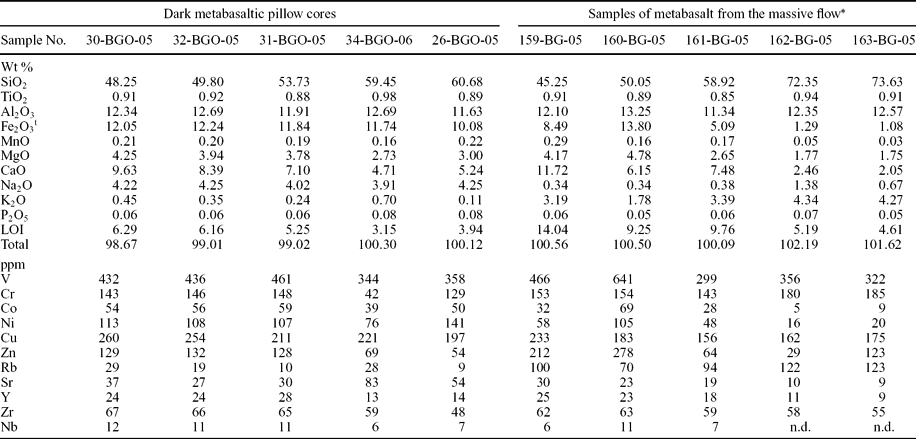
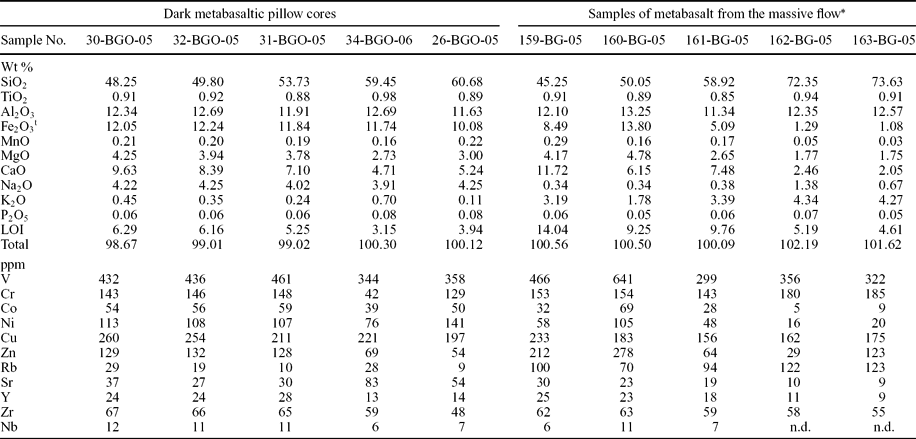
Chemical analyses of five samples from the purplish black cores of pillows are listed in Table 1. Selected elements are plotted in Figure 5 together with analyses of isolated flow bands and random samples of flow-banded lava reported in tables 1 and 2 of Robins et al. (Reference Robins, Sandstå, Furnes and de Wit2010) for comparison.
X-ray fluorescence analyses of samples from pillow cores as well as the massive flow uppermost in the volcanic sequence of the Hooggenoeg Complex as exposed along the Komati River, South Africa
*See Figure 1 for the stratigraphic locations of the samples.
Owing to allochemical alteration, the samples from the dark cores show a wide range in SiO2 (48.3–60.7 wt%) and the variations are therefore displayed in Harker diagrams in Figure 5. Elements such as CaO, MgO, Fe2O3t, Cr, Co, V, Zr and Y exhibit dispersed but generally linear variations in concentration. Al2O3 and TiO2 vary little, while most other elements decrease in concentration with increasing SiO2. These negative correlations are a result of silicification of the pillow cores, and comparisons of the compositions of the different varieties of metabasalt have to take this into account. Al2O3 and TiO2 appear to have been conserved during alteration. Zr is generally one of the more immobile elements during alteration, but in the Barberton metabasalts it appears to have decreased slightly in concentration with advancing silicification (Fig. 5), leading to increases in Al2O3/Zr and TiO2/Zr ratios.
For most elements, the trends in Harker diagrams defined by the dark-coloured metabasalt occupying the cores of pillows are distinct from those for samples of individual flow bands and flow-banded lava from the carapaces (see Robins et al. Reference Robins, Sandstå, Furnes and de Wit2010 for data), suggesting that the lavas had different compositions prior to alteration. However, several elements in samples from the black cores (MgO, Al2O3 and TiO2) exhibit trends coincident with those defined by the silicified, 19 m thick massive flow uppermost in the volcanic section of the Hooggenoeg Complex (Fig. 1). This flow shows a systematic increase in SiO2 from 45.3 wt% near the base to 73.6 wt% in the intensely silicified top (Table 1). Samples from the dark cores and the massive flow have similar Al2O3 and TiO2 concentrations and Al2O3/Zr and TiO2/Zr ratios. All of these are lower than in the majority of the samples of flow-banded lava (Fig. 5).
A noteworthy feature of the regression lines for the samples from pillow cores and the massive flow plotted in Figure 5 is that where they have slightly different slopes; they intersect or approach each other closely at SiO2 concentrations in the 45–50% range and plausible basaltic concentrations of the respective elements. This leads us to the conclusion that the intersections are close to the original compositions of both the pillow cores and the massive flow prior to silicification. The intersections are close to the compositions of samples 30-BGO-05 and 32-BGO-05 (Table 1), which we regard as good estimates of the original compositions of both the cores of the pillows and the uppermost massive flow.
4. Origin of the cored pillows
Our field observations support the view that the pillows are branching lava tubes (Jones, Reference Jones1968; Vuagnat, Reference Vuagnat1975; Ballard & Moore, Reference Ballard and Moore1977; Hargreaves & Ayres, Reference Hargreaves and Ayres1979). The largest pillows probably represent master tubes that channelled lava to the front of a submarine flow. Many flow-banded pillows were partially drained, once or repeatedly, leaving one or more relatively small flat-bottomed cavities or slots that have subsequently been filled by hydrothermal quartz and carbonate (Sandstå et al. in press). The origin of such drainage cavities has been linked with the spasmodic budding of pillows and episodic advance of lava tubes (Moore & Charlton, Reference Moore and Charlton1984; Dann & Grove, Reference Dann and Grove2007).
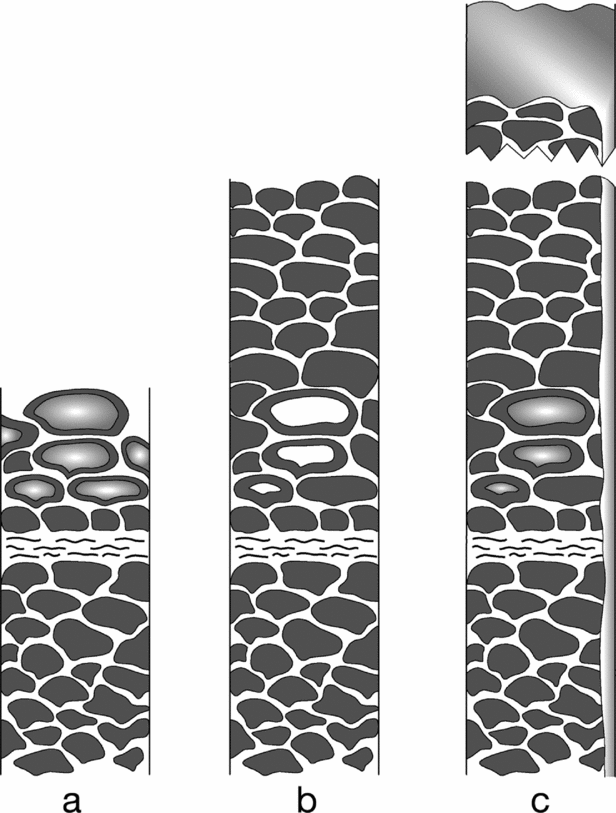
The dark metabasalt occupying the cores of some of the larger pillows evidently solidified from lava that was emplaced either at a late stage in the evolution of the pillowed flow or during a later eruption. Due principally to the compositional similarity of the dark cores with a younger, massive lava flow, we suggest that some lava tubes in the pillowed flow were almost completely drained, leaving hollow pillows with a carapace composed of solidified flow-banded lava (Fig. 6a, b). Evacuation was probably a consequence of an interruption in the supply of lava, possibly due to solidification of tubes upstream, while the flow continued to advance down slope. During a later eruption, resulting in rapid effusion of the thick lobate flow at the top of the volcanic sequence in the Hooggenoeg Complex, these hollow pillows were refilled by lava of different, more differentiated composition (Fig. 6c). The younger lava chilled initially against the pre-existing cold shells, but thereafter the rate of cooling slowed owing to the insulating effect of the poorly conducting pillow carapaces, and quite coarse textures developed in the interiors of the largest pillows.
Cartoon illustrating the origin of pillows with distinctive cores in the stratigraphically uppermost part of the Hooggenoeg Complex as exposed along the Komati River in the Barberton Greenstone Belt. (a) Eruption of submarine basalt with inhomogeneous lava flowing through tubular pillows towards the flow front. (b) Drainage of lava partially empties some pillows leaving hollow, flow-banded shells whereas others solidify completely. (c) The hollow pillows are refilled during eruption of a later massive flow, presumably from a crosscutting feeder dyke. See http://journals.cambridge.org/geo for a colour version of this figure.

Whether the hollow pillows were initially sealed and occupied only by gas, or were fractured and filled by water prior to refilling, is not certain. No hydrothermal lining separating the cores from the carapaces has been noted. Collapsed pillows like those figured by Bellaiche et al. (Reference Bellaiche, Cheminée, Francheteau, Hekinian, Le Pichon, Needham and Ballard1974) and Ballard & Moore (Reference Ballard and Moore1977) have not been observed in the section investigated, and it seems probable that either the carapaces were strong enough to support both the water pressure and the weight of the overlying lava or, more likely, that the hollow pillows were filled with water.
Spherulites can nucleate more readily on interfaces than within a homogeneous undercooled melt or glass (e.g. Barbieri et al. Reference Barbieri, Bondioli, Lancellotti, Leonelli and Montorsi2005), and some of the impinging varioles (altered plagioclase spherulites) in the carapaces along some contacts with the dark cores (Fig. 3) could conceivably have nucleated on the interior surfaces of the hollow tubes soon after lava drainage. However, this possibility is not supported by the development of varioles exclusively along the flat bases of minor drainage cavities in other pillows in the section (Sandstå et al. in press). We suggest that the varioles developed during reheating of vitreous pillow margins to a temperature high enough for spherulitic growth of feldspar in the original obsidian during later refilling.
5. Conclusions
We suggest that tubular pillows with homogeneous cores of distinctive appearance, texture and composition in the Palaeoarchaean Hooggenoeg Complex were initially hollow owing to lava drainage. The hollow, flow-banded carapaces were buried to a depth of about 150 m without collapsing and were subsequently refilled by lava during the later effusion of a thick lobate flow (Fig. 6). The local source of the lava that filled the previously empty pillows has not been identified, but may have been a dyke the fed the later massive flow.
Hollow pillows have been described from recent flows of basalt on the sea floor (e.g. Ballard & Moore, Reference Ballard and Moore1977) as well as from older sub-aqueous flows (e.g. Vuagnat, Reference Vuagnat1975), but there are no previous reports suggesting refilling. The recognition of younger cores in the Hooggenoeg pillow lava is the result of a combination of fortuitous circumstances, including the unusual occurrence of flow banding in the pillows and the compositional and textural differences preserved in successive basaltic flows in the uppermost part of the volcanic sequence in the Hooggenoeg Complex. In almost homogeneous submarine basalts any similar structures probably would go unnoticed.
Acknowledgements
The authors thank the Mpumalanga Parks Board for their permission to collect samples within the Songimvelo Nature Reserve. We are extremely grateful for the generous hospitality of Fred Daniel of the Nkomazi Wilderness Resort.