Most research on the socioeconomic, political, and symbolic roles of thread and cloth production in Mesoamerica has focused on the Late Postclassic and early Colonial periods and the highland regions in and around the Valley of Mexico, which can be explained in part by the rich ethnohistoric and archaeological evidence related to the Aztec tributary economy (Brumfiel Reference Brumfiel1996b, Reference Brumfiel1997, Reference Brumfiel2006; Hendon Reference Hendon2006; Joyce Reference Joyce2000a; McCafferty and McCafferty Reference McCafferty and McCafferty2000; Parsons Reference Parsons, Spence, Parsons and Parsons1972; Parsons and Parsons Reference Parsons and Parsons1990; Smith and Hirth Reference Smith and Hirth1988; Stark et al. Reference Stark, Heller and Ohnersorgen1998). My research on coastal Oaxaca has documented intensive thread production extending back into the Early Postclassic, and supports a scenario of long-distance interregional interaction between the coast and the highlands that presages both the Aztec rise to power in central Mexico and the historically-documented interaction between lowland peoples and Mixtec elites of the famous Late Postclassic cacicazgos in Oaxaca (Joyce et al. Reference Joyce, Workinger, Hamann, Koefges, Oland and King2004; Levine Reference Levine2007; Monaghan et al. Reference Monaghan, Joyce and Spores2003; Spores Reference Spores1993). Spindle whorls, which are the primary material paraphernalia of thread production preserved at Mesoamerican archaeological sites, were found in and around Early Postclassic houses at the coastal Oaxacan site of Río Viejo in relatively large quantities. The ubiquity of whorls in residential contexts suggests that coastal Oaxacan peoples were involved in a household-based industry of thread production during the Early Postclassic. In this paper, I discuss the technology, scale, and intensity of Río Viejo's thread production industry, drawing comparisons between the assemblage at Río Viejo and studies of spinning and cloth production elsewhere in highland and lowland Mesoamerica. I show that the thread produced at Río Viejo was unique compared to that produced elsewhere and suggest that surplus thread was produced for export to regional and/or long-distance markets in other parts of Oaxaca and Mesoamerica (King Reference King and Blomster2008). This Early Postclassic connection paved the way for the more strongly developed connection between coastal thread producers and highland weavers during the Late Postclassic period, documented in recent excavations in nearby Tututepec (Levine Reference Levine2007).
During the initial stages of this research I found little consistency in the reporting and quantification of spindle whorls in Mesoamerica, especially regarding the various ways researchers calculate whorl frequency and whorl density. The most accepted methods include measuring the number of spindle whorls in relation to some standardized measure of artifacts, the number of whorls per square meter of excavated (or even surveyed) area, and the number of whorls per cubic meter of excavated area. To make the Río Viejo data comparable to these other studies, I present the Río Viejo data in various formats and draw comparisons between Río Viejo and sites in other regions. While no method is without its own set of problems, in the end, I argue for more standardized reporting and presentation of whorl calculations and suggest more systematic use of volumetric whorl density measures.
The Río Viejo project was initially designed as a study of household social organization during the coastal Oaxacan Early Postclassic, focusing on social meaning of food production and food sharing (King Reference King2003). During the course of the field excavations, fiber processing emerged as a key secondary activity evidenced across the site. Thread production, like food sharing, is a meaningful social practice that contributed to creating a shared group identity. Residents emphasized the similarity between male and female adult house members rather than specifically linking (or materially marking) women and thread production. The Río Viejo data show that the traditional linkage between women and cloth production apparent in Mesoamerican ethnohistoric sources may, on the ground, need to be read as less rigidly defining gendered practices in specific places at specific points in time.
RÍO VIEJO DURING THE EARLY POSTCLASSIC
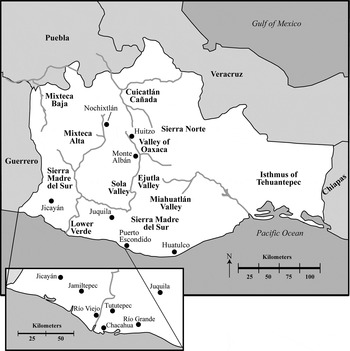
Río Viejo is located about 12 km inland on the fertile coastal plain of western Oaxaca known as the Costa Chica (Figure 1). The site lies along the floodplain of the Río Verde, a river that flows from the Valley of Oaxaca to the coast, depositing rich alluvial sediments (Joyce and Mueller Reference Joyce and Mueller1992, Reference Joyce and Mueller1997). The site was first occupied as early as the late Middle Formative (700–400 b.c.), and was important throughout the Formative and Classic periods, serving as the capital of a regional polity during the Late Classic (a.d. 500–800) (Joyce Reference Joyce2005, Reference Joyce and Blomster2008; Joyce et al. Reference Joyce, Bustamante and Levine2001a; Joyce and King Reference Joyce, King and Carrasco2000; Joyce and Workinger Reference Joyce and Workinger1996). The Early Postclassic occupation of the site is much more modest, lacking monumental architecture, ceremonial precincts, or a large central plaza. Early Postclassic residents built humble, single-roomed houses directly on top of the Late Classic period platforms and mounds. Excavations in two Early Postclassic neighborhoods, directed by Arthur Joyce and myself, have revealed architecture, burials, and artifacts used in domestic activities, but provide little evidence for differentiated social roles and statuses (Joyce and King Reference Joyce and King2001; Joyce et al. Reference Joyce, Levine and Bustamante2001b; King Reference King2003). Early Postclassic residents of Río Viejo devoted time to the production of thread, but also completed numerous other tasks in their houses in and around their houses, including making and using obsidian tools, costume ornaments, jewelry, and figurines, and preparing and eating food in and around their houses. Residents also actively participated in interregional exchange networks with the highlands and, in this way, tapped into many of the goods, ideas, and symbols circulating throughout of the greater Mesoamerican world (King Reference King and Blomster2008).
Map of Oaxaca, showing important regions, towns, and sites.

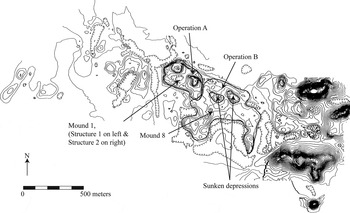
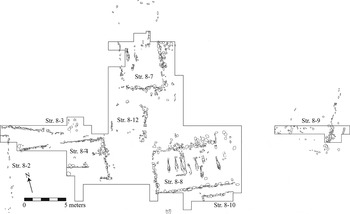
The Operation B neighborhood of Río Viejo, which is the primary focus of this study, lies on a low broad platform elevated about five meters above the floodplain (Figure 2). Here, foundation walls visible on the ground surface mark the presence of several dozen structures. Operation B covers a total excavated area of 284 m2, including two complete structures, and portions of another five (King Reference King2003) (Figure 3). The neighborhood includes two periods of occupation, three major stages of construction events, and numerous smaller-scale discrete activities, with relatively limited space between structures (King Reference King2003). The buildings measure roughly 5 × 11 m and each consists of a single room delimited by stone platform retaining walls, which supported perishable superstructures covered in daub. Four small pit features located in Structures 8-4 and 8-8 show repetitive use of small fires inside houses.
Map of Río Viejo, showing location of Operation B neighborhood.

Plan of Operation B neighborhood, Río Viejo.

Several buildings were constructed, occupied, renovated and abandoned in the Operation B neighborhood during the Early Postclassic. During this period of occupation, dating to between a.d. 975 and 1220 based on calibrated accelerator mass spectrometry (AMS) dates (King Reference King and Blomster2008), various people and families cycled through the buildings, eating, sleeping, working, celebrating life-cycle events, and burying their dead. Founding residents decided to live in this specific neighborhood, and descendants stayed in the same location and same houses along with the physical remains of their ancestors.
SPINNING IN COASTAL OAXACA
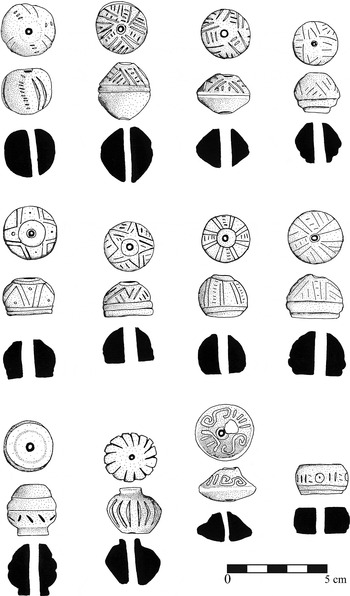
Ceramic spindle whorls were found throughout Río Viejo's Early Postclassic deposits and provide clear evidence that residents devoted significant time to spinning thread. The number of formally manufactured clay whorls found in Operation B is 86, or the equivalent of 0.3/m2 and 4.07/m3 in excavated Early Postclassic deposits. The design and form of the thread-producing spindle whorls at Río Viejo reveal the economic specialization, aesthetic preferences, and productivity of Río Viejo artisans. Most of the whorls were decorated with simple incised geometric designs that repeat around the whorl exterior, and were made by hand rather than in molds (Figure 4). A few similar whorls have been found in surface collection contexts at the site of Río Grande (El Corozal) east of the lower Verde, attributed to a Postclassic period occupation (Zárate Morán Reference Zárate Morán1995). Levine (Reference Levine2007:277) has found whorls in Late Postclassic deposits at nearby coastal Tututepec that are roughly similar in size to Early Postclassic period examples from Río Viejo, but with forms and decorations that are markedly distinct. Whorls at other Oaxacan and Mesoamerican sites bear little resemblance to those of coastal Oaxaca.
Spindle whorls from Early Postclassic Río Viejo.

THE TECHNOLOGY OF CLOTH PRODUCTION
The environment of the lower Río Verde valley, located in the lowland semi-tropics, is ideal for growing cotton. Cotton is a tierra caliente (hot land) crop, which favors elevations below 1,000 m, rainfall between 1,000 and 1,500 mm in distinct wet and dry seasons, and temperatures between 24° and 29°C (Berdan Reference Berdan1987; Purseglove Reference Purseglove1968; Stark et al. Reference Stark, Heller and Ohnersorgen1998). The domestic cotton grown in pre-Hispanic Mexico was probably Gossypium hirsutum L., which has both annual and perennial varieties (Stephens Reference Stephens and Byers1967). While the annuals would have required more labor in planting, they are better protected from insects and could be multi-cropped for an extended harvest season (Stark et al. Reference Stark, Heller and Ohnersorgen1998). The cotton used in traditional clothing on the Oaxaca coast is the annual variety called coyuche, which produces fibers that have a relatively short staple length and range in color from light tan to cinnamon (Klein Reference Klein1997:116). Coyuche cotton continues to be grown in home gardens along the coast for use in spinning and weaving.
Cotton cloth production is an industry that can be divided into segments based on growing, harvesting, and extracting raw cotton; dyeing; spinning thread; and weaving finished cloth. Sewing and embroidery are additional steps that use woven cloth as a base. Berdan (Reference Berdan1987:248) argues that in Mesoamerica cloth production was usually completed as a single operation, but in some cases raw cotton and spun thread were traded over long-distances prior to weaving. Ethnohistoric sources frequently report that raw cotton was exported from coastal regions and spun and woven in the highlands to meet tribute obligations (Berdan Reference Berdan1987:252), perhaps first removing seeds from the bolls to reduce the weight (Hicks Reference Hicks, Hodge and Smith1994:90). Alonso de Zorita (Reference Zorita and Keen1994:187) confirms that some highland Valley of Mexico communities “…did not grow cotton but worked it into a very good cloth. This excellent cloth was made by people of the tierra fria, who are better workers than those of the tierra caliente.” The presence of cotton spinning whorls in archaeological collections from highland Mexican sites, to which raw cotton was likely imported, also supports this conclusion (Brumfiel Reference Brumfiel1997; McCafferty and McCafferty Reference McCafferty and McCafferty2000; Parsons Reference Parsons, Spence, Parsons and Parsons1972:71).
Thread and cloth were major parts of the thriving Postclassic Mesoamerican world economy (Anawalt Reference Anawalt1980:10; Berdan Reference Berdan1987; Brumfiel Reference Brumfiel2006; Smith Reference Smith, Smith and Berdan2003b; Smith and Berdan Reference Smith and Berdan2000). Cotton was highly desired throughout Mexico during the pre-Hispanic and Colonial eras, and control of sources may have even contributed to Aztec militaristic expansion in the Late Postclassic (Stark et al. Reference Stark, Heller and Ohnersorgen1998). Cotton clothing was normally reserved for the elite and Aztec sumptuary laws restricted commoners from wearing cotton clothing (Durán Reference Durán1967:II:211–213), although the degree to which these restrictions were enforced, especially outside of the Aztec capital, is open to debate (Anawalt Reference Anawalt1980, Reference Anawalt1981). Aztec leaders often redistributed the cotton cloth they acquired as tribute to lesser nobility in a system of politically-motivated gift exchanges (Berdan Reference Berdan1987; Hicks Reference Hicks, Hodge and Smith1994). In the Mixteca Alta, tribute payments and elite gift exchanges associated with feasts and marriages may have facilitated the exchange of fancier cloth (Pohl Reference Pohl, Johnson and Sharon1994, Reference Pohl, Smith and Berdan2003). By early colonial times, cotton cloth in the form of mantas (lengths or quachtli) had become a standard measure for market exchange (Motolínia Reference Motolínia1971:374). In Oaxaca, cotton was used to build and reinforce alliances between Mixtec elite during the Late Postclassic and early Colonial periods (Hamann Reference Hamann, Claassen and Joyce1997). Cotton mantas and other cloth products were important commodities in Oaxaca during the early Colonial period and could be given in place of other tribute requirements (Rodríguez Canto et al. Reference Rodríguez Canto, Naváez, Hernández, Romero, Solano, Anaya, Dillañes and Castro1989; Terraciano Reference Terraciano1998:239). The military armor worn by soldiers in coastal Tututepec was stuffed with cotton (Paso y Troncoso Reference Paso y Troncoso1905:79, 235), as it was in other parts of Oaxaca and Mesoamerica (Anawalt Reference Anawalt1981; Hicks Reference Hicks, Hodge and Smith1994).
Highland Mixtec weavers were well known for producing high quality cloth in the early Colonial period (Terraciano Reference Terraciano1998:238), and some sources suggest that highland residents purchased the cotton in raw form. In the Relación Geográfica of Huitzo, written in 1579–1581, cotton was acquired from the “costa de Tututepec” (the lower Río Verde valley) and spun and woven in the highlands by Huitzo residents (Paso y Troncoso Reference Paso y Troncoso1905:204). Cotton whorls excavated from the Oaxacan site of Ejutla show that highland Oaxacan communities spun thread using cotton imported from the coast as far back as the Classic period (Feinman and Nicholas Reference Feinman and Nicholas1993, Reference Feinman and Nicholas1995). Woven cloth could have also been traded over long distances to be embellished or “finished” by other weavers with feathers, bells, or embroidery using cotton or other kinds of fiber (Anawalt Reference Anawalt1981; Berdan Reference Berdan1987:248), much like the machine-produced cloth that is embroidered by modern Mexican women (Brumfiel Reference Brumfiel2006:868). We also found fragments of three bone needles most likely used for embroidery. The infrequency of these items, which cannot be solely explained based on differential preservation, likely means that this stage of production was not as commonly practiced as fiber processing and spinning. The presence of spindle whorls in Early Postclassic deposits at Río Viejo without awls, picks, and battens further suggests that coastal Oaxacan residents were primarily spinning thread and were not completing all stages of cloth production at the same level or intensity.
Like in other regions of Mesoamerica (Stark 1998:19), informal sherd disk spindle whorls seem to pre-date specially manufactured hand and mold-made spindle whorls. Informal sherd disks comprise a larger percentage of spindle whorls at Classic period sites in the Valley of Oaxaca (Feinman et al. Reference Feinman, Nicholas and Haines2002a), and were the primary spindle whorl type used during the Late Classic period in Río Viejo. We located one informally-made sherd disk in Operation B, manufactured from a ceramic vessel with dark brown or red painted lines on a cream slip finish, whose paste, decoration, and slip are unlike lower Verde ceramic vessels and may thus be a fragment from an imported vessel. An additional six non-perforated sherd disks made from Late Classic sherds could have been blanks for informal spindle whorls, potentially redeposited in Early Postclassic fill.
Spinning is an activity that could be picked up and set down as necessary. Multiple members of the household could spin without full-time specialization, learning how to do so by working alongside a skilled producer, usually a mother (Hicks Reference Hicks, Hodge and Smith1994). The technology of cotton spinning is rather uncomplicated, requiring spindles made from wood, whorls to weigh down the spindle, and sometimes small ceramic bowls for support spinning (Berdan Reference Berdan1987; Hicks Reference Hicks, Hodge and Smith1994). Archaeological evidence of spinning is usually best observed through whorls, which preserve better than do raw cotton or cloth. Smith and Hirth (Reference Smith and Hirth1988) have identified small ceramic bowls in Aztec-period Morelos used for spinning cotton thread. Although spinning vessels have not been recovered in the Río Viejo assemblage, bowls made of organic materials could have just as easily been used for this purpose. Modern weavers in Jamiltepec use perishable gourds for support when spinning coyuche cotton.
McCafferty and McCafferty (Reference McCafferty and McCafferty2000) have reported archaeological evidence of dyes at Early Postclassic Cholula in association with spindle whorls. About 10 small samples of red and pink pigment were collected in Operation B deposits. As yet, the pigment remains unidentified. The western Oaxacan coastal area is well known for the production of a highly desirable purple dye, which is used to dye the fabric of the traditional pozahuanco skirts among other items of clothing (Klein Reference Klein1997; Turok Reference Turok1988). This dye is collected from the marine gastropod Purpura pansa found in rocky high-energy upper intertidal zones of the Pacific coast and could have easily been harvested by native peoples in the lower Verde (Turok Reference Turok1988). No evidence of Purpura pansa has been identified in the Río Viejo assemblage. Purple thread is obviously more eye-catching than the subdued natural color of coyuche, but there is evidence that the distinct tan to cinnamon color of coyuche may have been desirable in its natural form. According to the Relaciones Geográficas, coyuche fiber was reserved for ceremonial clothing in the Mixe community of Puxmetacan in the Sierra Norte of northeastern Oaxaca, while everyday wear was woven from white cotton (Esparza Reference Esparza1994:37). Some communities in highland Valley of Oaxaca today continue to dye white cotton to match the color of coyuche cotton (Klein Reference Klein1997:120). Río Viejo spinners could have also been supplying thread to other communities along the coast who devoted more of their time to dyeing.
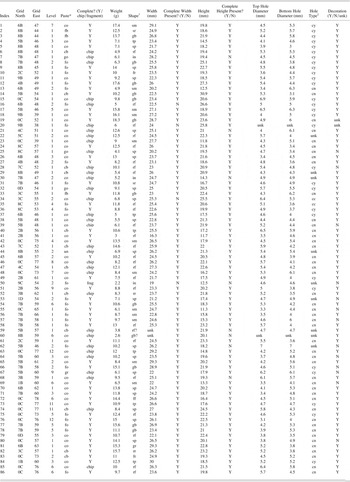
The measurements of the spindle whorls themselves indicate that they were probably used exclusively in the production of cotton thread (see Appendix 1 for a complete list of spindle whorl measurements). Formal differences in spindle whorls are closely related to the raw material or fiber used (cotton, maguey, etc.), and the quality of the resulting thread (Brumfiel Reference Brumfiel1996b, Reference Brumfiel1997; McCafferty and McCafferty Reference McCafferty and McCafferty2000; Parsons and Parsons Reference Parsons and Parsons1990). Whorls with larger diameters spin more slowly (have a higher moment of inertia) and produce thread that is less tightly woven. Lighter whorls produce thread that is thinner and finer. Since cotton fibers are short, they require less weight to maintain spinning momentum. Therefore cotton whorls should weigh less than whorls used in the production of maguey fiber thread. Hole diameter is generally smaller in cotton whorls as a consequence of smaller, more lightweight (thinner) spindles, and can vary depending on how many threads are being spun (McCafferty and McCafferty Reference McCafferty and McCafferty2000). Smaller hole diameters and/or lighter whorls within the range for each kind of fiber might also be related to the production of finer thread (Brumfiel Reference Brumfiel1996b, Reference Brumfiel1997; Feinman et al. Reference Feinman, Nicholas and Haines2002a; Parsons and Parsons Reference Parsons and Parsons1990).
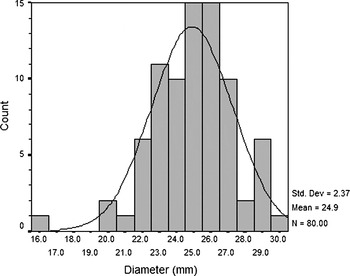
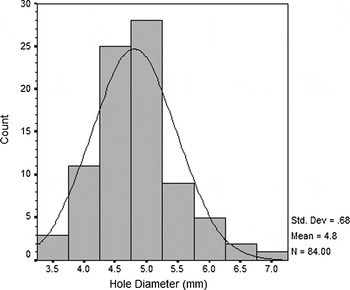
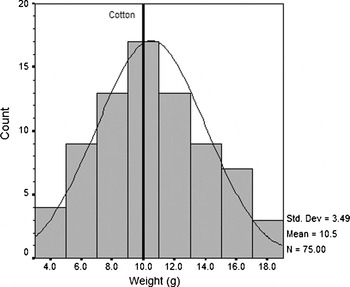
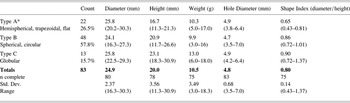
Parsons' (1972) analysis of spindle whorls recovered during the Teotihuacan Valley survey project showed that whorls were separable into types according to size and weight. In her typology, the smaller, lighter Type III whorls were used for spinning cotton, while other larger whorls in her collection were used for maguey. These whorls averaged less than 10 g in weight, ranged between 15 and 35 mm in diameter, and had hole diameters between 1.5 and 5.5 mm (Parsons Reference Parsons, Spence, Parsons and Parsons1972). For this reason, whorls weighing less than about 10 g are routinely interpreted as cotton-spinning whorls (see Brumfiel Reference Brumfiel, Gero and Conkey1991, Reference Brumfiel1997; Feinman and Nicholas Reference Feinman and Nicholas1995; Feinman et al. Reference Feinman, Nicholas and Middleton1994, Reference Feinman, Nicholas and Haines2002a; Nichols et al. Reference Nichols, McLaughlin and Benton2000; Norr Reference Norr and Grove1987; Parsons Reference Parsons1975; Smith and Hirth Reference Smith and Hirth1988; Stark et al. Reference Stark, Heller and Ohnersorgen1998). More recently, McCafferty and McCafferty (Reference McCafferty and McCafferty2000) have argued that this rule of thumb does not necessarily apply outside of the Valley of Mexico. In experimental studies using pre-Hispanic central Mexican whorls, Fauman-Fichman (Reference Fauman-Fichman1999:Appendix A) notes a weak relationship between spindle whorl size and type of fiber spun and demonstrates that spinners can adjust their spinning methods to accommodate different fibers using the same whorls. The Rio Viejo whorls provide another example of variation from Parson's calculations (Table 1). While the average dimensions for Río Viejo whorls fit near or below Parsons' range for cotton thread production, individual measurements fall outside the Type III range. The range of whorl diameters at Río Viejo fits well within the Parsons' cotton range, between 16.3 and 30.3 mm, with a mean of 24.9 mm (Figure 5). The range for hole diameter falls slightly outside Parsons' range for cotton whorls, between 3.5 and 7.0 mm and an average of 4.8 mm (Figure 6). The average whorl weight of 10.5 g is above the 10 g threshold for cotton-spinning whorls established by Parsons (Figure 7), but still fits within the cotton (and non-maguey) ranges that other authors have adopted (Arroyo Reference Arroyo, Bove, Medrano, Lou and Arroyo1993; McCafferty and McCafferty Reference McCafferty and McCafferty2000; Nichols et al. Reference Nichols, McLaughlin and Benton2000; Smith and Hirth Reference Smith and Hirth1988).
Histogram of spindle whorl diameter.

Histogram of spindle whorl hole diameter.

Histogram of spindle whorl weight.

Spindle whorl measurements

*In three cases, the whorls were too fragmentary to type.
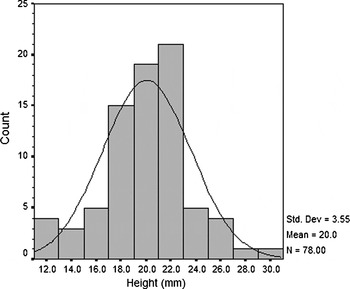
Spindle whorl height at Río Viejo has a unimodal distribution ranging between 11.3 and 30.9 mm, with an average of 20 mm (Figure 8). It is in height that the Río Viejo whorls differ the most from other cotton whorls, which tend to be flatter, disk-like, or hemispherical in shape (Levine Reference Levine2007:490–492; McCafferty and McCafferty Reference McCafferty and McCafferty2000; Parsons Reference Parsons, Spence, Parsons and Parsons1972; Smith and Hirth Reference Smith and Hirth1988). Increased whorl height increases the speed of the rotation, thereby producing a tighter twist. McCafferty and McCafferty (Reference McCafferty and McCafferty2000:46) note that in Jamiltepec, Oaxaca, modern weavers use whorls that are as tall or taller than they are wide, averaging 24 mm in diameter, 25 mm in height, 7 mm in hole diameter, and 12 g in weight to support-spin brown (coyuche) and white cotton. These same weavers use a slightly heavier (15 g) and slightly taller (31 mm) whorl to ply two threads of cotton together with a tighter twist. The whorls at Río Viejo more closely match modern Jamiltepec whorls in all dimensions than they do any of the other whorl dimensions presented in Mesoamerican whorl analyses, indicating that the thread produced by Río Viejo residents during the Early Postclassic may be similar in kind and quality to the thread produced by modern coastal Oaxacan weavers. The similarities in coastal Oaxacan whorl dimensions may also, in part, relate to the technological particularities of coyuche cotton and a different history of learning and practice.
Histogram of spindle whorl height.

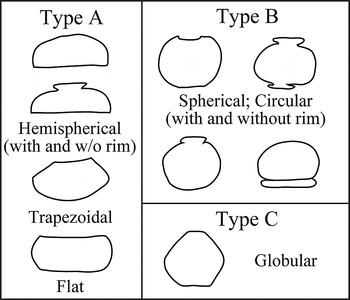
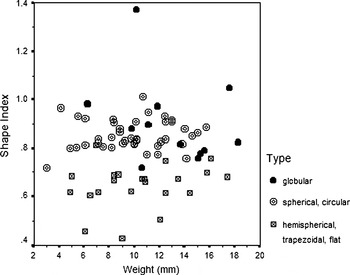
McCafferty and McCafferty (Reference McCafferty and McCafferty2000:45) propose using a shape index based on height and diameter to more effectively characterize the shape of spindle whorls. For Río Viejo whorls, height and weight are correlated (p = 0.03), although the linear relation between the two variables is loose (R2 = 0.0589). The shape index did, however, effectively separate the different shape types I defined for the Río Viejo assemblage based on visual identification (Figure 9). The shape index for the collection as a whole averages 0.80, with a range between 0.43 and 1.37 (Figure 10). According to this index, the three different shape categories only somewhat overlap, with globular whorls exhibiting the most diversity. Figure 10 also shows that whorl weight tended to vary within each shape type, which might mean that for each type of whorl, fibers of varying tightness were spun. The average shape index of 0.80 is well above the average calculated for Early Postclassic period Cholula spindle whorls. At Cholula, spindle whorls were generally less than half as tall as they were wide, between 0.08 and 0.67, with the greatest concentration between 0.23 and 0.27 (McCafferty and McCafferty Reference McCafferty and McCafferty2000:45). The Late Postclassic spindle whorls from nearby Tututepec are shorter on average than Río Viejo whorls (between 13.6 and 15.1 mm as opposed to 20 mm), but have an average shape index between 0.70 and 0.76, which is fairly close to the shape index calculated for Río Viejo and may indicate a continuation in spinning practices and/or use of the same variety of fiber through time. The shape indices from coastal Oaxacan archaeological sites (at 0.70 and 0.80) more closely approximate the shape index calculated from modern Jamiltepec whorls (1.00) (McCafferty and McCafferty Reference McCafferty and McCafferty2000:46) than they do the average shape index calculated for Cholula (0.25).
Spindle whorl shapes.

Scatterplot of spindle whorl weight by shape index, identified by type.

Further comparisons between the dimensions of cotton whorls from highland Mexico and those of Río Viejo indicate that Río Viejo residents likely produced a kind of thread that was different from cotton thread spun in highland Mexico. The tight, unimodal clustering in all whorl dimensions suggests that the Río Viejo whorls were manufactured specifically for the production of a particular kind of thread, with relatively minor variation in quality, thickness, and tightness. The coastal cotton thread was thicker than the cotton thread being spun in many communities in the highlands, perhaps two-ply, and was more tightly spun. On the basis of unique measurements, Fauman-Fichman (Reference Fauman-Fichman1999:218) suggests that spinners in Middle and Late Postclassic Morelos were producing distinct kinds of thread compared to producers in other central Mexican communities. While some differences might be related to the different varieties of cotton being grown or different histories of practice and production, the differences in whorls between communities could also be a reflection of conscious choices in production in response to particular threads being in higher demand in gift exchanges, regional markets, and in interregional trading expeditions. The unique thread produced at Río Viejo might have enjoyed its own specialized market niche in highland communities.
The interregional exchange networks for these goods probably extended through the Mixteca Alta and would have ultimately connected Río Viejo with the large Early Postclassic centers of Tula and Cholula, a connection that I discuss in more detail elsewhere (see King Reference King and Blomster2008). The reconstruction of the trade route is based on commonalities in stylistic motifs, vessel forms, and decorative firing in Early Postclassic ceramics from the Oaxaca coast and highland Mixteca Alta, Cholula, and Tula wares, as well as the role of these communities in highland exchange networks for other goods, such as obsidian (King Reference King and Blomster2008). The evidence for strong trading relationships between the lower Verde and Valley of Oaxaca and between the lower Verde and neighboring coastal regions is far weaker than it is for a Mixteca Alta route. It is reasonable, therefore, to suggest that the cotton thread produced at Río Viejo would have traveled along the same established networks through which other ideas and goods were exchanged.
INTENSITY OF CLOTH PRODUCTION
To assess the intensity of the thread production, I compare frequency and density measures for the Río Viejo whorl assemblage to those from other Mesoamerican sites. The comparative data were selected from sites where thread (or cloth) production beyond the needs of the household has been proposed or where spinning has been interpreted as an important and common activity. Any discussion of intensity requires a consideration of three important, conceptually distinct issues. First, we must use a standard means of comparing frequency or density of thread production-related remains across archaeological sites to assess intensity. Second, although admittedly difficult to untangle (Costin Reference Costin and Schiffer1991), we must understand how whorl numbers relate to the amount of thread produced, the number of producers, and thus the intensity of production. Third, as other researchers have argued, the parameters of scale and intensity need to be decoupled to allow for the possibility that household-scale production can be described as intensive, fulfilling both local needs and generating sufficient surplus to be used for trade (Clark Reference Clark and Isaac1995; Feinman and Nicholas Reference Feinman, Nicholas, Feinman and Manzanilla2000; Hendon Reference Hendon1996; Mills Reference Mills1995; Sievert Reference Sievert1992).
There seems to be little agreement on how best to calculate density as it relates to intensity of thread production. In Mesoamerica, researchers usually rely on frequency data of spinning paraphernalia relative to either some portion of the ceramic assemblage (rim sherds or total sherds) or to the overall artifact assemblage (Brumfiel Reference Brumfiel, Gero and Conkey1991; Fauman-Fichman Reference Fauman-Fichman1999; Feinman and Nicholas Reference Feinman, Nicholas, Feinman and Manzanilla2000; Levine Reference Levine2007; Masson Reference Masson, Smith and Berdan2003; Smith Reference Smith, Smith and Berdan2003a; Smith and Hirth Reference Smith and Hirth1988; Stark et al. Reference Stark, Heller and Ohnersorgen1998). Others present frequency data on the total number of spindle whorls, which sometimes is (or can be) converted into an areal density measure based on square meters of survey or excavation (Hendon Reference Hendon, de Barrios and García1992; McCafferty and McCafferty Reference McCafferty and McCafferty2000; Nichols et al. Reference Nichols, McLaughlin and Benton2000; Norr Reference Norr and Grove1987; Parsons Reference Parsons1971, Reference Parsons, Spence, Parsons and Parsons1972, Reference Parsons1975; Voorhies and Gasco Reference Voorhies and Gasco2004). Other researchers present volumetric whorl density measures based on the number of whorls found and amount of sediment excavated in given contexts (Evans Reference Evans and Evans1988; King Reference King2003; Nichols et al. Reference Nichols, McLaughlin and Benton2000). And still others argue for intensive thread production or fiber processing without providing specific counts or density measures (e.g., Feinman et al. Reference Feinman, Nicholas and Haines2002a, Reference Feinman, Nicholas and Haines2002b). Sometimes highly fragmentary whorls are included in total whorl counts (for instance, when plowing and trampling have been particularly destructive). The inclusion of fragments adds the danger of artificially inflating the Minimum Number of Whorls (MNW). In this discussion, I will present the Río Viejo data in various formats to make it comparable to several different studies where intensive spinning has been proposed.
At Río Viejo, 86 ceramic whorls were found in excavated Early Postclassic deposits. The MNW is also 86 because all but one of the whorls is complete enough to represent a single whorl. Therefore the density of whorls at Río Viejo may be even higher compared to sites where fragments may have been included in the total whorl count. According to frequency alone, Río Viejo excavations produced a relatively high number of whorls as compared to other Classic and Postclassic period sites in Oaxaca where whorls are mentioned or described (Caso Reference Caso1969:157–158; Caso et al. Reference Caso, Bernal and Acosta1967; Feinman et al. Reference Feinman, Nicholas and Middleton1994, Reference Feinman, Nicholas and Haines2002a; Finsten Reference Finsten1995; Levine Reference Levine2007; Spores Reference Spores1972). Late Postclassic Tututepec is the only Oaxacan site where more whorls were recovered, with a total of 135 (including fragmentary and complete examples) (Levine Reference Levine2007). The next largest concentration of whorls is at the site of Ejutla, where approximately 50 cotton whorls dating to the Classic period were recovered from residential excavations (Feinman and Nicholas Reference Feinman and Nicholas1995, Reference Feinman, Nicholas, Feinman and Manzanilla2000; Feinman et al. Reference Feinman, Nicholas and Middleton1994). Río Viejo Operation B whorl counts fall between these two.
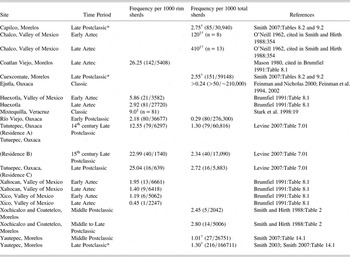
The most commonly-used method for calculating density of a particular artifact in Mesoamerica is to represent the number or frequency of a particular artifact as a percentage of overall number of ceramic rim sherds, total ceramic sherds, total ceramic artifacts, or total artifacts. By all these measures, Río Viejo has a greater density of spindle whorls than the Oaxacan site of Ejutla, but fewer than the sites of Capilco, Cuexcomate, Yautepec, Xochicalco, Coatetelco, and Coatlan Viejo in Morelos, Huexotla and Chalco in the Valley of Mexico, and Mixtequilla, Veracruz (Table 2). Some of these differences might be due to excavation conditions, collection methods, and methods of quantification (such as those figures from Coatlan Viejo and Chalco), while other differences might be explained in part by source contexts for the excavated material if, for example, only certain kinds of deposits were excavated. Many of the Río Viejo whorls were recovered from fill deposits associated with Early Postclassic period house construction and occupation debris. The contents of the fill can be reliably dated to the Early Postclassic on the basis of numerous fragments of diagnostic ceramics in the same deposits.
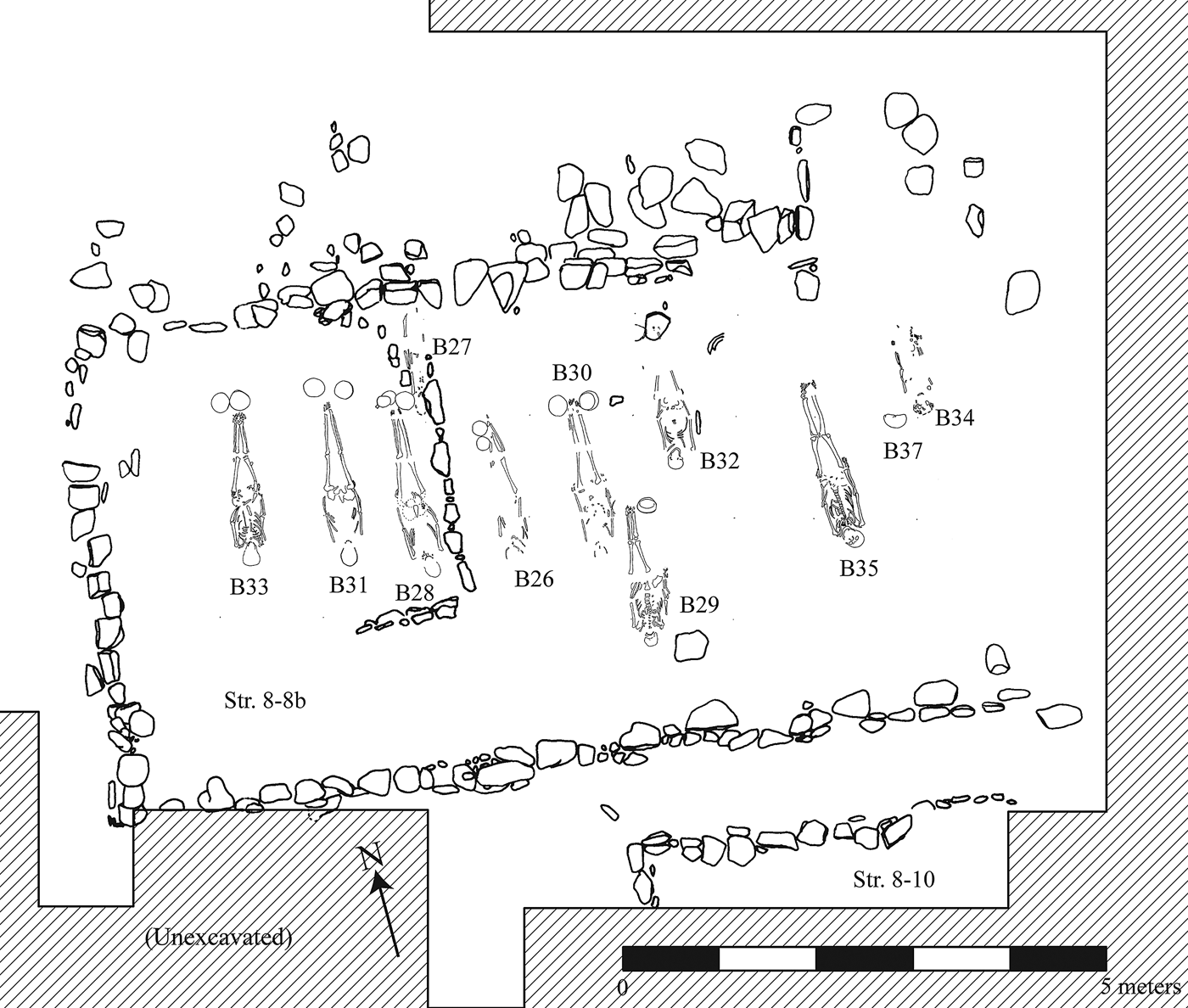
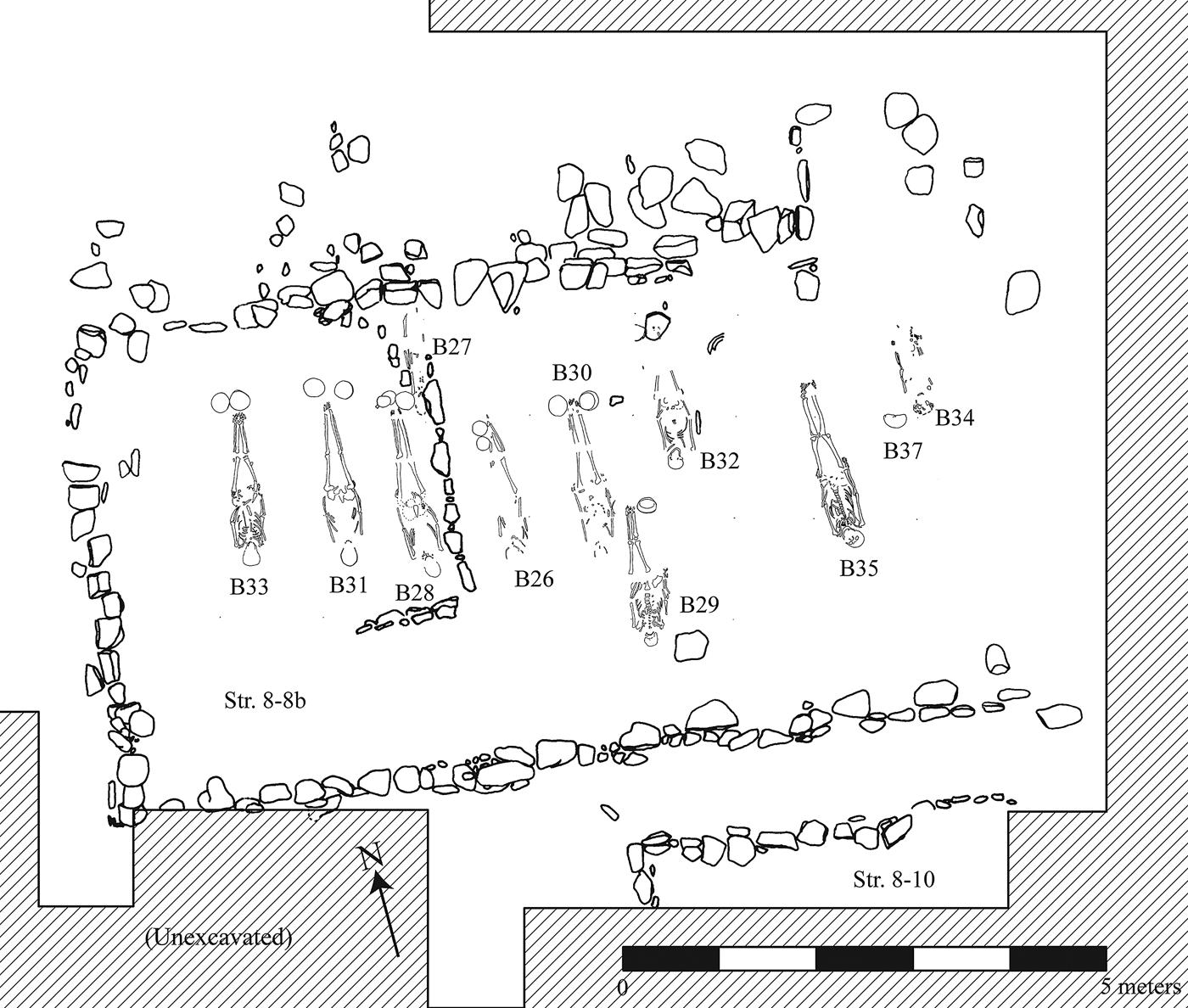
Plan of Structure 8-8, Operation B, Río Viejo, showing Early Postclassic period burials.
Selected spindle whorl density measures calculated as a percentage or frequency of whorls compared to a specified set of artifacts

*Early and Late Cuauhnahuac combined.
†Frequency per total ceramic artifacts
‡Partial or no raw numbers published.
Nichols et al. (Reference Nichols, McLaughlin and Benton2000) report over 1,700 whorl fragments recovered at the Aztec city-state of Otumba from over a decade of survey and excavation projects. This is an example of a site where fragments from shallow, plowed and trampled deposits have possibly inflated the overall count of whorls. Other survey and excavation projects have yielded far fewer. For example, the inventory of (surface collected) spindle whorls from the entire Teotihuacan Valley and Texcoco survey projects in central Mexico include less than 250 whorls each (Parsons Reference Parsons, Spence, Parsons and Parsons1972, Reference Parsons1975). For these latter projects, areal density measures could be reconstructed by dividing the total number of whorls recovered by the amount of land surveyed, but this inevitably results in extremely low numbers. For example, in the Texcoco region, researchers recovered 245 whorls across 337 km2, with a density of 0.001, or 1 whorl for every 1,375 m2. Another example is the report on the ceramic spindle whorls recovered from excavations and survey as part of the Balberta project in Pacific coastal Guatemala. Here, 59 ceramic whorls were recovered within a survey and excavation area of 26.06 km2, including examples dating from the Terminal Formative through the Late Classic periods (Arroyo Reference Arroyo, Bove, Medrano, Lou and Arroyo1993).
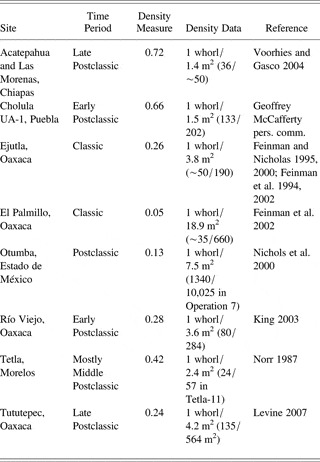
Nichols et al. (Reference Nichols, McLaughlin and Benton2000) further argue that a large 10,025 m2 area at the Aztec site of Otumba served as a maguey-fiber production workshop, one of the only fiber “workshops” described for a pre-Hispanic Mesoamerican archaeological site. In the workshop area, spindle whorl densities (from both excavations and survey) reached as high as 1 whorl/1.25 m2, with an average of 1 whorl/7.5 m2. By contrast, Río Viejo spindle whorl densities reached as high as 1 whorl/0.33 m2, with an average of 1 whorl/3.6 m2. Clearly, areal measures of density are not satisfactory for drawing comparisons between sites, since they do not account for volume, but they are necessary if we are going to try to draw comparisons with studies that include surface collected deposits. If the Otumba density figures are compared to area-based density measures for whorls found at Río Viejo, then the concentration of spindle whorls is higher at Río Viejo than it is in maguey fiber workshops at Otumba (see Table 3).
Selected spindle whorl density measures, calculated by whorls per square meter

Using an areal density measure, whorl densities at Early Postclassic Río Viejo are most similar to those of Classic period Ejutla in the Valley of Oaxaca, where the density is approximately 1 whorl/3.8 m2 (Feinman and Nicholas Reference Feinman and Nicholas1995; Feinman et al. Reference Feinman, Nicholas and Middleton1994, Reference Feinman, Nicholas and Haines2002a). Late Postclassic Tututepec follows closely behind with 1 whorl/4.2 m2 (Levine Reference Levine2007). All of these sites have higher whorl densities than Classic period El Palmillo in Oaxaca, where intensive maguey fiber processing has been proposed (Feinman et al. Reference Feinman, Nicholas and Haines2002b). Here, whorl density is roughly 1 whorl/18.9 m2 (Feinman et al. Reference Feinman, Nicholas and Haines2002a). Cholula, Puebla and Acapetahua and Las Morenas in the Soconusco region of Chiapas have yielded higher densities, at 1 whorl/1.5 and 1.4 m2, respectively.
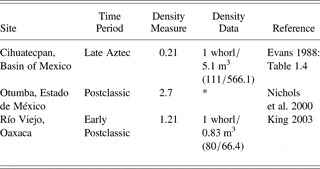
Another way to measure intensity is to calculate volumetric density measures, expressed as the number of whorls per cubic meter of excavated sediment. A volumetric measure is the best way to express the frequency of whorls relative to a measured amount of excavated site deposits, and produce a number that can then be compared across sites. There are two problems, however, with volumetric measures. First, volumetric measures lump all depositional contexts that have been excavated at a given site and could give problematic results based on the types of deposits excavated (for example, when one archaeologist excavates only middens or deep contexts and another focuses on high-traffic zones or lighter debris features). In this way, volumetric densities perhaps say more about depositional processes than they do about the density or intensity of any particular activity. But at the same time, volumetric measures are the only way to produce a cross-culturally valid measure of density since the measure will not, for instance, be problematically affected by differential use of ceramics or other kinds of artifacts between two different sites. More problematic is that many archaeologists do not record, measure, or publish volumes of excavated deposits, and instead report the total square meters excavated and (sometimes) raw artifact numbers. Río Viejo can only be compared to two other sites based on volumetric density measures; Otumba and Cihuatecpan, both Aztec period sites in the Basin of Mexico (Evans Reference Evans and Evans1988; Nichols et al. Reference Nichols, McLaughlin and Benton2000). Of these, Río Viejo has a greater density of whorls than Cihuatecpan, but falls short of the density at Otumba, although here again we confront the issue of how whorls and whorls fragments were counted (Table 4). Volumetric density measures are clearly a better method to use for cross-site comparison, but until reporting practices change, we have too little comparative data to draw conclusions. If we want to try to assess the intensity of any given productive activity, we are certainly going to have to do a better job of standardizing the way that we report and publish data, and we must include raw numbers and volumetric sediment measures in our presentation of data.
Selected spindle whorl density measures, calculated volumetrically

*No raw numbers published.
These data clearly demonstrate that fiber production increased from the Early Postclassic to the Late Postclassic periods in coastal Oaxaca. The coastal Oaxacan and the central Mexican highlands had similarly intensive cotton-spinning industries during the Late Postclassic. All of the measures of spindle whorls at Río Viejo imply a significant level of thread production in coastal Oaxaca during the Early Postclassic. Although at the lower end, Río Viejo fits well with other studies where intensive thread production for local use and for export has been proposed. It is not unreasonable, therefore, to argue that the level of thread production at Río Viejo would have been more than adequate to meet basic needs of the local household and community. These numbers demonstrate that Río Viejo residents, like those in Cholula, the Valley of Mexico, and highland Oaxaca, were producing enough thread to supply their own needs but also to generate some amount of surplus for export. The evidence from coastal Tututepec a few centuries later suggests that the thread spinning activities at Río Viejo may have laid a strong foundation for the continuation of cotton thread production during subsequent regimes.
Río Viejo did not have specialized fiber production workshops. Given the overwhelming evidence of residential occupation and a wide range of productive activities, it is more likely that cotton thread production was interspersed with other household activities. Because the Río Viejo whorls were recovered in accumulated occupation debris and fill contexts, we cannot analyze distributional differences across the area as an indicator of specific activity areas. Whorls were deposited on occupation surfaces and in occupation debris. Later, some of the debris-filled sediment was re-used for platform fill during episodes of building construction or renovation, which can be reliably dated to the Early Postclassic. The presence of high numbers of whorls across all of the excavated deposits suggests that cotton fiber production was an important household industry and a common Early Postclassic activity.
SCALE OF CLOTH PRODUCTION
Most authors agree that spinning was an activity completed in household settings since spindle whorls, like ceramic vessels fragments, are most often found across residential areas, in fill contexts, household middens, or eroding on the surface. This conclusion is usually based on archaeological evidence of low numbers of whorls dispersed relatively evenly across habitation sites or in household middens, as well as analogies to documented Late Postclassic and Colonial period cotton fiber production as a small-scale household industry (Anawalt Reference Anawalt1981; Berdan Reference Berdan1987; Hicks Reference Hicks, Hodge and Smith1994). At Río Viejo, since whorls were distributed relatively evenly across the excavated area in Early Postclassic architectural fill, occupation debris, and midden contexts, along with other household debris, I would suggest a similar interpretation.
In ethnographic studies of modern weavers, spinning and weaving are activities that are worked on sporadically, as time permits, rather than in long blocks of time (Hicks Reference Hicks, Hodge and Smith1994; Klein Reference Klein1997; Parsons and Parsons Reference Parsons and Parsons1990). Most of these studies focus on weaving and not spinning, but nonetheless demonstrate the difficulty in assessing production time, especially considering other factors such as the skill of the weaver, the quality of cloth produced, the kind of raw material, and number of cloth producers. On the other hand, these sources also suggest that ancient weavers would have been able to meet household needs relatively easily while still producing surplus for market purposes.
Since cloth production is labor intensive and was, according to ethnohistoric sources, often the task of women (and girls), inviting more than one adult female into the household was often an effective strategy to meet increased tribute obligations (Berdan Reference Berdan1987; Brumfiel Reference Brumfiel1996b, Reference Brumfiel1997; Cabrera Reference Cabrera1998; Nichols et al. Reference Nichols, McLaughlin and Benton2000; Stark et al. Reference Stark, Heller and Ohnersorgen1998). In colonial Mixteca Alta communities, nobles often appropriated women's textile production by tying commoner women to elite households through service (Terraciano Reference Terraciano2001:241). At Río Viejo, where status levels were muted, if not absent (King Reference King2003), we would not expect to find this kind of labor service. A nearly two-century time frame also makes calculations problematic. Parsons and Parsons (Reference Parsons and Parsons1990:314–315), in an ethnographic study of maguey fiber production, found that maguey fiber weavers used a collection of 2–5 whorls each, some of which were heirloom objects that had been passed down from mother to daughter. The frequency of whorls at Early Postclassic Río Viejo, even if it is adjusted to account for multi-generation (approximately 200 year) occupation, demonstrates that residents were heavily involved in cloth production.
Nearly all of the Río Viejo whorls were found intact and complete, and the 34 (or 40%) that suffered minor chips to the surface probably did so as a result of post-depositional processes. Use wear was visible on the Río Viejo whorls along the interior walls of the perforation, which would have worn smooth during spinning. In some cases, the incised and impressed designs on the exterior surface were also partially or completely eroded, however it is unclear whether the erosion is best explained (in whole or in part) by use wear or by abrasion following discard. The whorls at Rio Viejo were therefore discarded while still “functional,” unlike other classes of artifacts, such as ceramic vessels and figurines. Figurines and whistles, for example, are overwhelmingly recovered in incomplete fragments; 473 of 483 (97.9%) figurines and whistles recovered in Operation B excavations were incomplete (King Reference King2003). Clearly size and structural differences between spindle whorls, figurines and other classes of artifacts can explain much of the variation in preservation. However, just as ritual reasons have been proposed to explain excessive figurine breakage (Scott Reference Scott1993), so too must we consider the degree of intact preservation of spindle whorls as not just a matter of physics but as potentially culturally significant. The accumulation of numerous complete whorls in trash deposits and generic occupation debris, some of which were later redeposited in construction fill, implies that whorl supplies were relatively easy to replenish. Indeed, community members locally manufactured a wide variety of small ceramic items, including whorls, using similar pastes and technology.
McCafferty and McCafferty (Reference McCafferty and McCafferty2000) offer two possible explanations for the prevalence of complete whorls at Cholula. First, based on the Florentine Codex, spindle whorls may have been ritually burned and discarded at the time of the owner's death (Sahagún Reference Sahagún and Anderson;1950–1982:Volume 2). Second, spun thread may have been stored on spindles (with their whorls) as bobbins and later discarded when the thread was used. However, Parsons and Parsons' (1990) information about the use of heirloom whorls directly contradicts both possibilities, suggesting that whorls were sometimes passed down, curated, and presumably used by weavers across multiple generations. One would also then expect the thread to have been woven locally, but we have far less evidence for this stage of production. Río Viejo whorls were also used and discarded before breakage without apparent interest in formal curation, as one might more easily conclude if spindle whorls were imported or deposited in special offerings. This might suggest that Río Viejo whorls did not have the symbolic and economic value that they seem to have had in other parts of pre-Hispanic Mesoamerica where spindle whorls themselves were traded across long distances (Berdan Reference Berdan1987:247; Parsons Reference Parsons, Spence, Parsons and Parsons1972). The absence of spindle whorls in primary deposits at Río Viejo might mean that whorls were more ritually charged through use (in everyday practice) rather than as objects in mortuary offerings or as heirloom pieces.
Thread production at Río Viejo was completed at the scale of household-level, part-time specialization. We have no evidence of internal social differentiation to suggest that thread producers were introduced to Río Viejo to serve as full-time specialists or that Río Viejo itself was a specialized thread production center. Instead, the production of cotton thread was one of many tasks completed within and around Early Postclassic residences. Residents may have specifically chosen to focus on thread production activities in response to an active Early Postclassic local and long-distance demand for their goods.
CLOTH PRODUCTION AND THE SOCIAL FABRIC
Fiber processing and thread production, as a craft activity, had both social and economic meaning. Hendon (Reference Hendon2006) argues that discussions about intensity of cloth production activities need to consider that technological practices have more meaning than simply generating items to exchange. Cloth production should be viewed as a body of knowledge, a set of skills, ideas, techniques, and meanings, which in turn shapes people's understanding of the world around them. The acts of clothing and adornment are socially embedded and carry multivalent social meanings. The production of cloth requires a set of skills that members of a community would have learned and mastered at a young age, and each person would have learned the rules governing the correct use of cloth and the subtle nuances marking shifting social meanings (Hendon Reference Hendon2006). Particular designs, fabrics, embellishments, colors, patterns, and threads were all likely linked to changing identities and culturally specific systems of value. Cloth therefore is a key material component in how people interacted with the world around them and presented themselves as social beings (King Reference King2003). People at Río Viejo not only dedicated a significant amount of time and energy to spinning thread that could be made into cloth, but also produced large quantities of items related to bodily adornment, such as pendants, bells, jewelry, and rattles. These items emphasize the social nature of technological practices, as these too would have been produced, distributed, used, and worn on the body in various ways by different people in household settings, bringing together the technological, social, and the sensual in an intimate, material way. Many of the ceramic and stone costume ornaments and jewelry items could have been affixed directly to woven cloth to provide decorative and socially meaningful embellishment to items of clothing, which is evidenced in the depictions of clothing and ornaments on numerous excavated Early Postclassic clay figurines.
The production of thread and the distribution of cloth can also be connected to the establishment and maintenance of social ties between members of the household, where the acts of feeding and clothing create ties between individual households and the larger community, as evidenced in a modern Mixtec community described by Monaghan (Reference Monaghan1995, Reference Monaghan1996). Woven cloth was symbolically important for the social information the designs and styles carried. The designs, patterns, fabric, and ornamentation of clothing often conveyed important social information relating to status, rank, household membership, and community affiliation (Anawalt Reference Anawalt1980, Reference Anawalt1981). This symbolism contributed to cloth becoming such a highly-prized luxury item for Mesoamerican elites (Anawalt Reference Anawalt1980; Brumfiel Reference Brumfiel, Brumfiel and Earle1987; Hicks Reference Hicks, Hodge and Smith1994). Producers at all stages of production thus played important roles in the political arena of Late Postclassic and early Colonial period Mesoamerica (Brumfiel Reference Brumfiel, Gero and Conkey1991, Reference Brumfiel1996b, Reference Brumfiel1997; McCafferty and McCafferty Reference McCafferty and McCafferty2000).
Rich documentary evidence from pre-Hispanic and colonial Mesoamerica shows that women were the primary cloth producers (Anawalt Reference Anawalt1980, Reference Anawalt1981; Berdan Reference Berdan1987; Brumfiel Reference Brumfiel, Gero and Conkey1991, Reference Brumfiel1997; Burkhart Reference Burkhart, Schroeder, Wood and Haskett1997; Hendon Reference Hendon, Claassen and Joyce1997; Hicks Reference Hicks, Hodge and Smith1994). Spinning and weaving were symbolically associated with female gender identity and the house in Mesoamerica, especially for the Aztec (Brumfiel Reference Brumfiel, Gero and Conkey1991, Reference Brumfiel and Wright1996a, Reference Brumfiel2006; Joyce Reference Joyce1993, Reference Joyce2000b; McCafferty and McCafferty Reference McCafferty, McCafferty, Schevill, Berlo and Dwyer1991). Other strong examples are based on Oaxacan sources (Hamann Reference Hamann, Claassen and Joyce1997; McCafferty and McCafferty Reference McCafferty, McCafferty, Schevill, Berlo and Dwyer1991, Reference McCafferty and McCafferty1994; Terraciano Reference Terraciano2001). As producers of highly-marketable and desired cloth and cotton products, women would have held key positions of power in pre-Hispanic households (Brumfiel Reference Brumfiel1997; Hamann Reference Hamann, Claassen and Joyce1997; Joyce Reference Joyce2000a; McCafferty and McCafferty Reference McCafferty and McCafferty1988). Colonial period Mixteca Alta provides an excellent ethnohistoric example, where female leaders from the noble class were successful managers of cloth production activities in the community of Yolomecatl (Terraciano Reference Terraciano2001:135).
For Postclassic Mexico, and the Aztec especially, the abundant iconographic imagery and written codices support the interpretation that an identity-related distinction was made between adult males and females, with males associated with images and material culture of warfare and agriculture, and females associated with spinning, weaving, cooking, and child-rearing (Brumfiel Reference Brumfiel, Gero and Conkey1991; Joyce Reference Joyce1993, Reference Joyce2000b:477; Klein Reference Klein and Trexler1994; McCafferty and McCafferty Reference McCafferty, McCafferty, Schevill, Berlo and Dwyer1991, Reference McCafferty, McCafferty, Ardren and Hutson2006). However, whether people of Postclassic Mexico actually experienced a distinction between male and female gender identities and gender roles on a daily basis, or whether the producers of public media merely represented and promoted this dichotomy to no effect is unknown (Hamann Reference Hamann, Claassen and Joyce1997:172; Joyce Reference Joyce2000a:184–187). The association of males and females with specific tasks could imply that a gendered division of labor was in place in Postclassic Mexico, but we must also recognize that divisions of labor change through time, from context to context, and throughout the lives of specific individuals (Brumfiel Reference Brumfiel2006; Mills Reference Mills and Crown2000), such that none of these associations can be taken as absolute and unchanging. Further, even if women may have been the ones to spin thread and/or weave cloth, it does not necessarily mean that they were the sole producers since all members of a household or neighborhood probably participated in some stage of production, from cultivating the cotton to distributing the finished cloth, either at home or at the market (Wright Reference Wright1994). Hendon (Reference Hendon2006:368) makes a particularly eloquent argument about how cloth production was “embedded” or integrated with other tasks and events, such that the entire household would have helped or participated in the various tasks related to cloth production.
Sometimes women's and men's roles in Postclassic Mesoamerica were promoted as complementary, parallel, and even similar, rather than different and hierarchically valued (Burkhart Reference Burkhart, Schroeder, Wood and Haskett1997; Kellogg Reference Kellogg1995, Reference Kellogg, Schroeder, Wood and Haskett1997:127; McCafferty and McCafferty Reference McCafferty and McCafferty1988). For example, the varied interpretations of the iconography of the Late Classic Oaxacan carved stone “genealogical registers” show that they either trace genealogical connections through both male and female lines (Marcus Reference Marcus, Flannery and Marcus1983, Reference Marcus, Diehl and Berlo1989:205–206) or that they depict a male and female protagonist—perhaps a married couple—seated across from one another actively presenting offerings to conjure ancestors (Urcid Reference Urcid2005:126). Mixtec codices and Aztec documents record numerous marital alliances in Postclassic Mexico that opportunistically emphasize both maternal and paternal genealogical connections to establish or reinforce elite heritage (Gillespie Reference Gillespie1989; McCafferty and McCafferty Reference McCafferty and McCafferty1988; Spores Reference Spores1974; Terraciano Reference Terraciano2001). Similarly, the stone carving of two faces, one male and one female, above the entrance to Tomb 2 at Lambityeco in highland Oaxaca, effectively draws a parallelism and structural similarity between the two entombed people (Paddock et al. Reference Paddock, Mogor and Lind1968). In the Oaxaca barrio at Teotihuacan, both women and men garnered independent and equally rich burial offerings, suggesting that men and women enjoyed equal status (Spence Reference Spence and Plunket2002). Parallelism and complementarities in male and female images are also common in Mixtec codices (Hamann Reference Hamann, Claassen and Joyce1997:171; Terraciano Reference Terraciano2001).
On the coast of Oaxaca, the Late Classic period carved stone stelae, commonly depicting presumably male persons, shift to standing sculptures during the Early Postclassic; at least one identified as female, based on clothing and exposed breasts (Joyce et al. Reference Joyce, Bustamante and Levine2001a; Urcid and Joyce Reference Urcid and Joyce1999). Joyce and colleagues (2001a:373) suggest that the inclusion of female figures in Early Postclassic stone sculpture may reflect a gender ideology that allowed women greater social power. If this is true, the social power of women could possibly be linked to women's role in thread production, especially given that spinning was a new and highly important economic activity of the coastal Oaxacan Early Postclassic period. However, to argue convincingly that the women of Río Viejo had access to greater social power, we must first be able to understand the arenas of social power for both men and women prior to the Early Postclassic, and thereafter assess the possibility of change. To date, we have little comparative data from excavated Classic period contexts to draw these conclusions, apart from the carved stones themselves. Further, gender difference might not always correlate or correspond to a difference in power (Gilchrist Reference Gilchrist1999:52; James Reference James1997:218–219). Nonetheless, the possibility that women may have had key social and political roles in Early Postclassic coastal Oaxaca is tantalizing.
Mortuary ritual at Río Viejo provides an alternative, though not unproblematic, way to assess gender difference at Río Viejo, especially since burials were the only primary deposits uncovered in the Operation B residences produced by intentional in situ cultural activities. Burial offerings and the differential treatment of males and females allow for an examination of the intersection between economic activities, social categories, and ritual practice and their relation to gender, as long as an unexamined direct mapping between biological sex and the cultural experience of gender is not assumed (Geller Reference Geller2005; Gilchrist Reference Gilchrist1999:76; Meskell Reference Meskell1999; Moore Reference Moore and Moore1999; Sørenson Reference Sørenson2000).
The relative frequency of spindle whorls as burial offerings across Early Postclassic period Mesoamerica is difficult to quantify. Grave offerings are presented unsystematically in various publications and field reports, requiring tremendous work and interpretation to assess and make generalizations. Some examples, however, deserve mention. A recent study of burials at the Late Classic Maya site of Caracol reports that spindle whorls were found in graves of high status women and multiple graves that included a male and female, but were never recovered from graves of high status males buried alone (Chase et al. Reference Chase, Chase, Zorn and Teeter2008:136). On the basis of this differentiation, the authors conclude that spinning was associated with elite female gender identities. In Early Postclassic Cholula in central Mexico, spindle whorls were found with both men and women as burial offerings (McCafferty and McCafferty Reference McCafferty, McCafferty, Ardren and Hutson2006:38). In Oaxaca, the inclusion of highly decorative versions of cloth production tools with the principal high status occupant of Tomb 7 at Late Postclassic Monte Alban make an undeniable reference to spinning as symbolically important (Hamann Reference Hamann, Claassen and Joyce1997; McCafferty and McCafferty Reference McCafferty and McCafferty1994, Reference McCafferty, McCafferty and Nelson2003).Footnote 1
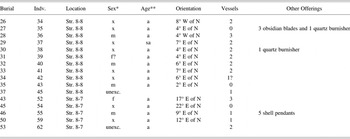
The burial offerings found at Río Viejo show that the association between women and spinning is not expressed explicitly in mortuary contexts (Table 5). Of the 16 individuals buried underneath house floors at Early Postclassic Río Viejo, both adult males and females are represented, and all were buried in nearly identical positions, in similar contexts, with similar offerings (King Reference King, Ardren and Hutson2006) (Figure 11). The most common offerings were ceramic vessels placed around the feet of the individual. Some of these vessels were “used” prior to placement in the burials, including a few molcajetes with abraded interior bases and one tripod vessel whose supports had broken off at some point well before interment. Phytolith analysis of a scraping from the interior surface of one of these vessels showed that it had once contained a maize-based food, either during an earlier use or as a food-based offering to accompany the deceased on its journey (King Reference King2003).
Mortuary data for the Early Postclassic burials found in Operation B, Río Viejo

*x = indeterminate, m= male, f = female, unexc. = unexcavated
**a = adult, sa = subadult
In spite of the high number of spindle whorls found in Operation B excavations, none were placed in burials of any kind as offerings. I argue that the lack of whorls with all deceased individuals at Río Viejo may perhaps show that adult gender identities were not partitioned and that gender identities were not strongly linked to spinning. At the same time, for all earlier time periods on the coast of Oaxaca, variation in burial offerings based on differentially-sexed individuals produces no statistically significant differences (King Reference King, Ardren and Hutson2006). Hendon (Reference Hendon2006) has recently suggested that in ancient Mesoamerica in general it is uncommon for burial offerings to contain tools that people would have used during life, but there are also clear examples from Mesoamerica where these kinds of offerings do occur (e.g., McCafferty and McCafferty Reference McCafferty, McCafferty, Ardren and Hutson2006:31). In two burials at Río Viejo, quartz burnishing stones that exhibit extensive polish from use-wear were placed as burial offerings in two separate burials. The presence of these burnishing stones shows that at least one kind of technology—in this case ceramic production—was worthy of acknowledgement in burial, yet spinning was not similarly referenced. Although we might never know the reasons why these specific tools were included, it is nonetheless important and noteworthy that ceramic production was marked while spinning was not.
I have argued elsewhere that during the Early Postclassic, the people of Río Viejo chose to emphasize the similarity between males and females in mortuary practices and grave offerings, rather than emphasize gender difference or complementarity (King Reference King, Ardren and Hutson2006). This could have two meanings with regard to thread production. First, both spinning and gender difference might not have had strong symbolic associations that warranted expression in mortuary ritual (Kamp Reference Kamp2001:7; Pearson Reference Pearson and Hodder1982). Additional support for this possibility comes from the observation that, in spite of the clear commitment to bodily adornment and costume decoration evident in both the artifact assemblage and in figurine imagery, few such items were actually placed in burials. So, while gender differentiation seems evident in other contexts, it is not expressed in burial. The second possibility is that the lack of differentiation and marking in burials might on the other hand show that women were not socially and/or symbolically linked to spinning at Río Viejo. Apart from ethnohistoric accounts and elite Late Postclassic iconography, no clear evidence exists to link women specifically to thread production in Early Postclassic coastal Oaxaca. This is not to deny that women may have had key roles in the production of thread, but that material evidence of this connection is difficult to find. While we might be tempted to argue that the balance of the ethnohistoric evidence would still nonetheless link women and thread production, the Río Viejo data might also signal that there were regional differences in the way that thread production was organized. Thread and finished cloth might have held different meanings for different communities and peoples in ancient Mesoamerica (Brumfiel Reference Brumfiel2006). Variation in meaning and practice is something that we should expect to find across both space and time, and the Río Viejo data show that these social differences might be detectable, even in locales where intensive thread production is proposed.
CONCLUSION
Thread production was an important economic activity at Early Postclassic Río Viejo. Based on the density of spinning paraphernalia and volumetric measures of Early Postclassic deposits as compared to similar measures from other Mesoamerican sites argued to be thread production loci, the spinning activities at Río Viejo were likely intensive part-time household-based industries.
Dimensions of the 86 spindle whorls indicate that the whorls were used for spinning cotton thread (Parsons Reference Parsons, Spence, Parsons and Parsons1972). The whorls from Río Viejo are tightly clustered in all significant size and weight dimensions, suggesting that the whorls were made specifically to produce a cotton thread of similar quality and kind. The Río Viejo whorls differ from contemporaneous Early Postclassic spindle whorls—such as those recorded in Cholula, Puebla (McCafferty and McCafferty Reference McCafferty and McCafferty2000) and Tetla, Morelos (Norr Reference Norr and Grove1987)—in both shape and design. Río Viejo whorls are most similar to the whorls excavated at Late Postclassic coastal Tututepec (Levine Reference Levine2007) and modern whorls described by McCafferty and McCafferty (Reference McCafferty and McCafferty2000) from the coastal community of Jamiltepec, Oaxaca, which are used to spin brown and white cotton thread. The narrow range of whorl variation and the unique sizes of coastal Oaxacan whorls show that Río Viejo residents produced a kind of thread that was different from that available in highland thread producing communities, and may have contributed to increasing the value of the coastal thread outside the local region.
The frequency and density of whorls at Río Viejo is higher than numerous other pre-Hispanic Mesoamerican sites from both coastal and highland regions where thread (and cloth) production is argued to have been at a level beyond the needs of the producing household or community. The frequency and denisty measures are most similar to those of Classic period Ejutla and Postclassic Tututepec, Oaxaca, and aligns well with other proposed thread-producing communities in central Mexico (including Cholula, Otumba, and various sites in Morelos). These data suggest that Río Viejo residents produced thread for their own use and for export. After meeting local needs, the thread produced by residents was likely taken to regional markets and/or traded over long distances in exchange for highland goods, probably via the Mixteca Alta. Spun thread and possibly raw cotton provided a solid source of income for coastal Oaxacan communities (in terms of providing surplus exchangeable product) and paved the way for more expanded interregional interaction during the Late Postclassic and beyond. Intensive household-scale thread production ensured Río Viejo residents a source of capital for acquiring desired highland goods and allowed all community members some degree of economic security.
I have argued that thread production was both economically and socially important to residents of Early Postclassic Río Viejo. Thread production may have helped to create and cement the bonds between members of the household, not only through the way that thread production was organized in household settings, but as one of many social practices focused on costume decoration and bodily adornment. Thread production in coastal Oaxaca did not have a symbolic association with women that is archaeologically marked, and instead, at least in mortuary ritual, gender identities were purposefully muted to emphasize a shared adult group identity. This suggests that perhaps the linkage between adult female gender identities and spinning thread attested in elite Postclassic Mesoamerican iconography might not have been as relevant to everyday life at Río Viejo, or at least is not readily apparent from the evidence that has so far been recovered. For this reason, I conclude that it is safer to argue that in coastal Oaxaca, thread production gave the community as a whole a relative amount of social and economic power and a unique voice in the greater Mesoamerican world.
In coastal Oaxaca specifically, thread production elevated coastal residents as important producers in a growing Postclassic world economy focused on cloth production. While during the Early Postclassic this seems to have given coastal residents relatively secure and easy access to highland goods, it also ultimately placed them in a vulnerable position with the growth of increasingly violent Mixtec and Aztec regimes during the Late Postclassic period.
RESUMEN
Excavaciones en el sitio de Río Viejo en la costa da Oaxaca, México, han revelado evidencias de una producción intensiva de hilo de algodón durante el posclásico temprano (975–1220 d.C.). Grandes cantidades de malacates fueron encontrados adentro y alrededor de casas en Río Viejo, indicando que la producción de hilo fue entremezclado con otras actividades domésticas y fue una industria productiva para uso local y de exportación. Mediciones tomadas de los malacates demuestran que el hilo producido en Río Viejo era único en comparación a otros sitios de la zona costera y el altiplano de Oaxaca y a otros sitios mesoamericanos en general. Sugiero que esta singularidad puede parcialmente estar resultado de la variedad especifica de cotón que ellos estuvieron utilizando, pero también puede reflejar una demanda interregional para su hilo. Utilizo diversos métodos para calcular la intensidad en las actividades de hilar en Río Viejo y de esta manera comparo los resultados con aquéllos obtenidos en sitios donde se ha propuesto una producción intensiva de hilos. En esta sección, trato los problemas inherentes a esas mediciones y propongo más estandarización en la colección y presentación de esos datos, preferiblemente con mediciones de densidad volumétrica. Por último, utilizo datos mortuorios y varias líneas de evidencia para retomar la relación, documentada etnohistóricamente, entre la mujer y la producción textil. En la zona costera de Oaxaca, la producción de hilo no estaba necesariamente fuertemente vinculada a identidades basadas en género en una manera que se puede ver arqueológicamente. En cambio, los miembros adultos de unidades domésticas señalaban materialmente su adscripción común al grupo social al que pertenecían sin referencia a identidades basadas en género. La producción de hilo fue una práctica compartida entre el grupo entero que involucraron varias artesanías (incluyendo mujeres), y ayudó a crear y cementar vínculos sociales entre los residentes. Simultáneamente, la producción de hilo proveyó los residentes del posclásico temprano con acceso seguro y a los recursos del altiplano, estableciendo una base para una industria de producción de hilo más desarrollada en el posclásico tardío.
ACKNOWLEDGMENTS
This paper is a revised version of a paper presented at the 2004 Society for American Archaeology meetings in a session titled “Textiles in Ancient Mesoamerica,” organized by Billie Follensbee and Geoffrey McCafferty. I thank them and other session participants for their stimulating ideas and discussion. The excavations at Río Viejo were generously supported by the Foundation for the Advancement of Mesoamerican Studies, Inc. Grant #99012 (with Arthur Joyce); the Stahl Endowment of the Archaeological Research Facility, University of California, Berkeley; the Lowie-Olson Fund of the Department of Anthropology, University of California, Berkeley; and National Science Foundation grant to Arthur Joyce (#99012) A National Science Foundation Doctoral Dissertation Improvement Grant (#0122226) and an Indiana University Summer Faculty Fellowship funded most of the laboratory analysis. Textile production is a topic addressed in my dissertation (King Reference King2003), and as such, this article has also benefited from the comments and suggestions provided by committee members Rosemary Joyce, Christine Hastorf, and Harvey Doner. Elizabeth Brumfiel and Laura Scheiber provided comments on earlier versions of this paper and Michael Smith kindly provided pre-publication whorl frequency data—I thank them for their generosity. Robert Markens, Cira Martínez López, and Alfredo Minetti kindly helped with the translation of the abstract into Spanish. I also thank various reviewers who have provided detailed comments on earlier drafts of this article, which significantly improved the final result. Any errors contained within are my own.
Spindle whorl raw data from Río Viejo Operation B

*Paste: cb = coarse brown, co = coarse orange, fb = fine brown, fo = fine orange, go = gray orange, gr = gray, un = unidentified
†Shape: gb = globular, ff = flat on both sides, fr = no rim on top, larger flat rim on bottom, rf = rim on narrower end, flat on other, rr = rim on both ends, sm = semispherical, sp = spherical, sr = semispherical with rim, gr = globular with rim, tp = trapezoidal, in = insufficient
‡Hole type: cc = conical on both sides (pierced from both sides and narrower in center), cn = conical (larger on one side, narrower on other), cy = cylindrical and even all the way through