Introduction
To a large extent, consumer preferences are driving the interest in local and regional food systems. Today's consumer wants to know the source of their food, seeks transparency regarding production and wants to eat healthier foods. Local and regional food systems are uniquely poised to fill this emerging market, as they are built on many of these same tenets. In addition to providing consumers with the type of food they desire, local and regional food systems contain opportunities for small- and medium-sized farms (Feenstra and Hardesty, Reference Feenstra and Hardesty2016; Knigge et al., Reference Knigge, Brimlow, Metcalf, Gatrell, Jensen, Patterson and Hoalst-Pullen2016). The popular view of local and regional foods centers on direct-to-consumer sales, most often through farmers markets, community supported agriculture, farm stands and other direct-to-consumer outlets. A different marketing possibility, the ‘intermediated market channel,’ has emerged along with growth in consumer demand for locally and regionally produced foods, defined by USDA as sales made direct to restaurants, institutions or to regional food aggregators (Low et al., Reference Low2015). Expansion of intermediated market channels may prove beneficial for small- and medium-sized farms, by facilitating access to the growing market for local foods.
Intermediated market channels link farms with consumers, who make their purchases in locally and regionally based food retail stores, schools, hospitals and other outlets. The marketing chains are generally regionally based and are shorter than the typical conventional food supply chain (Low and Vogel, Reference Low and Vogel2011). Some intermediated market channels are described as ‘Value-Based Supply Chains’ (VBSCs), which are supply chains configured with specific value-based goals, such as ensuring economic stability for producers (Feenstra and Hardesty, Reference Feenstra and Hardesty2016). The success of the intermediated market channels depends on consumer acceptance and interest in purchasing local foods outside of the farmers market. Evidence points to consumer acceptance, as local and regional food sales through intermediated channels are increasing (Richards et al., Reference Richards2017). The proportion of local food marketed through intermediated channels was 66% of local food sales in 2015 (USDA-NASS, 2016a).
Intermediated market channels are used more often by farms with annual sales above US$250,000 (Low and Vogel, Reference Low and Vogel2011). The volume produced by farms in this size category is often both too large for direct markets and too small for the conventional, national market—the classic problem of ‘agriculture of the middle’ (Kirschenmann et al., Reference Kirschenmann, Lyson, Stevenson and Welsh2008). The firms involved in intermediated channels are better able to accommodate the sales volumes and/or aggregate the production of several farms to meet the needs of their institutional or other buyer. These channels may offer opportunities for increased farm profits through an expanded market and stabilized prices (Knigge et al., Reference Knigge, Brimlow, Metcalf, Gatrell, Jensen, Patterson and Hoalst-Pullen2016).
Because intermediated markets have the potential to increase market access and the viability of local and regional farms, there has been a recent explosion in research on the topic. At the same time, federal data collection on the farm-level aspects of local and regional food systems, along with some aspects of marketing, has been greatly improved. This paper aims to examine the body of research and new data, to better understand the current state of research considering farmer use of intermediated market channels. We begin this review paper with an assessment of the intermediated market channels, based on current data, which is followed by a review of the existing literature. Finally, future research directions are set out, based on the findings of the literature review and survey data.
Data perspective of intermediated market channels
Understanding the state of agricultural marketing channels is a daunting task, partly because marketing channels vary across product types, such as grains, value-added products, fresh produce, eggs and meat. As a result, studies require both significant amounts of data and on-the-ground knowledge of the functioning of the market channels. Until recently, the paucity of data available has been a significant obstacle to the analysis of local and regional food system market channels. As the market for local food grew in size, pressure increased for data and analysis of local and regional food systems, including a congressionally requested analysis of local food systems (NSAC, 2015). New federal and other data collection efforts have made it possible, for the first time, to provide a systematic (although incomplete) view of local and regional food systems.
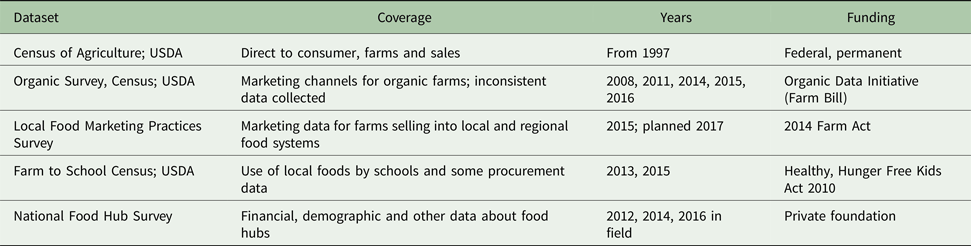
The first, albeit limited, view of the marketing channels was provided by the Census of Agriculture, which in 1997 began collecting data on the number of farms and value of sales resulting from direct marketing to consumers. Following this, the Organic Production Survey, first conducted for 2008, collected data on marketing practices of organic farms, although marketing data have not consistently been included on follow-up surveys (USDA-NASS, 2010). More recent data collection efforts have attempted to better understand the extent of farmer marketing to local and regional food systems. These new federal surveys targeting local and regional foods include USDA's Local Food Marketing Practices Survey, conducted for the first time in 2015 and USDA's Food and Nutrition Service's 2013 and 2015 Nationwide Farm to School Census of local and regional foods purchased by public school districts (USDA-NASS, 2016a,b; USDA-FNS, 2017). Finally, a privately funded survey of food hubs was conducted by Michigan State University and the Wallace Center in 2013 and 2015, covering the years 2012 and 2014, which follow an earlier Wallace Center baseline assessment of food hubs (Hardy et al., Reference Hardy2016). An examination of these five datasets provides a sense of the local and regional food systems at the farm-level and the corresponding intermediated markets (Table 1).
Available datasets covering local and regional food marketing

Farms marketing direct to consumer
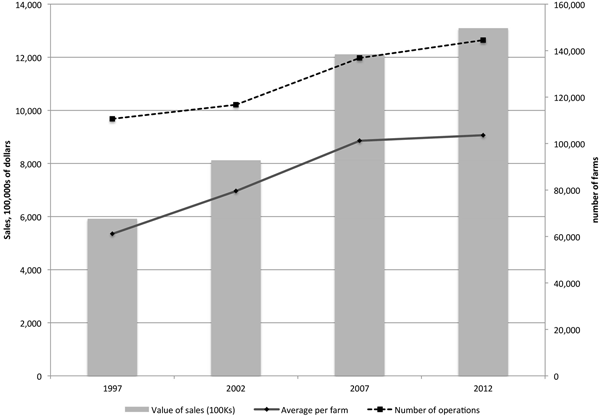
Trends in farmer use of direct-to-consumer markets can be assessed at 5-year intervals from 1997 to 2012 (see Fig. 1). All measures suggest that the use of direct-to-consumer market channels increased over this period. The number of farms marketing directly to consumers increased from approximately 111,000 to 145,000 farms over the 15-year period, although growth between 2007 and 2012 was relatively flat. Farm-level sales in 1997 of US$590 million grew to US$1.3 billion in 2012 (USDA-NASS, 2014a; USDA-NASS, 1999). Average direct-to-consumer sales per farm increased nearly 70% during this period, to approximately US$9000 (USDA-NASS, 1999; USDA-NASS, 2014a). One new piece of data was collected in the 2012 Census of Agriculture, which reported that nearly 50,000 farms marketed through intermediated channels (USDA-NASS, 2014a).

Marketing by certified organic farmers
Since at least 2002, USDA's Economic Research Service has reported that organic farmers use direct-to-consumer markets at higher rates than conventional farmers (Greene et al., Reference Greene2017). That conclusion was based on qualitative data, industry reports and anecdotal evidence since there were no official federal statistics available to describe the organic sector until 2008. Yet despite the promise of such data, inconsistencies in the data collected create challenges for analysis. While production data are available for 5 years (2008, 2011, 2014, 2015 and 2016), marketing data were excluded in 2016. In 2011 and 2015, exempt farms (those who have sales of organic products below US$5000 a year) were excluded from the data collection, while other years include both certified and exempt farms. For 2008, 2011 and 2014, both the number of operations and the percent of sales by market channel are reported. For 2015, only the number of operations is included, and for 2016, no marketing data are reported. Due to these inconsistencies, the examination of changes in market channels used by organic farmers is necessarily incomplete.
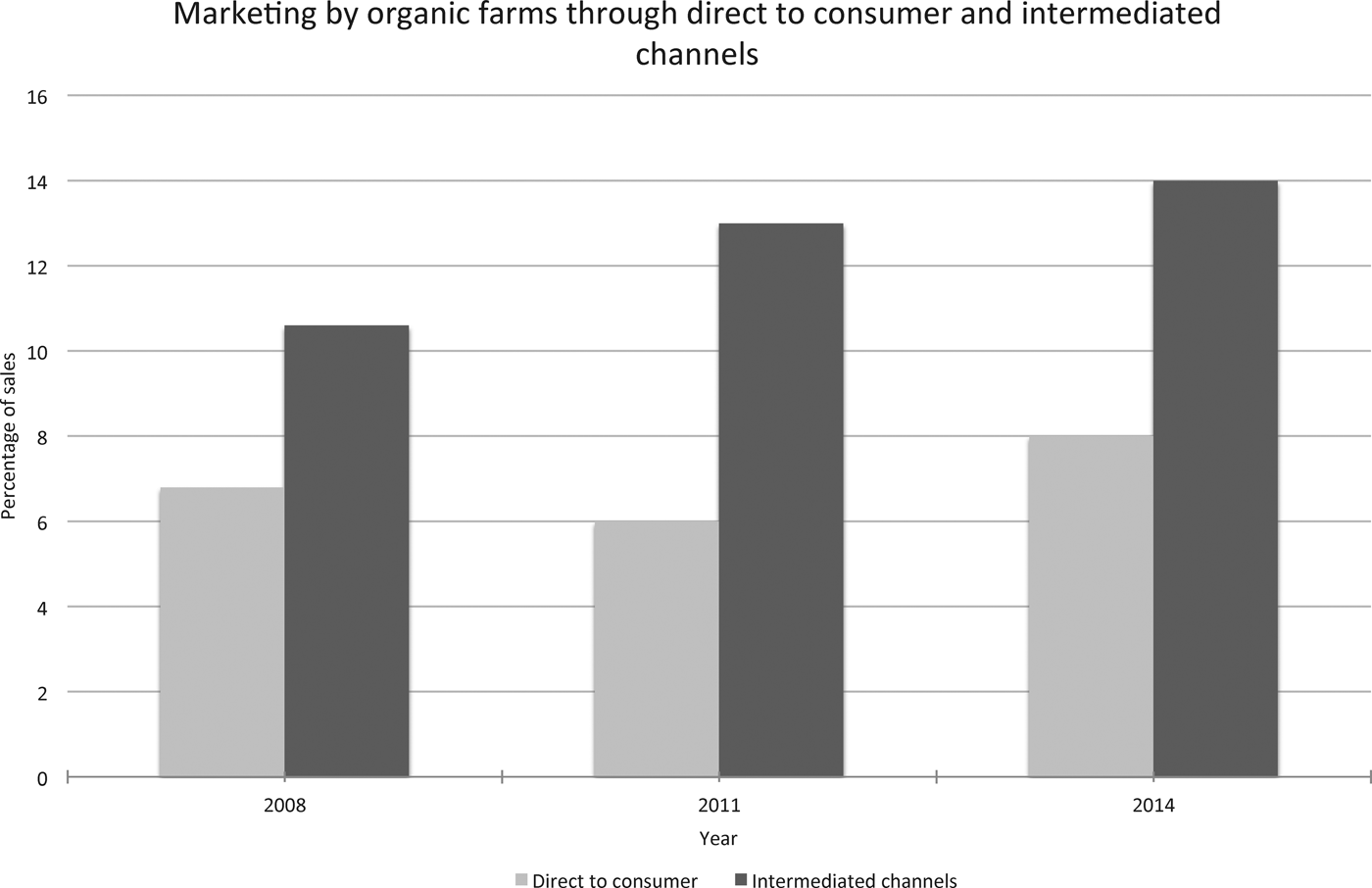
Using the partial data, the following two charts describe market channel use by certified organic farms. For consistency, the charts exclude data on exempt farms for 2008 and 2014. The first (Fig. 2) indicates that the percent of sales sold via intermediated channels increased between 2008 and 2014, while the percent of sales marketed directly to consumers fluctuates. Note that the smaller farms that meet the conditions for exempt status likely rely on direct-to-consumer sales at a higher rate than the larger certified organic (Dimitri and Greene, Reference Dimitri and Greene2000). Furthermore, the number of exempt farms may be sizable. For example, in 2014, approximately 1500 farms were organic and exempted from the certification requirement; in 2008, the exempt firms numbered roughly 3600 (USDA-NASS, 2010, 2015). Thus, the percent of sales sold directly to consumers, as shown in the following figure, likely understates the true share.

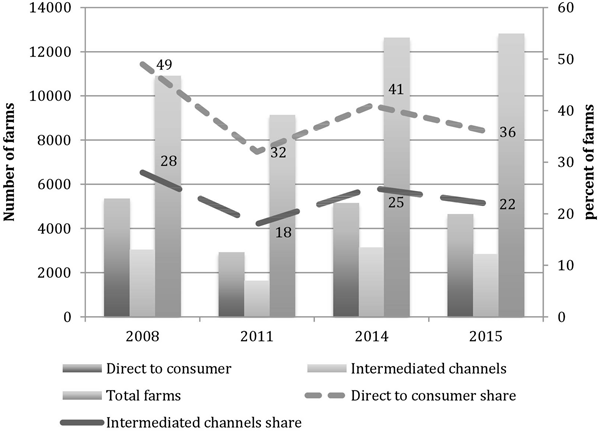
Trends in certified organic farm numbers, both total and by market channel, are displayed in Figure 3. The 2011 data show a decrease in the number of farms from 2008, which may be partially explained by the fact that data on operations producing floriculture, Christmas trees and mushrooms were collected in 2008, omitted in 2011, and then reinstated for subsequent surveys (USDA-NASS, 2012). In terms of farm numbers, the percent of farms marketing locally and regionally, including direct-to-consumer and through intermediated channels, slightly declined from 2008 to 2014. The shift in market channel usage accompanies a restructuring of the organic sector, which continued its movement from a separate, niche market to one that is now seen as an integral part of the national food system (Dimitri and Richman, Reference Dimitri and Richman2000; Dimitri and Oberholtzer, Reference Dimitri and Oberholtzer2009).

Local marketing practices of all farms
The next significant contribution to data on local and regional food systems focused on farm marketing practices. The 2014 Farm Act directed USDA to conduct a special study on the marketing of local and regional foods (USDA-ERS, 2017). The resultant data collection was implemented in 2016 when the USDA's Local Food Marketing Practices Survey collected marketing data from farmers for the year 2015. The results of the survey indicate that intermediated channel sales were valued at US$5.8 billion, which included sales made directly to retailers, intermediaries and institutions. An additional US$3 billion was marketed directly to consumers. Approximately 57,000 farms sold food into the local and regional food system through intermediaries or to institutions, and of this amount, 24,000 farms sold directly to retailers. Approximately 115,000 farms sold directly to consumers (USDA-NASS, 2016a,b). A second marketing survey is planned as a follow up to the 2017 Agricultural Census (USDA-NASS, 2016a,b).
Farm to school census examines school use of local foods
A separate federal effort examined the use of local foods in schools through the USDA Farm to School Census. Unlike the organic and local food surveys, the Farm to School Census examined the use of local and regional foods in K-12 schools rather than farm-level production and marketing. USDA's Food and Nutrition service collected data for 2015 and 2013. In 2015, private, public and charter schools were surveyed, while the 2013 data apply to public schools (USDA-FNS, 2016). The 2015 findings, which covered the 2013–14 academic year, indicate that 42% of responding school districts sponsored farm to school activities. The most common farm to school activity reported is the use of local foods in the school cafeteria. The 2015 census reports that schools purchased US$790 million of local foods in 2013–14. Approximately 40% of schools purchased directly from individual farmers, while about 60% purchased local foods through an intermediary (USDA-FNS, 2016).
Food hubs
A recent business innovation in the intermediated market channels is the ‘food hub,’ which is a business that actively markets source-identified food products (Barham et al., Reference Barham2012). Food hubs, through their aggregation and distribution activities, are poised to help small- and medium-sized farms gain access local and regional markets (Feenstra and Hardesty, Reference Feenstra and Hardesty2016). Food hubs have proliferated around the nation, with at least 547 such businesses identified in 2015 (Hardy et al., Reference Hardy2016), markedly larger than the 222 identified in 2013 (Fischer et al., Reference Fischer2013). Although they are estimates, the numbers are suggestive of growth in the number of food hubs.
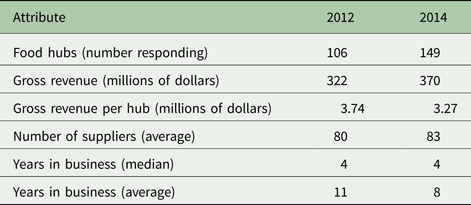
Baseline information, growth and operational characteristics of food hubs was collected by Michigan State University's Center for Regional Food Systems in 2013 and 2015, and in 2011 by the Wallace Center (Barham et al., Reference Barham2012; Fischer et al., Reference Fischer2013; Hardy et al., Reference Hardy2016). The 2011 baseline findings were not published. At the time of writing, the 2017 Food Hub Survey was out in the field. Table 2 presents select information from the 2013 and 2015 National Food Hub survey, which apply to the years 2012 and 2014. The data, despite not being representative, are illustrative of trends in food hubs. One finding is that while the number of food hubs responding in 2015 was 40% greater than in 2012, little difference in operational characteristics exists between the 2 years.
Select findings of the National Food Hub Survey

Notes: The 2105 Food Hub survey reports on 2014; the 2013 Food Hub survey reports on 2012. For gross revenues, N = 86 in 2012 and N = 113 in 2014. Sources: Fischer et al., Reference Fischer2013; Hardy et al., Reference Hardy2016.
Food hubs are a key part of intermediated markets, but they also operate as direct marketers. Direct to consumer food hubs comprised 20% of the respondents in 2014, with 28% selling to intermediated channels and 52% serving both direct and intermediated markets (Hardy et al., Reference Hardy2016). A significant finding is that food hubs remain a relatively new part of regional food systems, with about 60% of respondents reporting being in business for 5 or fewer years in 2014 (Hardy et al., Reference Hardy2016).
The importance of geography
It has long been understood that urban dwellers are an important consumer base for local and regional food systems. The Local Food Marketing survey found that the majority of farms (80%) sold their products within 100 miles of the farm's location and 67% of the sales were from farms located in metropolitan counties (USDA-NASS, 2016a,b). Other research has shown the importance of geography in terms of local and regional food system development. Farms located on the West Coast are typically located in rural settings, whereas farms in the Northeast are closer to cities. As a result, out of necessity, 85% of local food sales on the West Coast are marketed through an intermediated channel (Low and Vogel, Reference Low and Vogel2011). The 2015 Food Hub survey does not directly address urban or rural locations, but the 2013 survey indicates that approximately half of the food hubs were located in counties with populations equal to or greater than 1 million (Fischer et al., Reference Fischer2013). Counties with 100 or more farmers using intermediated market channels are concentrated in the population-dense regions of the Northeast, Mid-Atlantic and the West Coast (Low et al., Reference Low2015). Taken as a whole, research suggests that the intermediated market channels may effectively strengthen the tie between urban consumers and regional farmers.
Methodology for literature review
A search for published research addressing farmers’ use of intermediated markets relied on use of key words, such as ‘food hubs,’ ‘farm to institution,’ ‘farm to school,’ ‘intermediated market channels,’ ‘regional food systems,’ ‘local food systems,’ ‘direct to retail’ and ‘value-based food chain,’ in successive Google scholar searches provided a wide array of publications. Only studies specifically addressing farmer use of intermediated marketing strategies were included in this review. Studies that analyzed consumer utility, willingness to pay, direct-to-consumer market channels and economic benefits of intermediated market channels were excluded. Similarly, as the US market is the focus of this paper, research focusing on other countries was excluded.
The resulting 41 papers (listed in Table 3) were published in peer-reviewed journals, peer-reviewed research from USDA ERS, conference proceedings, book chapters, and reports and papers in the gray literature. Altogether, the papers examine the complete range of intermediated marketing channels: supply chains (13), food hubs (12 papers), direct to retail (eight papers) and direct to institution (eight papers). The review is organized by four themes: the difference between intermediated market channels and conventional supply chains; the potential for including social value into the supply chain; the importance of farmer prices; and challenges of fitting a new procurement ideology into the existing business models. While other organizing themes exist, these were selected for their contribution to our understanding of how new marketing models may benefit farmers.
Literature reviewed, by thematic area

The literature most often describes the shorter supply chains that make up local and regional food systems as a ‘value-based supply chain’. As such, the phrases value-based supply chain and intermediated marketing channel are used interchangeably. Technically, an intermediated market channel does not require the incorporation of values, but in practice, as shown below, most researchers and practitioners consider the inclusion of values to be a key part of the intermediated market channel.
Theme 1. Essential differences between intermediated market channels and conventional supply chains
In discussing the vision of and potential benefits of intermediated markets or value-based chains, the literature offers detail about differences between the conventional and intermediated supply chains. Although there are many, the main difference is the philosophical perspective. At the extreme, the conventional supply chain model rewards firms and farms for efficient, low-cost production, and buyers and sellers are largely indifferent toward others in the market. Independent and anonymous transactions dominate the food system. At the other extreme, the value-based supply chain considers social and environmental factors as equal in importance to economic factors. In the intermediated, value-based market, buyers consider farmers and rangers as strategic partners, not anonymous input suppliers (Stephenson et al., Reference Stephenson2011). Increases in scale are obtained not by increasing the size of an operation, but by joining the production of multiple farms and ranches (Stephenson et al., Reference Stephenson2011). Of course, in reality, extreme cases rarely exist, but the contrast is a helpful way to contextualize the new, intermediated market along with the modern food system.
Overall, there is a greater shared vision and shared responsibility among firms in the value-based chain, in comparison with the conventional food system. This requires the formation of strong, strategic partnerships, which provide benefits to all firms in the intermediated market supply chain. Scaling strategies within the Ohio regional food system are relationship-based (Clark and Inwood, Reference Clark and Inwood2016). Good relationships were identified as a key component of success in four Northeastern hubs (Severson and Schmit, Reference Severson and Schmit2015). Informal networks are used to coordinate marketing efforts (Diamond and Barham, Reference Diamond and Barham2011). Partnerships may include written agreements with integral partners such as school districts, as shown in Vermont (Conner et al., Reference Conner2011). Strategic business relationships can assist in decision-making, particularly for the farmers with low levels of business skills (Hardesty et al., Reference Hardesty2014). Relationships among the many agents participating in the farm-to-institution supply chain in Michigan were found to be as important as the farmer to consumer relationship, and as was having champion available to establish and maintain support (Buckley et al., Reference Buckley2013). An agent-based simulation model, using parameters estimated from consumers and producers associated with a food hub in Des Moines, Iowa, finds that consumer trust in producers supplying the food hub is critical to its success of the (Krejci et al., Reference Krejci2016).
Communication through the entire supply chain is also viewed as an essential part of creating successful intermediated markets (Diamond and Barham, Reference Diamond and Barham2011). In the conventional supply chain, prices, and in some cases third-party certifications, are the most important mechanism for information transmission. In intermediated market channels, product information and its values are less easily transmitted, requiring clear information exchange along the supply chain (Feenstra et al., Reference Feenstra2011). Sharing farmer stories with consumers may encourage them to buy local food, understand what they are purchasing and perhaps most importantly, pay a price premium (Feenstra et al., Reference Feenstra2011). The stories add value to the agricultural products sold through intermediaries, as they differentiate the products based on quality, locality of production, sustainability or other attributes (Berti and Mulligan, Reference Berti and Mulligan2016).
Theme 2. The potential for and challenges of incorporating social value into the food supply chain
Industry market research suggests that consumer demand for source identified food and transparency in the supply chain is ‘disrupting’ the food industry (Ringquist et al., Reference Ringquist2016). While not every intermediated marketer considers social or environmental aspects of local and regional food systems, many self-identify as part of a value-based supply chain. These associated values are diverse and include social missions such as supporting local farmers, sustainability, land preservation, labor rights, economic democracy (Berti and Mulligan, Reference Berti and Mulligan2016). The focus on values does not negate the importance of farm or intermediary profitability, but the inclusion of values means that profits are not the only or most important factor under consideration.
An advantage to the differentiated, value-based or regionalized intermediated market is the possibility of non-profit collaboration, whether through funding, staffing, business development or other forms of assistance. Non-profits may be a key figure in innovative food chain development. Conner et al. (Reference Conner2011) note that, based on a study of Vermont, for food system change to occur through one type of intermediated market channel (farm-to-school), external financial support may be necessary. Others have suggested that non-profits offer essential assistance in starting and maintaining structural change in regionalized food chains (Diamond and Barham, Reference Diamond and Barham2011). The 2015 National Food Hub survey indicates that one-third of the responding food hubs were non-profit organizations (Hardy et al., Reference Hardy2016). While all of the food hubs offered similar social missions for their organizations, the non-profit hubs were more likely to indicate goals of addressing racial disparities in food access, training their suppliers regarding business practices and increasing access to healthy food in economically disadvantaged communities, although statistical significance of these differences were not reported (Hardy et al., Reference Hardy2016). Non-profit distributors in Vermont indicate support of non-economic values, such as food security, local agriculture and seasonal eating (Conner et al., Reference Conner2014).
Operators of small- and medium-sized farms may also express value-based goals. Farmers participating in farm to the institution in Vermont find value in maintaining the integrity of local food systems, and many sell to their local schools even though it may not be profitable (Conner et al., Reference Conner2014). Socially or environmentally aware farmers are better able to meet the preference of consumers in differentiated markets since they are likely to share common values. West Virginia value-based farmers are more likely to try new farming methods or approaches to farming, although a study found these farmers were more likely to sell directly to consumers than through intermediated market channels (Farmer and Betz, Reference Farmer and Betz2016). Nonprofit food hubs in Vermont had social missions beyond the distribution of food, although the direct markets are so strong in Vermont that not all farmers see the benefit of marketing through the non-profit food hub (LeBlanc et al., Reference LeBlanc2014). The non-profit hubs had farmer involvement, with some including farmers in decision-making and devoting time to developing strategies that worked for farmers (LeBlanc et al., Reference LeBlanc2014).
Communicating the values to consumers is a key role of the value-based intermediary. Restaurants and chefs are actively engaged in such information sharing via menus and signage, while retailers may transmit information in produce displays (Feenstra and Hardesty, Reference Feenstra and Hardesty2016). Transmitting information about values throughout the supply chain is difficult to consistently implement in practice, and sharing this information can be costly in terms of time (Hardesty et al., Reference Hardesty2014). When compared with larger firms, smaller and mid-sized distributors in Ohio were better able to transmit values information, such as produced in Ohio or on a family farm, along the supply chain (Clark and Inwood, Reference Clark and Inwood2016).
Based on a study in North Carolina, implementing policies that allow stores to have a larger local orientation enable retailers to build meaningful social connections in their communities (Colloredo-Mansfeld et al., Reference Colloredo-Mansfeld2014). Even in cases when retailers do not purport to offer social value beyond the label ‘local’ on their products, they are able to earn higher margins and sell larger volumes when local foods make up an important part of their product lines (Richards et al., Reference Richards2017). However, while Richards et al., examine retail prices and margins, they do not examine prices paid for to suppliers, which is a key value of those participating in value-based supply chains. Feenstra and Hardesty (Reference Feenstra and Hardesty2016) indicate there is a need for more retailers to participate in value-based supply chains.
Theme 3. Prices, farm viability and their related challenges
A primary benefit of using intermediated channels for farmers, as identified in the literature, includes the local and regional price premiums that farmers earn. These higher prices are a key benefit of value-based supply chains, which aim to compensate farmers for values such as sustainability value or proximity to the consumer (Feenstra and Hardesty, Reference Feenstra and Hardesty2016). It is hoped that the higher prices—considered fair and equitable prices by some -contribute to enhanced farm viability for participating farmers. In the ideal version, intermediated channels offer opportunities for farmers and buyers to negotiate prices, rather than having farmers face take it or leave it prices (Stephenson et al., Reference Stephenson2011). In the same ideal world, enough consumers and increasing numbers of consumers are willing to pay higher prices.
New producers may lack the necessary business knowledge to be successful in the channels where they capture higher prices, leading some to suggest that support from more experienced producers may be necessary to increase the success of new producers (Hardesty et al., Reference Hardesty2014). Other forms of support for farm success include a tool developed by Schmit and LeRoux (Reference Schmit and LeRoux2014), which helps farmers assess their market channel options. The tool was recently tested with Colorado fruit and vegetable farmers, and new and less experienced farmers found value in the tool while experienced farmers were less interested (Christensen et al., Reference Christensen2017).
A study of the retailer-farmer supplier relationship in Hawai'i’ finds that operators of larger farms, when compared with smaller scale operations, are more likely to be satisfied with all aspects of the direct-to-retail relationship (Gupta and Jablonski, Reference Gupta and Jablonski2016). Direct to retail sales in North Carolina, however, found producers and buyers had a collaborative relationship that was also conditional; producers called retail stores when they had excess product, where they would receive roughly half their direct-to-consumer price if the retailer opted to purchase it (Dunning, Reference Dunning2016). Retailers were more likely to procure organic products directly from farmers if the store's priority was procuring from local producer or if price was not a high priority; furthermore, the number of years the store was involved in the organic sector positively influenced the probability of buying directly from farmers (Oberholtzer et al., Reference Oberholtzer, Dimitri and Jaenicke2014). In Ohio, smaller and mid-scale grocers, retailers and distributors were best positioned to purchase food raised on medium-sized farms, and larger buyers, in comparison with smaller and mid-scale buyers, reported finding price more important (Clark and Inwood, Reference Clark and Inwood2016).
Considering the supply chain as a whole, distributors, restaurants and other intermediaries have shown willingness to be flexible and innovative in purchasing food with sustainability values, despite higher prices (Feenstra et al., Reference Feenstra2011). Yet it is important to consider that, while a segment of consumers is willing to pay higher prices for differentiated products, generally speaking, consumers in the USA remain price sensitive (Feenstra and Hardesty, Reference Feenstra and Hardesty2016).
In contrast, participants in the Vermont farm-to-institution supply chain and committed to collaboration are willing to pay higher prices or accept lower profits (Conner et al., Reference Conner2014). Of the different types of institutions in Vermont, however, schools were the least able to pay higher prices for local schools, and colleges and senior meals were the least price sensitive (Becot et al., Reference Becot2014; Conner et al., Reference Conner2014). Some states, recognizing the tension created by the desire to increase local food use in schools, given the requirement to use the lowest bids and have granted public schools flexibility to pay slightly higher prices for local food (Dimitri et al., Reference Dimitri, Hanson and Oberholtzer2012). Federal policy, recognizing the challenges schools face in using local food in schools, supports serving local food in schools via The Healthy Hunger Free Kids Act of 2010 (Low et al., Reference Low2015). The Act created the Farm to School Program, housed in USDA, has a mission of increasing the use of local food in schools through grants, training and technical assistance, and research (Low et al., Reference Low2015).
Medium-sized farms may have a comparative advantage in intermediated markets as they have the capacity to produce relatively large quantities, but are small enough to be flexible in collaboration with their buyers (Stephenson et al., Reference Stephenson2011). Low and Vogel (Reference Low and Vogel2011) suggest that marketing into both direct and intermediated channels may be the optimal strategy for medium-sized farms, while large farms rely exclusively on intermediated channels and small farms use direct-to-consumer channels. Kim et al. (Reference Kim, Curtis and Yeager2014) suggest that risk-averse farmers earned expected higher profits when they diversified market channels, selling both directly and through intermediated channels. Their results are based on a simulation using Utah and Colorado farmers market prices and San Francisco terminal market prices; because they used prices from the national wholesale market, their analysis does not reflect the expected profitability of selling into intermediated markets (Kim et al., Reference Kim, Curtis and Yeager2014). Using the higher prices of intermediated market channels would likely change the optimal proportion of sales devoted to the different market channels. Taken together, the research suggests that common strategy for hedging risk among farmers is diversifying their market channels (Low and Vogel, Reference Low and Vogel2011; Stephenson et al., Reference Stephenson2011; Kim et al., Reference Kim, Curtis and Yeager2014).
While the literature is optimistic about higher and equitable prices for farmers, in practice paying higher prices can be a struggle for buyers and it does not always happen. Interviews with institutional buyers and producers in Vermont highlight both sides: farmers may sell at a lower price, for a values reason, while buyers are not always able to pay higher prices, even if they want to, due to company policy or competition with other firms (Conner et al., Reference Conner2014). Farmers were willing to sell the top quality product to Maryland schools only if they received retail prices, otherwise, they would only sell seconds (Dimitri et al., Reference Dimitri, Hanson and Oberholtzer2012). Retailers in North Carolina consider price as important when procuring local food, and will buy only when prices are low enough (Dunning, Reference Dunning2016). Distributors involved with farm to the institution in New England indicate that their customers want to buy local food, but feel that the local food prices are too high (Richman, Reference Richman2016). Ohio distributors reported that price is always a relatively important consideration, although the importance is greatest for larger firms (Clark and Inwood, Reference Clark and Inwood2016). Price is the most important barrier to institutional use of local food in Vermont (Becot et al., Reference Becot2014). One grower–supplier of local products to Walmart indicated that the national-level category manager for local foods asked for price reductions mid-season; the producer worked with local store managers to maintain his price, showing both the importance of personal relationships and the challenge of securing higher prices (Bloom and Hinrichs, Reference Bloom and Hinrichs2017).
Theme 4. Challenges created by the existing procurement model
Producers and sellers of agricultural products face numerous marketing challenges, with many of these well known as barriers faced by operators of small- and medium-sized farms (see, for example, Kirschenmann et al., Reference Kirschenmann, Lyson, Stevenson and Welsh2008). A farmer's ability to supply product is constrained by season, farm size and climate (Feenstra et al., Reference Feenstra2011). Shipping product of the needed size and quantities, plus navigating logistical systems can be challenging for farmers. These barriers suggest that two key challenges facing small and medium farms participating in intermediated markets are (1) the difficulty of maintaining year-round production and (2) supplying enough product to the market.
Producing the volume necessary to meet the demand of intermediated markets is a challenge for operators of small and medium-sized farms (Feenstra and Hardesty, Reference Feenstra and Hardesty2016). Generating low volume is one-factor leading farms to sell direct-to-consumer (Low and Vogel, Reference Low and Vogel2011). The inability to meet scale requirements is problematic in the modern food system, which is defined by year-round supplies of food and the efficiencies associated with large-scale procurement. This mindset hindered Walmart, as it sought to incorporate local produce into its lean retailing strategy (Bloom and Hinrichs, Reference Bloom and Hinrichs2017). Ultimately the company needed to adopt a hybrid approach to local procurement, but doing so raised questions about whether Walmart's branding approach, when applied towards local food, would be able to reflect the unique characteristics of local food in different regions (Bloom and Hinrichs, Reference Bloom and Hinrichs2017). In North Carolina, a 3-year study of local grocery chain finds that conventional procurement systems are not ideal for increasing the sale of local food (Dunning et al., Reference Dunning, Bloom and Creamer2015). The same study found, however, that the efficiency of the conventional procurement system allows retailers to effectively support communities in times of natural emergencies, such as hurricanes or other natural disasters, but that food system resiliency might be improved through increased use of local food (Dunning, Reference Dunning2016). These examples raise the question of whether it is possible to preserve the unique aspects of local food while marketing through wider and larger firms, and if so, how is this best accomplished.
The size and capacity of the distributor, as well as the size of the farms they work with, are all important for the success of the intermediated channels. Distributors tend to be more successful when anchored by larger farmers with the ability to provide large volumes (Feenstra et al., Reference Feenstra2011). Others have shown that even if anchored by a few large farms, medium-sized distributors may have a comparative advantage over larger distributors in value-based or regionalized food chains. In one such case, mid-size distributors were most likely to respond positively to the option of partnering with others in order to create collaborative infrastructure, while large distributors were less likely to participate, implying a greater flexibility within the management of mid-sized distributors (Clark and Inwood, Reference Clark and Inwood2016). Local, smaller distributors in Vermont were able to compete with large, broadline distributors, despite their higher prices, because their flexibility allowed them to carry more local food (Conner et al., Reference Conner2014). The flexibility and innovative abilities of small- and medium-sized farms and distributors are essential both to restructuring regional food systems and to protect the viability of medium-sized farms.
The food hub's role as an intermediary offers a potential solution to the scale and seasonality problems faced by small- and medium-sized farms. Through the activities of aggregating, distributing and marketing the product of multiple producers, food hubs increase market access for farmers (Woods et al., Reference Woods2013). The food hub position in the shorter supply chain reduces the cost of sharing information about products, making it better able to maintain source identification (Matson and Thayer, Reference Matson and Thayer2013). By maintaining source identification, the food hubs strive to receive higher prices from their buyers, to be passed on to producers (Barham et al., Reference Barham2012). Distributors in the farm-to-institution supply chain in Michigan performed a similar role of educating schools and producers (Buckley et al., Reference Buckley2013), suggesting that the information sharing role embraced by food hubs can be equally effectively adopted by distributors.
Because decentralized food supply chains increase the availability of local food to consumers, but increase transport costs for farmers, a food hub's transportation services have the potential to reduce farmer costs (Barham et al., Reference Barham2012; Krejci and Beamon, Reference Krejci and Beamon2014). And while food hubs cannot fill in supply gaps with local products during the off-season, during this time, many procure from outside of the region to keep their business operating year-round (Barham et al., Reference Barham2012).
In the case of these new intermediaries (or of scaling supply chains up), infrastructure investment is a critical aspect of increasing market capacities. Done strategically, supply chains can gain economies of scale through larger-scale facilities, decreasing costs and prices, consequently increasing consumer purchases (Hardesty et al., Reference Hardesty2014). Infrastructure that allows producers and consumers of local food find each other, often challenging in a thin market, may support the growth of intermediated markets, and needs to be region specific (Farmer and Betz, Reference Farmer and Betz2016). Additional marketing and logistics infrastructure is a key recommendation for large distributors participating in the farm-to-institution supply chain in New England (Richman, Reference Richman2016). Food hub infrastructure investments have included warehouses for farmers to drop off the product, light processing equipment, cooling systems and trucks for transportation (Barham et al., Reference Barham2012; Severson and Schmit, Reference Severson and Schmit2015). That said, each market is unique and each intermediary needs to consider the specific needs of its buyers and sellers (Severson and Schmit, Reference Severson and Schmit2015).
Discussion and future research directions
Growth in consumer demand for local foods, interest in source identification and the desire for transparency in the food supply chain suggest this may be a pivotal time for local and regional food systems. The extent literature discussing intermediated marketing channels reflects this potential and presents a hopeful view of the future for intermediated markets. The bulk of the research papers study specific locations, with a heavy representation of the Northeast, and more specifically, with many located in Vermont. Despite the hopefulness, more than any other factor, prices paid to farmers and prices paid by consumers appear to be an obstacle to market development; future growth is dependent on how much of a local price premium consumers are willing to pay.
The idiosyncratic nature of intermediated markets means that each location requires an individualized plan for successful market growth. Thus, the studies examining locations around the country—for example, West Virginia, Ohio, Vermont, Michigan, Maryland—are helpful in understanding the potential benefits and bottlenecks for success. The studies also identify challenges to overcome, such as how the short value chains are constrained by expectations consumers have about pricing and availability of product, created by the conventional supply chain. The literature also points to non-economic values as being important, and their subjective nature reinforces the importance of place-specific research.
The literature suggests that relationships along the supply chain are critical to the success of these new models. Relationships may take the form of farmer-to-farmer cooperation, farmer-to-buyer, or farmer network-to-buyer, comprise an essential component of the long-term success of intermediated market channels. These strategies are likely to be costly, involving significant effort on the part of the market participants—both the sellers and buyers—especially in comparison with marketing to the large-scale industrial food system, as many of the researchers indicated. Communication about market demands, available supply, timing, aggregation and logistics, will be a key component in building long-lasting relationships. Because regionally produced food may sell for a higher price, the research indicates that the target consumer needs to receive a message about the farmers and other firms in the value-based chains.
The other major source of information, the national-level data on marketing channels, provides a new understanding of how many producers use the channels, what they are selling and the economic value of their sales. Eventually, if data collection continues, analysis of trends will be possible. This will allow researchers to identify whether consumer preferences are having a positive effect on farm-level sales into local and regional markets. However, two key aspects identified in the literature—values and local price premiums—are not reflected in the current data, and it is not easy to see how national-level data collection could be modified to incorporate these two attributes. Similarly, the data collection (at least at the federal level) does not expand our understanding of the relationships among the supply chain participants.
Despite these shortcomings, continued collection of data at regular intervals is critical, so that researchers and policymakers can track growth and trends regarding local and regional food systems. Given that the Farm Bill dictates many of the federal data collection activities, there is uncertainty about their future as much of this spending is considered outside of the baseline and is thus subject to renegotiation in each Farm Bill cycle. Thus, until the level of funding is large enough to consider their inclusion permanent, the data collection must be explicitly mentioned in each subsequent Farm Bill. Private foundations provided funding the food hub surveys, so the data collection is subject to their continued willingness to provide funding. Finally, consistency in the type of data collected over time is necessary, and this is one area needing improvement.
The data give us a sense of what is happening, and the localized research studies may have a better understanding of why it is happening. However, at this point in time, it would be helpful to understand both. Also important to understand is in which parts of the country the new supply chains might be successful; this would allow us to better understand how to support operators of small and mid-sized farms. This is an area where data collection supported by foundations (such as the National Food Hub Survey) may be able to tackle the ‘why’ in addition to collecting quantitative data on intermediaries operating in the local and regional food systems.
Despite their imperfections, for the first time, multiple data sources are available, making it possible for researchers and policymakers to have a deeper understanding of these markets. Farmer and consumer interest appear to be high, and researchers and practitioners are assessing different ventures in select locations. This raises a related and important question, regarding the longevity of intermediated markets, and whether these channels are helpful to farmers over the long term. There has been turnover in farmers markets (Stephenson et al., Reference Stephenson, Lev and Brewer2006) and questions about the resiliency of non-profit food hubs (LeBlanc et al., Reference LeBlanc2014). Understanding the causes and implications of this instability is important, as the resiliency of intermediated markets is a key component of their success in bringing new opportunities, and hopefully increased farm viability, for operators of small- and medium-sized farms.
Acknowledgments
The authors thank two anonymous reviewers for helpful feedback on this review article. Funding was provided by the US Department of Agriculture's National Institute of Food and Agriculture, 2016-68006-24739.