Introduction
In virtually all Organisation for Economic Co-operation and Development (OECD) countries the number of older people who have experienced divorce at some point in their lives will increase in coming decades. The increase is a result of increases in divorce rates in recent decades combined with structural ageing of the population.Footnote 1 Understanding the long-run impacts of divorce into later life will become increasingly important. While there is an extensive literature that analyses the effects of divorce on wellbeing, there is relatively little research on the impact of divorce earlier in the lifecourse on wellbeing in later life. This paper provides the first nationally representative Australian estimates of the long-run impact of divorce on wellbeing into later life.
Overall, the existing empirical literature suggests that in the short run, on average, divorce has a negative impact on wellbeing. After reviewing studies of the impact of divorce on wellbeing, Amato (Reference Amato2000: 1274) concludes that compared to married people, people who are divorced have lower levels of psychological wellbeing (happiness, psychological distress and self-concepts), more health problems and a greater risk of mortality, greater inclination to report being socially isolated and a lower level of financial wellbeing (income, wealth, experience of economic hardship).Footnote 2 However, there has been only limited research into the longer-run impacts of divorce on the wellbeing of adults, particularly when they reach later life (e.g. Glaser et al. Reference Glaser, Stuchbury, Tomassini and Askham2008; Kalmijin Reference Kalmijin2007; Pezzin and Schone Reference Pezzin and Schone1999; Solomou et al. Reference Solomou, Richards, Huppert, Brayne and Morgan1998). Furthermore, much of the existing research has focused on the relationship between current marital status and wellbeing in later life, and has not taken into account marital history. As a result, the impacts of divorce on wellbeing are inadequately captured – a point made by Glaser et al. (Reference Glaser, Stuchbury, Tomassini and Askham2008).
A commonly used framework for understanding the impact of divorce on adults is the stress framework.Footnote 3 In this paper we adopt the divorce-stress-adjustment perspective developed by Amato (Reference Amato2000). In this model divorce is seen as process that begins before the separation and continues, in some cases for many years, after the divorce. Within this model divorce involves a number of events which most people experience as stressful and it is these stressors which have a negative effect on wellbeing (e.g. access to financial and community resources, happiness, life satisfaction, and mental and physical health). Successful adjustment occurs when a person experiences few negative effects on wellbeing. The stresses associated with divorce may include the loss of support networks, continuing conflict with ex-spouse, losing contact with children, decline in living standards and other stressful divorce-related events such as moving home. Divorce can also result in the loss of social status which in turn negatively effects wellbeing and happiness (de Botton Reference de Botton2004; Hirsch Reference Hirsch1976; Nock Reference Nock1998). A loss of social status can be seen as a stressor within the divorce-stress-adjustment model. While the divorce-stress-adjustment model tends to focus on the negative impacts of divorce, there may also be positive effects for some people. This may occur, for example, where a person is leaving an abusive relationship.
The long-term effects of divorce into later life will depend upon the extent to which divorce is associated with stressful events and how well a person adjusts to the end of their marriage. One possible model is that divorce is a disturbance to which a person adjusts over time (crisis model). In this model there are negative effects on wellbeing in the short term, but in the longer term those who experience divorce return to their pre-divorce level of wellbeing. Another possible model is that being divorced involves long-lasting strains which persist and thus the decline in wellbeing resulting from the divorce continues into later life (chronic strain model) (Amato Reference Amato2000).
Much of the existing research has found that divorce has a detrimental effect on social connectedness, extended family networks and intergenerational exchanges in later life (e.g. Amato, Rezac and Booth Reference Amato, Rezac and Booth1995; Bulcroft and Bulcroft Reference Bulcroft and Bulcroft1991; Dykstra Reference Dykstra1997; Pezzin and Schone Reference Pezzin and Schone1999; Rezac Reference Rezac2002; Shapiro Reference Shapiro2003; Solomou et al. Reference Solomou, Richards, Huppert, Brayne and Morgan1998). However, Glaser et al. (Reference Glaser, Stuchbury, Tomassini and Askham2008) find that overall divorce was not associated with lower levels of informal or formal support for British people aged 70 years or more. Studies have found that divorce has a greater impact on older men than on older women, especially regarding ties with extended family members (e.g., Cooney and Dunne Reference Cooney and Dunne2001; de Graaf and Fokkema Reference de Graaf and Fokkema2007; Pezzin and Schone Reference Pezzin and Schone1999; Rezac Reference Rezac2002; Solomou et al. Reference Solomou, Richards, Huppert, Brayne and Morgan1998). One possible reason for the lower levels of wellbeing among older divorced people is that divorce has a long-lasting negative financial impact. Using Australian data, de Vaus et al. (Reference de Vaus, Gray, Qu, Stanton, Kemp, Van den Bosch and Smith2008) find that divorce is associated with a lower level of income and poorer financial circumstances in older age.
Remarriage has been found to be associated with an improvement in financial wellbeing in later life (de Vaus et al. Reference de Vaus, Gray, Qu, Stanton, Kemp, Van den Bosch and Smith2008). The improvement in financial wellbeing may limit the negative social and health impacts of divorce given that among older people, higher socio-economic status is linked to higher levels of wellbeing (Pinquart and Sörensen Reference Pinquart and Sörensen2000). One reason for this is that resources enable people to maintain social relationships which, in turn, are fundamental to a sense of wellbeing (Arber Reference Arber2004). The literature has produced mixed findings about the extent to which the negative consequences of divorce are offset by remarriage for people in later life (e.g. Curran, McLanahan and Knab Reference Curran, McLanahan and Knab2003; Waite Reference Waite and Uhlenberg2009). There is also evidence that intergenerational exchanges are at their lowest when divorced parents remarry (e.g. Bulcroft and Bulcroft Reference Bulcroft and Bulcroft1991; Cooney and Uhlenberg Reference Cooney and Uhlenberg1990; de Graaf and Fokkema Reference de Graaf and Fokkema2007; Furstenberg, Hoffman and Shrestha Reference Furstenberg, Hoffman and Shrestha1995; Pezzin and Schone Reference Pezzin and Schone1999; Shapiro Reference Shapiro2003).
Are older people who have once divorced sicker, lonelier, unhappier and more isolated in later life than those who have remained married? This paper uses Australian data to estimate the effects of divorce on a number of aspects of wellbeing of older people (aged 55–74 years).Footnote 4 The dimensions of wellbeing analysed are: level of social interaction and connectedness, perceived social support, life satisfaction, and physical and mental health. The analysis uses data collected in 2005 from the Household Income and Labour Dynamics in Australia (HILDA) survey. HILDA provides detailed information on current marital status, marital history and a wide range of dimensions of wellbeing.
The remainder of the paper is structured as follows. In the following section, the methodological issues involved in estimating the impact of divorce on wellbeing, the data used and the estimation method used are discussed. The estimates of the association between divorce and wellbeing in older age are presented in the third section. The fourth section explores the extent to which the effects of divorce on wellbeing can be explained by being single rather than the effects of divorce per se. The final section concludes.
Methodological issues, data and estimation method
Methodological issues
While it is a relatively easy empirical exercise to compare the wellbeing of people who have experienced divorce with those who have not experienced divorce, it is more difficult to identify the causal impact of divorce on wellbeing. This is because people with difficult personalities, mental health problems, substance abuse or other issues that result in low levels of wellbeing may also be more likely to divorce than those without these traits. In this case, an association between being divorced and lower levels of wellbeing may reflect the impact of pre-existing characteristics that are associated with both a low level of wellbeing and a higher probability of experiencing divorce rather than a causal impact of divorce on wellbeing. There is evidence that while divorce has a negative causal impact upon wellbeing, at least part of the differences in wellbeing between the divorced and the married is due to selection effects (see Amato Reference Amato2000 for a review of this issue). There is also evidence that mental health issues increase the chance of divorce (Simon Reference Simon2002) and that physical health increases the chances that older men remarry (Lillard and Pannis Reference Lillard and Panis1996).
In this paper, statistical techniques (regression modelling) that may explain both an increased likelihood of experiencing divorce and lower levels of wellbeing are used to control for differences in the socio-economic and demographic characteristics between those who have been divorced and those who have remained married. While this approach reduces the likelihood that any effects of divorce on wellbeing are a result of pre-existing differences in wellbeing, the possibility that lower levels of wellbeing for those who have experienced divorce is a result of selection effects cannot be eliminated, since not all possibly relevant factors can be controlled statistically.
A number of approaches have been used to measure wellbeing. While, traditionally, assessment of personal wellbeing focused on the absence of signs of ill-being, in recent decades indicators of positive wellbeing have also been emphasised. Wellbeing has been measured in terms of the extent to which individuals have access to a set of resources prejudged as being necessary for meeting the basic needs for healthy functioning, handling life's problems or achieving ‘a good life’. It has also been measured in terms of people's subjective experiences or sense of wellness or happiness. Thus, wellbeing may include both objective circumstances (such as access to financial and community resources), subjective phenomena (such as happiness or life satisfaction), and circumstances that involve gradations of objective and subjective phenomena (such as physical health). The measures used in this paper include both objective and subjective measures (see below).
Overview of the HILDA survey and measures used
The HILDA survey has a number of advantages for estimating the impact of divorce on the wellbeing of older Australians. The data are nationally representative and include detailed information on wellbeing, current marital status and marital history. The annual survey, which commenced in 2001, tracks all members of an initial sample of 7,682 households across Australia each year. Within each household, interviews are sought from all members aged 15 and older. In Wave 1, face-to-face interviews were conducted with nearly 14,000 household members and further information was obtained from self-completed questionnaires from about 13,000 of these household members (Watson and Wooden Reference Watson and Wooden2006 provide a detailed discussion of the design of the survey). This paper uses data from the fifth wave of the survey collected in 2005. This wave has been selected because it is the only one that contains a measure of personality traits, an important time-invariant characteristic that may be related to both wellbeing and the likelihood of divorcing.
Of those initially interviewed in Wave 1, 74 per cent were re-interviewed in Wave 5. The sample is extended each year to include new household members resulting from changes in the composition of the original households. The original sample members form the initial group of permanent sample members, new children of permanent sample members and those who have a child with a permanent sample member also become permanent sample members, and all other new sample members only remain in the sample for as long as they live with a permanent sample member (Watson and Wooden Reference Watson and Wooden2006). In this paper we analyse measures of wellbeing in four areas: social connection and participation, perceived social support, satisfaction with life, and mental and physical health. The measures used are described next.
Social connection and participation
A measure of frequency of face-to-face social contact with friends or relatives outside the home was obtained from the question: ‘In general, about how often do you get together socially with friends or relatives not living with you?’ Response categories ranged from ‘every day’ to ‘less often than once every 3 months’. In this paper, this measure is coded to indicate whether getting together with friends or relatives living elsewhere occurred at least once a week or less than once a week. Active membership of a sporting, hobby or community-based club or association was captured via the question: ‘Are you currently an active member of a sporting, hobby or community-based club or association?’ This was a binary variable coded as ‘yes’ and ‘no’. These measures relate to objective circumstances.
Volunteer and charity work
Respondents were asked about how much time they spend doing volunteer or charity work in a typical week. This variable was coded as a binary variable which indicated whether the respondent spent any time or no time in voluntary and charity work in a typical week. This measure relates to objective circumstances.
Perceived social support
Using a rating scale ranging from 1, ‘strongly disagree’, to 7, ‘strongly agree’, respondents were asked about the extent to which they agreed or disagreed with a series of statements regarding the support they received from other people.Footnote 5 The specific items they were asked to rate were: ‘people don't come to visit me as often as I would like’; ‘I often need help from other people but can't get it’; ‘I seem to have a lot of friends’; ‘I don't have anyone that I can confide in’; ‘I have no one to lean on in times of trouble’; ‘there is someone who can cheer me up when I'm down’; ‘I often feel very lonely’; ‘I enjoy the time I spend with people who are important to me’; ‘when something's on my mind, just talking with the people I know can make me feel better’; and ‘when I need someone to help me out, I can usually find someone’. The coding of the five negatively phrased items was reversed so that a higher rating indicates positive feeling of social support. This set of questions was also converted into an overall scale measuring ‘social support’. The scale was constructed by summing the responses to each individual question and then converting the resulting score to a scale with scores ranging from 0 to 10, where a higher value indicates a greater sense of social support. These measures relate to a gradation of objective and subjective circumstances.
Satisfaction with life
Respondents were asked a series of questions about how satisfied or dissatisfied they were with a range of aspects of their life, using a rating scale ranging from 0 to 10. Higher scores indicate a higher level of satisfaction. The aspects of life that were rated were: the home in which they live; their financial situation; how safe they feel; whether the feel part of their local community; their health; the neighbourhood in which they live; and the amount of free time they have. Respondents were also asked the question ‘All things considered, how satisfied are you with your life?’ These measures relate to subjective circumstances.
Mental and physical health
Three aspects of health were measured, using questions from the widely used SF-36 Scale (Ware et al. Reference Ware, Snow, Kosinski and Gandek2000) – general health, vitality and mental health,Footnote 6 and each scales ranges from 0 to 100, where a higher score indicates better health. These measures relate to a gradation of objective and subjective circumstances.
Sample characteristics
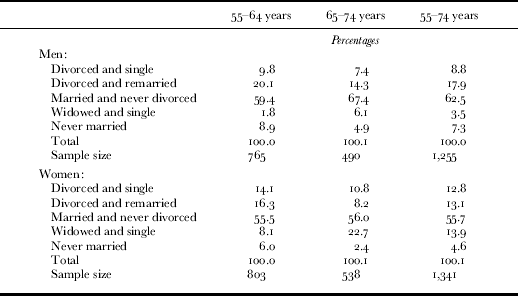
The analysis is restricted to those aged 55–74 years who had previously been married or were married at the time of the interview. This age grouping was chosen in order to obtain a sufficient sample size of older Australians to allow an analysis by gender.Footnote 7 According to the HILDA survey, 26.7 per cent of men aged 55–74 years had experienced divorce, 62.5 per cent were married and had never divorced, 3.5 per cent were widowed and 7.3 per cent had never married. About two-thirds of those who had experienced divorce had remarried at the time of interview (also referred to here as the divorced and remarried), and one-third had divorced and remained single (also referred to in this paper as the divorced singles).Footnote 8 For women aged 55–74 years, 25.8 per cent had ever divorced, 55.7 per cent were married and had never divorced, 13.9 per cent were widowed and 4.6 per cent had never married. Of those who had experienced divorce, half had remarried at the time of the HILDA interview and half remained single (Table 1). Table 1 also provides information on the current relationship status and relationship history of HILDA respondents for those aged 55–64 years and 65–74 years. For both men and women, the proportion that had been divorced is higher for those aged 55–64 years than those aged 65–74 years. As expected, the proportion that was widowed and single was much higher for women than men and was higher for those aged 65–74 years than those aged 55–64 years.
Relationship history, by age and gender
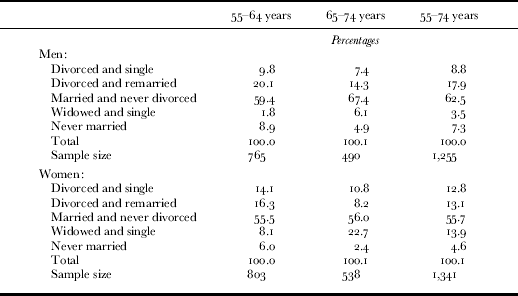
Note: Excludes a small number of respondents who were separated but had not legally divorced at the time of the interview. Estimates are based on unweighted data. Sum of column percentages may exceed 100% due to rounding.
Source of data: Household Income and Labour Dynamics in Australia (HILDA) survey, Wave 5, 2005.
The analysis is restricted to those who have ever been married. Respondents who had never been married but had previously been in a cohabiting relationship were excluded. This is because it is difficult to determine the ‘seriousness’ of cohabiting relationships using the HILDA survey. In any event, the number of older Australians with this relationship history was small and the results are not sensitive to the exclusion of these respondents from the analysis.
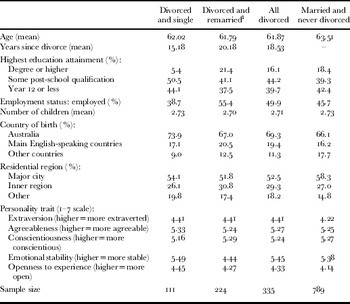
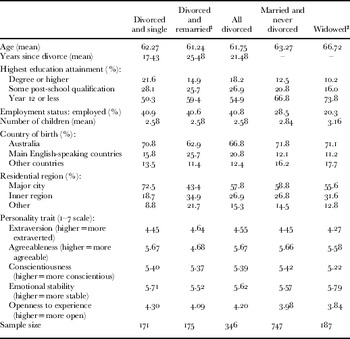
Tables 2 and 3 provide information on the socio-economic, demographic characteristics and personality traits of men and women by marital history. For both men and women there are a number of important differences in the characteristics between marital histories. The categories of marital history are divorced and remained single, divorced and remarried, or currently married and never divorced. For women, another group included is widowed and single at the time of the interview. There is an insufficient sample of widowed men to allow an analysis of this group. For men and women, there was little difference in their average age according to marital history (the average age varied between 61 and 63 years). The only exception was that women who were widows were older (66.7 years), on average, than the other groups of women. On average, men had divorced 18.5 years ago and women had divorced 21.5 years ago.Footnote 9 Typically men and women who had remarried had divorced longer ago than those who had divorced and were still single. Thus, in this paper the effects of divorce are being estimated for people who were born between 1930 and 1950 and who mostly divorced many years prior to the time of the survey.
Men who had ever divorced (regardless of whether they remarried) had similar levels of education to those who were married and had never divorced. However, men who had divorced and remarried had higher levels of education (21.4 per cent with a degree or higher-level qualification) than those who had divorced but remained single (5.4 per cent). Among women, the opposite pattern held. Divorced women who remained single had the highest level of education of the four groups. Nearly 22 per cent of divorced but single women had a degree, compared to 14.9 per cent of the divorced and remarried women, and 12.5 per cent of the married and never divorced women. Widowed women had a slightly lower level of education than married and never divorced women.
There were also differences in employment status according to marital history. Men who were divorced but remarried had the highest rate of employment (55.4 per cent), while men who remained single had the lowest rate of employment (38.7 per cent). Among women, there was little difference in employment rates according to marital history except that widowed women are the least likely to be employed at the time of the interview (20.3 per cent employed). For men and women, there was little difference in the number of children they had, according to marital history. The only exception was that widowed women had more children on average than the other groups.
The HILDA survey collects information on personality traits. Research has found that personality has a strong influence on subjective wellbeing (Diener, Oishe and Lucas Reference Diener, Oishe and Lucas2003). In terms of personality traits, there is little difference in the dimensions of extroversion, agreeableness, conscientiousness and emotional stability overall across the three marital history groups. For both men and women, however, in the dimension of openess (characteristics such as imagination and curiosity), the divorced singles appeared to be more open to new experiences than the married and never divorced.
Taken overall, women who divorced and remained single had better education and employment rates than married women (both ever- and never divorced), while the reverse was true for divorced and single men. These men were less advantaged than both married men (ever- and never divorced) and divorced single women. The fact that divorced remarried men had a higher level of human capital than divorced single men, and the reverse pattern was found for divorced women, is consistent with research into partnering patterns (de Vaus and Richardson Reference de Vaus and Richardson2009). This research shows that women tend to marry men with a higher level of education, labour market earning capacity and assets than themselves, whereas men tend to marry women with the same or lower levels of educational attainment, labour market earning capacity and assets than themselves (Birrell and Rapson Reference Birrell and Rapson1998). This may be particularly pronounced for second marriages. The pattern in which men and women with similar characteristics tend to marry each other is referred to as ‘assortative mating’, and the tendency for men to have an educational and labour market capacity at least a little higher than their partners is called the ‘marriage gradient’.
Selected characteristics of older Australians, by marital history, men

Notes: 1. The divorced and remarried include a small number of respondents who were cohabiting at the time of interview. Estimates are based on unweighted data.
Source of data: Household Income and Labour Dynamics in Australia (HILDA) survey, Wave 5, 2005.
Selected characteristics of older Australians, by marital history, women

Notes: 1. The divorced and remarried include a small number of respondents who were cohabiting. 2. The widowed is restricted to widows who had not re-partnered at the time of the interview. Estimates are based on unweighted data.
Source of data: Household Income and Labour Dynamics in Australia (HILDA) survey, Wave 5, 2005.
Estimation method
Differences in personal wellbeing between the groups of men and women according to their divorce history may be attributable to differences in socio-economic and demographic characteristics between those who had divorced and those who were married and had never divorced rather than to the effects of divorce. In order to control for differences in the characteristics of the groups (e.g. in education and employment levels), a series of regression models were estimated for the wellbeing measures. For binary measures of wellbeing a logistic model was used, and for continuous measures of wellbeing ordinary least squares (OLS) was used. The binary measures of wellbeing are: getting together at least once a week with friends and relatives living elsewhere; being an active member of a sporting, hobby or community-based club or association; and spending any time doing unpaid voluntary or charity work. All of the other wellbeing measures are either ratings or summary scores and therefore modelled using OLS.
The explanatory variables included were age and age-squared (age-squared was included to control for a possible non-linear relationship between age and wellbeing), educational attainment, employment status, number of children, any children living in the household, residential region,Footnote 10 country of birth, and personality trait variables. The effects of marital history and current marital status were estimated using measures of being divorced and remarried, divorced and single, and married and never divorced. The omitted category in these estimates was married and never divorced. The regression models were estimated separately for men and women.
While the regression analysis goes some way towards controlling for differences in characteristics according to marital history, it is unlikely that the characteristics available in HILDA cover all the relevant characteristics. Therefore, the possibility that differences in wellbeing according to marital status are explained by selection effects cannot be discounted. Perhaps the biggest gap is that the HILDA data do not, in most cases, provide information on the characteristics of ex-partners (the exception is where the relationship breakdown occurred during the period covered by the HILDA survey).
Estimates of the effects of divorce on wellbeing in older age
In order to illustrate the estimated effects of divorce on wellbeing, predicted probabilities and adjusted means are reported. For the binary wellbeing measures, the predicted probability of good social connections for each marital history category were analysed while holding constant the values of all other explanatory variables. This was achieved by setting the values of the continuous explanatory variables at the sample mean, and the values chosen for the categorical explanatory variables had, for each variable, equal proportions in each category.Footnote 11 For continuous wellbeing variables, the predicted value (sometimes termed an ‘adjusted mean’) was calculated for each marital history category while holding constant the value of all other explanatory variables.Footnote 12
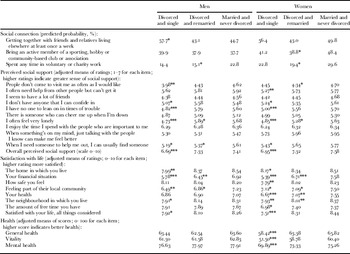
The predicted probabilities and adjusted means for each of the wellbeing measures according to marital history and gender are presented in Table 4. Asterisks indicate the statistical significance of the differences in wellbeing between those who had married and never divorced and, respectively, the divorced singles and those who had divorced and remarried. An example may assist with the interpretation of the results. In Table 4, the first row provides estimates of whether the respondent got together with friends and relatives living elsewhere at least once a week. For this measure, it is estimated that divorced single men had a 57.7 per cent probability of getting together with friends and relatives weekly, divorced and remarried men had a 43.1 per cent probability, and married and never divorced men had a 44.7 per cent probability. The asterisk attached to the predicted probability for divorced single men indicates that the wellbeing of the divorced single men was significantly different to that of the married and never divorced – in this case higher. The effect of divorce was therefore to increase by 13.0 percentage points the probability of getting together regularly with friends and relatives.
Predicted wellbeing of older Australians, by marital history and gender

Notes: The explanatory variables included in the regression model from which the predicted probabilities are derived are described in the ‘Estimation Method’ section. The significance tests reported in the table indicate the statistical significance of the difference of the ‘divorced and single’ and the ‘divorced and remarried’ categories to the ‘married and never divorced’ category. The significance test is based on the significance of underlying coefficients in the regression model. Predicted probabilities and adjusted means of ratings and scores were computed by setting explanatory variables at their sample means for continuous variables or equal proportions in each category for categorical variables.
Significance levels: *p<0.05, ** p<0.01, *** p<0.001.
Source of data: Household Income and Labour Dynamics in Australia (HILDA) survey, Wave 5, 2005.
Social contact
Focusing first on the impact of divorce on the level of social contact (connections) for men and women, the divorced singles were more likely to report getting together at least once a week with friends and relatives than the married and never divorced group, although the difference is only statistically significant for men. There is no difference between the divorced and remarried and the married and never divorced men and women on this measure of wellbeing. This is probably a result of the divorced singles being much more likely to be living alone than those who had a partner. For men, there are no differences between divorced single men and married and never divorced men in the probability of being an active member of a club or association or in the probability of doing voluntary or charity work. Divorced and remarried men, however, were less likely than married and never divorced men to do voluntary or charity work. For women, the divorced singles are estimated to be less likely to be a member of a community organisation or to do voluntary work than the married and never divorced, though differences are not statistically significant. Divorced and remarried women are significantly less likely than the married and never divorced to be members of community organisations or doing voluntary work. For example, divorced and remarried women have a predicted 38.8 per cent probability of being an active member of a community organisation, compared to 48.4 per cent for otherwise similar married and never divorced women.
Perceived social support
Divorced single men have a statistically significant lower level of overall perceived social support than married and never divorced men (a mean of 6.69 and 7.41, respectively, on a scale from 0 to 10). For men, there are no differences between the divorced and remarried and the married and never divorced on perceived social support. While the effects of divorce on specific perceived social support items varies a little between items, the pattern of results is clear. Divorced single men report a statistically significant lower level of perceived social support on five of the ten individual items. For the other five items where the difference is not statistically significant, the estimated level of wellbeing is lower for the divorced singles than the married and never divorced. For men who are divorced and remarried, statistically significant differences from the married and never divorced were found for only two of the ten measures of wellbeing. For one of the items (‘I often feel lonely’), the divorced and remarried group report a higher level of wellbeing than the married and never divorced group, and for the other item (‘When I need someone to help me out, I can usually find someone’), the divorced and remarried report a lower level of wellbeing than the married and never divorced.
Similar results are found for women, with the divorced singles reporting a lower level of perceived social support than the married and never divorced women (6.95 and 7.58, respectively). No differences were found between those who had married and never divorced and those who had divorced and remarried. At the individual item level, as was the case for men, the divorced single women reported a statistically significant lower level of perceived social support on five of the ten individual items.
On only two of the individual perceived social support items are there statistically significant differences for the divorced and remarried women when compared to the married and never divorced women. This pattern of results indicates generally weak effects of divorce on wellbeing for women who have remarried.
Satisfaction with life
Being divorced and remaining single thereafter appears to result in a lower overall satisfaction with life for both men and women. For men, the divorced singles are estimated to have an overall life satisfaction score of 7.92, compared to 8.26 for otherwise similar married and never divorced men. For women, the divorced singles are estimated to have an overall life satisfaction score of 7.51, compared to 8.44 for the married and never divorced. When satisfaction with different aspects of life (e.g. home, financial situation, feeling of safety) are examined, divorced single men reported being less satisfied than married and never divorced men in relation to the home in which they live, their financial situation, feeling part of their local community, and the neighbourhood in which they live.
For women, the effects of divorce on satisfaction with different aspects of life appear to be more pervasive than for men. Women who divorced and remained single reported being less satisfied with all of the aspects of their life about which they were asked (home, financial situation, feeling safe, feeling part of their local community, health, the neighbourhood in which they live and their amount of free time). Women who divorced but remarried reported being less satisfied with their financial situation, their health and the neighbourhood in which they live than otherwise similar married and never divorced women. Divorced and remarried men were less satisfied with their financial situation and feeling part of their local community than married and never divorced men. Thus, it appears that there are stronger long-term negative effects of divorce for women who have remarried than for divorced men who have remarried.
Health
For men, marital history does not appear to have any effect on general health, vitality and mental health, as measured using the SF-36 set of questions. In contrast, for women, divorced singles had lower levels of general health, vitality and mental health than those who had married and never divorced. For example, divorced single women were estimated to have a mental health score of 69.89 (on a scale from 0 to 100), compared to a score of 75.26 for otherwise similar women who were married and had never divorced. There were no statistically significant differences in the health of women who were divorced but remarried and women who had married and never divorced.
Summary
Although the longer-term effects of divorce varied somewhat between the different measures of wellbeing, the overall pattern is clear. For both older men and women, divorce earlier in life had a negative impact on wellbeing later in life. However, the negative effects were larger for those who remained single after divorce compared to those who remarried. It appears that remarriage offsets many, although not all, of the negative effects of divorce on wellbeing. For men, divorce earlier in life had a negative impact upon their perceived social support and satisfaction with life, but not on their general health, vitality or mental health later in life. For women, in addition to these domains, divorce had a long-term negative impact upon their general health, vitality and mental health. Older women who had divorced and remarried were more likely than otherwise similar married women who had never divorced to feel lonely and to have less social contact than they would like. Older divorced and remarried women were also less satisfied with their financial situation, felt less safe and felt less a part of their local community. For older men, the effects of divorce for those who had remarried were much more limited and manifested only in their lower level of satisfaction with their financial situation, feeling less a part of their community, being less able to find someone to help them out when needed and feeling lonely.
Comparing the wellbeing of divorced singles and widowed singles
A possible explanation for why divorce has a negative effect on the wellbeing of older divorced single Australians is that it is the state of being single rather than being divorced per se that has the impact. Couple relationships are important for meeting the basic human need of forming intimate bonds (Feeney and Rosen Reference Feeney, Rosen and Ponzetti2003) and for providing an individual with a sense of security and emotional stability. Research consistently highlights the importance of the quality of marital relationships for personal wellbeing (e.g. Headey and Wearing Reference Headey and Wearing1992, Reference Headey, Wearing and Eckersley1998).
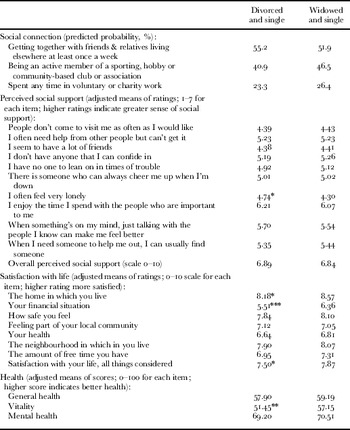
One way of testing the hypothesis that it is singleness rather than divorce that is influencing wellbeing is to compare the wellbeing of those who are single as a result of divorce and those who are single due to widowhood. As discussed above, there were an insufficient number of widowed men in the HILDA survey to provide statistically reliable estimates for widowed men and so the analysis in this section is restricted to women. While it would be valuable also to compare divorced singles with older women who are single because they have never married, the number of women in the latter group among HILDA respondents is too small to allow meaningful comparison. The comparisons of the wellbeing of women who were single as a result of divorce and those who were single as a result of the death of their husband are derived from the regressions used to estimate the effects of divorce on wellbeing. Table 5 shows the probabilities or adjusted means of the wellbeing measures for divorced single women and widowed single women, based on the multivariate analysis.Footnote 13
Predicted wellbeing of older divorced single women and widowed single women

Notes: The regression models and values of explanatory variables used to calculate the predicted probabilities and adjusted means are the same as those used to construct the estimates for women presented in Table 4. The significance tests reported in the table indicate the statistical significance of the difference between divorced single women and widowed single women. The significance test is based on the significance of underlying coefficients in the regression model. For the computation of predicted probabilities and adjusted means, see Table 4 note.
Significance levels: *p<0.05, ** p<0.01, *** p<0.001.
Source of data: Household Income and Labour Dynamics in Australia (HILDA) survey, Wave 5, 2005.
Overall, there are relatively few differences in wellbeing between women who were single as a result of divorce and those who were single as a consequence of widowhood. There are no differences between these two groups in the extent of their social connection. For the perceived social support measures, the only difference between the two groups is that the divorced single women were significantly less likely than the widowed single women to say that they often felt very lonely.
Compared with widowed single women, divorced single women are significantly less satisfied with two aspects of life (the home in which they live, and their financial situation) and less satisfied with life overall, but they are not significantly different in five other aspects of life. Divorced single women also have significantly less energy than widowed single women, but the two groups of women have very similar levels of mental and physical health. The results suggest that the differential wellbeing between divorced single women and married and never divorced women cannot be fully explained by the single status of divorced women.
Concluding comments
The paper shows that divorce has a long-lasting, negative impact on wellbeing that lasts into later life for both men and women. However, the negative effects of divorce on wellbeing are largely confined to those who do not re-partner. An important difference between men and women is that for women who are divorced and single, the negative effects of divorce are found for general health, vitality and mental health. Furthermore, these effects are reasonably large. For men, there appear to be no effects of divorce on physical or mental health.
Women who were divorced and single were less satisfied than their otherwise similar married and never divorced counterparts for all seven of the aspects of life satisfaction. While divorced single men were less satisfied with several aspects of their lives than married and never divorced men, not all of the differences are significant. Furthermore, the effects of divorce on satisfaction with various aspects of life are smaller for men than for women. While there appears to be some effect of divorce on perceived social support for both men and women, the effects of divorce on social support are less pervasive than the effects of divorce on satisfaction with life and, for women, health. The divorced singles appear to have more social contact with people living elsewhere. This is perhaps not surprising given that many of them were living alone.
This paper has adopted a lifecourse approach to understanding wellbeing in later life and has demonstrated the importance of placing the experience of later life within the context of experiences earlier in life. In his influential review paper, Amato (Reference Amato2000: 1282) writes
Divorce benefits some individuals, leads others to experience temporary decrements in well-being that improve over time, and forces others on a downward cycle from which they might never fully recover. Continuing research on the contingencies that determine whether divorce has positive, neutral, or negative long-term consequences for adults and children is a high priority.
The data presented in this paper have demonstrated that divorce, a lifecourse transition that occurred much earlier in life, shapes the experience of wellbeing, life satisfaction and social connection in later life. Further, we have demonstrated that the long-term consequences of divorce extend well beyond the financial consequences that are more commonly the focus of divorce research and which have been found for older Australians (de Vaus et al. Reference de Vaus, Gray, Qu, Stanton, Kemp, Van den Bosch and Smith2008). The findings of long-term negative effects of divorce lends support to Amato's (Reference Amato2000) chronic strain model of the effects of divorce.
We have also demonstrated the importance of marriage or marriage-like relationships for wellbeing in later life. In general, people have a better sense of wellbeing in later life if they have remained married to the same partner; remarriage mitigates many of the negative effects of divorce for wellbeing and social connection in later life and certainly results in better outcomes than for those who divorce and remain single. Older women who are single regardless of whether it is by via divorce or widowhood have a poorer sense of wellbeing than those who have a partner. Divorce seems to add in some respects to the effects of singleness per se. The positive association between remarriage and wellbeing is consistent with the findings of research into the positive impacts of remarriage earlier in life, including the positive financial effects of remarriage identified by de Vaus et al. (Reference de Vaus, Gray, Qu, Stanton, Kemp, Van den Bosch and Smith2008).
The longer-term consequences of divorce for wellbeing in later life are gendered. In particular, divorce earlier in life appears to have larger and more generalised effects on the wellbeing of older women than on older men. In this respect the evidence challenges some views about the relative benefits of marriage for men and women. While some people argue that marriage is good for men and bad for women (Bernard Reference Bernard1972; Gove Reference Gove1972), the evidence presented here has shown that in the longer term older women who have ended a marriage have a poorer sense of wellbeing and poorer social connection than those who have remained married.
While much can be done to assist older people with living a vital and full life, this task cannot simply be left to later life. Building and supporting strong relationships earlier in life pays off in terms of personal and social wellbeing in later life. While there is considerable emphasis on the need for people to begin to prepare in early and mid-life for their financial wellbeing in later life, it is also clear that investing in solid and secure relationships in early and mid-life will pay its own dividends in later life. In this paper the effects of divorce are estimated for people who were born between 1930 and 1950 and who mostly divorced many years prior to the time of the survey. The social stigma associated with divorce has changed enormously over the lifetime of the people studied. It will be important to monitor whether the findings for this cohort will be reproduced for later cohorts.
Acknowledgements
Earlier versions of this paper were presented at the Australian Social Policy Conference, University of New South Wales, Sydney, 11–13 July 2007, and the 10th Australian Institute of Family Studies Conference, Families Through Life, Melbourne, 9–11 July 2008. We are grateful to Sara Arber, Alan Hayes, Boyd Hunter and two anonymous referees for comments on an earlier version of this paper. The views expressed in this paper are those of the authors and may not reflect those of the Australian Government or the Australian Institute of Family Studies.