INTRODUCTION
The majority of Alfisols available for crop production in the tropics are strongly weathered and of inherently low organic matter and nutrient status (Lal, Reference Lal1987). In addition, Alfisols have a weak structure and are highly susceptible to crusting, compaction and accelerated erosion (Lal, Reference Lal1987) leading to low crop yields. Cocoyam like any other root and tuber crops is a heavy feeder, exploiting a large volume of soil for nutrient and water (Osundare, Reference Osundare2004). Tillage is an important cultural practice that can be used to increase the yield of cocoyam. In the humid tropics where most farmers are poor and fertilizer is expensive, soil working and tillage methods can temporarily serve as an alternative to fertilizer application (Adekiya and Ojeniyi, Reference Adekiya and Ojeniyi2002).
Traditionally, cocoyam is grown on heaps, ridges and occasionally on flat manually cleared soils. Until now, a wide range of mechanized tillage methods, e.g. ploughing, harrowing, ridging and discing have been used for crop production in the humid tropics, without the benefit of experimental data on soil properties and crop response. Hence, there is a need to examine the potential of growing cocoyam using the traditional tillage method, mechanized ploughing plus harrowing and ploughing plus harrowing twice and their effects on nutrients uptake and cocoyam performance. There is a lack of information on tillage requirements of cocoyam on tropical Alfisols because previous tillage studies in the tropics on cocoyam have concentrated on acidic Ultisols (Anikwe et al., Reference Anikwe, Mbah, Ezeaku and Onyia2007; Hulugalle et al., Reference Hulugalle, Lal and Opara-Nadi1985).
Tillage methods for crops depend on soil type and depth, micro-climate and topography (Agbede, Reference Agbede2006; Howeler et al., Reference Howeler, Ezumah and Midmore1993). Tillage studies have mainly compared the effect of conventional tillage practices on cocoyam yields. The few studies undertaken largely neglected minimum or traditional and conventional tillage practices and their effects on soil properties and cocoyam yield (Agbede, Reference Agbede2008). The few studies carried out in Nigeria and other tropical countries produced inconclusive and controversial results under the different tillage practices compared (Hulugalle et al., Reference Hulugalle, Lal and Opara-Nadi1985). For instance, Villanueva (Reference Villanueva1986) investigated the effect of tillage intensity on production of upland taro (cocoyam) and found no significant differences between ploughing and harrowing once or twice. In Hawaii, taro (cocoyam) is usually grown on puddled flooded soils with high input fertilizer, resulting in very high yield of up to 60 Mg ha−1 (Plucknett et al., Reference Plucknett, Ezumah and de la Pena1973). Ridging of the soil did not significantly increase yield (Ezumah and Plucknett, Reference Ezumah and Plucknett1982). On a sandy Ultisol in southeast Nigeria, Hullugalle et al. (Reference Hulugalle, Lal and Opara-Nadi1985) found that zero tillage reduced yield of cocoyam compared with ploughing. Also Anikwe et al. (Reference Anikwe, Mbah, Ezeaku and Onyia2007), in an experiment on an Ultisol in southeast Nigeria, evaluated the effects of two tillage systems (tilled and not-tilled) and plastic film mulch (black and clear plastic-film mulch) on the performance of cocoyam. At harvest, corm yield was obtained in tilled black mulch plots (29.1 Mg ha−1). This was significantly higher (p = 0.05) than yields obtained in no-till no mulch plot by 72%. However, Ghosh et al. (Reference Ghosh, Ramanujam, Jos, Morrthy and Nair1988) recommended ploughing once with incorporation of farmyard manure, followed by harrowing, and if necessary, either mounding or ridging. Howeler et al. (Reference Howeler, Ezumah and Midmore1993) suggested that research efforts should be directed towards the characterization of the physico-chemical and biological factors that determine the tillage requirement of a given soil for a given root crop.
This study compared five tillage methods as to their effects on soil physical and chemical properties, growth and yield of cocoyam on an Alfisol of southwest Nigeria.
MATERIALS AND METHODS
Site description and tillage treatments
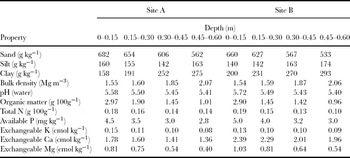
Field experiments were carried out at St Catherine's Girls Grammar School (Site A) and Obasooto village (Site B), in Owo, Ondo state during the 2007, 2008 and 2009 cropping seasons. Owo is located at lat. 5°12′N, long. 5°35′E within the forest-savanna transition zone of southwest Nigeria. The soil at Owo is an Alfisol, and is classified as an Oxic Tropuldalf (USDA, 2010) or Luvisol (FAO, 1998) of the basement complex, and locally classified as Okemesi Series (Smyth and Montgomery, Reference Smyth and Montgomery1962). The physical and chemical properties of the soils at the two sites before experimentation are shown in Table 1. The low organic matter before the start of the experiment is partly attributable to its fairly high bulk density (Adekiya and Ojeniyi, Reference Adekiya and Ojeniyi2002). The total annual rainfall for 2007, 2008 and 2009 was 1335, 1346 and 1547 mm, respectively. There are two rainy seasons, one from March to July and the other from mid-August to November. The sites were under two years fallow after arable cropping.
Soil physical and chemical properties (0–0.60 m depth) of sites prior to experimentation.

Five tillage treatments were replicated three times in a randomized complete block design. The treatments were (a) manual clearing (MC): manual clearing with cutlass and weeds removed from plots before planting on flat without primary or secondary tillage operation, (b) manual ridging (MR): the ridge was prepared by heaping the soil surface layer using the traditional hoe after cleared weeds were removed from the plots, (c) manual mounding (MM): the mound was prepared by heaping the soil surface layer using the traditional hoe after cleared weeds were removed from the plots, (d) ploughing plus harrowing (P+H): soil was ploughed and harrowed to 0.20 m depth once with a tractor-mounted disc plough and harrow and (e) ploughing plus harrowing twice (P+2H): soil was ploughed to 0.20 m depth once with a tractor-mounted disc plough followed by harrowing to 0.20 m depth twice with tractor-mounted disc harrow. The tractor used was a Steyr 768 and its weight was 4500 kg. There was an initial clearing of the plots before tillage operations for treatments P+H and P+2H. Each plot was 12 m × 10 m. Tillage treatments were carried out in April each year. The same location was used at each site for the three years of the experiment.
Planting of cocoyam
Cocoyam was planted in April each year of the experiment after tillage. Cocoyam (Xanthosoma sagittifolium cv. Owo local) cormels weighing about 150 g were planted. One cormel was planted per hill at a spacing of 1 m × 1 m to give a plant population of 10 000 plants ha−1. Weeding was done manually at 45 and 110 days after planting.
Soil sampling and analysis
Prior to the commencement of the experiment in 2007, soil samples were taken from 0–0.15, 0.15–0.30, 0.30–0.45 and 0.45–0.60 m depths of a pit located at 10 points selected randomly from each site. Soil samples were collected from the centre of the depth intervals using steel coring tubes (0.04 m diameter, 0.10 m high) and were put in an oven set at 100 °C for 24 h for determination of bulk density. The soil samples collected were also bulked, air-dried and sieved using a 2-mm sieve and analysed for particle size, soil organic matter, N, P, K, Ca, Mg and pH. Soil samples were also collected at harvest of cocoyam from 0–0.15 m depth in 2008 and 2009 on an individual plot basis and similarly analysed for chemical properties. Samples were analysed as described by Carter (Reference Carter1993). Particle size was analysed by the hydrometer method (Sheldrick and Hang Wang, Reference Sheldrick, Wang and Carter1993). Soil organic carbon was determined by the procedure of Walkley and Black using the dichromate wet oxidation method (Nelson and Sommers, Reference Nelson, Sommers and Sparks1996). Organic matter was calculated by multiplying C by 1.724. Total N was determined by the micro-Kjeldahl digestion method (Bremner, Reference Bremner and Sparks1996). Available P was determined by Bray-1 extraction followed by molybdenum blue colorimetry (Frank et al., Reference Frank, Beegle, Denning and Brown1998). Exchangeable K, Ca and Mg were extracted using 1M ammonium acetate. Thereafter K level was determined on a flame photometer, and Ca and Mg were determined by EDTA titration (Hendershot and Lalande, Reference Hendershot, Lalande and Carter1993). Soil pH was determined using a soil-water medium at a ratio of 1:2 with a digital electronic pH meter.
Determination of soil physical properties
One month after imposition of tillage, determination of certain soil physical properties in all plots at both sites commenced and this was done at monthly intervals on five occasions, for each year. Five undisturbed samples were collected at 0–0.10 m depth from each plot using core soil samplers and were used for the evaluation of bulk density and gravimetric moisture content as described above (Campbell and Henshall, Reference Campbell, Henshall, Smith and Mullin1991). Soil temperature was determined at 15:00 hours with a soil thermometer inserted to 0.10 m depth. Five readings were made per plot at each sampling time and the mean computed.
Determination of growth and yield parameters
Ten plants were selected per plot for determination of plant height and leaf area at 168 days after planting when the cocoyam plant reached its peak growth (Ndon et al., Reference Ndon, Ndulaka and Ndaeyo2003). Plant height was measured by metre rule and leaf area by the graphical method (Ndon et al., Reference Ndon, Ndulaka and Ndaeyo2003). The cormel and corm yields were determined by harvesting 10 cocoyam plants per plot and separating them into cormels and corms. They were washed and cleaned to remove traces of sand before weighing on a top loading balance to determine their fresh weights.
Statistical analysis
Data collected from each experiment were subjected to analysis of variance (ANOVA) using the Genstat statistical package (GENSTAT, 1993) to determine the effects of treatments on soil physical and chemical properties, growth and yield of cocoyam. The standard error of difference between means (s.e.d.) was used to compare the treatment means. Mention of statistical significance refers to p = 0.05 unless otherwise stated.
RESULTS
Initial soil fertility status
The soils at both sites were sandy loam in texture and slightly acidic. The sand tended to reduce and the clay content increase with depth. The silt content had an inconsistent distribution pattern within the profile. At 0–0.45 m depth where cocoyam tubers are formed, bulk density was high and increased with depth. The soils at both sites were generally low in essential nutrients (except for Mg at site A and Ca and Mg at site B, which were adequate), according to the critical levels of 3.0 g 100 g−1 organic matter, 0.20 g 100 g−1 N, 10.0 mg kg−1 P, 0.16–0.20 cmol kg−1 K, 2.0 cmol kg−1 Ca and 0.40 cmol kg−1 Mg recommended for crop production (Akinrinde and Obigbesan, Reference Akinrinde and Obigbesan2000). The value of soil pH, SOM, N, P, K, Ca and Mg were higher at the surface horizon and reduced with depth.
Effect of years, sites and tillage methods on soil physical properties
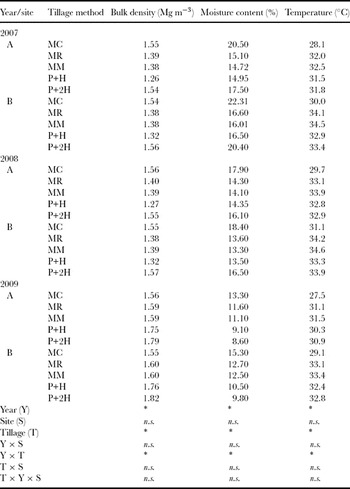
Table 2 contains data on the effect of years, sites and tillage methods on soil physical properties. Years and tillage methods played a significant role in influencing the physical properties of the soil when studied as individual factors. Sites have no significant effect when studied as individual factors. In the first two years (2007 and 2008), P+H produced relatively lower bulk density compared to other tillage methods. In 2009, P+2H produced the highest bulk density. Moisture content and soil temperature were also influenced by years and tillage methods. In the three years, MC produced the highest moisture content and lowest soil temperature as compared with other tillage methods. Moisture content was in the decreasing order of MC > P+2H > MR, MM and P+H in the first two years while the order was MC > MR and MM > P+H and P+2H in the third year. Although MR and MM had the highest soil temperature in the three years considered, the values for all tilled treatments were similar. The interactive effect of year (Y) and site (S), and tillage (T) and site (S) for soil physical properties was not significant. However, Y × T was significant. When all three factors (Y × S × T) were considered together, interactions were not significant.
Effect of years, sites and tillage methods on soil physical properties.

*Significant difference at p = 0.05; n.s. not significant at 0.05; MC: manual clearing; MR: manual ridging; MM: manual mounding; P+H: ploughing + harrowing; P+2H: ploughing + harrowing twice.
Effect of years, sites and tillage methods on soil chemical properties
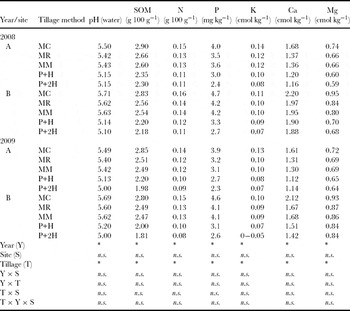
The effects of years, sites and tillage methods on soil chemical properties are shown in Table 3. When studied as individual factors Y and T significantly influenced soil chemical properties. The values for both sites were not significant. In both sites and years, MC produced significantly higher values of soil pH, SOM, N, P, K, Ca and Mg compared with other tillage methods, and MR and MM have similar values. In all cases, 2008 produced higher values of soil nutrients compared with 2009. The interactive effect of Y × S, T × S and T × Y was not significant, nor was the Y × S × T interaction.
Effect of years, sites and tillage methods on soil chemical properties (2008 and 2009).

* Significant difference at p = 0.05; n.s:. not significant; MC: manual clearing; MR: manual ridging; MM: manual mounding; P+H: ploughing + harrowing; P+2H: ploughing + harrowing twice; SOM: soil organic matter; N: total nitrogen; P: available phosphorous; K: exchangeable potassium; Ca: exchangeable calcium; Mg: exchangeable magnesium.
Effect of years, sites and tillage methods on growth and yield of cocoyam
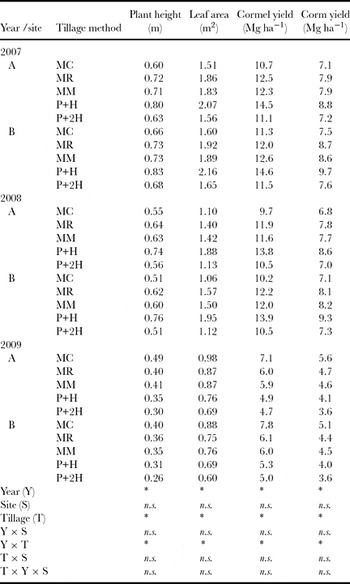
Table 4 contains data on the effect of years, sites and tillage methods on growth and yield of cocoyam. When studied as individual factors Y and T significantly influenced the growth and tuber yield of cocoyam. Sites have no significant effect. In 2007 and 2008, at both sites, P+H produced the highest values of plant height, leaf area, cormel and corm yields, and MC and P+2H produced the lowest values. In 2009, MC produced the highest values of growth and yield while P+2H gave the lowest values. Yield was significantly higher in 2007 and 2008 than in 2009. The interactive effect of Y × S and T × S was not significant, but T × Y was significant. When the three factors Y × S × T was considered together, interaction was not significant. Averaged across years, sites and tillage methods; MC, MR, MM, P+H and P+2H produced 9.5, 10.6, 10.4, 11.0 and 8.6 Mg ha−1, respectively, for cormel yield and 6.5, 7.0, 6.9, 7.4 and 6.1 Mg ha−1, respectively, for corm yield.
Effect of years, sites and tillage methods on growth and yield of cocoyam.

* Significant difference at p = 0.05; n.s:. not significant; MC: manual clearing; MR: manual ridging; MM: manual mounding; P+H: ploughing + harrowing; P+2H: ploughing + harrowing twice.
When soil physical properties (bulk density, moisture content and soil temperature) were regressed as independent variables with cormel and corm yields as dependent variables (Table 5), the coefficient of determination (R2) for cormel and corm yields were 0.87 and 0.86, respectively. The multiple regressions revealed that bulk density and moisture content significantly influenced the yield of cocoyam. When soil chemical properties (pH, OM, N, P, K, Ca and Mg) were regressed as independent variable (Table 6), the R2 for cormel and corm yields were 0.56 and 0.51, respectively. The multiple regressions revealed that the soil chemical properties were not significant.
Results of multiple regressions of yield components using soil physical properties.

* Significant at p = 0.05 level; BD: bulk density; MC: moisture content; ST: soil temperature.
Effect of multiple regressions of yield component using soil chemical properties.

* Significant at p = 0.05 level; SOM: soil organic matter; N: total nitrogen; P: available phosphorous; K: exchangeable potassium; Ca: exchangeable calcium; Mg: exchangeable magnesium.
DISCUSSION
The lower values of bulk density at the surface horizons could be due to good aggregation caused by relatively high organic matter content and the high bulk density in the other subsoil horizons can be attributed to the possibility of migrating clay (lessivage) filling up the pore spaces in the supposedly well structured B horizon. The reason why the soil bulk density increased with depth can also be due to lower concentration of organic matter, less aggregation, less root penetration and compaction caused by the weight of the overlying layers (Brady and Weil, Reference Brady and Weil1999). The pH, K, Ca and Mg decreased with depth due to clay mineralogy effects on CEC. Higher values in surface due to soil organic matter effects, also the decrease of N and P with organic matter.
In the first two years of the experiment, MC and P+2H had higher bulk density compared with other tillage methods. The higher bulk density of MC could be due to non-tillage and compaction. This observation implies that continuous exposure of untilled soil to rainfall without tillage compacts the soil. Ojeniyi and Adekayode (Reference Ojeniyi and Adekayode1999) had earlier reported higher bulk density for MC compared with tilled soils. The higher density of P+2H compared with MR, MM and P+H was attributed to wheel traffic of tractor and implement passes which compact the soil. There were no significant differences between the bulk densities of ridge and mound, likewise Hulugalle et al. (Reference Hulugalle, Palada and Carsky1991) did not find significant differences between bulk densities of ridge and mound surfaces. The low bulk density of P+H, MR and MM compared with MC was due to loosening effects of tillage. Compared with tilled soils, MC had higher moisture content and low temperature. This is because MC is protected by a layer of low conductivity (dry soil) on the surface that reduces evaporation losses. On the other hand, tilled soils are exposed to radiation and increased evaporation loss of soil water. Untilled soil (MC) has lower temperature compared with tilled soil because the unporous nature of untilled soil increased heat conduction into the soil during the day and consequently reduced water evaporation.
In 2009, the order of reduction in bulk density was P+2H and P+H > MR and MM > MC. The highest soil bulk density produced by tractorized treatments (P+2H and P+H) was due to break down of soil structure due to slaking and raindrop impacts. Repetitive tillage degrades soil qualities and causes rapid collapse of soil structure especially under tropical conditions. A compacted layer may also be formed just below the surface leading to reduction in infiltration rate, ponding and attendant anaerobic conditions. Therefore Alfisols have a coarse texture surface horizon overlying a clayey sub-surface layer which are weak in structure and highly susceptible to crusting, compaction and accelerated erosion. The significant differences between the three years in term of soil physical properties were due to differences in total rainfall in the three years (see Site description above). The soil surface exposed after tillage is prone to break down of aggregates as the energy from raindrops is dissipated resulting in clogging of soil pores, consequently reducing water infiltration. Therefore in the sub-humid and humid regions of the tropics, the high intensity rainfall tends to nullify the loosening effect of tillage.
Manual clearing had the highest values of soil pH, SOM, N, P, K, Ca and Mg in 2008 and 2009 compared with other treatments. This can be related to presence of organic matter. The decline in the nutrient reserves of tilled soils especially P+2H could be because of the high destruction of soil structure during land preparation which encourages soil erosion (soil wash) that preferentially removes colloidal fractions with high ‘enrichment ratio’ (Agbede and Ojeniyi, Reference Agbede and Ojeniyi2009), resulting in a progressive depletion of its nutrient reserves. Ridging and mounding produced higher values of soil nutrients compared with P+H and P+2H. This was due to minimal disturbance of soil by these treatments compared with mechanized tilled soils. There were no significant differences in soil nutrient contents between MR and MM. Similarly Agbede and Adekiya (Reference Agbede and Adekiya2009) did not find significant differences in soil chemical properties between manually ridged and mounded soils.
In the first two years of study, P+H produced the highest values of plant height, leaf area, cormel and corm yields compared with other tillage methods. This finding can be related to lower bulk density produced by P+H. Pardales and Villamayor (Reference Pardales and Villamayor1983) also found that in the Philippines ploughing and harrowing once was sufficient for cocoyam. Also in Hawaii, for upland cultivation of cocoyam, land preparation involves clearing, ploughing and harrowing (Plucknett et al., Reference Plucknett, de la Pena, Dela and Obrero1970). In 2009, tillage methods were in the order MC > MR and MM > P+H > P+2H in term of growth and yield. The highest performance of cocoyam under MC was due to better soil conditions resulting from this treatment. These were associated with reduced density, higher moisture content and soil nutrients compared with other treatments. The least growth and yield of P+2H in 2009 was due to deterioration of soil quality resulting from repeated passage of implement and low soil nutrients.
Multiple regressions revealed that bulk density and moisture content significantly influenced the yield of cocoyam. The values of soil chemical properties were not significant. Reducing bulk density and increasing moisture content were consistent with increase in cormel and corm yields. However, the degree of influence of soil physical properties depended on the degree of soil manipulation imposed by tillage systems. Onwueme (Reference Onwueme1978) reported that when soil water content is low, corm yield of cocoyam is reduced. From this study a degree of tillage appears to be indispensable for sustainable cocoyam production on tropical Alfisols. However, because of the degradation of the soil quality due to P+2H, it should be discouraged for cocoyam production. Three methods – P+H, MR and MM – have the potential for soil conservation.
CONCLUSIONS
A degree of soil manipulation appears to be indispensable for cocoyam production. The differences in bulk density dictated the differences in the growth and yield of cocoyam between manual clearing, manual tillage and mechanized tillage systems. Growth and yield of cocoyam increased under P+H, MR and MM relative to MC and P+2H. The most disadvantageous method to soil and cocoyam productivity was P+2H, and therefore this is not recommended for cocoyam cultivation. On a small scale, either manual ridging or manual mounding is recommended. For large scale cocoyam production, ploughing and harrowing once is recommended