Introduction
This paper describes two new species and two new subspecies of Convolvulus L. (Convolvulaceae), as part of a revision of the Arabian members of the genus for Flora of the Arabian Peninsula and Socotra.
Three of the names formally published here have already appeared, invalidly, accompanying colour photographs of the novelties in Collenette (Reference Collenette1999). These illustrations are cited in the appropriate protologues.
The sectional classification used in the standard revision of the Convolvulus species of the Middle East and Mediterranean areas (Sa’ad, Reference Sa’ad1967) is now known to be out-dated, with some sections undoubtedly not monophyletic. For example, Carine et al. (Reference Carine, Alexander and Russell2003, Reference Carine, Russell, Santos-Guerra and Francisco-Ortega2004) inferred that both Convolvulus sect. Inermes Boiss., in which the first species described in this paper would be classified if Sa’ad’s classification were followed, and C. sect. Acanthocladi Boiss., in which the other three taxa described here would be placed, were polyphyletic and that the spines of species of both sections from different geographic areas are non-homologous. Thus, in the absence of a sectional classification that better reflects the phylogeny of the genus, the novelties described here have not been assigned to infrageneric taxa.
Proposed IUCN conservation assessments are given for each taxon described below. These follow the criteria of IUCN Red List Categories and Criteria version 3.1 (IUCN, 2001) and according to Version 8.1 of the guidelines for applying these criteria published by the IUCN Standards and Petitions Subcommittee (2010).
New Taxa
Convolvulus excelsus R.R.Mill, sp. nov.Figs 1,2.
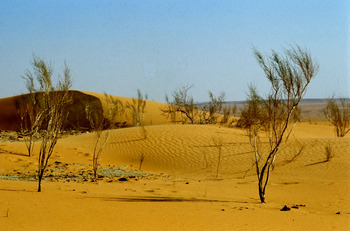
Fig. 1.Convolvulus excelsus, plants growing at type locality. Photo: Sheila Collenette.
 Fig. 2.
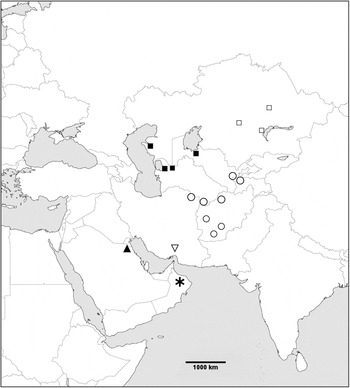
Map of Arabia and part of SW and Middle Asia showing distributions of Convolvulus excelsus (▴), C. erinaceus sensu stricto (▪), C. erinaceus var. kermanensis (▽), C. hamadae (○), C. subsericeus (□), and an unknown Convolvulus species from Oman (*) (Whitcombe 807, see discussion under C. excelsus).
Affinis Convolvulo hamadae (Vved.) Petrov, C. korolkowii Regel & Schmalh. et praecipue C. erinaceo Ledeb. sed eis multo altiore [usque ad 3 m alto, non 10–50(–100) cm]; a C. hamadae et C. korolkowii corollis distincte lobatis (non tantum plicatis) facile separatur; a C. erinaceo habitu excelso 150–300 cm non 25–50 cm alto atque scopiformi haud globoso, pilis caulium ramulorumque brevioribus (minus quam 0.1 mm, non 0.2–0.5 mm), caulibus magis distincte striatis, pedunculis cylindricis (haud anguste conicis), corolla cylindrico-campanulata (non breviter campanulata usque subrotata) plerumque paulo longiore (ad 8.5 mm), lobis suborbicularibus usque late obovatis (haud triangularibus) obtusis (non acutis) multo latioribus (c.3.5 mm, non 1.3–1.5 mm latis) differt. – Type: Saudi Arabia, Northern Borders Region, Jabal Jibalah, 135 km NNW of Zabirah, 28°35′30″N 42°25′30″E, summit of partly dune-covered limestone hill, 2300 ft [701 m], 20 xi 1987, I.S. Collenette 6385 (holo E; iso K; photos of habit and inflorescence reproduced in Collenette, Reference Collenette1999: 228).


Shrub 1.5–3 m tall, branched from base into 2–5 or more slender, mostly ascending-erect, somewhat flexuous trunks, further branched in upper half, the ultimate branchlets numerous, broom-like, the whole plant thus having the habit of Retama Raf. (Fabaceae); non-spinescent. Trunks and principal lateral branches pale brown; twigs grey-green, distinctly striate, densely puberulent with very closely adpressed, extremely short hairs 0.05–0.1 mm. Lower part of plant apparently leafless (or leaves deciduous). Leaves in inflorescence region few, in fascicles of 3–10 or alternate, sessile; lamina linear-oblanceolate or lingulate, 8–13 × 0.9–1.7 mm, shortly adpressed-sericeous above and beneath, with obtuse apex, attenuate-decurrent base and entire, non-undulate margin; each leaf often curving backwards at tip. Internodes of inflorescence branches weakly zigzag-flexuous, 11–25 mm. Flowers solitary at branchlet tips, numerous. Peduncle 3–5 × 0.4–0.6 mm, cylindrical (not tapering distally), densely but very shortly adpressed-puberulent, subtended by a pair of erecto-patent to subpatent, oblong bracts 1–2 mm. Pedicel 1.5–2.7 mm, articulated to the peduncle and subtended at the junction by a group of 2–4, closely approximate, closely adpressed, obovate bracteoles 0.7–1 mm (if more than 2, in alternate pairs of opposite bracteoles). Sepals obovate, the outer ones c.5.5 × 2–3 mm and densely short-adpressed-puberulent outside, the inner ones c.4.5 × 2.6 mm, membranous-margined and with longer exterior pubescence on the green central area than the outer sepals; all sepals obtuse, glabrous within. Corolla pale pink, cylindrical-campanulate, c.8.5 × 10 mm, deeply 5-lobed to slightly more than halfway; tube c.3 mm, densely hirsute to base; lobes spreading, c.3.5–4 × 3.5–4 mm, obovate to obovate-rhombic, obtuse, densely hairy outside. Stamens subequal, exserted from corolla tube; filaments white, 3.5–4 mm, expanded gradually towards base, eglandular; anthers ovoid, white with brown connective, c.1 × 0.7 mm, ± retuse at apex, finally sagittate at base. Style c.2.3 mm, hairy almost as far as the stigmas; stigmas filiform, curved, c.3.4 mm (i.e. longer than style). Ovary densely hairy all over except for dark brown, basal disc. Capsule unilocular, 1-seeded, globose-ovoid, sparsely hairy. Seed black, ovoid, c.3.2 × 2.6 × 2.2 mm (2 faces narrower than other 2), with interrupted lines of groups of somewhat spreading, silky, silvery hairs.
Distribution. Endemic to Jabal Jibalah in northern Saudi Arabia.
Habitat and ecology. A psammophyte, growing at the summit of a limestone hill partly covered with dunes, with very little other vegetation evident; c.700 m.
Proposed IUCN conservation assessment. Data Deficient (DD). The plant is known from a single locality and population on one hill that comprises about 100 plants (Collenette, Reference Collenette1999). Its extent of occurrence and area of occupancy are both currently unknown but would both almost certainly meet the threshold criteria for the Endangered (EN) category, if not also Critically Endangered (CR). Although the small number of plants is well within the threshold for CR under criterion C1, there is no indication of current or future decline nor any knowledge of possible other populations. Collenette (Reference Collenette1999) commented that the plants were not subjected to grazing and the inaccessibility of the locality by surface transport suggests that human disturbance is likely to be minimal. Until the nature and level of any threat is known it seems best to classify it as Data Deficient.
Convolvulus excelsus was found by Mrs Sheila Collenette growing on Aeolian sand at the summit of a low limestone hill in the Nafud region of northern Saudi Arabia. It was forming an open grove of medium-sized to tall bushes up to 3 m in height, with virtually no other associated vegetation (Fig. 1). The largest bushes somewhat resemble Retama in their numerous, slender, broom-like branches (all more-or-less facing the same direction, probably as a result of wind exposure), borne at the top of several slender woody trunks (Fig. 1).
The technical morphological characters that distinguish Convolvulus excelsus ally it with a group of species mainly from Middle Asia (to use the Russian term for lowland desert central Asia, as opposed to the mountainous areas which they term Central Asia: Pimenov, pers. comm. 1996, and Walter & Box, Reference Walter, Box and West1983) including Convolvulus eremophilus Boiss. & Buhse, C. erinaceus Ledeb., C. hamadae (Vved.) Petrov, C. korolkowii Regel & Schmalh., C. subsericeus Schrenk, C. leptocladus Boiss. and C. tujuntauensis Kinzik. All of these occur much further east, from eastern Iran (Khorasan and Kerman provinces) to Afghanistan, Kazakhstan and Uzbekistan, and form a rather difficult group of narrowly defined species. Collenette’s collection has been compared with all of these species, and the most similar is Convolvulus erinaceus. Both the Nafud plant and Convolvulus erinaceus have a deeply lobed corolla limb whereas in all the other putative relatives listed above this is plicate but not lobed. However, Convolvulus excelsus is a tall broom- or spire-like plant up to 3 m with the main branches narrowly ascending (Fig. 1) whereas C. erinaceus is a low intricately branched bush only 25–50 cm tall with the main branches of the plants patent to divaricate; sometimes the plants can have a ball-like habit and be buried in the sand (Paulsen, Reference Paulsen1912). Amongst the other differences between Convolvulus erinaceus and the Arabian plants is the shape of the corolla lobes, which are broad, orbicular-ovate and obtuse in the Arabian plant but ovate-triangular and acute or subacute in Convolvulus erinaceus. Convolvulus erinaceus also has a shortly campanulate corolla whose limb opens out quite flat when a corolla is rehydrated, whereas in the Arabian plant the corolla has a longer tube (thus appearing cylindrical-campanulate) and the lobes are somewhat ascending in a rehydrated corolla.
The epithet excelsus alludes to its lofty habit, it being by far the tallest of any Convolvulus occurring in the whole of Middle and Central Asia, the Middle East, N Africa and mainland Europe. However, in Macaronesia there occur two arboreal species of Convolvulus, C. floridus L.f. (‘tree bindweed’) and C. scoparius L.f. (‘rose-root’ or ‘rose-wood’) that both exceed 1.5 m in height and, particularly in the case of the latter species, may nearly equal the height of the tallest plants of C. excelsus. Convolvulus scoparius has been described as having the habit of broom (Cytisus L.); its bushes are broad and domed, quite unlike the narrow, wispy, rather one-sided bushes of C. excelsus.
Convolvulus excelsus is a Saudi Arabian endemic at present known only from the type locality (Fig. 2), which, according to Collenette, is very inaccessible (except by helicopter).
Although the tall, almost arboreal habit is one of the most distinctive features of Convolvulus excelsus, it is not known to what extent this is due to the absence of grazing. Collenette noted that the plants of Convolvulus excelsus on Jabal Jibalah were not grazed whereas, of the putatively allied Middle Asian species, at least C. hamadae and C. korolkowii are pasture plants which are browsed in autumn and winter (Grigorjev, Reference Grigorjev and Shishkin1953). If the latter were not browsed, it is possible that they might be capable of attaining a greater height than they do; however, all authorities agree that Convolvulus hamadae forms stands of only 10–50 cm high (e.g. Grigorjev, Reference Grigorjev and Shishkin1953; Vasil’chenko, Reference Vasil’chenko and Nikitin1954; Fisun, Reference Fisun and Pavlov1964; Sa’ad, Reference Sa’ad1967; Kinzikaeva, 1984). However, one specimen of Convolvulus erinaceus, Aitchison 606 (E) from the Hari-rud valley (Afghanistan), was said in its field notes to be ‘2–3 ft.’ [60–90 cm] tall although this is still much less than the height attained by C. excelsus.
Phytogeography. Convolvulus excelsus is very disjunct from the other members of the C. erinaceus group. The type locality is about 1500 km to the west of the known authenticated range of any allied species and c.1800 km SW from the nearest known site of typical Convolvulus erinaceus itself, whose main distribution area is Kazakhstan including the Lake Balkhash region (Fig. 2, black squares). A variety, Convolvulus erinaceus var. kermanensis (Bornm.) Sa’ad, has been described from Kerman Province in SW Iran (Fig. 2, white triangle), and C. hamadae, which was included in Sa’ad’s circumscription of C. erinaceus (Sa’ad, Reference Sa’ad1967) although it differs in habit, extends from Iran to Afghanistan and beyond (Fig. 2, white circles). Although the disjunction between Convolvulus excelsus and other allied species is quite considerable, and very interesting phytogeographically, there are extremely few areas of sand desert in the intervening distance that would provide a suitable habitat for any member of the group.
Convolvulus excelsus is thus the most westerly representative of the C. erinaceus–C. hamadae–C. korolkowii group, no representatives of which are known to occur in Palestine or Sinai. A record of Convolvulus eremophilus from Azerbaijan (Sofieva, Reference Sofieva and Karyagin1957: 118) is probably a misidentification while another record of C. eremophilus from ‘Breik Qotait’ in the Jebel Akhdar (Oman: Fig. 2, star), based on Whitcombe 807 (E), is also a misidentification. Whitcombe’s specimen may represent another undescribed species of the Convolvulus erinaceus species group but it is too incomplete to be formally described. Convolvulus excelsus should be considered a relict vicariad of Turanian stock. This extension of the known range of this species group to the Nafud of Saudi Arabia appears to be the first example of a Middle Asia/Khorasan–Nafud disjunction, although a small number of species, e.g. Arabidopsis kneuckeri (Bornm.) O.E.Schulz, are known to be disjunct between Middle Asia and Sinai. Other examples of desert vicariads of Turanian origin, centred in Middle Asia but which have spread westwards to other parts of the Middle East, have been discussed by Zohary (Reference Zohary1973), Rechinger & Wendelbo (Reference Rechinger and Wendelbo1976), Rechinger (Reference Rechinger1977) and Akhani (Reference Akhani2007). They include Lachnoloma lehmanii Bunge (Brassicaceae: disjunct between Middle Asian lowlands and the Kavir area of Iran), Crozophora gracilis Fisch. & C.A.Mey. ex Kar. (Euphorbiaceae: Turkmenistan, Uzbekistan and Siah Kuh (Iran); an obligate psammophyte), Chamaesphacos ilicifolius Schrenk (Lamiaceae: sand deserts of Middle Asia, W Afghanistan and Siah Kuh (Iran)), Smirnowia turkestana Bunge (Fabaceae), and Horaninowia ulicina Fisch. & C.A.Mey. (Chenopodiaceae), all of which are disjunct between the Middle Asian deserts and the Touran area of Iran, Haloxylon persicum Bunge ex Boiss. (Chenopodiaceae), and a series of vicarious species of Anabasis L. (Chenopodiaceae). Three psammophytic species of Heliotropium L., H. micranthos (Pallas) Bunge (incl. H. acutiflorum Kar. & Kir.: Akhani, Reference Akhani2007), H. arguzioides Kar. & Kir. and H. dasycarpum Ledeb. (Boraginaceae), have a disjunct Middle Asia/Aralo-Caspian/central Iranian distribution pattern as noted by Akhani (Reference Akhani2007). Zohary (Reference Zohary1973) considered that the Iranian locality of Convolvulus erinaceus was a Turanian enclave. Further study of the floristic composition of Jabal Jibalah could lead to the conclusion that it, too, is a Turanian enclave. However, in spite of some work by Léonard (1981–1992), Freitag (Reference Freitag1986) and others on the composition of the vegetation of the sand deserts of Iran and Afghanistan, previously very poorly known, there is still apparently no paper that specifically addresses the problem of vicariance between the desert floras of Middle Asia, Iran–Afghanistan and Arabia. A paper planned by Rechinger and mentioned by him elsewhere (Rechinger, Reference Rechinger1977), that would have dealt with vicariant psammophytic taxa of the Flora Iranica area and Middle Asia, apparently never appeared before his death in December 1998.
Convolvulus hystrix Vahl subsp. dhofarica R.R.Mill,subsp. nov.
A subsp. Convolvulo hystriche subsp. hystriche bracteolis pilis albidis patentibus longioribus 1.5–2.5 mm (raro usque 3 mm longis) vestitis, calycibus dense villosis (pilis 1.5–3 mm longis) haud pubescentibus tantum (pilis minus quam 1 mm longis), bracteolis ovato-oblongis (haud obovatis) longioribus quam latis, floribus magis numerosis, ubi pastis in inflorescentiis quam in subsp. hystriche magis congestis distinguitur. – Type: Oman, Dhofar, Jebel Qamar, Sarfait, open rocky slopes with Pulicaria sp. and Gnidia somalensis Gilg, 1500 m, 11 ix 1989, A.G. Miller & J.A. Nyberg M. 9288 (holo E).
Bracteoles ovate-oblong, longer than broad, subacute. Flowers on grazed shoots in congested cymes, but solitary or in fewer-flowered clusters on ungrazed and leader shoots. Bracteoles and calyces very densely spreading-villous; hairs 1.5–2.5(–3) mm.
Distribution. Oman (Dhofar) and southern Yemen. Endemic to a relatively small area of the southernmost part of the Arabian Peninsula, straddling the easternmost part of Yemen and the westernmost part of Oman. Convolvulus hystrix subsp. hystrix does not occur in Oman. Within Arabia it occurs in Saudi Arabia (where especially common around Jiddah) and in Yemen, and it is also present in Sinai, Egypt, Somalia and Sudan.
Habitat and ecology. Open rocky slopes and wadi sides (often on limestone), with Boswellia Roxb. ex Colebr. (Burseraceae) etc., and in shallow sandy depressions; 40–1500 m.
Proposed IUCN conservation assessment. This new subspecies is assessed as Near Threatened (NT) although the widely distributed parent species is not red-listed. The subspecies occupies an area extending from southeastern Yemen into southwestern Oman. The extent of occurrence is probably not more than 30,000 km2 and is likely to be close to the minimum threshold of 20,000 km2 that is required to meet Vulnerable criterion B1. Numerous localities are known that appear from herbarium collections to be scattered. Changes in land use, such as increased grazing and/or degradation through utilisation of Boswellia, could reduce the extent of occurrence and bring it below the threshold required to meet VU criterion B1.
Additional material examined. Yemen (S). Al Mahrah Governorate: Mahrah, 34 km from Sayhut along road to Qishn, 15°18′N 51°24′E, 100 m, 16 x 1992, Thulin et al. 8429 (K). Hadhramaut: N of Djôl, Oberes Wadi Mahmedin, 5 v [year not stated; probably 1939], Wissmann 3533 (BM); East Aden Protectorate, Wadi Mitan, 85 miles E of Sanau, 1800 ft, 3 v 1962, Woodford 31 (BM).
Oman.Dhofar: Dry wadi on the road to Ayun, 40 cm [sic, probably intended to be km] from Mudhai (c.17°20′N 53°00′E), 19 i 1985, McLeish 472 (E); Ayun, 17°19′N 53°55′E, 19 x 1984, McLeish 245 (E); Wadi Ghudun, 10 iii 1978, Lawton 1996 (BM, K); Jebal Qara, Ayun pools, 500 m, 25 ix 1979, Miller 2254 (E); just above Ayun springs, N slopes Jebel Qara, 900 m, 9 iii 1979, Whitcombe 519 (E); wadi on N side of Jebel Qara, 900 m, 9 iii 1979, Whitcombe 510 (E); Jebel Qamar, Sarfait, 1500 m, 11 ix 1989, Miller & Nyberg 9288 (E, holotype); 48 km N of Salalah on road to Thumrait, 17°21′N 54°04′E, 550 m, 6 x 1977, Radcliffe-Smith 5370 (K); main Salalah to Thamrait road, 7 km N of Raven’s Roost, 600 m, 4 x 1979, Miller 2523 (E); Camp 6, wadi 45 km E of Thumrait, 17°42′N 54°30′E, 11 iii 1978, Lawton 2001 (BM); 40 km SW of Mugshin, 150 m, 20 ix 1979, Miller & Whitcombe 2050 (E); J. Semhan, N of Juffa, Dragon’s Blood Valley, open limestone slopes, 1460 m, 23 ix 1984, Miller 6326a (E); no locality, 19°N 56′E, 14 ii 1968, Popov 68/28 (BM); Jazir coast, 14 ii 1968, Popov 68/35 (BM); wadi in hill bordering Sahil al Jazir, 18°19′N 56°27′E, 40 m, 12 v 1983, Gallagher 6757/8 (E); hills above Sharbitat, 18°03′N 56°22′E, 190 m, 24 xii 1986, Hughes & Gallagher 7895/10 (E); Jiddat al Harasis, Upper Wadi Haitam, c.70 km S of Yalooni, 125 m, 23 ix 1989, Miller & Nyberg 9516 (E); Wadi Haytam, 19°11′N 57°00′E, 100 m, 14 v 1983, Gallagher 6768/6 (E).
Plants of this new subspecies have a greyer overall appearance than Convolvulus hystrix subsp. hystrix; the bracteoles of the inflorescence are ovate-oblong (longer than broad), with much longer, spreading, creamy-white setiform hairs 1.5–2.5(–3) mm long; flowers on ungrazed leader shoots are solitary or in few-flowered clusters (as in Convolvulus hystrix subsp. hystrix), but are in congested clusters on grazed shoots. The type is an ungrazed specimen but most specimens seen have been grazed and, probably in response, are more intricately branched with congested flower clusters. The distinctive bracteole shape and indumentum is the same regardless of whether or not the plant has been subjected to grazing. In Popov 68/35 the flowers were described as being scented.
Convolvulus infantispinosus R.R.Mill,sp. nov.
Affinis Convolvulo oxyphyllo Boiss. sed plantulis spinis instructis (non inermis), habitu intricatissime ramoso ramis densissime sed minutissime adpresse puberulis (haud tomentoso-lanatis) pilis patentibus nullis, margine foliorum valde undulato-crenato utroque latere c.4 crenis instructo recedit. – Type: Saudi Arabia, Riyadh, Howtah Reserve, SW of Hilwah, off the Riyadh–Sulayit road, crevices of barren limestone plateau, slight runnel, 2000 ft, 26 iv 1988, I.S. Collenette 6723 (holo E; iso K). – For colour photograph see Collenette (Reference Collenette1999: 229).
Densely twiggy much-branched spiny shrublet 30–60 cm tall and up to 1 m wide. Lateral branches numerous, rather approximate, arranged alternately, divaricate and often slightly descending, very densely but very minutely adpressed-puberulent. Spines developing even at the seedling stage, puberulent like stems almost to their apex; younger spines less hairy, bright green. Leaves in a group near the stem base and alternate along the stems (normally each leaf subtending a lateral branch) and alternate along lateral branches, all rather bright bluish-green, densely but minutely adpressed-puberulent on both surfaces, the midvein impressed above and strongly raised beneath, the lateral veins also ± raised beneath; lowest leaves petiolate (petiole 7–8 mm), lamina linear-oblong to narrowly elliptic, (7–)10–15 × 2.8–5(–5.5) mm, the apex obtuse or retuse, the base attenuate, the margin strongly undulate-crenate with usually 4 undulations per side; larger cauline leaves similar in shape and size with progressively shorter petioles, those along lateral branches and spines rather remote, sessile, ovate-elliptic or ovate-suborbicular, much smaller (1–2.5 × 0.5–1.2 mm), the apex subacute, the base cuneate. Flowers axillary, solitary or in small fascicles of 2–3 that are scarcely longer than the subtending bract. Peduncle and pedicel absent. Bracts linear-lanceolate, 1.5–2 mm. Calyx urn-shaped, composed of 5 sepals with slightly outwardly recurved tips, the lower half hyaline, the upper half green with narrow pinkish border which dries white; 2 outer sepals oblong-ovate, c.3 mm, obtuse, middle one more narrowly oblong-ovate, obtuse, 2 inner ones narrowly oblong, subacute. Corolla white, infundibular-campanulate, 7–9 mm long, 12–14 mm in diameter, very delicate; both tube and limb hairy externally (the tube hairy down to the base), the hairs erecto-patent but pressed close to corolla surface; limb distinctly lobed, the lobes ovate, acute, with a tuft of hairs at tip. Stamens unequal (2 short, 3 long); filaments all strongly dilated below, completely glabrous; anthers oblong-sagittate, the apex depressed-truncate with a tiny mucro. Style densely hairy throughout, the hairs subadpressed. Stigmas erect, ± parallel, only slightly shorter than style, the extreme tips paler and abruptly spreading at c.90°. Ovary densely hairy. Ripe capsule not seen.
Distribution. Saudi Arabia (endemic to the Howtah Reserve and the area between Medina and Buraydah).
Habitat and ecology. Limestone and granite substrates, growing in rock crevices and shallow channels; 600–900 m.
Proposed IUCN conservation assessment. Data Deficient (DD). The new species is known from two localities that are quite widely separated geographically: in the Nuqra area midway between Medina and Buraydah, and the Howtah Reserve, a protected area to the south of Riyadh. The areas of occupancy at each locality are not known although at the latter site Collenette (Reference Collenette1999) described it as being ‘quite common locally’. Threats to the species, and their degrees, are also not known.
Additional material examined. Saudi Arabia. Hail: South of Nuqra, between Medina and Buraydah, 3000 ft, 10 iii 1977, Collenette 97 (E, K); Jabal Qala’a near Naqra, Madinah–Buraydah road, 2000 ft, 30 iv 1985, Collenette 5332 (E). Riyadh: Howtah Reserve, 130 km S of Riyadh, Wadi Mathan, 2000 ft, 8 viii 1991, Collenette 7874 (E, drought affected).
Convolvulus infantispinosus is apparently a near relative of C. oxyphyllus Boiss. but differs strongly in being spiny even at the seedling stage. This character has been used to derive the specific epithet, formed from Latin infans, -ntis, a little child, and spinosus, spiny. Although this name is perhaps not the best that could have been coined for this species I retain it so as to maintain the link with the use of the name, not validly published, in Collenette (Reference Collenette1999) and taken up in a number of other publications and websites. In all three subspecies of Convolvulus oxyphyllus (especially C. oxyphyllus subsp. oxycladus Rech.f. and C. oxyphyllus subsp. sheilae R.R.Mill described below) the spines develop only at a late stage when the plant is adult. (A photograph in Collenette, Reference Collenette1999: 230, purporting to depict Convolvulus oxyphyllus subsp. oxycladus, is not typical of that subspecies. In both the degree of corolla lobing and in having stems spiny as seedlings it approaches C. infantispinosus and was collected within the range of the latter species.) Other characters separating Convolvulus infantispinosus from the C. oxyphyllus group are the much shorter, puberulent (not tomentose) stem indumentum and the distinctly lobed corolla limb. The style is hairy throughout its length, a character shared by Convolvulus oxyphyllus subspp. oxycladus and sheilae although C. oxyphyllus subsp. oxyphyllus differs from the other two subspecies and from C. infantispinosus in having a completely glabrous style.
Convolvulus oxyphyllus Boiss. subsp. sheilae R.R.Mill,subsp. nov.
Affinis Convolvulo oxyphyllo Boiss. subsp. oxyclado Rech.f. sed caulibus multo magis tomentosis, plantis autumno florentibus, corollae tubo usque ad basin hirsuto differt. Species Convolvulo lanato Vahl hactenus confusa a qua et corollae tubo et stylo hirsuto distincta. – Type: Saudi Arabia, Qassim, Zabirah, c.200 km N of Buraydah, in scrub-filled wadi, in red sand, a grazed white-downy shrublet to 30 cm tall, the lateral shoots developed into blunt spines, white flowers 1.2 cm wide, 1800 ft [549 m], 22 ix 1981, I.S. Collenette 2836 (holo E). – For colour photograph see Collenette (Reference Collenette1999: 230).
Much-branched shrub to 30 cm tall. Branches straight, erecto-patent at about 70° to axis, in a regular spire-like pattern similar to Convolvulus oxyphyllus subsp. oxycladus, initially non-spiny but finally softly spinescent; all stems and branches are very densely downy-tomentose with whitish hairs (drying whitish-buff); hairs both appressed and spreading, the spreading hairs 1–1.5 mm; spines puberulent except for glabrous tip. Lower leaves on main axis oblanceolate, 13–21 × 4.5–6.5 mm, others ovate, 3–10 × 1.5–3 mm, all densely sericeous, the midrib slightly elevated beneath; all leaves sessile and lacking spinescent tips. Flowers axillary, sessile, appearing in autumn (plants sterile in spring). Bracteoles narrowly oblong-ovate, similar to but shorter than inner sepals. Sepals strongly dimorphic: the outer 2 broadly triangular-ovate, obtuse, the middle one broadly ovate and subacute, the inner 2 narrowly oblong-ovate, subacute, all green distally and colourless proximally, without membranous margins. Corolla white, infundibular-campanulate; tube hairy to base; limb unlobed, hairy outside. Stamens unequal; filaments white, glabrous, the shorter 2 strongly dilated basally, all of them flattened but becoming filiform and abruptly constricted some distance below anther; anthers oblong-ovoid, deeply sagittate. Style hairy throughout its length; stigmas linear-cylindrical. Ovary pilose with erect hairs.
Distribution. Saudi Arabia; endemic and only collected (twice) from the type locality.
Habitat and ecology. On drifted red sand on a wide scrub-filled wadi; c.550 m. Flowering in September, the plant being sterile in spring.
Proposed IUCN conservation assessment. Critically Endangered (CR B1ab(ii,iii)+2ab(ii,iii)). The subspecies is known from a single very small location in one wadi near Zabirah, where it has been collected in spring and autumn. Collenette (Reference Collenette1999) described it as being ‘fairly widespread on sandy plains in the north and centre’ but there is no herbarium or other evidence to back up this statement. Threats include mining to supply the nearby Al Zabirah bauxite mine, and grazing (the type was a grazed specimen).
Additional material examined (paratype). Saudi Arabia. Qassim: Near Zabirah, 200 km N of Buraydah, 1800 ft, 24 iv 1981, Collenette 2510 (E, K; sterile).
I am very pleased to name this new subspecies after Mrs Sheila Collenette, whose two collections of it from the same locality near Zabirah are the only ones known so far. It differs from the other two subspecies of Convolvulus oxyphyllus in Saudi Arabia (C. oxyphyllus subspp. oxyphyllus and oxycladus) in being autumn-flowering, not spring-flowering. The stems are much more densely tomentose than in the other two subspecies and the corolla tube is hairy to the base. The plant is illustrated in Collenette (Reference Collenette1985: 182), as Convolvulus lanatus Vahl, and in Collenette (Reference Collenette1999: 230) under the name validly published for it here. Convolvulus lanatus, from Egypt and Palestine, has a glabrous corolla tube and a glabrous, not hairy, style. In Convolvulus oxyphyllus subsp. sheilae the style is hairy, a character it shares (along with the rather regular, spire-like branching pattern) with C. oxyphyllus subsp. oxycladus which is by far the most widespread subspecies of C. oxyphyllus in Arabia. Convolvulus oxyphyllus subsp. oxyphyllus, common in Iraq and further east, is known in Arabia only from one collection from Kuwait; it differs from C. oxyphyllus subspp. oxycladus and sheilae in its less regular branching, glabrous style, and spinose leaf tips. The three taxa are clearly closely allied and Convolvulus oxyphyllus subspp. oxycladus and sheilae are particularly so. Therefore, although the differences between Collenette’s plant from Zabirah and other material of the Convolvulus oxyphyllus group deserve taxonomic recognition, they are not considered sufficient to justify separation at specific rank. Subspecific rank is considered the most appropriate as the population would appear to be biologically if not totally geographically separated from Convolvulus oxyphyllus subsp. oxyphyllus on account of its different flowering period, although more specimens are needed to confirm the constancy of this.
Acknowledgements
Philip Thomas (RBGE) commented on and evaluated my proposed IUCN assessments. Tony Miller gave advice on one or two obscure localities and drew my attention to some papers on disjunctions. Sheila Collenette generously donated all her Arabian colour transparencies to RBGE and I thank Elspeth Haston for locating the digitised file of the photograph of Convolvulus excelsus at the type locality that forms Fig. 1. Two anonymous reviewers are thanked for their comments that have helped to improve the paper. The Royal Botanic Garden Edinburgh is supported by the Scottish Government’s Rural and Environment Science and Analytical Services Division.